


If you’re an early-stage startup seeking funding, you typically have two main options: angel investors and venture capitalists (VCs). Both provide capital, but they differ in terms of funding amounts, decision-making speed, involvement, and long-term expectations.
- Angel Investors: Individuals using their own money to invest smaller amounts ($25,000–$500,000) in early-stage startups. They’re faster to commit (days to weeks), provide mentorship, and require minimal control (no board seats). However, their funding capacity and follow-on investment potential are limited.
- Venture Capitalists: Firms managing institutional funds that invest larger sums ($500,000–$100M+). They offer extensive resources, credibility, and follow-on funding but often demand significant equity (20%-50%), board seats, and a slower decision-making process (months).
Quick Overview:
- For under $500,000 and a need for speed, angel investors are suitable.
- For over $1 million and scaling resources, VCs are the better option.
Quick Comparison
| Factor | Angel Investors | Venture Capitalists |
|---|---|---|
| Funding Amount | $25,000–$500,000 | $500,000–$100M+ |
| Decision Speed | Days to weeks | Months |
| Involvement | Informal mentorship | Formal governance, board seats |
| Equity Requirements | 10%-30% | 20%-50% |
| Stage Focus | Pre-seed, Seed | Seed, Series A, and beyond |
| Resources Provided | Personal network, advice | Recruiting, scaling resources |
Both options have trade-offs, so your decision depends on your startup’s stage, goals, and funding needs. Below, we break down their differences in detail.
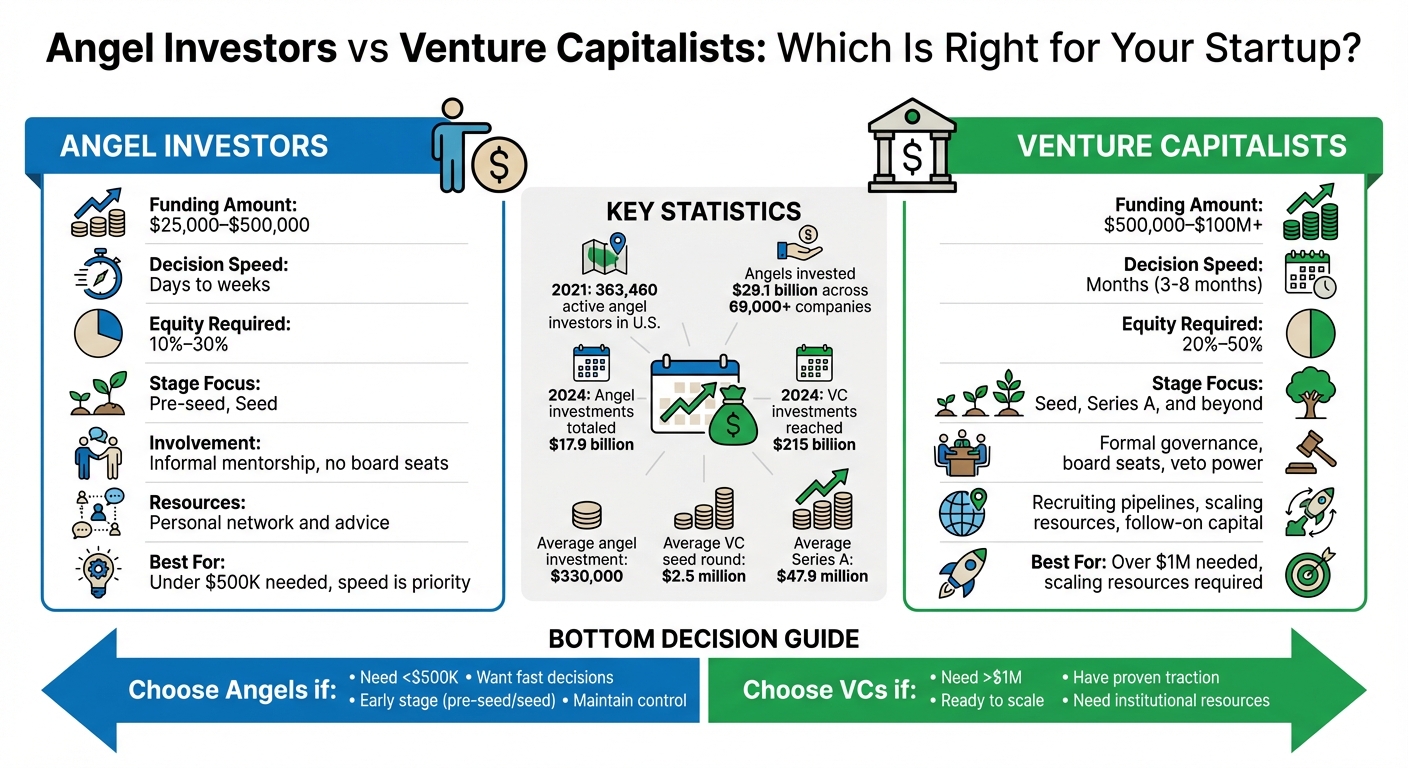
Angel Investors vs Venture Capitalists: Key Differences Comparison Chart
What Are Angel Investors?
Angel investors are individuals who use their personal funds to invest in early-stage startups, typically in exchange for equity or convertible debt. Unlike institutional investors who manage pooled funds, angel investors directly commit their own money.
They usually step in during the "pre-seed" or "seed" stages, bridging the funding gap between contributions from friends and family and formal venture capital. Individual angel investments often range from $25,000 to $100,000, while syndicates – groups of angel investors pooling resources – can contribute anywhere from $250,000 to over $750,000. On average, angel investments hover around $330,000, with most seed-stage deals falling between $50,000 and $200,000.
Angel investors are known for backing startups with untested ideas, prototypes, or early-stage products – opportunities that traditional institutional investors might shy away from. In 2021, the U.S. saw approximately 363,460 active angel investors who collectively invested $29.1 billion across more than 69,000 companies. To participate as an angel investor under SEC guidelines, individuals must qualify as accredited investors. This means having a net worth of at least $1 million (excluding their primary residence) or earning $200,000 annually (or $300,000 for joint filers).
But angel investors don’t just bring money to the table. Many also provide mentorship and strategic advice, leveraging their own entrepreneurial or executive experience. Often, they are former founders or retired executives who have successfully built and exited businesses. These investors typically aim for minority stakes, owning 10%-30% of the company, and look for returns of 10x or more within five years. Their decision-making process is notably quick, with deals often closing within days or weeks.
"Angel investors are uniquely interested in what I call ‘meaningful money,’ [which] means they feel as if they are doing something meaningful that also makes money." – Terri Maxwell, Angel Investor
Understanding what drives angel investors lays the foundation for examining how their approach differs from that of venture capitalists.
sbb-itb-ba0a4be
What Are Venture Capitalists?
Venture capitalists (VCs) represent a different approach to startup funding compared to angel investors. While angel investors use their own money, VCs are firms that pool funds from institutions like pension funds and endowments to invest in startups. These firms operate as limited partnerships, where general partners handle investment decisions, and limited partners supply the capital. This structure allows VCs to manage larger financial resources and implement more formal governance practices.
The scale of VC investments sets them apart. Angel investors typically invest between $25,000 and $100,000, but VCs deal in much larger sums – ranging from $1 million to over $100 million. For instance, in 2024, VC investments grew significantly, reflecting their ability to inject substantial funding into fewer, more developed companies. On average, VC-led seed rounds are about $2.5 million, while Series A rounds climb to approximately $47.9 million.
VCs don’t just bring money to the table – they often play a significant role in a company’s governance. They frequently require board seats, voting rights, and veto power over major decisions like additional fundraising or a potential sale. Their involvement is backed by extensive due diligence, including financial audits, legal reviews, and committee evaluations, a process that can take several months.
"VCs are professional investors who manage a pool of investment capital from various sources. At any given time, they have millions of dollars invested in relatively mature startups." – Investopedia
VC firms typically operate under a "Two and Twenty" fee model: a 2% management fee and 20% of profits. This setup pushes VCs to aim for high returns – often 10x to 15x their initial investment – since around 75% of venture-backed startups fail to generate any returns. To meet these expectations, VCs often pressure startups to reach a liquidity event, like an IPO or acquisition, within an 8 to 12-year timeframe.
Angel Investors vs Venture Capitalists: Direct Comparison
When deciding between angel investors and venture capitalists (VCs), your startup’s stage and needs play a huge role. Angels rely on their personal wealth to make smaller, faster investments – often deciding within days or weeks. On the other hand, VCs manage institutional funds, invest larger sums, and require lengthy approval processes that can take months.
Timing matters. A VC firm considering a $5 million Series A will go through extensive due diligence, including financial audits, legal reviews, and partner meetings before making a decision. If you’re in a time crunch to grab a market opportunity or extend your runway, this slower pace could be a drawback compared to the speed of an angel investor.
Involvement levels also differ. Angels often act as informal mentors, offering advice through casual check-ins or quick messages. VCs, however, expect structured governance, including formal oversight and possibly a board seat. If you’re raising under $500,000, angels might be your best bet for quick funding without adding too much complexity to your cap table. However, for rounds over $1 million, VCs bring more resources, even if that comes with stricter governance.
"Angel investors trade equity for speed and mentorship, while venture capitalists (VCs) trade equity for scale capital and institutional resources." – Team CRV
Networks and resources are another key difference. Angels can open doors through personal industry contacts and often help connect you with VCs for future funding rounds. VCs, however, provide access to institutional resources like recruiting pipelines, pricing strategy support, and additional funding opportunities that angels can’t match. Having a well-known VC on your cap table can also boost your startup’s credibility, making it easier to attract top talent and gain customer trust – advantages individual angels typically can’t offer.
Here’s a breakdown of these differences:
Comparison Table
| Factor | Angel Investors | Venture Capitalists |
|---|---|---|
| Investment Stage | Pre-seed, Seed, Series A | Seed, Series A, and beyond |
| Funding Amount | $25,000 – $500,000 per investor | $500,000 – $100 million+ per investment |
| Decision-Making | Individual, fast (days to weeks) | Committee-based, slow (months) |
| Involvement Level | Personal mentorship, informal advisor | Structured governance, board seat |
| Equity Requirements | 10% – 30% typical | 25% – 50% typical |
| Risk Tolerance | High; invests personal capital | Calculated; invests institutional funds |
| Additional Resources | Personal network and experience | Recruiting pipelines, follow-on capital |
Angel Investors: Advantages and Disadvantages
Angel investors can be a game-changer for startups, offering both opportunities and challenges that entrepreneurs need to weigh carefully.
One of their standout benefits is speed. Since they use personal funds, angel investors can make decisions quickly – sometimes in just days or weeks – without the lengthy approval processes typical of institutional investors. This quick turnaround can be crucial when you’re trying to extend your runway or act on a time-sensitive opportunity. Another big plus? Angels are often willing to invest in startups at the idea stage or before generating revenue, placing their bets on your vision rather than hard metrics.
Many angels bring more than just money to the table. Often, they are seasoned entrepreneurs or former operators with a wealth of experience to share. Their mentorship and insights can help you navigate challenges early on. And unlike venture capitalists, who often demand formal governance structures, angel investors typically take minority stakes without requiring board seats or veto rights. This means you get their expertise without sacrificing much control. Plus, they often use Simple Agreements for Future Equity (SAFEs), which simplify the legal process compared to the more complex priced rounds that institutional investors favor.
However, angel investors have their limitations. Funding amounts usually range from $25,000 to $500,000, which might not be enough for startups needing significant capital to scale quickly or tackle resource-heavy projects. Mentorship quality can also be hit-or-miss; while some angels are deeply involved, others might only offer occasional guidance. Additionally, receiving multiple small checks (e.g., under $5,000) from various angels can clutter your cap table, potentially discouraging institutional investors in later rounds. Another downside is their limited ability to provide follow-on funding, which means you’ll need to seek additional investors as your business grows.
"Early-on investors, typically angels, are more influenced by the team. Later investors, like VCs, are more influenced by the business’s outcomes." – M. Kim Saxton, Co-Author of The Titanic Effect
Pros and Cons Table
| Advantages | Disadvantages |
|---|---|
| Speed: Decisions happen quickly, often within days or weeks. | Limited Capital: Funding amounts may not support rapid scaling. |
| Flexible Terms: Often use SAFEs, avoiding complex legal processes. | Inconsistent Mentorship: Support quality can vary widely. |
| Mentorship: Access to experienced entrepreneurs and operators. | Cap Table Issues: Multiple small checks can complicate future funding rounds. |
| Risk Tolerance: Willing to invest at the idea or pre-revenue stage. | No Follow-on Funding: Limited capacity to invest in later rounds. |
| Maintained Control: Typically don’t demand board seats or veto rights. | Equity Dilution: Risk of giving up significant equity for smaller investments. |
Venture Capitalists: Advantages and Disadvantages
Venture capitalists (VCs) bring a different set of opportunities and challenges compared to angel investors. They are known for providing significant funding – often $1 million or more. For reference, the median seed round is around $2.5 million, while Series A rounds average $47.9 million. This level of funding allows startups to scale quickly, invest in advanced product development, and expand operations efficiently. Additionally, VC backing adds institutional credibility, making it easier to attract enterprise customers and top executive talent. Beyond funding, VCs often offer structured support, such as access to recruiting pipelines, legal resources, and strategic networks. They also set aside funds for follow-on investments, reducing the need to find new lead investors in subsequent rounds. However, as with any funding source, these benefits come with trade-offs.
The most notable challenge is the cost of equity. VCs typically require 20%–50% ownership, which can dilute founders’ stakes significantly, especially in later funding rounds. For example, founders often retain just 56.2% ownership post-seed. VCs also demand board seats and veto rights over critical decisions, which can limit a founder’s control. The process of securing VC funding is another hurdle – it’s not uncommon for due diligence and approvals to take three to eight months. Additionally, the pressure to deliver high-value exits, such as IPOs or acquisitions, can conflict with a startup’s long-term growth plans. This urgency stems from the 8–12-year lifecycle of most VC funds.
"Early-on investors, typically angels, are more influenced by the team. Later investors, like VCs, are more influenced by the business’s outcomes: Do they have a large market? Can they protect their market position? What’s their likely exit strategy?" – M. Kim Saxton, Co-Author of The Titanic Effect
Pros and Cons Table
| Advantages | Disadvantages |
|---|---|
| Large Capital Amounts: Access to $5M+ for scaling and hiring. | Equity Dilution: Founders give up 20%–50% ownership. |
| Market Credibility: Institutional backing boosts customer and hiring confidence. | Reduced Control: VCs gain board seats and veto power over major decisions. |
| Structured Support: Resources like recruiting pipelines, legal teams, and networks. | Lengthy Vetting: Funding approval can take 3–8 months. |
| Follow-on Capacity: Ability to reinvest in future funding rounds. | Exit Pressure: VCs push for high-value exits within 8–12 years. |
| Strategic Guidance: Insights from managing multiple portfolio companies. | High Return Expectations: VCs target 10x–15x returns, which may deprioritize steady, profitable growth. |
How to Choose the Right Funding Source for Your Startup
When deciding on funding, consider your startup’s stage and how much capital you need. For startups in the pre-seed or idea phase requiring less than $500,000, angel investors can be a great choice. They often make quick decisions and require minimal oversight. For instance, one e-commerce brand secured a $55,000 angel investment, which they used to ramp up social media advertising and achieve rapid revenue growth.
If your business is scaling with growth rates between 25% and 200% and needs over $1 million, venture capitalists (VCs) might be a better fit. VCs bring more than just funding – they offer institutional credibility, access to top-tier recruiting networks, and follow-on capital. A great example is Cofactr, which raised $17.2 million in a Series A round, showcasing how VCs can help businesses scale.
Timing is another key difference. Angel investments typically close in under six weeks, while VC deals can take three to eight months due to their more thorough due diligence processes. However, keep in mind that venture capital often comes with strings attached. Their 8- to 12-year fund lifecycle may push you toward a quicker exit, such as an IPO or acquisition, which might not align with your long-term goals.
Your legal structure also plays a big role in attracting investors. If you’re running a remote-first or borderless business, tools like Business Registration, EIN Applications, and Virtual Mailbox from BusinessAnywhere can help you establish a professional foundation. Their Digital Nomad Kit is especially helpful for founders building global startups, ensuring your legal framework is ready for investors while avoiding messy cap tables.
Lastly, be cautious about taking too many small angel investments – checks under $5,000 to $10,000 can create administrative headaches and complicate your cap table, potentially discouraging future institutional investors. If you need more funding than a single angel can provide but aren’t ready for venture capital, consider forming an angel syndicate. These groups can pool between $250,000 and $500,000 under a single lead investor, simplifying your fundraising process while meeting your capital needs.
Key Takeaways
Deciding between angel investors and venture capitalists comes down to your funding needs, business stage, and how much control you want to maintain. If you’re in the pre-seed or idea stage and need less than $500,000, angels are often the better choice. They typically move quickly – making decisions in days or weeks – and rarely ask for board seats, allowing you to retain control. On the flip side, if your business has proven traction and you’re looking for $1 million or more, venture capitalists offer more than just money. They bring institutional credibility, access to recruiting networks, and the ability to support follow-on funding. However, this often comes with trade-offs: VCs usually demand 25% to 50% equity and a board seat.
In 2024, angel investors poured over $17.9 billion into early-stage companies, while venture capital investments reached around $215 billion. Angels can close deals in under six weeks, while VCs take three to eight months to complete their due diligence. That said, VCs’ longer fund lifecycles often push for quicker exits.
To prepare for funding, establish a solid legal foundation. Tools like Business Registration and EIN Applications can help meet investor expectations while supporting your growth plans. Additional resources, such as the Virtual Mailbox and Digital Nomad Kit, are tailored for remote-first startups. For broader guidance, the U.S. Small Business Administration provides comprehensive information on funding options and investor readiness. By weighing these factors, you can align your funding strategy with your startup’s growth goals and long-term vision.
FAQs
What’s the best way to approach angels vs VCs for my startup?
The right funding path for your startup hinges on factors like its current stage, how much capital you need, and the level of involvement you’re seeking from investors. Angel investors are a great choice in the early days. They usually provide smaller investments – ranging from $25,000 to $100,000 – while also offering flexibility and valuable mentorship. On the other hand, venture capitalists step in during later stages, bringing in larger amounts of funding but often expecting evidence of strong growth and scalability. A smart approach? Work with angel investors to build early momentum, then bring in venture capitalists when your business is ready for substantial growth and funding.
How do I avoid cap table issues when raising from multiple angels?
When raising funds from multiple angel investors, it’s crucial to manage your cap table thoughtfully to avoid complications. One effective approach is using SPVs (Special Purpose Vehicles) or syndicates. These tools consolidate multiple investors into a single entity, making ownership easier to manage.
Additionally, make sure to clearly outline terms such as valuation and equity type to prevent misunderstandings. Limiting the number of direct investors can also keep your cap table streamlined and manageable.
Finally, keep your cap table updated and review it regularly. This ensures transparency for everyone involved and helps you prepare for future funding rounds without unnecessary surprises.
When should I switch from angel funding to venture capital?
Switching from angel funding to venture capital makes sense when your startup demonstrates strong traction, early customer adoption, and the need for larger investments to scale. Angel investors usually back startups in their early stages with smaller amounts of funding. In contrast, venture capitalists bring in bigger checks and additional resources aimed at driving rapid growth. Make this transition when your business is prepared for more substantial funding and can manage the increased oversight that comes with VC involvement.