


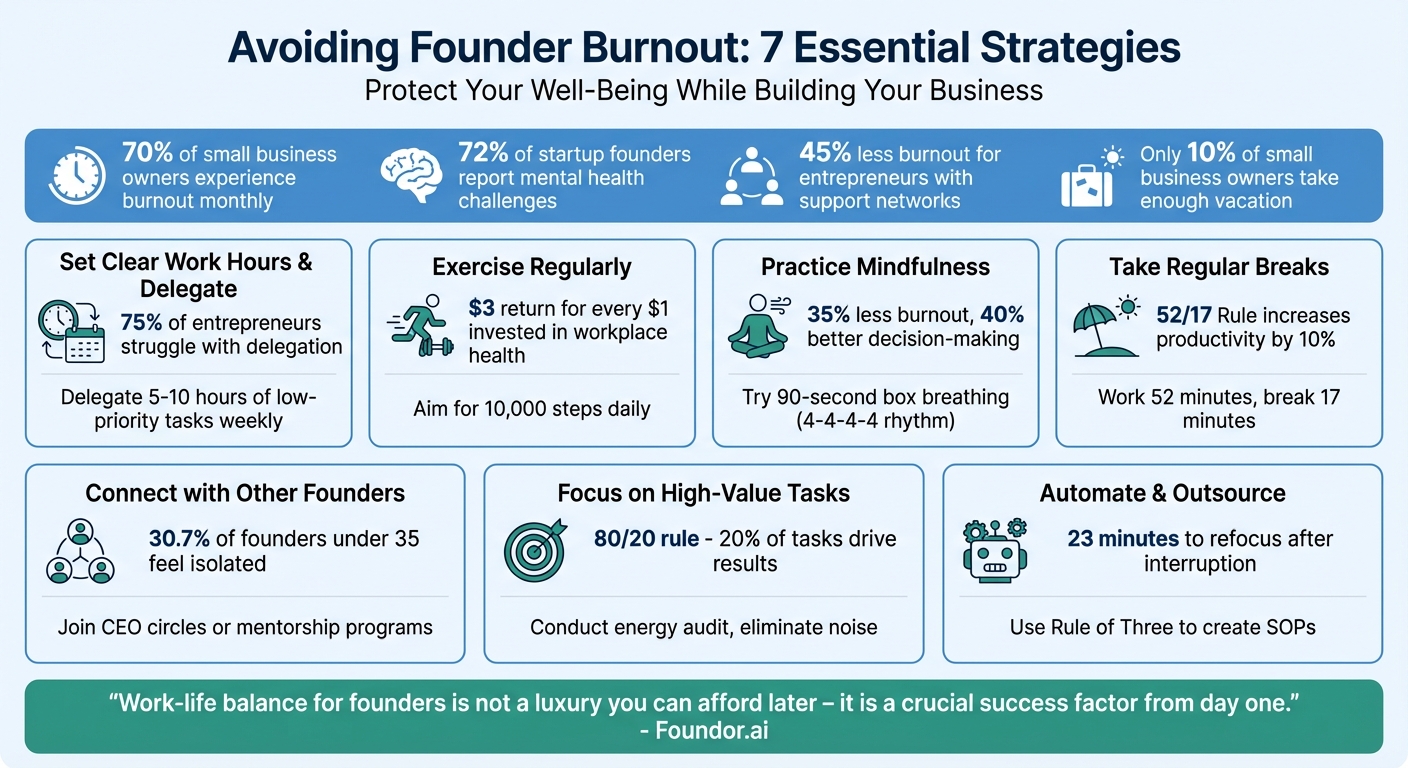
Burnout is a common struggle for entrepreneurs. With 70% of small business owners experiencing burnout monthly and 72% reporting mental health challenges, maintaining balance is critical. This article outlines seven actionable tips to protect your well-being while running a business:
- Set clear work hours and delegate tasks: Manage energy with work sprints and offload low-priority tasks to focus on high-impact activities.
- Exercise regularly: Incorporate physical activity into your routine to boost energy, resilience, and decision-making.
- Practice mindfulness: Simple techniques like box breathing can reduce stress and improve focus.
- Take breaks and time off: Schedule recovery periods to reset and improve creativity.
- Connect with other founders: Build a support network to share challenges and insights.
- Focus on high-value tasks: Prioritize what truly drives your business and eliminate distractions.
- Automate and outsource: Use tools and virtual assistants to handle repetitive tasks efficiently.
These strategies help entrepreneurs maintain energy, improve decision-making, and sustain long-term business success. Start small – pick one or two tips to implement today.
1. Set Clear Work Hours and Delegate Tasks
For entrepreneurs, the concept of a traditional 9-to-5 schedule often feels like a myth. Without defined boundaries, workdays can easily stretch into 16-hour marathons, with client calls spilling into personal time. The key isn’t about forcing a rigid schedule – it’s about managing your energy effectively and being strategic about delegation.
Start by identifying your peak energy periods throughout the day. Instead of chasing a perfectly balanced schedule, try "work sprints" – short bursts of focused effort followed by recovery breaks. This method not only helps protect your time but also enhances your productivity and business outcomes.
"Work-life balance for founders does not mean shutting your laptop at 5 p.m. every day. It’s about conscious decisions, energy management, and the ability to switch between intense work phases and recovery phases." – Foundor.ai
Once you’ve optimized your working hours, the next step is delegation. While it can be tough to let go, it’s essential for growth. Studies show that 75% of entrepreneurs struggle with delegation, even though it can significantly impact business performance. Consider this: managing emails and scheduling alone can eat up hours of valuable time every week. These are hours that could be redirected toward high-impact tasks.
Start small – delegate 5 to 10 hours of low-priority tasks each week. Focus on activities that don’t require your unique expertise, like inbox management, scheduling, or routine processes. To ensure tasks are completed effectively, define clear outcomes by setting deadlines and quality expectations. Avoid micromanaging by creating simple Standard Operating Procedures (SOPs), such as checklists or short video tutorials, to make hand-offs seamless and efficient.
sbb-itb-ba0a4be
2. Make Time for Regular Exercise
Boost your energy and focus by making regular exercise a part of your daily routine. Exercise not only improves your physical health but also strengthens mental resilience and emotional balance – qualities that are critical for effective leadership. Studies reveal that executives who stick to a consistent exercise regimen experience lower cortisol levels and better sleep, which enhances their ability to make sound decisions under pressure. Plus, workplace health programs have been shown to generate a return of $3 in productivity for every $1 invested.
The key is to prioritize exercise as you would any important meeting. Block out specific days, like Mondays, Fridays, and Saturdays, to establish a consistent schedule. If carving out a full hour feels impossible, break it into smaller chunks – three 15-minute walks can add up to a solid 45-minute workout.
"If I am feeling stressed, and like I’m stuck or not making progress on any given day, I jump on the treadmill or Stairmaster for 20 minutes and find myself creating solutions to business challenges as I exercise." – Mary Cioffi, Executive Coach, Mary Cioffi Executive Coaching Services
For maximum benefits, mix strength training, cardio, and mobility exercises. This combination can improve both endurance and mental clarity. Aiming for 10,000 steps each day is another simple yet effective way to maintain energy levels throughout long workdays. Even small bursts of activity – like running up stairs or pacing during phone calls – can make a difference.
You can also weave movement into your workday. Try taking calls while walking on a treadmill, holding walking meetings with your team, or setting aside 20–30 minutes for a screen-free walk between work and personal time. These strategies not only keep you active but also help maintain the balance needed to avoid burnout. By making exercise a priority, you’ll feel more energized and ready to tackle the challenges of prioritization and delegation.
3. Practice Daily Mindfulness Techniques
Mindfulness can help form habits that protect against burnout. Did you know that 70% of entrepreneurs face chronic stress, which can jeopardize both their well-being and the success of their business? According to research from the Harvard Business Review, integrating short mindfulness exercises into your day can lead to 35% less burnout and improve decision-making clarity by 40%.
A great starting point is 90-second box breathing. Here’s how it works: inhale for four counts, hold your breath for four counts, exhale for four counts, and then hold again for four counts. This 4-4-4-4 rhythm activates your parasympathetic nervous system, helping you feel calm almost instantly. It’s perfect for moments between meetings or before tackling challenging conversations. For entrepreneurs with packed schedules, apps like Ahead offer quick "micro-moments" of mindfulness that fit seamlessly into busy days.
"The job of CEO is an endurance sport, not a sprint." – Ben Horowitz, Co-founder of Andreessen Horowitz
Beyond breathing exercises, try mapping your energy. Write down your daily tasks and label each as either "charging" or "draining". This simple activity helps you pinpoint what replenishes your mental energy versus what depletes it. Combine this with the "One Thing" Rule: each day, identify one key goal that will simplify or eliminate other tasks. This approach reduces decision fatigue and keeps you focused on what truly matters for your business.
At the end of the day, implement a shutdown ritual. This could involve turning off notifications, taking a short mindful walk, or spending seven minutes reviewing your progress. These small habits create a clear boundary between work and personal time, which is crucial for emotional recovery. To build the habit, start with one technique that takes less than 10 minutes and stick with it for three weeks before introducing additional practices.
4. Plan Regular Breaks and Time Off
Taking regular breaks isn’t just about feeling refreshed – it’s about protecting your well-being and keeping your business running smoothly. Surprisingly, only 10% of small business owners feel they take enough vacation, while a staggering 70% report experiencing burnout at least once a month. The problem often lies not just in overworking but in never truly stepping away.
Your body and mind naturally operate in cycles of exertion and recovery. Ignoring this rhythm won’t make you more productive – in fact, it can do the opposite, leaving you drained and less effective. Scheduling time off helps reset your mindset, ensuring that business challenges don’t feel like personal defeats. Taking a 2–4-week break can also serve as a stress test for your business systems, exposing any weaknesses before they turn into crises. These pauses not only help prevent burnout but also sharpen your decision-making and boost creativity.
One strategy to ensure you take breaks is reverse scheduling: plan your recovery time first, and then fit work around it. Pair this with the 52/17 Rule – work for 52 minutes, then take a 17-minute break. Studies show this approach can increase productivity by 10% compared to working nonstop.
"A leader’s calendar reveals their values." – Lina, Executive Coach
Another practical tip is to leave 15-minute gaps between meetings. This small adjustment has been shown to improve project success rates by 20%. Combine focused work periods with unplugged weekends or extended time off to create a rhythm that promotes long-term resilience.
It’s also helpful to track your recovery just as you track revenue. Pay attention to indicators like consistent sleep patterns and the number of evenings you fully disconnect from work. If your business can’t run smoothly without you for a few weeks, it might be time to focus on strengthening your systems and leadership team instead of chasing new growth. By prioritizing breaks, you set yourself up for better time management and sustainable success.
5. Connect with Other Founders
Running a business can feel incredibly lonely, especially when every decision falls squarely on your shoulders. The stats paint a stark picture: 72% of startup founders say their entrepreneurial journey has negatively affected their mental health. Younger founders seem to feel the weight even more – 30.7% of those under 35 report feelings of isolation compared to 21.2% of those over 35. And that isolation can be a direct path to burnout.
But there’s a silver lining: Entrepreneurs with a support network are 45% less likely to experience burnout. Michael Dermer, the founder of Lonely Entrepreneur, explains it well:
"Outside peers, especially other founders, normalize the emotional swings and share playbooks".
Knowing that others face the same stress, uncertainty, and pressure to have all the answers can be a game-changer. It not only lightens the emotional load but also provides practical strategies for making tough calls.
Beyond emotional support, peer networks offer tangible benefits. Businesses with mentors survive at twice the rate of those without. Whether you join a formal CEO Circle, engage with communities like YPO or Indie Hackers, or tap into free resources like SCORE – which connects you with over 10,000 volunteer business mentors across the U.S. – these relationships can help you navigate challenges, refine strategies, and act on feedback before burnout takes hold.
Consider asking 1–2 trusted peers to serve as "truth-tellers" who can spot early signs of strain, such as snapping at colleagues or withdrawing from your team. Erica Stacey, an entrepreneur and business strategist, puts it plainly:
"Support does not mean weakness. It is a risk management strategy".
Building these connections doesn’t have to take much time. Join online forums, attend events hosted by your local Chamber of Commerce, or set up regular check-ins with fellow founders. By creating a network of support, you’ll not only combat isolation but also develop a more balanced approach to leadership. A strong support circle can help keep you grounded, even in the toughest times.
6. Focus on What Matters Most to Your Business
Concentrating on the tasks that truly move the needle is essential to staying balanced and avoiding burnout. It’s easy to confuse being busy with being productive, but tackling low-value tasks often leads to stress without meaningful progress. The solution? Get crystal clear on what matters most.
Start by conducting an 80/20 Energy Audit. Pinpoint the 20% of tasks that sap your energy but don’t contribute significantly to your goals. Once identified, either eliminate, delegate, or automate these tasks. Next, sort your workload into four categories: deep work (like strategy or product development), management (such as team meetings or reviews), operations (approvals or billing), and noise (unproductive meetings or low-priority requests). Protect your deep work time by scheduling uninterrupted 90-minute blocks, create a rhythm for management tasks with weekly routines, and cut out tasks that don’t add value.
Use the "Only I Can Do This" filter to audit your calendar. Over three weeks, assess which tasks genuinely require your expertise. Aim to reduce this workload by 20–30% each quarter by delegating not just tasks but entire outcomes. To streamline further, apply decision-making frameworks. Jeff Bezos offers a helpful approach: Type 1 decisions are high-stakes and irreversible, requiring careful thought, while Type 2 decisions are reversible and low-risk, meaning they can be made quickly or delegated. Most decisions fall into the second category, but many business owners treat them all as equally critical.
To cut down on decision fatigue, create decision rules for recurring situations, like hiring criteria or product investments. Instead of revisiting the same debates repeatedly, establish written principles to guide your choices. Shift your focus from lagging metrics, like revenue, to leading indicators – metrics you can directly influence, such as customer conversations or experiments launched. These provide a more actionable and immediate feedback loop.
Lastly, schedule time for strategic boredom – intentional blocks with no set agenda. This isn’t wasted time; it’s a chance to reflect and think at a higher level. By prioritizing what truly drives your business, you align your energy with earlier strategies on time management and delegation. This approach not only helps prevent burnout but also sets the foundation for sustainable growth while maintaining your quality of life.
7. Use Automation and Outsource Administrative Work
Administrative tasks can be a major time sink, pulling your focus away from activities that actually grow your business. Repetitive communication, manual data entry, invoicing, and scheduling social media posts are prime examples of tasks that don’t scale well when handled manually. The solution? Automate and outsource whenever possible to free up your mental bandwidth.
A simple framework to get started is the "Rule of Three": the first time you do a task, just complete it; the second time, observe and note the steps; and the third time, document the process to create a Standard Operating Procedure (SOP). For example, if you’ve sent the same client onboarding email more than twice, turn it into a reusable template. Similarly, batching and automating social media content can save you 5–8 hours weekly, and using text expansion tools for frequently typed phrases can save over 30 hours annually. Once you’ve identified these repetitive tasks, let technology take over.
No-code platforms like Zapier or Make can help you automate workflows without needing advanced technical skills. These tools can connect your apps to handle tasks like automatically sending new form submissions to your CRM or Slack, or setting up automated payment reminders. For tasks that require a human touch, consider the 80% Quality Rule – delegate tasks that can be completed at 80% of your quality standard by a trusted partner or tool. Virtual assistant platforms, offering services for $5 to $15 per hour, are a cost-effective way to handle such work.
Interruptions also come at a high cost. Research shows it takes about 23 minutes and 15 seconds to regain full focus after being interrupted. By automating small, recurring decisions – like scheduling meetings or approving routine requests – you can conserve your mental energy and stay focused on scaling your business without burning out.
Conclusion
Use these seven strategies to safeguard your well-being while steering your business toward success. From defining clear work hours to automating repetitive tasks, these methods transform self-care into a cornerstone of effective business management.
Entrepreneurs with strong work-life boundaries are 45% less likely to experience burnout. Even small, consistent adjustments can lead to noticeable improvements.
"Work-life balance for founders is not a luxury you can afford later – it is a crucial success factor from day one." – Foundor.ai
Take this as your cue to act. Start by adopting one or two practices that fit your current needs – whether that’s planning your first real vacation in months or finally delegating a task you’ve been holding onto. Keep track of your progress by monitoring metrics like how often you truly unplug in the evenings or how consistently you’re getting quality sleep. In fact, venture capital firms like Andreessen Horowitz and First Round Capital now assess founder well-being as part of their investment criteria, emphasizing that "a healthy founder is an investable founder", as highlighted by The Successful Founder.
Burnout happens when the demands placed on you exceed your capacity to handle them. By rethinking how you approach your work, you’re not just preserving your health – you’re also building a business that thrives without requiring you to be constantly "on." This creates the freedom and impact you envisioned when you started. Begin implementing these strategies today to lay the groundwork for both personal resilience and long-term business success.
FAQs
What are the earliest signs I’m heading toward founder burnout?
The early signs of founder burnout often show up as emotional numbness, where neither successes nor failures seem to spark much reaction. Alongside this, there’s the weight of constant physical and emotional exhaustion, which can drain energy and enthusiasm over time. These feelings can chip away at both motivation and self-confidence. Spotting these symptoms early is crucial to protecting your mental health and keeping burnout at bay.
How do I decide what to delegate first when everything feels urgent?
Start by handing off tasks that don’t need your specialized skills or strategic decision-making. Think about routine activities like scheduling meetings or organizing receipts. Prioritize delegating urgent but lower-priority tasks to open up more time for work that truly matters. By doing this, you’ll avoid bottlenecks, minimize burnout, and ensure your energy is focused on impactful decisions that support growth and align with your main goals.
What’s the simplest automation I can set up this week to save time?
One of the easiest ways to reclaim time this week is by using scheduling tools to organize your calendar. Set up recurring events for things like mindfulness breaks or buffer times between meetings. This way, you can ensure you’re taking essential breaks without constantly reminding yourself, helping to boost focus, cut down on decision fatigue, and avoid burnout. Digital calendars and scheduling apps make this process simple and efficient, so you can focus on what matters most.