


If you’re deciding how to fund your startup, you have two main options: bootstrapping or venture capital (VC). Each has its own advantages and trade-offs, and your choice will shape your business’s growth, control, and financial future.
- Bootstrapping: You fund your business using personal savings, profits, or customer revenue. You retain full ownership and control but may face slower growth and higher personal financial risk.
- Venture Capital: You secure funding from investors in exchange for equity. This provides resources for rapid scaling and access to industry networks but involves giving up ownership and decision-making power.
Key Differences:
- Bootstrapping keeps you in control but limits resources.
- VC offers faster growth but comes with dilution of ownership and investor pressure.
Quick Overview:
- Bootstrapping suits low-cost businesses or founders prioritizing control.
- VC works for high-growth industries needing significant upfront investment.
Your decision depends on your goals, market, and risk tolerance. Let’s break it down further.
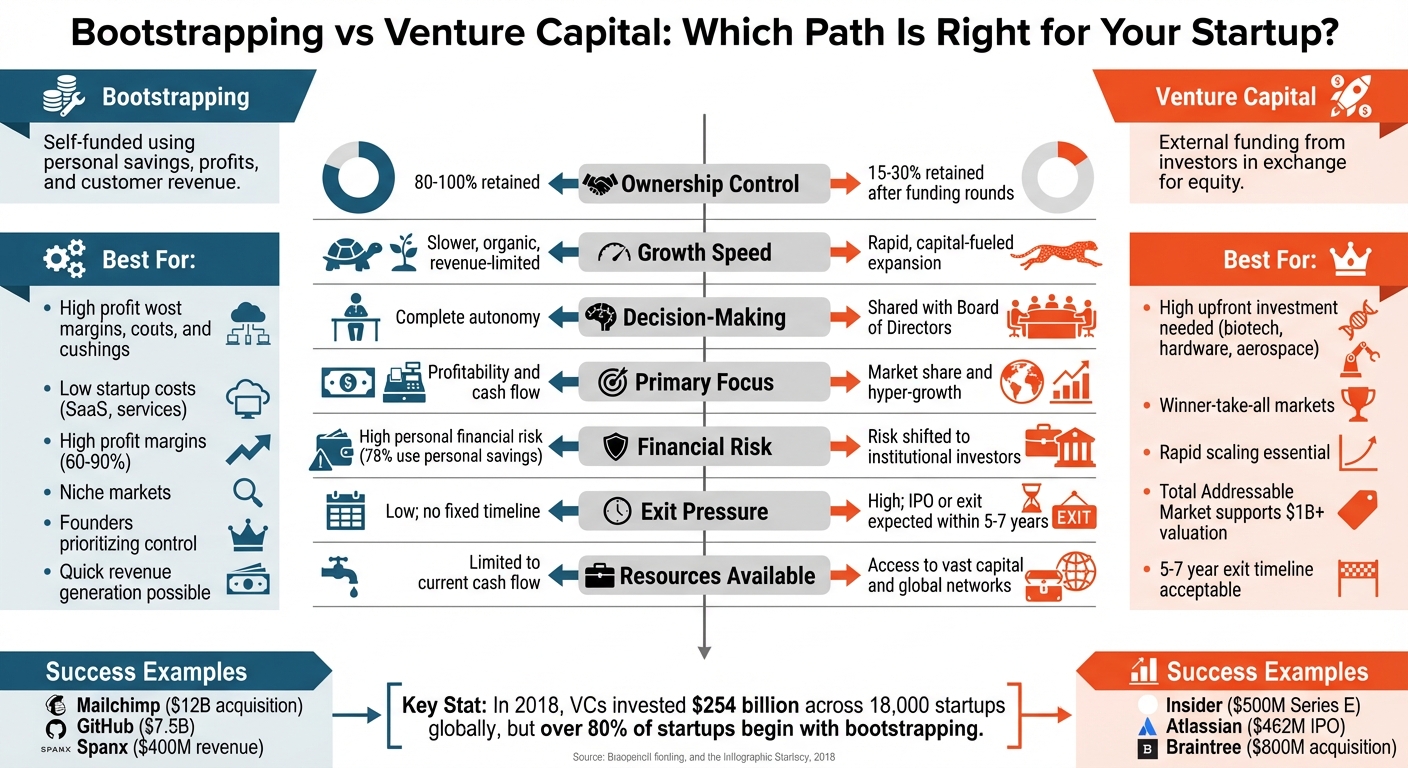
Bootstrapping vs Venture Capital: Complete Comparison Guide for Startups
What Is Bootstrapping?
Bootstrapping is all about building a business using your own resources – like personal savings, customer revenue, and profits you reinvest – rather than relying on outside funding from venture capitalists or angel investors. It’s a self-driven approach to growth that prioritizes independence and sustainability.
"Bootstrapping means funding a startup through customer revenue, personal savings, credit cards or other self-generated resources instead of raising from external capital sources, like venture capital firms or angel investors." – First Round
How Bootstrapping Works
Bootstrapping typically unfolds in three distinct stages:
- Validate the idea: Founders start by dipping into personal savings, using credit cards, or taking small loans to build a prototype and test their concept.
- Reinvest early profits: As the business begins earning revenue, those profits are funneled back into areas like hiring, marketing, or improving the product.
- Achieve sustainable operations: Over time, the company generates enough recurring revenue to cover its operations and fund further growth.
Take Jotform and Zapier as examples. Aytekin Tank, the founder of Jotform, launched the platform in 2006 while still working a full-time job. Initially, he offered the service for free to gather user feedback and gradually built a base of paying customers. Fast forward to June 2024, Jotform boasts over 25 million users and 660 employees worldwide – all without outside funding. Similarly, Zapier began as a side project for its founders, who relied on early customer revenue to refine their product and eventually turn a profit.
When Bootstrapping Makes Sense
Bootstrapping is particularly suited to businesses with low startup costs, like service-based companies or SaaS platforms. If your business model has high profit margins and quick payback cycles, reinvesting revenue can be a powerful way to grow. Founders who value complete ownership and control often prefer this route, as it avoids the compromises that come with external investors. It’s also a great fit for niche markets where steady growth and customer satisfaction matter more than rapid expansion.
Brian de Haaff, co-founder and CEO of Aha!, scaled his product development software business to $100 million in Annual Recurring Revenue in just eight years – all through bootstrapping. He puts it this way:
"Bootstrapping fundamentally changes how you think. It is a mindset that sharpens your decisions, drives value, and forces focus." – Brian de Haaff, Aha!
sbb-itb-ba0a4be
What Is Venture Capital?
While bootstrapping relies on internal resources, venture capital (VC) offers a way to accelerate growth by bringing in external funding.
Venture capital is a type of private equity financing where professional investors provide funding to startups with high growth potential in exchange for equity. Unlike self-funding, VC not only delivers the cash needed to scale but also offers strategic guidance and industry connections. These funds typically come from institutional firms, banks, financial institutions, or high-net-worth individuals who believe in your startup’s potential.
The trade-off? You receive the capital to grow quickly, but you give up a percentage of your company’s ownership. Beyond money, many VC firms contribute technical expertise, management insights, and access to networks that can open doors to top-tier talent and customers. However, investors often take board seats, meaning they’ll have a say in major decisions.
One key benefit of venture capital is that if your startup doesn’t succeed, you generally don’t have to repay the investment. The financial risk shifts to the investors. That said, VC funds typically operate on a 10-year cycle, which puts pressure on startups to achieve a liquidity event – like an IPO or acquisition – within 5 to 7 years.
How Venture Capital Works
Securing venture capital isn’t a quick process – it can take 3 to 6 months. It starts with pitching your business model, growth strategy, and market opportunity to potential investors. If they’re interested, they’ll conduct due diligence, thoroughly examining your financials, team, product, and market position. Once satisfied, they’ll negotiate terms and finalize legal agreements.
Funding happens in stages. Early funding rounds often dilute founder equity significantly. By the time a startup has gone through multiple rounds, founders may hold only 15–30% of their company, compared to the 80–100% equity retained by bootstrapped businesses.
"We want to see your plan to generate $50 million in five years – that means you’ve become a player in your industry, you have amazing customers and figured something out. Anything less than that isn’t worth our time." – Trace Cohen, New York Venture Partners
This process underscores why venture capital is best suited for startups with extraordinary growth potential.
When Venture Capital Makes Sense
Venture capital is ideal for startups in industries that demand heavy upfront investment, like biotech, hardware, aerospace, or deep-tech. It’s also a good fit for businesses in "winner-take-all" markets – such as social media platforms or marketplaces – where rapid scaling is essential to outpace competitors.
If your Total Addressable Market (TAM) supports the possibility of a billion-dollar valuation and you’re ready to focus on hyper-growth rather than immediate profitability, venture capital can act as the fuel to capture market share quickly. For instance, in 2018, venture capitalists invested $254 billion across 18,000 startups worldwide. But VC isn’t for everyone. It’s a path worth considering only if you’re comfortable with significant equity dilution and sharing control of your company’s future.
Bootstrapping: Pros and Cons
When deciding how to fund a business, the choice between bootstrapping and external funding shapes everything from control to growth pace. Let’s dive into what makes bootstrapping both appealing and challenging.
Benefits of Bootstrapping
One of the biggest perks of bootstrapping is complete ownership. Unlike VC-backed founders, who often end up with only 15–25% equity after multiple funding rounds, bootstrapped founders keep 100% ownership. That means if your company sells for $100 million, you pocket the entire amount – not just a fraction.
Another upside is having full control over your business. Without investors setting mandates, you’re free to make decisions about the product, hiring, and company direction. This flexibility allows you to adapt quickly without waiting for approvals or updating a board of investors.
Bootstrapping also encourages financial discipline. Since you’re not relying on investor cash, you’re forced to focus on profitability early on. This often leads to a better product-market fit because your revenue comes from paying customers – not speculative funding.
There are plenty of success stories to back this up. Take Mailchimp, for example. The company started as a side project and grew into a marketing powerhouse without outside funding. By 2021, it was sending over 10 billion emails monthly and sold to Intuit for $12 billion. Founders Ben Chestnut and Mark Armstrong retained full ownership. Similarly, Jotform founder Aytekin Tank turned his side hustle into a global enterprise with 25 million users and over 660 employees – all without external investment.
"Bootstrapping fundamentally changes how you think. It is a mindset that sharpens your decisions, drives value, and forces focus." – Brian de Haaff, CEO, Aha!
Drawbacks of Bootstrapping
Despite its advantages, bootstrapping comes with its own set of hurdles.
For starters, it often results in slower growth. Without significant upfront capital, scaling your team or capturing market share can feel like an uphill battle compared to VC-backed rivals. Limited resources also mean founders frequently juggle multiple roles, which can slow down product development and customer support.
There’s also the personal financial risk. With around 78% of startups funded through personal savings, you’re betting your own money on an uncertain future. And with a 90% startup failure rate, the stakes are high. This risk becomes even more pronounced when competing with well-funded companies that can afford aggressive marketing and rapid expansion.
Another challenge is visibility and networking. Without backing from a prominent VC firm, it’s harder to gain instant credibility, attract top talent, or secure enterprise clients who view VC funding as a stamp of approval.
Finally, bootstrapping limits your runway for experimentation. When cash flow is your lifeline, you don’t have the luxury to test multiple strategies or markets. Bootstrapped businesses often spend only a quarter of what VC-backed companies invest in customer acquisition, which can slow growth in competitive industries.
"As a bootstrapper, you have the luxury of focusing obsessively on your product and answering to no one." – Aytekin Tank, Founder, Jotform
Bootstrapping Pros and Cons Summary
| Aspect | Advantage | Challenge |
|---|---|---|
| Ownership | Retain 100% equity | Personal savings at risk; high failure rate |
| Control | Full autonomy over decisions | Founders take on multiple roles, slowing progress |
| Growth Speed | Profit-focused growth | Slower scaling compared to VC-backed rivals |
| Financial Focus | Encourages lean, efficient operations | Limited budget for marketing or R&D |
| Customer Focus | Revenue tied to real customers | Limited funds for market testing |
| Visibility | No investor pressure | Harder to gain credibility and network |
Venture Capital: Pros and Cons
While bootstrapping puts you firmly in control, venture capital (VC) opens doors to opportunities that can transform your startup’s trajectory. Choosing the right path depends on your goals and the unique needs of your business. Here’s a closer look at both the upsides and challenges of venture capital funding.
Benefits of Venture Capital
One of the biggest draws of VC funding is access to substantial capital. When your startup faces high upfront costs – whether for research and development, infrastructure, or scaling – VC funding can provide the resources that revenue alone might not cover. For instance, in 2018, venture capitalists invested $254 billion across 18,000 startups globally, showcasing the immense financial opportunities available.
This influx of capital can supercharge growth. With VC backing, startups can hire at scale, launch large marketing campaigns, and even acquire competitors. This is particularly important in industries where being first to market gives you a significant edge.
"If you’re in a space where the first to market will have a massive moat that will be hard to compete against, raising funds will be necessary for success." – Brennan White, Founder, Cortex
Beyond money, venture capitalists bring more to the table. They often offer strategic advice, technical expertise, and board-level guidance to help you steer through complex challenges. Their backing can also enhance your startup’s credibility, making it easier to attract top talent, secure partnerships, and gain enterprise customers. Additionally, their networks can open doors to recruiting pipelines, mergers and acquisitions expertise, and other valuable connections.
Another advantage? Reduced personal financial risk. Unlike bootstrapping, where founders pour their own money into the business, VC funding is exchanged for equity. This means that if your startup doesn’t succeed, you’re not personally liable to repay the funds.
However, these benefits come with trade-offs that must be carefully weighed.
Drawbacks of Venture Capital
The biggest downside is equity dilution and a loss of control. By the time founders go through multiple funding rounds (Seed through Series C), they typically retain only 15–30% ownership of their company. Each funding round often reduces ownership by 20–25%. Additionally, VC agreements frequently include terms like board representation, veto powers on key decisions, and liquidation preferences, which can limit your autonomy.
"Once you take institutional VC investment, you are effectively committed to a ‘high growth at all costs’ trajectory." – Lance Cottrell, Founder, Anonymizer
There’s also intense pressure to scale quickly. Venture capitalists expect substantial returns – often 10× or more – forcing startups to prioritize rapid growth over sustainability or profitability. This often aligns with a VC fund’s 10-year lifespan, which typically requires startups to aim for an IPO or acquisition within 5–7 years. Such timelines may clash with your long-term vision for the business.
The process of raising funds itself can be a distraction. Securing VC funding often takes 3–6 months, pulling founders away from core business activities like product development and customer engagement. On top of that, the competition for VC funding is fierce, with only a small fraction of proposals receiving backing.
Finally, large cash infusions can sometimes lead to poor financial discipline. Startups might overspend on scaling efforts before achieving revenue growth. A prime example is Uber, which experienced nearly $30 billion in operating losses between 2016 and 2023 as it pursued aggressive global expansion before turning an annual profit.
These challenges highlight the importance of evaluating whether VC funding aligns with your startup’s goals and growth strategy.
Bootstrapping vs Venture Capital Comparison
Here’s a side-by-side look at how bootstrapping and venture capital stack up:
| Criteria | Bootstrapping | Venture Capital |
|---|---|---|
| Ownership Control | High (80–100% retained) | Low (15–30% retained after rounds) |
| Growth Speed | Slower, organic, revenue-limited | Rapid, capital-fueled |
| Decision-Making | Complete autonomy | Shared with Board of Directors |
| Primary Focus | Profitability and cash flow | Market share and hyper-growth |
| Risk Distribution | High personal financial risk | Risk shifted to institutional investors |
| Exit Pressure | Low; no fixed timeline | High; pressure for IPO or major exit within 5–7 years |
| Resources | Limited to current cash flow | Access to vast capital and global networks |
How to Choose Between Bootstrapping and Venture Capital
Now that we’ve explored the basics of bootstrapping and venture capital, let’s dive into how to determine which path best suits your startup. The choice largely depends on your industry, product, market dynamics, and your personal goals as a founder.
Evaluate Your Startup’s Requirements
The first step is to assess your startup’s capital needs. Certain industries, like biotech, aerospace, or hardware, require significant upfront investments in research and development. For these, venture capital is often necessary to cover costs that early revenue streams can’t support. On the other hand, industries with lower initial costs – such as software, service businesses, or e-commerce – are often better suited to bootstrapping.
Market dynamics also play a big role. If you’re entering a fiercely competitive space, like social networks or online marketplaces, where being a first mover is critical, venture capital can provide the resources to capture market share quickly. However, if your target market is fragmented or niche, bootstrapping allows for sustainable, steady growth without the pressure to dominate immediately.
Another key factor is your revenue timeline. If your product can start generating income relatively quickly, bootstrapping could be the way to go, as customer revenue can fund your growth. But if your product requires years of development before earning its first dollar, venture capital can help bridge that gap. Additionally, businesses with high gross margins (60–90%) are often ideal for bootstrapping since profits from each customer can directly fuel expansion.
"VC is high stakes. Can I give up control? Is financial gain my priority for launching a business? Am I excited about new ideas and want to eventually leave this company and start another?"
– Brandi Baldwin, CEO, Millennial Ventures Holdings
Balancing these market and operational considerations with your funding goals will help clarify your path forward.
Match Funding to Your Goals
Your personal priorities as a founder are just as important as market factors when deciding on a funding strategy. If maintaining full control over your company is a top priority, bootstrapping is the better choice. It allows you to retain 80–100% ownership and make decisions without external interference. On the flip side, if your goal is rapid growth – even at the cost of some ownership – venture capital can provide the resources to scale quickly.
Your exit strategy also matters. Bootstrapped companies can operate indefinitely or sell on your own terms. For instance, some well-known bootstrapped businesses have avoided the tight exit timelines often imposed by venture capitalists. In contrast, VC-backed startups are usually expected to achieve an exit – whether through acquisition or IPO – within 5–7 years to meet investor expectations.
Risk tolerance is another critical consideration. Bootstrapping involves personal financial risk, as you’re funding the business out of your own pocket. Venture capital shifts much of that financial risk to investors, but it comes with its own challenges. For example, only about 15% of startups that secure seed or angel funding successfully raise a Series A round.
Some founders opt for a hybrid approach: bootstrapping until they achieve product-market fit or hit $1–3 million in annual recurring revenue (ARR), then seeking venture capital to scale at a higher valuation with less dilution. This strategy combines the control and independence of bootstrapping with the growth potential of venture capital when the timing aligns with your goals.
Startup Examples: Bootstrapping and Venture Capital
Looking at real-world examples, it becomes clear how different funding strategies can lead to impressive outcomes. These companies highlight the importance of aligning funding decisions with their overall business goals.
Successful Bootstrapped Startups
Take Mailchimp, for example. Co-founders Ben Chestnut and Dan Kurzius launched the email marketing platform in 2001 as a side project. In 2009, they introduced a freemium model, allowing users with fewer than 500 subscribers to access the service for free. This move paid off big time – their user base skyrocketed from 85,000 to 450,000 in just a year, a 430% increase. Annual revenue also jumped from $2 million to $5 million during that time. By September 2021, when Intuit acquired Mailchimp for $12 billion, the company had surpassed $1 billion in annual recurring revenue and captured a 72% market share – all without ever taking venture capital.
GitHub also started small. Founded in 2008 by Tom Preston-Werner, Chris Wanstrath, and PJ Hyett, the team kept expenses low by working remotely from coffee shops. They became profitable the moment they introduced subscription fees. After four years of bootstrapping, they accepted their first outside investment of $100 million in 2012, which helped fuel their growth. By 2018, Microsoft acquired GitHub for $7.5 billion.
Then there’s Spanx, founded by Sara Blakely in 1998 with just $5,000 in her savings account. To save money, she wrote her own patent application and personally handled early sales calls. By 2016, Spanx was generating an estimated $400 million in annual sales, with Blakely retaining 100% ownership. Similarly, Tough Mudder co-founders Will Dean and Guy Livingstone started with $8,000 in savings and a $300 website. They used Facebook ads to pre-sell tickets, and by 2015, their events were bringing in over $100 million annually – again, without any external funding.
Now, let’s shift gears to startups that thrived with venture capital backing.
Successful Venture-Backed Startups
Insider, an AI-driven marketing platform, secured a $500 million Series E round in November 2024, led by General Atlantic. The funding was allocated to expand their 350+ engineering team, enhance their "Sirius AI" solution, and break into the U.S. market. Co-founder and Chief Revenue Officer Serhat Soyuerel explained their vision:
"Many brands are eager to move away from traditional marketing clouds that limit their growth. We are on a mission to help as many users as possible transition from legacy marketing clouds to Insider".
Atlassian started with just $10,000 in credit card debt in 2002 and managed to achieve 40 straight profitable quarters before taking on $60 million in venture capital in 2010. That investment supercharged their global growth and paved the way for their 2015 IPO, which raised $462 million. Similarly, Braintree Payments operated independently for four years before raising $69 million to scale its fraud protection and payment infrastructure. This move led to PayPal acquiring Braintree for $800 million in 2013. Meanwhile, Campaign Monitor, founded in 2004, operated independently for a decade before securing $250 million in funding in 2014. This allowed them to expand their offerings and reach $153 million in annual revenue by 2019.
Choosing the Right Funding Path for Your Startup
When deciding how to fund your startup, the choice between bootstrapping and venture capital comes down to aligning your strategy with your goals and the realities of your market. As mentioned earlier, each option has its own set of benefits and challenges. For startups in competitive markets where speed and scale are critical, venture capital can provide the resources to outpace rivals. On the other hand, if your market is fragmented or highly specialized, bootstrapping allows for steady growth without the pressure of meeting aggressive targets.
Capital requirements can heavily influence your decision. Startups with significant upfront costs for research, development, or infrastructure often need venture capital from the outset. In contrast, software and SaaS businesses, which typically have lower overhead and quicker revenue cycles, are better positioned to bootstrap. A key factor to evaluate is your unit economics: if your customer revenue exceeds acquisition costs, you may be able to reinvest profits to fund growth organically.
The trade-off between control and growth is another critical consideration. Bootstrapping allows founders to retain decision-making power and, after five years, typically maintain 80-100% ownership. Venture capital, however, often reduces ownership to 15-30% after multiple funding rounds. For founders who value autonomy, bootstrapping can be a compelling option.
A blended approach is also worth exploring. Many startups bootstrap to achieve product-market fit and then raise venture capital to scale. This method can help secure better valuations, reduce dilution, and demonstrate the viability of your business model. Data shows that over 80% of startups begin with self-funding, and around 65% of SaaS startups rely on bootstrapping in their early stages.
Main Takeaways
To choose the best funding path, keep these factors in mind:
- Financial runway and risk tolerance: Bootstrapping often means sacrificing a founder’s salary in the early years, which can be a significant personal financial risk.
- Ownership versus scale: Weigh the potential for a smaller ownership stake in a larger, venture-backed company against retaining more ownership in a smaller, bootstrapped business.
- Exit timelines: Venture capital funds typically operate on a 10-year cycle, with expectations for an exit within 5-7 years. If you prefer flexibility and the option to run your business indefinitely or sell on your own terms, bootstrapping may be the better fit.
Ultimately, your decision should reflect the specific needs of your startup, the dynamics of your industry, and your long-term vision. Aligning your funding strategy with these factors will set the foundation for success.
FAQs
How do I know if my startup is VC-backable?
To figure out if your startup is a good fit for venture capital (VC) funding, focus on a few key factors. Does it have the potential for high growth, a scalable business model, and the ability to attract substantial outside investment? Venture capitalists typically look for startups targeting a large addressable market, showing clear signs of rapid revenue growth, and aligning with their goals of shaking up industries or markets.
On the other hand, if your business is geared toward steady, organic growth and maintaining control, bootstrapping might be a better route to consider.
When should I switch from bootstrapping to raising VC?
When your startup reaches a point where growth demands resources beyond what you can provide personally, it might be time to think about moving from bootstrapping to venture capital. This shift often becomes crucial when you need substantial funding for rapid expansion, scaling operations, or major infrastructure investments.
The decision largely depends on your goals. If maintaining control and focusing on profitability are your priorities, bootstrapping might still be the better path. On the other hand, venture capital can be an ideal choice if your aim is to achieve market dominance quickly. Before making the leap, ensure your business has already demonstrated its viability – investors will want proof that your idea works and has potential for significant returns.
What terms should I watch for in a VC deal?
When analyzing a venture capital (VC) deal, it’s essential to zero in on a few critical terms that can shape the future of your business. Start with equity dilution – this refers to the percentage of ownership you’ll give up in exchange for funding. Next, consider control, which outlines the level of influence investors will have over your company’s decisions.
Other key factors include valuation, which determines how much of your company investors will own based on its perceived worth, and preferred stock, which grants investors certain rights and privileges. Pay close attention to liquidation preferences, which dictate the order and amount investors are paid if the company is sold or goes under, as well as vesting schedules, which establish when equity ownership is earned over time.
Understanding these terms is crucial for evaluating how a deal will affect your ownership, decision-making power, and financial outcomes.