


Building trust in remote teams is essential for engagement, productivity, and collaboration. Without face-to-face interactions, leaders must take intentional steps to build connections and eliminate misunderstandings. Here’s how:
- Set Clear Roles and Goals: Define responsibilities and use goal-tracking tools to ensure clarity through measurable targets like SMART goals.
- Communicate Transparently: Use multiple channels (e.g., Slack for quick chats, Zoom for sensitive topics) and over-communicate to avoid assumptions.
- Regular Check-Ins: Schedule consistent one-on-ones to address challenges and celebrate achievements.
- Promote Autonomy: Focus on results, not hours worked, and empower decision-making.
- Support Work-Life Balance: Respect boundaries, implement flexible policies, and encourage rest.
- Leverage Tools: Use platforms like Trello or Slack for visibility and collaboration while avoiding micromanagement.
- Measure Trust: Use surveys and feedback to gauge trust levels and refine strategies.
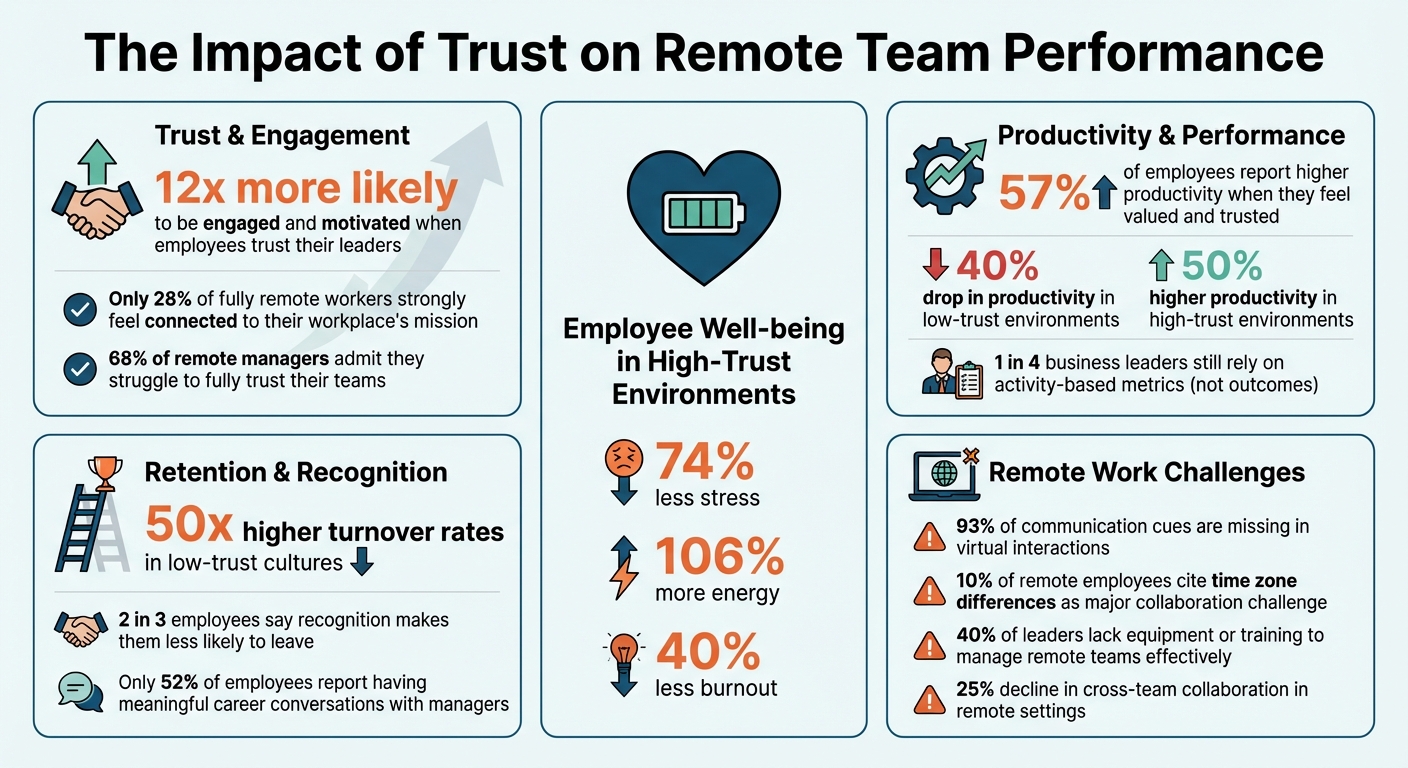
The Impact of Trust on Remote Team Performance: Key Statistics
Set Clear Roles, Expectations, and Goals
Ambiguity can erode trust faster than anything else in remote work. In traditional office settings, casual interactions often help clarify roles and expectations. But in virtual teams, you need to be deliberate about defining responsibilities, deadlines, and quality benchmarks. Leadership coach Jenny Wood emphasizes this point:
Building trust starts with the manager or the leader setting clear "swim lanes." This means being clear on roles, responsibilities, and expectations so every team member knows who is accountable for what – and there isn’t any confusion.
When roles are unclear, it’s easy for contributions to be overlooked or for disputes over credit to arise. To avoid this, accountability should be tied to clear deliverables – not just visibility.
Define Roles and Responsibilities
Start by clearly identifying who is responsible for what. Think of it as creating "swim lanes" that ensure everyone knows their specific responsibilities. This isn’t about micromanaging – it’s about avoiding overlaps and ensuring no tasks slip through the cracks. Document these roles thoroughly, specifying who handles particular deliverables, the standards they need to meet, and who has the final say on approvals.
A simple tool like a RACI matrix (Responsible, Accountable, Consulted, Informed) can help clarify these boundaries quickly. Store this documentation in a centralized platform – whether it’s Notion, Confluence, or a shared Google Doc – so it’s always accessible. When everyone knows their role, you reduce duplicated effort and the frustration that comes from unclear ownership.
Set Measurable Goals and KPIs
Vague goals only create confusion. Instead, use SMART goals – Specific, Measurable, Achievable, Relevant, and Time-bound – to give your team clear targets to aim for. For instance, instead of saying "improve customer satisfaction", a more actionable goal might be: "Reduce average support ticket response time from 4 hours to 2 hours by June 30, 2026."
Many remote-first organizations are shifting to Results-Only Work Environments (ROWE), where the focus is on the quality and timeliness of work rather than hours logged. Tools like Trello, Airtable, or Jira can help make workflows visible and ensure everyone understands how their contributions fit into the bigger picture.
Once roles and goals are defined, the next step is to establish clear communication guidelines to support them.
Communicate Expectations Clearly
Clarity is key to successful collaboration. Create a "Ways of Working" guide that outlines how your team communicates, expected response times, and any overlapping core working hours. For instance, specify whether urgent questions should go to Slack and clarify how quickly feedback should be provided.
For individual projects, detailed briefs are essential. These should include deadlines, available resources, and specific quality standards. To help your team understand what’s expected, provide examples of completed work that meet the required standards. This eliminates the need for constant back-and-forth and ensures everyone is on the same page.
Create Transparent and Open Communication
Once roles and goals are clearly defined, the next step is fostering open communication. Transparency builds trust by creating an environment where team members feel safe to ask questions, voice concerns, and challenge ideas. In remote settings, where body language and facial expressions are absent, misunderstandings can easily arise. A delayed response on Slack might be seen as disapproval, and a short email could come off as cold or dismissive.
As Tarika from FocusU points out:
In a virtual setting, silence is not golden. It’s often filled with anxiety and incorrect assumptions.
Simple scenarios, like a manager not responding immediately to a message, can lead to negative assumptions. While the reality might be that the manager is simply busy, an employee might interpret it as dissatisfaction with their work. To counter this, leaders should over-communicate and approach messages with a mindset of positive intent.
Clear communication channels are critical, and the strategies below can help ensure they are used effectively.
Use Multiple Communication Channels
Every type of conversation has its place. A communication charter – a straightforward guide outlining which tools to use for specific purposes – can cut down on confusion and prevent channel overload. For example:
- Slack or Microsoft Teams: Ideal for quick questions and casual interactions.
- Zoom or Google Meet: Best for sensitive discussions or brainstorming sessions.
- Email: Suited for formal announcements or detailed documentation.
When team members know where to go for specific discussions, they waste less time searching for information and can focus on meaningful tasks.
Michael Pryor, co-founder of Trello, underscores the importance of transparency in communication tools:
The advantage of Slack is that it’s transparent. If you keep almost all discussion in public channels, no one needs to worry that they’re being left out.
Public channels help avoid siloed information, ensuring everyone stays aligned and informed.
Encourage Active Listening and Feedback
Active listening goes beyond hearing words – it involves understanding the intent behind them and fostering open dialogue. During one-on-one meetings, steer the conversation away from just status updates. Instead, ask open-ended questions like "What challenges are you facing?" or "How can I support you better?". These questions show genuine care for the individual, not just their work output.
Feedback should flow in both directions. Leaders can normalize vulnerability by admitting mistakes or acknowledging when they don’t have all the answers. This openness encourages team members to do the same. Proactively seek input from quieter individuals who might hesitate to speak up in group settings, and approach challenges as opportunities to learn rather than failures. Employees who feel heard are 12 times more likely to stay engaged and motivated. Building that trust starts with active listening.
These practices help create a balance between real-time and asynchronous communication, ensuring a flexible yet consistent approach.
Balance Real-Time and Asynchronous Communication
Not every discussion has to happen in real time. Asynchronous communication – like Loom videos, shared Google Docs, or weekly Notion updates – can accommodate time zones, reduce meeting fatigue, and preserve time for focused work. Around 10% of remote employees cite time zone differences as a major collaboration challenge. Flexibility is key.
Reserve live meetings for situations that require nuance, such as brainstorming, resolving conflicts, or delivering sensitive feedback. If a text-based conversation becomes confusing or tense, escalate it to a video call to clarify. Afterward, share the resolution in a public channel to keep everyone informed. For global teams, rotate meeting times to avoid burdening the same people with inconvenient schedules. Always document key takeaways from live meetings so those who couldn’t attend can stay updated.
This structured communication approach reinforces accountability and keeps teams aligned.
| Communication Type | Best Use Cases | Trust Impact |
|---|---|---|
| Video Calls | Sensitive topics, brainstorming, 1-on-1s | High; offers non-verbal cues and reduces misinterpretation |
| Instant Messaging | Quick questions, social chat | Medium; builds rapport but may lead to "productivity theater" |
| Asynchronous (Email/Docs) | Documentation, formal announcements | Medium; respects boundaries and supports focused work |
Build Team Connection Through Regular Check-Ins
Regular check-ins turn trust into action. In a remote setting, where casual chats or impromptu coffee breaks are missing, leaders need to deliberately create opportunities for connection. These structured moments help reduce feelings of isolation, reveal challenges that might not surface in project updates, and give team members a safe space to voice their concerns.
Regular meetings have been shown to triple employee engagement by offering a steady platform to discuss obstacles and celebrate wins. Yet, only 28% of fully remote workers strongly feel connected to their workplace’s mission and purpose. This gap between communication and true connection is real – but it’s one that regular check-ins can help bridge. Below are some ways to make these check-ins meaningful.
Schedule Consistent One-on-Ones
One-on-one meetings are a cornerstone of trust. These sessions should focus on the employee’s growth, challenges, and priorities – not just status updates that could be handled over email. Make these meetings non-negotiable. Canceling them frequently sends the wrong message: that the person isn’t a priority. Kim Scott, author of Radical Candor, emphasizes their importance:
1:1s are your must-do meetings, your single best opportunity to listen, really listen, to the people on your team to make sure you understand their perspective on what’s working and what’s not working.
Start each meeting with a brief personal check-in – a simple step to recreate the casual interactions remote employees often miss. Then, structure the discussion using the 3×3 Framework, which splits the time into three 10-minute segments: Looking Back (recent wins and lessons learned), Current State (challenges and support needed), and Looking Ahead (priorities and growth goals).
Engage with open-ended questions like "What’s been the hardest part of your week?" or "How can I support you better?" to encourage honest dialogue. Use shared agenda documents where both you and the employee can add topics throughout the week, ensuring the meeting addresses real concerns instead of whatever comes to mind in the moment. Follow the 90/10 rule: dedicate 90% of the time to the employee’s topics and only 10% to your own feedback or updates.
Recognize and Celebrate Achievements
Recognition – both public and private – has a big impact on engagement and retention. In fact, nearly two-thirds of employees say that feeling recognized would make them less likely to look for a new job. However, only 52% of employees report that their manager has had a meaningful career conversation with them.
Strike a balance between public and private recognition. Use team meetings or dedicated Slack channels (like #shout-outs) to celebrate wins publicly. Then, follow up with personal messages to express appreciation privately. Eric Richard, VP of Engineering at HubSpot, highlights the value of peer recognition:
Peer recognition is an important element on any team. High Fives generate a feeling of accomplishment, and people feel that their work was noticed and appreciated.
Don’t limit celebrations to work-related accomplishments. Acknowledge birthdays, work anniversaries, and personal milestones during check-ins to strengthen personal connections. You can also automate alerts for project milestones in shared channels, so progress gets celebrated in real time. Focus on the impact of the work rather than just the hours put in, and use data as a way to spark positive conversations – not as a performance critique.
Resolve Conflicts Early
Clear roles and open communication build trust, but unresolved conflicts can quickly erode it. Remote work magnifies misunderstandings – a short email might come across as cold, or a delayed Slack reply might feel like disapproval. Without non-verbal cues (which make up about 93% of communication), remote teams are more prone to conflicts that can escalate quickly. If a complex issue requires more than three back-and-forth messages, it’s time to schedule a real-time call.
Use check-ins to help team members separate facts from assumptions. Encourage them to distinguish what’s verifiable from the negative stories they might be telling themselves. Always assume positive intent and model this mindset for your team. When mistakes happen, shift the focus from blame to learning by asking "What can we learn from this?" instead of "Who’s at fault?" to maintain a safe and supportive environment.
For peer conflicts, a quick three-minute conversation facilitated by a leader can often resolve misunderstandings before they grow into bigger problems. These small interventions can make a big difference in preserving collaboration and trust.
Use Tools to Strengthen Collaboration and Trust
Tools can help build trust by making information accessible and transparent. Without the right infrastructure, remote teams often face communication breakdowns, misplaced documents, and doubts about leadership capabilities. For instance, 68% of remote managers admit they struggle to fully trust their teams due to the lack of physical proximity. The solution isn’t micromanagement or surveillance – it’s implementing systems that promote visibility and accountability.
These tools act as the glue for remote teams, replacing casual office interactions like hallway chats or quick desk visits. However, it’s important to avoid overwhelming your team with too many platforms. Instead, focus on a few key tools and use them consistently. Notably, 40% of leaders report they lack the equipment or training needed to effectively manage remote teams. The goal is to centralize information and make collaboration seamless. Here’s how tools can help foster trust and improve teamwork.
Streamline Communication with Collaboration Tools
Collaboration tools do more than just facilitate communication – they enhance transparency and ensure everyone stays informed. Centralizing communication helps prevent information silos, which can lead to distrust. Platforms like Slack and Microsoft Teams allow teams to store files, share updates, and hold discussions in one place, reducing the chaos of scattered emails or private messages. While text communication can lose its nuance, video tools like Zoom or Google Meet bring back important non-verbal cues for more complex conversations.
To make communication smoother, extend your team’s communication guidelines to specify the best tools for different types of interactions. For example:
- Use Slack for quick updates and daily check-ins.
- Rely on Zoom for in-depth problem-solving discussions.
- Reserve email for formal documentation or longer updates.
This approach ensures urgent messages don’t get buried. A helpful tip? Apply the "Three-Exchange Rule": if a text-based conversation takes more than three back-and-forth messages without resolution, switch to a video call.
Don’t underestimate the value of informal communication. Channels like #team-random or #pets can replicate those "water cooler" moments that help build personal connections. These casual spaces allow team members to bond beyond work tasks. For teams that need a professional business presence, BusinessAnywhere’s virtual mailbox offers a permanent U.S. address with unlimited mail scanning and forwarding. This ensures that important documents – like legal notices – are accessible, even when team members are working across time zones.
Once communication is streamlined, project tracking tools can further enhance trust by ensuring accountability and clarity.
Improve Transparency with Project Tracking Tools
In addition to communication platforms, project tracking tools provide visibility into task progress and deadlines, shifting the focus from monitoring activity to measuring outcomes. Currently, 1 in 4 business leaders rely on activity-based metrics to gauge productivity, which often leads to "productivity theater" – where employees appear busy without delivering real results. Tools like Trello, Asana, or Jira help eliminate this by making progress visible to everyone, reducing the need for constant status updates.
Visual boards can show who owns each task, deadlines, and any blockers. Assigning a Directly Responsible Individual (DRI) for each deliverable ensures clarity around ownership. Use features like "Blocked" tags to flag issues early. This transparency helps team members see how their work contributes to larger goals, while also enabling leaders to address bottlenecks quickly.
Standardizing tasks with templates that define the “definition of done” and acceptance criteria can prevent misunderstandings. Additionally, keeping a decision log within your project management tool ensures that past decisions are documented and easily searchable. As Marin Jurčić from Productive.io points out:
Trust grows when people know what to expect.
Integrate BusinessAnywhere for Business Needs
Beyond communication and project tracking, having a reliable administrative foundation is crucial for building trust. A strong business infrastructure signals professionalism and stability. For remote teams, tasks like mail handling, compliance tracking, and document management can become roadblocks if not automated. BusinessAnywhere simplifies these processes by offering virtual mailboxes, global mail forwarding, registered agent services, and compliance support – all accessible through a single dashboard.
This centralized approach addresses the 25% decline in cross-team collaboration often seen in remote settings by keeping all team members informed. Leaders can access scanned legal notices, tax documents, or client correspondence instantly, ensuring no critical deadlines are missed. The platform also provides compliance alerts and manages annual filings, reducing the risk of reputational damage from overlooked paperwork.
For entrepreneurs or digital nomads managing U.S.-based businesses remotely, BusinessAnywhere’s services – like EIN applications, S-Corp tax filings, online notary, and bank account setup assistance – offer a reliable framework. This minimizes administrative burdens, allowing leaders to focus on outcomes rather than logistics. Research shows that 57% of employees report higher productivity in workplaces where they feel valued and trusted.
sbb-itb-ba0a4be
Promote Empowerment and Work-Life Balance
Effective tools may help manage tasks, but building trust requires more than that – it’s about empowering your team and respecting their boundaries. Trust grows when leaders give their teams autonomy and acknowledge personal limits. For remote leaders, the challenge lies in balancing being informed with letting go of control. Right now, 68% of remote managers admit they don’t fully trust their teams, often because they can’t physically see work happening. This distrust can spiral into a toxic cycle: micromanagement leads to employee dissatisfaction, which then causes a 40% drop in productivity in low-trust environments.
The fix isn’t more surveillance or endless check-ins. Instead, it’s about fostering a culture where autonomy and well-being are priorities. When employees feel trusted and valued, the results speak for themselves – 57% of workers who feel appreciated report higher productivity. Remote leaders need to focus on outcomes rather than tracking every activity, while also remaining mindful that burnout can quickly undermine trust.
Encourage Autonomy and Decision-Making
One of the best ways to build trust is by empowering your team to make decisions independently. Yet, 1 in 4 leaders still measure productivity by monitoring activity and visibility, such as checking Slack’s green status or hours logged. This approach is a surefire way to alienate top performers who value independence. Instead, set SMART goals to define success, then step back and let your team take the lead.
A great example comes from Parabol, a remote meeting platform. In June 2022, CEO Jordan Husney introduced an "asynchronous decision-making process" called "trust by default." This system allows individual team members to make decisions without waiting for approval, eliminating bottlenecks across time zones. Husney explains:
Surveillance – whether checking for ‘butts on seats’ by eye or measuring response time online – is the inverse of trust.
By setting clear decision-making boundaries for each role, your team knows what they’re responsible for without needing constant permission. During one-on-one meetings, focus on support rather than micromanagement by asking questions like, "What’s blocking you?" or "How can I support you this week?" This shows trust in their abilities and a commitment to removing obstacles.
Encouraging autonomy not only builds trust but also creates the foundation for policies that respect personal boundaries and well-being.
Support Work-Life Balance with Flexible Policies
Respecting boundaries is key to building loyalty and preventing burnout. Employees in high-trust environments report 74% less stress, 106% more energy, and 40% less burnout. Remote work often blurs the line between professional and personal life, so leaders must actively safeguard their team’s well-being. For example, avoid sending non-urgent messages outside working hours and consider implementing "no-meeting days" to combat Zoom fatigue.
Zapier offers a great example of how to respect boundaries. Since 2020, the company has used "Friday updates", weekly internal blog posts where employees, including CEO Wade Foster, share their progress and goals. This system replaces daily status meetings, promotes transparency, and accommodates different time zones while protecting deep work time.
You can also provide wellness perks, like budgets for gym memberships, ergonomic equipment, or mental health days. Lead by example – take vacations and encourage your team to use their full paid time off. When leaders prioritize rest, it sends a clear message: you value your team as people, not just as workers.
These respectful policies, combined with empathy and emotional intelligence, can strengthen trust even further.
Model Empathy and Emotional Intelligence
Building emotional connections in remote settings takes effort. With 93% of communication cues missing in virtual interactions, it’s crucial to assume positive intent when messages seem curt or responses are delayed. Avoid making snap judgments about someone’s commitment based on their Slack activity.
Leadership coach Jenny Wood highlights the importance of informal moments:
Meetings are where you do your job. The margins are where you build trust.
Use these "margin moments" to send quick follow-up texts or personal recognition messages. These small gestures show you appreciate your team’s efforts. During video calls, give your full attention – don’t multitask – and ask thoughtful questions like, "What’s keeping you up at night?" to understand challenges beyond work.
Creating psychological safety is another cornerstone of trust. Admit when you don’t have all the answers or when you’ve made a mistake. This vulnerability encourages your team to be open about their own challenges without fear of judgment. Tools like "ReadMe" guides, where team members outline their preferred working and communication styles, can also help bridge personality and cultural gaps.
Measure and Sustain Trust in Remote Teams
Remote work eliminates the daily face-to-face interactions that naturally build trust, leaving many leaders uncertain about how to gauge team dynamics. In fact, 68% of remote managers admit to struggling with trust in their teams due to limited visibility into how trust develops. The key is to measure trust effectively and take action based on the data. Just like defining clear roles and fostering open communication, monitoring and refining trust metrics is essential for creating a successful remote team.
Track Key Trust Metrics
Trust can be observed through specific behaviors and outcomes. Start by monitoring both leading indicators (like response times to messages, proactive communication, and admitting mistakes) and lagging indicators (such as retention rates, internal referrals, and performance metrics). To dig deeper, conduct quarterly anonymous trust surveys with simple, direct questions like, "Do you feel trusted to make decisions without approval?" or "Do you believe leadership is transparent about company challenges?". Weekly pulse checks – short surveys or discussion prompts – can catch potential problems early. Tools like Officevibe are great for gathering honest feedback from employees who might hesitate to speak up in meetings.
Avoid over-relying on activity monitoring. Employees who trust their leaders and peers are 12 times more likely to feel engaged and motivated. However, 1 in 4 leaders still measure productivity by tracking Slack status or logged hours. Instead, focus on outcomes, such as completed projects, meeting deadlines, and the quality of deliverables. Also, pay attention to qualitative signs like how quickly conflicts are resolved, how often team members support one another, and whether employees feel safe taking risks. These insights provide a foundation for meaningful improvements.
Adjust Strategies Based on Feedback
Gathering feedback is only the first step – what you do with it matters most. After each survey or trust audit, analyze the results for patterns. For example, if employees feel disconnected from the company’s mission – something only 28% of fully remote workers strongly agree with – increase communication about strategic goals and show how individual work contributes to the bigger picture. During one-on-one meetings, ask open-ended questions like, "What’s been keeping you up at night?" or "Are there any projects that feel unclear in terms of roles or responsibilities?". These conversations can help clarify misunderstandings or address feelings of isolation, such as assuming a missed promotion was due to working remotely rather than other factors.
Regular retrospectives are another way to refine team dynamics. Use these sessions to review not just project outcomes but also the processes behind them. Are communication practices effective? Are team rituals still serving their purpose? Adjustments based on this feedback can prevent problems from escalating. After all, companies with low-trust cultures experience turnover rates 50 times higher and stress levels 74 times greater than those with high trust.
Commit to Continuous Improvement
Trust-building isn’t a one-and-done effort – it requires ongoing attention. Set up a tiered system for monitoring: weekly pulse checks for immediate concerns, monthly reviews to identify trends, and quarterly planning to strengthen relationships. This layered approach helps you address short-term challenges while investing in long-term trust.
Self-reflection is just as important. Ask yourself regularly, "Am I demonstrating the transparency I expect from my team?" Normalize vulnerability by admitting when you’re wrong or unsure. As Tarika from FocusU explains:
Admitting when you’re wrong or don’t have the answer doesn’t make you a weak leader. It makes you a believable one.
This kind of honesty fosters psychological safety, encouraging team members to share their own challenges openly.
Stay adaptable as your team evolves. What worked six months ago might not work now. Keep communication lines open, publicly celebrate successes, and address concerns promptly. The effort is worth it – employees in high-trust environments report 74% less stress, 106% more energy, and 50% higher productivity. By committing to continuous improvement, you’re not just preserving trust – you’re laying the groundwork for a resilient, high-performing remote team.
Conclusion
Earning trust as a remote leader doesn’t require elaborate plans or flashy initiatives. Instead, it’s about consistent, thoughtful actions that promote transparency and create a remote work culture that fosters psychological safety. Whether it’s clearly defining roles, setting measurable goals, or maintaining open communication across various platforms, these approaches collectively compensate for the natural trust-building that happens in traditional office settings. By combining regular one-on-one meetings, outcome-focused accountability, and tools like BusinessAnywhere to simplify administrative processes, following a remote business setup checklist can ensure you have the right foundation, you can foster a workplace where individuals feel valued, empowered, and aligned with the team’s mission.
The impact of trust is undeniable: employees in high-trust environments experience 74% less stress, 106% more energy, and 50% higher productivity. These aren’t just abstract figures – they reflect tangible benefits like reduced turnover, fewer sick days, and teams that innovate without fear of failure. Leading remotely means prioritizing transparency, explaining the reasoning behind decisions, and demonstrating the same openness you expect from your team.
As Tarika from FocusU aptly states:
Trust is the currency of high performing teams. It unlocks collaboration, fuels innovation, and creates the psychological safety needed for people to do their best work.
Start small. Choose one strategy from this guide – be it setting clear response time expectations, scheduling regular check-ins, or conducting quarterly trust surveys – and commit to it for 30 days. Building trust takes time, but with consistent effort and a focus on growth, you can cultivate a remote team that doesn’t just manage the challenges of distance – it thrives because of them.
FAQs
How do I build trust without micromanaging?
To create trust without falling into micromanagement, prioritize transparency, clear communication, and setting well-defined expectations. Be open about sharing relevant information – it helps build trust and reduces the need for constant follow-ups. Establish clear goals and guidelines that allow team members to stay accountable without feeling overly monitored.
Leverage tools like Slack or Zoom to keep communication channels open and maintain visibility. Regular check-ins are important, but focus these conversations on outcomes instead of nitpicking tasks. This approach shows that you trust your team to manage their responsibilities while respecting their independence and professionalism.
What should I do when Slack messages are misunderstood?
Addressing misunderstandings quickly is key to maintaining clear communication. A simple follow-up message like, "I wanted to clarify my earlier message to avoid any confusion," can work wonders. If the issue persists, consider switching to a quick video or voice call for better clarity. Encourage open dialogue by inviting questions and feedback, and set clear communication guidelines to help prevent similar issues in the future.
How can I measure trust on my remote team?
Trust within a remote team becomes evident through specific behaviors and feedback. Key indicators include consistently meeting deadlines, maintaining open communication, and fostering collaboration. Surveys can help gauge team members’ views on transparency and fairness. Additionally, engagement metrics, such as active participation in discussions and sharing ideas, offer valuable insights into trust levels. By combining these observations with regular feedback, you can better understand the overall trust within your team.