

Ignoring compliance is a costly mistake. Businesses of all sizes have faced severe penalties, reputational damage, and even criminal charges for failing to meet regulatory standards. From data privacy violations to cybersecurity failures, these real-world cases underline the importance of staying compliant. Key takeaways include:
- Data Privacy: Clearview AI faced over $100 million in fines globally for improperly collecting biometric data without consent.
- Cybersecurity: EyeMed’s weak IT security led to a $4.5 million fine and a $5 million class-action settlement.
- HIPAA Violations: A doctor faced criminal charges for improperly sharing patient records.
- Breach Cover-Ups: Uber concealed a data breach, resulting in $148 million in fines and criminal charges for its former security officer.
The lesson is simple: follow regulations, secure your systems, and report issues transparently. Failing to do so can destroy trust, lead to massive fines, and even jeopardize your business’s future.
Case Study 1: Clearview AI‘s Data Privacy Violations
The Mistake: Collecting Data Without Consent
Clearview AI created a massive facial recognition database by scraping billions of images from public websites and social media platforms like Facebook, Instagram, and YouTube. Using automated "image crawlers", the company collected photos and metadata, converting them into biometric data points for its system.
The problem? Clearview did this without obtaining explicit consent from individuals. The company wrongly assumed that since the images were publicly accessible, they were fair game for commercial use. Regulators across multiple countries disagreed, determining that this approach violated privacy laws. They made it clear that even publicly available photos can’t be used for mass identification without proper authorization.
In February 2021, Canadian privacy authorities conducted a joint investigation and concluded that Clearview’s practices amounted to mass surveillance. The investigation revealed that millions of Canadians’ images were collected without their consent. Faced with mounting pressure, Clearview voluntarily exited the Canadian market in July 2020.
"The mass collection of images and creation of biometric facial recognition arrays by Clearview… represents the mass identification and surveillance of individuals by a private entity in the course of commercial activity."
– Office of the Privacy Commissioner of Canada
This misstep opened the door to significant regulatory scrutiny.
The Consequences: Fines and Reputation Damage
The aftermath for Clearview was harsh. In May 2024, the Dutch Data Protection Authority fined the company €30.5 million (about $33.7 million) for processing biometric data without a legal basis. Similarly, in France, CNIL imposed a €20 million fine in 2022, later adding €5.2 million in May 2023 when Clearview failed to show compliance with regulations.
In the U.S., Clearview faced a class-action lawsuit in Illinois. By June 2024, the company reached a settlement valued at over $50 million. However, due to financial constraints, the settlement offered affected individuals a share of Clearview’s potential future value instead of immediate monetary compensation.
The reputational damage was equally severe. Regulators deemed Clearview’s database "illegal", effectively barring the company from operating in multiple markets. Dutch businesses were specifically warned against using its services, further isolating the company.
These hefty fines and market restrictions illustrate the high cost of ignoring privacy laws.
The Lesson: Follow Data Privacy Rules
This case serves as a stark reminder that "publicly available" does not mean "free to use." Businesses must have a legitimate legal basis and secure explicit consent before collecting or processing biometric data – even if the data comes from public sources. For companies operating in the U.S., this emphasizes the importance of adopting strict data privacy protocols. Always ensure your data sources are ethically and legally sound by implementing transparent practices and conducting regular audits.
Case Study 2: EyeMed’s Cybersecurity Failure
The Mistake: Weak IT Security Systems
In June 2020, EyeMed Vision Care LLC, a provider of vision plans to 60 million members across the U.S., experienced a cybersecurity breach that highlighted major vulnerabilities in its IT infrastructure. The breach began with a phishing attack targeting employees, allowing a cybercriminal to exploit weak security measures. What made the situation worse were internal lapses in security protocols.
Nine employees shared a single email account for handling new customer enrollments, and the company had not fully implemented multi-factor authentication (MFA), leaving critical data exposed. Compounding the issue, the email inbox contained six years’ worth of sensitive information – including data on minors – due to a lack of data minimization policies. EyeMed also inaccurately certified its compliance with New York’s cybersecurity regulations for four consecutive years. Over the course of a week, the attacker accessed personal health records belonging to hundreds of thousands of individuals.
The Consequences: $4.5 Million Settlement and Lost Trust
The breach had far-reaching consequences. In October 2022, the New York Department of Financial Services (NYDFS) fined EyeMed $4.5 million for violating state cybersecurity laws. The company was also required to submit a detailed cybersecurity risk assessment by January 2023.
"It is critically important that consumers’ non-public information is kept safe from potential criminal activity. … This settlement demonstrates DFS’s ongoing commitment to protecting consumers while ensuring the safety and soundness of financial institutions from cyber threats."
– Adrienne Harris, Superintendent, NYDFS
In addition to the regulatory penalty, EyeMed faced a $5 million class-action settlement in July 2025. This settlement allowed affected consumers to claim up to $10,000 for documented losses. The company also had to implement costly remediation measures, including upgrading MFA, improving password protocols, and conducting third-party HIPAA risk assessments.
The reputational damage was just as damaging. Customers lost confidence in EyeMed, which had failed to safeguard sensitive health data while falsely claiming compliance with cybersecurity standards.
The Lesson: Improve Security and Stay Compliant
This case highlights the importance of treating cybersecurity as a core business responsibility. Companies must enforce MFA across all accounts, particularly those handling sensitive data, and ensure employees use individual credentials to maintain accountability.
Data minimization is another critical practice. Regularly auditing and deleting unnecessary data can reduce the impact of potential breaches. Additionally, businesses should conduct detailed risk assessments that meet regulatory standards, such as NYDFS Part 500 or HIPAA, instead of relying on generic IT audits.
Finally, certifying compliance without verifying the implementation of security measures can lead to severe penalties and reputational damage. EyeMed’s experience serves as a reminder that strong cybersecurity practices and adherence to regulations are essential for protecting both consumers and the business itself.
Case Study 3: Dr. Frank Alario’s HIPAA Breach
The Mistake: Sharing Patient Information Without Permission
In New Jersey, Dr. Frank Alario made a critical error by granting a pharmaceutical sales representative access to his practice’s Electronic Health Record (EHR) system using his personal login credentials. The sales rep misused this access to target patients with costly compounded medications, prioritizing profit over ethics. This action was a clear violation of HIPAA regulations.
The Consequences: Criminal Charges and Professional Risk
Dr. Alario faced criminal charges for conspiring to breach HIPAA, highlighting how severe the repercussions can be when patient privacy is compromised. This case serves as a stark reminder of the risks tied to improper data handling and the potential damage to professional reputations.
The Lesson: Handle Sensitive Data Properly
This incident underscores the importance of maintaining strict access controls and ensuring that all healthcare staff receive comprehensive HIPAA training. Protecting patient data starts with simple but critical practices, such as using unique login credentials and never sharing them – even with trusted colleagues or partners.
Tailored HIPAA training is crucial to help staff understand the rules and potential consequences of violations. Additionally, organizations should perform detailed risk analyses to identify where protected health information is stored and who has access to it.
"Conducting an accurate and thorough risk analysis is not only required but is also the first step to prevent or mitigate breaches of electronic protected health information"
– Anthony Archeval, Acting Director, OCR
Technical safeguards, like audit controls, can further enhance data security by monitoring access to patient records. These measures create accountability and act as a deterrent against unauthorized use. Ultimately, no financial gain is worth compromising patient trust and privacy.
sbb-itb-ba0a4be
Case Study 4: Uber’s Data Breach Cover-Up

The Mistake: Hiding a Security Breach from Regulators
In November 2016, Uber faced a major security breach when hackers exploited an exposed access key to download sensitive data from 57 million riders and drivers. The compromised information included 25.6 million names and email addresses, 22.1 million phone numbers, and 607,000 driver’s license numbers.
Instead of reporting the breach to regulators, Uber paid the hackers $100,000 in Bitcoin through its bug bounty program – a platform meant for ethical security researchers. The company also required the attackers to sign non-disclosure agreements, effectively covering up the incident. This decision was highly questionable, especially since Uber was already under FTC investigation for a separate 2014 data breach.
The breach remained hidden for over a year until November 2017, when newly appointed CEO Dara Khosrowshahi disclosed the incident. During the cover-up, then-Chief Security Officer Joe Sullivan instructed his team to tightly control information about the breach to prevent it from reaching regulators or the public.
The Consequences: Criminal Conviction and Increased Scrutiny
The fallout from Uber’s decision to conceal the breach was severe. In October 2022, a federal jury convicted Joe Sullivan of obstruction of justice and misprision of a felony. This case marked a significant moment in cybersecurity law, holding an executive criminally liable for mishandling a breach. Sullivan faced a potential sentence of up to five years for the obstruction charge. Meanwhile, Uber agreed to pay $148 million to settle claims with 50 U.S. states and the District of Columbia .
"We will not tolerate concealment of important information from the public by corporate executives more interested in protecting their reputation and that of their employers than in protecting users."
– Stephanie M. Hinds, U.S. Attorney for the Northern District of California
Additionally, the FTC revised its 2017 settlement with Uber, imposing stricter requirements. The company is now obligated to undergo independent third-party assessments of its privacy program every two years for the next 20 years. Uber must also report any future incidents involving unauthorized access to consumer data. These measures underscore the importance of transparency and proper breach reporting.
The Lesson: Report Breaches and Stay Transparent
This case highlights the risks of concealing data breaches. Beyond financial penalties, executives may face criminal charges for failing to act transparently. Uber’s decision to hide the breach resulted in long-term regulatory oversight, significant fines, and criminal convictions.
"The message in today’s guilty verdict is clear: companies storing their customers’ data have a responsibility to protect that data and do the right thing when breaches occur."
– Robert Tripp, FBI Special Agent
To avoid similar outcomes, businesses must establish clear protocols for reporting breaches to the appropriate authorities immediately. Bug bounty programs should only reward ethical security researchers, not be misused as a cover-up tool. Transparency, though challenging, is critical for minimizing damage and maintaining trust.
Common Mistakes and How to Prevent Them
Learning from past compliance failures can help businesses avoid costly mistakes. Many issues arise from poor planning, inadequate systems, and a lack of transparency. Skipping proper record-keeping, missing deadlines, or using unapproved communication channels can lead to severe penalties or even criminal charges.
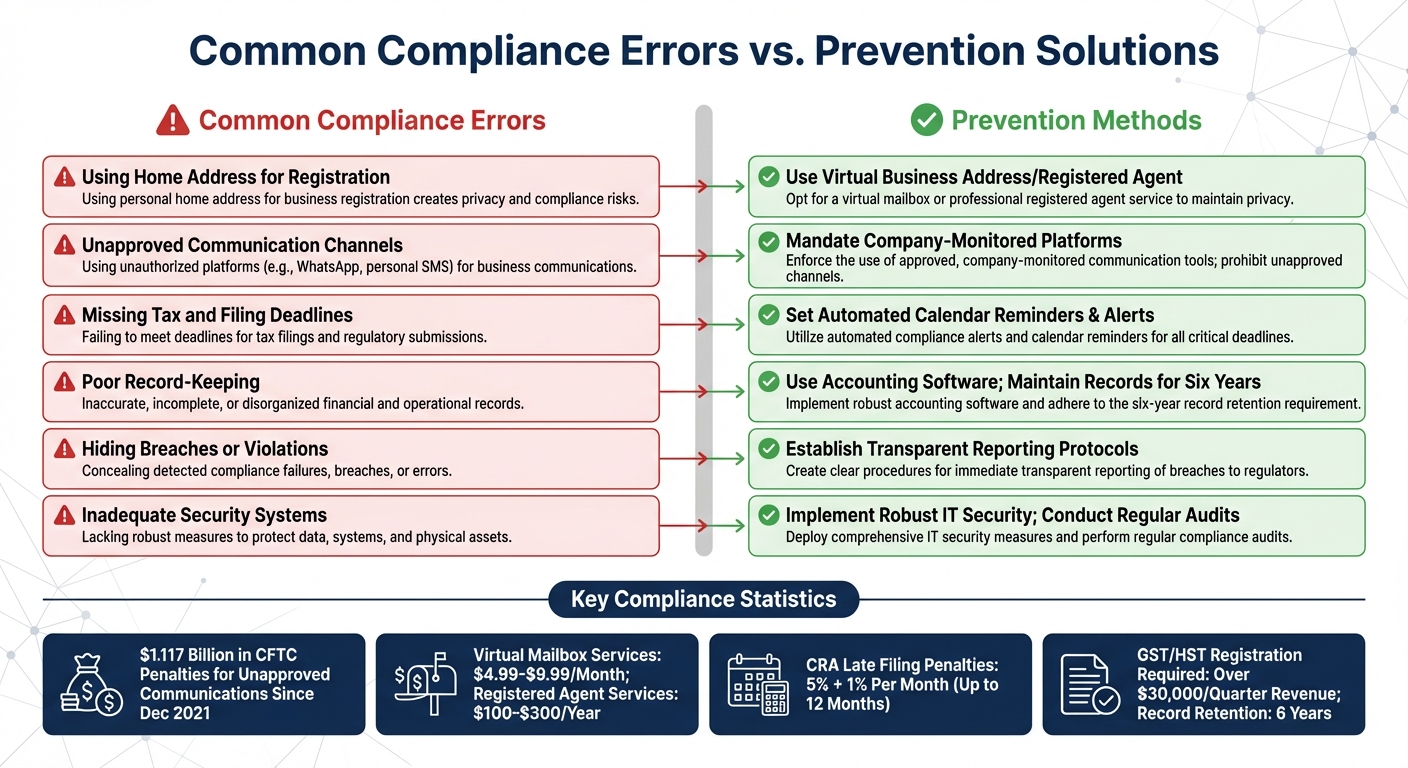
Take, for instance, the use of personal communication platforms like WhatsApp for business purposes. This practice has caused major compliance problems. Since December 2021, the CFTC has imposed a staggering $1.117 billion in civil penalties on 20 financial institutions for failing to maintain proper records due to unapproved communication methods like WhatsApp and personal text messages. One notable example is Interactive Brokers Corp., which was fined $20 million in September 2023 because employees – including senior staff – violated federal regulations by using WhatsApp for business communications between 2019 and 2023.
Another frequent misstep is using a home address when registering an LLC or corporation. This information becomes public through Secretary of State searches, compromising your privacy and potentially blurring the line between personal and business assets. This lack of separation can jeopardize the corporate veil. Protecting yourself is straightforward and affordable, with virtual mailbox services costing as little as $20 to $85 per month and registered agent services ranging from $100 to $300 annually.
Tax compliance is another area where businesses often falter. Missing tax deadlines can result in hefty penalties. For example, late filings can incur CRA penalties of 5% plus 1% per month for up to 12 months. Additionally, failing to register for GST/HST, required for businesses earning over $30,000 per quarter, can lead to fines up to 4% of the owed tax. Tools like automated calendar reminders and compliance alert systems can help businesses stay on track and avoid these pitfalls.
Side-by-Side: Errors vs. Solutions
| Common Compliance Error | Prevention Method | Business Anywhere Solution |
|---|---|---|
| Using home address for registration | Use a virtual business address or registered agent | Virtual Mailbox ($20–$65/month) + Registered Agent ($147/year, first year free) |
| Unapproved communication channels | Mandate company-monitored platforms; prohibit WhatsApp/personal SMS | Document Management Dashboard for secure, archived communications |
| Missing tax and filing deadlines | Set automated calendar reminders and compliance alerts | Compliance Alerts + Annual Report Services |
| Poor record-keeping | Use accounting software; maintain records for six years | Bookkeeping and Accounting Services with organized digital storage |
| Hiding breaches or violations | Establish transparent reporting protocols; notify regulators immediately | Professional support for compliance reporting and regulatory filings |
| Inadequate security systems | Implement robust IT security; conduct regular audits | Secure cloud-based document storage with 24/7 access |
Compliance Checklist for Business Owners
To keep your business compliant, consider these essential steps:
- Assign a compliance officer or point person: This individual should track deadlines, manage filings, and oversee all regulatory requirements. Use a centralized calendar with automated reminders for tasks like tax submissions, permit renewals, and filing annual reports.
- Separate personal and business data: Register your business using a virtual address and hire a registered agent to handle legal notices. This safeguards your privacy and ensures you never miss critical correspondence.
- Standardize communication policies: Ban personal apps like WhatsApp or unmonitored email for business purposes. All communications should occur on approved, archived channels to meet regulatory standards.
- Automate financial tracking: Use tools like QuickBooks or Xero to reconcile accounts monthly, organize receipts, and store financial records for at least six years.
- Protect customer data and internal documents: Establish strict data handling protocols. Avoid uploading sensitive information to public AI tools like ChatGPT, as highlighted in recent CISA warnings.
- Conduct regular audits: Perform quarterly mock inspections, review IT security measures, and ensure employee training is documented and current.
- Report breaches immediately: Notify the appropriate authorities to mitigate risks and demonstrate transparency.
Conclusion
Cases like BitMEX, Block Inc., and Capital One highlight the dangers of sidestepping regulations or neglecting compliance. For instance, Capital One faced a $390 million penalty from FinCEN for failing to file nearly 50,000 suspicious activity reports covering transactions worth over $16 billion. As FinCEN Director Kenneth A. Blanco put it:
"Capital One willfully disregarded its obligations under the law in a high-risk business unit".
These examples underscore a critical point: prioritizing compliance is not just about avoiding penalties – it’s about safeguarding your business’s future.
The lesson is clear. Skimping on compliance can wreak havoc on both your finances and reputation. Investing in proper licensing, implementing strong KYC/AML systems, and maintaining transparency with regulators are essential steps. Reporting breaches promptly and staying proactive can help avoid costly enforcement actions.
To make compliance more manageable, services like Business Anywhere offer tools designed to simplify these processes. From Registered Agent services and Virtual Mailboxes to Compliance Alerts, these resources help businesses meet requirements effortlessly. For remote entrepreneurs, the Digital Nomad Kit provides everything needed to establish and operate a U.S. business with ease. This includes setting up virtual addresses for international entrepreneurs to maintain a professional presence.
FAQs
What happens if my business doesn’t follow data privacy regulations?
Failing to follow data privacy laws can have serious consequences for your business. We’re talking about massive fines, potential lawsuits, and a damaged reputation that could take years to rebuild. For instance, companies have been hit with penalties ranging from tens of thousands to billions of dollars for violations like mismanaging customer data or skipping necessary legal registrations.
Beyond fines, non-compliance opens the door to data breaches, putting sensitive customer information at risk and eroding trust. Add to that the possibility of regulatory investigations and enforcement actions, which can disrupt your operations and pile on extra costs. Staying compliant with data privacy regulations isn’t just a legal requirement – it’s a smart move to protect your business and secure its future.
What steps can businesses take to strengthen their cybersecurity and avoid data breaches?
To boost cybersecurity and guard against data breaches, businesses need to take a proactive stance. This means implementing robust security protocols and offering ongoing training for employees. Since human error plays a major role in many breaches, educating staff on how to spot and handle potential threats is essential.
Steps like regularly updating security software, performing routine audits, and utilizing advanced threat detection tools can help pinpoint and fix vulnerabilities before they’re exploited. Staying compliant with cybersecurity regulations, such as those set by the New York Department of Financial Services (NYDFS), is another critical measure. Compliance not only reduces the risk of fines but also helps safeguard a company’s reputation.
Creating an organization-wide culture of security awareness is equally important. Leveraging free tools and guidance from agencies like the Cybersecurity & Infrastructure Security Agency (CISA) can provide additional support. These resources can help businesses protect sensitive data more effectively while maintaining customer trust.
Why is it important to report data breaches quickly and transparently?
When a data breach happens, acting fast and being open about it is crucial. It’s not just about following legal rules – it’s about protecting the people affected and keeping their trust in your organization. By responding quickly, you can notify those impacted, offer helpful resources like credit monitoring, and tighten security to stop further damage.
Delaying or failing to report a breach can have serious repercussions. We’re talking about hefty fines, potential lawsuits, and a hit to your reputation that could take years to repair. Being transparent shows you’re taking responsibility, which helps rebuild consumer confidence and keeps your business on solid ground.