

Starting a business in the U.S. isn’t just about having a great idea. You need the right licenses and permits to legally operate. Without them, you risk fines, closures, or even criminal charges. Here’s what you need to know:
- Types of Licenses: General business licenses, professional licenses, and industry-specific permits (e.g., alcohol, firearms).
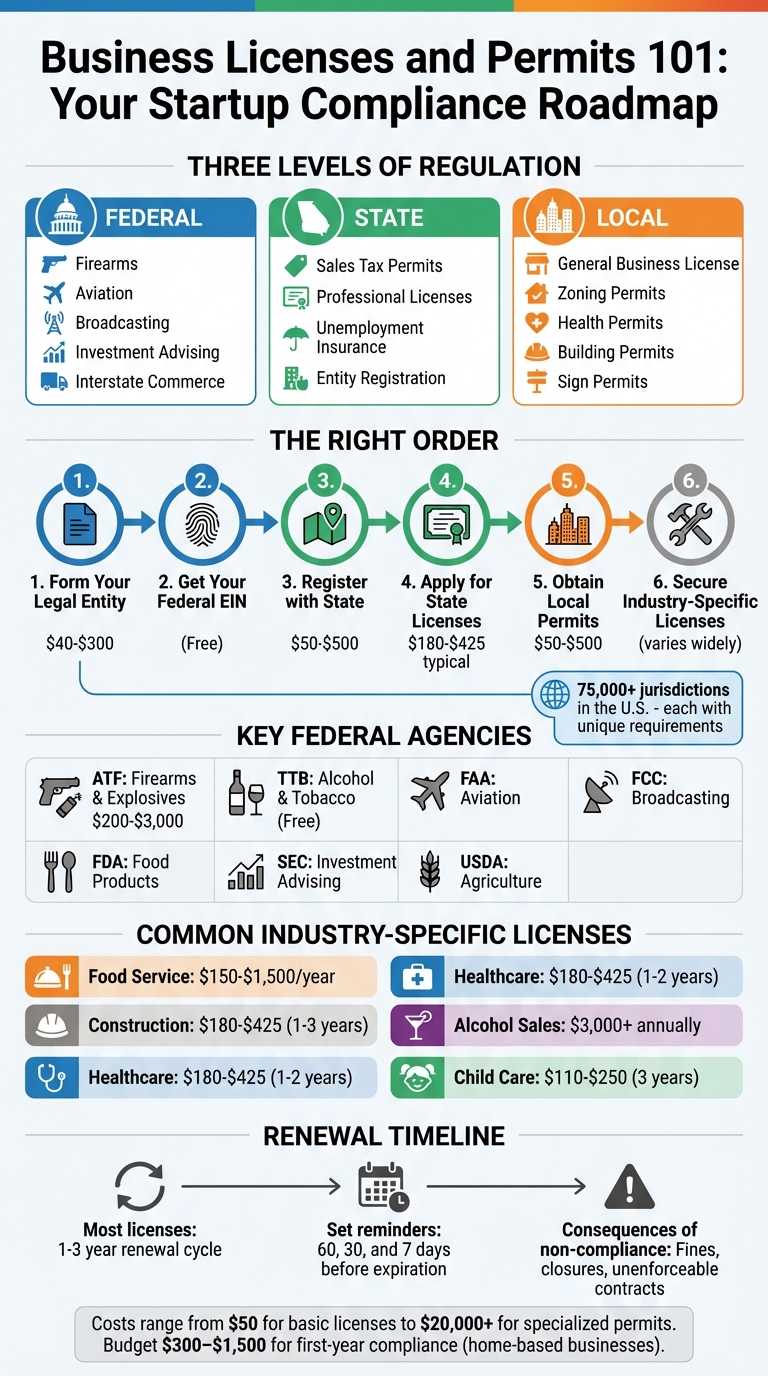
- Levels of Regulation: Federal (e.g., firearms, aviation), state (e.g., sales tax, professional services), and local (e.g., zoning, health permits).
- Key Steps: Form your legal entity, get an EIN, and research necessary licenses for your industry and location.
- Costs & Renewals: Fees vary widely ($50–$3,000+), and most licenses require renewal every 1-3 years.
Staying compliant ensures your business runs smoothly and builds trust with customers. Let’s break down the details.
Step-by-Step Guide to Obtaining Business Licenses and Permits for Startups
Federal Business Licenses and Permits
When Your Startup Needs a Federal License
Most startups don’t need federal licenses, but there are exceptions. If your business activities fall under federal regulation or involve moving goods across state lines, you’ll likely need one. Common examples include dealing with firearms, explosives, alcohol, or tobacco; operating commercial aircraft; broadcasting; or transporting regulated goods. For businesses importing or transporting animals, plants, or biotechnology across state lines, the U.S. Department of Agriculture (USDA) requires a permit. Similarly, offering paid investment advice means registering with the Securities and Exchange Commission (SEC). Before diving into federal license applications, ensure you’ve established your legal entity and obtained an EIN. Then, research the relevant federal agencies and their licensing requirements.
Federal Agencies That Issue Licenses
The Bureau of Alcohol, Tobacco, Firearms and Explosives (ATF) oversees licenses for businesses handling firearms, ammunition, and explosives. For instance, a Type 01 Dealer/Gunsmith license costs $200 upfront and $90 for renewal every three years, while a Type 09 license costs $3,000 for both application and renewal. Processing typically takes 60 days, during which all "Responsible Persons" (owners, partners, or corporate officers) must complete background checks, submit fingerprints and photos, and attend an in-person interview with an investigator.
"If you intend to engage in a business involving the dealing, manufacturing, or importing of firearms, or manufacturing or importing ammunition, you must apply for a federal firearms license (FFL) from ATF." – ATF
For alcohol and tobacco businesses, the Alcohol and Tobacco Tax and Trade Bureau (TTB) manages permits. Good news: TTB permits are free, but you’ll need pre-approval through their "Permits Online" system.
Other federal agencies involved in licensing include:
- Federal Aviation Administration (FAA) for aircraft operation and maintenance.
- Federal Communications Commission (FCC) for radio and TV broadcasting (note: online-only podcasts don’t require FCC licenses).
- Food and Drug Administration (FDA) for food products crossing state lines.
- U.S. Nuclear Regulatory Commission (NRC) for nuclear energy.
- Federal Maritime Commission for maritime transportation.
Here’s a quick reference table for key business activities and their regulating agencies:
| Business Activity | Regulating Federal Agency |
|---|---|
| Agriculture (Interstate/Import) | U.S. Department of Agriculture (USDA) |
| Alcoholic Beverages | Alcohol and Tobacco Tax and Trade Bureau (TTB) |
| Aviation & Aircraft | Federal Aviation Administration (FAA) |
| Firearms, Ammunition, Explosives | Bureau of Alcohol, Tobacco, Firearms and Explosives (ATF) |
| Broadcasting (Radio/TV/Cable) | Federal Communications Commission (FCC) |
| Investment Advising | Securities and Exchange Commission (SEC) |
| Drug and Food Manufacturing | Food and Drug Administration (FDA) |
| Maritime Transportation | Federal Maritime Commission |
| Nuclear Energy | U.S. Nuclear Regulatory Commission (NRC) |
State-Level Licenses and Permits
Common State Licenses and Permits
Once you’ve addressed federal licensing, the next step is navigating state-level requirements. These licenses primarily focus on taxation and regulatory compliance, and with over 75,000 jurisdictions in the U.S., the rules can vary significantly.
One of the most common state requirements is obtaining a sales tax (seller’s) permit. If your business involves selling physical goods, this permit is essential to legally collect and remit sales tax to the state. While most states only tax tangible products, Hawaii, New Mexico, and South Dakota also apply sales tax to services. You’ll need to secure this permit from your state’s Department of Revenue or Treasury before making your first sale.
For specialized industries, occupational and professional licenses are mandatory. These ensure that professionals in fields like medicine, law, accounting, construction, or cosmetology meet established safety and expertise standards. Depending on the state, both the individual practitioners and the business entity may need separate licenses issued by state professional boards. Some states require the individual to hold the license, while others license the business itself, so it’s vital to check with your state’s professional board for specific requirements.
If you’re hiring employees, you’ll also need to register for unemployment insurance through your state’s Department of Labor. This registration enables you to contribute to unemployment tax funds. Additionally, most businesses with employees must obtain a state employer identification number, which is separate from the federal EIN, for state tax reporting.
"While a basic business license could be as low as $50 in some states, permits for a marijuana business could run into the tens of thousands of dollars." – Christine Mathias, Attorney
Certain products, like alcohol, tobacco, firearms, lottery tickets, or gasoline, require additional state permits beyond a general business license. These highly regulated items often demand both state and federal permits, so be prepared for a longer application process and higher fees.
How to Register Your Business Entity
To establish your business legally, you’ll need to register your business entity with your state’s Secretary of State office. Whether you’re forming an LLC, corporation, or nonprofit, this step defines your business structure. Registration fees typically range from $40 to $300 or more, depending on the state. Completing this step early can help you avoid duplicate fees and streamline compliance with state and local regulations.
Here’s the recommended sequence: first, form your entity; next, obtain your federal EIN; and then apply for state licenses. If you start the licensing process as an individual and later incorporate, you’ll likely have to pay for the licenses again under your company’s name. Skipping this order could cost you hundreds of dollars in duplicate fees and lead to unnecessary complications.
In eight states – Alabama, Alaska, Delaware, Florida, Nevada, Tennessee, Washington, and West Virginia – a state-level general business license is required in addition to local permits. In these states, you’ll register through the Secretary of State or Department of Revenue. In most other states, general business licensing is handled at the city or county level, but you’ll still need to register your entity with the state.
Make sure to obtain your state tax identification number before pursuing local permits. This step is crucial to avoid delays when applying for local licenses. If you’re selling online, be aware of "economic nexus" rules. These may require you to obtain sales tax permits in states where you don’t have a physical presence but exceed certain revenue thresholds.
For a smoother process, platforms like BusinessAnywhere can handle the research and filing for your entity registration and state-level compliance. Instead of juggling multiple state websites and deciphering complex rules, you can rely on a single service to ensure your business meets all legal requirements. Keep an eye on renewal dates, as most state licenses expire every one to three years. Missing a renewal could lead to fines or even business closure.
Local and County Licenses
Once you’ve secured your state-level permits, it’s time to tackle local and county requirements. With over 75,000 federal, state, and local jurisdictions in the U.S., your exact obligations will depend on where your business is physically located.
Start by identifying whether you’ll need to work with your city or county government. If your business is within city limits, you’ll typically apply through the City Clerk or Business License Division. For businesses in unincorporated areas, you’ll deal with the County Clerk. From there, you’ll need to review permits for zoning, health, and building compliance.
Most businesses require a general business license (sometimes called a business tax certificate) to operate legally. This license registers your business for local taxes and usually costs between $50 and $500 annually, with many municipalities averaging around $180.
"Forming your LLC makes you a legal entity. Getting your Business License makes it legal for you to open your doors." – The SMB Bureau
Beyond the general license, you might need additional permits to meet specific safety, health, or zoning regulations. For instance, opening a restaurant may require permits for food handling, fire safety, and building modifications.
Zoning, Health, and Building Permits
Zoning permits are essential to confirm that your business is allowed in its chosen location – whether it’s zoned for commercial, industrial, or residential use. Before signing a commercial lease, make sure the zoning aligns with your business type. Including a contingency clause in your lease to allow termination if zoning approval is denied can save you from costly issues.
Don’t assume a location is compliant just because a similar business operated there before. If the previous tenant left long ago, updated codes – such as ADA requirements or modern grease traps – might necessitate a new Certificate of Occupancy. Contact the local Planning or Development Department early to determine what permits are needed for renovations.
Certain industries require closer scrutiny. Health permits are mandatory for businesses handling food or personal care services to ensure sanitation standards are met. Fire permits are needed for businesses using flammable materials or hosting large groups. Sign permits regulate the size and placement of exterior signage to avoid fines or forced removal.
| Permit Type | Purpose | Common Scenarios |
|---|---|---|
| Zoning Permit | Ensures the business fits local land-use plans | Opening a retail shop in a residential area |
| Health Permit | Verifies sanitation and safety standards | Restaurants, cafes, food trucks, salons |
| Fire Permit | Ensures compliance with fire safety requirements | Businesses using flammable materials or hosting large crowds |
| Sign Permit | Regulates the size, lighting, and location of signage | Installing a new storefront sign or temporary banner |
| Building Permit | Necessary for structural changes or repairs | Remodeling a leased commercial space |
| Occupancy Permit | Confirms that a building is safe for public use | Moving into a new location or changing property use |
DBA Filings and Home-Based Business Permits
DBA filings and home-based business permits help ensure your business complies with local laws and community standards. If your business operates under a name different from your legal entity or personal name, you’ll need to file a "Doing Business As" (DBA) registration with the county clerk. DBA registration costs range from $10 to $100, and many cities require it before issuing a local business license. Keep in mind, DBA names cannot include terms like "Corporation" or "Inc." unless your business is formally registered with the Secretary of State.
For home-based businesses, a Home Occupation Permit is required to legally operate from your residence. These permits are designed to ensure that home-based operations don’t disrupt the neighborhood. Restrictions often include limits on signage, client visits, and employee numbers.
Home occupation permits come with strict rules. Outdoor signage is usually prohibited, client visits are capped, and only household members can be employed on-site. Additional restrictions may include parking limits and noise controls. It’s important to verify these rules before investing heavily in your setup – a single complaint from a neighbor could lead to a cease-and-desist order.
Also, review your Homeowners Association (HOA) covenants and residential lease agreements. Some explicitly forbid commercial activity, which could impact your business even if you have city approval. On average, home-based businesses spend between $300 and $1,500 on licenses and permits during their first year.
Keep track of renewal dates, as most local licenses need to be updated annually or biennially. Missing a renewal can result in noncompliance, fines, or even the need to reapply entirely. Setting reminders at least 60 days before renewal deadlines can help you avoid unnecessary penalties.
Professional and Industry-Specific Licenses
Some industries require additional licenses to demonstrate that businesses meet essential safety and training standards, ensuring compliance with public health and safety regulations. Below are examples of industries with specific licensing requirements.
Restaurants, for instance, need a Food Service Vendor License (costing between $150 and $1,500 annually), a Food Safety Manager’s License (ranging from $25 to $120), and Food Handler Permits for staff (priced at $15 to $25 each). These documents must be readily available for unannounced inspections. In many states, a certified manager is required to be on-site during operating hours.
"Business licenses and permits are intended to keep consumers safe and operations transparent." – NerdWallet
Construction and contracting businesses must obtain contractor licenses, which cover general contracting and specialized trades like plumbing or electrical work. These licenses typically cost $180 to $425 and need renewal every one to three years. Healthcare providers must secure state-issued medical or professional licenses, and facilities such as pharmacies often require additional permits at both state and federal levels. Other regulated professions include law, accounting, real estate, cosmetology, and auto repair.
Examples of Industry-Specific Licenses
Each industry has unique licensing requirements, fees, and renewal schedules. Being aware of these details can help you budget effectively and avoid compliance issues that might disrupt your operations.
Here’s a quick look at some common industries, their typical licenses, and associated costs:
| Industry | Common License Type | Issuing Authority | Estimated Fees | Renewal Schedule |
|---|---|---|---|---|
| Food Service | Health Permit / Food Service License | State or County Health Dept | $150–$1,500 | Annual |
| Construction | Contractor / Trade License | State Licensing Board | $180–$425 | 1–3 Years |
| Healthcare | Medical / Professional License | State Medical Board | $180–$425 | 1–2 Years |
| Alcohol Sales | Liquor License | State ABC Board / TTB | $3,000+ | Annual |
| Personal Services | Cosmetology/Aesthetician License | State Board of Cosmetology | $180–$425 | Biennial |
| Child Care | Child Care Center License | State Licensing Agency | $110–$250 (3 years) | Every 3 Years |
These specialized licenses work alongside general, state, and local permits to ensure businesses in regulated industries operate within the law.
Before applying for these licenses, make sure to secure your federal EIN, as it’s often required in the application process. Additionally, confirm that your business location is zoned appropriately for your industry before signing a lease. Commercial zoning permits can range widely, from $120 to $20,000, depending on factors like location and building size.
sbb-itb-ba0a4be
How to Determine Which Licenses Apply to Your Startup
Figuring out what licenses your startup needs starts with identifying where your business actually operates – not where your LLC was formed or where you live. Your licensing requirements are tied to your business’s physical location, the type of products or services you offer, and whether your activities are regulated at the federal, state, or local level.
Here’s a quick breakdown: Federal licenses are only necessary for businesses in regulated industries like alcohol, firearms, aviation, or broadcasting. State-level requirements often include professional licenses, sales tax permits, and permits tied to specific industries. Meanwhile, local governments handle general business licenses, zoning permits, and health department approvals.
Even if you’re running your business from home, you’ll probably need a home occupation permit and must follow residential zoning laws. Before signing a lease or starting operations, make sure the location is zoned appropriately for your business.
Steps to Identify Required Licenses
- Get Your EIN: Start by applying for an Employer Identification Number (EIN) with the IRS – it’s free and required for most license applications.
- Check State Requirements: Visit your Secretary of State’s website to find state-level requirements like professional licenses or sales tax permits.
- Contact Local Offices: Reach out to your City or County Clerk’s office for information on general business operating licenses and local permits.
- Use Online Resources: Simplify your research with tools like the U.S. Small Business Administration (SBA) website, which provides guidance on federal requirements and links to state agencies. Some states even offer tailored portals to generate a list of necessary permits based on your business type and location. Examples include CalGold (California), Wide Open for Business (Texas), and NY Business Express (New York).
- Professional Services: If your business involves professional services – like healthcare, law, accounting, real estate, or cosmetology – check with your state’s regulatory board to understand specific licensing requirements.
- Federally Regulated Activities: For industries like agriculture, alcohol, broadcasting, or investment advising, go directly to the relevant federal agency (e.g., USDA, TTB, FCC, or SEC).
Lastly, verify zoning regulations before committing to a location. Review local zoning codes or your lease agreement to confirm that your business activities are allowed at your chosen address.
Using BusinessAnywhere for Compliance
BusinessAnywhere simplifies the licensing and compliance process by offering key filing services directly through its platform. For example, you can add EIN application services for $97, ensuring you have the federal identification number needed for licenses and opening a bank account. The platform also handles Beneficial Ownership Information Report (BOIR) filings for $37, helping you meet FinCEN reporting requirements for most LLCs and corporations.
Once registered, you’ll receive compliance alerts through your BusinessAnywhere dashboard. These reminders help you stay on top of renewal deadlines and reporting obligations, which is crucial since most licenses expire every one to three years. The platform also includes a document management system, keeping all your licensing paperwork organized and accessible 24/7. This makes it easier to respond to inspections or renewals without stress.
How to Obtain Licenses and Permits
Application Process Overview
Once you’ve identified the licenses your business needs, the next step is applying for and maintaining them. To get started, gather essential documents like your EIN, formation paperwork, a description of your business activities and location, details of authorized signers, and any relevant certifications. Missing even one required document can cause delays in processing your application.
Most agencies now encourage online submissions through their portals, making the process faster and sometimes cheaper. For federal licenses, visit the specific agency’s website. For instance, the Alcohol and Tobacco Tax and Trade Bureau (TTB) offers a "Permits Online" system tailored for alcohol-related businesses. At the state level, licenses are often available through your Secretary of State’s website or centralized platforms like Maryland One-Stop or Nevada’s SilverFlume. Local licenses, such as general operating licenses, zoning permits, or DBAs, can usually be accessed on city or county ".gov" websites or at your County Clerk’s office. Once your documents are ready, you can proceed with the online application.
Keep in mind that all fees are due upfront and are non-refundable, even if your application is denied. Costs vary widely: municipal business licenses generally range from $50 to $180, professional licenses can cost between $180 and $425, and specialized permits like liquor licenses may run as high as $3,000. In January 2026, Chicago significantly increased its business license fees – regulated business licenses jumped from $250 to $1,000, a 400% hike. Hyde Park resident Liesl Shurtliff, who helped a friend apply for a small cleaning business license, expressed shock at the new $1,000 fee, saying:
"It’s prohibitively expensive for small service-based businesses – cleaning, creatives, tutors, home-based businesses – many of whom operate on narrow margins".
Processing times can vary greatly depending on the type of license and issuing agency. While some applications are approved within days, others may take months. Make sure to keep copies of all submissions, confirmation numbers, and any PINs provided during the process. Ignoring high-regulation licenses can lead to severe consequences, including fines, temporary closures, or even criminal penalties like jail time.
Tracking and Renewing Licenses
Once you’ve secured your licenses, staying compliant is critical. Most permits need to be renewed every one to three years, and missing a renewal deadline can have serious consequences. For instance, it might void your business contracts or insurance coverage. In some areas, operating without a valid license could even render your business contracts unenforceable in court. As the Boyer Law Firm explains:
"Your business can be legally formed but still operating illegally if you do not have the required licenses".
Renewing a license is usually quicker and less costly than starting over with a new application. To avoid missing deadlines, consider using a compliance calendar or tracking tool. Services like BusinessAnywhere offer compliance alerts to help you monitor renewal dates. The U.S. Small Business Administration also advises:
"Keep close track of when you need to renew them – it’s often easier to renew than it is to apply for a new one".
BusinessAnywhere’s compliance alerts are especially helpful, sending reminders through your dashboard and keeping all your licensing documents organized and accessible at any time.
Compliance and Renewal Requirements
Renewal and Reporting Obligations
Business licenses in the U.S. typically expire every one to three years, requiring timely renewals at federal, state, and local levels. Federal agencies oversee regulated activities, state authorities handle entity registrations and professional licenses, while local governments manage zoning and operating permits. Keeping these updated is essential for maintaining your startup’s legal status.
The U.S. Small Business Administration emphasizes the importance of renewals:
"Some licenses and permits expire after a set period of time. Keep close track of when you need to renew them – it’s often easier to renew than it is to apply for a new one".
Certain changes, like relocating your office or altering your ownership structure, may require immediate updates. For example, moving locations could mean undergoing a new zoning review and obtaining an updated Certificate of Occupancy. Similarly, adding a new owner might necessitate re-approval for licenses if the ownership percentage crosses specific thresholds.
State annual reports are another critical obligation. Filing fees typically range from $50 to $500, with most states requiring submissions every one or two years. Additionally, small businesses must now file Beneficial Ownership Information (BOI) reports with FinCEN, ensuring any changes in ownership are reported within designated timeframes.
Failing to meet renewal deadlines can lead to serious consequences, including late fees, suspended licenses, forced closures, or even unenforceable contracts. Troy Ayala, Compliance Business Consultant at Wolters Kluwer, cautions:
"A failure to maintain the right licenses or pay licensing fees could result in a variety of consequences since each jurisdiction may levy its own penalties".
Considering there are over 75,000 federal, state, and local jurisdictions in the U.S., each with unique requirements, managing compliance manually is a daunting task.
Compliance Tools and Alerts
Staying on top of renewals requires effective tools and systems. Relying solely on government notices can be risky, so maintaining a detailed license register is essential. This register should include key details like license names, numbers, jurisdictions, portal login URLs, expiration dates, fees, and the person responsible for renewals. To avoid missing deadlines, set reminders at 60, 30, and 7 days before each due date.
Platforms like BusinessAnywhere simplify this process by automatically tracking renewal dates and sending dashboard alerts. The platform also organizes all licensing documents, ensuring they are accessible whenever needed.
It’s equally important to track dependencies such as insurance policies, surety bonds, or continuing education credits. For instance, if your professional liability insurance lapses, you may be unable to renew your professional license, even if your application is submitted on time. Assigning a specific team member to oversee each license and conducting quarterly reviews of your license register can help ensure everything aligns with your current operations.
As compliance experts at Joorney explain:
"Compliance is logistics. Treat it like inventory, tracked and replenished before it runs out".
Conclusion
Running a business without the necessary licenses and permits can lead to serious consequences: hefty fines, asset freezes, forced shutdowns, or even criminal charges. Beyond that, unlicensed businesses face significant hurdles, such as difficulty securing financing, obtaining insurance, or enforcing contracts in court.
The good news? Staying compliant doesn’t have to be overwhelming. Start by forming your business entity and securing an EIN before applying for other licenses – this helps avoid duplicate fees. Check zoning requirements before signing a lease, and determine which federal, state, and local permits are required for your industry and location. Keep a close eye on renewal dates, as most licenses need to be renewed every one to three years.
"Business licenses do more than help you avoid fines. They hold your service to the highest possible standard".
Beyond compliance, licenses enhance your credibility. They show that your business meets government standards for safety and professionalism, which can build trust with customers and partners. Taking a structured approach to licensing ensures your startup is set up for steady growth and legal protection.
With over 75,000 jurisdictions in the U.S., managing compliance manually is a daunting task. That’s where BusinessAnywhere steps in. The platform simplifies the process by tracking renewal dates, sending automated reminders, and keeping all your licensing documents in one centralized dashboard. Whether you’re running a home-based startup or expanding across multiple states, BusinessAnywhere helps you stay compliant without the administrative headaches. With the right tools and strategy, you can focus on growing your business while keeping its legal foundation secure.
FAQs
How do I know which licenses I need?
To figure out the licenses your startup needs, start by looking at your business activities, location, and industry since licensing requirements can differ at federal, state, and local levels. If your business involves activities regulated at the national level, check for federal licenses. Next, review state rules to see if your industry requires specific licenses. Finally, reach out to local government offices to understand any municipal permits you might need. For industries with more complex requirements, consulting a legal expert can help you navigate compliance effectively.
Do online or home-based startups need permits?
Yes, most online or home-based startups require permits and licenses to operate legally. A general business license from your city or county is usually necessary, and if you’re selling taxable goods or services, you’ll also need a state sales tax permit. Depending on what your business does, you might need additional permits, such as professional certifications or health permits. It’s also crucial to review local zoning laws and any regulations specific to your industry to make sure you’re in compliance.
What happens if I miss a renewal date?
Missing the renewal date for your business license or permit can result in penalties, fines, or even the suspension or revocation of your license. This could stop you from legally running your business until the renewal is completed. To keep things running smoothly, make sure to monitor and stick to all renewal deadlines.