


Crowdfunding can help startups get funding without relying on banks or venture capitalists. By presenting your idea to the public through platforms like Kickstarter, Indiegogo, or Wefunder, you can secure smaller contributions from many people. This approach works best for consumer products, creative projects, or startups in early or growth stages.
Key points:
- Types of crowdfunding: Reward-based (pre-sales) or equity-based (selling shares).
- U.S. regulations: Equity crowdfunding must comply with SEC rules, including filing Form C and using registered intermediaries.
- Platform options: Kickstarter (creative projects), Indiegogo (tech), Wefunder (equity for high-growth startups).
- Preparation is critical: Build an audience, create a strong pitch, and plan for marketing and production.
- Common mistakes: Unrealistic goals, poor communication, and lack of pre-launch preparation.
Crowdfunding is ideal if you need to test demand, build a customer base, or secure funding for scaling. However, it requires careful planning, compliance with regulations, and a successful crowdfunding strategy to succeed.
When to Use Crowdfunding for Your Startup
Crowdfunding can be a powerful tool, but its success heavily depends on the stage of your business, the type of product or service you offer, and your overall readiness. Timing your campaign correctly can be the difference between raising substantial funds and failing to gain traction.
Best Business Stages for Crowdfunding
Crowdfunding tends to work best during specific stages of a startup’s journey. For pre-seed and seed-stage startups, reward-based crowdfunding is often the ideal choice. At this stage, having a working prototype is crucial. Platforms like Kickstarter require a physical prototype to assure backers that your product can be delivered.
Take the board game ARTISTRY, for example. They raised an impressive $736,673 on Kickstarter by employing a clever strategy: potential backers could reserve a mini-expansion for just $1. This reservation funnel generated $167,177 within the first 24 hours, far surpassing their modest $5,000 goal. Similarly, the iXi smart golf trolley used Indiegogo to pre-sell their product, raising over $937,000 and transitioning from prototype to full-scale manufacturing.
For startups in the scaling stage, equity crowdfunding is often more effective. This approach is better suited for businesses like software platforms, B2B services, or tech companies that need significant capital to grow. Under Regulation CF, you can raise up to $5,000,000 annually through equity crowdfunding. This method works well for businesses with proven models that are ready to offer shares in exchange for growth funding.
A strong pre-launch strategy can dramatically improve your results. For instance, securing $1 reservation deposits during this phase can boost conversions significantly – those who place a deposit are 30 times more likely to purchase than those who only provide an email address.
Business Types That Succeed with Crowdfunding
Certain types of businesses are naturally better suited for crowdfunding. Consumer-facing products often dominate because they are tangible, easy to understand, and appeal to a broad audience. Think smart home devices, wearable tech, or kitchen gadgets. These types of products solve everyday problems and can be effectively showcased during a short campaign window.
Creative projects and community-driven ventures also tend to thrive. Board games, tabletop gaming accessories, and independent creative works often succeed by tapping into passionate, niche communities. For example, the Polycade Sente retro gaming hardware campaign raised over $1.6 million by targeting superfans of premium brands through Meta ads.
Mission-driven businesses with a strong social or environmental focus also do well. Crowdfunding connects these startups with backers who care deeply about the cause. These supporters often become enthusiastic advocates for the brand.
On the flip side, B2B services and industries with heavy regulations often struggle in the crowdfunding space. Professional services, enterprise software, and other niche solutions typically fail to resonate with the broader audience needed to build momentum.
| Crowdfunding Type | Best Business Type | Primary Benefit |
|---|---|---|
| Reward-Based | Consumer electronics, board games, physical goods | Market validation & pre-sales |
| Equity-Based | SaaS, B2B, robotics, high-growth startups | Large capital raises ($50,000–$5,000,000) |
| Donation-Based | Nonprofits, social causes, community projects | No repayment or equity loss |
When Crowdfunding Makes Sense
Crowdfunding is particularly effective when traditional funding options, like venture capital, aren’t available. It also works well when you need to validate customer interest before committing to full-scale production. A successful crowdfunding campaign not only confirms demand but can also attract additional investors down the line.
Reward-based campaigns, in particular, allow you to test the market while minimizing financial risk. By securing pre-orders, you can gauge interest before investing in mass production. This helps you avoid costly mistakes, like manufacturing products that might not sell.
However, remember that crowdfunding isn’t an easy shortcut. As marketing expert Seth Godin points out:
"Kickstarter campaigns fail when the tribe of people who believe in the idea is too small… [It’s] the last step, not the first one".
To succeed, you need an existing network or community to support your campaign right from the start. Without a base of ready supporters, your campaign may fall flat.
Additionally, ensure you’re prepared for the demands of a crowdfunding campaign. This includes having a marketing budget, production capacity, and a plan for engaging with backers after the campaign ends. If you’re not ready to commit fully, crowdfunding might create more challenges than benefits.
sbb-itb-ba0a4be
How to Choose a Crowdfunding Platform
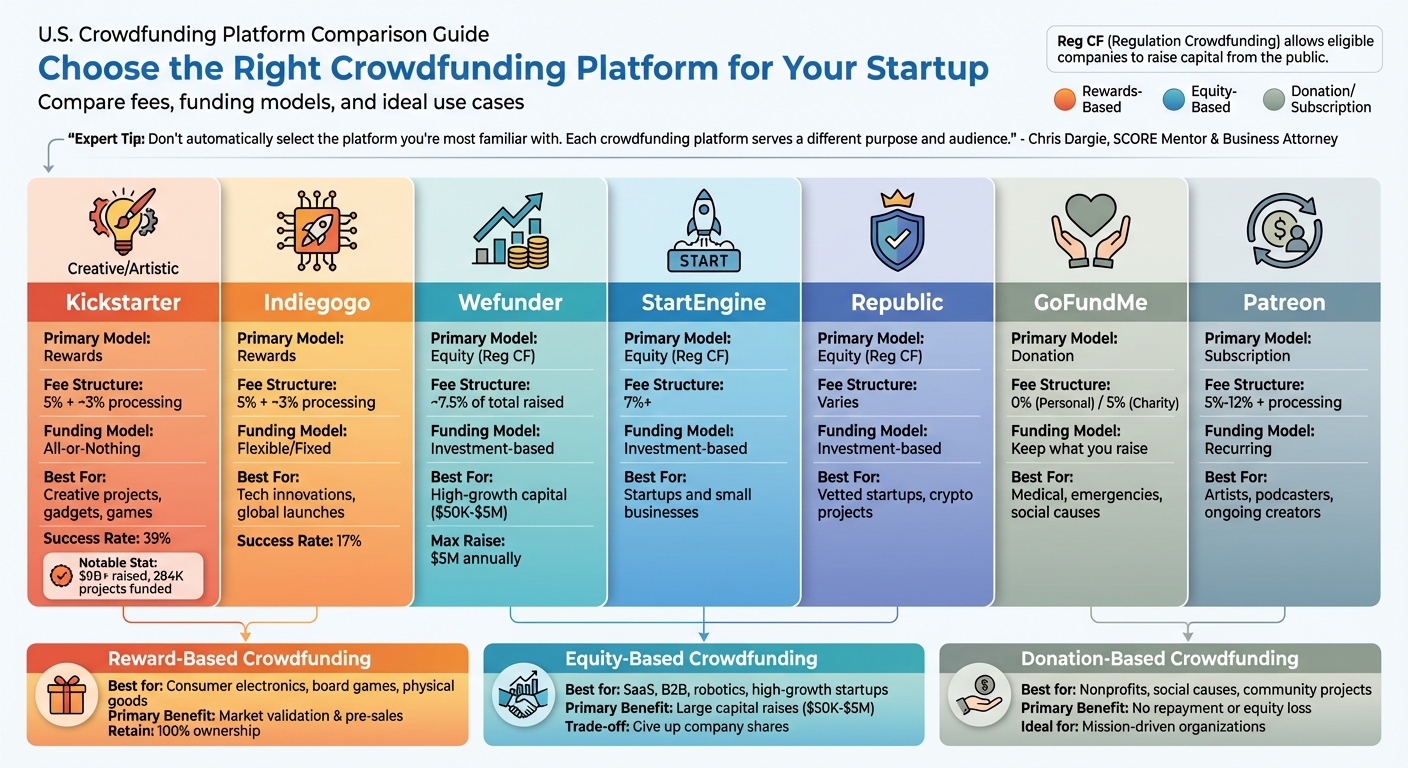
U.S. Crowdfunding Platform Comparison: Fees, Models, and Best Use Cases
Picking the right crowdfunding platform is a crucial step in launching a successful campaign. The platform you choose should align with your business model, funding goals, and the level of ownership you wish to retain. Since each platform targets different audiences and serves distinct purposes, it’s essential to match the platform to your specific needs.
What to Look for in a Crowdfunding Platform
Start by identifying a funding model that works for your goals. If you’re launching a physical product and want to maintain full ownership, reward-based platforms like Kickstarter are a great option. Backers receive a product or perk instead of equity. On the other hand, equity-based platforms such as Wefunder cater to startups looking for larger capital raises – up to $5 million under Regulation CF – but you’ll need to give up shares in your company in return.
Understanding the funding rules is also key. For instance, Kickstarter’s all-or-nothing model requires you to hit 100% of your goal to access funds. This can create urgency among backers. Platforms like Indiegogo, however, offer flexible funding, allowing you to keep the funds raised even if you fall short of your target.
Fees and success rates are other factors to consider. Most reward-based platforms charge a 5% fee on the total raised, plus processing fees of around 3%. Equity platforms like Wefunder and SeedInvest charge higher fees – approximately 7.5% – and often include additional legal and administrative costs. Success rates vary widely: Kickstarter has a success rate of about 39%, Indiegogo’s is around 17%, while Seed&Spark, which focuses on film projects, boasts an impressive 82% success rate.
Lastly, think about the platform’s niche. Different platforms cater to different industries. Kickstarter is popular for creative projects, gadgets, and games, while Indiegogo often attracts tech innovations and global product launches. Equity platforms like Republic focus on highly vetted startups and even crypto projects. SCORE mentor and business attorney Chris Dargie advises:
"Don’t automatically select the platform you’re most familiar with. Each crowdfunding platform is set up to serve a different purpose and audience, so choose the one that fits best with your business type and goal."
U.S. Crowdfunding Platform Comparison
Here’s a breakdown of popular U.S. crowdfunding platforms, their models, fees, and ideal campaign types:
| Platform | Primary Model | Fee Structure | Funding Model | Best For |
|---|---|---|---|---|
| Kickstarter | Rewards | 5% + ~3% processing | All-or-Nothing | Creative projects, gadgets, games |
| Indiegogo | Rewards | 5% + ~3% processing | Flexible/Fixed | Tech innovations, global launches |
| Wefunder | Equity (Reg CF) | ~7.5% of total raised | Investment-based | Startups seeking high-growth capital |
| StartEngine | Equity (Reg CF) | Varies (7%+) | Investment-based | Startups and small businesses |
| Republic | Equity (Reg CF) | Varies | Investment-based | Vetted startups, crypto projects |
| GoFundMe | Donation | 0% (Personal)/5% (Charity) | Keep what you raise | Medical, emergencies, social causes |
| Patreon | Subscription | 5%–12% + processing | Recurring | Artists, podcasters, ongoing creators |
Data source:
Kickstarter, for example, has funded nearly 284,000 projects and raised over $9 billion as of mid-August 2025. A standout example is Oculus VR, which raised $2.4 million on Kickstarter in 2012 for its virtual reality headsets. The company was later acquired by Meta in 2014 for $2.3 billion. Another success story is M3D, which raised $3.4 million in 2014 for its "Micro" 3D printer, eventually landing in major retail outlets.
Indiegogo offers more flexibility. In 2023, the GPD WIN 4 handheld gaming PC raised nearly $4 million, making it the platform’s highest-funded product of the year. In July 2025, Indiegogo was acquired by Gamefound, a Polish platform, and shifted to a flat 5% fee structure.
For equity crowdfunding, platforms like Wefunder, StartEngine, and Republic operate under Regulation Crowdfunding (Reg CF), which requires compliance with SEC regulations. In 2024, companies using Reg CF raised $343.6 million, with equity-based campaigns accounting for 88% of that total. The average investment size for these campaigns was $1,500 – up 26% from 2023.
Before launching an equity campaign, confirm the platform’s registration on FINRA‘s Funding Portals page or BrokerCheck to ensure compliance. Also, you’ll need to complete your online company registration first, as most professional platforms require this. Services like BusinessAnywhere offer $0 business formation (state filing fees apply).
Don’t forget to budget for extra costs. Beyond platform fees, there are payment processing fees (around 3%) and potential legal fees for equity campaigns. Rewards-based funds are typically treated as taxable business income by the IRS, so consulting a tax advisor is a smart move.
How to Launch a Crowdfunding Campaign
Launching a crowdfunding campaign involves careful planning and execution across four main stages. Each step builds on the last, starting with setting up your business and ending with maintaining backer relationships after your campaign is over.
Step 1: Register Your U.S. Business
To meet the requirements of Regulation Crowdfunding (Reg CF), your company must be a U.S.-based entity, either an LLC or a Corporation. Business attorney and SCORE mentor Chris Dargie advises:
"You need to legally form your business entity before you begin your crowdfunding campaign."
Start by selecting a business structure. Many startups prefer LLCs for their flexibility and tax advantages, while those planning to raise significant equity capital often choose a C-Corporation. Services like BusinessAnywhere offer $0 business formation (you only pay state filing fees) and include a free year of registered agent service.
Once your business is formed, secure an EIN from the IRS. This is essential for opening a business bank account and accepting investments. Additionally, if your business is formed after January 1, 2024, you’ll need to file a Beneficial Ownership Information Report (BOIR) with FinCEN. BusinessAnywhere offers BOIR filing services for $37.
Don’t forget to designate a registered agent to handle legal documents. After the first free year with BusinessAnywhere, the service costs $147 annually.
For equity crowdfunding campaigns, additional steps are required. Conduct a "bad actor" check to ensure directors, officers, and major stakeholders (20% or more ownership) haven’t been disqualified for securities fraud. You’ll also need to file Form C electronically through the SEC’s EDGAR system before launching.
Prepare financial statements based on your fundraising target. If you’re raising over $124,000, your financials must be reviewed by an independent public accountant. For campaigns exceeding $1,235,000 (for first-time issuers), audited statements are required.
| Offering Amount | Financial Statement Requirement |
|---|---|
| $124,000 or less | Certified by Principal Executive Officer (PEO) and tax return info |
| $124,001 – $618,000 | Reviewed by independent public accountant |
| $618,001 – $1,235,000 | Reviewed by independent public accountant (for first-time issuers) |
| Over $1,235,000 | Audited by independent public accountant (or if previously sold via Reg CF) |
Budget for ongoing compliance as well. Reg CF requires annual reports (Form C-AR) to be filed within 120 days of the fiscal year-end until certain conditions are met. The maximum amount you can raise under Reg CF is $5 million in a 12-month period.
Once your business is legally established and compliant, you can move on to crafting an engaging campaign pitch.
Step 2: Create Your Campaign Pitch
Your pitch is what turns visitors into backers. Campaigns with high-quality videos raise 105% more than those without.
Start by addressing the "10-second rule." Your campaign page should quickly answer three key questions: "What is this?", "Why should I care?", and "What’s in it for me?" Use a clear hook at the top of your page to immediately grab attention.
A video can make all the difference. Marina Vaamonde, founder of PropertyCashin, explains:
"The best accompanying media in any crowdfunding campaign is a video."
Your video should be concise and focus on storytelling. Highlight the journey behind your product, the problem it solves, and your mission to create an emotional connection with backers. Dan Demsky, co-founder of Unbound Merino, found success by emphasizing benefits over features:
"Rather than telling them ‘it’s breathable’ or ‘it’s made with this fabric,’ we pointed to how [our apparel] will relieve aspects of their life."
Design your campaign page for easy navigation. Use high-quality visuals like images, GIFs, and infographics to break up text and explain complex ideas. Showcasing a working prototype or physical product adds credibility and reassures backers that your project is ready for manufacturing.
For reward-based campaigns, structure your rewards thoughtfully. Include incremental tiers and create urgency with "early-bird" discounts. Make sure rewards are priced fairly and can be delivered as promised. For equity campaigns, clearly outline terms like the valuation, the equity being offered, and what investors can expect.
Set a funding goal based on real costs. Research suggests campaigns with non-rounded funding goals (e.g., $4,850 instead of $5,000) are 6% to 10% more likely to succeed. This shows backers you’ve carefully calculated your needs.
Be upfront about key metrics and potential challenges. Transparency builds trust and can turn one-time backers into loyal supporters.
Step 3: Launch and Promote Your Campaign
The groundwork for success is laid before your campaign goes live. Crowdfunding expert Khierstyn Ross notes:
"If you launch your campaign with zero audience, you are launching to crickets."
Start by building an email list and growing a social media following well in advance. The first 24 hours are crucial. Elnaz Sarraf, CEO of ROYBI, highlights:
"The momentum built in the first 24 hours of a crowdfunding campaign is critical to reaching your funding goal."
Platforms like Kickstarter and Indiegogo boost visibility for campaigns that hit their goals quickly, creating a snowball effect.
Use a "reservation funnel" during pre-launch. Create a landing page where potential backers can place a $1 deposit for a VIP discount or exclusive reward. This strategy identifies high-intent backers, who are 30 times more likely to purchase during the campaign. For example, the board game campaign ARTISTRY used this tactic in early 2026, offering a mini-expansion for $1. This helped raise $167,177 in the first 24 hours and $736,673 overall, far surpassing its $5,000 goal.
Leverage Meta ads (Facebook and Instagram) to drive traffic to your pre-launch page. Target superfans by focusing on interests in similar brands, influencers, or hobbies. For instance, Polycade Sente raised over $1.6 million by targeting fans of retro video games, premium brands like Ferrari, and tech influencers like MKBHD.
Plan your ad budget carefully – successful campaigns typically allocate 25% of their total funding goal to advertising. For a $100,000 goal, set aside about $25,000 for ads.
When reaching out to friends and family, make it personal. Dan Demsky of Unbound Merino shared:
"To ensure we got the momentum, we created custom videos [for friends and family]… This compelled people to respond because it was so personal, rather than a copied and pasted message."
Once live, keep your campaign active by posting weekly updates and engaging with your community on social media. Respond promptly to comments to maintain interest. As Chalmers Brown, co-founder of Due, says:
"You need to be able to convey the value of the product if you want them to support your crowdfunding project. If they don’t believe it will work, they won’t back it."
With your campaign promoted effectively, the next step is delivering on your promises.
Step 4: Fulfill Rewards and Engage Backers
Reaching your funding goal is just the beginning. Post-campaign follow-through is where trust is built, and backers can become long-term advocates.
Develop a clear timeline for fulfilling rewards and communicate updates regularly. Share realistic production and delivery schedules, and be upfront about any delays. Transparency during this phase is key to maintaining backer confidence and setting the stage for future success.
Common Crowdfunding Mistakes to Avoid
Even the most well-thought-out crowdfunding campaigns can fall apart if critical mistakes are made. Recognizing these errors – and keeping track of your progress – can make all the difference between hitting your funding goal or missing the mark.
Mistakes That Hurt Crowdfunding Campaigns
One of the biggest missteps is viewing your launch date as the starting point. If you click "launch" without months of groundwork, you’re already behind. As Financial Models Lab warns:
"If you treat the launch button as the starting line, you’ve already lost."
The truth is, the 90 days leading up to your launch will determine about 80% of your campaign’s success. Pre-launch preparation is crucial. Crowdfunding platforms tend to favor campaigns that hit 30% of their funding goal within the first 48 hours [32,33,34].
Another common error is setting an unrealistic funding goal. High targets can scare off backers, while low ones may leave you unable to cover production and fulfillment costs. A cautionary tale is the Coolest Cooler, which raised $13 million from 62,642 backers on Kickstarter in 2014. Despite its massive funding, unforeseen manufacturing and scalability issues left many backers empty-handed. Be sure to account for platform fees (5%), payment processing (3–5%), failed pledges (5–10%), and fulfillment costs (15–25%). Adding a 10–15% buffer for unexpected expenses can also save you from financial headaches [31,33].
Poorly designed rewards can also derail your campaign. Offering too many reward tiers can confuse backers, and pricing rewards too close to their retail value may reduce the incentive for early support [33,35,36]. Stick to five to seven reward tiers and price them about 15% below the expected retail price. Additionally, secure firm shipping quotes rather than relying on estimates – shipping costs rose 8% year-over-year in Q3 2025.
Failing to provide regular updates is another pitfall. Campaigns that don’t update backers at least every 14 days see a 15–20% increase in refund requests [31,33]. As Financial Models Lab highlights:
"Backers understand delays – it’s the nature of product development – but they absolutely do not tolerate being left in the dark."
For example, the Retro Computers Vega+ campaign raised over $500,000 from 3,600 backers in 2016 but collapsed due to production issues and legal disputes.
Finally, don’t rely solely on organic traffic. Self-driven efforts like paid ads, PR, and influencer partnerships should account for 60–80% of your traffic, as organic traffic typically only contributes 20–40% of total funding. Allocating 10–20% of your funding goal to marketing can make a significant impact.
| Cost Category | Typical % of Funds Raised | Actionable Insight |
|---|---|---|
| Platform Fees | 5% | Deduct immediately from your goal |
| Payment Processing | 3–5% | Use the higher end for safety |
| Failed Pledges | 5–10% | Budget as uncollected revenue |
| Fulfillment & Shipping | 15–25% | Get firm quotes; don’t estimate |
| Contingency Buffer | 10–15% | Account for material price fluctuations |
Avoiding these common mistakes is just the start. Keeping track of performance metrics throughout your campaign is equally important.
How to Measure Campaign Performance
Once your campaign is live, tracking key metrics can help you refine your strategy. Success isn’t just about reaching your funding goal – it’s about maintaining momentum and delivering on your promises.
Start by monitoring where your traffic is coming from. The best campaigns generate 60–80% of their traffic through external channels, while those relying on the platform for 80% or more of their traffic tend to struggle.
Pay attention to your campaign video. Aim for at least 70% viewer retention past the 30-second mark, as high-quality videos can boost funding by an average of 400%.
Consistent communication is another critical factor. Respond to comments and questions within eight hours on business days, and encourage backer-to-backer conversations. A healthy campaign sees over 20% of its comments as interactions between backers.
After your campaign ends, evaluate your operational readiness. Many campaigns stumble post-funding because they underestimate actual costs – often by as much as 18%. Be thorough in calculating all landed costs, including manufacturing, packaging, quality control, and tariffs, which can add 5–15% to unit costs. Keep in mind that only about 43% of Kickstarter campaigns successfully meet their funding goals [32,34], so hitting your target is just the beginning.
Ultimately, success comes down to fulfilling your promises and turning backers into loyal customers. Take PEEjamas as an example. By leveraging targeted Facebook ads, they scaled their Kickstarter funding from $26,000 to $227,469. Their real achievement, however, lay in delivering orders and building a sustainable business.
Is Crowdfunding Right for Your Startup?
Determining whether crowdfunding is the right path for your startup depends on several factors. Crowdfunding tends to work well if your product has broad public appeal. However, it’s often less effective for niche B2B services or industries with heavy regulations.
Before diving in, take a close look at your audience and preparation. Most successful campaigns have a solid foundation, including at least 10,000 email subscribers and about three months of planning. Additionally, platforms like Kickstarter require a working prototype – they won’t accept vague ideas or incomplete concepts.
Launching a crowdfunding campaign also demands significant time and resources. You’ll need high-quality content to attract backers, and advertising costs can eat up around 25% of your fundraising goal. Plus, managing backers and fulfilling promises requires ongoing effort. Another important step is legally forming your business entity before collecting public funds. Tools like BusinessAnywhere can simplify this process, offering services like free LLC registration (excluding state fees) and a virtual mailbox to give your startup a professional U.S. address – key elements to have in place before launching your campaign.
If crowdfunding doesn’t feel like the right fit, there are other funding options to explore. Angel investors, venture capital, government grants, or even bootstrapping could be better aligned with your startup’s goals. While the global crowdfunding market raised $17.2 billion in 2022 and is expected to grow to $32.9 billion by 2028, that doesn’t mean it’s the best route for every business. Success in crowdfunding hinges on how well you’ve prepared, engaged your audience, and allocated resources. Carefully evaluate these factors to decide if this path aligns with your startup’s needs and objectives.
FAQs
How do I know whether rewards or equity crowdfunding fits my startup?
Choosing between rewards-based crowdfunding and equity crowdfunding comes down to your goals, the nature of your product, and how you want to engage with backers.
If you’re looking to test your product, grow an early customer base, and generate excitement without giving up any ownership, rewards crowdfunding is a great fit. On the other hand, equity crowdfunding works better if you need significant capital to scale quickly and want to attract investors who are in it for the long haul – though it does mean sharing ownership of your company.
The key is to match your funding approach with your business goals and long-term strategy.
What do I need ready before launching a crowdfunding campaign?
Before kicking off a crowdfunding campaign, it’s crucial to have a solid foundation in place. Start by assembling a dependable team, crafting a persuasive story that resonates with your audience, and building a detailed campaign page that clearly outlines your goals. Additionally, map out your marketing strategy, design appealing backer rewards, and make sure you’re fully compliant with all legal and financial requirements. To give yourself the best chance of success, begin these preparations at least two months before your launch.
How much should I budget for fees, marketing, and fulfillment?
Budgeting for crowdfunding goes beyond just accounting for platform fees, which usually hover around 5%. You’ll also need to factor in costs like marketing, fulfillment, legal compliance, and reward production, all of which can add up quickly. Setting aside a significant part of your budget for marketing and fulfillment is crucial to keep your finances on track and avoid unpleasant surprises. Don’t forget to plan for less obvious expenses, such as administrative and legal fees, which can sneak up on you if you’re not prepared.