


Digital nomad visas are reshaping how remote workers live and work globally. These visas allow you to legally stay abroad while earning foreign-sourced income, offering benefits like long-term residency, local banking, and tax perks. As of March 2026, 66-69 countries offer such programs, with most launched after 2020. Key factors to consider include income requirements (ranging from $700 to $7,200/month), visa durations (6–24 months), and tax obligations. Popular options include Portugal, Spain, and Mexico, which offer pathways to permanent residency, while countries like Georgia and Brazil provide lower income thresholds and cost-effective living. Below are highlights from 10 countries offering digital nomad visas:
- Portugal: €3,680/month income, leads to citizenship after 5 years.
- Spain: $3,100/month income, tax benefits under Beckham Law.
- Estonia: €4,500/month income, tech-friendly infrastructure.
- Croatia: €3,295/month income, tax-free foreign earnings.
- Georgia: $2,000/month income or $24,000 savings, low taxes.
- UAE: $3,500–$5,000/month income, 0% income tax.
- Costa Rica: $3,000/month income, 0% tax on foreign income.
- Mexico: $4,400/month income, leads to permanent residency.
- Brazil: $1,500/month income, affordable living.
- Greece: €3,500/month income, 50% tax reduction for 7 years.
Choosing the right visa depends on your income, residency goals, and lifestyle preferences. Below is a quick comparison to simplify your decision.
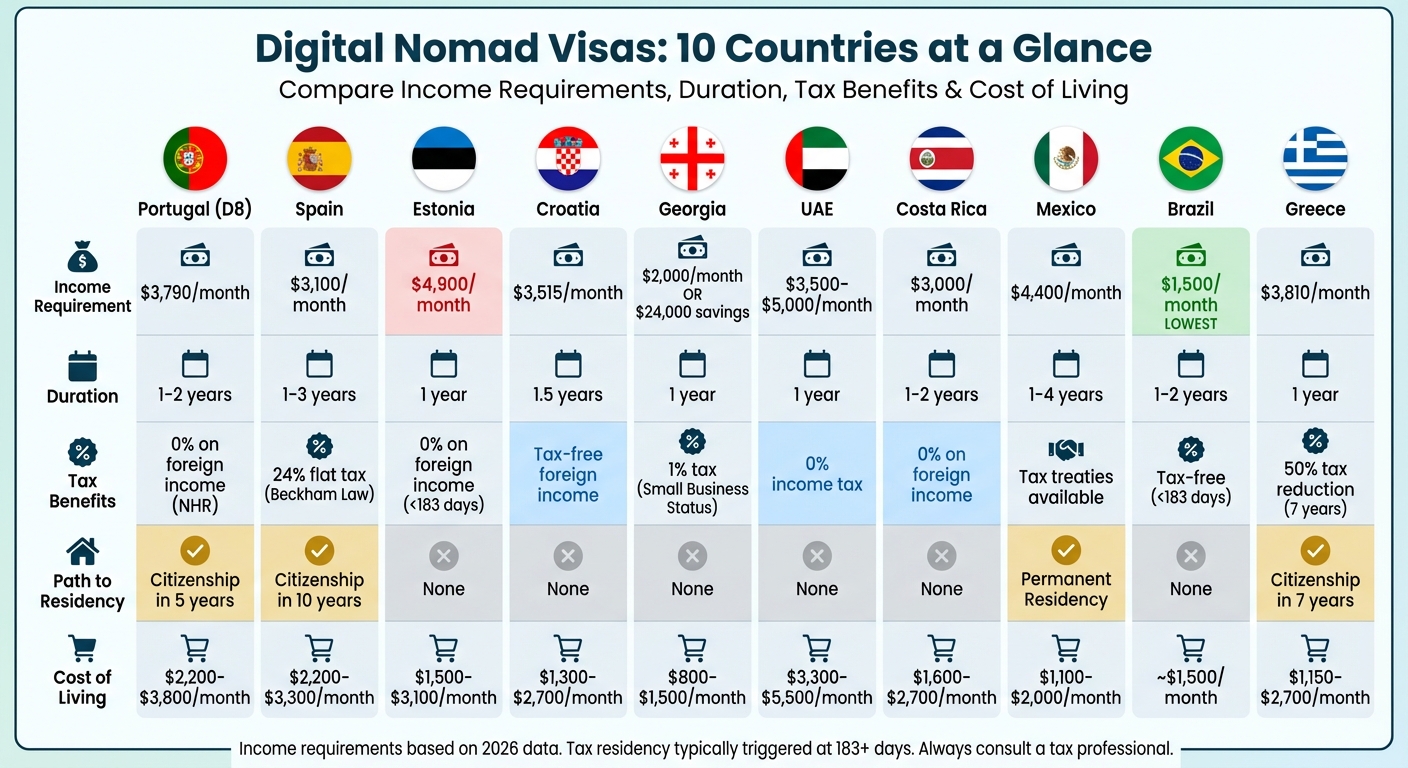
Digital Nomad Visa Comparison: Income Requirements, Duration, and Tax Benefits for 10 Countries
Quick Comparison
| Country | Income Requirement (USD/Month) | Visa Duration | Tax Perks | Path to Residency | Cost of Living (Monthly) |
|---|---|---|---|---|---|
| Portugal | ~$3,790 | 1–2 years | 0% on foreign income (NHR) | Citizenship (5 yrs) | $2,200–$3,800 |
| Spain | ~$3,100 | 1–3 years | 24% flat tax (Beckham Law) | Citizenship (10 yrs) | $2,200–$3,300 |
| Estonia | ~$4,900 | 1 year | 0% on foreign income (<183d) | None | $1,500–$3,100 |
| Croatia | ~$3,515 | 1.5 years | Tax-free foreign income | None | $1,300–$2,700 |
| Georgia | ~$2,000 or $24,000 savings | 1 year | 1% tax (Small Business Status) | None | $800–$1,500 |
| UAE | $3,500–$5,000 | 1 year | 0% income tax | None | $3,300–$5,500 |
| Costa Rica | $3,000 | 1–2 years | 0% tax on foreign income | None | $1,600–$2,700 |
| Mexico | ~$4,400 | 1–4 years | Tax treaties for foreign income | Permanent Residency | $1,100–$2,000 |
| Brazil | $1,500 | 1–2 years | Tax-free (<183 days) | None | ~$1,500 |
| Greece | ~$3,810 | 1 year | 50% tax reduction (7 yrs) | Citizenship (7 yrs) | $1,150–$2,700 |
Each program has unique requirements and advantages. Whether you’re seeking EU citizenship, low taxes, or affordable living, there’s a visa tailored for your needs.
1. Portugal’s D8 Digital Nomad Visa
Portugal introduced its D8 Digital Nomad Visa in October 2022, and since then, more than 2,600 digital nomads have chosen Portugal as their new home. This visa is specifically tailored for non-EU, non-EEA, and non-Swiss nationals who work remotely for companies or clients based outside of Portugal. To qualify, applicants must provide documentation such as an employment contract, service agreements, or proof of owning a business headquartered abroad. Let’s dive into the program’s key details for remote professionals.
Visa Length and Renewal Options
Portugal offers two visa pathways. The Temporary Stay Visa is valid for up to one year and can be renewed up to four times. However, it doesn’t lead to permanent residency or allow family members to accompany the applicant. The Residence Visa, on the other hand, starts with a four-month entry permit, which can be converted into a two-year residence permit after completing an AIMA appointment. This permit is renewable in three-year increments and counts toward the five-year requirement for permanent residency or Portuguese citizenship.
Minimum Monthly Income Requirements
For 2026, applicants must demonstrate a monthly income of €3,680 – four times the national minimum wage of €920. If applying with dependents, an additional 50% is required for a spouse and 30% for each child. Applicants also need to provide proof of steady income over several months, and having savings of at least €11,040 can improve the chances of approval.
Tax Benefits or Obligations
Spending more than 183 days in Portugal within a 12-month period makes you a tax resident. This means you’ll need to report worldwide income. Under the updated NHR 2.0 (IFICI) regime, qualifying professionals pay a flat 20% tax on Portuguese-sourced income and 0% tax on most foreign passive income for 10 years.
"The D8 visa is more accessible for remote workers. You don’t need to invest in Portuguese real estate, start a local business, or get a job offer from a Portuguese employer." – Henrique Moreira de Sousa, Head of Immigration at Touchdown.
For self-employed nomads earning less than €200,000 annually, a simplified tax regime is available, taxing only 75% of gross income.
Unique Lifestyle or Professional Advantages
Both visa types grant visa-free access to the 26-country Schengen Area. Portugal’s reputation as one of the safest and most attractive destinations for digital nomads is well-earned, with Lisbon alone hosting an estimated 16,000 nomads. Residence permit holders also gain access to Portugal’s public healthcare system (SNS).
The visa application fee is €110.80, while residence permit fees range from €58.10 to €181.50. To apply, you’ll need a Portuguese Tax Identification Number (NIF), a local bank account, proof of accommodation, and private health insurance with coverage of at least €30,000.
2. Spain’s Digital Nomad Visa
Spain introduced its Digital Nomad Visa in 2023, and since then, 28,000 non-EU residents have relocated under this program. Designed for remote workers and entrepreneurs, the visa targets those earning the majority of their income from clients or companies outside of Spain. To qualify, applicants must follow the 80/20 income rule, have worked remotely for at least three months, and be employed by a company that has been operational for over a year.
Visa Length and Renewal Options
The visa duration depends on where you apply. If you apply while in Spain, you’ll receive a three-year residence permit. Applying through a Spanish consulate abroad grants you a one-year visa. Processing for in-country applications is quicker, with a 20-business-day resolution period. Once issued, the initial permit can be renewed for two more years, allowing up to five years of residency. After that, you can apply for permanent residency. However, to keep your visa valid, you can’t spend more than six consecutive months outside Spain or exceed 183 days outside the country in any 12-month period.
Minimum Monthly Income Requirements
To meet the income criteria, single applicants need to earn at least $3,100 per month, which is 200% of Spain’s national minimum wage. For family members, you’ll need to add about $1,125 for a spouse or first dependent and $375 for each additional dependent. Required documents include employment contracts, bank statements, and foreign documents that are both apostilled and translated into Spanish.
Tax Benefits and Obligations
Spain offers tax benefits under the Beckham Law, which allows eligible digital nomads to pay a flat 24% tax rate on qualifying income up to $650,000 annually. To qualify, you must not have been a Spanish tax resident in the previous five years and must submit Form 149 within six months of becoming a resident.
"The Beckham Law regime is optional, not automatic – you must file a formal application (form 149) within the deadline." – Gonzalo Benavides López de Ayala, Tax Specialist, Benavides Asociados
Freelancers are required to register as autónomos with Spain’s social security system, contributing $250–$315 monthly. However, if your home country has a bilateral social security agreement with Spain, you can use an A1 certificate to remain covered under your home system.
Unique Lifestyle and Professional Advantages
Spain is projected to be the top destination for digital nomads in 2025/2026 due to its excellent infrastructure, high quality of life, and supportive legal environment. Another perk? Nationals from Ibero-American countries, the Philippines, and Equatorial Guinea can apply for Spanish citizenship after just two years of residency under this visa, instead of the usual 10 years.
The visa application fee ranges from $87 to $174, while total application costs, including translations and apostilles, fall between $270 and $705. Additionally, private health insurance is a must, costing between $65 and $163 per month.
3. Estonia’s Digital Nomad Visa
Estonia offers a forward-thinking option for remote workers, especially those in tech, with its Digital Nomad Visa. Launched on August 1, 2020, this visa allows a 365-day stay, with the option to reapply immediately after. However, EU rules limit total stays to 548 days within a 730-day period, meaning a second visa is often capped at six months.
Minimum Monthly Income Requirements
To qualify, applicants need to prove a gross monthly income of at least €4,500 (about $4,900) for the six months before applying. This amount corresponds to 0.75 times the daily subsistence level of €150. Supporting documents like bank statements, pay stubs, or invoices must confirm the income’s consistency and source. If all paperwork is in order, the processing time is typically between 15 and 30 days.
"The process is relatively smooth and efficient (15-30 days approval if documents are perfect), but strict on income proof (€4,500+ gross/month for the last 6 months) and remote work verification." – Continental Immigration
Estonia’s focus on clear income standards helps it stand out as a destination for remote professionals.
Tax Benefits and Obligations
Tax residency in Estonia is determined by a 183-day rule. If your stay is under 183 consecutive days within a 12-month period, your foreign-sourced income is not subject to Estonian taxes. However, exceeding this threshold makes you an Estonian tax resident, and a flat 22% income tax applies to your global income. Entrepreneurs operating an Estonian company (OÜ) can benefit from a 0% tax rate on retained and reinvested profits, with the 22% tax only applying to distributed dividends.
Unique Lifestyle and Professional Advantages
While visa holders can take on side jobs with local companies, their primary focus must remain on remote work for foreign employers. The visa fee for a Type D visa ranges from $109 to $131, and applicants are required to have health insurance with coverage of at least €30,000 (around $32,700). Estonia’s advanced digital infrastructure and efficient administrative processes make it an appealing choice for tech-savvy remote workers looking for a European base.
Next, we’ll dive into Croatia’s Digital Nomad Visa, which offers its own perks for remote entrepreneurs.
4. Croatia’s Digital Nomad Visa
Starting in March 2025, Croatia will extend its digital nomad visa from 12 to 18 months, making it one of the longest options available in Europe. Initially, you’ll receive a 12-month permit, with the opportunity to apply for a six-month extension. To secure the extension, you must file your application at least 60 days before the original permit expires. Once the 18-month period ends, you’ll need to leave Croatia for six months before reapplying.
Visa Length and Renewal Options
The 18-month visa is divided into two stages. The first stage grants a 12-month permit, while the second allows for a six-month extension if requested on time. In 2024, the approval rate for these visas was relatively low, with only 342 out of 824 applications being approved (approximately 41.5%).
Minimum Monthly Income Requirements
To qualify, applicants must prove a minimum monthly income of €3,295 (around $3,515). If you’re bringing dependents, you’ll need to add an extra 10% of that base amount – about €329.50 per dependent. Alternatively, you can demonstrate financial stability by showing savings of €39,540 for a 12-month stay or €59,310 for the full 18 months.
Tax Benefits and Obligations
One of the most attractive features of Croatia’s digital nomad visa is the tax exemption on income earned from foreign employers or clients. However, this benefit is limited to remote work; you cannot work for Croatian companies or serve local clients without losing the exemption. U.S. citizens must still file federal tax returns and pay taxes on global income, but the U.S.-Croatia double taxation treaty, signed in December 2022, helps avoid being taxed twice on the same earnings.
Unique Lifestyle and Professional Advantages
Croatia combines modern infrastructure with a relaxed coastal lifestyle. Internet speeds are impressive, with broadband averaging 108.7 Mb/s and mobile speeds at 117.7 Mb/s. Additionally, Croatia is among the top five countries where English is widely spoken as a second language, making it easier for digital nomads to settle in.
Visa application fees range from €87.59 to €189.88, depending on whether you apply online, at an embassy, or in Croatia itself. Once you arrive, you’ll need to register your local address at a police station within three days.
"Croatia has enhanced its offering, without raising the entry barrier too high. For remote workers looking for EU access, stable infrastructure, great weather, and a laid-back coastal lifestyle, this update makes Croatia one of the most viable long-term options out there." – Manish Khandelwal, Founder & Editor-in-Chief of Travelobiz
Next, we’ll take a look at Georgia’s Remotely from Georgia Program, which offers a different perspective on attracting remote workers.
5. Georgia’s Remotely from Georgia Program
Georgia stands out as one of the easiest destinations for digital nomads. If you’re a U.S. citizen – or from one of 95+ eligible countries – you can enjoy up to 365 days of visa-free entry simply by arriving in the country.
Visa Length and Renewal Options
This program allows you to stay for a full year without needing to fill out any formal applications or paperwork. If you want to stay beyond the 365 days, you have two main choices: either register as an Individual Entrepreneur (IE) to secure a residence permit or leave and re-enter the country. For those planning to stay long-term, applying for formal residency is a better option than relying on border runs. You can also apply for the official "Remotely from Georgia" permit online. The application is free, takes about 10–14 business days to process, and the residence card costs around 210 GEL (about $77).
Minimum Monthly Income Requirements
To qualify, you’ll need to prove a minimum monthly income of $2,000 or show savings of at least $24,000. Acceptable proof includes bank statements, employment contracts, or client agreements. Even if you’re entering visa-free, it’s smart to carry evidence of your remote work and financial stability.
Tax Benefits and Obligations
Georgia’s tax policies are a big draw for digital nomads. By registering as an Individual Entrepreneur with "Small Business Status", you can enjoy a 1% tax rate on gross earnings up to roughly $155,000 (500,000 GEL) annually. However, staying in Georgia for more than 183 days in a 12-month period makes you a tax resident, which means you’ll need to report worldwide income. The good news? Georgia’s territorial tax system generally only taxes income earned locally. Foreign income, when structured properly, is often taxed at 0%. U.S. citizens will still need to file federal tax returns, but Georgia has double taxation treaties with over 55 countries, reducing the risk of being taxed twice.
Unique Lifestyle and Professional Advantages
Beyond the visa and tax perks, Georgia offers an appealing lifestyle. Cities like Tbilisi and Batumi are bustling hubs with reliable high-speed internet, averaging 150–230+ Mbps. Renting a one-bedroom apartment in Tbilisi’s city center costs between $400 and $900 per month, and coworking spaces range from $100 to $200 monthly. Opening a local bank account is straightforward – usually, all you need is your passport and a local phone number. The cost of living is much lower than in many other countries, and Georgia is known for being one of the safest places in its region.
Up next, we’ll look at the UAE’s Virtual Work Visa, which takes a completely different approach in the Middle East.
6. UAE’s Virtual Work Visa
The UAE’s Virtual Work Residence Visa is a compelling choice for remote entrepreneurs seeking quick processing times, state-of-the-art infrastructure, and the benefit of zero income tax. This visa is valid for one year, renewable annually, and doesn’t require a local sponsor since it’s entirely self-sponsored. Processing typically takes 5 to 7 business days. However, staying outside the UAE for over six consecutive months will invalidate the visa.
Minimum Monthly Income Requirements
To qualify, remote employees need to earn at least $3,500 per month, while business owners must demonstrate a monthly income of $5,000. In January 2026, the income requirement for remote employees was lowered from $5,000 to $3,500 to attract more digital nomads. Applicants must provide 3–6 months of bank statements showing consistent foreign deposits, along with an employment verification letter or proof of business ownership.
Tax Benefits and Obligations
Visa holders enjoy the UAE’s 0% personal income tax, as well as no taxes on capital gains or inheritance for foreign-earned income. However, this visa does not automatically grant UAE tax residency. To obtain a Tax Residency Certificate, you must be physically present in the UAE for at least 183 days annually. U.S. citizens are still required to file federal tax returns on their global income. Additionally, visa holders cannot work for UAE-based companies or invoice local clients; all income must come from foreign sources.
Unique Lifestyle and Professional Advantages
Once approved, you’ll receive an Emirates ID, which opens up access to local bank accounts, long-term housing leases, and school enrollment. First-year costs range from $760 to $3,000, covering application fees, medical exams, Emirates ID issuance, and mandatory UAE-based health insurance. For remote workers, Abu Dhabi’s Hub71 offers "landing pad" packages, which include workspace, healthcare, and furnished housing. In 2025, the UAE ranked second globally as a top destination for remote workers, with residents enjoying visa-free travel to 180 countries.
Next, take a look at Costa Rica’s Digital Nomad Visa for a remote work option in Central America.
sbb-itb-ba0a4be
7. Costa Rica’s Digital Nomad Visa
Costa Rica’s Digital Nomad Visa offers remote professionals the chance to live and work in a tropical paradise with legal protections in place. The visa is initially valid for one year, with the option to renew for an additional year. To qualify for renewal, you must spend at least 180 days in Costa Rica during the first year and submit your renewal application no later than 30 days before your current visa expires.
Minimum Monthly Income Requirements
To apply, individuals need to prove a steady monthly income of $3,000. If applying with dependents, the required income increases to $4,000 per month. Applicants must provide 12 months of bank statements showing consistent foreign-sourced income, along with a notarized affidavit from a CPA or Public Notary. Stability is key – your income must meet the minimum requirement every month. For the $100 application fee, an additional $15 bank fee applies when paying via international transfer.
Tax Benefits and Obligations
Visa holders enjoy a 0% income tax rate on all foreign-sourced earnings and are not considered tax residents, even if staying more than 183 days. There’s no need to file local tax returns or report foreign income. The visa also allows duty-free importation of essential work equipment like laptops and telecommunications devices. However, working for Costa Rican companies or serving local clients is strictly prohibited, ensuring that all income originates from abroad.
"The digital nomad visa explicitly requires working for foreign employers/clients, avoiding the problem of dual social security obligations entirely." – Javier Sauma, Immigration Lawyer, Sauma Rossi Law Firm
Unique Lifestyle and Professional Advantages
Once approved, you’ll receive a DIMEX card, which grants the ability to open local bank accounts and legally drive using your home country’s driver’s license throughout the visa period. Since the program’s launch in 2021, over 5,000 digital nomad visas have been issued, with most applicants hailing from the U.S., Canada, and Europe. Internet speeds in the San José metro area average 75 Mbps, while nationwide speeds are approximately 46.5 Mbps download and 15.2 Mbps upload. Expect first-year costs to total around $750 for self-managed applications or $1,300 if you use legal assistance, plus mandatory health insurance with at least $50,000 in coverage. Up next, learn about Mexico’s Temporary Resident Visa for another exciting option in Latin America.
8. Mexico’s Temporary Resident Visa
Mexico’s Temporary Resident Visa is a practical option for those looking to transition toward permanent residency. While Mexico doesn’t have a specific digital nomad visa, remote workers earning foreign income can use this visa to live and work in the country. Initially valid for one year, it can be renewed annually for up to four years. After maintaining temporary residency for four consecutive years, you can apply for Permanent Residency, which allows indefinite stays without additional financial checks.
Visa Length and Renewal Options
Renewing your Temporary Resident Visa involves visiting a Mexican INM office, and you must apply within 30 days before your current card expires. However, the initial application can’t be started while in Mexico as a tourist – it must be submitted at a Mexican consulate abroad. Once you arrive in Mexico with your visa sticker, you have 30 days to visit an INM office to exchange it for a physical residency card.
Minimum Monthly Income Requirements
For 2026, applicants need to prove a monthly income of approximately $4,400 USD (≈79,770 MXN) over the past six months or show average savings/investments between $74,000 and $80,000 USD (≈1,344,372 MXN) for the past year. These amounts are based on the UMA (Unidad de Medida y Actualización), with a 2026 daily value of 117.31 MXN. If you have dependents, the financial requirement increases by 20–30%, adding roughly $850–$900 USD per month. Keep in mind that some consulates may enforce stricter standards than the legal minimums.
Tax Benefits and Obligations
Spending more than 183 days a year in Mexico makes you a tax resident, subjecting you to progressive worldwide income tax rates ranging from 1.92% to 35%. Fortunately, Mexico has double taxation treaties with countries like the U.S., Canada, and the UK to help reduce tax burdens. If you plan to stay beyond 183 days, consulting a tax professional is a smart move to navigate these treaties and obtain an RFC (tax ID). Importantly, this visa restricts employment to foreign income sources, keeping the focus on remote work.
Unique Lifestyle and Professional Advantages
Having a residency card unlocks several conveniences: you can open local bank accounts, sign long-term leases, and register utilities in your name, avoiding the hassle of tourist visa renewals. Cities like Mexico City and Guadalajara offer fast internet, with fiber-optic speeds often exceeding 100 Mbps and solid 4G/5G coverage. Additionally, legal residents can enroll in the IMSS public healthcare system for $110–$1,000 USD annually (2,000–18,000 MXN), depending on age. Residency card fees range from about $620 USD for one year to $1,390 USD for four years, plus a consulate application fee of $51–$75 USD. Monthly living expenses vary by location: roughly $900–$1,400 USD in Mérida, $1,200–$1,800 USD in Oaxaca, and $1,400–$2,500+ USD in Mexico City’s trendy Roma or Condesa neighborhoods.
Next, learn how Brazil’s Digital Nomad Visa offers another compelling option for remote workers in Latin America.
9. Brazil’s Digital Nomad Visa
Brazil’s Digital Nomad Visa (VITEM XIV) is one of the most accessible options worldwide, requiring a minimum monthly income of $1,500 or a bank balance of at least $18,000. This visa is valid for one year and can be renewed for another, allowing remote workers to stay in Brazil for up to two years total.
Applications can be submitted at a Brazilian consulate, with processing typically taking about five business days. Alternatively, if you enter Brazil as a tourist, you can apply through the MigranteWeb system. Keep in mind that in-country applications take longer, ranging from 4 to 12 weeks.
Visa Length and Registration
Once approved, you’ll need to register with the Federal Police within 90 days to obtain a National Migratory Registration Card (CRNM). This card usually costs between $30 and $50. It’s also a good idea to get a CPF (Brazilian tax ID) early, as it’s required for opening bank accounts, signing leases, and using Brazil’s Pix payment system.
Income Requirements and Fast-Track Option
The visa requires proof of $1,500 in monthly income. However, a fast-track option introduced in 2026 allows for quicker processing (within 30 days) if you meet a higher income threshold of $3,000 per month. This expedited route uses AI verification and blockchain technology for document authentication. If you’re applying with dependents, you’ll need to add $60 per month per dependent to your income proof. Application fees range from $100 to $150, with an additional $60 for in-country processing through the Federal Police.
Tax Considerations
Spending more than 183 days in Brazil within any 12-month period makes you a tax resident, subjecting your worldwide income to progressive tax rates between 7.5% and 27.5%. However, under Law 15,270/2025, monthly income up to R$5,000 (around $910) is tax-free. While Brazil has tax treaties with over 35 countries, it does not have one with the United States, so consulting a tax expert is recommended for extended stays. Non-residents staying under 183 days are generally not taxed on foreign-sourced income.
Why Brazil Stands Out
Brazil’s low income requirements and relatively quick processing make it a popular choice for remote professionals. Beyond its affordability, the country boasts thriving tech hubs. São Paulo is a leader in fintech, Rio de Janeiro shines in creative media and gaming, and Florianópolis – nicknamed "Silicon Island" – is a hotspot for software development.
When applying, you’ll need to provide documents like criminal records and birth certificates, which must be apostilled and translated into Portuguese by a certified translator. Apostilles typically cost $20–$40 per document, and translations range from $5–$20 per page. Health insurance is also mandatory for applicants from abroad, with basic plans starting at around $50 per month.
The fast-track system, launched in 2026, has a 92% approval rate for complete applications and aims to attract 50,000 digital nomads annually, contributing an estimated $1.5 million to Brazil’s economy.
Up next, discover Greece’s Digital Nomad Visa.
10. Greece’s Digital Nomad Visa
Greece’s Digital Nomad Visa is your gateway to enjoying life in picturesque Europe while working remotely. It starts with a Type D national visa valid for 12 months. Before it expires, you can upgrade to a two-year residence permit, which can be renewed indefinitely as long as you meet the requirements. After five years of uninterrupted residency, you could qualify for long-term EU residency, and after seven years, you may even apply for Greek citizenship.
Minimum Monthly Income Requirements
To qualify, you’ll need to demonstrate a steady net monthly income of at least €3,500 (around $3,780). If you’re bringing a spouse, that amount increases by 20%, totaling €4,200. Each additional child adds 15%, so a family of three would need approximately €4,830 per month.
Tax Benefits or Obligations
If you stay in Greece for more than 183 days within a calendar year, you’ll be considered a Greek tax resident, meaning your global income will be subject to Greek taxation. However, there’s good news for eligible digital nomads: you can take advantage of a 50% reduction in income tax for up to seven years. This effectively lowers the top personal tax rate from 44% to 22%. To qualify, you must not have been a Greek tax resident for five of the last six years. U.S. citizens should note that they’ll still need to file U.S. tax returns and comply with FBAR and FATCA requirements.
Unique Lifestyle or Professional Advantages
Greece boasts impressive 5G coverage, reaching 97% in Athens and 90% in Thessaloniki. Internet speeds in major cities typically range from 50 to 100 Mbps, with some areas offering speeds over 1 Gbps through fiber optic connections. The visa application fee is €75, and the two-year residence permit costs €1,000, plus a €150 administration fee for each dependent. Additional setup costs, including document translations and health insurance, usually range between €300 and €800. Visa processing generally takes 10 to 30 days.
Keep in mind, though, that you cannot work for Greek employers or provide services to the Greek market – your income must come from abroad.
Up next: a side-by-side comparison of all ten visa programs to guide your decision.
Visa Program Comparison Table
Choose the right visa by comparing income requirements, duration, renewal options, and living expenses. The table below outlines key details for ten popular countries, helping you match programs to your financial goals and future plans.
| Country | Initial Duration | Min. Income (USD/Month) | Renewal Terms | Typical Cost of Living (Monthly) |
|---|---|---|---|---|
| Portugal (D8) | 1–2 years | ~$3,790 | Renewable up to 5 years; leads to PR | $2,200 – $3,800 |
| Spain | 1–3 years | ~$2,880 | Renewable up to 5 years; leads to PR | $2,200 – $3,300 |
| Estonia | 1 year | ~$4,900 | Non-renewable | $1,500 – $3,100 |
| Croatia | 1–1.5 years | ~$2,765 | Non-renewable; must exit for 6 months | $1,300 – $2,700 |
| Georgia | 1 year | ~$2,000 or Flexible | Non-renewable (must re-enter) | $800 – $1,500 |
| UAE (Dubai) | 1 year | $3,500 – $5,000 | Renewable annually | $3,300 – $5,500 |
| Costa Rica | 1 year | $3,000 | Renewable for 1 additional year | $1,600 – $2,700 |
| Mexico | 1 year | $2,600 – $4,400 | Renewable up to 4 years; leads to PR | $1,100 – $2,000 |
| Brazil | 1 year | $1,500 | Renewable annually | ~$1,500 |
| Greece | 1 year | ~$3,810 | Renewable up to 3 years | $1,150 – $2,700 |
If you’re looking for budget-friendly options, Georgia, Brazil, and Mexico stand out with lower income requirements and living costs often under $2,000. For those aiming for permanent residency, Portugal, Spain, and Mexico are strong choices, as time spent on these visas can count toward citizenship eligibility.
On the other hand, Estonia and the UAE cater to higher earners. Estonia’s income requirement is nearly $4,900 per month, while the UAE sets its threshold between $3,500 and $5,000, combined with higher living expenses.
A quick note: the income figures in the table reflect gross income, as verified through recent applications. In Spain, 40% of applications are rejected due to confusion between gross and net income documentation, so double-check your paperwork before applying.
Additionally, staying more than 183 days in most countries triggers tax residency, meaning your worldwide income may become taxable locally unless exemptions apply, as in Croatia or the UAE. For countries like Spain or Portugal, where tax rules can be complex, it’s wise to consult a tax advisor within six months of arrival to maximize any potential benefits.
This guide simplifies the decision-making process for remote entrepreneurs, ensuring your visa choice aligns with your personal and business goals. Next, learn how to manage your U.S. business efficiently while living overseas.
Running a U.S. Business While Living Abroad
If you’re a digital nomad, a U.S. LLC can meet the foreign entity requirement for many visa programs by grounding your business in a stable, trustworthy jurisdiction. This setup not only satisfies residency rules but also keeps your business tied to a location known for its credibility – something most programs look for.
Key administrative tools make managing a U.S. business from abroad much easier. A registered agent provides a legal address for official correspondence, while a virtual mailbox digitizes your mail, letting you access it online. An EIN (Employer Identification Number) is essential for opening U.S. business bank accounts and staying tax-compliant. On top of that, an online notary eliminates the need to visit a U.S. embassy for notarizations. Together, these elements form the foundation for running a remote U.S.-based business.
It’s smart to set up your LLC and secure an EIN before applying for a digital nomad visa. Many countries require 3–6 months of bank statements showing steady income, which could range from $900 to over $7,000 depending on the country.
This setup offers practical benefits. You can live in affordable destinations like Thailand or Colombia while maintaining U.S. banking, payment systems, and client relationships. Additionally, combining a U.S. LLC with specific tax-friendly programs – like Portugal’s NHR or Spain’s Beckham Law – can help lower both personal and corporate taxes. However, staying in one country for more than 183 days might trigger local tax obligations, so consulting a tax advisor early is crucial.
To make managing these tasks easier, you might want to explore an all-in-one solution. For instance, BusinessAnywhere’s Digital Nomad Kit offers a streamlined package that includes LLC registration, EIN application, registered agent services, and a virtual mailbox – all designed to save you time and let you focus on growing your business.
Conclusion
This guide gives you the tools to navigate the world of digital nomad visas and business setup strategies, helping you find the best path for your remote work journey. With over 75 countries offering dedicated digital nomad visas, living and working abroad legally has never been easier. The ten programs featured here stand out as some of the most approachable and established, each catering to different needs based on income, tax considerations, and long-term aspirations.
When choosing a digital nomad visa, consider factors like financial requirements, tax obligations, and residency goals. For instance, Portugal and Spain provide pathways to EU citizenship, while Croatia and Estonia focus on shorter-term stays. Understanding these distinctions can help you pick the option that best aligns with your lifestyle and objectives.
"The ‘Golden Age’ of remote work is at its peak – now, the challenge is choosing a destination that aligns with your lifestyle and financial goals." – Mike Wallace, CEO, Greenback Expat Tax Services
If you’re running a U.S.-based business from abroad, you’ll need tools like a registered agent, virtual mailbox, EIN, and remote notary services to stay compliant and efficient.
To simplify this process, BusinessAnywhere offers a Digital Nomad Kit that bundles these essential services into one convenient package. With the number of U.S. digital nomads projected to reach 18.5 million by 2025, having the right infrastructure in place is crucial for success abroad.
FAQs
Do digital nomad visas let me work for local clients?
Digital nomad visas are usually set up with specific restrictions. One of the key limitations is that they typically prohibit working for local clients within the host country. Instead, these visas are meant for individuals who perform remote work for employers or clients located outside of the country they’re residing in.
How can I avoid becoming a tax resident abroad?
To steer clear of tax residency while on a digital nomad visa, it’s crucial to familiarize yourself with the tax laws and residency requirements of the country you’re staying in. Many countries use the 183-day rule, meaning if you spend fewer than 183 days in a year there, you might not be considered a tax resident. However, this isn’t the only factor – keeping strong ties to your home country, such as owning a primary residence or maintaining active bank accounts, can also play a key role.
Since tax rules and residency thresholds differ from one country to another, it’s always a good idea to consult with a tax professional. They can help you navigate the specifics and ensure you’re fully compliant with both local and international regulations.
Can I bring my spouse and kids on a nomad visa?
Yes, many digital nomad visas let you bring your spouse and children along. However, the rules and requirements can differ depending on the country. Family members might need to meet certain conditions and pay extra fees. It’s important to carefully review the visa guidelines for your destination to understand the process and any related costs.