


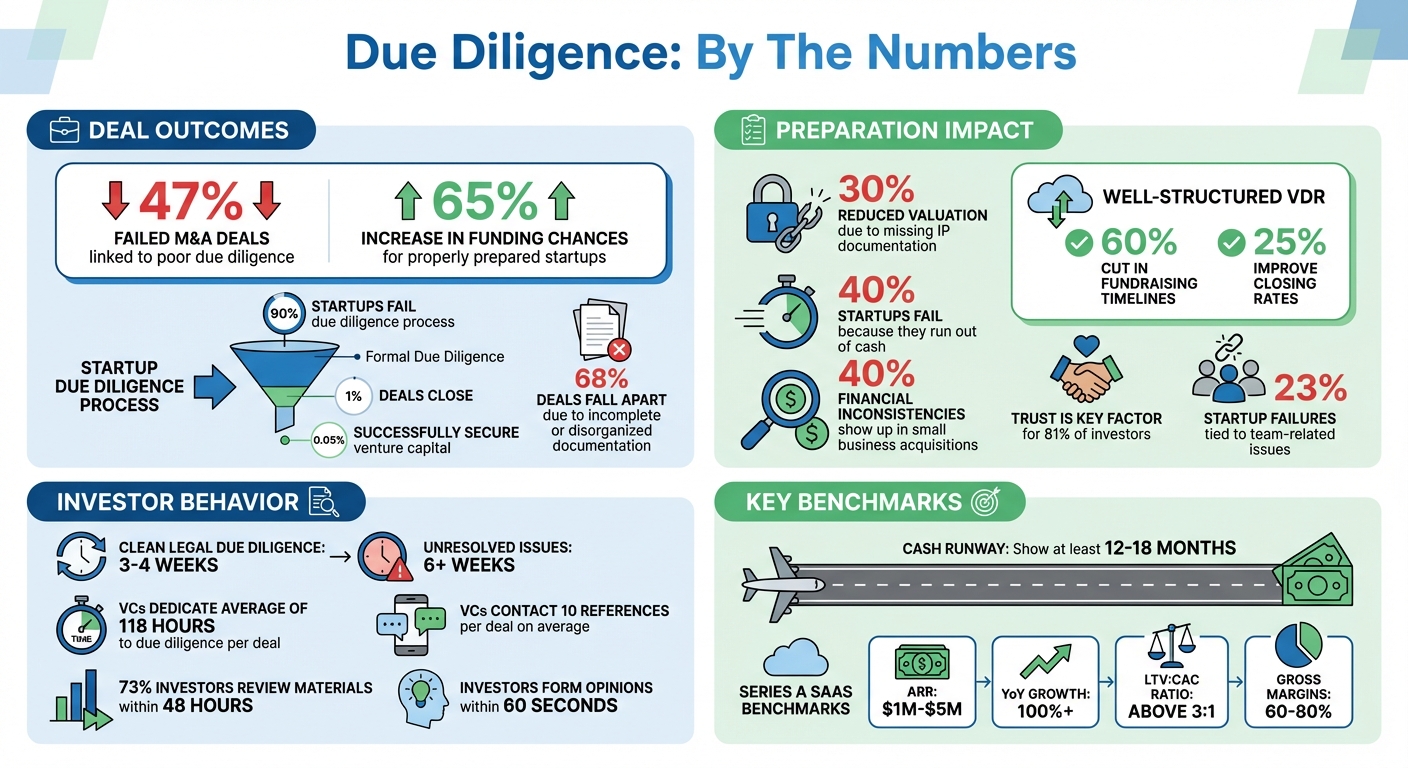
Due diligence is how investors verify your startup’s claims before funding. It involves examining your financials, legal documents, intellectual property, team, and operations. If these aren’t in order, deals can fall apart – 47% of failed M&A deals are linked to poor due diligence. However, startups that prepare properly increase their chances of securing funding by 65%.
Here’s what you need to know to get ready:
- Legal Documents: Keep your Articles of Incorporation, bylaws, cap table, and IP assignments accurate and up-to-date.
- Financial Records: Provide clean income statements, balance sheets, cash flow statements, and tax filings. Show at least 12–18 months of cash runway.
- Intellectual Property: Ensure ownership of all IP through signed agreements. Missing IP documentation can reduce your valuation by up to 30%.
- Team and Market: Present a clear organizational chart, employment agreements, and validated growth metrics like ARR, CAC, and retention rates.
- Virtual Data Room: Organize documents in a secure, well-structured system to make investor review quick and efficient.
Preparation isn’t just about documents – it’s about building trust. When everything aligns, you show investors that you’re ready to scale and minimize risks.
Due Diligence Preparation Statistics and Success Metrics for Startups
Preparing Legal and Corporate Documents
Investors view your corporate records as a direct reflection of how you manage your business. Missing board minutes, unsigned intellectual property (IP) assignments, or an outdated cap table can signal operational gaps that might derail a deal before you even get to the term sheet stage. On the other hand, well-organized documentation shows that your company has a solid legal foundation and disciplined operations.
"Messy corporate hygiene kills deals faster than imperfect metrics." – Deqian Jia, Peony
Issues like missing contractor IP assignments or outdated records can create serious roadblocks. For example, if investors discover that your company doesn’t own the technology you’ve pitched or that your cap table doesn’t match your stock purchase agreements, they’re likely to walk away. Inaccurate ownership records can even invalidate their investment if it turns out later that founders didn’t own the percentages they claimed.
On the flip side, clean legal due diligence can help close deals in just 3-4 weeks, while unresolved issues can stretch that timeline to 6 weeks or more. The faster you get through due diligence, the less risk there is of deal fatigue or competing offers complicating negotiations.
Required Legal Documents
Investors expect a complete "corporate record book" that outlines your company’s history from its inception. At a minimum, you’ll need your Certificate of Incorporation (Charter), Bylaws, and organizational board consents. These documents prove your company’s legal existence and structure.
Your cap table is often the most scrutinized document during due diligence. It needs to be accurate, up-to-date, and backed by supporting documents such as Stock Purchase Agreements, SAFEs, or convertible instruments. Every equity issuance must be documented, including 83(b) elections filed with the IRS within 30 days of stock issuance – failure to do so can result in hefty tax liabilities for founders.
Intellectual property assignments are equally critical. Every founder, employee, and contractor must sign a Proprietary Information and Inventions Assignment Agreement (PIIAA) to transfer all IP rights to the company. If you’ve missed contractor assignments, address this immediately – waiting until due diligence gives contractors leverage to demand additional compensation or equity.
| Document Category | Key Items Required | Why Investors Care |
|---|---|---|
| Corporate Foundation | Articles of Incorporation, Bylaws, EIN | Verifies legal existence and structure |
| Capitalization | Cap Table, Stock Purchase Agreements, 83(b) filings | Confirms ownership percentages and tax compliance |
| Intellectual Property | IP Assignments (PIIAs), Trademarks, Patents | Ensures the company owns its core technology/brand |
| Governance | Board Minutes, Stockholder Consents | Proves all major actions were properly authorized |
| Employment | Offer Letters, Contractor Agreements, Option Plan | Evaluates team stability and future liabilities |
Additionally, you’ll need board and stockholder meeting minutes and written consents for major actions like issuing shares or appointing officers. Compliance documents are also essential, including your Federal EIN, state tax registrations, foreign qualifications (if you operate outside your state of incorporation), and any required business licenses. Investors will also look for a Certificate of Good Standing from your state registry to confirm that your filings are up to date and that you’re authorized to raise capital.
Once your legal documents are in order, maintaining ongoing compliance becomes much easier with the right tools.
Using BusinessAnywhere for Formation and Compliance
A strong legal foundation not only simplifies due diligence but also saves you from costly cleanup later. BusinessAnywhere offers a streamlined solution for startups, including $0 Business Registration (you only pay state fees) and a free first-year Registered Agent Service https://businessanywhere.io/business-registration/. These services cover two critical startup needs: proper formation and a registered agent to handle official legal documents.
For venture-backed startups, forming a Delaware C-corp is the standard. BusinessAnywhere takes care of the formation paperwork, ensures your Articles of Incorporation and Bylaws are correctly filed, and provides registered agent services – saving you about $300 annually compared to traditional providers. After the first year, the service continues at $147 per year, offering significant savings.
The platform also offers convenient add-ons like EIN applications ($97) and S-Corp tax elections ($147) https://businessanywhere.io/business-registration/. With all your compliance documents stored in one place, you won’t have to scramble to locate key files when investors request them during due diligence.
Organizing Financial Records and Projections
Financial records are more than just numbers – they’re a reflection of how well you understand and manage your business. If the figures in your pitch deck don’t align with your accounting records, it raises red flags about your operational control.
"The biggest deal-killer isn’t any single issue – it’s loss of trust. When investors discover that data in the pitch deck doesn’t match the data room… they walk away." – Eagle Rock CFO
Here’s a sobering statistic: 40% of startups fail because they run out of cash. Even more concerning, financial inconsistencies show up in over 40% of small business acquisitions. This is why investors dig deep into your financial health. They want to see where your money is coming from, where it’s going, and how long it will last. Let’s dive into the key financial documents that demonstrate your fiscal discipline.
Required Financial Documents
When it comes to financial documentation, investors focus on the "Big Three":
- Income Statement (Profit & Loss)
- Balance Sheet
- Cash Flow Statement
These documents reveal critical details like revenue growth, profitability, asset quality, debt levels, and – most importantly – your burn rate and cash runway. If you can’t show at least 12–18 months of runway, securing funding becomes an uphill battle. Beyond these, you’ll need your federal and state tax returns for the past three years, an accurate cap table aligned with legal records, and 3–5 year financial projections. These projections should include monthly data for the first year and quarterly data for the following years.
Your projections should account for different scenarios – base case, best case, and worst case – to show how your business might perform under varying conditions. Investors also compare your actual results to past budgets to gauge the accuracy of your forecasts. For SaaS companies at the Series A stage, certain benchmarks stand out:
- $1M–$5M in ARR
- 100%+ year-over-year growth
- LTV:CAC ratio above 3:1
- Gross margins between 60% and 80%
Here’s a quick breakdown of what investors look for in each document:
| Document Type | Key Investor Focus Areas |
|---|---|
| Income Statement | Revenue growth, gross margins, EBITDA, and business model sustainability. |
| Balance Sheet | Asset quality, debt levels, liquidity, and overall financial health. |
| Cash Flow Statement | Burn rate, cash runway, and how capital is allocated for growth. |
| Tax Returns | Compliance with federal/state obligations and potential hidden liabilities. |
| Financial Projections | Logic of assumptions, unit economics, and future scalability. |
Accurate documentation isn’t just about numbers – it’s about building trust. Investors take notice if you’re relying on Excel instead of professional accounting software. For scaling startups, adopting Generally Accepted Accounting Principles (GAAP) and implementing a month-end close process ensures audit-ready records. These steps lay the groundwork for meeting compliance standards.
Meeting Financial Compliance Requirements
To stay compliant, securing a Federal Employer Identification Number (EIN) is essential. This nine-digit IRS-issued number is required for tasks like opening business bank accounts, filing taxes, and hiring employees. It’s also one of the first things investors check during due diligence.
For startups, services like BusinessAnywhere’s EIN Application Service ($97) can simplify the process. Instead of wrestling with IRS forms, this service ensures your application is completed and submitted accurately – especially helpful for first-time founders.
If you’re considering S-Corp tax status, BusinessAnywhere also offers an S-Corp Tax Election Service ($147). S-Corp status can bring tax advantages, but filing IRS Form 2553 on time is crucial. Professional assistance ensures this step is handled correctly.
These services not only streamline compliance but also demonstrate to investors that your company is well-organized and legally sound. A clean tax structure and proper registrations signal your commitment to building a business that’s ready for growth.
Securing Intellectual Property and Compliance Documents
Intellectual property (IP) is one of the most critical assets for a startup. When investors consider funding your company, they’re essentially backing assets that can be owned, sold, or even used as collateral. If you can’t prove legal ownership of your core technology, brand, or processes, you risk losing investor trust – and worse, facing legal disputes over those assets down the line.
The stakes couldn’t be higher. Weak IP documentation can slash your valuation by as much as 30%. Missing key agreements or regulatory filings could even derail a deal entirely. While legal and financial documents form the foundation of your operations, a solid IP portfolio and compliance record act as a safeguard for your startup’s value. Investors are particularly focused on “Core IP” that’s essential to your business model – like a SaaS platform’s source code or a trademarked brand – while “Non-core IP,” such as website design, generally receives less scrutiny. To inspire confidence, you need to show a clean chain of title, which means ensuring all contributors have signed IP assignment agreements.
Organizing IP and Regulatory Documents
Owning IP isn’t automatic. By default, the creator owns their work unless there’s a legal transfer. To avoid disputes, make sure all pre-incorporation work is covered by IP assignment agreements. These agreements, often called Proprietary Information and Inventions Assignment Agreements (PIIAAs), are a must-have for transferring ownership to the company.
Here’s a breakdown of key IP assets, the documents investors expect to see, and what they’ll be looking for:
| IP Asset Type | Key Documentation Required | Investor Focus |
|---|---|---|
| Software/Code | IP assignments, open-source audit, NDAs | Ownership and license compliance |
| Trademarks | Registration certificates, domain records | Brand protection and market exclusivity |
| Patents | Filings, grants, maintenance fee records | Technical edge and defensibility |
| Trade Secrets | NDAs, confidentiality agreements | Protection of proprietary processes |
| Compliance | BOIR, regulatory licenses, security policies | Legal standing and risk mitigation |
In addition to IP, regulatory compliance is just as critical. For instance, filing the Beneficial Ownership Information Report (BOIR) with FinCEN is mandatory. Investors will also evaluate your use of open-source software. If you’re using libraries with “copyleft” licenses like GPL, you could be legally required to disclose your proprietary code. To avoid this, keep a detailed inventory of open-source components and their licenses.
"If you don’t legally own your IP, they’re essentially funding something that could be taken away." – My Legal Pal Team
Registered IP, such as trademarks and patents, offers stronger legal protection than common law rights because it’s easier to verify. If you haven’t yet registered your brand name or logo, now’s the time. A trademark dispute could force you into costly rebranding, which would not only hurt your finances but also shake investor confidence.
Using BusinessAnywhere for IP and Compliance
BusinessAnywhere offers tools to simplify IP and compliance management. Their Trademark Filing Service helps you register brand names and logos with the U.S. Patent and Trademark Office, creating a solid legal shield around your brand. By ensuring your application is filed correctly, this service minimizes errors that could delay the process.
For compliance, their BOIR Filing Service ($37) takes care of your mandatory Beneficial Ownership Information Report for FinCEN. Automating this process keeps you on track with federal transparency rules, reducing the risk of red flags during due diligence.
These services not only protect your assets but also show investors that you’re serious about maintaining operational discipline. A well-organized IP portfolio, paired with up-to-date compliance filings, demonstrates the kind of readiness and professionalism that investors value during evaluations.
Demonstrating Team Strength and Market Readiness
Investors don’t just invest in products – they invest in people. About 23% of startup failures are tied to team-related issues. Venture capital firms, on average, dedicate 118 hours to due diligence and contact 10 references per deal. Just like solid legal and financial documentation builds credibility, a strong team and a clear market strategy are critical for securing investor confidence.
Only about 1% of deals that enter formal due diligence actually close. What sets your startup apart? It’s your team’s expertise and your market strategy. While financial slides are a key indicator of discipline, investors also evaluate whether your team has the skills to meet those numbers and if your strategy is realistic. A well-documented team inspires the same trust as thorough financial and legal records, showcasing your readiness to execute.
"Due diligence isn’t just about passing an investor’s scrutiny – it’s an opportunity to showcase your startup’s potential and demonstrate your team’s capability to execute on your vision." – Mario Peshev, CEO, DevriX
Presenting Your Team and Advisors
To start, create two organizational charts: one showing your current team and another projecting 12–18 months into the future. This forward-thinking approach lets investors see how you plan to scale. For example, if you intend to hire two SDRs in Q3 2026, link that decision to a specific goal, such as increasing pipeline coverage from 2x to 3x.
Ensure role histories are accurate and align with official filings. Investors will double-check these details. Organize an HR folder with signed offer letters, employment agreements, and a headcount plan tied directly to your budget and runway.
Prepare 6–10 references, including managers, peers, direct reports, and customers. Send them a concise overview of your role and outcomes to ensure their feedback is specific and meaningful. Show that your team is incentivized for long-term success by using time-based vesting with cliffs and equity refresh policies.
Once your team is solidly presented, the next step is proving your market position and growth potential.
Validating Market Position and Growth Potential
Investors often dismiss vague "top-down" forecasts claiming you’ll capture 1% of a billion-dollar market as unrealistic. Instead, create a bottom-up forecast based on real metrics like marketing spend, conversion rates, and customer acquisition cost (CAC). For example, if your Google Ads budget is $10,000/month with a 2% conversion rate and a $50 cost-per-click, break down how that leads to new customers and revenue.
Show demand by segmenting your customer base (Enterprise, Mid-market, SMB). Highlight your top 10–20 customers, including their Annual Recurring Revenue (ARR), start dates, and notes on expansion or churn. Provide a snapshot of your sales pipeline, including probability-weighted close dates, win rates, and average sales cycle length. For Series A, aim for $1M–$5M+ in ARR, 100%+ year-over-year growth, and Net Revenue Retention (NRR) of 100%–120%+.
Your unit economics should demonstrate sustainability. Investors generally look for an LTV:CAC ratio of 3:1 or higher, a CAC payback period of 16–18 months or less, gross margins between 70% and 85%, and a "Magic Number" above 0.75. A 90% monthly retention rate signals strong product-market fit, while scoring above 40% on the "very disappointed" survey validates market demand.
Clearly outline your competitive positioning. Highlight how you’ll maintain an edge over competitors through patents, trade secrets, or first-mover advantages. Include a detailed go-to-market strategy, specifying channels like partnerships, direct sales, and digital marketing, alongside plans for geographic or vertical expansion. Pair this with a product roadmap showing future features designed to drive growth. To strengthen your financial model, add an "Assumptions Tab" that explains the logic behind key drivers like cost-per-click or server costs per user.
"Don’t just present numbers; weave a narrative that explains the ‘why’ behind the ‘what.’ This goes beyond accuracy; it fosters engagement with stakeholders." – Hugo Lu, CEO, Orchestra
sbb-itb-ba0a4be
Building a Virtual Data Room
When it comes to legal, financial, and intellectual property diligence, having a well-organized virtual data room (VDR) is crucial. Think of it as your central hub for managing due diligence. After proving your team’s capabilities and your market position, the next step is to compile everything into a VDR – essentially a secure online space where investors can review your documents. Here’s why it matters: 68% of deals fall apart due to incomplete or disorganized documentation. A well-structured VDR can cut fundraising timelines by as much as 60% and improve closing rates by 25%. Investors tend to form opinions quickly – within 60 seconds – and 73% of them review materials within 48 hours.
A VDR is more than just a collection of files; it’s a reflection of how you run your business. Andreessen Horowitz (a16z) reportedly advises founders, “I assume you run your company like you run your data room”. To ensure your VDR meets professional standards, choose a provider with SOC 2 Type II and ISO 27001 certifications for security. Features like dynamic watermarking – which overlays each document with the viewer’s email, IP address, and timestamp – can discourage unauthorized sharing. Add two-factor authentication (2FA) and audit logs to monitor who accesses your documents.
"A great data room is not the one with the most files; it is the one where a reviewer can form a clear, defensible view of your business without getting lost." – Peony
Let’s dive into how to structure your VDR effectively to showcase your startup’s readiness.
How to Organize Your Data Room
Start with a clear folder structure. Use numbered prefixes to make navigation intuitive. For instance, consider a format like:
- 01_Corporate
- 02_Financials
- 03_Legal/IP
- 04_Team/HR
- 05_Product
- 06_Market
This approach ensures investors can easily find what they need without confusion. Keep folder depth to two or three levels at most to avoid overwhelming users. Consistent file naming is also key – try a format likeYYYY-MM-DD_Category_Description– and convert all files to PDF for uniformity.
Don’t release all your documents at once. Start with high-level materials like your pitch deck and executive summary for initial reviewers. As discussions progress, share more detailed financials. Reserve highly sensitive documents – like full cap tables, material contracts, and detailed IP filings – for the later stages of due diligence, once a term sheet is on the table. To streamline access, organize users into groups (e.g., "Initial Look" and "Active Due Diligence") rather than managing individual permissions.
Include a master index document that outlines your data room’s structure. This helps investors understand how your files are organized. Clearly mark every document with an "as of" date so it’s clear when the data was last updated. For version control, use timestamped file names and move outdated drafts into an "Old" or "Archive" subfolder instead of deleting them.
Managing all of this might seem daunting, but tools like BusinessAnywhere can simplify the process.
Using BusinessAnywhere for Document Management
BusinessAnywhere offers a Document Management Dashboard that centralizes all your essential files in one secure location, making it easy to maintain a deal-ready data room. The platform stores key documents like formation papers, compliance filings, board minutes, and contracts, with 24/7 access from anywhere. Plus, Compliance Alerts notify you of upcoming deadlines for annual reports, tax filings, and other critical tasks, so your documents stay up to date without the hassle of manual tracking. It’s a streamlined way to keep your VDR current and accessible.
Due Diligence Readiness Checklist
Complete Checklist
Before opening your virtual data room to investors, make sure every detail is in order. Due diligence often reveals weaknesses that can derail deals – 90% of startups fail this process, and venture capital firms close only about 1% of deals that make it to due diligence. Thorough preparation is key.
Start with corporate and legal documentation. Make sure your Articles of Incorporation, Bylaws, and board meeting minutes are complete and stored in a folder named "01_Corporate." Verify that your company holds a current "Good Standing" certificate from your state, as this is a must for any funding round. Tools like BusinessAnywhere’s Registered Agent Service can help you stay compliant and avoid missing critical deadlines.
Next, organize your financial records. Include your income statement, balance sheet, and cash flow statement for the past 12–36 months, along with 12–24 months of financial projections. Add your federal, state, and local tax returns for the past three years and any correspondence with the IRS. Services like BusinessAnywhere’s Virtual Mailbox make it easy to digitize and access physical tax notices and government mail, ensuring these documents are always available in your "02_Financials" folder. After confirming your financials, double-check the accuracy of your cap table and intellectual property filings.
For your cap table and intellectual property, document all equity instruments and vesting schedules in detail. Ensure that all founders, employees, and contractors have signed IP assignment agreements. A cautionary tale: In August 2025, the game Project Genom was removed from Steam after a developer filed a DMCA claim because the startup had failed to secure a formal IP transfer agreement. To avoid such pitfalls, tools like BusinessAnywhere’s Document Management Dashboard can securely store and organize all your formation papers, contracts, and IP filings, offering 24/7 access to keep everything up-to-date.
Once your corporate, financial, and intellectual property records are in order, shift focus to your team documentation and market traction. Prepare an organizational chart, standard offer letters, and employment agreements that include confidentiality clauses. Collect proof of your market traction, such as Monthly Recurring Revenue (MRR), Customer Acquisition Cost (CAC), Lifetime Value (LTV), and churn rates. For seed-stage funding, investors typically look for $5K–$20K in MRR with 10–20% monthly growth. Conducting a mock diligence review can help ensure fast retrieval of key documents, a sign of operational efficiency. BusinessAnywhere’s Compliance Alerts can also notify you about upcoming deadlines for annual reports, tax filings, and more.
Conclusion
Due diligence goes beyond just reviewing documents – it’s a way to demonstrate trust and show how your startup truly operates. Investors rely on this process to confirm your story, evaluate your team’s discipline, and identify any risks before committing their funds. When your pitch deck, financial records, and legal documents align seamlessly, you inspire the confidence needed to secure a deal. On the flip side, disorganization can suggest a lack of operational readiness, quietly jeopardizing funding opportunities.
This process isn’t just a box to check – it’s a chance to show your startup’s readiness and credibility.
Consider this: only 0.05% of startups successfully secure venture capital, and 81% of investors say trust is a key factor in their decisions. Additionally, 47% of failed M&A deals in Canada have been tied to poor due diligence, emphasizing the importance of preparation. Staying "diligence-ready" year-round sends a clear message that your startup has the systems in place to scale smoothly. These numbers make one thing clear: preparation is not optional – it’s essential.
BusinessAnywhere simplifies this process by centralizing your corporate records, compliance documents, and intellectual property filings into one secure platform. With tools like the Registered Agent Service to ensure state compliance and the Virtual Mailbox for instant access to government mail and tax notices, you can stay on top of critical tasks. The Document Management Dashboard keeps formation papers, contracts, and IP assignments organized and accessible 24/7, eliminating the frantic searches that can unsettle investors.
Get ahead by conducting a mock due diligence review, scoring your readiness on a 1–5 scale, and addressing any weak spots before investors get involved. Combining well-organized document management with proactive preparation not only meets investor expectations but also showcases your startup’s professionalism. When you’re organized, transparent, and prepared, you don’t just pass due diligence – you prove to investors that your startup is ready to thrive.
FAQs
What are the biggest due diligence red flags?
During due diligence, some of the biggest warning signs include financial inconsistencies – think revenue figures that don’t align across documents – and legal troubles, such as unresolved lawsuits or intellectual property conflicts. Disorganized records, like incomplete or chaotic data rooms, and management issues, such as founders misrepresenting facts or displaying weak leadership, are equally concerning. These red flags suggest a lack of preparation, transparency, or even deeper risks, which could seriously threaten funding prospects.
How do I fix a messy cap table before fundraising?
If your cap table is disorganized, it’s crucial to tidy it up before approaching investors. Start by ensuring all equity records are accurate and current. This means reconciling stock issuances, option grants, and any other securities to clearly outline the ownership structure.
Next, take the time to organize and document every transaction – this includes transfers, issuances, or any changes in ownership. Transparency is key here; investors want to see a clear and reliable record of who owns what.
Lastly, review ownership percentages on a fully diluted basis to give a complete picture of equity distribution. You might want to consult legal counsel or consider using specialized software to standardize and streamline your cap table. A clean, clear cap table makes a strong first impression on potential investors.
What should I share first in a data room?
Begin by presenting corporate and governance documents to establish your company’s credibility. These should include key items like your formation documents (e.g., Certificate of Incorporation, bylaws), board meeting minutes, and stockholder records. These materials demonstrate that your company is properly structured and compliant with necessary regulations.
Financial Statements and Projections
Follow up with financial statements and projections to highlight your company’s financial standing and growth potential. Share historical financial data alongside forward-looking models to provide a comprehensive view of your performance and future plans. This combination allows investors to quickly evaluate your company’s foundation and operational health.