


The E-2 Investor Visa allows entrepreneurs from treaty countries to live and work in the U.S. by investing in a qualifying business. Here’s what you need to know:
- Eligibility: You must be a citizen of a treaty country and invest a substantial amount in a U.S. business.
- Investment: No set minimum, but $100,000–$200,000 is common. Funds must be actively committed and "at risk."
- Business Ownership: You need at least 50% ownership or operational control.
- Family Benefits: Spouses can work, and children under 21 can attend U.S. schools.
- Renewability: The visa can be renewed indefinitely in two-year increments if your business remains active.
To apply, you’ll need to document your investment, business viability, and lawful source of funds. A solid business plan with financial projections and hiring plans is critical. Popular business types include franchises, service-based ventures, and hospitality.
This visa offers flexibility and a pathway to residency while allowing you to manage your own business.
E-2 Visa Eligibility Requirements
Getting a handle on the E-2 visa’s criteria is crucial for aligning your business plans with the application process. These requirements revolve around three main pillars: your citizenship, the financial investment you’re making, and your role in managing the business. Overlooking any of these can lead to a rejection.
Treaty Country Citizenship
Your passport plays a key role in determining your eligibility. To qualify, you must be a citizen of one of the roughly 80 countries that have a treaty of commerce and navigation with the United States. Permanent residency in a treaty country doesn’t count – only citizenship matters. For instance, an Indian citizen with Canadian permanent residency would not qualify unless they also hold citizenship from a treaty country.
If you hold dual citizenship, you can apply using the passport from your treaty-eligible country. For example, a person with both Brazilian and UK citizenship could apply using their UK passport since Brazil is not a treaty country. To check eligibility, the U.S. Department of State provides a "Treaty Countries" list and a "Reciprocity Table" that outline qualifying nations, visa validity periods, and associated fees. Japan led E-2 visa applications in 2024, with 15,521 issued, followed by South Korea (6,778) and Canada (6,747).
British nationals have an additional requirement: they must reside in British territories within Europe (like the British Isles, Channel Islands, or Gibraltar) to qualify under the UK treaty. Notably, Portugal joined the treaty program on March 15, 2024.
Investment Amount and Business Viability
After citizenship is confirmed, the next hurdle is your financial investment. While there’s no legally defined minimum investment, the amount must be substantial and proportional to the business’s total costs. For smaller-scale businesses, this often means investing 75% to 100% of the required capital, whereas larger ventures valued over $3 million might require around 30%.
In practice, successful applications typically involve investments ranging from $50,000 to $200,000. For example, a German investor put $185,000 into opening a franchise coffee shop in Texas. This amount covered nearly all startup costs, including franchise fees, equipment, inventory, and working capital, and was backed by a business plan that included hiring part-time employees.
It’s also essential that your funds are "at risk." This means the money must be fully committed to the business and subject to loss if the venture doesn’t succeed. Additionally, the business needs to demonstrate potential for generating income beyond what’s required for basic living expenses, often shown through job creation or broader economic contributions.
"The enterprise must not be marginal, meaning it must have the present or future capacity to generate more than enough income to provide a minimal living for the investor and their family." – Nita Nicole Upadhye, US Immigration Attorney
Ownership and Management Requirements
To meet eligibility criteria, you must own at least 50% of the U.S. business or maintain operational control through a managerial role. Your involvement should go beyond financial backing – you need to actively manage and develop the enterprise.
If your business uses a holding company structure, you’ll need to provide detailed documentation proving that at least 50% of the ultimate beneficial owners are nationals of a treaty country. Partnerships or co-ownership are allowed, as long as you retain the necessary ownership percentage and control. The key is showing that you’re not just an investor but an active participant in building and managing a business that contributes to the U.S. economy.
sbb-itb-ba0a4be
Selecting a Qualifying U.S. Business
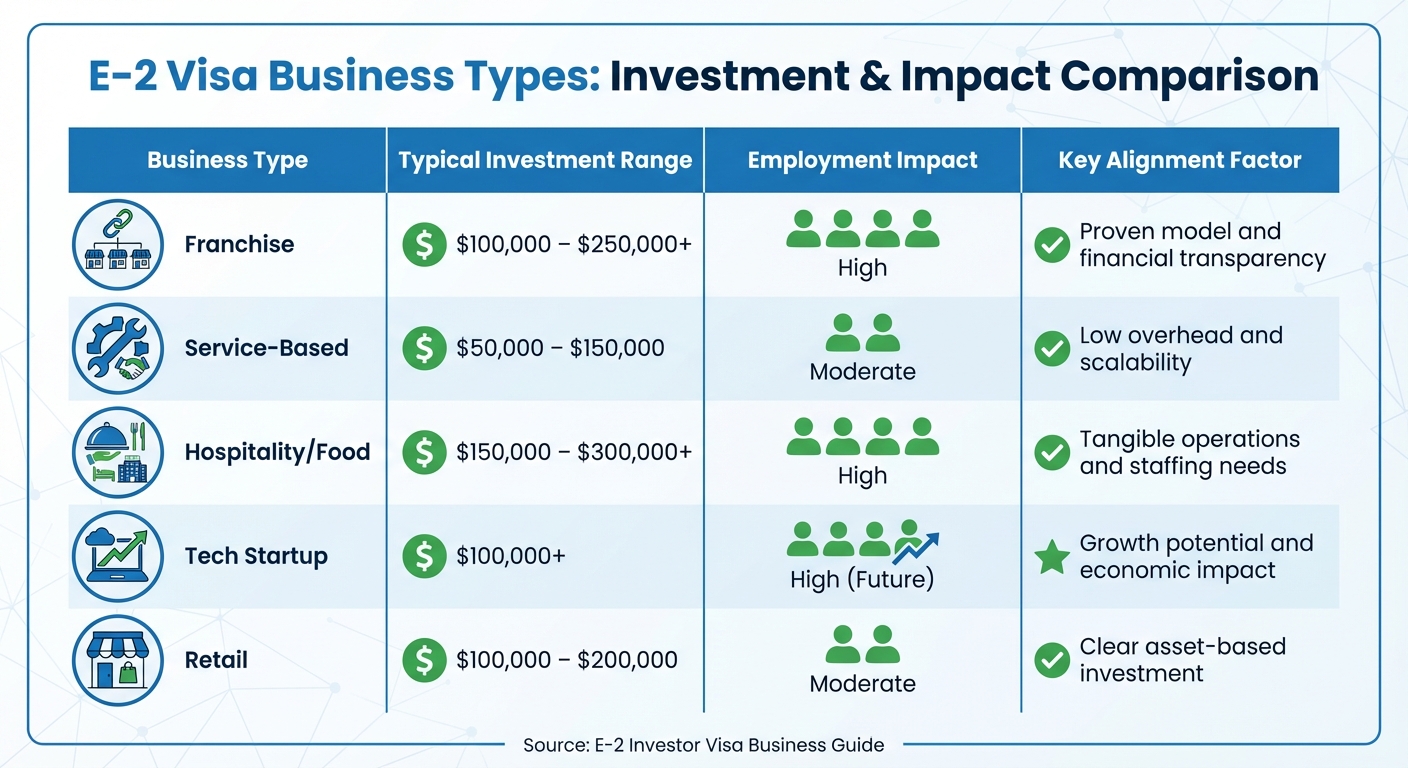
E-2 Visa Business Types: Investment Ranges and Key Success Factors
The first step in your E-2 visa journey is choosing an active U.S. business. Passive investments – like stock portfolios or undeveloped land – don’t qualify. Instead, your business must actively produce goods or services for profit and demonstrate its ability to generate surplus income. This requirement is crucial, as the visa has strict operational guidelines.
Common Business Types for E-2 Visa Applicants
Some business models naturally align with E-2 visa requirements because they involve active management, job creation, and financial transparency. Franchises are a standout choice. They come with established systems, brand recognition, and detailed financial records, making it easier to document startup costs and revenue projections. Their proven frameworks and built-in support systems appeal to both investors and U.S. immigration officials.
Service-based businesses are another popular option. These include home services like cleaning, HVAC, and pest control, as well as B2B services such as IT support, consulting, and marketing. These businesses often have lower overhead costs compared to retail operations and offer scalability by adding more staff or crews. Meanwhile, hospitality and food ventures – restaurants, cafes, and boutique hotels – remain classic choices. These businesses require hands-on management and naturally employ U.S. workers. Immigration attorney Alicia N. Morgan emphasizes that “the best and easiest business ideas for an E2 visa include franchises, service-based businesses, retail, and food ventures. Franchises and existing businesses are the simplest since they have proven models.”
Other viable options include retail operations, whether physical stores or e-commerce platforms with a U.S. base, as well as tech startups like software-as-a-service (SaaS) and AI-driven ventures, which are gaining traction. Active real estate businesses – such as property management firms, real estate development companies, or brokerages – also qualify, as they involve daily operations and staffing, unlike passive real estate investments.
| Business Type | Typical Investment Range | Employment Impact | Key Alignment Factor |
|---|---|---|---|
| Franchise | $100,000 – $250,000+ | High | Proven model and financial transparency |
| Service-Based | $50,000 – $150,000 | Moderate | Low overhead and scalability |
| Hospitality/Food | $150,000 – $300,000+ | High | Tangible operations and staffing needs |
| Tech Startup | $100,000+ | High (Future) | Growth potential and economic impact |
| Retail | $100,000 – $200,000 | Moderate | Clear asset-based investment |
What to Consider When Choosing Your Business
Once you’ve identified a business type that fits E-2 criteria, focus on factors that can strengthen your application. Choose a business aligned with your professional expertise, growth potential, and readiness to operate. Immigration officials will evaluate whether your background matches the business you’re proposing. For example, if you’re a software engineer investing in a tech consulting firm, your expertise supports the venture. But if you plan to open a restaurant without relevant experience, you’ll need a solid plan to show how you’ll successfully manage and grow the business.
Hiring at least 2–3 U.S. workers within the first three years can significantly bolster your application, helping to avoid concerns about "marginality" (the idea that your business isn’t substantial enough to support more than just you and your family). Your business must also have a physical U.S. location – whether it’s an office, storefront, or warehouse. Virtual offices are often viewed negatively. Additionally, your investment funds must be "at risk", meaning they should be committed to actual business expenses like leases, equipment, inventory, or marketing, rather than sitting idle in a bank account.
If you’re purchasing an existing business, consider using an E-2 compliant escrow agreement, which releases funds to the seller only after your visa is approved. Established businesses often face less scrutiny, as they typically already have revenue and employees. Startups, on the other hand, will need strong five-year growth projections to demonstrate their viability.
How to Set Up Your U.S. Business for E-2 Visa
Once you’ve decided on the type of business you want to establish, the next step is getting everything set up properly. This is crucial because immigration officials will closely examine your business structure, documentation, and financial commitment to ensure you meet the E-2 visa requirements. The process includes registering your business, gathering key documents, and creating a thorough business plan that aligns with visa standards.
Registering Your U.S. Business
Start by selecting a business structure. For E-2 applicants, an LLC is a common choice for its flexibility, while a C-Corporation might be better suited for venture-backed startups.
Next, decide where to incorporate. Delaware is a popular choice for venture-backed companies, while Wyoming and Nevada appeal to startups looking for privacy and lower costs. However, incorporating in the state where your business will operate is often the simplest option, as it avoids the hassle and expense of registering in multiple states. Keep in mind that each state requires a registered agent with a physical address to handle legal and government correspondence.
After forming your business, you’ll need an Employer Identification Number (EIN) from the IRS. This federal tax ID is essential for opening a U.S. business bank account and hiring employees. If you don’t have a Social Security Number (SSN), you can apply for an EIN via fax using IRS Form SS-4, which typically takes 4–10 business days.
Once you have your EIN, open a U.S. business bank account to keep personal and business finances separate. This step is critical because immigration officials require proof that your investment funds are actively being used for business expenses. Simply holding money in a bank account won’t meet the "at risk" investment standard.
With your business registered and your EIN secured, the next step is to gather all the necessary documentation to validate your investment and operational plans.
Required Documents for Business Formation
Immigration officials will expect a detailed paper trail to confirm that your business is legitimate and that your investment meets the required standards. Start with your entity formation documents, which include Articles of Organization for LLCs or Articles of Incorporation for corporations, along with supporting documents like your Operating Agreement or Bylaws and the EIN confirmation letter (Form CP 575) from the IRS.
You’ll also need proof of ownership to show you control at least 50% of the business. This could include stock certificates, share ledgers, or capitalization tables. Additionally, you must demonstrate that your investment is committed and at risk. This means providing evidence like wire transfer confirmations, receipts for equipment purchases, signed lease agreements, vendor contracts, and a breakdown of expenditures. Immigration officials want to see that your funds are being used for real business needs, not just sitting idle.
Another critical piece is documenting the source of your funds. You’ll need to show a clear trail – such as tax returns, property sale records, bank statements, or gift letters – to prove your money was obtained lawfully.
To demonstrate operational readiness, include items like a signed commercial lease (residential addresses are typically not accepted), business licenses, utility bills, and photos of your business location.
Platforms like BusinessAnywhere can simplify much of this process. They offer services such as EIN applications, registered agent services, and virtual mailboxes starting at $20/month, providing a professional U.S. address for your business correspondence. For international entrepreneurs, their Digital Nomad Kit bundles LLC registration, EIN, registered agent services, and compliance tools, making it easier to set up and maintain your U.S. business remotely.
| Step | Action Required | Required Documents | BusinessAnywhere Service |
|---|---|---|---|
| Formation | Submit formation documents | Passport, Business Name, Registered Agent Info | $0 Business Registration + state fees |
| Tax ID | Apply for EIN via IRS Form SS-4 | Formation Documents, Responsible Party Info | EIN Application Service ($97) |
| Banking | Open U.S. Business Bank Account | EIN Confirmation Letter, Articles of Incorporation | Bank Account Opening Assistance |
| Investment | Deploy "At-Risk" Capital | Receipts, Invoices, Lease Agreements, Contracts | – |
| Compliance | File BOI Report with FinCEN | Beneficial Ownership Information | BOIR Filing Service ($37) |
| Planning | Draft 5-Year Business Plan | Market Analysis, Financial Projections, Hiring Plan | – |
Writing a Business Plan for E-2 Visa Compliance
With your business established and your investment documented, the next step is crafting a business plan that meets E-2 visa requirements. This document is critical to your application because it demonstrates your business’s viability and compliance with U.S. regulations. Your plan must meet the "Matter of Ho" standard, meaning it should be well-organized, detailed, and directly tied to legal requirements. This isn’t a simple pitch deck – it’s a legal document.
"The business plan is a central document in the adjudication of an E2 application. A poorly prepared or vague plan can result in requests for further evidence or even refusal."
– Nita Nicole Upadhye, US Immigration Attorney, NNU Immigration
One key requirement is proving non-marginality – your business must generate more than just a basic living for you and your family. Typically, this means demonstrating the potential to earn $50,000–$70,000 annually. The best way to show this is through a detailed 5-year hiring plan. List specific roles, responsibilities, salaries, and hiring timelines. For instance, a restaurant might plan to hire two servers and a cook in the first year, add a manager in the second year, and expand with additional staff by year five.
Your market analysis should focus on local data, not generic national trends. Include information about competitors, target demographics, and real market research. Tie this to your financial projections, which should include detailed revenue forecasts, profit and loss statements, cash flow projections, and a break-even analysis. For example, a restaurant might calculate revenue based on seat capacity and average check size, while a consultancy could base projections on billable hours.
"You must ensure that every sentence of your business plan meets not only the legal requirements… and that your financial projections truly reflect that plan."
– Head of Non-Immigrant Visa Section, U.S. Consulate
Finally, address risk management. Identify potential challenges, like supply chain issues or regulatory changes, and explain how your business will adapt. With E-2 visa approval rates historically exceeding 80%, a well-prepared business plan can make all the difference.
Applying for the E-2 Visa
Once your business is set up and your plan is ready, it’s time to submit your E-2 visa application. This step involves thorough scrutiny by consular officers to ensure your investment is genuine, your business is viable, and you meet the treaty requirements. The process includes gathering detailed documentation, attending an interview at a U.S. embassy or consulate, and staying informed about how to maintain your visa status through renewals.
Documents You’ll Need
You’ll need to provide a range of documents, divided into several key categories:
- Personal documentation: This includes a valid passport from a treaty country, passport-style photos, and a completed Form DS-160 (non-immigrant visa application). The DS-160 filing fee is $315 as of 2025.
- Investment evidence: Show that your capital is committed and at risk with documents like bank statements, wire receipts, escrow agreements, and an itemized list of expenses. Funds simply sitting in a bank account won’t suffice – officers need proof that your money is actively being used for things like leases, equipment, or payroll.
- Source of funds: Provide evidence of the lawful origin of your investment. This could include personal tax returns (from the past two or more years), property sale contracts, gift affidavits, or loan documents secured by personal assets. Consular officers carefully examine this trail, so any gaps could lead to a denial.
- Business viability: Submit your 5-year business plan, typically 30–50 pages long, which includes financial projections, market analysis, and a staffing plan. Also include corporate formation documents such as Articles of Incorporation or Organization, your EIN confirmation letter, business licenses, and your operating agreement or bylaws.
- Proof of operations: Provide signed commercial leases, vendor contracts, marketing materials, website screenshots, and payroll records if you’ve hired employees.
- Ownership and control: Demonstrate your managerial role with stock certificates, an organizational chart, and a narrative statement outlining how you’ll "develop and direct" the enterprise.
Here’s a quick breakdown of the document categories:
| Document Category | Documents | Purpose |
|---|---|---|
| Personal | Passport, photos, Form DS-160 | Verify identity and nationality |
| Investment | Wire transfers, receipts, expense breakdowns | Show capital is committed and at risk |
| Source of Funds | Tax returns, property sales, gift letters | Prove lawful origin of investment |
| Business Viability | 5-year plan, financials, market analysis | Demonstrate job creation and business value |
| Corporate Formation | Articles, EIN letter, licenses, bylaws | Confirm legal business structure |
| Operations | Leases, contracts, marketing materials, payroll | Verify active business operations |
| Ownership | Stock certificates, org chart, role statement | Establish managerial control |
Services like BusinessAnywhere can simplify parts of this process. Their Business Registration service provides essential documents like the Articles of Organization and EIN confirmation. Their Virtual Mailbox service (starting at $20/month) offers a professional U.S. business address, while their BOIR Filing Service ($37) helps you comply with beneficial ownership reporting rules.
Once your paperwork is ready, you can proceed with filing your application and preparing for your consular interview.
Filing Your Application and Interview Preparation
After organizing your documents, the next step is filing your application at the U.S. embassy or consulate in your home country. Processing times vary depending on the location.
The consular interview is a critical stage. While your documents are important, officers will also assess your credibility. They’ll want to confirm that your business is operational, that you have real managerial control, and that your financial investment is genuine.
"The interview is the final gate… they want to see if you, the entrepreneur, are as credible as your paperwork."
– Law Offices of Peter D. Chu
Be prepared to discuss your business plan in detail – especially your five-year projections, marketing strategy, and hiring plans. You should also be ready to talk about competitors, your target market, and your timeline for hiring U.S. workers without relying on notes. Expect questions about your day-to-day role and how you’ll actively manage the business rather than taking a passive ownership role.
You’ll also need to clearly explain the source of your funds. Consular officers may ask you to trace every dollar back to its origin, so practice explaining this with confidence. Any inconsistencies could raise concerns. Mock interviews with an attorney or advisor can help you rehearse answers about your investment, how your funds are “at risk,” and how you’ve allocated your capital.
Dress professionally for the interview, as you would for an important business meeting. While the E-2 visa is renewable indefinitely, you must still demonstrate an intent to leave the U.S. when your status ends, so be prepared to discuss ties to your home country.
If your application isn’t approved immediately, it might be placed in administrative processing (221(g)) for further review or additional document requests. This is a temporary refusal, not a final denial.
Renewing Your E-2 Visa
The E-2 visa offers indefinite renewals, provided your business continues to meet all eligibility requirements. While the initial application focuses on projections, renewals emphasize actual business performance – profitability and contributions to the U.S. economy are key.
"The focus of the E2 visa renewal will be on the business’ performance. The authorities will be looking to see that your investment remains substantial, active, and at risk, while the business is profitable and contributing to the US economy."
– Nita Nicole Upadhye, US Immigration Attorney
Start your renewal process at least six months before your visa or I-94 expires. For USCIS extensions, file Form I-129 at least 12 weeks before your I-94 expiration. Filing fees are $460 for businesses with fewer than 25 employees and $780 for larger businesses.
Renewal applications require updated documentation, including payroll records (W-2s and 1099s), business tax returns, profit and loss statements, and proof that your business isn’t “marginal.” This typically involves showing that you’ve hired U.S. workers and that your business generates more than just a minimal living for your family.
It’s important to understand the distinction between visa validity and period of stay. Your visa stamp may be valid for up to five years (depending on your country’s agreement with the U.S.), but Customs and Border Protection typically grants a two-year stay each time you enter the U.S..
If you renew your status through USCIS while in the U.S., you’ll receive a new I-94 but not a new visa stamp. If you leave the U.S., you’ll need to attend a consular interview abroad to get a new visa stamp for re-entry. For this reason, many E-2 holders choose to renew through consular processing (Form DS-160, $315 fee) during international travel, as this provides both renewed status and a visa stamp.
Any major changes to your business – such as mergers, acquisitions, or selling a division – require filing a new Form I-129 with USCIS to stay compliant. Keep detailed records of your business activities, financial performance, and hiring practices to demonstrate ongoing compliance with visa requirements.
Conclusion
The E-2 Investor Visa provides a straightforward route for entrepreneurs from treaty countries to live and work in the U.S. by investing in a qualifying business. Success hinges on selecting a viable business, thoroughly documenting your investment – from its lawful origin to its committed use – and maintaining compliance with all regulations.
To qualify, your business must be an active, for-profit enterprise. You’ll need to show at least 50% ownership or operational control, make a substantial investment (often $100,000 or more, depending on the business type), and demonstrate that your funds are "at risk." This means allocating your capital to key expenses like leases, equipment, inventory, and payroll before submitting your application.
Administrative requirements, such as forming a U.S. entity, obtaining an EIN, and staying compliant, can be time-intensive. Services like BusinessAnywhere simplify these tasks. Their $0 Business Registration service covers LLC or Corporation formation and includes a free first-year registered agent. Additionally, their Virtual Mailbox (starting at $20/month) provides a professional U.S. address for receiving critical correspondence. By outsourcing these administrative tasks, you can focus on growing your business.
The E-2 visa is indefinitely renewable, as long as your business remains operational and contributes to the U.S. economy. Building a business that meets these requirements and achieves sustainable profitability is key to securing renewals.
With careful planning, detailed documentation, and a commitment to compliance, the E-2 visa can offer you and your family the opportunity to live, work, and thrive in the United States while building your business. By aligning your entrepreneurial goals with U.S. immigration requirements, you can create a clear path to long-term residency.
FAQs
Can an E-2 visa lead to a green card?
Yes, an E-2 visa can open the door to a green card through options like the EB-2 National Interest Waiver (NIW) or the EB-5 Immigrant Investor Program. These pathways allow you to use a successful E-2 business as a stepping stone toward securing permanent residency.
How do I prove my E-2 funds are “at risk”?
To demonstrate that your E-2 funds are "at risk", you need to show that your investment is substantial, fully committed to the business, and at risk of being lost if the business does not succeed. This means providing clear documentation that the funds are actively invested and not safeguarded or guaranteed in any way.
Examples of acceptable documentation include:
- Purchase agreements showing the acquisition of business assets or property.
- Bank statements reflecting the transfer of funds into the business account.
- Contracts that confirm the funds have been allocated to business operations.
It’s also crucial to highlight that the investment directly supports the business’s active operations, such as covering expenses, purchasing inventory, or funding equipment. Investments that are passive or protected – like funds sitting in a savings account – won’t meet the requirements.
What are the top reasons E-2 applications get denied?
Common reasons for E-2 visa denials often include the investment falling short of being considered substantial, the business appearing marginal or incapable of generating enough income or jobs, and incomplete or poorly supported documentation. Additionally, failing to meet essential requirements – such as maintaining active business operations or presenting credible plans for job creation – can also lead to rejection. To boost your chances of approval, make sure your application is detailed and satisfies all necessary criteria.