


Starting a company is one thing. Running it as it grows? That’s a whole different challenge. Once your startup surpasses 50 employees, your hands-on approach won’t cut it anymore. To succeed, you must shift from being a "doer" to becoming a true leader. Here’s the key takeaway: your ability to scale as a leader determines your company’s success.
What You’ll Learn:
- Mindset Shift: Transition from executing tasks to focusing on vision, hiring, and tracking progress.
- Delegation: Stop micromanaging and empower your team to take ownership of tasks.
- Team Building: Hire the right people, define clear roles, and build accountability into your processes.
- Data-Driven Decisions: Use metrics and systems to guide your choices instead of relying on gut instinct.
- Long-Term Growth: Focus on measurable goals, anticipate challenges, and balance innovation with efficiency.
- Culture and Communication: Define core values, encourage open dialogue, and lead by example.
Why It Matters: Over 50% of businesses fail within five years, often because founders struggle to evolve their leadership style. However, 73% of startups that hit $1 billion valuations are founder-led. Making this shift isn’t just about survival – it’s about thriving as a leader and scaling your impact.
Change Your Mindset from Founder to CEO
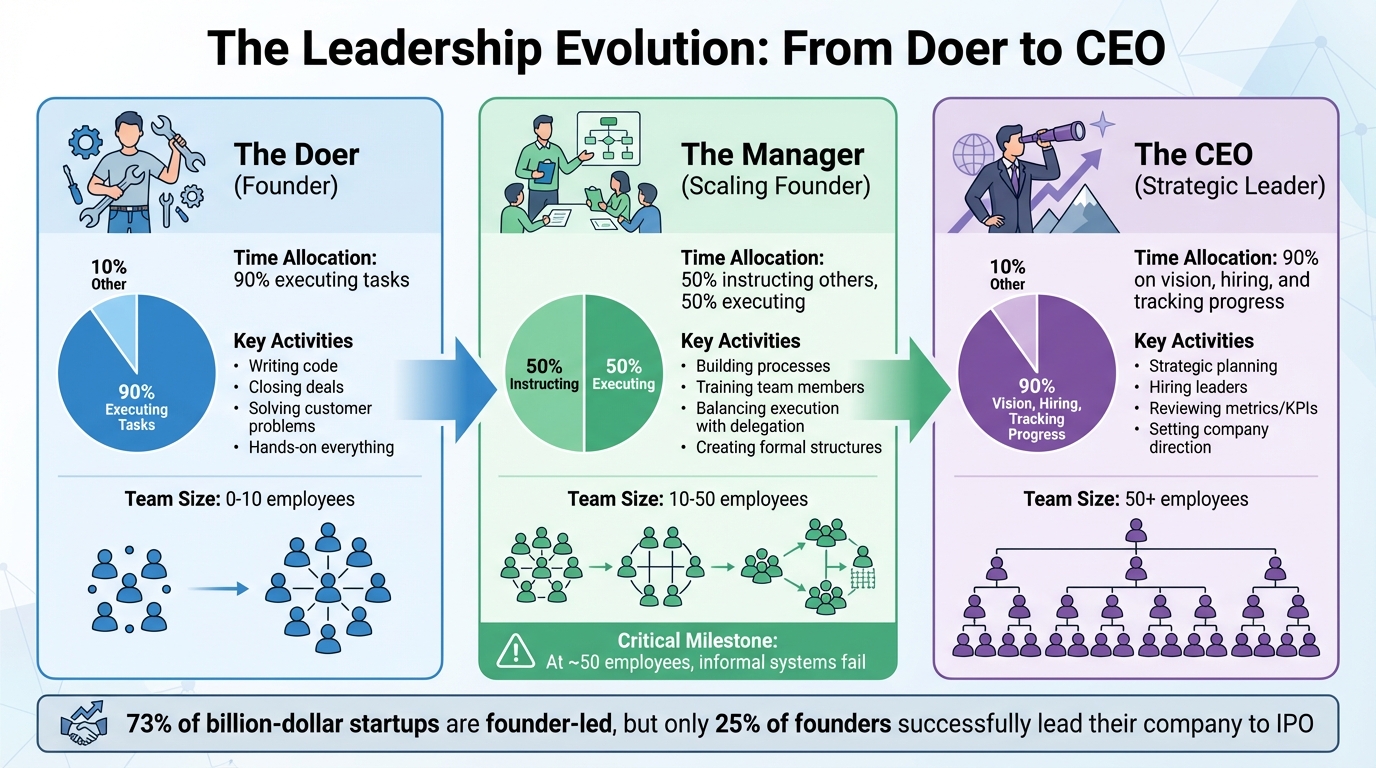
Scaling a startup isn’t just about growing your business – it’s about evolving as a leader. To succeed, you need to shift your mindset and redefine your role. This transformation from "hands-on founder" to "strategic CEO" is what determines whether your company thrives – or if you become the bottleneck holding it back.
Understand How the CEO Role Differs
As a founder, you’re in the thick of everything – writing code, closing deals, and solving customer problems. But as a CEO, your focus changes completely. You’re no longer the star player making the big moves; you’re the coach designing the system that ensures the entire team wins.
The day-to-day tasks that once filled your schedule are replaced by strategic planning. When your company grows to around 50 employees, informal communication systems start to fail. At this stage, you need formal structures, clear reporting lines, and repeatable processes to keep things running smoothly. Your decisions also carry more weight now, impacting not just you and a co-founder, but an entire team. This means moving from instinctive choices to decisions backed by data. Plus, you’re now accountable to investors, legally and professionally, for delivering results.
"A caterpillar who emerges from a cocoon as a butterfly can’t expect to continue living life as a caterpillar… Acknowledging that your day-to-day as a CEO will look fundamentally different from your day-to-day as a founder is step one."
- Aytekin Tank, Founder and CEO, Jotform
To fully embrace this new role, you’ll need to spend about 90% of your time on vision, hiring, and tracking progress rather than executing tasks yourself. Once you understand this shift, the next challenge is reshaping your mindset to focus on growth.
Adopt a Growth Mindset
Being a CEO requires constant learning. You go from building things yourself to learning from others – admitting what you don’t know, seeking advice from experts, and using new data to guide your decisions. This means setting aside personal ego and prioritizing the company’s success above all else.
Think of failure as a chance to learn, not a disaster. Whether it’s a product launch that misses the mark or a key hire that doesn’t work out, take time to reflect on what went wrong and identify lessons for the future. This ability to learn and adapt separates CEOs who grow from those who repeat the same mistakes.
Here are some practical ways to embrace this mindset:
- Audit your productivity: Identify tasks you can delegate or eliminate.
- Block two hours weekly for strategic thinking: Treat these sessions as non-negotiable, just like board meetings.
- Join a CEO roundtable: Peer groups can offer unbiased feedback and fresh perspectives.
- Test your delegation skills: Take a vacation and see how well your team operates without you.
Stop Micromanaging
Micromanaging is one of the quickest ways to stall your company’s growth. If you constantly override your team’s decisions or jump in to solve every problem, you’re not just preventing them from taking ownership – you’re also making yourself the single point of failure.
Instead, focus on defining outcomes rather than dictating every step. Share the "what" and the "why" – like growth goals, revenue targets, or customer satisfaction benchmarks – but leave the "how" to your team. This approach gives them real responsibility and allows you to step back.
"Your company can only grow as large as your ability to let go."
- Jordan Imutan, Consultant and Mentor
To make this shift, invest in creating systems that solve recurring issues. Document workflows so your team can handle problems without needing your input.
Ask yourself these questions to identify where you might be blocking progress:
- Does your team understand the company’s main goal?
- Are there tasks you’re holding onto that someone else could handle better?
- Is accountability clear when a project doesn’t succeed?
- Have you documented answers to common questions?
Hiring people who excel in areas where you don’t is another key step. If you’re still the smartest person in every room, it’s a sign you need to rethink your hiring strategy. Delegating effectively not only frees up your time but also strengthens your organization as a whole.
| Phase | Your Role | Time Allocation |
|---|---|---|
| Phase 1 | The Doer | 90% executing tasks |
| Phase 2 | The Manager | 50% instructing others |
| Phase 3 | The CEO | 90% on vision, hiring, and reviewing progress |
sbb-itb-ba0a4be
Delegate Work and Build Your Team
If you want to scale effectively, building a strong team is non-negotiable. Transitioning from founder to CEO means placing the right people in the right roles and giving them genuine ownership. This requires strategic hiring, clear role definitions, and efficient tools to keep everyone aligned. Here’s how you can make it happen.
Hire for Skills and Culture Match
Did you know a bad hire can cost more than $240,000 when you factor in salary, benefits, training, and lost opportunities? That’s why having a structured hiring process is critical. Start by clarifying the problem this role will solve and setting measurable success benchmarks for the first 30, 60, and 90 days. Use tools like scorecards and brief practical tests (under two hours) to objectively evaluate candidates’ skills in areas like strategy, communication, and technical expertise.
When assessing culture fit, focus on observable behaviors. Look for traits like direct communication and accountability instead of relying on gut feelings. Remember, diverse teams are 35% more likely to outperform their competitors.
In the early stages, founders should handle sales until you’ve secured 4–5 paying customers and established a repeatable process. Only then should you bring on a dedicated sales lead. Early hires should be generalists who can juggle multiple responsibilities. As you grow – especially by the time you hit Series A and scale to 20–60 employees – shift to hiring specialists and functional leaders to manage entire departments.
Once you’ve built your team, the next step is to create clear structures for everyone’s roles.
Define Clear Roles and Responsibilities
When your team grows beyond 7–10 employees, lack of clarity can lead to stalled decisions and duplicated work. To avoid this, define roles and responsibilities using frameworks like RACI. This model identifies who is Responsible (executes the task), Accountable (makes the final decision), Consulted (provides input), and Informed (kept in the loop) for every major project or decision. It’s a simple way to ensure accountability and prevent confusion.
Encourage your team to propose solutions with clear budgets and timelines. Instead of vague questions like, “What should I do?”, they should present actionable recommendations – for example, allocating 10 hours for research or a set budget to resolve a customer issue.
Here’s a quick guide to matching tasks with the right level of delegation:
| Degree of Delegation | Your Role | Their Role | Best For |
|---|---|---|---|
| Follow My Lead | Provide step-by-step instructions | Execute exactly as directed | Data entry, CRM updates |
| Research & Report | Make the final decision | Analyze options and recommend | Software or vendor selection |
| Do It & Report | Stay informed | Decide and act independently | Managing receivables |
| Do It | None (unless a major issue) | Full authority | Low-risk tasks, expert domains |
For example, one CEO gave their assistant full access to six email accounts. Over 15 years, the assistant sent 30,000 emails with only 10 serious mistakes – a fraction of the cost compared to the CEO handling those emails personally.
With clear roles in place, the next step is ensuring your team stays aligned through the right tools.
Use Tools for Team Collaboration
As your team grows, informal communication becomes unsustainable. When you hit around 50 employees, formal systems are essential to keep everyone on the same page. The right tools can streamline delegation, reduce miscommunication, and empower your team to act without constant approvals.
Start by documenting repetitive processes. Tools like Loom let you record quick videos for tasks like client onboarding or customer support workflows, so new hires can learn without needing live training. Maintain a centralized company wiki or shared drive with decision-making frameworks, common answers, and OKR templates for easy access.
For project management, pick a platform that provides visibility without requiring constant updates. Automating status reports can cut unnecessary emails – one founder reduced status-update emails by 70% by implementing a monthly KPI review.
Establishing a consistent communication rhythm is just as important. Schedule weekly leadership syncs, monthly strategy meetings, and quarterly town halls or “Ask Me Anything” sessions. These regular touchpoints replace ad-hoc meetings and create predictable opportunities for team updates and issue resolution.
The goal isn’t to micromanage but to create systems that allow your team to operate independently while giving you the oversight needed to make high-level decisions.
"The goal isn’t to reduce your workload to zero. The goal is to reclaim enough time and mental space to make better decisions".
Develop Long-Term Thinking for Growth
As a leader, transitioning from a reactive founder to a forward-thinking CEO is essential for sustained growth. This shift means moving away from putting out daily fires and focusing on proactive strategies for the future. Scaling challenges often trip up businesses within their first five years. However, founder-led companies that embrace strategic planning are four to five times more likely to achieve top-tier performance. Let’s explore actionable steps to reinforce long-term growth.
Set Measurable Goals and KPIs
Data-driven decisions are your best friend as your business scales. To replace reactive problem-solving with structured growth, set clear targets and accountability systems. Frameworks like OKRs (Objectives and Key Results) can link goals to specific roles, making performance transparent across your team.
Standardizing workflows is another critical step. For instance, one company implemented a simple monthly cash review process, cutting unexpected financial shortfalls by half. Depending on your industry, focus on metrics that matter. SaaS companies should monitor churn and net revenue retention, while manufacturers might prioritize yield and time to market. These aren’t just numbers – they’re indicators of whether your systems are thriving or struggling.
Dedicate time every month for strategy reviews. Instead of dictating solutions, ask your team, “What do you recommend?” This approach encourages ownership and strengthens decision-making skills. As a founder, your value often lies in your direct contributions. As a CEO, your value shifts to ensuring the system functions effectively. With clear metrics and accountability, you’ll be better equipped to navigate market trends and challenges.
Anticipate Market Trends and Challenges
Staying ahead means doing more than skimming industry reports. Set aside time weekly to engage directly with customers and study trends across industries. This hands-on approach helps you identify changes before they surface in data.
Joining peer advisory groups or CEO communities provides another layer of insight. These groups allow experienced leaders to challenge your assumptions without the biases that employees or board members might have. This external perspective can highlight blind spots you’d otherwise miss.
Additionally, create systems to capture customer feedback consistently. This ensures your business can adapt even if you’re unavailable for a period. It’s not about micromanaging – it’s about building a resilient company that attracts investors and weathers challenges. Balancing these insights with disciplined operations is critical for sustained growth.
Balance Innovation and Operational Efficiency
One of the toughest challenges for any scaling CEO is balancing the need for innovation with the demand for operational reliability. The solution isn’t choosing one over the other – it’s learning to orchestrate both. Think of yourself as a "conductor", ensuring all departments work in harmony, rather than a "musician" focused on individual tasks.
As your team grows to 25–50 employees, improvisation no longer works. Institutionalize processes with quarterly planning, dashboards, and governance practices that align strategy with execution. Protect time for big-picture thinking – whether it’s one day a week or a dedicated block of time – to ensure innovation doesn’t get buried under daily tasks.
Hiring experts is another game-changer. Conduct a personal skills gap analysis and bring in leaders, like a COO, to manage operational efficiency while you focus on long-term vision. Companies in the S&P 500 where founders remained actively involved outperformed others by 3.1 times over 15 years.
"The most important shift that has to take place is recognizing that the success of the business is more a function of how well run the company is than how good you are at the specific skill, craft or expertise you started the business with." – David Friedman, CEO of CultureWise
Build Company Culture and Communication
Transitioning from managing daily tasks to focusing on strategic leadership means prioritizing your company culture. As the CEO, you’re not just steering the ship – you’re shaping the environment where your team thrives. You’re the Culture Architect, responsible for creating a workplace that attracts top talent, drives results, and stands the test of time. Once your team grows beyond 10 people, casual chats won’t cut it anymore. At this stage, you’ll need structured systems to keep everyone aligned.
Define and Promote Core Values
Start by clearly defining your company’s purpose and the impact you aim to have. Then, make sure those values aren’t just words on a wall. Reinforce them regularly through town halls, memos, team discussions, or even videos. Repetition across different channels ensures your message sticks.
Take Gymshark, for example. Founder Ben Francis realized the company couldn’t grow further without stepping back from daily operations. By focusing on building a leadership team and implementing systems, Gymshark was able to scale successfully. Similarly, Monzo grew its team to over 100 employees in just three years by shifting from founder-led decision-making to structured management processes.
Your values shouldn’t just be aspirational – they need to show up in every aspect of your business. Use them to guide hiring decisions, shape company policies, and influence daily behaviors. Tailor your communication for different audiences: share metrics with the board, set timelines for managers, and clarify daily priorities for staff. If anything in your company contradicts these values, address it immediately.
"The product is a single battle; the culture is the entire war. Your job is no longer to build the thing, but to build the machine that builds the thing." – Jake Smolarek, Strategic Consultant
Strong values lay the groundwork for transparent communication, which becomes even more critical as your team grows.
Encourage Open and Transparent Communication
Psychological safety is a cornerstone of high-performing teams. Employees need to feel comfortable voicing ideas, sharing concerns, and taking risks without fear of backlash. To foster this environment, create clear feedback channels such as anonymous suggestion boxes, skip-level meetings, or dedicated office hours.
"Ask Me Anything" sessions can also be powerful tools. Use them to explain tough decisions and invite questions. Even when opinions differ, this level of openness builds trust and buy-in. Additionally, share your own mistakes publicly – not as failures, but as learning moments.
As your company surpasses 50 employees, informal communication becomes less effective. That’s when formal systems are essential. Protect time on your calendar for deep, focused work. By setting aside "no meeting" blocks, you signal that strategic thinking is just as important as being constantly available.
With these systems in place, your actions as a leader must align with the culture you’re promoting.
Lead by Example
Your behavior sets the standard for your entire team. Want employees to take initiative and own their responsibilities? Show them how it’s done.
"CEOs don’t need to be the smartest person in the room, they need to be the most strategic." – Jeffrey Hayzlett, Author and Speaker
To lead effectively, separate your personal identity from business outcomes. This helps you make objective decisions. Be open about what you don’t know and ask your team for recommendations instead of always dictating solutions. This creates a workplace where people feel empowered to act rather than waiting for instructions.
Tackle tough conversations head-on. These moments, though uncomfortable, build accountability and a sense of belonging. Regularly revisit your company values to ensure they still align with your growing team’s needs – what worked for a team of 5 might not work for a team of 50.
Keep in mind, over half of businesses don’t make it past their fifth year, often because leadership fails to evolve beyond the startup mindset. Your commitment to growth, transparency, and accountability sets the tone for your entire organization.
Master Decision-Making and Keep Learning
Being an effective leader requires making smart decisions and committing to lifelong learning. As your startup grows, the stakes of every decision become much higher. What worked with a small team of five won’t necessarily succeed when you’re managing a team of 50. Transitioning from a hands-on founder to a strategic CEO means refining how you make decisions and prioritizing your personal development. While 65% of unicorn startups in the past 15 years have kept their original founder as CEO, only 25% of founders successfully lead their company to an IPO. What sets them apart? They adapt their decision-making approach and embrace continuous learning.
Make Data-Driven Decisions
Relying on gut instinct might work in the early days, but as your company grows, the risks of intuition-based decisions become too great. This is where data-driven decision-making steps in, allowing you to lead proactively rather than reactively.
To get started, focus on understanding metrics at a system-wide level. Instead of looking at numbers in isolation, examine how data from different areas – like sales, operations, and product – interconnect. Use these metrics as a scorecard to drive profits, hold teams accountable, and streamline operations. Consistency is key, so standardize and document processes to ensure reliable data collection.
Consider using frameworks like RACI, cost-benefit analysis, SWOT, or pilot-and-scale models to guide your decisions. Set up regular review cycles – weekly or monthly – that focus on outcomes rather than micromanaging details. Aim to handle meetings with direct reports and executives within one to two days a week, leaving the rest of your time for strategic planning and KPI monitoring. Block out time – at least two hours per week – for analyzing market trends, internal data, and long-term strategies.
"CEOs don’t need to be the smartest person in the room, they need to be the most strategic." – Jeffrey Hayzlett, Author and Speaker
Adopt strategic detachment by basing decisions on objective data and your company’s shared vision rather than personal preferences. Document the reasoning behind critical decisions so others can understand your thought process later.
These practices not only improve decision-making but also lay the groundwork for your growth as a leader.
Invest in Personal and Professional Development
Once you’ve embraced data-driven strategies, the next step is to focus on your own growth. Continuous self-improvement separates CEOs who thrive from those who stall. Balancing this with your other responsibilities is challenging, but essential. A mix of coaching, reading, and structured reflection can make a big difference.
Hire an executive coach to help you navigate tough situations, sharpen your leadership skills, and set measurable goals like improving your 360-degree feedback scores.
"The learning curve of being a great executive is a lot less like learning the guitar, and a lot more like skydiving. It’s the kind of thing you should not do without an instructor." – Tobias Lutke, CEO of Shopify
Expand your knowledge by exploring leadership content from various industries, focusing on management and strategic thinking. Take time to reflect on your mistakes and learn from them.
Join CEO roundtables or founder networks to connect with peers facing similar challenges. These groups offer honest feedback that your internal team might hesitate to provide. Find mentors – former CEOs or industry veterans – who can help you navigate board decisions, tradeoffs, and potential blind spots. Start with weekly mentor meetings, then scale back to biweekly as you gain confidence.
"We all need people who will give us feedback. That’s how we improve." – Bill Gates, Founder and former CEO of Microsoft
Protect time for deep work and strategic thinking to stay ahead.
Learn from Other Successful Founders
Rich Barton, co-founder and CEO of Zillow Group, stresses the importance of evolving into a "leader of leaders" rather than just managing a team. This transition requires humility, a growth mindset, and a lot of effort. Barton also points out that founders who fail to enhance their leadership teams or bring in external talent often find themselves replaced.
The numbers support this. Founder-led companies often see a nearly 10% higher valuation at IPO, and S&P 500 companies with active founder involvement have outperformed their peers by 3.1 times over 15 years. However, the added value founders bring typically diminishes about three years after the company goes public. This highlights the importance of developing your leadership skills during this critical window.
Spend time with successful leaders to learn from their approaches. Use industry events and networks to benchmark your company’s performance and governance against others. Turn every major decision into a learning opportunity by documenting your reasoning. Studying other leaders reinforces the importance of data-driven decisions and ongoing learning, helping you navigate the transition from founder to CEO with confidence.
Use BusinessAnywhere Tools for Remote Leadership
Stepping into the role of CEO from founder requires a shift in focus – from handling day-to-day tasks to making strategic decisions and fostering growth. Statistics show that over half of businesses fail within five years, often because founders struggle to scale beyond the startup phase. To avoid this pitfall, modern CEOs need tools that automate routine tasks and enable efficient remote operations, freeing up time for big-picture planning.
Simplify Operations with BusinessAnywhere
BusinessAnywhere offers a range of services designed to take the hassle out of administrative work. For example, its virtual mailbox digitizes your mail, giving you instant access to official documents and helping you avoid delays or missed deadlines. The registered agent services ensure a dedicated legal contact for your business, keeping your personal and business communications separate.
By automating these tasks, you can shift your focus from tactical execution to strategic delegation – whether that means mentoring your leadership team or identifying new market opportunities. This kind of operational efficiency creates the foundation for embracing remote and flexible work solutions.
Increase Flexibility with Remote Solutions
Once your operations are streamlined, remote-first tools make it easier to expand your team without being tied to a single location. These tools allow you to hire from a broader talent pool while avoiding the costs of maintaining a physical office. BusinessAnywhere’s cloud-based platform ensures your administrative systems are accessible no matter where you work – whether you’re at home, in a co-working space, or traveling internationally.
Their virtual mailbox services, available in key U.S. states like Florida, Arizona, New Mexico, and Wyoming, let you maintain a professional presence while running your business globally. Plus, with 24/7 access, you’re not limited by time zones or office hours, making it easier to collaborate asynchronously with remote teams.
Maintain Compliance and Focus on Growth
As your company grows, so does the complexity of regulatory and reporting requirements. BusinessAnywhere’s compliance tools simplify this process by automating tasks like BOIR filings, annual reports, and EIN services. This centralizes essential information and ensures your team and stakeholders have what they need, when they need it.
Staying on top of compliance deadlines is critical for avoiding penalties that could disrupt growth. With legal notifications and filing statuses tracked on your dashboard, you reduce the risk of non-compliance. This kind of system ensures your business continues to run smoothly – even when you’re not available – a key trait of effective leadership.
For founders managing U.S. businesses remotely, the Digital Nomad Kit bundles these services into a single package. At approximately $3,070 for U.S. citizens, it includes everything from LLC registration to banking setup, giving you the tools to professionalize your role as CEO while maintaining the flexibility to work from anywhere.
Conclusion
Shifting from founder to CEO doesn’t mean letting go of the passion that brought your startup to life – it’s about channeling that drive into building systems and empowering others. This transition involves moving from being hands-on to strategically delegating, thinking in terms of years instead of weeks, and focusing on creating leaders rather than followers. With 73% of high-value exits led by founders, this shift can clearly pay off.
At the heart of this transformation are five key commitments that can reshape your leadership approach: embracing delegation with a growth mindset, assembling a team with clear accountability, focusing on long-term strategies through measurable KPIs, fostering a strong company culture with open communication, and committing to continuous learning via coaching and peer connections. As Rich Barton, Co-founder and CEO of Zillow Group, puts it:
"Becoming a ‘leader of leaders,’ rather than merely a ‘leader of a team,’ takes a growth mindset, humility and hard work".
With over 50% of businesses failing within five years, many founders struggle to scale their companies beyond the startup stage. But you don’t have to face this challenge alone. BusinessAnywhere simplifies compliance, documentation, and administrative tasks, giving you the freedom to focus on strategic decisions and team development. From automating BOIR filings to maintaining a professional virtual mailbox in key U.S. states or accessing registered agent services, these tools provide the operational foundation you need to lead effectively. By streamlining your operations, you can dedicate more time to driving your company’s growth.
FAQs
What should I stop doing first as my startup grows?
As your startup begins to grow, one of the first habits to leave behind is centralizing decision-making and operational control. When founders try to take on too much themselves, they can quickly become bottlenecks, delaying decisions and stalling scalability. Instead, focus on creating systems and processes that allow your team to operate more independently. Learning to delegate authority and stepping away from micromanagement isn’t just helpful – it’s essential for scaling effectively and ensuring long-term success.
How do I delegate without losing quality or control?
To delegate well while ensuring quality and maintaining control, start with clear communication. Be specific about goals, timelines, and deliverables. Set expectations early, so everyone knows what success looks like. Trust your team by giving them the freedom to execute, but provide the resources and guidance they need to succeed – without hovering over their every move.
Ask for honest feedback to confirm that everyone is on the same page and understands your standards. As you transition into a CEO role, shift your focus toward strategic oversight rather than managing every detail. This shift not only increases your capacity for decision-making but also ensures that quality remains consistent as your responsibilities grow.
Which KPIs should I track as a scaling CEO?
As a CEO steering a growing company, keeping an eye on the right key performance indicators (KPIs) is essential for managing both growth and overall operational health. The right metrics can give you a clear picture of where your business stands and where it’s headed.
Start with financial metrics. These include revenue growth, profit margins, and customer lifetime value (CLV). These numbers reveal the financial health of your company and help you identify areas for improvement or investment.
Next, pay attention to operational metrics. Employee productivity and turnover rates are particularly important. High productivity often signals efficient processes and a motivated workforce, while low turnover can indicate strong employee satisfaction and retention.
Finally, don’t overlook strategic KPIs. Metrics like OKRs (Objectives and Key Results) and project completion rates help ensure that teams are aligned with your company’s goals. They also make it easier to track progress and adjust strategies as needed.
By balancing these financial, operational, and strategic KPIs, you’ll be better equipped to make data-driven decisions that support sustainable growth.