


The U.S. offers international entrepreneurs access to the world’s largest consumer market, abundant venture capital, and a business-friendly environment. However, entering this market comes with legal and communication challenges that can hinder progress if not addressed. Key obstacles include:
- Legal Complexities: U.S. laws vary by state and involve intricate compliance requirements, tax obligations, and visa restrictions. For example, owning a U.S. business does not grant the right to live or work in the country, and obtaining an EIN without a U.S. SSN can cause delays.
- Business Practices: U.S. communication is direct, punctuality is critical, and trust is built on measurable results rather than personal relationships. Hierarchical structures are less rigid, encouraging feedback across all levels.
- Business Structures: Founders must choose between LLCs (flexible but less attractive to investors) and C-Corps (ideal for venture capital but subject to double taxation). Delaware is a favored state for incorporation due to its business-friendly laws.
Solutions:
- Use platforms like BusinessAnywhere to simplify compliance, EIN applications, and filings.
- Hire U.S.-based managers and legal experts to bridge knowledge gaps.
- Prioritize proper IP protection, tax compliance, and state-specific filings to avoid penalties.
Success in the U.S. requires preparation, expert advice, and tools to manage operations effectively.
Cultural Challenges: Adapting to U.S. Business Practices
International founders face more than just legal hurdles when entering the U.S. market – they also need to navigate a set of cultural norms that shape every business interaction.
Communication Styles and Business Etiquette
In the U.S., business communication tends to be direct and solution-oriented. Americans appreciate clarity and active engagement during discussions. Silence, on the other hand, may be interpreted as uncertainty or disengagement, which can create misunderstandings.
Punctuality is another cornerstone of U.S. business culture. Arriving late or failing to meet deadlines without prior notice is often viewed as unprofessional. Feedback is typically delivered using the "positive sandwich" approach – constructive criticism is framed between two positive comments to ensure clarity while maintaining a good rapport.
Unlike cultures that prioritize personal relationships before business dealings, the U.S. operates on a "business first, relationships later" mindset. Small talk about neutral topics like weather, sports, or travel is common and helps build rapport. However, sensitive subjects such as politics, religion, or personal finances are best avoided.
These communication norms reflect the broader U.S. preference for collaborative and flat organizational structures.
Hierarchical vs. Flat Organizational Structures
In the U.S., businesses often adopt low power-distance structures, where collaboration and feedback are encouraged across all levels. For founders coming from cultures with strict, top-down hierarchies, this can be a significant adjustment. Geert Hofstede, a well-known management researcher, offers insight into this dynamic:
"A society with high power distance will create and enforce strict hierarchies with a top-down effect, whereas low power distance groups will solicit and incorporate feedback from all levels, bridging the gap between authority figures and those ‘below’ them".
Companies like Google exemplify this approach by fostering open communication and emphasizing constructive feedback at every level. Managers in the U.S. tend to set broad objectives, leaving employees to determine how best to achieve them, rather than issuing detailed instructions.
Building Trust in Cross-Border Business Relationships
In U.S. business culture, trust is often extended early in a relationship but must be consistently reinforced through transparency and reliable performance. Unlike some cultures where trust is rooted in personal connections or family ties, the U.S. places greater emphasis on professional competence and the ability to deliver measurable results. While being personable helps, it cannot substitute for proven outcomes.
To align with these expectations, international entrepreneurs should highlight their achievements using quantifiable metrics relevant to the U.S. market. This approach demonstrates credibility and aligns with local preferences. Additionally, persistent follow-ups on leads and meetings are seen as a sign of professionalism and dedication in the U.S. business environment.
Legal Hurdles: Compliance and Operational Requirements
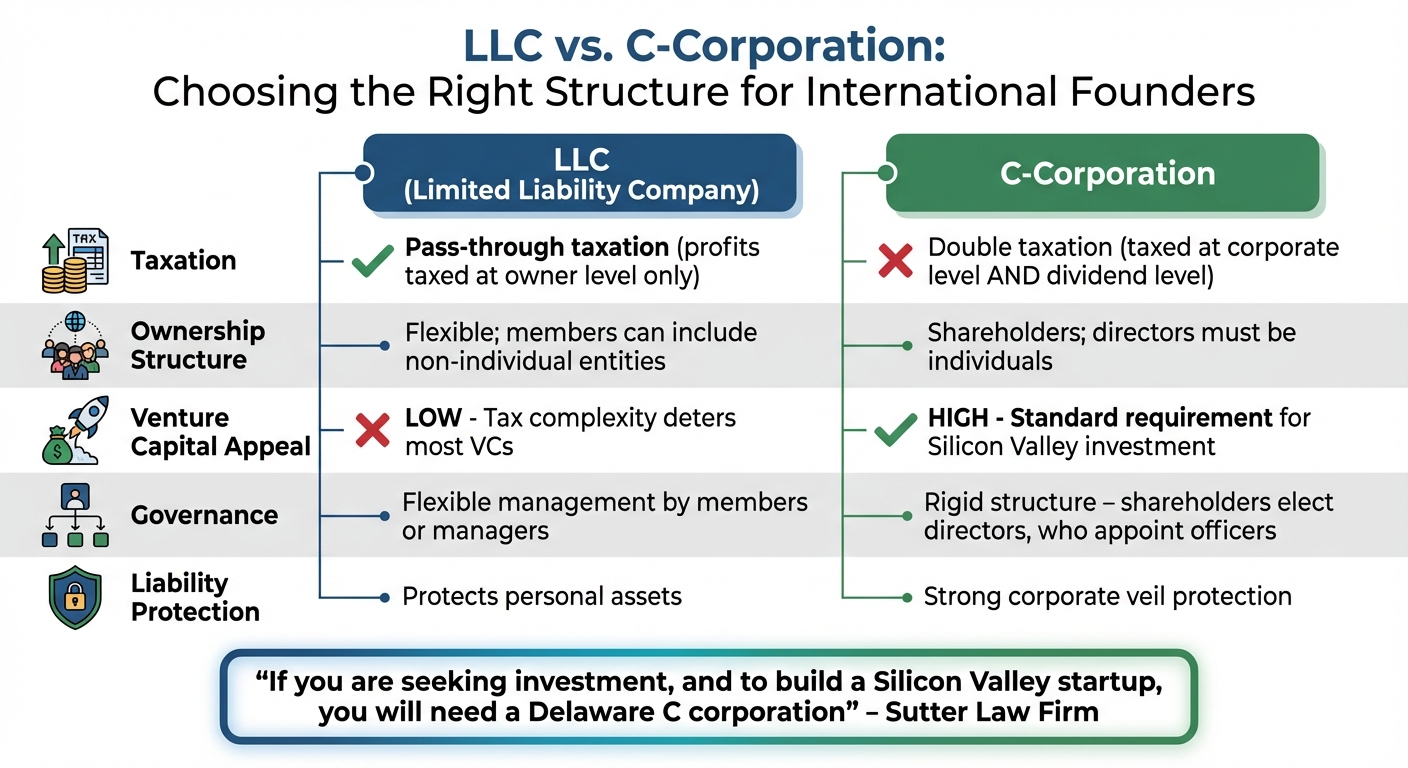
LLC vs C-Corporation Comparison for International Founders
Navigating the U.S. legal landscape is a critical step for international founders. With federal and state laws operating independently, regulations can vary significantly depending on the state and the type of business. Understanding these complexities is essential for success.
Choosing the Right Business Structure: LLC vs. C-Corp
The choice of business structure has far-reaching implications, influencing tax responsibilities, fundraising opportunities, and liability protection.
A C-Corporation (C-Corp) is the go-to option for founders aiming to attract venture capital or go public. It provides strong liability protection and is taxed as a separate entity. Many Silicon Valley investors insist on a Delaware C-Corp before offering funding. As Sutter Law Firm puts it:
"If you are seeking investment, and to build a Silicon Valley startup, you will need a Delaware C corporation".
On the other hand, a Limited Liability Company (LLC) offers flexibility in management and pass-through taxation, where profits are taxed at the owner level rather than the corporate level. However, for non-U.S. taxpayers, the IRS may treat an LLC as a C-Corp for tax purposes, which can diminish its tax benefits. Additionally, venture capital firms often avoid LLCs due to the added tax complexities.
The decision boils down to balancing investment readiness with tax flexibility. While C-Corps face double taxation – once on corporate income and again on dividends – they remain the preferred structure for institutional investors. It’s also worth noting that international founders typically cannot opt for S-Corp status, as this is limited to U.S. citizens and resident aliens.
| Feature | LLC (Limited Liability Company) | C-Corporation |
|---|---|---|
| Taxation | Pass-through (profits taxed at owner level). | Double taxation (corporate and dividend levels). |
| Ownership | Flexible; members can include non-individual entities. | Shareholders; directors must be individuals. |
| VC Appeal | Low; tax complexity deters most VCs. | High; standard for Silicon Valley investment. |
| Governance | Flexible; managed by members or managers. | Rigid; shareholders elect directors, who appoint officers. |
| Liability | Protects personal assets. | Strong corporate veil protection. |
Delaware is a popular choice for incorporation due to its business-friendly laws and specialized Chancery Court. For instance, Delaware charges a $90 formation fee and a $300 annual franchise tax for LLCs. Wyoming, with a $100 filing fee and a $60 annual report fee, offers a cost-effective alternative for startups focused on saving money and maintaining privacy.
To limit U.S. legal exposure, international founders should avoid branch offices and instead establish a Delaware C-Corp subsidiary, which separates U.S. tax obligations from the parent company.
State-Specific Taxes, Licenses, and Compliance Filings
After selecting a business structure, staying compliant with state-specific requirements becomes vital. Each state enforces its own rules for taxes, licenses, and annual filings. For example, a business incorporated in Delaware but operating in California must register as a "foreign" corporation in California and pay a registration fee. This "foreign qualification" is mandatory for companies with significant operations, employees, or a physical presence in states outside their incorporation.
Businesses must also designate a registered agent with a physical address in their state of incorporation to receive legal documents. For foreign founders without a U.S. address, professional registered agent services are a practical solution, costing $50 to $200 annually. For instance, BusinessAnywhere offers these services for $147 per year, with the first year free when you register through their platform.
States often require annual or biennial reports to update business details. Missing these filings can result in penalties, late fees, or even administrative dissolution. California, for example, imposes a minimum franchise tax of $800 per year on all entities conducting business in the state, regardless of revenue.
Selling products online to U.S. customers may also trigger tax obligations. Even without a physical office, an online business could create a tax nexus, requiring registration and collection of state sales tax. Conducting a nexus study can help determine whether your business activities in certain states meet the threshold for tax compliance.
For tax identification purposes, founders may face delays in obtaining an EIN without a U.S. SSN. Additionally, businesses must register with tax authorities in every state where they operate, which includes securing state tax IDs and understanding employment laws that may exceed federal standards.
Employment, IP, and Tax Compliance
Employing U.S. workers and safeguarding intellectual property (IP) are critical steps for operational success. Employment laws in the U.S. are often less rigid than in other countries. Most states follow "at-will" employment, allowing either party to terminate the relationship for any lawful reason unless a contract states otherwise. Employers typically rely on simple documentation like offer letters, non-disclosure agreements (NDAs), and invention assignment agreements.
Hiring in the U.S. comes with additional costs. Employers should budget at least 30% above base salaries to cover mandatory and competitive benefits. As Mintz advises:
"The US has a very fluid labor market, and offering competitive packages is necessary to obtain strong talent. Make sure to budget at least 30% on top of base salaries to account for these necessary expenses".
Protecting intellectual property is equally important. Since U.S. IP laws are territorial, foreign registrations may not apply domestically. Founders should register patents and trademarks with the USPTO and copyrights with the U.S. Copyright Office upon entering the market. For example, utility patents typically provide 20 years of protection from the filing date, while copyrights last for the author’s lifetime plus 70 years for works created after January 1, 1978.
Sara Rona, Managing Director of Global Gateway at Silicon Valley Bank, highlights the importance of IP:
"In the innovation ecosystem, your intellectual property, or your IP, is the DNA of your organization which undoubtedly serves as your competitive advantage".
To protect company assets, founders, employees, and contractors should sign Proprietary Information and Invention Assignment agreements (PIIAs), ensuring the company retains ownership of work created during employment. NDAs are also essential for safeguarding trade secrets, provided reasonable measures are taken to maintain confidentiality.
The U.S. operates on a "first-to-file" patent system, so filing early is critical to maintaining a competitive edge. The USPTO currently has an average patent approval cycle of about 22 months, with over 580,000 unexamined applications.
Tax compliance is another area requiring close attention. Services like BusinessAnywhere simplify EIN applications with a one-time fee of $97. Businesses must comply with federal and state income taxes and may also face sales and use taxes, even without a physical presence. Reviewing tax treaties between the U.S. and the founder’s home country can help minimize double taxation and clarify whether a "permanent establishment" exists.
sbb-itb-ba0a4be
Solutions: How to Overcome Cultural and Legal Challenges
Using All-in-One Platforms for Business Operations
Setting up and managing a U.S. business as an international founder can be a daunting task. However, platforms like BusinessAnywhere simplify the process by offering a range of administrative services in one place. For example, they provide $0 business formation (plus state fees), include the first year of registered agent service for free, and charge $147 annually after that. Other services include EIN applications for $97, BOIR filing for $37, and virtual mailbox services starting at $20 per month. These mail services include unlimited scanning and global forwarding, making it easier to handle correspondence remotely.
Such platforms streamline operations and compliance management. Take BusinessAnywhere’s virtual mailbox, for instance – it gives you a physical U.S. street address, which is often a requirement for banks and government agencies. At the same time, it allows you to manage mail from anywhere. On top of that, compliance alerts ensure you don’t miss important deadlines, helping you avoid penalties or even the risk of administrative dissolution. While technology plays a key role, combining it with effective cross-cultural strategies and legal expertise makes entering the U.S. market much smoother.
Working with Cross-Cultural Training and Local Legal Experts
Hiring a U.S.-based General Manager can bridge the gap between your home country’s practices and American business norms. Angela Denise Muth, an expert in U.S. market expansion, explains:
"U.S. work culture emphasizes direct communication, individual achievement, and fast-paced decision-making."
Providing your team with formal cross-cultural training can help reduce misunderstandings between your headquarters and U.S. operations. Additionally, using Professional Employer Organizations (PEOs) like ADP, Paychex, or Gusto simplifies payroll, health insurance, and compliance with U.S. employment laws.
Navigating legal complexities, such as filing Form 5472 for foreign-owned corporations, is another critical area where expert advice is invaluable. Missing these filings can result in steep penalties of $25,000 per form, per year. Kodem Law highlights another key point:
"Ownership of a U.S. business does not automatically allow a foreign national to live or work in the United States."
This makes it crucial to align your business structure with visa requirements from the beginning. Combining expert legal guidance with automation ensures you stay compliant and avoid unnecessary complications.
Tools for BOIR Filing, EIN Applications, and Annual Reports
Staying compliant with U.S. regulations requires efficient tools for BOIR filings, EIN applications, and annual report submissions. Most business entities must file Beneficial Ownership Information Reports (BOIR) with FinCEN to remain in good standing. Automated tools can help manage these filings and send reminders for critical deadlines.
When it comes to EIN applications, automated services can save time and reduce delays. Platforms like BusinessAnywhere handle the paperwork and follow-ups, making the process smoother for international founders.
To maintain accurate financial records, cloud-based accounting software like QuickBooks or Xero is essential. These tools help ensure your books comply with U.S. Generally Accepted Accounting Principles (GAAP), which is key for building trust with banks and investors. Digital banking platforms such as Mercury and Brex also make it easier for founders to open accounts remotely, even without a physical U.S. presence.
Conclusion: Succeeding in the U.S. as an International Founder
Key Takeaways for International Entrepreneurs
Starting a business in the U.S. requires a solid plan, adequate funding, and strict attention to legal and operational details. As Harris Sliwoski puts it: "With the proper mix of preparation, partnerships, and compliance, foreign companies can capture the full range of opportunities the US has to offer while avoiding unnecessary legal risks." Success comes from careful groundwork, understanding local practices, and using reliable tools to keep operations running smoothly.
One important point to keep in mind: owning a business in the U.S. doesn’t automatically grant you the right to work there. You’ll need the correct visa – whether it’s an E-2, L-1, or O-1 – before you can actively manage your U.S. operations.
Protecting your ideas and financial reputation is another critical step. Register your intellectual property with the USPTO as early as possible to safeguard your innovations. At the same time, use GAAP-compliant accounting practices from the start to build trust with banks, investors, and auditors.
Lastly, don’t skip consulting with U.S. legal and tax professionals before making major decisions. They can guide you in selecting the best business structure, whether that’s a Delaware C-Corp for attracting venture capital or an LLC for more flexibility. They’ll also help you navigate state-specific rules and avoid costly errors, like mixing personal and business finances. To simplify compliance, consider using automation tools for tasks like EIN applications, BOIR filings, and annual reports.
With the right preparation, expert advice, and dependable tools, you’ll be ready to tackle the legal and cultural challenges of the U.S. market and tap into its enormous potential of over 330 million consumers.
FAQs
Which U.S. state should I form my company in?
Choosing the best U.S. state for your business involves weighing factors like legal protections, tax policies, and how your business operates. Many startups opt for Delaware due to its business-friendly legal system and reliable corporate laws, which can be appealing to investors. However, if your business primarily operates within your home state, it might make more sense to register there for simplicity and convenience. Other states, like Nevada and Wyoming, are also known for offering attractive tax advantages. To make the right choice, it’s wise to consult with legal or financial experts who can align your decision with your unique business goals.
How can I legally work in the U.S. if I own a U.S. business?
Owning a business in the U.S. doesn’t automatically allow you to work there. To work legally, you’ll need appropriate work authorization or a visa. Some options include visas like the International Entrepreneur Rule or other employment-based visas. It’s essential to consult legal professionals to identify the right path for your circumstances and ensure you’re complying with U.S. immigration laws.
What filings and deadlines do I need to stay compliant each year?
As a foreign entrepreneur operating in the U.S., you’re required to handle specific federal tax filings each year. This includes IRS Form 5472 and a pro forma Form 1120, even if your business hasn’t generated any income. Additionally, many states mandate filing annual reports and franchise taxes, though the deadlines for these vary depending on the state.
If your sales surpass certain thresholds, sales tax nexus laws could also come into play, requiring you to collect and remit sales tax. To stay compliant and avoid penalties, it’s crucial to keep detailed financial records for at least 5–7 years.