


Hiring international employees can unlock global talent, but it also comes with legal and payroll challenges. Non-compliance with local labor laws can lead to fines, lawsuits, back taxes, and reputational damage. For example, Germany imposes fines up to $540,000 for violating minimum wage laws, and Canada charges $1,000 CAD daily for missing employment records. Misclassifying workers or overlooking local rules can trigger financial penalties and operational setbacks.
To hire globally while staying compliant, you need to:
- Understand country-specific labor laws (e.g., mandatory benefits, termination rules, and language requirements).
- Choose the right hiring structure: set up a local entity, relocate talent, or use an Employer of Record (EOR).
- Draft contracts tailored to local laws, covering compensation, benefits, termination terms, and intellectual property.
- Handle payroll accurately, including taxes, social security, and mandatory benefits.
- Avoid common mistakes like worker misclassification, missing labor law updates, and poor record-keeping.
Compliance isn’t optional – it protects your business from costly risks and ensures smooth international operations. Whether you’re hiring one overseas employee or building a global team, understanding these steps will help you navigate the complexities effectively.
International Employment Law Basics
When hiring internationally, U.S. employment policies don’t carry over. Instead, employees are automatically entitled to the rights granted by the labor laws of their work location. For example, a developer based in Vietnam is subject to Vietnamese labor laws, regardless of any U.S.-focused contract terms. A U.S. "at-will" employment agreement cannot override these local protections – courts will uphold the labor laws of the employee’s home country, even if the contract says otherwise. Below, we’ll look at how employment laws differ across countries and the global standards that influence them.
This principle of territorial labor law caught a Seattle-based company off guard in September 2025. The company had hired five employees in Vietnam under English-only contracts governed by Washington state law. When the company terminated these employees, the workers sued in Vietnam. Because the contracts violated several Vietnamese labor laws, the company couldn’t enforce its Seattle arbitration clause and had to settle. This settlement avoided court-ordered reinstatement, back pay, and hefty fines.
This case highlights why it’s critical to understand each country’s labor laws before drafting employment contracts.
How Employment Laws Work by Country
Labor laws vary dramatically from one country to another. What’s optional in the U.S. is often required elsewhere. For instance:
- In the U.S., paid vacation is discretionary, but Germany mandates at least 20 paid days, the UK requires 28 days, Mexico includes a 10% profit-sharing rule, and Portugal enforces additional monthly salaries.
- Termination rules also differ. While U.S. employers rely on "at-will" employment, around 77% of countries allow courts to review dismissals. Courts in these countries can order reinstatement with back pay if the dismissal is deemed unfair.
- Spain requires that employees be "heard" before a disciplinary termination. Without this step, even a justified dismissal could be ruled unfair.
- In China, employers must provide a written contract within the first month of employment. Failing to do so can result in penalties, including paying double wages for months 2 through 12.
These examples show how critical it is to understand local rules when managing international teams.
International Labor Standards and Their Limits
Global organizations like the International Labor Organization (ILO) set benchmarks for fair wages, working conditions, and workplace safety. However, there’s no universal framework that all countries must adhere to. These standards act as recommendations rather than enforceable laws. Even within regional groups like the European Union, employment laws can differ significantly from one country to another.
Regional directives sometimes shape local laws. For instance, on March 30, 2023, the European Parliament adopted a pay transparency directive. This requires large companies to report pay data and disclose salary ranges to job applicants. EU Member States have three years to align their national laws with this directive. However, each country will interpret and implement these changes differently.
While these global benchmarks influence local policies, they don’t override the specific labor laws of any jurisdiction. Employers must still comply with the unique rules of each country where they hire. Understanding these fundamentals is essential for drafting compliant employment contracts and choosing the appropriate hiring approach.
3 Ways to Hire International Employees
If you’re looking to hire international employees, there are three main approaches to consider: setting up a local entity, relocating talent to the U.S., or partnering with an Employer of Record (EOR). Each option comes with its own set of timelines, costs, and compliance requirements.
Opening a Local Business Entity
Setting up a local entity gives you complete control over operations in a foreign country but requires significant time and financial investment. You can choose between a Representative Office (limited to non-commercial activities like market research), a Branch Office (an extension of your U.S. company), or a Subsidiary (a separate legal entity). Subsidiaries are often the go-to option for companies planning to hire at least 25 employees in a single country.
The process typically takes 2–6 months and involves several steps, including appointing local directors, filing paperwork with the local registrar, paying registration fees, and opening local bank accounts. Initial costs can exceed $20,000, with annual maintenance fees often surpassing $50,000. For example, in the UK, foreign companies must file form OS IN01 and pay a registration fee.
You’ll also need to meet country-specific requirements like minimum share capital and name reservation rules. Collaborating with local legal and tax professionals ensures compliance with labor laws and other regulations. While this approach gives you direct control over payroll and benefits, it can be complex and time-consuming. If this feels overwhelming, other methods may be more practical.
Relocating Talent to the U.S.
Bringing international talent to the U.S. involves navigating the country’s immigration laws and visa processes. Common visa types include:
- H-1B visas for specialized professionals (subject to an annual lottery).
- L-1 visas for intracompany transfers.
- O-1 visas for individuals with extraordinary abilities.
- TN visas for Canadian and Mexican professionals under USMCA.
To sponsor an H-1B or similar visa, you’ll first need to file a Labor Condition Application (LCA) with the Department of Labor, followed by Form I-129 with USCIS. Once the employee arrives in the U.S., you’ll need to verify their identity and work authorization using Form I-9 within three days of their start date. Additionally, you’ll handle payroll taxes, including 6.2% for Social Security and 1.45% for Medicare.
Robinson Immigration Law emphasizes: "Immigration law is strict in the U.S., and hiring someone without the correct work status can result in fines, audits, and bans from future employer sponsorship".
This approach simplifies compliance by bringing employees under U.S. labor laws, but it requires careful attention to immigration regulations. For a faster and less complex solution, many companies opt to work with an EOR.
Working with an Employer of Record (EOR)
An EOR acts as the legal employer for your international hires, handling payroll, taxes, benefits, and compliance while you focus on the employee’s day-to-day work. This option eliminates the need to establish a local entity and allows you to onboard employees in just a few days.
EORs handle everything from creating locally compliant employment contracts to administering mandatory benefits like health insurance and pensions. They also file necessary government paperwork and reduce the risk of worker misclassification. Fees for these services typically range from 5% to 20% of the employee’s payroll or a flat monthly fee per employee.
Carolyn Choo, VP of People at ShopBack, shares: "The primary driver for our switch to Deel was the compliance capability. We needed a platform that could quickly facilitate hiring and onboarding in markets where we didn’t have an entity".
When selecting an EOR, make sure they own their local entities directly rather than relying on third-party providers. Confirm they have strong expertise in the countries where you plan to hire. This option simplifies compliance with local labor laws and payroll regulations, making it an excellent choice for rapid international expansion.
Creating Compliant Employment Contracts
Once you’ve decided on your hiring structure – whether through a local entity, relocating to the U.S., or using an employer of record – the next step is to draft contracts that meet local legal standards. A contract that works in the U.S. might not be valid in France, China, or Mexico. Each country has its own rules about what needs to be included, how it should be worded, and even the language it must be written in.
What to Include in Employment Contracts
To ensure compliance, your contract should cover several key elements. Start with the identification of parties, including legal names, corporate and home addresses, job titles, and national IDs or business registration numbers. Then, include a clear job description detailing the employee’s role, primary duties, working hours, time zone expectations, and whether the position is remote, hybrid, or onsite.
Next, outline the compensation package. This includes the gross salary, pay frequency, and the currency used for payments. Be sure to include all statutory benefits and leave entitlements – such as paid vacation, sick leave, public holidays, and parental leave – ensuring these meet or exceed local minimums. For instance, Germany mandates at least 20 days of paid vacation annually, while Mexico requires an "Aguinaldo" bonus of at least 15 days’ pay by December 20th.
Define termination terms, including notice periods, dismissal grounds, and severance calculations according to local laws. In Australia, redundancy pay starts at four weeks for employees with one to two years of service and can go up to 16 weeks for those with 10+ years. Probationary periods should also be addressed, along with the specific terms that apply during this time. It’s worth noting that acceptance rates for international roles average 56%, and 18% of new hires leave during their probation period.
Include intellectual property (IP) and confidentiality clauses. In countries like Switzerland, IP rights remain with the creator unless the contract explicitly states otherwise. Finally, specify the governing law and dispute resolution process. Keep in mind that many countries require local labor laws and courts to take precedence, regardless of what the contract states.
In some countries, meeting language requirements is crucial. For example, France, Saudi Arabia, and Vietnam require contracts to be written in or translated into the local language to be legally binding. Providing a bilingual version – English and the local language – can help minimize disputes over interpretation.
Arlo Kipfer of Harris Sliwoski advises: "The best and usually least expensive approach is to tailor your handbooks and contracts to each specific country".
Contract Compliance Checklist
With the essential elements in place, use the following checklist to ensure your contract aligns with local laws. Avoid relying on U.S.-style templates, as many countries require specific procedures for cause, notice, and termination.
- Collective Bargaining Agreements (CBAs): Incorporate any applicable agreements, as these often go beyond statutory minimums for pay, leave, and benefits. For example, CBAs in France, Spain, and Italy may supersede standard requirements and must be reflected in individual contracts. Additionally, Portugal mandates 13th and 14th-month payments, while Mexico requires PTU profit sharing (10% of the prior year’s taxable profits distributed by May or June).
- Non-Compete Clauses: Review these carefully, as they may be unenforceable in certain jurisdictions or require mandatory compensation during the restricted period. Recent reforms in Europe have invalidated many standard global non-compete agreements.
- Termination Procedures: Ensure that grounds for dismissal are clearly documented. In China, for example, "for cause" termination is only valid if the specific grounds are listed in a legally adopted employee handbook. Properly addressing dismissal procedures can help avoid claims of unfair dismissal.
- Data Privacy: Include Data Privacy Agreements (DPA) to comply with regulations like the GDPR in Europe or state-specific laws in the U.S. Misclassifying workers in contracts can lead to costly penalties – some companies have faced fines of up to $40 million.
sbb-itb-ba0a4be
Handling Payroll, Taxes, and Benefits
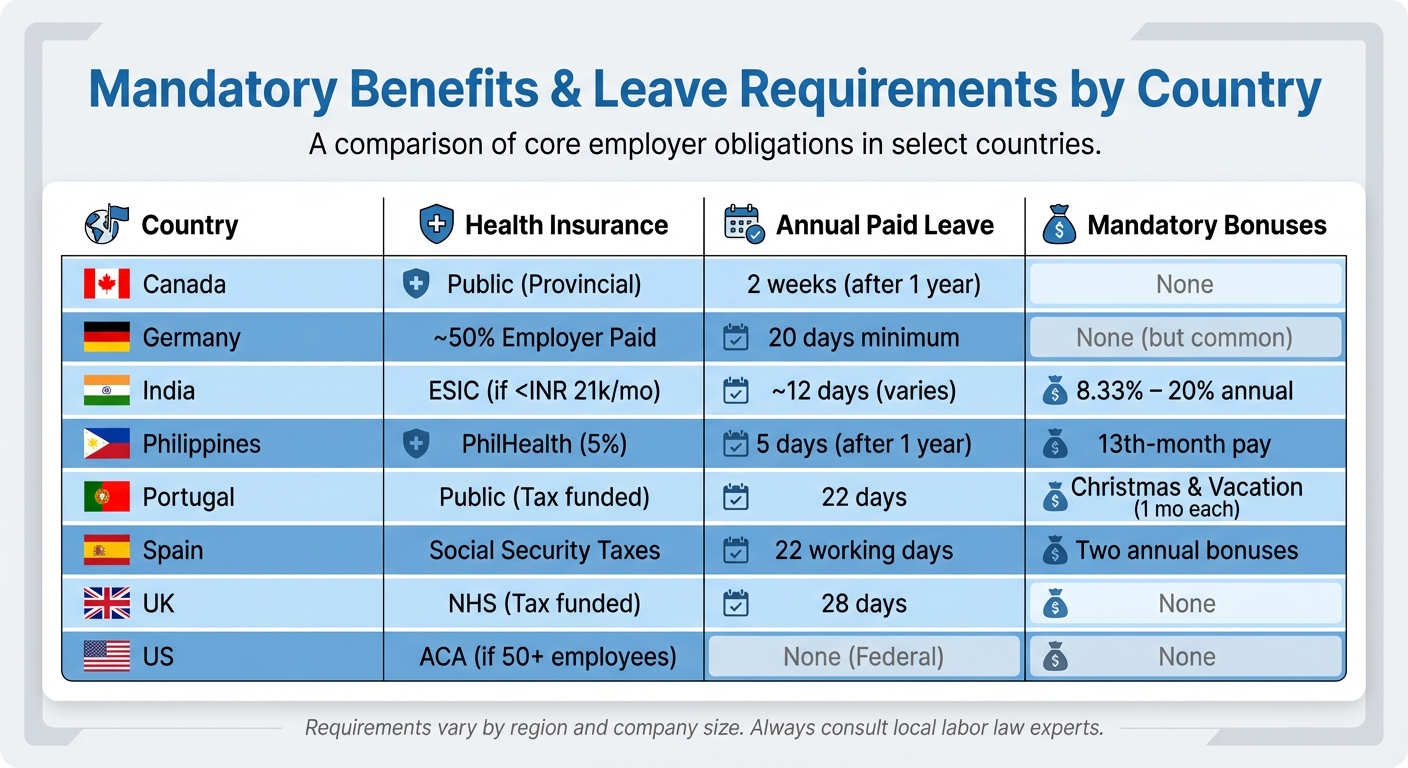
International Employment Benefits and Leave Requirements by Country
Managing payroll for international employees requires precision and compliance. This involves calculating local taxes, handling social security contributions, and administering region-specific mandatory benefits. Accurate contracts are the foundation for smooth payroll and benefits management.
Payroll Compliance Requirements
To operate legally, you must register with the tax and social security authorities in each country where you hire employees. This registration provides employer IDs needed to withhold taxes and file reports. As an employer, it’s your responsibility to calculate and remit federal and regional income taxes. Social security contributions are also mandatory, covering healthcare, pensions, disability, and unemployment insurance. For instance, employers in Spain contribute about 30% of an employee’s salary to Social Security, while in the UK, National Insurance contributions stand at 13.8%, with an additional minimum of 3% directed to employee pension schemes.
Employee classification is another critical area. Misclassifying employees as independent contractors can result in hefty fines, back taxes, and legal consequences.
If employees are temporarily working abroad, you might need to implement a shadow payroll. This system ensures taxes are reported and paid in both the home and host countries. Double-tax treaties can help avoid double taxation, but you’ll need certificates of coverage to benefit from them.
Understanding and following these guidelines will help streamline payroll processes and ensure compliance with each country’s legal requirements.
Required Benefits by Country
In addition to taxes, providing mandatory and expected benefits is key to compliance. Benefits fall into two categories: statutory (legally required) and customary (market-expected). Failure to meet these obligations can lead to fines, back-pay demands, or even criminal charges in countries like Germany and France.
Benefits vary widely across regions, including differences in health insurance, paid leave, and bonus requirements:
| Country | Health Insurance | Annual Paid Leave | Mandatory Bonuses |
|---|---|---|---|
| Canada | Public (Provincial) | 2 weeks (after 1 year) | None |
| Germany | ~50% Employer Paid | 20 days minimum | None (but common) |
| India | ESIC (if <INR 21k/mo) | ~12 days (varies) | 8.33% – 20% annual |
| Philippines | PhilHealth (5%) | 5 days (after 1 year) | 13th-month pay |
| Portugal | Public (Tax funded) | 22 days | Christmas & Vacation (1 mo each) |
| Spain | Social Security Taxes | 22 working days | Two annual bonuses |
| UK | NHS (Tax funded) | 28 days | None |
| US | ACA (if 50+ employees) | None (Federal) | None |
Some countries have additional requirements. For example, in France, employers must cover at least 50% of private health insurance costs (mutuelle). In the Netherlands, employers are required to pay 70% of wages for up to two years if an employee becomes ill. Meanwhile, countries like the Philippines, Greece, and Brazil mandate a 13th-month salary, with some even requiring a 14th-month payment.
Using Payroll Management Tools
Handling payroll across multiple countries manually can be overwhelming. Cloud-based payroll software simplifies this process by automating tax calculations, generating compliant pay stubs, and managing multi-currency payments. These tools often integrate with HRIS and time-tracking systems, reducing errors from manual data entry.
If your hiring strategy involves an Employer of Record (EOR), these tools can make compliance even easier. Without a local legal entity, an EOR acts as the official employer, managing tax withholding, reporting, and compliance. For example, one company saved over $24,000 monthly and cut administrative time by 80% by outsourcing payroll and compliance to an EOR.
"We didn’t want to hire full-time HR people to figure out things like health benefits and filing tax returns with the IRS. We were concerned about all the compliance, but now we know we can trust Deel to manage the complexities of hiring in the US." – Matthew Buchanan, CEO, Letterboxd
For companies with local entities, global payroll providers can centralize processes, offering standardized reporting and better oversight. Regular audits of payroll records and service providers are also essential to staying aligned with changing local laws.
Common Compliance Mistakes to Avoid
Even with the best intentions, businesses can stumble into compliance pitfalls when hiring internationally. These mistakes can lead to hefty fines, back-pay demands, and prolonged legal battles that drain resources and damage reputations. Steering clear of these common errors is essential for building a strong global hiring strategy.
Worker Misclassification
Misclassifying employees as contractors is one of the most frequent – and costly – errors. In fact, between 10% and 30% of U.S. employers have misclassified at least one worker. While misclassification might save around $3,710 per worker annually by avoiding benefits and taxes, the costs of retroactive reclassification are far greater.
Regulators don’t just look at the contract label; they examine the actual working relationship. If you’re controlling when and how someone works, providing company equipment (like laptops), assigning a company email, or requiring daily check-ins, you’re likely treating them as an employee – even if the contract says otherwise.
Consider some high-profile cases: In 2022, Nike faced a potential $530 million liability for allegedly misclassifying thousands of temporary office workers as independent contractors. Similarly, FedEx settled for $228 million in 2015 after California drivers argued they were misclassified, despite the company’s control over their daily routines. And in 2023, the U.S. Department of Labor recovered over $250 million in back wages tied to misclassification cases.
Penalties vary widely. In the U.S., accidental misclassification can result in paying 1.5% of salaries, plus interest, and matching 40% of Medicare and Social Security contributions. Intentional misclassification carries steeper penalties – up to 20% of wages and even potential jail time. In Germany, fines range from €5,000 to €50,000 per case, with bans on future contracts also possible.
"Misclassifying employees as independent contractors is among the most common mistakes in employment in general, let alone international employment."
- Anja Simic, Director of Content Marketing, Deel
To avoid these pitfalls, watch for warning signs like exclusivity requirements, long-term engagements without a clear end date, or integration into core business operations. Regularly audit contractor relationships and consult with local employment experts. Staying informed about evolving labor laws is equally important for maintaining compliance.
Missing Labor Law Updates
Employment laws change quickly. What worked last year could now lead to penalties. For example, the Philippines raised minimum wages in June 2025, while Portugal recently required reimbursement for remote work expenses. France has strict "right to disconnect" rules, and Japan continues to adjust its overtime regulations under work-style reform laws.
Applying your home-country practices abroad is risky. For instance, U.S.-style "at-will" employment doesn’t exist in countries like France or Germany, where strict termination protections apply. Using a generic contract template across markets can also overlook key local requirements, like notice periods, severance, or mandatory leave.
"Employment law is highly local. Requirements around minimum wage, working time, paid leave, notice periods, severance, probation, and termination protections differ materially between jurisdictions."
- Playroll
To stay ahead, set up systems to monitor regulatory changes in every country where you operate. Subscribing to legal updates, training HR and finance teams on local rules, and appointing compliance officers for larger operations can help. Automated tools that send real-time alerts about law changes in your hiring regions are also worth considering.
Poor Record Keeping
Accurate record-keeping is another cornerstone of compliance. Many countries have stricter documentation requirements than the U.S. For example, Germany mandates storing employment and payroll records for at least 10 years. Failing to produce these during an audit can lead to fines, even if everything else is in order.
Incomplete records can also lead to disputes over wages, benefits, or termination. Employment contracts, payroll calculations, tax withholdings, benefit enrollments, and time-off requests all need to be well-documented. In 2022, Chanel faced penalties for underpaying £70,413.59 to 250 workers in the U.K. due to oversight gaps.
Centralizing records through global HR or payroll software can simplify compliance by automatically logging transactions and creating audit trails. Regular internal reviews can also ensure accuracy. If you work with an Employer of Record, confirm they maintain thorough records and provide easy access when needed.
Data privacy laws like GDPR add another layer of complexity. Non-compliance can result in fines of up to €20 million or 4% of global annual turnover, whichever is higher. Brazil’s LGPD and California’s CCPA impose similar requirements. To stay compliant, secure employee data, obtain proper consent for processing, and appoint Data Protection Officers where necessary.
Conclusion
Navigating the complexities of global hiring requires a thorough understanding of local labor standards, payroll tax rules, and compliance obligations. While hiring internationally can connect you with top-tier talent, it also comes with significant responsibilities. From adhering to local labor laws to avoiding worker misclassification and managing payroll accurately, every detail matters. Mistakes in these areas can lead to steep penalties, such as hefty GDPR fines or retroactive tax liabilities, which could disrupt your operations.
The good news? You can simplify this process by adopting a compliance-first approach. By embedding compliance into every stage – recruitment, onboarding, and payroll – you can shield your business from legal risks and reputational harm while ensuring smoother international growth. Whether you set up a local entity, partner with an Employer of Record, or hire contractors, careful planning is non-negotiable.
Automation tools are making this process more manageable. These platforms handle tasks like generating contracts, monitoring regulations in real time, and centralizing payroll, cutting administrative work by as much as 70%. For instance, Paperform saved nearly $100,000 annually by consolidating its global hiring operations onto one platform in 2025. Similarly, Gecko Robotics improved payroll efficiency by 70% after adopting an automated international payroll system. These examples highlight how automation can transform global hiring.
"International payroll is no longer a luxury; it’s essential for unlocking new markets, building diverse teams, and setting your company up for global success."
- Willson Cross, CEO, Borderless AI
To make this process even smoother, BusinessAnywhere offers essential services for establishing a U.S. business foundation, including business registration, EIN applications, virtual mailbox solutions, and compliance support. With the right framework and a solid grasp of international labor laws, you can build a distributed team that drives growth without the weight of compliance challenges.
FAQs
Do I need a local entity to hire overseas?
No, setting up a local entity isn’t always necessary to hire internationally. With an Employer of Record (EOR), businesses can legally employ workers in other countries without the need for a local entity. An EOR takes care of critical tasks like compliance, payroll, taxes, and benefits, making the onboarding process faster and smoother. While creating a local entity might make sense for long-term operations, an EOR offers a more flexible and straightforward option for companies looking to expand globally without the added complexity.
How do I avoid contractor misclassification abroad?
To steer clear of contractor misclassification when working internationally, it’s crucial to align with local labor laws. This means classifying workers accurately based on their job roles, the level of control you have over their work, and their independence. Implement standardized processes such as:
- Using localized contracts tailored to the specific country’s legal framework.
- Clearly defining the scope of work for each contractor.
- Documenting the contractor’s independence to establish the nature of the relationship.
Additionally, make it a habit to regularly review relevant labor laws and tax regulations. Ensure that contracts explicitly highlight the independent nature of the relationship to reduce the risk of legal complications and penalties.
What’s the fastest way to run compliant international payroll?
The quickest way to manage international payroll while staying compliant is by using a global payroll platform. These platforms take care of automating compliance with local labor laws, manage currency conversions seamlessly, and ensure employees are paid on time. By simplifying operations across various countries, they cut down on administrative work and help businesses meet tax, benefits, and reporting obligations. This makes payroll processing smoother and more efficient for global teams.