

In remote work, success hinges on finding candidates with the right traits. Here are five key qualities to look for when hiring for distributed teams:
- Self-Motivation: Remote workers need to take initiative and work independently without constant supervision.
- Strong Communication Skills: Clear, concise, and proactive communication is essential for digital collaboration.
- Flexibility: Candidates must handle changing collaboration tools, workflows, and time zones effectively.
- Time Management: The ability to prioritize tasks and maintain focus without a structured office environment is critical.
- Collaboration Skills: Remote team members should actively engage, share updates, and work well with others across various platforms. Many teams also leverage AI tools for collaboration to streamline these interactions.
To identify these traits, use behavioral questions, trial projects, and assess their ability to manage tasks and communicate clearly. Hiring individuals with these qualities ensures your remote team thrives and delivers results.
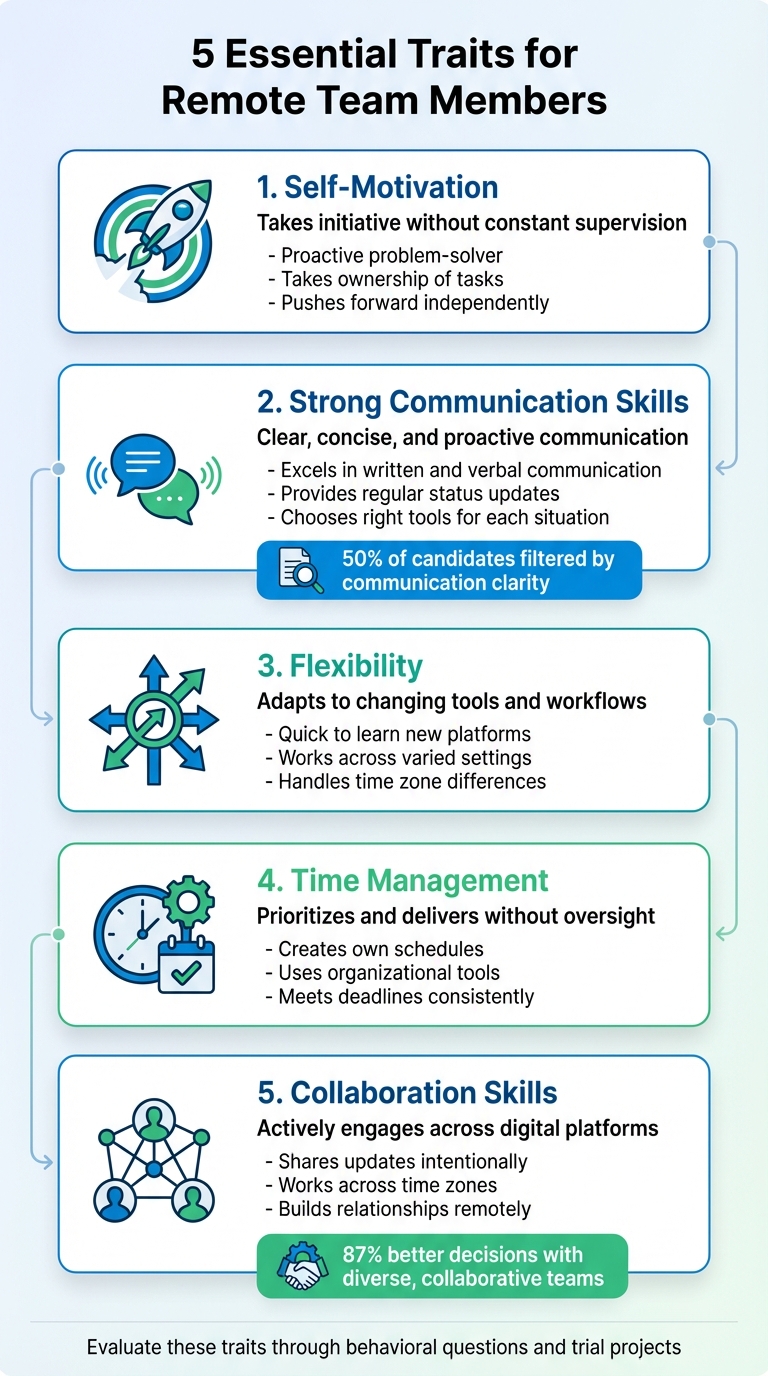
5 Essential Traits for Remote Team Members
1. Self-Motivation
Working remotely means there’s no manager physically present to monitor progress or provide daily check-ins. That’s why self-motivation is absolutely critical for success in this environment. Remote workers need to take charge, prioritize their tasks, and deliver results without constant oversight.
One of the clearest warning signs during the hiring process? Candidates who rely heavily on step-by-step instructions. Automattic, the company behind WordPress.com, has been fully remote from the start and understands this challenge well. During their trial process, they evaluate whether candidates can take initiative or if they need to be guided at every turn. Sara Rosso, Marketing Manager at Automattic, explains:
"If during the trial process a candidate needs a lot of ‘handholding’ and waits for specific instructions before moving forward, they probably won’t be a good fit."
The best remote workers are proactive problem-solvers. They take ownership of their tasks, understand how their work contributes to the company’s success, and consistently push themselves to improve. Lori McLeese, Head of HR at Automattic, highlights this mindset:
"We look for people that are self-starters/have a high degree of independence, value continuous learning, and are receptive to feedback."
In action, a self-motivated remote worker doesn’t just focus on completing what’s assigned – they think ahead and figure out what needs to happen next. When challenges arise, they don’t sit idle; they come up with solutions and keep moving forward. They set personal goals each day and stick to them without needing external pressure or reminders.
To identify this quality in candidates, ask them to share an example of a project they handled from start to finish with little oversight. Pay close attention to how they tackled obstacles – did they take the lead or wait for someone else to step in? Even better, consider a paid trial project that mimics the actual job. This will show whether they can independently produce results or if they’ll require constant supervision – something that’s simply unsustainable in a remote team. While self-motivation is key for working solo, it’s also the foundation for thriving in collaborative remote environments using the right tools.
sbb-itb-ba0a4be
2. Strong Communication Skills
In remote teams, communication is the glue that holds everything together. Without the casual chats in hallways or the ability to pick up on body language, remote workers depend heavily on written and verbal communication through digital tools. Jon Hill, Chairman & CEO of The Energists, puts it perfectly:
"A candidate’s communication skills are one of the strongest indicators of their potential to thrive in a remote position."
Whether it’s Slack messages, emails, or project updates, clarity and brevity are essential to avoid unnecessary delays. Screening candidates for clear and concise writing early on can make a big difference. For instance, filtering for applicants who are "straightforward and succinct" during the initial stages can eliminate nearly 50% of candidates.
But communication isn’t just about good writing. Great remote workers excel in proactive communication. Ann MacDonald, Director of Content Strategy at LoveToKnow, highlights how staying connected fuels her team’s productivity:
"We stay productive by staying in touch, offering status reports, and working through challenges. These things are all easier when everyone is communicative."
Regular status updates and early identification of challenges help smooth out potential misunderstandings and keep projects on track. This proactive approach is also a key metric when evaluating candidates for remote roles.
When assessing communication skills, pay attention to every interaction from the very first email. Are their responses professional and clear? Do they miss details that were already provided in the job description? Rhiannon Ruff, Vice President at Beutler Ink, offers a word of caution:
"A confused (or confusing!) application email… is a sign that an applicant is not going to follow written instruction well and is not going to give clear updates on project statuses."
A practical way to test this is the "Slack-Proof" challenge: ask candidates to summarize a major achievement in a short, Slack-style message. This helps you see if they can balance brevity with enough context. Strong communicators also know how to choose the right tool for the job – whether it’s a quick Slack message, a detailed email, or a video call for more nuanced discussions. Paired with other key traits like adaptability, strong communication is a cornerstone of any successful remote team.
3. Flexibility
Remote work thrives on adaptability. Tools, workflows, and team dynamics are constantly evolving, and successful remote workers need to keep up with these changes. Darryl Stevens, CEO of Digitech Web Design, sums it up well:
"Remote roles require flexibility to manage different time zones, virtual tools, and evolving workflows. Candidates who… can adapt to new tools quickly are better equipped to succeed in a remote setup."
This ability to adjust complements other key traits like self-motivation and effective communication, both of which are critical for excelling in remote roles.
Tech stacks in distributed teams are rarely static. One company might prefer Slack and Asana, while another leans on Microsoft Teams and Trello. Employees who resist adopting new tools can slow down the entire team. As 4 Corner Resources points out:
"Switching from onsite to remote work will come with some inevitable changes to how you do things; if you have a staffer stuck on the old way of doing things, they can slow the rest of the team down or get left behind."
Flexibility goes beyond software. Remote workers must remain productive across varied physical settings – whether that’s a home office, a coffee shop, or a co-working space. They also need to juggle synchronous and asynchronous tasks, particularly when collaborating across time zones.
To assess flexibility, consider asking situational questions like, "Describe a time you changed direction mid-project. What did you do?". Another effective tactic is assigning a small test project using your team’s collaboration tools to see how quickly a candidate adapts without needing extensive guidance. Lauren Proctor from Jobbatical emphasizes this point:
"The worst thing you can do… is hire someone who doesn’t have the confidence to figure out how to do things on the fly."
Look for candidates with a learning mindset – those who actively update their tech skills and show enthusiasm for mastering new platforms.
Next, dive into how time management and discipline play a crucial role in building a successful remote team.
4. Time Management and Discipline
Effective time management is a cornerstone of success for remote workers. Without a manager physically present to oversee their day, remote employees need to create their own schedules, prioritize tasks, and consistently meet deadlines. This self-driven approach often separates those who thrive in remote settings from those who struggle.
But it’s not just about juggling tasks during busy periods. Slow days can be equally challenging, especially when home-based distractions – like family interruptions or household chores – creep in. To stay productive, remote workers often rely on organizational tools to keep them on track. Giacomo ‘Peldi’ Guilizzoni, Founder and CEO of Balsamiq, captures this balance perfectly:
"Working at home is amazing for the first six months, great for the first two years, and can be tough after that unless you come up with your ‘system’ for separating work from your personal life."
Evaluating a candidate’s ability to manage their time effectively is crucial during the hiring process. Asking about their strategies and tools can provide insight into their organizational skills. Strong candidates will point to specific methods, such as Trello boards, digital calendars, or time-tracking apps, rather than vague answers like "I just keep a mental list". Alex Turnbull, CEO and Founder of Groove, underscores the importance of intentionality:
"As a remote team, we need to hire not just great performers, but great remote performers; people who can excel at self-starting and self-managing. A big part of that is being thoughtful about your workspace."
Situational questions like "How do you decide what tasks to work on when faced with multiple deadlines?" or "How do you stay focused when you’re not in a traditional office?" can offer valuable insights into a candidate’s time management skills. For a more hands-on evaluation, consider assigning a paid trial project with a firm deadline. This approach simulates real remote work conditions and helps reveal whether the candidate can manage their workload independently.
Strong time management is non-negotiable for remote teams, especially as it directly supports effective collaboration across digital platforms.
5. Collaboration Skills
Working remotely means collaboration isn’t something that happens on its own – it requires deliberate effort. Unlike traditional office settings, remote work eliminates those casual, in-person interactions that naturally build team connections. Instead, collaboration in a remote environment has to be intentional. Team members need to actively share updates, build relationships, and work together across different time zones. This purposeful approach helps fill the gap left by the absence of spontaneous office interactions and ensures that teamwork remains effective in a virtual setting.
And it’s worth the effort. Research shows that diverse teams are 87% more likely to make better decisions than teams lacking inclusivity. Carol Cochran, Director of People & Culture at FlexJobs, underscores the importance of open communication in remote work:
"You lose the nonverbal aspect of communication in a remote company so it’s critical that everyone is comfortable speaking up about what’s working and what isn’t."
Successful remote collaborators know how to choose the right communication tools for each situation. They’re also transparent, keeping their work well-documented and knowing when to ask for help to keep things moving.
When evaluating these skills in candidates, ask them to share examples of how they’ve resolved conflicts remotely or how they’d explain a complex idea to someone they can’t meet in person. Pay attention to how they handle scheduling across time zones – if they’re proactive about accommodating your location, it’s a good sign of their collaboration skills.
Stijn Beauprez from Outsite shares their approach to assessing collaboration during the hiring process:
"The last interview is always with the whole team. It’s more like an introduction, but everybody has the chance to ask some questions."
Another effective method is assigning a trial project. This allows you to see firsthand how a candidate works with your team, responds to feedback, and adapts to your communication style. When hiring, focus on finding candidates who bring fresh perspectives and align with your team’s mission, aiming for "culture add" rather than just "culture fit".
How to Evaluate These Traits During Hiring
The hiring process should reflect how your team operates day-to-day. A great way to do this is by asking behavioral questions that focus on real experiences rather than hypothetical scenarios. Instead of asking, "What would you do if…", try, "Tell me about a time when…" This approach lets you understand how candidates have handled challenges in remote work settings. It’s a practical way to assess their ability to work remotely while reinforcing the five key traits discussed earlier.
For self-motivation, consider questions like:
- "Describe a time you faced a blocker, and your manager was unavailable. How did you handle it?"
- "Tell me about a time you had to juggle multiple remote tasks with little oversight. How did you ensure everything got done?".
To gauge communication skills, you might ask:
- "Can you share a time when a written message you sent was misunderstood and caused confusion? What steps did you take to resolve the issue?".
Pair these questions with hands-on assignments to get a well-rounded view of the candidate’s remote work capabilities.
Work samples are more telling than interviews. Assign trial projects that mirror real tasks your team handles. For example, give candidates a 48-hour deadline to complete an assignment with some intentional ambiguities – like asking them to make something "production-ready" without clarifying what that means. Candidates who excel will ask thoughtful questions and clearly document their assumptions. This process helps you identify those who can work independently versus those who may need constant guidance.
Assess their tools and systems. Ask candidates about the tools they use to stay organized – whether it’s calendars, project management apps, or their workspace setup. Giacomo ‘Peldi’ Guilizzoni, Founder and CEO of Balsamiq, explains:
"Working at home is amazing for the first 6 months, great for the first 2 years, and can be tough after that unless you come up with your ‘system’ for separating work from personal life."
Candidates who already have a clear, structured system for managing their work-life balance are more likely to thrive in a remote environment over the long term.
Once you’ve nailed down these evaluation methods, platforms like BusinessAnywhere can help with the administrative side of managing a remote team. From business registration to virtual mailbox services and compliance support, having the right infrastructure allows you to focus on what really matters – hiring candidates who excel in remote work environments.
Conclusion
Building a successful distributed team begins with hiring individuals who have the right mindset for remote work. These aren’t just "nice-to-have" qualities – they’re the backbone of keeping your team productive and cohesive, even when spread across different locations. Remote work tends to magnify communication challenges and mismatched work styles, so these traits act as the glue that holds everything together.
Focusing on these qualities during the hiring process simplifies management and sets the stage for a team that thrives. When team members excel at self-management, it reduces the need for micromanagement and constant check-ins. Instead, you’ll have a group that proactively communicates, solves problems independently, and consistently delivers results. As Brie Reynolds, Writer at Recruiter.com, aptly says:
"Individuals who possess these characteristics will make your remote team a strong, successful, and happy one."
Prioritizing these traits not only boosts productivity but also fosters a culture of trust and independence, leading to higher retention and long-term success. The effort you invest upfront in finding the right people pays off when your team excels in a remote setting instead of struggling to adapt.
Focus on outcomes rather than hours worked, use practical tests to see these traits in action, and remember that even the best candidates need a supportive environment to flourish. With the right traits and support in place, your distributed team can consistently surpass expectations.
FAQs
How can I spot self-motivation in a remote candidate fast?
To gauge self-motivation in a remote candidate, focus on behavioral questions that reveal how they handle tasks independently and maintain momentum without direct oversight. Ask about their experiences with remote work, strategies for self-management, and routines they follow to stay on track. Look for candidates who share examples of taking initiative, pursuing personal growth, and consistently completing tasks on their own – these traits often indicate a strong sense of self-motivation.
What’s the best way to test remote communication skills?
Assessing remote communication skills works best with structured evaluations tailored for virtual settings. Tools like scenario-based tests, role-playing exercises, and written assignments are excellent for gauging a candidate’s ability to express ideas clearly, adjust their communication style, and manage asynchronous interactions.
Another key indicator? Pay attention to how candidates communicate during interviews. Their responsiveness and clarity in these interactions can give you valuable insights into their remote communication capabilities.
How do I run a fair paid trial project for remote hires?
To create a fair paid trial project, make sure it aligns closely with the role, is conducted ethically, and offers appropriate compensation. Define tasks that genuinely reflect the responsibilities of the job, keep the trial period reasonable, and pay for any real work completed. Be upfront about expectations and evaluate candidates using clear, consistent criteria, focusing on skills, communication, and overall fit. This approach promotes fairness and builds trust for both sides.