


Starting a business in the U.S. as a foreign founder is exciting, but immigration mistakes can derail your plans. Here are five common pitfalls to avoid:
- Choosing the wrong visa type: U.S. immigration doesn’t offer a startup-specific visa. Founders often rely on options like O-1A (for extraordinary ability), E-2 (for treaty investors), or EB-2 NIW (for national impact). Picking the wrong one can lead to delays or denials.
- Weak documentation: Incomplete or vague paperwork – like unclear business plans or missing financial evidence – can trigger visa denials or Requests for Evidence (RFEs).
- Misusing tourist visas: Using a B-1/B-2 visa for work beyond allowed activities (like managing operations) can result in deportation or bans.
- Ignoring compliance requirements: Overlooking state filings, tax obligations, or beneficial ownership reports can harm your business and visa status.
- Delaying professional help: Immigration rules are complex and ever-changing. Early guidance from an attorney can prevent costly mistakes.
Quick Comparison of Visa Options
| Visa Type | Best For | Investment Required | Path to Green Card |
|---|---|---|---|
| O-1A | Founders with achievements | None | Indirect |
| E-2 | Treaty nationals with capital | ~$100,000+ | No direct path |
| EB-2 NIW | National-impact founders | None | Direct |
| L-1A | Expanding foreign businesses | None (requires ops) | Yes (via EB-1C) |
To avoid setbacks, plan ahead, gather strong evidence, and consult experts early. Immigration isn’t just a legal formality – it’s a key part of your startup’s success.
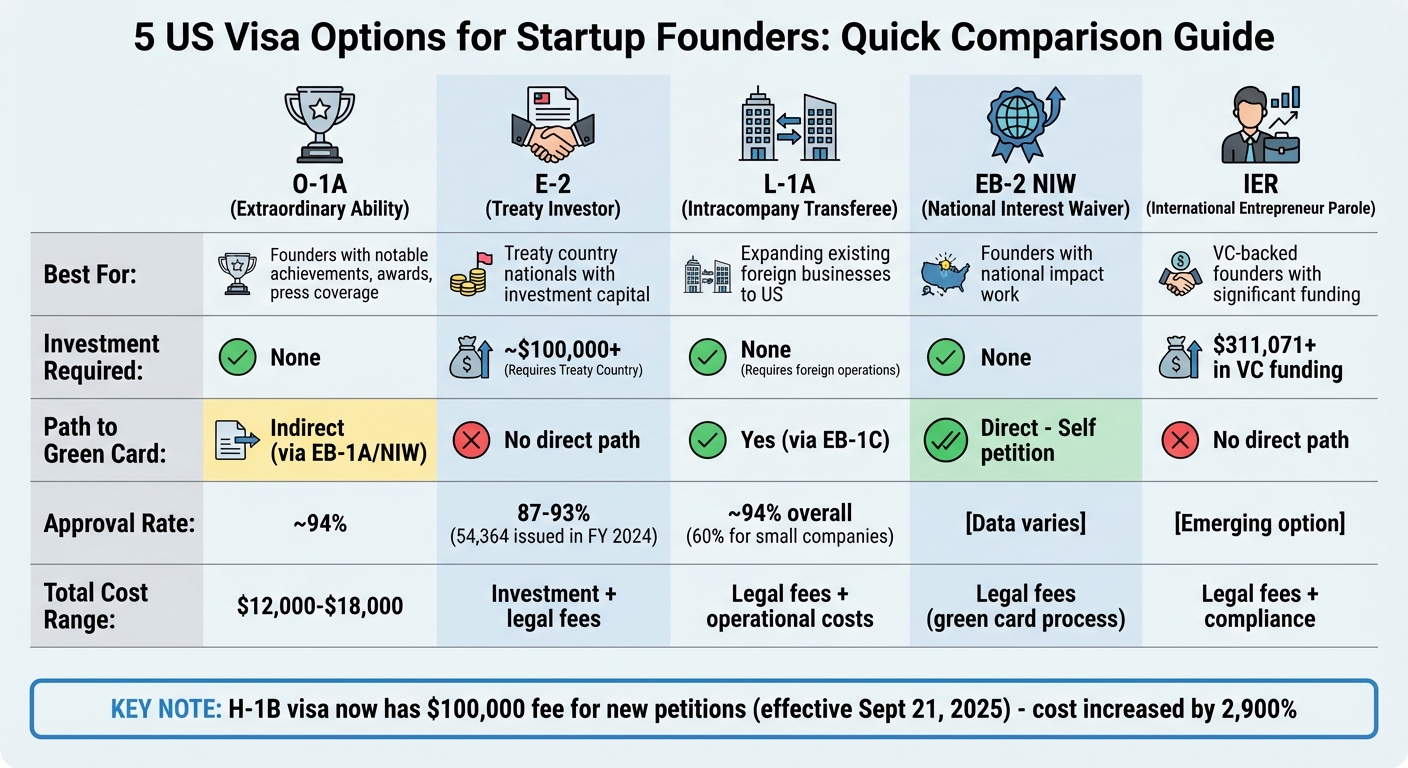
US Visa Options Comparison for Startup Founders
1. Selecting the Wrong Visa Type
Choosing the wrong visa can seriously delay your business plans. Since the U.S. doesn’t have a dedicated startup visa, founders often rely on investor or employee visa categories. Picking the wrong one can mean months of delays, wasted fees, or even outright denials that throw your timeline off track.
Visa Options for Startup Founders
Several visa options exist for startup founders, each tailored to different circumstances:
- O-1A (Extraordinary Ability): Ideal for founders with notable achievements like industry awards, press coverage, or key roles in major projects. This visa doesn’t have an annual cap or lottery, and your U.S. company can sponsor you, provided you establish a Board of Directors to meet employer-employee relationship requirements. Approval rates hover around 94%, but a strong application typically includes 500 to 700 pages of evidence. Premium processing costs $2,965 as of March 1, 2026, with decisions guaranteed within 15 business days.
- E-2 (Treaty Investor): Best for nationals of treaty countries who can invest a "substantial" amount, usually $100,000 or more, into a U.S. business. In FY 2024, 54,364 E-2 visas were issued, with approval rates between 87% and 93%. However, this visa doesn’t offer a direct pathway to permanent residency, which could complicate long-term plans.
- L-1A (Intracompany Transferee): Suitable for founders expanding an existing foreign business to the U.S., provided they’ve worked for the foreign entity for at least a year.
- EB-2 NIW (National Interest Waiver): This green card option is available to founders whose work holds "substantial merit and national importance." It allows for self-petition without needing a job offer.
- International Entrepreneur Parole (IER): A viable option for VC-backed founders, requiring $311,071 in qualified U.S. investment.
Here’s a quick comparison of these visa options:
| Visa Type | Best For | Investment Required | Path to Green Card |
|---|---|---|---|
| O-1A | Founders with notable achievements | None | Indirect (via EB-1A/NIW) |
| E-2 | Nationals of treaty countries | ~$100,000+ | No direct path |
| L-1A | Expanding foreign businesses | None (requires foreign ops) | Yes (via EB-1C) |
| EB-2 NIW | Founders with national impact | None | Direct (Self-petition) |
| IER | VC-backed founders | $311,071+ in VC funding | No direct path |
While the H-1B visa was once a common choice for founders, recent changes have made it less practical. A Presidential Proclamation effective September 21, 2025, introduced a $100,000 fee for new petitions from beneficiaries outside the U.S., increasing costs by over 2,900%.
How to Choose the Right Visa Category
To select the right visa, consider five key factors: your nationality, funding level, achievements, urgency, and long-term residency goals. For instance:
- If you’re from a treaty country with capital to invest, the E-2 might be your best option.
- If you have impressive achievements but limited funding, the O-1A could be a better fit.
- If permanent residency is your priority, the EB-2 NIW offers a direct pathway.
"The US is the best place in the Western world to build a tech business right now. To get an O-1, you need to show that you’re a high earner, you’ve made a meaningful contribution to your field."
– Christopher Kong, Co-Founder & CEO, Corvera
Make sure your visa aligns with your business plan. For example, the E-2 requires demonstrating job creation and business viability, while the NIW demands evidence of national impact. Misalignment could lead to costly requests for evidence (RFEs) or denials.
Start preparing evidence 6–12 months before filing. Gather proof of media mentions, awards, judging roles, and key contributions to major projects. Avoid using awards perceived as "pay-to-play", like Stevie or Globee, as USCIS often disregards them or issues Notices of Intent to Revoke. Accelerator memberships are also under increased scrutiny, as USCIS may view them as potential rather than proven success.
For O-1A self-petitions, ensure proper governance by setting up a Board of Directors to fulfill employer-employee relationship requirements. You’ll also need a legitimate U.S. entity – services like Business Anywhere can help with EIN registration and compliance to establish the necessary structure.
Costs for the O-1A range from $12,000 to $18,000, including $5,000–$15,000 in attorney fees. Given the complexity, consulting an immigration attorney is highly recommended. Choosing the right visa at the outset can save time, money, and avoid disruptions that could jeopardize your startup.
2. Submitting Incomplete or Weak Documentation
Incomplete or poorly prepared documentation can significantly delay visa approvals. In FY 2023, over 20% of H‑1B petitions received Requests for Evidence (RFEs). Of those, 22% cited insufficient evidence – like missing degree evaluations or unclear job responsibilities. Additionally, about 10% of rejected petitions in FY 2022 were returned due to avoidable clerical mistakes, such as unsigned forms, unchecked boxes, or outdated USCIS forms. These errors can result in months of delays and unnecessary expenses for founders.
Frequent Documentation Errors
One of the most common mistakes is providing vague company descriptions. For example, saying "providing technology solutions" without detailing your industry, unique offerings, or specific products can raise red flags with USCIS.
"A vague company description is a red flag. Without clear and specific details, government authorities are left guessing about the nature of the business." – Visa Business Plans
Financial inconsistencies are another frequent issue. When the financial details in your business plan don’t match supporting documents like bank statements or invoices, it can trigger RFEs. In FY 2022, 8% of RFEs specifically requested additional financial documentation to confirm employers could pay wages. Every financial claim should be backed by verifiable evidence, such as receipts or bank statements.
Unrealistic projections can also lead to scrutiny, especially if they lack market research to support them. Similarly, weak hiring plans – those missing specific job titles, detailed responsibilities, or recruitment timelines – invite additional review. Startups often face challenges proving operations, which requires evidence such as client or vendor agreements, transaction records, and proof of a physical office. While the overall L‑1 visa approval rate is around 94%, it drops to just 60% for small companies with fewer than 10 employees.
These documentation errors not only delay operations but can also jeopardize funding opportunities. Avoiding these pitfalls requires careful preparation.
| Error Type | Frequency (FY 2023) | Common Outcome |
|---|---|---|
| Incomplete Forms | 10% of rejections | Immediate rejection |
| Missing/Inadequate Evidence | 22% of RFEs | Denial if unresolved |
| Insufficient Financial Proof | 8% of RFEs | Administrative processing |
How to Prepare Strong Supporting Documents
Start gathering your documents 4–6 months in advance to minimize errors. USCIS prioritizes "probative and credible" evidence – objective data that supports your claims over subjective assertions. Instead of relying heavily on recommendation letters, focus on hard evidence like revenue metrics, user growth statistics, patent awards, or organic media coverage from respected outlets.
Avoid using "pay-to-play" awards or sponsored recognitions, as USCIS often disregards these. Sponsored articles, advertorials, and awards like Stevie or Globee are closely scrutinized. A strong O‑1A petition typically includes 500–700 pages of evidence, organized with a clear cover letter and exhibit index. Founders should include employment agreements, detailed job descriptions, and attestations from co-founders or HR directors to demonstrate their active role in the startup.
Educational credentials should be backed by diplomas, transcripts, and evaluations for foreign degrees from recognized agencies like WES. For specialty occupation visas, use precise job titles and ensure the duties clearly align with the requirement for a bachelor’s degree or higher.
If you’re claiming intellectual property, include supporting documents like patent filings or research publications. Founders who have participated in reputable startup accelerators like Y Combinator or Techstars should include documentation of their participation. However, keep in mind that USCIS may view accelerator memberships as indicators of future potential rather than proof of past achievements.
Finally, ensure all documents meet U.S. legal standards by using professional services for authentication. For example, BusinessAnywhere’s online notary service charges $37 per notarization. Always double-check that you’re using the latest USCIS forms from their official website, as outdated forms can lead to immediate rejections.
"Accuracy is your best ally." – Arvian Law Firm
In 2023, 15% of RFE responses still resulted in denials due to unresolved evidentiary gaps.
3. Using Tourist Visas for Business Work
Misusing tourist visas can cause serious problems for your startup’s operations in the U.S. Founders often make the mistake of using B-1/B-2 visas for business activities that go beyond what these visas allow, risking severe consequences. For example, in 2013, Infosys faced a $34 million settlement for using B-1 visas for work that required H-1B status. Such violations can lead to immediate deportation, visa cancellations, and reentry bans ranging from three to ten years.
What’s Allowed – and What’s Not
The line between acceptable and unacceptable activities on a B-1 visa is often misunderstood. You’re allowed to attend meetings, negotiate contracts, incorporate a U.S. company, and perform other "passive" tasks. However, you cannot manage daily operations, supervise employees, or engage in any work that benefits a U.S. business directly. Even unpaid work can be problematic if it replaces a role that would typically be filled by a U.S. worker.
Customs and Border Protection (CBP) officers are vigilant about detecting unauthorized work. They often inspect electronic devices and social media profiles to verify compliance. As Alex Schulte from Centuro Global explains:
"If officers suspect you’ll engage in unauthorised activities or labour, denial is mandatory, not discretionary."
- Alex Schulte, Content Marketing Manager, Centuro Global
Remote work adds another layer of complexity. Working for your foreign employer while physically in the U.S. on a tourist visa is usually seen as a violation, even if you’re not being paid.
Tourist Visa Basics
B-1 visas typically allow a stay of up to six months, while travelers under the Visa Waiver Program (ESTA) are limited to 90 days with no extension option. The cost of a B-1 visa is around $185, but starting October 1, 2025, an additional $250 Visa Integrity Fee will bring the total to $435.
Here’s a quick breakdown of what’s allowed and what’s not:
- Permitted activities: Attending board meetings, negotiating contracts, participating in conferences, conducting market research, incorporating a U.S. entity, opening bank accounts, and seeking investment.
- Prohibited activities: Supervising U.S. employees, making hiring or firing decisions, onboarding staff, engaging in product development, or receiving any salary from a U.S. source. Physical labor and performing as an artist or athlete for a paying audience are also off-limits. Academic courses for credit require a student visa.
| Activity Type | B-1 Business Visitor | Visa Waiver (ESTA) |
|---|---|---|
| Maximum Initial Stay | 6 months | 90 days |
| Extension of Stay | Possible (up to an additional 6 months) | Not permitted |
| Permitted Activities | Meetings, negotiations, research | Same as B-1 |
| Change of Status | Possible (subject to the 90-day rule) | Not permitted |
Overstaying your visa can lead to serious penalties, including a three-year ban for overstays of more than 180 days and a ten-year ban for overstays exceeding one year. Violating your visa status under INA Section 222(g) can void your current visa and make future immigration much more difficult. In fiscal year 2024, the global approval rate for B-1/B-2 visas was about 72.2%, and increased scrutiny has pushed some interview dates as far out as 2027.
Staying Compliant While Operating Remotely
To avoid issues, plan your visit carefully and communicate clearly. When speaking with CBP officers, avoid saying you’re coming "to work." Instead, describe your visit as "attending business meetings" or "negotiating contracts." Bring supporting documents like invitation letters, meeting schedules, and proof of return travel.
It’s also wise to limit any remote work to a maximum of 30 days while in the U.S. to reduce immigration and tax risks. Make sure your professional profiles, such as LinkedIn, align with the purpose of your visit, as border officials often review this information. High-level strategic tasks are generally allowed, but operational work is not.
If your role expands to include managing daily operations or hiring employees, it’s time to switch to an appropriate work visa, such as the O-1, L-1, or E-2. Continuing on a tourist visa under these circumstances could jeopardize future immigration applications.
"If you’re providing operational benefit to a U.S. business, CBP may consider it unauthorized employment regardless of compensation."
To maintain a presence in the U.S. without being physically involved in day-to-day operations, consider using virtual tools. For instance, services like BusinessAnywhere offer virtual mailboxes and registered agent support, enabling you to handle essential tasks remotely while staying compliant with immigration laws. Taking these precautions ensures your visa status aligns with your business needs.
sbb-itb-ba0a4be
4. Ignoring U.S. Business Compliance Requirements
Starting a U.S. company is just the first step. The real challenge lies in maintaining compliance, and failing to do so can have serious consequences for your visa status and future immigration applications.
Common Compliance Oversights
Several compliance pitfalls can derail your immigration process if overlooked. Here are some key ones to watch out for:
1. Beneficial Ownership Information Report (BOIR):
Since 2025, most U.S. companies must report beneficial ownership details to the Financial Crimes Enforcement Network (FinCEN). Non-compliance, especially for foreign-owned businesses, can lead to federal scrutiny and jeopardize your company’s good standing – something crucial for visa renewals.
2. S-Corp Elections:
If you’ve chosen an S-Corp structure, filing Form 2553 with the IRS by the deadline is mandatory. You’re also required to pay yourself a "reasonable salary" through a formal payroll system. The IRS actively audits this, and failure to comply can result in tax issues that may complicate your immigration status.
3. State-Level Compliance:
Many founders register their businesses in one state (like Delaware) but operate in another. If you don’t file for foreign qualification in the operating state, you risk penalties and additional fees. This is especially important for visa extensions, as state compliance is often reviewed during the process.
4. VIBE Database:
The Validation Instrument for Business Enterprises (VIBE) database is used by USCIS to verify your company’s legitimacy during visa adjudications. An incomplete or non-compliant VIBE record can lead to delays or even visa denials. As Mark I. Davies, Chairman of Davies & Associates, explains:
"Forming a U.S. company is often simple; maintaining proper compliance is where most founders run into issues."
5. Tax Residency and Reporting:
Under the Substantial Presence Test, spending 183 days in the U.S. over a rolling three-year period means you must report worldwide income to the IRS. Additionally, holding more than $10,000 in foreign bank accounts requires filing a Foreign Bank Account Report (FBAR) with the U.S. Treasury. Missing this can result in hefty penalties.
Here’s a quick summary of these compliance tasks, their deadlines, and the potential immigration consequences of non-compliance:
| Compliance Task | Typical Deadline or Frequency | Immigration Impact if Missed |
|---|---|---|
| BOIR Filing | Upon company formation | Federal penalties and loss of good standing |
| S-Corp Election (Form 2553) | IRS deadline following formation | IRS audits and tax complications affecting visa applications |
| State Annual Reports | Annually (varies by state) | Loss of good standing and potential visa extension denials |
| VIBE Registration | Before filing a visa application | Visa delays or denials due to unverified company status |
| Form I-9 (Employment Eligibility) | Within 3 days of hiring | Civil penalties ranging from hundreds to thousands per violation |
Managing Compliance with Automated Tools
Staying on top of compliance requirements is critical, especially when your immigration status depends on it. Manual tracking can be risky, but automated tools can help you avoid costly mistakes.
Platforms like BusinessAnywhere simplify compliance by automating tasks such as BOIR filings (for $37) and S-Corp elections (for $147). These tools send reminders for critical deadlines and manage submissions, reducing the risk of missed filings. Their centralized dashboards also help you track state annual reports, franchise taxes, and other recurring obligations.
In addition to automation, separating your finances by opening a dedicated business bank account is essential. This not only protects your liability shield but also makes tax deductions easier – both of which are critical during immigration reviews.
If you’re pursuing an L-1 or E-2 visa, ensure your business structure meets the specific requirements. For instance, E-2 visas require at least 50% ownership by treaty nationals. Falling below this threshold could result in losing your visa status. Aligning your business and financial compliance with your immigration goals from the start can save you from costly restructuring later on.
5. Waiting Too Long to Get Professional Help
Getting professional assistance early can make all the difference when navigating the complexities of U.S. immigration policies. Many founders delay addressing immigration issues, often underestimating how quickly things can spiral into delays or even denials. Immigration rules are constantly changing, and trying to keep up on your own can lead to costly missteps that could have been avoided with expert guidance.
How Policy Changes Affect Founders
U.S. immigration policies are anything but static. Even well-prepared applications can hit roadblocks due to sudden policy shifts. For instance, the overhaul of the H-1B lottery system in February 2026 introduced a wage-weighted model, giving Level IV positions four times the selection weight of Level I roles. This, combined with increased premium processing fees, has made it essential for founders to update job descriptions and financial plans promptly. Additionally, new fees, like the $300 surcharge per Form I-129 for small employers with 25 or fewer employees, add another layer of complexity.
Another significant change is the USCIS requirement for consular officers to review five years of social media history, a policy that took effect in 2026. Such changes can disrupt operations and make immigration a critical part of a startup’s infrastructure. And the stakes are high – 23% of startup failures are tied to team-related issues, including immigration hurdles. Even something as routine as a Request for Evidence (RFE) from USCIS can delay timelines by 2 to 4 months, potentially derailing product launches or forcing founders to pivot unexpectedly.
Given these challenges, securing professional help early isn’t just a good idea – it’s essential.
When to Hire Immigration Professionals
The best time to bring in an immigration expert? Before you dive into active work for your startup. While initial activities like market research or incorporation might not require immediate authorization, anything involving product development, hiring, or customer outreach does.
Adan G. Vega, a Board-Certified Immigration Specialist, emphasizes the importance of preparation:
"I review cases where investors spent $1 million but lost approval due to poor documentation. We spend months gathering evidence before filing. This preparation prevents denials and saves time."
Early engagement with an immigration attorney can also help you avoid structural pitfalls. For example, pursuing an H-1B visa requires establishing a "bona fide" employer-employee relationship, which often involves setting up a formal Board of Directors. Choosing the wrong business structure, such as a sole proprietorship instead of a C-Corp, could lead to costly restructuring later.
Professional fees for immigration services vary, typically ranging from $15,000 to $50,000, depending on the complexity of the case, plus government filing fees. For non-U.S. founders, tools like BusinessAnywhere’s Digital Nomad Kit (around $3,200) provide a complete setup package, including LLC registration, EIN application, registered agent services, and compliance support. This kind of bundled service ensures your business structure aligns with your immigration goals from the start, helping to avoid expensive mistakes down the road.
As Muhammed Uzum, Founding Attorney at Grape Law Firm PLLC, advises:
"Founders should consider immigration strategy as a fundamental component of their business planning. Start early, maintain meticulous documentation, and stay informed about policy changes."
Conclusion
The strategies outlined above can help founders avoid common immigration pitfalls. U.S. immigration challenges don’t have to disrupt your startup’s growth. The five key mistakes – choosing the wrong visa type, submitting weak documentation, misusing tourist visas, ignoring compliance requirements, and delaying professional help – can all be sidestepped with proper planning and resources.
It’s crucial to map out your immigration strategy early. For example, building evidence for an O-1A visa may take 6–12 months, while H-1B self-sponsorship requires establishing the right governance structures in advance. Keep in mind, owning a business doesn’t grant you work authorization; you’ll need the correct visa to handle contracts, hire employees, or develop your product.
Services like BusinessAnywhere simplify tasks such as entity formation, EIN registration, and compliance, ensuring your business structure aligns with immigration requirements. For non-U.S. founders, the Digital Nomad Kit (priced at approximately $3,200) combines these essentials into a single package, reducing the risk of structural issues that might jeopardize your visa application later.
Stay updated by checking the USCIS Visa Bulletin regularly. With changes like the H-1B lottery moving to a wage-weighted model starting February 27, 2026, and new social media review requirements already in place, staying informed is more critical than ever.
Muhammed Uzum of Grape Law Firm PLLC offers this key advice:
"Founders should consider immigration strategy as a fundamental component of their business planning. Start early, maintain meticulous documentation, and stay informed about policy changes".
FAQs
Which U.S. visa is best for my startup and long-term goals?
The right U.S. visa for your startup and long-term goals hinges on your specific situation. Popular choices include:
- The E-2 visa, ideal for entrepreneurs making a substantial investment in their business.
- The O-1A visa, suited for individuals with extraordinary abilities in their field.
- The EB-2 NIW, a pathway to a green card for those whose work benefits the national interest.
Carefully assess your business needs and future ambitions when deciding which option aligns best with your plans.
What evidence should I prepare to avoid an RFE or denial?
To steer clear of an RFE or denial, it’s crucial to provide clear, precise, and well-documented evidence with your application. Essential documents to include might be:
- Detailed job descriptions and duties: These help justify wage levels for applications like H-1B or PERM.
- Financial projections and proof of business operations: Necessary for visa types such as E-2 or L-1.
- Investment documentation, organizational charts, and business plans: These are critical for demonstrating the viability of your business.
Careful preparation, tailored to the specific visa requirements, can significantly reduce potential risks.
What startup tasks are illegal on a B-1/B-2 or ESTA?
When traveling to the U.S. on a B-1/B-2 visa or under the ESTA program, it’s important to know what’s allowed – and what isn’t. Activities like managing daily operations, hiring or firing employees, performing hands-on work, or accepting U.S.-source compensation are prohibited. These visas are strictly for specific purposes, such as attending meetings, negotiating contracts, or exploring potential business opportunities. They do not permit employment or involvement in operational roles.