


Managing a U.S. business while living abroad involves strict legal and tax obligations. Here’s what you need to know:
- Tax Compliance: The IRS taxes your worldwide income as a U.S. citizen or resident. Failing to meet tax obligations can lead to severe penalties, including passport issues.
- Registered Agent: Every U.S. business must maintain a registered agent with a physical address in the U.S. Professional services can help handle this requirement.
- Annual Filings: Stay on top of annual reports and franchise fees to keep your business in good standing. Deadlines and fees vary by state.
- Form 5472: If you own 25% or more of a U.S. business, you must file Form 5472 to report certain transactions. Missing deadlines can result in hefty penalties.
- Virtual Mailboxes: These services provide a U.S. address and digitized mail access, ensuring you don’t miss critical documents while overseas.
- State Nexus Rules: Your business activities, like having remote employees or significant sales in a state, may trigger state tax obligations.
Using professional services and digital tools can simplify compliance, helping you meet legal requirements and avoid costly mistakes.
Maintaining a Registered Agent in the U.S.
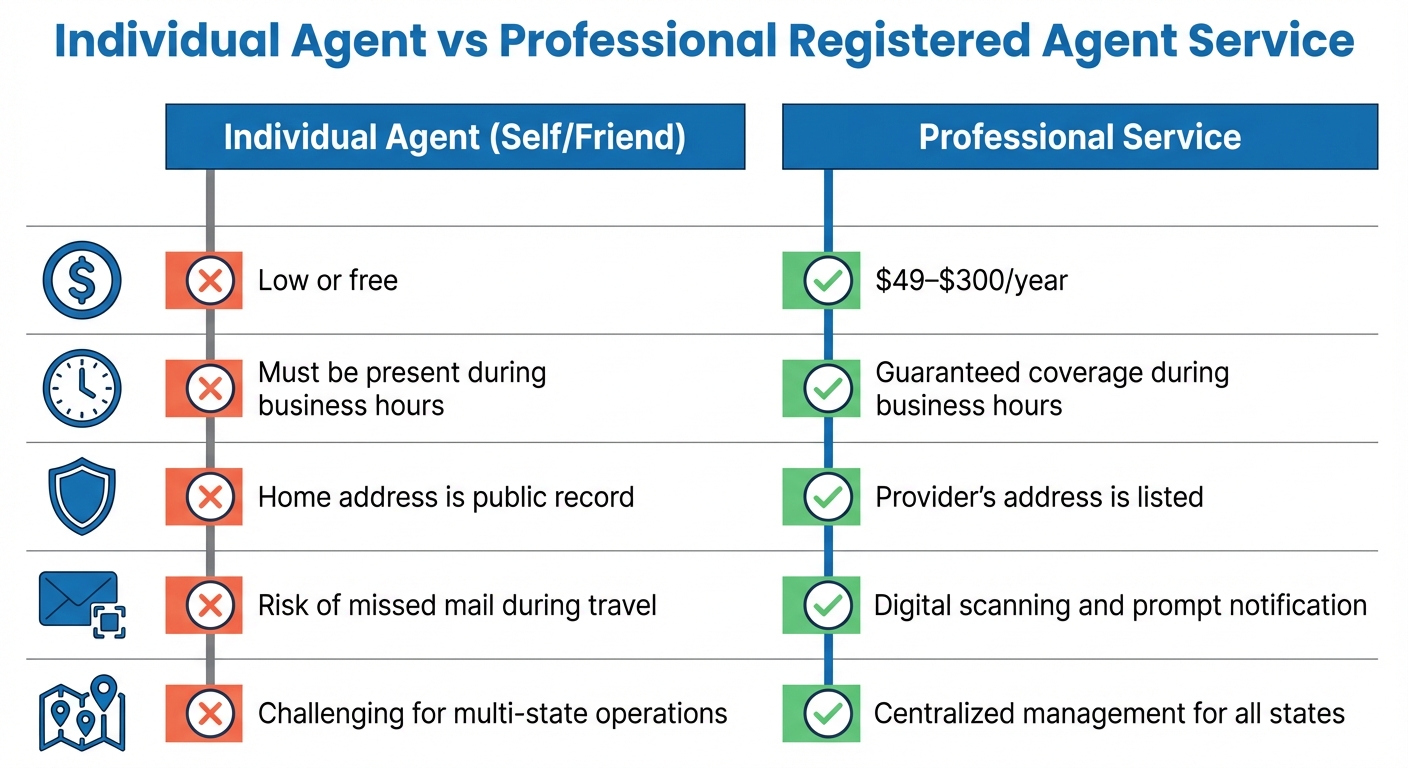
Individual vs Professional Registered Agent Services Comparison
Why You Need a Registered Agent
If you’re running a U.S.-registered business while living abroad, having a registered agent is a must. This role ensures your business stays legally compliant and accessible for official communications. Whether you operate an LLC, corporation, LP, or LLP, every state requires you to designate a registered agent with a physical street address. The agent must be available Monday through Friday, from 9:00 AM to 5:00 PM. Keep in mind – P.O. boxes and virtual mailboxes don’t meet this requirement.
For businesses abroad, a professional registered agent can be a lifesaver. They ensure you never miss critical legal documents, as Business.com explains:
"A registered agent is an individual or business that acts as a state’s means of communicating with a corporation or limited liability company (LLC)."
Failing to maintain a registered agent can have serious consequences. Your business could lose its good standing, face administrative dissolution, or even risk a default judgment if a legal notice goes unanswered. Worse, this could jeopardize the personal asset protection your business structure provides .
How to Choose and Update Your Registered Agent
For entrepreneurs living outside the U.S., hiring a professional registered agent service is usually the best route. These services typically cost between $49 and $300 per year. For instance, BusinessAnywhere offers registered agent services for $147 annually, with the first year free when you register your business. Their services include a legal U.S. address and compliance reminders.
When selecting a service, don’t just look at the price. Consider features like same-day document scanning and electronic delivery, which allow you to quickly access important legal notices no matter where you are. If your business operates in multiple states, opt for a national provider that offers multi-state compliance management and automated reminders.
Need to update your registered agent? File a "Statement of Change of Registered Agent" with your Secretary of State. Most states charge $25 to $50 for this filing. Online submissions typically take one to two weeks, while mail filings may take two to four weeks. Make sure to report any changes within 30 days to avoid compliance issues. And always appoint a new agent before your current one steps down.
Another benefit of using a professional service? Protecting your privacy. They keep your home address off public records. As SCORE points out:
"If you list yourself as your business’s registered agent, you’ll probably be listing your home address… This puts your home address on public record, and anyone who wants to officially contact your business… will find your home address."
Here’s a quick comparison of using an individual agent versus a professional service:
| Feature | Individual Agent (Self/Friend) | Professional Service |
|---|---|---|
| Cost | Low or free | $49–$300/year |
| Availability | Must be present during business hours | Guaranteed coverage during business hours |
| Privacy | Home address is public record | Provider’s address is listed |
| Reliability | Risk of missed mail during travel | Digital scanning and prompt notification |
| Scalability | Challenging for multi-state operations | Centralized management for all states |
Understanding Tax Obligations and Reporting Requirements
Federal Tax Requirements: Filing Form 5472
Owning a U.S. business while living abroad doesn’t exempt you from federal tax responsibilities – even if your business doesn’t generate revenue. As Vincenzo Villamena, CPA and CEO of Entity Inc., explains:
"The IRS doesn’t care where you live. When you own a US entity, you must comply with US regulations."
If you’re a foreign owner with at least a 25% stake in a U.S. business, you’re required to file Form 5472. This form details transactions between your company and related foreign parties, including capital contributions, owner funding, distributions, loans, and reimbursements. Additionally, you must include a pro forma Form 1120 as a cover page, even if your LLC doesn’t owe corporate income tax.
The filing deadline for Form 5472 is April 15, 2026. If you need extra time, you can file Form 7004 for a six-month extension, pushing the deadline to October 15, 2026. However, this extension applies only to filing, not to paying any taxes due. Missing the deadline or filing incorrectly can lead to a hefty $25,000 penalty, which could exceed $50,000 if not corrected promptly. To avoid issues, keep detailed records of all reportable transactions for at least seven years.
State and Local Tax Compliance
Federal tax filings are just the beginning – state and local tax rules add another layer of responsibility. Each state has its own guidelines, and many enforce nexus (a taxable connection) if your business has a physical presence, such as property or employees, or if it meets specific economic thresholds. For instance, in many states, nexus is triggered when annual receipts within the state exceed $500,000.
Remote work arrangements can also create unexpected tax obligations. As Jeffrey N. Bilsky, CPA at BDO USA LLP, highlights:
"Since the end of the COVID-19 pandemic, states have become more aggressive in asserting nexus against taxpayers with limited in-state presence caused by remote employees."
It’s important to note that federal tax treaties don’t shield you from state-level taxes. States like California and Pennsylvania often tax income that would otherwise be excluded under such treaties. To stay compliant, track where your employees are located and monitor sales by state. Be aware of liabilities like franchise taxes, sales taxes, and gross receipts taxes. If your LLC operates in multiple states, you may need to register it as a foreign entity in those states. Additionally, major cities like New York, Los Angeles, and San Francisco may impose their own local taxes on top of state requirements.
Navigating both federal and state tax rules is essential for running your U.S. business smoothly from abroad. Proper planning and attention to detail can help you avoid costly penalties.
Managing Annual Filings and Compliance Deadlines
Annual Reports and Franchise Fees Explained
Staying on top of annual filings is a must for keeping your U.S. business in good standing, especially if you’re managing operations from abroad. These filings include annual reports and franchise tax payments, both of which are essential for compliance. Annual reports ensure that your business information – like your address, registered agent, and ownership structure – is up-to-date with the state. On the other hand, franchise taxes are state-specific fees for the privilege of legally operating your business. Missing these deadlines can lead to penalties or even administrative dissolution, so understanding and meeting your state’s requirements is critical.
As Özgür Kuşkonmaz from Clemta puts it:
"Filing your annual report is critical for maintaining your business’s legal standing in the U.S."
Franchise taxes differ from income taxes. They are flat fees or minimum charges set by states for legal business operation. For example, Delaware requires LLCs to pay $300 annually, while California sets a minimum franchise tax of $800, regardless of the company’s revenue. Missing deadlines can be costly – Florida, for instance, imposes a $400 penalty for reports filed after May 1. California also enforces strict penalties, with its $800 LLC tax due on January 1 and a $200 monthly penalty for late payments.
Deadlines vary widely. Some states base them on your business’s formation anniversary, while others follow the calendar year. If your business operates in multiple states, you’ll need to handle separate filings for each. This makes it crucial to track deadlines carefully, especially when managing operations remotely. Centralized digital tools can be a game-changer for staying organized.
Using Digital Tools for Timely Filing
Managing compliance deadlines across multiple states can get overwhelming, but digital tools can make it much easier. These tools automate reminders, consolidate filing processes, and save significant administrative time. They’re especially useful for businesses with remote employees or sales activity in different states, which can create additional nexus and compliance requirements.
Specialized compliance tools can track state-specific requirements and ensure nothing slips through the cracks. Additionally, professional registered agent services, which typically cost between $50 and $200 annually, are invaluable for receiving critical government notices.
For example, BusinessAnywhere offers registered agent services for $147 per year, with the first year free if you register your business through them. Their service includes compliance alerts to help you meet deadlines. Pairing this with a virtual mailbox ensures all official correspondence is digitized and accessible from anywhere. This setup can prevent missed notices that might jeopardize your business’s legal standing.
sbb-itb-ba0a4be
Using Remote Tools to Stay Compliant
Remote tools can play a crucial role in keeping your business legally and financially compliant, even when you’re operating from abroad. These tools integrate seamlessly into your digital compliance strategy, helping you meet essential legal and tax obligations.
Virtual Mailbox Services for Managing Business Mail
Virtual mailbox services are a game-changer for remote business operations, especially for those working internationally. These services provide a U.S. street address (not a P.O. Box), which is essential for IRS compliance, state registrations, and banking needs. They scan your incoming mail and upload it to a secure online dashboard, giving you 24/7 access from anywhere in the world.
Here’s what makes virtual mailboxes so useful:
- Check deposit services: Some providers can deposit checks directly into your U.S. business bank account.
- Audit-ready records: Digital copies are timestamped, meeting the IRS’s 7-year retention requirement.
- Privacy protection: Keeps personal addresses off public records, adding an extra layer of security.
Plans for virtual mailboxes are affordable. Basic options start at $15–$30 per month, while mid-tier plans, which are ideal for expats, cost $30–$50 per month. For instance, BusinessAnywhere offers a virtual mailbox service starting at $20/month. This includes unlimited scanning and global forwarding, with locations in Florida, Arizona, New Mexico, and Wyoming. To authorize a virtual mailbox provider to handle your mail, you’ll need to complete USPS Form 1583. Thankfully, many providers now offer remote notary services to simplify this process, even if you’re overseas.
"A virtual mailbox provides the stability and peace of mind that comes from knowing you won’t miss critical mail."
– Mike Wallace, CEO, Greenback Expat Tax Services
For example, Sarah, a digital nomad living in Southeast Asia, used a mid-tier virtual mailbox plan in Texas for $35/month in 2025. She managed about 10 pieces of mail each month and forwarded packages every few months for $30 per shipment. Her annual cost for maintaining her U.S. presence and banking stability was around $540.
Virtual mailboxes don’t just help with mail – they also ensure you stay on top of crucial filings like EIN and BOI submissions.
Remote EIN and BOI Filing Services
Securing an Employer Identification Number (EIN) and filing Beneficial Ownership Information (BOI) reports can be tricky when you’re abroad. Non-residents without a Social Security Number or ITIN can’t use the IRS’s online EIN portal, leaving fax or mail as the only options. Faxing typically takes 5–15 business days for approval, while mail applications can stretch to 4–6 weeks during busy periods.
Professional filing services simplify this process. They handle the preparation and submission of IRS Form SS-4 and BOI reports, reducing the risk of errors and rejections. Many platforms bundle these services with registered agent support, providing a comprehensive compliance solution. For instance, BusinessAnywhere offers EIN application services for $97 and BOIR filing for $37, all managed through a secure online dashboard.
"An EIN is required soon after [formation] to handle key business activities… including opening a U.S. business bank account [and] registering with Stripe, Amazon, or PayPal."
– Vincenzo Villamena, CEO at Entity Inc.
When applying for an EIN, make sure the "responsible party" listed on Form SS-4 is an individual, not another business entity, to meet IRS regulations. A virtual mailbox can help you receive critical IRS documents, like the CP 575 confirmation letter, without delays.
Conclusion
Managing a U.S. business from overseas demands ongoing attention to compliance. Key tasks like appointing registered agents, filing taxes, submitting annual reports, and maintaining a valid business address are essential for protecting your liability shield and avoiding penalties that can climb as high as $25,000.
Digital tools make this process more manageable. For instance, virtual mailbox services ensure you stay connected to important government correspondence, while professional filing services can handle EIN applications and BOIR filings – eliminating the hassle of international faxing or mailing delays. Platforms like BusinessAnywhere streamline these tasks, offering everything from business registration (starting at $0 plus state fees) to virtual mailbox plans beginning at $20/month, and EIN filing services for $97.
Missing compliance deadlines or required filings can have serious consequences, including losing good standing, exposing yourself to personal liability, or even risking passport revocation for unresolved tax debts. To avoid these risks, appoint a registered agent, set up automated compliance reminders, and use digital tools to handle your U.S. business operations efficiently from abroad. These proactive steps will help safeguard your business’s legal status while you manage it internationally.
FAQs
Do I need to file U.S. taxes even if I live abroad?
Yes, if you’re a U.S. citizen or resident alien living overseas, you’re typically required to file U.S. tax returns and report your worldwide income. This rule applies no matter where you live or where your income is earned.
Can I use a virtual mailbox as my registered agent address?
Yes, you can use a virtual mailbox as your registered agent address, provided it offers a physical U.S. address. It should also include mail scanning and forwarding services, which are crucial for receiving official and legal documents tied to your business. These services help ensure you remain compliant while managing a U.S.-registered business from outside the country.
How do I know if I owe state taxes in a state I don’t live in?
If you’re earning income from a state you no longer live in, or if that state still considers you a resident for tax purposes, you might still owe state taxes there. This all comes down to the state’s residency rules and whether you’ve officially ended your residency. Be sure to review the specific guidelines for that state to figure out your tax responsibilities.