


If you’re earning money as a creator or influencer, setting up an LLC could save you from legal and financial headaches. Without an LLC, your personal assets – like your home or savings – are at risk if your business faces lawsuits or debts. Plus, you might miss out on tax deductions and credibility with brands. Here’s why forming an LLC makes sense:
- Protect Your Personal Assets: An LLC separates your personal and business finances, shielding your belongings from business liabilities.
- Tax Advantages: Claim deductions for equipment, travel, and more. For higher earnings, S-Corp taxation can reduce self-employment taxes.
- Boost Professional Image: Using an LLC name and EIN instead of your personal info strengthens your credibility with sponsors and agencies.
- Simplify Growth: An LLC makes it easier to hire help, open business accounts, and manage contracts.
If you’re earning at least $500/month or nearing $50,000/year, it’s time to consider forming one. Services like Business Anywhere can guide you through the process, helping you stay compliant and focused on your work.
Main Benefits of Forming an LLC for Creators
Forming an LLC can address many of the risks creators face while offering a range of benefits that help protect personal assets, reduce tax burdens, and enhance professional credibility.
Protection from Personal Liability
One of the biggest advantages of forming an LLC is the legal separation it creates between your personal and business assets. Without this separation, as a sole proprietor, your personal belongings – like your home, car, or savings – could be at risk if your business faces a lawsuit. An LLC establishes a "corporate veil", making your business a distinct legal entity. This means, in most cases, only your business assets are at stake if legal issues arise.
This layer of protection is especially valuable for creators, who may encounter risks like copyright disputes, defamation claims, or contract disagreements with brands. For instance, if a brand partnership goes south and leads to legal action, your personal assets remain protected, while only your business property – such as business bank accounts and equipment – might be exposed. Additionally, using a registered agent service keeps your home address off public records, offering extra privacy. You can also apply for an Employer Identification Number (EIN) from the IRS, which allows you to use a business tax ID on contracts and W-9 forms instead of your Social Security Number.
To maintain this protection, it’s important to open a dedicated business bank account as soon as your LLC is formed. Mixing personal and business finances can compromise the "corporate veil", putting your personal assets at risk.
Tax Benefits and Options
An LLC can also simplify and optimize your tax situation. By default, a single-member LLC is treated as a "disregarded entity" for tax purposes, meaning your business income flows directly to your personal tax return (reported on Schedule C of Form 1040). This setup avoids the double taxation that corporations often face and allows you to deduct business expenses like cameras, editing software, home office costs, travel, and marketing. Without a formal business structure, the IRS might classify your content creation as a hobby, limiting your ability to claim these deductions.
For creators earning over $20,000 annually, electing S-Corp taxation can lead to even more savings. With this option, you pay yourself a "reasonable salary" subject to self-employment taxes (15.3%), while the rest of your profits can be distributed as dividends, which are not subject to these taxes. For those earning $50,000 or more per year, this approach can significantly lower tax obligations.
Whenever you sign contracts or brand deals, make sure to do so under your LLC’s name. This reinforces the separation between personal and business liabilities and ensures you take full advantage of the tax benefits tied to your LLC.
Improved Credibility and Business Growth
Operating as an LLC can also enhance your professional image, making you more attractive to potential partners and sponsors. Using your LLC’s name on contracts and providing an EIN instead of personal details on tax forms signals that you’re running a serious business. This professional image can be key when negotiating high-value brand deals or working with agencies.
For example, organizations like SAG-AFTRA require influencers to have an LLC or corporation to sign certain agreements. Additionally, an LLC makes it easier to open business bank accounts, build business credit, and issue professional invoices. It also provides a formal structure for hiring team members like editors, assistants, or managers, helping you scale your operations smoothly.
An LLC also creates a solid framework for managing intellectual property, such as logos, trademarks, and digital products. This can make your brand more appealing for licensing opportunities or even acquisition in the future. In a creator economy generating over $100 billion annually, transitioning from being a solo creator to a "creator-CEO" can set the stage for long-term success.
Risks of Not Having an LLC
Running a business without an LLC can leave creators exposed to serious risks, both financially and professionally.
Personal Financial Risk
Without an LLC, there’s no legal distinction between you and your business. This means that if something goes wrong – like a copyright infringement claim, a defamation lawsuit, or a contract dispute – your personal assets are on the line. If you lose a case or can’t cover a settlement, creditors could come after your personal property to settle business debts.
The creator economy is full of potential legal pitfalls. Using unlicensed music, making defamatory statements, or running giveaways incorrectly can lead to lawsuits. Even missing FTC #ad disclosures can land you in hot water. And if legal trouble arises, you’re solely responsible for the costs of defending yourself. This lack of protection can also complicate your tax planning, especially when deciding between an LLC vs C Corp.
Higher Taxes and Limited Deductions
Sole proprietors often face higher tax burdens compared to those with an LLC. As a sole proprietor, you’re required to pay self-employment taxes on your entire net income. However, forming an LLC allows you to elect S-Corp status, which offers a tax advantage: you can pay yourself a salary (subject to self-employment taxes) and take the remaining profits as distributions, which aren’t taxed the same way.
Additionally, without a formal business structure, the IRS could classify your content creation as a hobby instead of a legitimate business. This limits your ability to deduct business expenses like cameras, editing software, travel, or marketing. Mixing personal and business finances further complicates tax deductions, potentially leading to missed opportunities to write off expenses.
Challenges Securing Brand Partnerships
Brands and agencies often prefer working with creators who have a formal business structure. Without an LLC, you might be seen as a hobbyist rather than a professional, making high-value sponsors less likely to collaborate with you. In fact, some brands require creators to have an LLC before signing contracts.
"Brands, agencies, and collaborators are more likely to work with influencers who operate under a legitimate business entity rather than as individuals." – LLC Attorney
Using your personal name and Social Security Number on W-9 forms instead of a business name and EIN can also hurt your credibility. Beyond partnerships, not having an LLC can make it harder to scale your business. Hiring team members, building business credit, or securing loans – key steps for growth in a creator economy worth over $100 billion annually – becomes significantly more difficult without the proper structure.
How and When to Form an LLC
When Should You Form an LLC?
Knowing when to form an LLC can make a big difference for your business. If your monthly earnings hit $500 or your annual revenue gets close to $50,000, it’s a good time to start considering it.
Once your yearly income lands in the $50,000 to $80,000 range, forming an LLC becomes even more beneficial. At this point, you can opt for S-Corp taxation. This setup allows you to pay yourself a reasonable salary (subject to self-employment taxes) while taking the rest of your earnings as distributions. This approach can reduce the 15.3% self-employment tax. For example, a creator earning $100,000 annually could save around $6,480 using this structure.
Steps to Form an LLC with Business Anywhere
If you’re ready to form an LLC, Business Anywhere makes the process straightforward:
- Choose the right state: Start by registering in your home state to avoid extra fees. However, if you’re a high earner (making $100,000 or more), states like Wyoming, Florida, or Texas might be worth considering for their privacy or tax advantages.
- Check your business name: Make sure your desired name is available and meets state requirements, including the use of "LLC".
- Pay filing fees: These range from $50 to $500, depending on the state. Business Anywhere includes free initial registered agent services, with ongoing fees starting at $147.
- Get an EIN: After your LLC is approved, you’ll need an Employer Identification Number (EIN) from the IRS to open a business bank account. Business Anywhere can help with the EIN application and offers a custom operating agreement for $97.
- Open a business bank account: This step is crucial to keep your personal and business finances separate, protecting the "corporate veil" that shields your personal assets.
Business Anywhere also helps you stay compliant by tracking deadlines for annual reports and other state requirements, ensuring your LLC remains in good standing.
sbb-itb-ba0a4be
LLC Costs and Maintenance
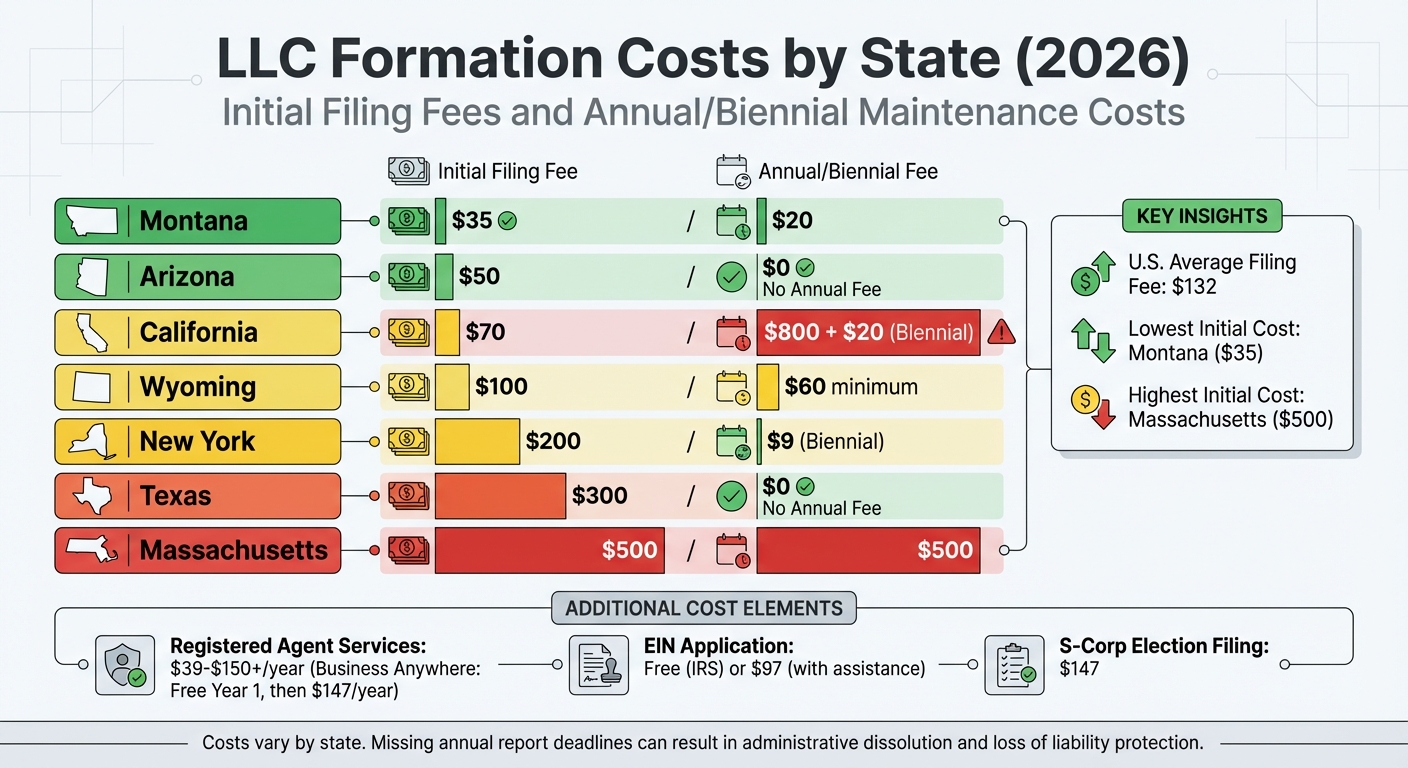
LLC Formation Costs by State for Creators and Influencers
Formation and Annual Costs
The cost of forming an LLC depends on your state. As of 2026, the average filing fee across the U.S. is $132, though it ranges from $35 in Montana to $500 in Massachusetts. These fees cover the Articles of Organization, the document that officially establishes your LLC.
Beyond the initial filing, there are other costs to consider, like hiring a registered agent. A registered agent is someone (or a service) with a physical address in your state who accepts legal documents for your LLC. You can act as your own registered agent if you have a qualifying address, but professional services typically cost between $39 and $150+ per year. For example, Business Anywhere offers free registered agent services for the first year, with fees starting at $147 annually after that.
States also have ongoing requirements that come with their own fees. For example, state report fees can range from $0 in Arizona and Texas to $800 in California, which includes an annual franchise tax regardless of your business income. Missing these deadlines can lead to administrative dissolution and loss of personal liability protection.
Here’s a quick look at some state-specific costs:
| State | Initial Filing Fee | Annual/Biennial Fee |
|---|---|---|
| Montana | $35 | $20 |
| Arizona | $50 | $0 |
| California | $70 | $800 + $20 (Biennial) |
| Wyoming | $100 | $60 minimum |
| New York | $200 | $9 (Biennial) |
| Texas | $300 | $0 |
| Massachusetts | $500 | $500 |
You’ll also need an Employer Identification Number (EIN), which you can get for free from the IRS. If you prefer assistance, services like Business Anywhere offer help with EIN applications for $97. Additionally, starting in 2024, most LLCs must file a Beneficial Ownership Information (BOI) report with FinCEN. While filing it yourself is free, some services charge for handling it.
Staying on top of these requirements is key to avoiding penalties and maintaining your LLC’s good standing.
Compliance and Maintenance Tasks
Once your LLC is formed, there are ongoing responsibilities and costs to keep it compliant. One of the most important tasks is filing state-required reports, which update your LLC’s information, like your registered agent and business address. Deadlines for these reports vary by state. Services like Business Anywhere can help track these deadlines to ensure you remain compliant.
Another critical step is opening and maintaining a separate business bank account. Combining personal and business finances can lead to legal risks, as it could "pierce the corporate veil" and put your personal assets at risk. Open a business account as soon as your LLC is approved, and use it exclusively for business-related transactions.
If your business income grows significantly, consider an S-Corp tax election. Filing Form 2553 with the IRS allows you to reduce self-employment taxes, though it involves additional accounting work. Business Anywhere offers S-Corp election filing for $147. While this option isn’t for everyone, it’s worth exploring if you anticipate substantial profits.
Keeping detailed financial records is another essential task. Tracking all business-related expenses – like equipment, software subscriptions, or travel for partnerships – not only helps with tax deductions but also protects you in case of audits or legal issues. If you expect to owe $1,000 or more in federal taxes, plan to make quarterly estimated tax payments to avoid penalties.
For those willing to handle the paperwork themselves, forming your LLC and acting as your own registered agent can save over $400. However, as your business grows, professional services may save you time and ensure compliance, making them a worthwhile investment.
Conclusion
Setting up an LLC is a practical step for creators once their income becomes steady. It provides a crucial layer of protection by separating personal assets from business liabilities. This means that if legal or financial issues arise, only your business is affected – not your personal finances. On top of that, an LLC allows you to write off business expenses like equipment, software, and travel. And when your income hits around $50,000, choosing S-Corp status could potentially save you thousands in self-employment taxes each year.
An LLC doesn’t just protect – it also boosts your professional image.
"Having ‘LLC’ after your business name makes you look like you know what you’re doing. Brands, sponsors, and clients take you more seriously".
This added credibility can open doors to better partnerships and make negotiating formal contracts much smoother. By establishing an LLC, you’re not just protecting your assets – you’re building a stronger foundation for your creator brand and increasing your chances of landing high-value opportunities.
If you’re ready to take this step, services like Business Anywhere can simplify the process. They offer free registered agent services for the first year, compliance tracking, and support with EIN and S-Corp filings, so you can focus on what you do best: creating.
FAQs
What tax advantages can creators gain by forming an LLC?
Forming an LLC can provide creators with some helpful tax perks. For starters, an LLC is considered a pass-through entity, meaning the business income goes straight to the owner’s personal tax return. This setup avoids the double taxation that corporations often deal with, making tax reporting simpler and potentially reducing your overall tax bill.
As your income grows, you can take things a step further by choosing S-Corp status. This option lets you lower self-employment taxes by splitting your income: part as a reasonable salary (subject to payroll taxes) and the rest as distributions, which aren’t hit with those same taxes. It’s a smart way to keep more of what you earn.
Another benefit of an LLC is the ability to claim tax deductions more easily. Business expenses like equipment, travel, and even home office costs can be written off, helping to reduce taxable income. Plus, keeping your personal and business finances separate makes your financial records clearer – something you’ll definitely appreciate as your business grows.
How does forming an LLC protect my personal assets as an influencer?
Forming an LLC (Limited Liability Company) creates a protective barrier between your personal assets and your business. This means if your influencer business encounters legal troubles – like lawsuits over copyright issues, defamation claims, or contract disputes – your personal property (such as your house, car, or savings) is generally shielded from being used to settle those business-related debts or claims.
This layer of protection becomes increasingly important as your brand expands and you take on bigger projects or partnerships. With an LLC, you can focus on growing your business without the constant worry that your personal belongings might be at risk if challenges arise. It’s a smart way to secure your future as a creator while giving yourself some peace of mind.
When should influencers or creators consider setting up an LLC?
Creators and influencers should consider setting up an LLC once their content creation starts bringing in steady income – typically around $500 or more per month – or when they begin working with brands, signing contracts, or hiring help. An LLC provides legal protection by keeping personal and business assets separate, which helps protect you from financial risks. Plus, it comes with tax advantages that can make managing your income and expenses more straightforward.
This step becomes even more important as your business grows, especially if you’re taking on big collaborations or want to present yourself as more professional to potential partners and clients. Forming an LLC is a smart way to safeguard your brand and set yourself up for long-term success.