


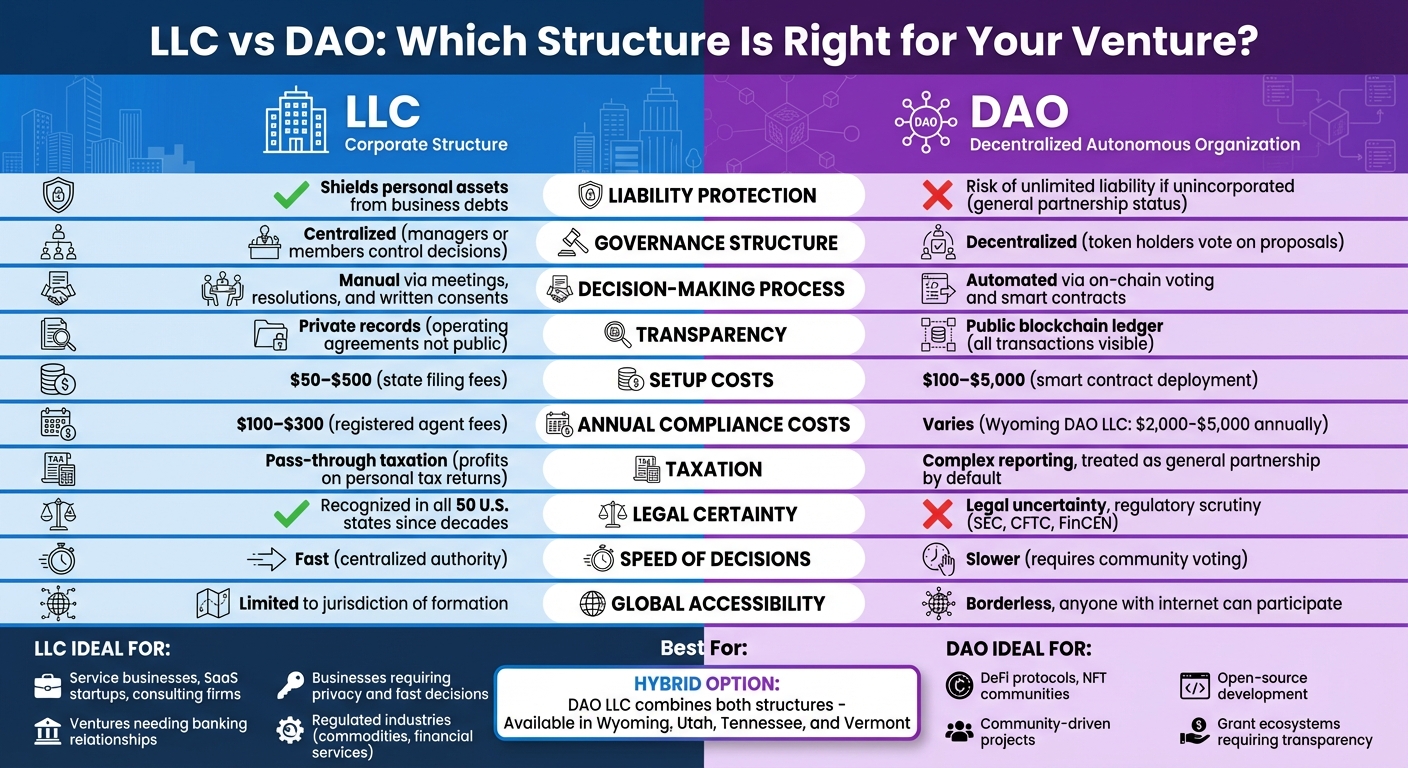
Choosing between an LLC and a DAO depends on your business goals and priorities. Here’s a quick breakdown to help you decide:
- LLCs: Offer personal liability protection, legal certainty, and privacy. They are ideal for businesses needing centralized management, faster decision-making, and compliance with established regulations.
- DAOs: Operate on blockchain technology, enabling decentralized governance and transparency. They are suited for community-driven projects like DeFi protocols or NFT ecosystems but come with legal and regulatory risks if not formally structured.
Quick Comparison
| Feature | LLC | DAO |
|---|---|---|
| Liability Protection | Shields personal assets | Risk of unlimited liability if unincorporated |
| Governance | Centralized (managers or members) | Decentralized (token holders) |
| Decision-Making | Manual, via meetings or resolutions | Automated, via on-chain voting |
| Transparency | Private records | Public blockchain ledger |
| Setup Costs | $50–$500 (state filing fees) | $100–$5,000 (smart contract deployment) |
| Taxation | Pass-through taxation | Complex reporting, varies by setup |
Key Insight: If you value legal protection and efficiency, an LLC is the safer choice. For ventures prioritizing community governance and transparency, a DAO may be worth considering. Hybrid DAO LLCs combine the benefits of both structures, offering limited liability with decentralized decision-making.
What is a Limited Liability Company (LLC)?
LLC Definition and Purpose
A Limited Liability Company (LLC) is a type of business entity that blends the liability protection of a corporation with the tax advantages and simplicity of a partnership. It’s recognized in all 50 U.S. states and is a go-to choice for small business owners and entrepreneurs. The key benefit? It offers a "liability shield", which means your personal assets – like your home, car, or savings – are generally safe from creditors if your LLC encounters legal or financial troubles. This structure allows business owners to take risks without jeopardizing their personal financial security. The foundation of this protection lies in a formal document called an Operating Agreement, which governs how the LLC operates.
How LLCs Work
An LLC is governed by its Operating Agreement, a private document that outlines the rules and structure of the business. Attorney Huong Lee describes it as follows: "A traditional LLC is controlled by an Operating Agreement which is a physical contract created by the member/managers of the LLC. The Operating Agreement will usually contain membership shares, voting rights, taxation, and the overall management structure of the LLC".
LLCs can be structured in two ways: member-managed, where the owners handle daily operations, or manager-managed, where designated individuals or a board make decisions. Most LLCs enjoy pass-through taxation, meaning profits are reported on the owners’ personal tax returns, avoiding the double taxation faced by corporations.
To stay compliant, you’ll need to file formation documents with your state, which generally costs between $50 and $500. If you don’t have a physical address in the state, hiring a registered agent will cost an additional $100 to $300 annually. States may also require annual reports or franchise taxes, depending on their regulations. These factors all play into the advantages and challenges of running an LLC.
Pros and Cons of LLCs
| Advantages | Drawbacks |
|---|---|
| Limited liability protection for personal assets | State-specific filing fees ranging from $50-$500 |
| Pass-through taxation eliminates double taxation | Annual compliance costs, including registered agent fees ($100-$300/year) |
| Operational flexibility with customizable Operating Agreements | Ongoing state requirements like franchise taxes vary by jurisdiction |
| Privacy – internal documents remain private and are not public record | |
| Investor confidence due to a well-established legal framework | |
| Legal certainty backed by decades of court and financial institution recognition |
LLCs are widely recognized and trusted by banks, insurers, and investors, giving them a clear advantage over newer business structures. Their long-standing legal precedent ensures smoother interactions when signing contracts or opening business bank accounts, making them a reliable choice for entrepreneurs.
sbb-itb-ba0a4be
What is a Decentralized Autonomous Organization (DAO)?
DAO Definition and Purpose
A Decentralized Autonomous Organization (DAO) operates on blockchain technology and is managed by smart contracts rather than traditional leadership structures. Unlike a centralized LLC where authority rests with a CEO or board, a DAO spreads decision-making power among its members, typically those who hold governance tokens or NFTs.
"A DAO is a collectively-owned organization working towards a shared mission." – ethereum.org
The concept is simple but transformative: instead of placing trust in individuals like executives, members rely on transparent, immutable code stored on a public blockchain. DAOs typically revolve around three essential components: a shared treasury (often managed through a multisig wallet), governance rules that dictate how decisions are made, and a membership system defining who can participate. This structure allows people from anywhere in the world to collaborate securely, even without personal connections or prior trust. This decentralized framework is at the heart of how DAOs operate.
How DAOs Work
"The backbone of a DAO is its smart contract, which defines the rules of the organization and holds the group’s treasury." – ethereum.org
Once a DAO’s smart contract is deployed, its rules are locked in and can only be changed through a community vote. For instance, if members propose spending $50,000 on a marketing campaign, token holders vote on the proposal. If it secures 51% approval, the smart contract automatically executes the payment.
DAOs use different governance models depending on their goals. Token-based systems, like MakerDAO, assign voting power based on the number of tokens a member holds. In share-based models, such as MolochDAO, individuals must submit proposals to join, creating a more exclusive membership. Reputation-based systems grant voting power based on contributions rather than token ownership.
Because all actions and transactions occur on-chain, DAOs are inherently global and borderless. Developers, investors, and creators from all corners of the world can participate without worrying about banking systems, currency exchanges, or time zones. Every operation is fully transparent, thanks to the underlying blockchain technology.
Pros and Cons of DAOs
| Advantages | Drawbacks |
|---|---|
| Complete transparency – Every vote and transaction is publicly accessible on the blockchain. | Legal uncertainty – Without formal legal structures, DAOs may be treated as general partnerships, exposing members to personal liability. |
| Global inclusivity – Anyone with internet access can join and contribute. | Slower decision-making – Voting processes can delay urgent actions. |
| Automated processes – Smart contracts reduce human error by executing decisions automatically. | Security vulnerabilities – Bugs in smart contracts can be exploited, as seen in the 2016 DAO hack, which led to a $50 million loss. |
| Democratic governance – Members directly vote on decisions, eliminating reliance on executives. | High setup costs – Deploying smart contracts can cost anywhere from $100 to $5,000. |
| No borders – DAOs operate globally without the constraints of traditional corporate systems. | Regulatory risks – In 2022, the CFTC classified Ooki DAO as an "unincorporated association", holding members accountable for its actions. |
A key legal development occurred on January 14, 2025, with a federal court ruling in the Lido DAO case. The court found that token holders and venture capital firms, including Paradigm and Andreessen Horowitz, could face unlimited personal liability as general partners since the DAO lacked formal incorporation. Attorney Chanté Eliaszadeh commented, "The Lido DAO ruling changed everything… DeFi protocols worldwide scrambled to implement legal entity structures they should have established years ago."
Despite these hurdles, DAOs have shown remarkable potential for collective action. Take ConstitutionDAO, for example. In November 2021, this DAO raised nearly $40 million from over 17,000 contributors in just a few days to bid on an original copy of the U.S. Constitution at Sotheby’s. While their $43.2 million bid fell short, the effort demonstrated how DAOs can mobilize global resources at an incredible pace.
LLC vs. DAO: Side-by-Side Comparison
How Governance and Decision-Making Differ
LLCs rely on traditional methods for decision-making, such as meetings, written consents, and board resolutions, all outlined in their LLC Operating Agreement. Managers oversee contracts, budgets, and other decisions manually, keeping records private.
DAOs, on the other hand, operate entirely on-chain. Proposals are submitted and voted on through blockchain technology. Once a proposal is approved, smart contracts automatically execute the decision. For instance, if members approve funding for a marketing campaign, the smart contract immediately transfers the funds.
"A DAO is ultimately people plus code, and the law will generally treat it that way." – Promise Legal
Here’s a quick comparison of governance features:
| Feature | Traditional LLC | Decentralized Autonomous Organization (DAO) |
|---|---|---|
| Governing Document & Execution | Physical Operating Agreement with manual execution | Smart Contract Code with automated execution |
| Management Structure | Centralized (Managers or Members) | Decentralized (Token Holders) |
| Decision-Making | Meetings and written resolutions | On-chain voting and consensus |
| Transparency | Private (Internal records) | Public (On-chain ledger) |
| Fiduciary Responsibilities | Managers owe duty of care/loyalty | Often explicitly disclaimed in DAO statutes |
Some organizations adopt a hybrid governance model. They reserve token-based voting for major decisions, like protocol upgrades, while using role-based permissions for routine operations. This approach minimizes voter fatigue and avoids bottlenecks in decision-making.
For Wyoming DAO LLCs, aligning the Operating Agreement with the smart contract is critical. If there’s a conflict, Wyoming law prioritizes the smart contract. Additionally, these entities must complete at least one governance action annually to avoid dissolution.
Next, let’s see how these governance differences impact legal protections and liabilities.
Legal Status and Liability Protection
The legal framework for LLCs and DAOs directly affects personal liability. DAOs without formal legal structures are often treated as general partnerships or unincorporated associations. This means members could face joint-and-several liability for the DAO’s activities. A notable example occurred in September 2022, when the CFTC charged Ooki DAO for running an illegal commodities platform. In that case, the DAO was treated as a "person" under the Commodity Exchange Act.
Recent court decisions have highlighted the risks for DAO token holders. In January 2025, the Samuels v. Lido DAO case suggested token holders could bear unlimited liability as general partners due to the lack of formal incorporation.
Hybrid DAO LLC structures, available in states like Wyoming, Utah, Tennessee, and Vermont, provide legal personhood and limited liability while maintaining decentralization. By March 2023, Wyoming had over 800 registered entities with "DAO" in their name. Wyoming officially recognized DAO LLCs on July 1, 2021, while Utah began accepting LLD registrations on January 1, 2024.
Now, let’s explore how taxation and compliance differ between these two structures.
Tax Treatment and Compliance Requirements
LLCs benefit from pass-through taxation, meaning profits are reported directly on members’ individual tax returns. Compliance involves filing Articles of Organization, appointing a registered agent, and submitting annual reports. Filing fees range from $50 to $500, with registered agent fees typically between $100 and $300 annually.
Unincorporated DAOs, however, default to being treated as general partnerships. This creates complex tax reporting for token holders, who may owe taxes on unrealized gains or protocol revenue – even if no funds are distributed. The IRS is also rolling out new requirements for digital asset brokers, including Form 1099-DA. Gross proceeds reporting begins January 1, 2025, with basis reporting starting January 1, 2026.
"Without a formal legal entity, DeFi protocol participants operate as an unincorporated general partnership by default under state law." – Chanté Eliaszadeh, Astraea Counsel
DAO LLC structures offer clearer tax guidelines:
- Wyoming DAO LLCs: Formation costs range from $5,000 to $15,000, with annual compliance fees between $2,000 and $5,000. These entities must include a "Notice of Restrictions on Duties and Transfers" in their formation documents and maintain publicly accessible smart contract identifiers.
- Cayman Islands Foundations: Formation costs run between $25,000 and $50,000, with annual compliance fees of $20,000 to $40,000.
- Swiss Foundations: Require approximately $52,000 in initial capital.
DAOs also face increasing regulatory scrutiny. Agencies like the SEC, CFTC, and FinCEN are closely monitoring these entities. For example, in early 2025, the Uniswap Foundation proposed forming a Wyoming Decentralized Unincorporated Nonprofit Association (DUNA) to formalize governance, implement protocol fee switches, and protect token holders from liability.
How to Choose Between an LLC and a DAO
Deciding between an LLC and a DAO depends entirely on your venture’s goals and operational needs. Neither structure is inherently superior – they each cater to different priorities.
When an LLC Makes More Sense
An LLC is a great choice for businesses that value speed, clarity, and regulatory certainty. This structure works well for service-based companies, SaaS startups, and consulting firms where centralized management ensures smooth operations. Industries like commodities trading or financial services also lean toward LLCs due to their straightforward compliance with existing regulations.
LLCs also offer a level of privacy that DAOs cannot. For example, your operating agreements and financial details remain private, unlike the public nature of DAO smart contracts. Additionally, LLCs are recognized across all 50 states, making tasks like signing contracts, hiring employees, and opening bank accounts much simpler.
"While people may think that they can use DAOs as a conduit to avoid the law, they are misguided. You are much better off using a traditional LLC." – Corporate Direct
If your business requires quick decision-making without waiting for community votes, the manager-driven model of an LLC can help avoid unnecessary delays.
When a DAO Makes More Sense
On the other hand, DAOs shine in ventures that thrive on community-driven governance and transparency. They are particularly effective for projects like DeFi protocols, NFT communities, and grant ecosystems where token holders actively participate in decision-making. In these setups, members vote directly on treasury allocations or protocol upgrades, ensuring collective involvement.
By late 2022, over 1 million individuals were actively involved in DAOs. This structure is ideal for ventures prioritizing open-source development and public accountability, as every transaction is recorded on the blockchain for all to see.
DAOs also reduce the need for intermediaries by automating processes through smart contracts. This can lower costs and minimize human error. However, pure DAOs – those without any legal entity – come with risks. They may be classified as general partnerships, which could leave members personally liable for the organization’s debts.
The DAO LLC Hybrid Option
If you want the best of both worlds, a hybrid DAO LLC structure offers an intriguing alternative. This model blends the legal protections of an LLC with the decentralized governance of a DAO. States like Wyoming, Utah, and Tennessee now allow these entities, providing limited liability while enabling token-based voting.
This hybrid approach is particularly useful for blockchain projects that need to operate within traditional systems. The LLC framework makes it easier to handle tasks like signing contracts, hiring employees, or setting up bank accounts – areas where pure DAOs often face challenges. Many projects adopt a dual-layer strategy: token holders manage major decisions, while an LLC committee oversees day-to-day operations.
Starting January 1, 2024, Utah introduced the Limited Liability Decentralized Organization (LLD), offering a new legal framework for such hybrids. This approach is perfect for ventures aiming for gradual decentralization. You can begin with an LLC to establish your core product and later transition to DAO governance as your protocol matures. Just make sure your smart contract logic aligns with your written operating agreement to avoid legal complications.
Final Thoughts
Deciding between an LLC and a DAO requires aligning your business structure with how you operate. LLCs are ideal for ventures like service businesses, SaaS startups, or any enterprise needing traditional banking relationships. They offer speed, legal clarity, and privacy. On the other hand, DAOs shine in areas like community governance, transparent treasury management, and decentralized protocol upgrades – perfect for missions centered around collective decision-making.
The January 14, 2025, Lido DAO ruling highlighted a critical issue: unincorporated DAOs can leave token holders exposed to unlimited personal liability. For serious ventures, this makes having a legal wrapper essential. If your project involves significant assets or large-scale protocols, institutional entities like Cayman or Swiss Foundations can provide the credibility and liability protection you’ll need.
"The wrong structure exposes founders to personal bankruptcy risk. The right structure provides liability protection while preserving decentralized governance." – Chanté Eliaszadeh, Astraea Counsel
These regulatory hurdles have also sparked the rise of hybrid models that combine the strengths of both LLCs and DAOs. For many founders, a hybrid DAO LLC model strikes the right balance, offering liability protection while maintaining decentralized governance. States like Wyoming, Utah, and Tennessee now offer legal frameworks that merge limited liability with on-chain governance.
FAQs
Can I be personally liable in a DAO?
Yes, personal liability can arise in a DAO, depending on how it’s set up legally. If a DAO operates without formal incorporation, it might be viewed as a partnership under the law, which could leave members personally liable. On the other hand, creating a DAO LLC in places like Wyoming can offer limited liability protections, much like a standard LLC. Choosing the right legal structure is key to reducing potential risks.
How do DAO taxes work for token holders?
Token holders in a DAO encounter specific tax challenges. In the U.S., any payments or token drops are typically treated as taxable income on the day they’re received, calculated based on their fair market value at that time. If those tokens are later sold, the transaction may lead to capital gains or losses. Given the lack of clarity in DAO-related tax regulations, it’s essential to keep detailed records of the dates and values of received tokens to ensure proper reporting to the IRS and maintain compliance.
What is a DAO LLC and who should use it?
A DAO LLC merges the decentralized governance model of a Decentralized Autonomous Organization (DAO) with the legal protections of a traditional Limited Liability Company (LLC). Using blockchain-based smart contracts, it ensures transparent operations and decentralized decision-making while still providing limited liability for its members. This setup is particularly appealing to entrepreneurs, Web3 startups, and groups aiming to integrate blockchain governance while retaining legal protections. States like Wyoming, known for being DAO-friendly, make this structure even more accessible.