


Securing funding for your startup without giving up equity is possible through non-dilutive sources. These options provide cash, resources, or tax benefits, allowing you to retain full ownership. Here are seven effective ways to access non-dilutive funding:
- SBIR/STTR Grants: Federal programs offering up to $3 million for research and development. These require strict eligibility and detailed applications.
- State and Local Grants: Region-specific programs that support job creation and innovation, offering amounts up to $500,000.
- R&D Tax Credits: Federal tax incentives allowing startups to claim up to $500,000 annually against payroll taxes, boosting cash flow.
- Innovation Challenges: Prize competitions rewarding completed projects, with awards ranging from $50,000 to $10 million.
- Corporate Partnerships: Programs providing cash, resources, or mentorship, such as AWS Activate or Microsoft for Startups.
- University Incubators: Academic programs that fund startups through grants and resources, often tied to research commercialization.
- Foundation Grants: Mission-driven funding for social or environmental projects, offering amounts from $5,000 to millions, depending on alignment with the foundation’s goals.
Each source has unique requirements, timelines, and benefits. Combining options can maximize funding opportunities while preserving equity. Below is a quick comparison of these funding sources:
| Funding Source | Typical Funding Amount | Key Requirements | Timeline |
|---|---|---|---|
| SBIR/STTR Grants | Up to $3M | U.S.-based, fewer than 500 employees | 6–9 months for review |
| State/Local Grants | $5K–$500K | Regional focus, job creation | Varies by program |
| R&D Tax Credits | Up to $500K annually | Qualifying R&D expenses | Annual tax filings |
| Innovation Challenges | $50K–$10M | Completed projects, competition-based | Fixed competition dates |
| Corporate Partnerships | Cash + in-kind resources | Alignment with corporate goals | Rolling or invite-only |
| University Incubators | $15K–$5.75M | Research-focused, academic partnerships | Program-dependent |
| Foundation Grants | $5K–Millions | Mission alignment, detailed proposals | 3–12 months for approval |
Non-dilutive funding not only supports your growth but also enhances credibility and attracts future investors. Prioritize sources that align with your startup’s goals and stage to make the most of these opportunities.
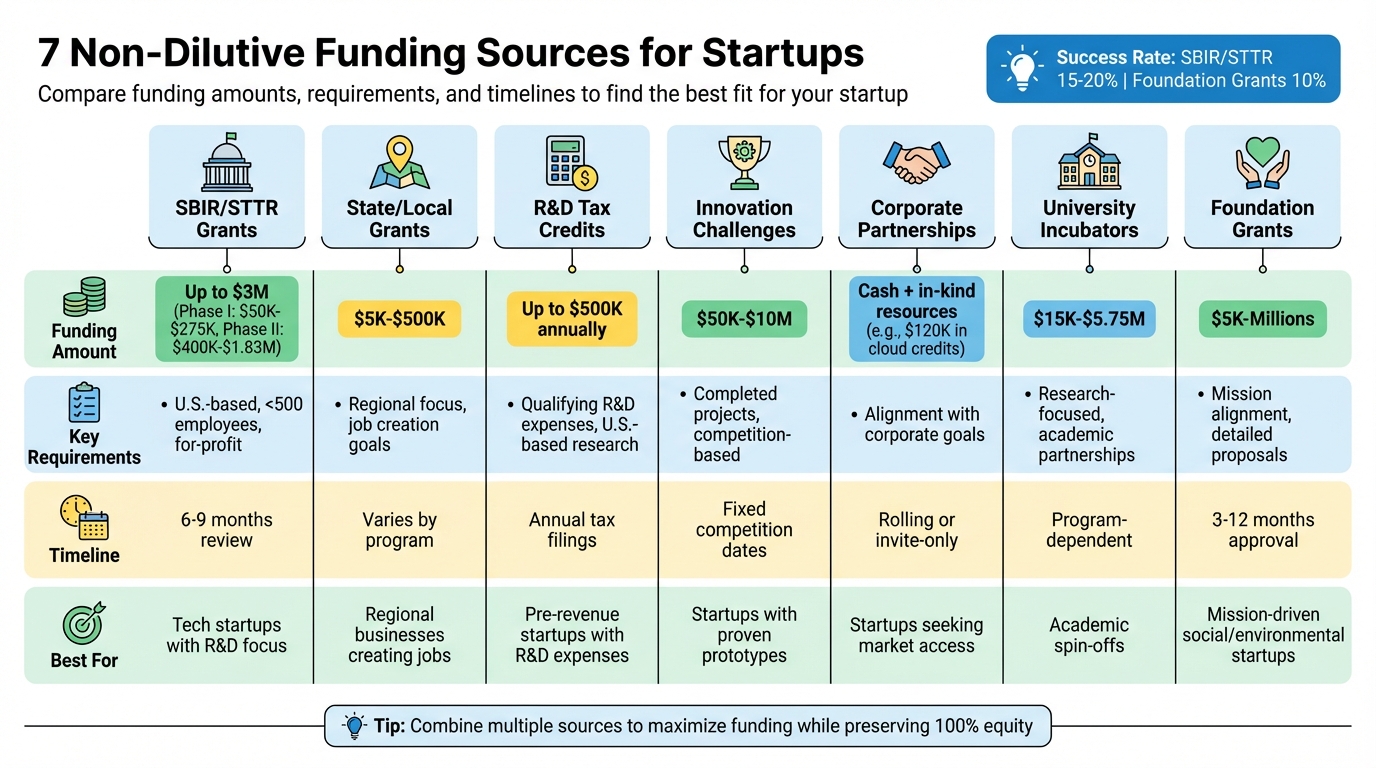
7 Non-Dilutive Funding Sources for Startups Comparison Chart
1. SBIR and STTR Grants
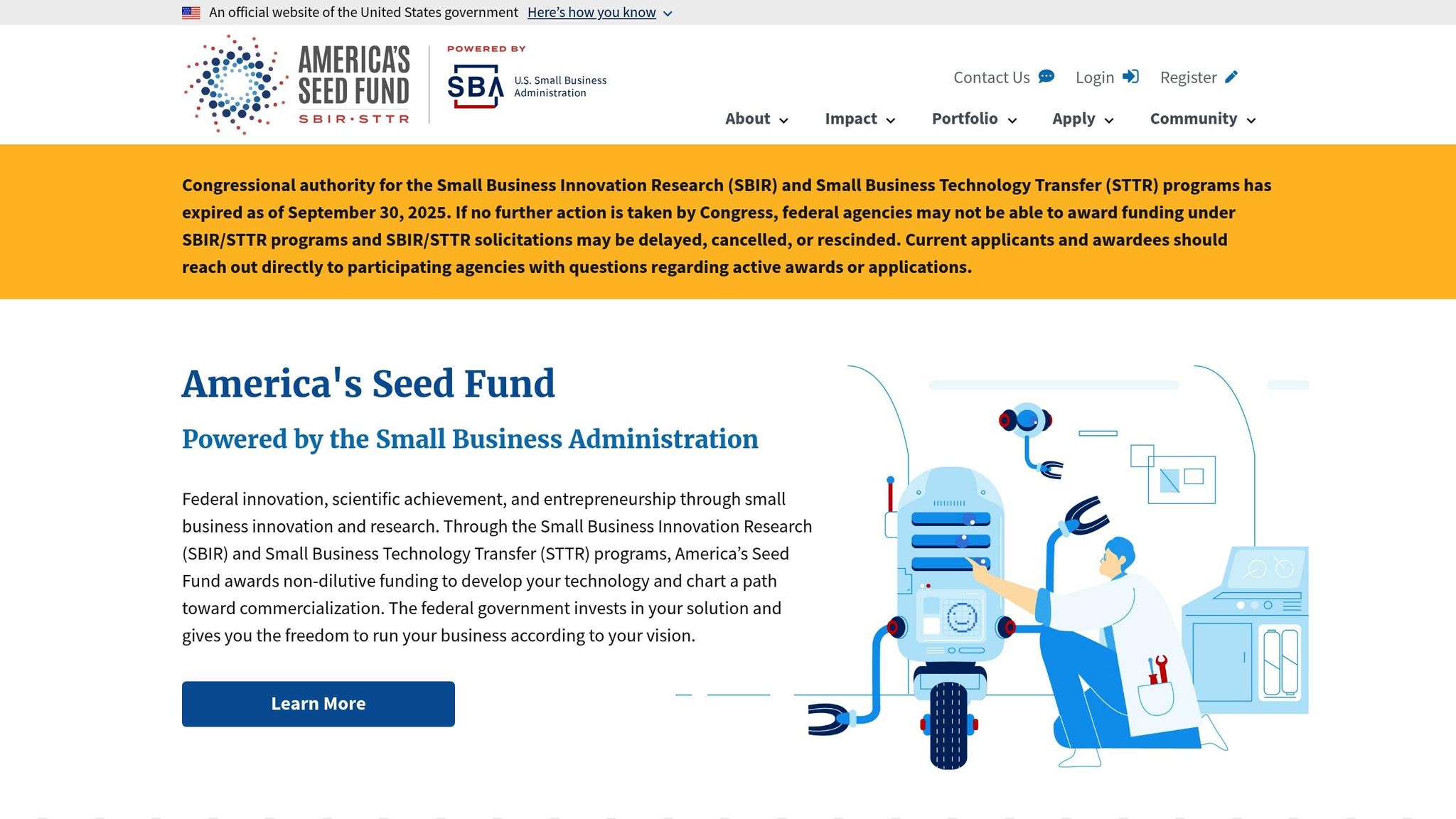
The Small Business Innovation Research (SBIR) and Small Business Technology Transfer (STTR) programs – known collectively as "America’s Seed Fund" – are the largest federal sources of non-dilutive funding for tech startups. These programs offer funding in three phases: Phase I provides $50,000–$275,000 for proof-of-concept work over 6–12 months, Phase II allocates $400,000–$1.83 million for research, development, and prototyping over 24 months, and Phase III focuses on commercialization, though no additional SBIR/STTR funds are provided at this stage. Let’s break down funding details and eligibility criteria.
The main difference between the two programs lies in collaboration requirements. SBIR allows startups to work independently, while STTR mandates a partnership with a U.S. research institution, such as a university. In STTR, the startup must complete at least 40% of the work, while the institution handles a minimum of 30%.
Funding Amounts Available
The funding amounts vary by agency. For instance:
- Department of Defense: $50,000–$250,000 for Phase I and $800,000–$1.83 million for Phase II, focusing on areas like AI, cybersecurity, and space.
- National Science Foundation (NSF): Up to $300,000 for Phase I and $1.25 million for Phase II.
- NASA: $150,000 for Phase I and $1 million for Phase II, with an emphasis on aerospace and robotics.
- USDA: $125,000–$175,000 for Phase I and $600,000 for Phase II.
Eligibility Requirements
Startups must meet strict criteria to qualify. Eligible companies must:
- Be for-profit and have fewer than 500 employees (most have fewer than 10).
- Be majority U.S.-owned and conduct all research domestically.
- Obtain a Unique Entity ID from SAM.gov and an EIN/TIN.
An example of success is re:3D, Inc., which used SBIR/STTR funding to create the Gigabot platform, a large-scale 3D printer designed for onsite manufacturing in disaster response scenarios.
Application Process Complexity
As of February 2026, congressional authority for SBIR and STTR grants expired on September 30, 2025. Before applying, check SBIR.gov for updates on reauthorization and funding availability. The application process is detailed and unforgiving – administrative mistakes can lead to disqualification. Each agency has unique requirements, so reviewing the full solicitation is essential. Some states offer "Phase 0" programs, which provide matching grants to cover proposal preparation costs, and SBA-partnered local programs can assist with SAM registration and proposal training.
Alignment with Startup Goals
These grants offer long-term protection for technical data and intellectual property – up to 20 years – while allowing you to retain full equity. Although the funding is taxable, research expenses may be deductible, so consulting a tax professional is a good idea. Additionally, some agencies provide Technical and Business Assistance (TABA) to help with commercialization. This funding path is a valuable way for startups to secure capital without giving up equity.
2. State and Local Economic Development Grants
State and local economic development grants offer a way to fund your startup while driving regional growth. These programs aim to boost local economies through job creation, innovation, and targeted industry support. The options available can vary widely depending on your location – what’s offered in Massachusetts might look completely different from what’s available in Texas or Delaware.
Funding Amounts Available
Grants from state programs typically range between $5,000 and $500,000, depending on the program. For example, Delaware’s EDGE Grant provides up to $100,000 for STEM-based businesses and $50,000 for non-STEM applicants, requiring a 1:1 match from the recipient. Massachusetts’ START program is structured in stages: $100,000 for initial commercialization (Stage I), $200,000 for scaling (Stage II), and $500,000 for companies nearing significant market expansion (Stage III).
For smaller-scale needs, consider programs like San Francisco’s Accessibility Grant, which offers up to $10,000 for businesses earning less than $2.5 million in revenue to remove ADA barriers. However, the application window for this grant is brief.
States also often provide SBIR/STTR matching grants, which can double your federal research funding. These programs typically offer between $100,000 and $250,000 in matching funds. By stacking these resources, you can extend your funding runway without giving up equity.
Eligibility Requirements
Eligibility primarily depends on your geographic location. You must be registered, licensed, and actively operating in the state offering the grant, and your state and local tax obligations must be in good standing. Other factors, such as your industry (e.g., tech, biotech, manufacturing, or agriculture), ownership demographics (e.g., women, veterans, minorities), or your startup’s development stage, can also influence eligibility.
Matching requirements can sometimes pose challenges. For instance, Delaware’s EDGE Grant requires you to match the awarded amount through revenue, private investment, or in-kind resources. Similarly, reimbursement-based grants, like New Jersey’s NJEDA Small Business Improvement Grant, require you to cover project costs upfront, with reimbursement covering up to 50% later. These grants are often best suited for startups with clear, actionable plans and some financial flexibility.
Application Process Complexity
Once you confirm your eligibility, the application process demands attention to detail. You’ll need to prepare documents like an updated business plan, financial statements, tax returns, and a project budget that highlights how your work will impact the community. Application windows can be tight – California Competes Tax Credit, for example, often has a two-week window – so having all documentation ready ahead of time is crucial.
"If you are serious about building your business without giving up equity, state-level grants are one of the most powerful cheat codes you can use." – Hustler’s Library
Start by reaching out to your state’s commerce department or local innovation office. Many grants are quietly announced through mailing lists rather than widely publicized platforms. Free resources like SCORE and Small Business Development Centers (SBDCs) can guide you through the process and help strengthen your application. Some states even offer consolidated portals, like New York’s Consolidated Funding Application (CFA), allowing you to apply for multiple grants in one place.
Alignment with Startup Goals
Securing a state grant can do more than just fund your startup – it can also enhance your credibility. Winning a grant often attracts local investors and partners, helping you maintain full equity while fueling growth. As one expert put it:
"Winning [an innovation award] automatically puts you on the radar of local investors, innovation hubs, and corporate partners." – Hustler’s Library
To improve your odds, align your application with your region’s Comprehensive Economic Development Strategy (CEDS). These strategies outline local priorities, such as clean energy, tourism, or downtown revitalization. Startups that align with these goals often see higher success rates. Programs like Rhode Island’s Innovation Voucher, which offers up to $50,000, allow you to collaborate with local universities, effectively "renting expertise" while building valuable partnerships. Unlike federal grants, state funding often focuses on creating immediate benefits for the local community rather than long-term national objectives.
3. Research and Development Tax Credits
R&D tax credits, outlined under IRC Section 41, offer businesses a dollar-for-dollar reduction on federal taxes for qualifying research activities. These credits provide a practical way to improve cash flow without requiring startups to give up equity.
Funding Amounts Available
Every year, the federal government allocates over $12 billion for R&D credits, and there’s no annual cap on the program. On average, startups can expect to receive 13–14 cents for every dollar spent on qualifying research. For pre-revenue startups, there’s an added benefit: Qualified Small Businesses (QSBs) can apply up to $500,000 annually in credits directly against payroll taxes (Social Security and Medicare), offering much-needed cash flow even before generating income.
"For cash-strapped startups that aren’t yet profitable, the ability to apply the credit against up to half a million dollars in payroll taxes offers a crucial financial lifeline when it matters most." – Mark McGee, Director of R&D, Exactera
Any unused credits can be carried forward for up to 20 years.
Eligibility Requirements
To qualify for the credit, your research must meet a four-part IRS test: it should aim to improve a product or process, rely on hard sciences or engineering, address technical uncertainty, and involve systematic experimentation. Additionally, the research must be conducted within the United States.
For QSBs to access the payroll tax offset, they must have less than $5 million in gross receipts for the current year and no gross receipts in the prior five years. However, certain activities – like social science research, customer-specific adaptations, and work done after commercial production – don’t qualify.
"The truth is that qualifying for the credit is not complex. Your company simply needs to be working to improve a product or process here in the U.S." – Dave Tilstone, Executive Director of Business Development, bavius technologie
Application Process Complexity
To claim the credit, file IRS Form 6765 with your annual tax return. If you’re using the payroll tax offset, also file Form 8974 in the first quarter after filing your income tax return. Keep in mind, the election to apply the credit against payroll taxes must be made on a timely filed return – it cannot be added later via an amended return.
Most startups opt for the Alternative Simplified Credit (ASC), which requires only three years of R&D expense data. First-time claimants with no prior data can claim 6% of current-year qualified expenses, while repeat claimants can claim 14% of expenses exceeding 50% of their three-year average. The ASC is far less demanding than the Regular Research Credit, which often requires decades of historical data.
One notable challenge is the documentation. The IRS revised Form 6765 for the 2025 tax year, adding stricter requirements for wage allocations and detailed technical descriptions. To reduce audit risks, it’s essential to maintain thorough, real-time records.
Alignment with Startup Goals
R&D tax credits align perfectly with a non-dilutive funding approach, offering financial rewards for work you’re already doing. Surprisingly, fewer than one in three eligible companies claim the credit, leaving a lot of potential funding untapped. Startups can also combine federal credits with state-level incentives, as most states offer their own programs mirroring federal guidelines. States like Texas, Pennsylvania, and California updated their R&D credit programs in 2025. Additionally, the One Big Beautiful Bill Act restored the immediate expensing of R&D costs, reversing a 2022 rule requiring amortization over five years. This change significantly boosts cash flow for early-stage companies. These credits are an excellent way to preserve equity while driving innovation.
4. Innovation Challenge and Prize Competitions
Innovation challenges provide a different type of non-dilutive funding by rewarding completed projects instead of supporting ongoing research. Federal agencies often run these competitions through Challenge.gov, a platform where startups can explore active opportunities across various government departments. Unlike grants, which fund work as it progresses, prize competitions focus on rewarding winners after the work is done. This approach involves fewer administrative hurdles and encourages creative solutions.
Funding Amounts Available
The prize money for these competitions can range widely depending on the scope. For instance, the SBA Growth Accelerator Fund Competition (GAFC) has allocated up to $3 million in Stage One prize money for 2024, with individual awards between $50,000 and $200,000. Larger competitions, like the X Prize, offer awards as high as $10 million for groundbreaking technological advancements. University-based contests also provide substantial prizes; for example, the Rice University Business Plan Competition offers $150,000 for first place, $100,000 for second, and $50,000 for third. In 2022, Team NimbRo from the University of Bonn earned $5 million in an XPRIZE competition for their technological innovations.
Eligibility Requirements
Most federal prize competitions are open to a wide range of participants, including individuals, teams, and private organizations. The SBA Growth Accelerator Fund Competition, for example, focuses on organizations that assist startups in areas like National Security, AI, and Sustainability. Under the America COMPETES Reauthorization Act, these competitions reward only the best-performing solutions. Unlike grants, participants must present a functional prototype or a proven solution ready for evaluation, as prizes are awarded for completed work rather than future development.
"Prize competitions set fewer rules, giving participants more freedom to be creative. This approach works well when there are many possible solutions, including ideas the agency may not have thought of." – GSA (Challenge.gov)
With eligibility requirements clearly outlined, the next step involves navigating the application process.
Application Process Complexity
The application process for prize competitions tends to be simpler than that of federal grants, as it focuses on the final product rather than detailed documentation of the development process. Typically, these challenges follow a three-step cycle: agencies announce a problem, participants submit their solutions, and winners are selected after evaluation. However, high-profile competitions may involve a rigorous application and pitch process. Before committing, consider whether your team has the capacity to meet these demands. Even if you don’t win, feedback from judges can help validate your business model.
Alignment with Startup Goals
For pre-revenue startups, prize competitions offer more than just financial support – they can enhance credibility, provide mentorship, and open doors to future funding opportunities. Many also offer media exposure and validation from respected organizations. For example, the SBA Growth Accelerator Fund Competition helps foster local partnerships and supports entrepreneurs in underserved markets. While the "winner-takes-all" nature of these competitions introduces some risk, they attract a diverse range of participants, including those from unconventional backgrounds. Regularly checking Challenge.gov can help startups find competitions that align with their solutions, making these challenges a valuable part of a broader non-dilutive funding strategy.
5. Corporate Startup Partnership Programs
After exploring federal, state, and R&D funding options, corporate partnerships emerge as another path that blends funding with market access. These programs often provide non-dilutive funding through cash grants, prize contests, and in-kind resources, allowing companies to tap into innovative solutions while giving startups both capital and validation. For instance, some contests offer cash prizes of up to $60,000.
Funding Amounts Available
In addition to cash, in-kind support plays a crucial role. Programs like Microsoft for Startups offer $120,000 worth of cloud tools and developer resources. Similarly, AWS Activate combines $50,000 in cash with $50,000 in service credits. Comcast RISE has provided $110 million in monetary, marketing, and technology grants to 13,000 small businesses since 2020. Meanwhile, the Cisco Global Problem Solver Challenge boasts a prize pool exceeding $1,000,000 to promote technology solutions that drive social impact.
Eligibility Requirements
Corporate programs often target specific groups and regions. Many focus on supporting minority-owned, women-owned, veteran-owned, and Black-owned businesses. For example, Fiserv’s Back2Business program committed $50 million to minority-owned businesses, and Progressive’s Driving Small Business Forward Fund offers $25,000 grants for Black entrepreneurs needing commercial vehicles. In addition to demographic criteria, startups typically need to align with the corporation’s goals, such as advancing community impact, sustainability, or addressing technical challenges.
Application Process Complexity
The complexity of applying varies. Direct grant programs often require minimal documentation and focus on community impact. On the other hand, competition-based programs, like Microsoft’s Pegasus program, may demand formal presentations and are sometimes invite-only. For programs like Microsoft for Startups, applications are reviewed quickly – typically within three business days when complete. This efficiency not only helps startups secure funding but also positions them for strategic growth opportunities.
Alignment with Startup Goals
Corporate partnerships go beyond funding by offering access to decision-makers, customers, and valuable resources. For example, in 2023, Reality Defender joined Comcast NBCUniversal’s LIFT Labs program, secured a pilot during the program, and subsequently raised $33 million in a Series A round, with Comcast becoming an investor. MassChallenge reports that 65% of startups in its corporate innovation programs secure follow-on pilots or partnerships. These programs help startups fine-tune their go-to-market strategies, overcome procurement hurdles, and leverage corporate marketing expertise. Like other non-dilutive funding options, corporate partnerships allow startups to grow without giving up equity.
"The accelerator gave us a structured way to showcase our capabilities and learn how we could fit into Comcast’s vision." – Alexandre Robicquet, CEO and Co-Founder, Crossing Minds
sbb-itb-ba0a4be
6. University Incubators and Translational Research Funds
University programs offer a compelling alternative to corporate partnerships for startups seeking funding without giving up equity. By tapping into academic resources, university incubators and translational funds help bridge the gap between research and market-ready applications. These programs are specifically designed to support "near-term, pre-commercial technologies" developed within universities, aiding founders in turning academic discoveries into viable products or services.
Funding Amounts Available
University translational funds typically provide funding in distinct phases, tailored to different stages of commercialization. Early-stage grants, ranging from $15,000 to $20,000, focus on market analysis and business planning. For proof-of-concept and validation work, grants increase to $100,000–$125,000. Specialized programs like the BioMaryland Center offer funding between $50,000 and $200,000 for life sciences projects. On a larger scale, the NSF Convergence Accelerator awards up to $5.75 million across two phases to multidisciplinary teams tackling societal challenges. Meanwhile, NSF Entrepreneurial Fellowships provide over $350,000 over two years, allowing startups to retain their intellectual property. With clear funding stages, startups must focus on meeting eligibility requirements to access these resources.
Eligibility Requirements
To qualify for these funds, startups need to follow specific steps. Begin by declaring your technology with the university’s Technology Transfer Office (TTO). For late-stage funding, a license agreement with the university must be executed within 12 months of applying. Programs like NSF I-Corps require a team structure consisting of a Technical Lead, an Entrepreneurial Lead, and a Business Mentor. Maryland Industrial Partnerships (MIPS), another option, supports joint R&D projects between companies and university faculty, often requiring matching funds. Since its inception in 1987, MIPS-supported products have generated over $25.2 billion in sales, showcasing the program’s impact.
Alignment with Startup Goals
University funding programs not only protect equity but also speed up the journey from research to market. For instance, NSF I-Corps employs "Lean LaunchPad" methodologies, encouraging startups to assess market potential by directly engaging with industry challenges. A great example of success is Harpoon Medical, a University of Maryland startup that developed a heart valve repair device. With support from the Maryland Innovation Initiative (MII), Harpoon Medical secured critical funding during its development phase and later raised $3.5 million in Series A financing. Early engagement with mentors is key to refining proposals and identifying strategic partners. Additionally, collaborative projects between universities can yield a 25% funding bonus, making these programs even more attractive for startups leveraging academic research.
"The goal of the NSF Innovation Corps (I-Corps) program… is to reduce the time and risk associated with translating promising ideas and technologies from the laboratory to the marketplace." – National Science Foundation
7. Foundation Grants for Mission-Driven Startups
Foundation grants can be a powerful funding source for startups tackling social, environmental, or other mission-focused challenges. Unlike traditional investors, foundations prioritize long-term impact over immediate financial returns. These grants are also non-dilutive, meaning founders can retain 100% ownership and intellectual property while advancing their goals.
Funding Amounts Available
The amount of funding available depends on the specific grant and its purpose. Smaller grants, often aimed at early-stage needs like building a prototype or securing a patent, typically range from $5,000 to $10,000. Larger sector-specific grants offer more funding. For instance, the Green Impact Foundation supports climate-focused startups, while the Health Innovators Fund backs healthcare-related projects. Women-led ventures in health and education may benefit from the Startup Catalyst Award. High-impact programs like the NSF Convergence Accelerator can provide up to $5.75 million for startups working on cross-disciplinary solutions.
Eligibility Requirements
To qualify for most foundation grants, your startup must meet specific criteria. These often include being a registered entity and demonstrating innovation through a prototype or measurable outcomes. Your mission must align with the foundation’s focus, such as sustainability, health equity, clean energy, or education. Some grants prioritize underrepresented founders, such as women-led teams or those operating in underserved areas. A strong application will include a detailed business plan and proposal that clearly outlines your team, target market, mission alignment, and how the funds will be used. Tools like the Candid database and the Community Foundation Locator can help you identify relevant grant opportunities in your area.
Application Process Complexity
Securing a foundation grant is no small feat. The process often takes 3 to 12 months, and only about 10% of applicants are successful. To improve your chances, craft a compelling narrative that positions your startup as the perfect match for the funder’s mission. Reach out to program officers before applying to better understand their priorities, and include letters of support from industry experts to strengthen your case. Pay close attention to formatting and submission guidelines – errors can hurt your chances. If your application is rejected, ask for feedback to refine your approach for future opportunities.
"The secret to winning startup grants is framing your business as the solution to a problem the funder cares about deeply." – OpenGrants
Alignment with Startup Goals
Once you secure a grant, ensuring your mission aligns with the funder’s objectives is critical for maximizing the partnership’s impact. Some programs, like the Social Impact Seed Fund, accept applications year-round, offering ongoing support for mission-driven startups. Others, such as the CleanTech Launchpad, focus exclusively on areas like green innovation, making them ideal for environmentally focused ventures. Starting with smaller, local grants can help you build credibility, making it easier to secure larger national awards down the line.
Foundation grants allow startups to grow without giving up equity, but they come with responsibilities. Grant funds are considered taxable income and must be reported accordingly. Additionally, while foundation grants often have fewer restrictions than government programs, they still require detailed reporting on how the funds are used and progress toward specified goals.
Funding Source Comparison Table
Selecting the best non-dilutive funding source for your startup depends on several factors, including your industry, growth stage, and funding timeline. Below is a side-by-side comparison of seven funding options to help you decide which aligns with your immediate needs and long-term objectives.
| Funding Source | Typical Funding Amount | Key Eligibility Requirements | Application Timeline |
|---|---|---|---|
| SBIR/STTR Grants | Phase I: $50,000–$500,000; Phase II: $750,000–$3,000,000 | U.S.-based for-profit with fewer than 500 employees; majority-owned by U.S. citizens or permanent residents; STTR requires a research institution partnership | 6–9 month review; 6–24 month project duration |
| State and Local Economic Development Grants | Varies by state program | Must meet job creation or local investment milestones (e.g., 75 jobs in urban areas or 25 in rural areas for the Texas Enterprise Fund) | Varies by state cycle; performance-based disbursement |
| R&D Tax Credits | Approximately 13% of eligible R&D expenses (e.g., a $130,000 credit on $1 million in spending); up to $500,000 annually in payroll tax offsets for 5 years | U.S.-based company conducting qualified research; recent changes now allow pre-revenue startups to offset payroll taxes | Claimed with annual tax filings |
| Innovation Challenge and Prize Competitions | Ranges from $1,000 micro-grants (Awesome Foundation) to awards of roughly $100,000 (Cartier Women’s Initiative) | Varies by competition; often industry or mission specific | Competitions follow fixed dates and pitch-based judging |
| Corporate Startup Partnership Programs | Varies – may include cloud credits, facility access, mentorship, or funding | Alignment with corporate strategic goals; specifics vary by industry | Rolling applications for credits and program hubs |
| University Incubators and Translational Research Funds | Varies by program; for example, NSF invests roughly $200 million annually in about 400 startups | Requires a formal partnership with a research institution and a focus on technology transfer | Dependent on academic or program cycles |
| Foundation Grants for Mission-Driven Startups | Varies widely by program | Based on mission alignment with the foundation’s goals | 30 days to 18 months for review; 1–3 months for fund disbursement |
Each funding option has its own strengths and challenges. For instance, SBIR/STTR grants offer substantial funding but come with longer review periods and stringent eligibility requirements. On the other hand, if you’re looking for quicker funding, innovation challenges or R&D tax credits might be better suited to your timeline since tax credits are processed during annual filings. Notably, the SBIR program alone has an annual budget exceeding $3.5 billion, making it one of the largest non-dilutive funding sources available.
Success rates also play a role in decision-making. SBIR/STTR programs typically have a success rate of 15–20%, while foundation grants are even more competitive, with only about 10% of applications accepted. A diversified approach is often the most effective strategy to secure funding.
"Non-dilutive funding is far more than a ‘fallback option,’ it’s your distinct strategic advantage." – Gallium Solutions
Programs like Direct to Phase II (D2P2) allow startups with a minimum viable product (MVP) to skip Phase I feasibility studies and access up to $1.8 million directly. Additionally, some states offer Phase 0 matching programs, which provide small grants to cover the costs of preparing federal SBIR/STTR proposals. These nuances can make a big difference in accelerating your funding timeline.
Use this table as a quick reference to identify the funding sources that best suit your startup’s current stage and future goals.
Conclusion
Securing funding while keeping full ownership intact is a strategic advantage for startup founders. This article explored seven key avenues – SBIR/STTR grants, state and local grants, R&D tax credits, innovation challenges, corporate partnerships, university incubators, and foundation grants – that collectively offer billions of dollars each year. For example, SBIR and STTR programs have historically provided over $70 billion in R&D funding, and federal clean energy grants are projected to allocate around $2.5 billion in 2025.
The secret lies in aligning funding strategies with your startup’s stage and focus. For pre-revenue startups, grants and competitions are often the best fit. Revenue-generating businesses might lean toward revenue-based financing options, while R&D-heavy startups can benefit significantly from SBIR/STTR grants and tax credits. On the other hand, SaaS and e-commerce companies often find revenue-based financing more suitable. The beauty of non-dilutive funding is that it allows founders to keep full ownership and control, as Jennifer Newton, Founder of StartSmart Counsel, emphasizes:
"Non-dilutive funding provides capital without requiring the business to relinquish equity. This means the founders and existing shareholders maintain their percentage of ownership, preserving control and future value."
Diversifying your funding sources is another smart move. Many successful founders combine federal R&D grants with other non-dilutive funding options to cover operational expenses. To maintain a steady flow of opportunities, keep track of deadlines, update essential documents, and regularly check platforms like Grants.gov for new funding options.
FAQs
Which non-dilutive funding option fits my startup stage best?
The ideal non-dilutive funding choice largely depends on where your startup stands and what it requires. If you’re in the early stages, federal programs like SBIR (Small Business Innovation Research) and STTR (Small Business Technology Transfer) are excellent options. These programs provide funding for technology development without taking any equity.
For startups further along in their journey, grants from government agencies or private organizations can be a great way to fund activities like product validation, scaling efforts, or pilot programs. It’s also worth looking into funding opportunities that are specific to your industry or region, as these can offer targeted support tailored to your unique needs.
How can I stack multiple non-dilutive funding sources without conflicts?
To effectively merge multiple non-dilutive funding sources without running into conflicts, it’s essential to design a funding strategy that aligns with your business objectives. Start by thoroughly reviewing the restrictions of each program, such as eligibility criteria and maximum assistance limits, to ensure there are no overlaps.
Pay close attention to stacking rules, especially when dealing with government grants, as these rules dictate how funding from different sources can be combined. Carefully map out your funding sources, considering factors like timing, purpose, and the specific amounts involved. A well-structured plan will not only help you maximize funding opportunities but also ensure you remain fully compliant and eligible across programs.
What documents should I prepare before applying for grants or credits?
Before diving into grant or credit applications, make sure you’ve gathered essential documents. These typically include a detailed business plan, financial statements, proof that you meet eligibility requirements, and any specific forms requested by the grant provider. To make your application stand out, include a clear and compelling explanation of how you plan to use the funds. This added detail can make a strong case for why your request should be approved.