


Starting a business without formal agreements is risky. Essential legal documents protect your company, clarify roles, and prevent disputes. Here’s what you need:
- Operating Agreements: Define ownership, management, and profit-sharing for LLCs. Required in some states, recommended for all.
- Bylaws: Establish internal rules for corporations, covering board roles, meetings, and shareholder rights.
- Shareholder & Partnership Agreements: Manage equity, decision-making, and partner exits.
- IP Assignment Agreements: Ensure the company owns its intellectual property.
- Founder Vesting Agreements: Align equity with long-term commitment.
Without these, you risk personal liability, disputes, and operational issues. Draft and update agreements early to safeguard your business.
Operating Agreements for LLCs: Setting Clear Roles and Rules
An operating agreement acts as the internal guidebook for how your LLC operates on a daily basis. Unlike the Articles of Organization – a public document filed with the state to establish your LLC – the operating agreement is a private contract among members. It defines ownership percentages, management responsibilities, and decision-making processes. Without one, state laws will apply default rules that may not reflect the contributions or intentions of the members, often leading to disputes. This document provides a clear framework to help avoid such conflicts.
Having a formal agreement also strengthens the LLC’s legal standing. As Nolo explains:
"While many states do not legally require your LLC to have an operating agreement, it’s foolish to run an LLC without one, even if you’re the sole owner of your company".
Beyond legal protections, banks and lenders often require a signed operating agreement to open business accounts or approve loans, even if state law doesn’t mandate one.
What to Include in an Operating Agreement
A well-drafted operating agreement should address key areas like ownership structure, management roles, decision-making processes, and exit strategies. Start by defining each member’s ownership percentage, which should reflect their initial contributions. You can also include vesting schedules – such as a four-year plan with a one-year cliff – to ensure equity is earned over time, protecting the LLC if someone leaves early.
Next, clarify your management structure. Decide whether the LLC will be member-managed (where all members handle daily operations) or manager-managed (where designated individuals or groups take charge). Clearly outline the authority and limits of managers, such as spending caps or hiring powers. To prevent disputes, set specific voting thresholds: routine decisions might need a simple majority, while major actions – like admitting new members, selling the business, or taking on significant debt – could require a supermajority or unanimous agreement.
Financial provisions are another critical piece. Specify how profits and losses will be divided, which doesn’t always need to match ownership percentages if roles vary. Include tax distribution clauses to ensure members have enough cash to cover personal tax obligations on pass-through income. Additionally, add transfer restrictions, like a Right of First Refusal (ROFR), to give current members the first chance to buy out a departing member’s interest before it’s sold to an outsider. Lastly, outline the conditions for dissolving the LLC and the order in which assets will be distributed. These details make the agreement a powerful tool for managing internal operations.
Adapting Your Operating Agreement to State Laws
While the operating agreement serves as your internal rulebook, it must align with state laws to avoid legal complications. Although most states don’t require LLCs to have an operating agreement, five states – California, Delaware, Maine, Missouri, and New York – do. Regardless of legal requirements, tailoring your agreement to fit state-specific rules is essential. State laws can vary on critical matters like fiduciary duties, member withdrawal rights, and handling the death of a member.
It’s best to finalize and sign your operating agreement before any significant contributions – whether money, property, or time – are made to the business. Make sure the document explicitly references the laws of the state where your LLC was formed, even if you operate in multiple states. For the agreement to be binding, all members must sign it, and the executed copy should be stored in your permanent company records. Reviewing the agreement annually helps ensure it reflects any changes in ownership, management, or state laws. For complex LLC structures or industries with higher risks, hiring an attorney to draft the agreement (typically costing around $900 for fixed-fee services) can provide customized protections and ensure compliance with state-specific rules.
sbb-itb-ba0a4be
Bylaws for Corporations: Setting Up Internal Rules
Corporate bylaws are the backbone of your corporation’s internal structure, laying out the rules and procedures for how your business operates. While the Articles of Incorporation officially register your business with the state, bylaws handle the behind-the-scenes details – covering everything from board meetings to officer responsibilities to shareholder rights. As attorney Jane Haskins, Esq., puts it, "Bylaws describe the way your corporation will be organized and operated, and they’re required in most states". In fact, 31 states mandate that corporations adopt bylaws, making them a legal necessity for compliance.
Beyond compliance, bylaws play a crucial role in maintaining your corporation’s credibility. They help demonstrate adherence to formalities, which is essential for protecting the corporate veil – the legal barrier that separates personal assets from business liabilities. When these formalities are ignored, creditors are more likely to pierce the corporate veil, a scenario that occurs in nearly half of cases where business formalities are neglected.
What to Include in Corporate Bylaws
To ensure smooth internal governance, your corporate bylaws should cover several key areas:
- Board Governance: Specify the number of directors, their qualifications, term lengths, and how they are elected or removed. For example, having an odd number of directors can prevent voting deadlocks.
- Shareholder Meetings: Define the schedule for annual meetings, procedures for calling special meetings, and notice requirements – typically between 10 and 60 days before the meeting. Also, set a quorum threshold, often a majority of voting shares.
- Officer Roles: Lay out positions like CEO, CFO, Secretary, and Treasurer, detailing their responsibilities and the process for their appointment or removal.
- Stock and Share Administration: Include rules for issuing and transferring shares, along with procedures for managing physical stock certificates.
- Conflict of Interest Policies: Require directors and officers to disclose any personal financial interests to ensure decisions align with the corporation’s best interests.
- Indemnification Clauses: Protect directors and officers from personal liability and legal expenses, provided they act in good faith on behalf of the corporation.
- Amendment Procedures: Clearly outline the voting requirements for updating the bylaws. Keep a signed copy in your corporate records for due diligence purposes.
How Bylaws Differ from Operating Agreements
Understanding what bylaws include also highlights how they differ from LLC operating agreements.
Bylaws are designed for corporations, which typically follow a formal hierarchy, while LLC operating agreements cater to a more flexible structure with customized profit distributions and roles. Another key difference is that bylaws are adopted by a corporation’s board of directors and usually don’t list individual members. In contrast, operating agreements are contracts signed by all members (owners) of an LLC.
From a legal standpoint, most states require corporations to have bylaws to maintain their corporate status. On the other hand, operating agreements are only legally required in five states – California, Delaware, Missouri, Maine, and New York. Despite this, both documents are private and serve as critical tools for preventing disputes and shielding owners from personal liability.
These distinctions help entrepreneurs choose the right governance structure for their business, ensuring smoother operations and minimizing conflicts.
Shareholder and Partnership Agreements: Protecting Business Relationships
Safeguard business partnerships with well-crafted legal agreements. Stephen Thienel, a business attorney at Thienel Law, emphasizes their importance:
"A shareholder agreement isn’t just a formality – it’s a critical legal document that sets the rules of engagement between co-owners".
The type of agreement you need depends on choosing the right business structure. If you’ve filed Articles of Incorporation with your state, a shareholder agreement is necessary. For General Partnerships, Limited Partnerships, or Limited Liability Partnerships, a partnership agreement is required. These agreements work alongside operating agreements and bylaws to create a legal framework that minimizes disputes and keeps operations running smoothly. Below, we’ll explore key provisions for both shareholder and partnership agreements.
Shareholder Agreements: Managing Equity and Ownership
Shareholder agreements outline how equity owners collaborate and make decisions. These private contracts aren’t filed with the state, allowing for customization to meet your business’s unique needs. Key provisions include protecting equity, managing exits, and setting voting thresholds.
Decision thresholds are crucial. Instead of relying on a simple majority, consider requiring a supermajority – typically 66% or 75% – for major decisions like issuing new shares, approving large loans, or signing significant contracts. This approach balances decision-making power, protecting minority shareholders while enabling progress.
Transfer restrictions ensure stability when shares change hands. A Right of First Refusal (ROFR) gives the company or current shareholders the chance to buy shares before they’re sold to outsiders. Tag-along rights allow minority shareholders to join a majority-led sale, while drag-along rights ensure minority shareholders participate in a sale for consistency.
Buy-sell provisions address what happens during events like death, disability, bankruptcy, or job termination. These clauses should include a clear valuation method – such as a formula, fixed price, or third-party appraisal – and precise language in buyback terms (e.g., using "shall" for mandatory purchases).
To protect the business further, include restrictive covenants like non-compete, non-solicitation, and confidentiality clauses. For S-Corporations, provisions for "tax distributions" can help shareholders cover personal tax liabilities from the company’s pass-through income.
Partnership Agreements: Preventing Partner Disputes
Partnership agreements define roles, responsibilities, and profit-sharing among partners. Without one, state default rules apply, often requiring equal profit and loss sharing. Although only five states – California, Delaware, Maine, Missouri, and New York – require LLCs to have an operating agreement, Nolo advises:
"While many states do not legally require your LLC to have an operating agreement, it’s foolish to run an LLC without one, even if you’re the sole owner of your company".
Management structure is a key element. Specify whether the business is "member-managed" (all partners involved in daily operations) or "manager-managed" (specific individuals handle operations). Clearly state which partners have the authority to make binding decisions, such as signing contracts or approving major expenses, to avoid unauthorized actions.
For decision-making, use similar supermajority rules as shareholder agreements. Routine decisions might require a simple majority, while major actions – like admitting new partners or dissolving the business – might need supermajority or unanimous consent. In 50/50 ownership setups, include a casting vote or buy-sell trigger to resolve deadlocks.
Profit and loss sharing should reflect each partner’s contributions. While state rules default to equal sharing, agreements can include "special allocations" based on capital contributions, sweat equity, or preferred returns for investors. Adding "tax distribution" clauses ensures partners have enough cash flow to cover personal tax liabilities on profits that haven’t been distributed as cash.
Exit provisions are essential for handling partner withdrawals. Agree on valuation methods early, such as a multiple of trailing 12-month EBITDA or a fixed price updated annually. An ROFR can prevent partners from selling their interest to outsiders without offering it to the group first. For involuntary exits like death or disability, buy-sell life insurance policies can provide the funds needed for buyouts.
As Carlotta Roberts, J.D., from Kennesaw State University SBDC, explains:
"Putting something in writing forces the shareholders to deal with some ‘what if’ scenarios before any of those scenarios ever become a reality".
Finally, include mediation or arbitration clauses to handle disputes internally, avoiding costly litigation.
IP Assignments and Founder Vesting Agreements
After setting up internal governance, the next crucial steps for a startup are protecting intellectual property (IP) and ensuring founders earn their equity over time. These agreements act as a safeguard against disputes that could jeopardize the company’s future. Without them, ownership conflicts over IP or equity can create major roadblocks. Two key agreements – IP Assignment and Founder Vesting – help avoid these pitfalls by clearly defining rights and responsibilities.
Intellectual Property Assignment Agreements
In the U.S., the individual who creates intellectual property automatically owns it unless they’ve signed it over in writing. As The IP Law Blog points out:
"Under U.S. law, the person who creates intellectual property owns it unless they’ve assigned it in writing. That means your company may not own its core code, designs, or brand even if you paid for them".
This means that without a written IP Assignment Agreement, your startup might lack legal ownership of the very assets – like code, designs, patents, or trademarks – that drive its value. To address this, Technology Assignment Agreements (TAA) transfer IP created before the company’s incorporation (e.g., early prototypes or an MVP), while Invention Assignment Agreements (IAA) cover IP developed after incorporation, typically during employment or service.
The risks of skipping this step are real. For example, in 2008, Facebook paid $65 million to settle a lawsuit with ConnectU founders over unassigned IP, delaying the company’s progress.
John Montague, an attorney at Montague Law, underscores the importance of these agreements:
"Investors won’t fund a company that doesn’t own its core technology. Acquirers won’t buy you. This isn’t theoretical – I’ve watched deals fall apart over this exact issue".
To avoid these issues, execute IP Assignment Agreements as soon as the company is incorporated and before issuing founder stock. Use clear, present-tense language like "hereby assigns" to ensure automatic transfer of rights. Including a power of attorney clause (allowing the company to sign IP documents on behalf of a founder if they become unavailable) and listing any "Prior Inventions" can further protect the company’s interests.
While IP assignments secure the company’s assets, founder vesting agreements ensure long-term commitment from the team.
Founder Vesting and Equity Schedules
Founder vesting agreements ensure that equity is earned over time, preventing a scenario where a founder who leaves early retains a large stake in the company. These agreements are typically structured through a Restricted Stock Purchase Agreement (RSPA), which gives the company the right to repurchase unvested shares.
The standard setup involves a four-year vesting period with a one-year cliff. Here’s how it works:
- During the first year (the "cliff"), no equity vests. If a founder leaves within this time, they forfeit all their shares.
- After the cliff, 25% of the equity vests immediately, with the remaining 75% vesting monthly over the next three years (approximately 2.08% per month).
As Promise Legal explains:
"Investors will not fund your startup without a founder agreement… During due diligence, investors check for vesting schedules (protects against founders who leave early)".
For added protection, consider using double-trigger acceleration instead of single-trigger acceleration. With double-trigger, vesting accelerates only if two conditions are met – such as an acquisition followed by termination without cause. This ensures founders remain engaged even after an acquisition.
Another important detail is the Vesting Commencement Date, which should be set as either the incorporation date or the date a founder begins full-time work.
Lastly, don’t forget to file an 83(b) election with the IRS within 30 days of receiving restricted stock. This election allows founders to pay taxes on the stock’s current low valuation rather than its future, potentially much higher value as it vests. Missing this deadline can result in hefty tax bills later on.
Together, these agreements lay the foundation for a startup’s stability and growth, aligning founder contributions with long-term success.
Choosing the Right Agreement for Your Business Structure
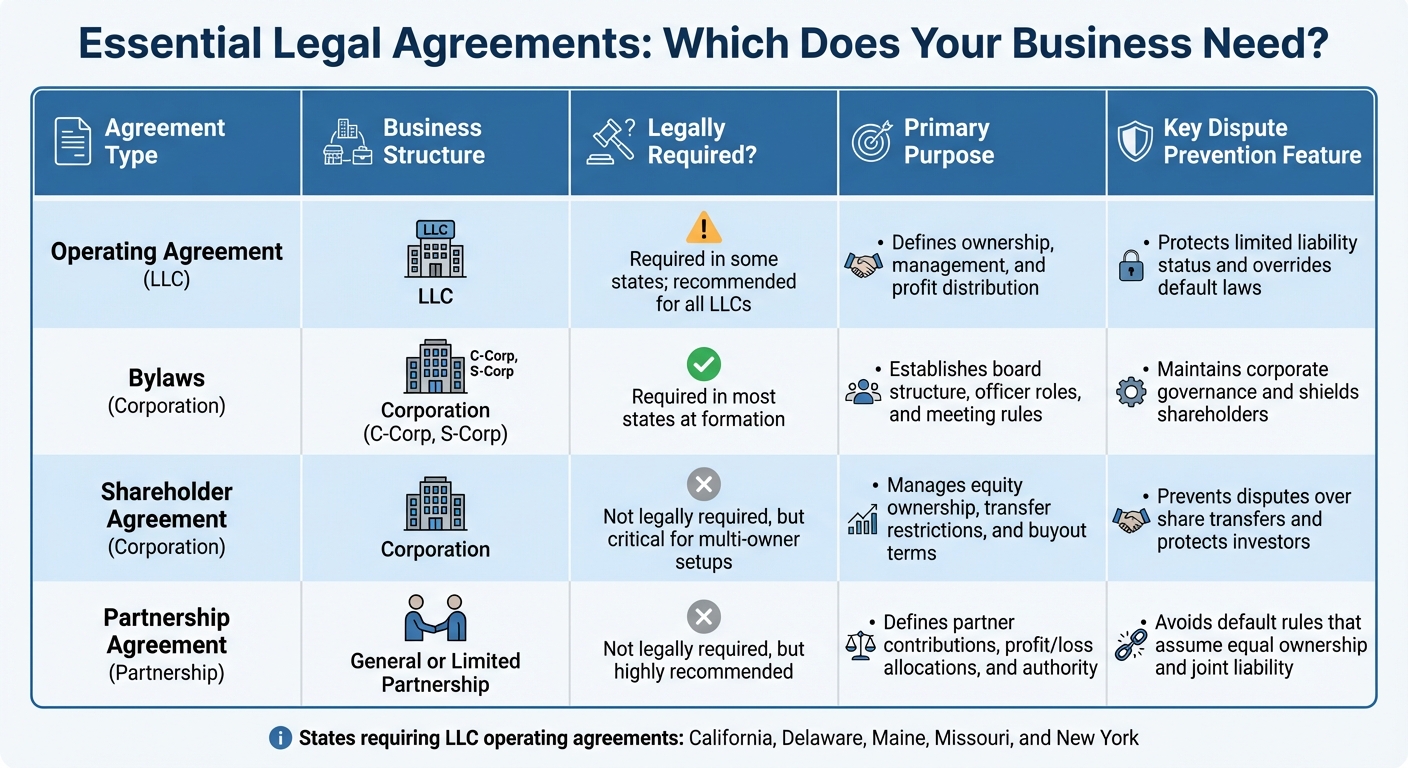
Comparison of Essential Legal Agreements by Business Structure
Your business structure determines the legal documents you need to safeguard personal assets and ensure smooth operations. Without these documents, you could face serious risks like losing personal asset protection, disputes among stakeholders, banking complications, or challenges in raising capital. Whether you’re running an LLC, corporation, or partnership, having tailored agreements is crucial to clarify governance and limit liability.
Selecting the appropriate agreement ensures alignment between ownership and liability protections. For example, general partnerships leave all partners exposed to unlimited personal liability for business debts and the actions of their co-partners. Corporations without bylaws risk losing their liability shield, allowing creditors to pierce the corporate veil and go after shareholders’ personal assets. Similarly, LLCs – especially single-member LLCs – need an operating agreement to establish the business as a separate legal entity and reduce exposure to liability.
State laws also play a role in determining the necessary documentation. While most states don’t mandate a written operating agreement for LLCs, states like California, Delaware, Maine, Missouri, and New York either require or strongly recommend one. Corporations, on the other hand, are typically required to adopt bylaws at the time of formation. Without these, your business could be subject to default state laws that might allocate profits, voting power, or decision-making authority in ways you didn’t intend.
Banks and investors often demand these documents as well. Many banks won’t open a business account without seeing an operating agreement or bylaws that confirm who has signing authority. Even single-owner businesses benefit from having proper documentation in place. With this foundation, you can better understand and compare the agreements that suit your business needs.
Comparison Table: Features and When to Use Each
Below is a breakdown of key agreements, their purposes, and how they address potential challenges:
| Agreement Type | Business Structure | Legally Required? | Primary Purpose | Key Dispute Prevention Feature |
|---|---|---|---|---|
| Operating Agreement | LLC | Required in some states; recommended for all LLCs | Defines ownership, management, and profit distribution | Protects limited liability status and overrides default laws |
| Bylaws | Corporation (C-Corp, S-Corp) | Required in most states at formation | Establishes board structure, officer roles, and meeting rules | Maintains corporate governance and shields shareholders |
| Shareholder Agreement | Corporation | Not legally required, but critical for multi-owner setups | Manages equity ownership, transfer restrictions, and buyout terms | Prevents disputes over share transfers and protects investors |
| Partnership Agreement | General or Limited Partnership | Not legally required, but highly recommended | Defines partner contributions, profit/loss allocations, and authority | Avoids default rules that assume equal ownership and joint liability |
Kelly DuFord Williams, Founder and Managing Partner at Slate Law Group, underscores the importance of bylaws for corporations:
"Bylaws establish the rights and duties of the parties involved in the corporation and, if properly followed by the parties, limit the possibility that courts will ‘pierce the corporate veil’ and hold shareholders personally liable for corporate debts."
Next, we’ll dive into practical steps for drafting and implementing these vital agreements.
How to Draft and Implement Your Agreements
Where to Find Templates and Legal Services
When it comes to creating business agreements, you’ve got three main options: using DIY templates, exploring online legal platforms, or hiring specialized attorneys. Each approach comes with its own balance of cost, customization, and compliance.
DIY templates are the most affordable, typically ranging from $0 to $100. However, as Surge Business Law points out:
"Templates lack legal enforceability, state compliance, and customization. It’s particularly risky for startups, especially those seeking investors".
These templates often miss crucial state-specific details and don’t offer room for tailored provisions.
Online legal platforms provide a middle-ground solution. For instance, BusinessAnywhere offers formation services starting at $0 (plus state fees) and includes essential documents like operating agreements. They also provide a remote online notary service for $37 per notarization – a convenient feature for businesses needing notarized agreements to open bank accounts. Similarly, ZenBusiness offers operating agreement templates for $99, while LegalZoom provides formation plans starting at $0 (plus state fees) and holds a solid 4.6/5 rating based on over 28,335 reviews.
For businesses with more complex needs – like multiple founders, equity vesting, or investor negotiations – hiring an attorney may be the best route. Some law firms offer startup-specific packages starting under $1,000, while local attorneys often charge $1,000 or more per hour, depending on the complexity of the work and the level of customization required.
Once you’ve chosen the right method for drafting your agreements, it’s time to move on to completing and filing them efficiently.
Steps to Complete and File Your Agreements
To get started, gather all the key details about your LLC, including its legal name, formation state, registered agent information, and member names. Then, decide if your business will be member-managed (where all owners handle daily operations) or manager-managed (where designated managers handle operations while some owners take on passive roles).
Next, focus on the financial details. Clearly document each member’s initial capital contribution, whether it’s in cash, assets, or "sweat equity." Also, outline ownership percentages and specify how profits and losses will be distributed. Establish voting thresholds – use a simple majority for routine decisions and reserve supermajority or unanimous consent for major actions like admitting new members or dissolving the business.
Once the terms are finalized, have all members and managers sign the agreement. While notarization isn’t always legally required, it adds credibility in court and satisfies many banks’ requirements for opening business accounts. Platforms like BusinessAnywhere make notarization easy with their remote online notary service, which is especially helpful for businesses with remote teams.
Finally, ensure you keep one definitive, secure digital copy of the agreement. Avoid having multiple versions or making informal amendments, as these can lead to disputes later. While you’ll need to file Articles of Organization or Incorporation with your state to officially create your business, operating agreements and bylaws are internal documents and typically don’t need to be filed with government agencies. Make sure to update these documents whenever you admit new members, raise capital, or adjust management structures to keep them legally enforceable. This approach ensures your business is built on a solid legal foundation, reducing the risk of future conflicts.
Common Mistakes and How to Avoid Them
Writing Clear Roles and Responsibilities
Skipping formal agreements is a frequent misstep, especially when you form a single-member LLC or partnerships among friends. This oversight leaves the business subject to default state laws, which may not align with the partners’ intentions. Relying on generic templates can also result in issues like mismatched ownership percentages or unenforceable terms.
Another common pitfall is vague role descriptions, which can stall decision-making. For instance, if an agreement doesn’t clearly outline who can sign contracts, hire employees, or manage accounts, daily operations can come to a standstill. As Raetzer PLLC Business Law Firm aptly states:
"If it’s not in writing, it’s optional – until a dispute."
To prevent such problems, explicitly define decision-making authority. For routine matters, a simple majority may suffice. Use a supermajority (66.7%–75%) for significant decisions, such as incurring debt or adjusting leadership salaries, and unanimous consent for foundational changes like admitting new members or dissolving the company. In cases of 50/50 ownership, consider appointing a tie-breaker or rotating final decision authority to avoid deadlocks.
Neglecting to establish exit and buyout provisions is another mistake that can lead to disputes and costly legal battles. For example, one restaurant chain expansion fell apart, racking up over $50,000 in legal fees because its operating agreement lacked a dispute resolution process. To avoid such scenarios, pre-agree on valuation methods. Options include annual third-party appraisals or formulas like four times annual profits. Also, include a right of first refusal clause, allowing existing members the first chance to buy a departing member’s shares.
Clearly defined roles and a structured approach to resolving disputes are essential to keeping operations smooth.
Adding Effective Dispute Resolution Clauses
In addition to well-defined roles, incorporating strong dispute resolution clauses is critical for safeguarding your business. As noted earlier, clear decision thresholds are vital, and this principle applies equally to handling disputes.
A multi-step escalation process is a practical solution. Start with internal review, move to mediation, proceed to binding arbitration, and reserve litigation as a last resort. This framework helps avoid deadlocks when partners disagree on strategic, financial, or management matters.
Specific mechanisms like "shotgun" clauses can be particularly effective. These provisions allow one partner to offer to buy out the other at a set price, requiring the other to either accept the offer or buy out the initiator at the same price. Additional options include third-party tie-breakers or rotating voting power. Greg G. Gutzler, Partner at DiCello Levitt, underscores the importance of clarity:
"Founders must prioritize clarity. That doesn’t always mean lengthy legalese or stifling formalities. But it does mean ensuring unambiguous terms about ownership, responsibilities, and decision-making authority from the outset."
Ensure "for cause" removal criteria are clearly defined to streamline the enforcement of exit clauses. Consider adding a tax distribution clause to guarantee members receive enough cash to cover personal tax liabilities. Finally, review your dispute resolution process annually to ensure it evolves alongside your business.
Conclusion: Building a Strong Legal Foundation
A well-built legal foundation is key to tackling early challenges and avoiding disputes. Legal agreements eliminate guesswork by clearly defining roles, protecting assets, and securing intellectual property.
This structure serves as the backbone of your startup’s stability. Ignoring it can lead to serious issues – banks might deny account openings, investors could withdraw during due diligence, and regulatory agencies may question your business’s legitimacy. Surprisingly, many startups fail not because of market pressures but due to internal disputes among founders. As Boyer Law Firm highlights:
"The contracts you sign or neglect before launch often determine whether your startup survives its first major challenge".
Start formalizing agreements early – before conflicts arise and while relationships remain strong. Avoid relying on generic templates that might overlook state-specific rules or your unique ownership setup. Instead, include dispute resolution clauses, update agreements during key events (like raising funds or adding new members), and ensure every founder, employee, and contractor has formal intellectual property assignments. By doing this, you not only comply with regulations but also set your business up for steady growth.
BusinessAnywhere makes this process easier with remote services tailored for entrepreneurs. Their offerings include business registration, EIN application, and registered agent support. For a more comprehensive solution, the Digital Nomad Kit bundles LLC formation, a virtual mailbox, and banking setup – all managed remotely through one platform.
A strong legal framework today means fewer conflicts tomorrow. Formalize your agreements, keep them updated, and protect your business at every stage.
FAQs
Which document do I need for my business type (LLC vs. corporation vs. partnership)?
The documents required will vary based on your business structure:
- For an LLC, you’ll need an operating agreement. This document lays out the ownership details, management structure, and how decisions will be made.
- Corporations typically require bylaws, which establish governance rules and procedural guidelines.
- Partnerships should have a partnership agreement to clearly define roles, profit-sharing arrangements, and how disputes will be handled.
These documents are essential for minimizing conflicts and ensuring responsibilities are clearly outlined, all tailored to the specific needs of your business structure.
What clauses prevent founder or partner disputes the most?
Clauses that help avoid disputes between founders or partners often focus on ownership, decision-making, and conflict resolution. For instance:
- Ownership clauses: These define equity splits and contributions, ensuring everyone knows their stake and role upfront.
- Decision-making clauses: These outline voting rights and management responsibilities, clarifying who has authority over various aspects of the business.
- Conflict resolution clauses: These might include methods like mediation, arbitration, or tie-breaker provisions to handle disagreements without unnecessary delays.
By addressing these areas, such clauses bring clarity, simplify decision-making, and create a structured approach to resolving conflicts, ultimately helping to avoid expensive disputes.
When should founders sign IP assignments and vesting paperwork?
Founders should handle IP assignment and vesting paperwork as early as possible – ideally during the company’s formation or when drafting a founder agreement. Taking care of this upfront ensures ownership rights are clearly defined and helps avoid disputes down the road. Experts often advise completing these documents at the company’s inception to establish solid legal protections from the beginning.