


When it comes to selling your startup, preparation is key. Most founders overlook critical steps, which can lead to lower valuations or failed deals. The best approach? Always be ready for a sale. This article breaks down how to position your business for a successful exit by focusing on four areas:
- Organized Finances: Keep GAAP-compliant records, separate personal and business expenses, and maintain at least three years of clean financial statements.
- Efficient Operations: Build systems that allow your business to run without you. Standardize processes, delegate responsibilities, and document workflows.
- Protected Intellectual Property: Secure your trademarks, patents, and trade secrets. Ensure all ownership rights are documented and free of disputes.
- Scalable and Diversified Revenue: Reduce reliance on key customers, focus on recurring revenue streams, and prove your business can grow without significant cost increases.
Start preparing 12–24 months before listing your business. Well-prepared companies typically close deals faster and secure higher valuations. Buyers pay for clarity, not surprises.
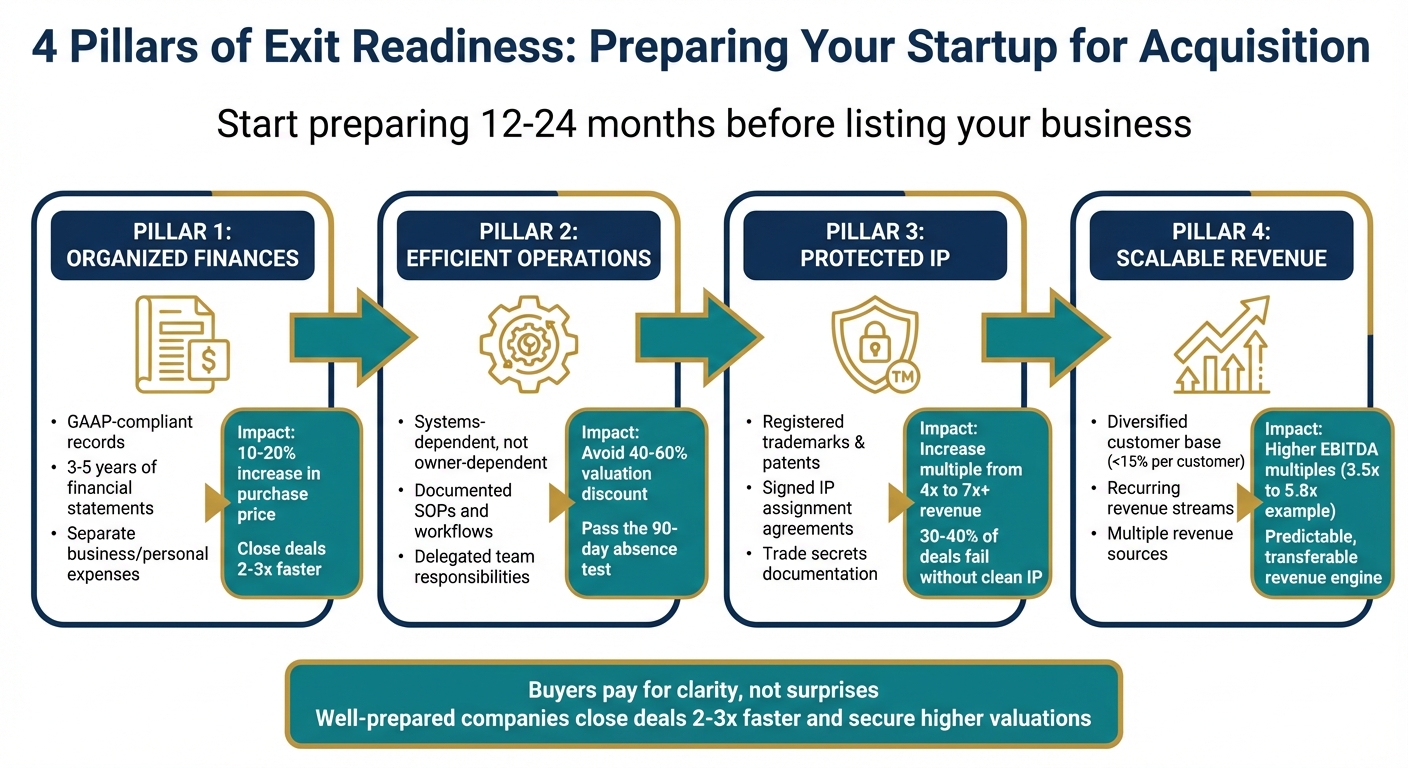
4-Step Exit Preparation Framework for Startup Founders
Maintaining Clear Financial Records
Your financial records are the backbone of any acquisition deal. Buyers base their decisions on your revenue and the profit it generates, so they’ll scrutinize every detail in your books. Disorganized records can derail a deal – confusion raises red flags, leading buyers to either lower their offer or walk away altogether. As Acquire.com aptly states:
"If you’re in doubt about a line item, expect your buyer to be too".
Well-organized, GAAP-compliant records inspire buyer confidence and can even increase your sale price by minimizing uncertainties. For example, efficient working capital management alone can impact your final purchase price by 10% to 20%. There’s also a time advantage: sellers with organized financial data often close deals 2–3 times faster than those scrambling to gather documents. Consider the case of Carol Tice, who sold her monthly-membership platform in October 2023. Her accountants had misclassified expenses and double-counted revenue, leaving her net income figures inconsistent with her P&L statements. This error forced her to settle for $100,000 less than her original asking price.
Keep Accurate Financial Statements and Tax Records
Buyers typically request at least three years of financial history, although five years is ideal to demonstrate growth. You’ll need complete P&L statements, balance sheets, and cash flow statements for each year, all prepared according to Generally Accepted Accounting Principles (GAAP).
Here’s what buyers focus on in these documents:
| Financial Document | What Buyers Look For |
|---|---|
| P&L Statement | 3–5 years of history; clear EBITDA; growth trends; recurring vs. one-time revenue |
| Balance Sheet | Accurate asset valuation; simplified debt structure; reconciled liabilities |
| Cash Flow Statement | Net cash flow; ability to sustain operations without owner contributions |
| Tax Returns | Alignment with internal P&Ls; proof of reported earnings to the IRS |
Switching to accrual accounting can provide a clearer picture of your revenue. While cash accounting is simpler, accrual accounting smooths out revenue spikes from annual memberships or seasonal sales, offering buyers a better view of monthly trends. Predictable income streams are far more appealing than volatile cash movements. Transparent, accurate records not only satisfy buyer due diligence but also enhance your company’s perceived value.
It’s also critical to eliminate any "off-the-books" income. Undocumented revenue is a liability that lowers your valuation since buyers only consider earnings reported on tax returns. If necessary, re-file corrected returns and address penalties now to avoid jeopardizing the deal later. Holly Magister, CPA and Founder of Exit Promise LP, emphasizes:
"Buyers purchase based on revenue and the profit it produces".
Aim for a five-day close – finalizing your books within five business days after each month ends. This demonstrates financial discipline and operational rigor, qualities that attract premium buyers. To further strengthen your position, consider conducting a sell-side Quality of Earnings (QoE) review 12–24 months before listing your business. This pre-sale audit can identify issues like inconsistent revenue recognition that might derail negotiations.
Use Separate Business Bank Accounts
Mixing personal and business expenses creates what investors call disorganized books, casting doubt on your company’s true profitability. Buyers need to see a clear separation between personal finances and business operations. When accounts are commingled, it becomes nearly impossible to distinguish legitimate business expenses from personal spending.
Set up dedicated business bank accounts and credit cards for all company transactions. This not only simplifies financial reviews during due diligence but also ensures your records are easier to reconcile. Balance these accounts monthly by comparing bank and credit card statements with your accounting software. This step verifies that the revenue you’re reporting was actually received.
If you own multiple businesses, maintain separate P&Ls and balance sheets for each. Buyers will struggle to value a business when they can’t determine which expenses belong to the entity they’re evaluating. Taking the time to separate entities now will save you weeks of frustration during the sale process.
Avoid running personal expenses through your business accounts. Even legitimate add-backs, like car payments or travel costs, can make it appear as though you’re treating the company as a personal account rather than a professional operation. This erodes buyer trust and can lower your valuation. Review and eliminate personal expenses to present a cleaner Seller’s Discretionary Earnings statement before going to market.
Once your financial records are in order, you can shift your focus to refining daily operations for scalability.
Improving Day-to-Day Operations
Buyers aren’t interested in purchasing a business that depends entirely on you. What they want is a self-sustaining, turnkey operation that doesn’t require constant owner involvement. If you’re the one answering every email or managing every client relationship, your business might be valued 40% to 60% lower than one with streamlined, systematic operations.
Here’s a simple test to gauge if your business is ready for an exit: can it maintain consistent performance for 90 days without your involvement? If the answer is no, there’s work to be done. Stefania Arca, Founder of International Exit Strategy, sums it up perfectly:
"Systems-dependent beats owner-dependent every time".
Take, for example, a London-based creative agency that brought in $8M annually. In October 2025, the founder realized the business wasn’t sellable because 85% of client relationships required his direct input, and no processes were documented. Over the next 12 months, the agency implemented standardized workflows and delegated authority to team leads. The result? The business achieved a 30-day founder absence without disruption and sold at a 40% higher valuation than initially expected.
The next step is creating scalable systems that can operate without you.
Set Up Systems That Can Grow With Your Business
Cloud-based tools are game-changers for simplifying operations and centralizing data. Platforms like Brex, Stripe, and LiveFlow provide real-time dashboards for tracking key metrics like monthly burn rate or vendor spending. Buyers love quick answers – if it takes you three days to find financial data instead of 30 seconds, you’re signaling inefficiency.
Tools like Notion and Process Street help turn informal know-how into Standard Operating Procedures (SOPs). By documenting workflows for core tasks like order fulfillment, client onboarding, and ticket resolution, you show buyers that your business model is both repeatable and scalable – without needing you to oversee every detail.
Keep a "living" data room updated quarterly with 10 critical files, such as cap tables, intellectual property documentation, a top 20 customer list, and three-year financial projections. This level of preparedness demonstrates operational discipline. As Stormy AI puts it:
"The speed of your response is the difference between ‘we’ll think about it’ and ‘we are wiring the money tomorrow.’ Documentation is a competitive advantage."
Consider the lesson learned by a B2B SaaS company with over $1M in annual recurring revenue and 70% profit margins. In 2024–2025, the founder handled every customer ticket and pricing decision without documented SOPs. This lack of systems led buyers to see the company as high-risk, slashing its valuation from a 5× multiple to 2.8× – a difference that cost the founder millions.
Train Your Team to Work Independently
Shift client communications away from your personal email to shared inboxes or CRM systems, enabling the team to take ownership. Bring account executives and customer success leads into key client and vendor relationships to reduce dependency on you. This approach builds stronger institutional ties and minimizes single points of failure.
Establish clear organizational charts with defined KPIs and decision-making authority for every role. Cross-train employees to ensure no one becomes a bottleneck. Your team should be confident handling daily operations, resolving issues, and making decisions without waiting for your approval. This delegation not only proves scalability but also reassures buyers that the business doesn’t rely on your constant presence.
To monitor progress, maintain a 13-week cash flow report that’s updated weekly with actual cleared payments. This helps avoid financial pitfalls like being "profitable on paper, but bankrupt on Friday." Buyers are willing to pay more for businesses with predictable, well-managed operations – not ones that depend on the brilliance of a single individual.
Securing Your Intellectual Property
Once your operations are running smoothly, the next priority is protecting your intangible assets. Intellectual property (IP) plays a crucial role in increasing your company’s valuation, offering legal protection and boosting buyer confidence. When properly secured and documented, IP can elevate your valuation multiple from 4× revenue to as high as 7× or more.
Here’s the catch: about 30% to 40% of mergers and acquisitions (M&A) deals fall apart during due diligence due to gaps in IP ownership. Buyers need solid proof that your company owns every trademark, patent, and even every line of code. For example, if a contractor developed part of your software but never signed an IP assignment agreement, you might not legally own that code – even if you paid for it. As PatentPC highlights:
"IP is not just paperwork. It’s power. And diligence is how you make sure you’re actually buying it."
Major acquisitions illustrate how IP can drive valuations. In May 2012, Google acquired Motorola Mobility for $12.5 billion, largely because of Motorola’s robust patent portfolio, which helped shield Android from legal battles. Similarly, in January 2014, Google spent $3.2 billion on Nest Labs, primarily for its proprietary thermostat technology and related IP. These examples show how well-documented IP can directly translate into higher acquisition prices.
File Trademarks and Patents
To protect your brand names, logos, and inventions, register them with the USPTO. This step provides benefits like statutory damages, recovery of attorney fees in infringement cases, and the ability to record trademarks with U.S. Customs and Border Protection (CBP). For instance, recording with CBP costs just $190 per trademark class – a small price for safeguarding brand equity that buyers value.
Keep in mind that trademarks typically take around 11 months to register, while patents can take at least 26 months. Start the process early, especially before pitching to investors or potential buyers. Publicly disclosing an invention before filing can severely limit or even void your patent rights, both in the U.S. and abroad. Additionally, IP rights are territorial, meaning a U.S. patent won’t protect you in markets like Europe or Asia.
Document Your Proprietary Methods and Technology
Your trade secrets – such as algorithms, datasets, and processes – need protection through NDAs, access controls, and encryption to ensure they remain enforceable under the law. Buyers will closely examine whether your competitive edge is secured or if it’s just informal knowledge that could leave with your team.
Another critical step is creating a Software Bill of Materials (SBOM) to document open-source components and confirm compliance with licensing terms. Conduct an internal IP audit to catalog patents, trademarks, copyrights, and trade secrets. Ensure that every employee and contractor has signed IP assignment agreements to avoid ownership disputes down the road.
Before initiating the sale process, organize all this information in a virtual data room. Buyers typically request hundreds of documents – sometimes 200 to 500 or more – during due diligence, with a strong focus on IP ownership and litigation records. Your purchase agreement will include legal guarantees that you own all IP, and any breach could lead to indemnification claims or escrow holdbacks, which could tie up 10% to 20% of your sale proceeds for years.
Having clean, well-organized documentation not only reduces these risks but also signals to buyers that your company is professionally managed and acquisition-ready. A strong IP portfolio reinforces your startup’s credibility and enhances its overall value.
Creating a Business Model That Scales
Once you’ve secured your intellectual property, the next step is proving that your revenue can grow without a proportional increase in costs. Why? Because buyers focus on future cash flows, not just your current earnings. A scalable business model, built on efficient operations and protected IP, helps separate the company’s success from its founder. This independence makes the business more attractive to potential buyers.
Here’s the deal: a business that can’t function without its founder isn’t seen as an asset – it’s viewed more like a job. Buyers value companies with documented, repeatable systems because they show operational independence and predictable growth. This autonomy directly impacts valuation. Businesses with scalable models, like SaaS platforms or e-commerce, tend to command higher multiples because they can handle growth without significant infrastructure changes. On the other hand, service-based businesses that require additional staff for every new client face natural growth limits.
Ben Tickler, Executive Director of Innovation Economy at J.P. Morgan, highlights the role of technology in scaling:
"By embracing automation and AI as your company scales, you can build efficiency and lower the cost to serve at scale".
A scalable model doesn’t just support growth; it also creates opportunities for diverse and predictable revenue streams.
Develop Multiple Revenue Sources
Diversifying your revenue streams is essential for reducing buyer risk and boosting your company’s valuation. Heavy reliance on a single customer – especially if they account for more than 15% of your total revenue – raises red flags for buyers. This kind of dependency can lead to valuation discounts or even derail deals entirely. Buyers worry about what happens if that key relationship ends after the acquisition.
Take, for example, a Novi-based machining company that earned $8 million in revenue but relied on General Motors for 65% of its income. In 2024, the company was valued at 3.5× EBITDA. Over the next 18 months, they diversified into aerospace and medical device industries, reducing GM’s share to 35%. When they returned to market, their valuation jumped to 5.8× EBITDA, adding over $4 million to the sale price.
To achieve this kind of growth, consider adding complementary revenue streams that leverage your existing infrastructure. Transitioning from one-time sales to recurring revenue – through subscriptions, memberships, or retainer services – can stabilize cash flow and make earnings more predictable. As Alex Lubyansky, Managing Partner at Acquisition Stars, explains:
"Recurring revenue beats one-time sales every time".
Standardizing your contracts is another way to boost buyer confidence. When revenue depends on personal relationships or bespoke agreements, it introduces risk. Instead, use standardized customer agreements with auto-renewal clauses and clear pricing terms. These changes reduce friction during due diligence and signal a mature, scalable revenue model. Diversified income streams also strengthen customer relationships, increasing long-term retention.
Increase Customer Retention and Lifetime Value
Retention is a powerful metric that directly impacts valuation. Buyers are willing to pay more for businesses with high retention rates because they indicate strong product loyalty and sustainable growth. When customers integrate your product into their daily operations – through features like specialized training or workflow integrations – it becomes harder for them to switch, creating a protective barrier around your business.
To make your retention rates work in your favor, track and document key metrics like net retention, churn, and renewal rates over a 24- to 36-month period. These records help buyers project future performance based on historical trends.
The difference between businesses with strong retention and those without is stark. Umbrex explains:
"Buyers rarely pay a premium for ‘great salespeople.’ They pay a premium for a revenue engine that is predictable, transferable, and resilient when ownership changes".
This underscores the importance of institutionalizing customer relationships. Create multiple points of contact – such as account executives, customer success teams, and executive sponsors – to ensure revenue doesn’t vanish if a single employee leaves.
Tools like Net Promoter Score (NPS) can also help measure customer loyalty and predict future retention and referral rates. These metrics provide concrete evidence that your customer base is stable and will remain so under new ownership. Remember, buyers are investing in your ability to generate cash flow after you’ve exited. The more you can prove customer loyalty and reduce perceived risks, the higher the price they’ll be willing to pay.
sbb-itb-ba0a4be
Getting Ready for Buyer Review
Once you’ve developed a business model that can scale, the next step is proving it to potential buyers. This phase involves a deep dive into your operations, with buyers often requesting between 200 and 500 documents during due diligence. This process is a critical test of your readiness and builds on the financial clarity and operational systems you’ve already established. It’s worth noting that 30–40% of M&A deals fall through during due diligence due to undisclosed issues. Sellers who are well-prepared tend to close deals 2–3 times faster than those who scramble to gather documents at the last minute.
Think of this review as a stress test for your business. Buyers will scrutinize every financial statement, contract, and compliance record for inconsistencies. As Ascent CFO explains:
"Buyers pay for certainty – reduce surprises and you increase the value of your company; increase ambiguity and buyers discount value or walk away".
To avoid surprises that could derail the deal, start preparing 12–24 months before listing your business. Use this time to clean up your books, standardize reporting, and address compliance gaps. A well-organized data room that can be delivered within 24 hours demonstrates operational efficiency, while delays can create doubt and lead to "deal fatigue." Proper preparation can help businesses sell 25–40% faster and often at higher prices.
Organize Required Documents
Buyers will need immediate access to documents that verify your revenue, operations, and legal standing. To streamline the process, create a Virtual Data Room (VDR) with clearly labeled categories like Financial, Corporate/Legal, Intellectual Property, Commercial, Human Resources, and Compliance. A simple index will help buyers navigate quickly.
Using a tiered disclosure strategy can make this process more efficient:
- Tier 1 (pre-Letter of Intent): High-level financials such as three years of profit and loss statements, balance sheets, and tax returns.
- Tier 2 (post-LOI): Full data room access, including customer contracts, vendor agreements, and a 24-month pipeline report.
- Tier 3 (late-stage): Highly sensitive materials like source code or full customer lists.
Here’s a snapshot of the essential documents buyers will request:
| Document Category | Essential Records to Organize |
|---|---|
| Financial | 3 years of P&L statements, balance sheets, cash flow statements, and federal/state tax returns. |
| Corporate/Legal | Articles of Incorporation, bylaws, meeting minutes, and a fully diluted cap table. |
| Intellectual Property | Patent filings, trademark registrations, and signed IP assignments from all contributors. |
| Commercial | Customer contracts (especially those >5% of revenue), vendor agreements, and a 24‑month pipeline report. |
| Human Resources | Employee/contractor agreements, payroll summaries (W‑2/1099), and an organizational chart. |
| Compliance | Permits, licenses, SOC 2 reports, and GDPR/CCPA compliance documentation. |
Before uploading documents, redact sensitive information like Social Security Numbers, personal addresses, and competitive details. Make sure revenue and margin figures align across your general ledger, tax returns, and management reports. As Umbrex warns:
"Missing documents are treated as missing controls. Unclear definitions are treated as worse-than-advertised performance".
Additionally, review all material contracts for "change-of-control" clauses that may require vendor or customer consent during a sale. These clauses can delay or even derail a deal if discovered late in the process. Address them early by securing waivers or preparing clear explanations to mitigate any concerns.
Calculate Your Business Value
Understanding your business’s value before negotiations is essential to avoid undervaluing your company or pricing yourself out of the market. Common valuation methods include:
- EBITDA multiples: Often used for mid-market companies.
- Revenue multiples: Frequently applied to high-growth tech startups.
- Discounted Cash Flow (DCF): Suitable for businesses with predictable cash flows.
Professional valuations can cost between $5,000 and $50,000, depending on the complexity of your business. While this might seem steep, a professional valuation provides a defensible number supported by industry benchmarks and detailed analysis.
Prepare a list of add-backs – non-recurring or one-time expenses such as a founder’s personal travel, one-off legal fees, or equipment purchases. These adjustments help showcase the true earning potential of your business. For instance, if your EBITDA is $500,000 but includes $75,000 in one-time expenses, your adjusted EBITDA would be $575,000. Depending on the multiple applied, this adjustment could significantly increase your sale price.
Consider investing in a Quality of Earnings (QofE) report from a third-party firm. This report validates key metrics like EBITDA, revenue trends, and working capital while flagging risks before buyers do. Think of it as a pre-inspection for your business, allowing you to address potential issues before they become negotiation hurdles.
Finally, conduct an exit readiness assessment with your leadership team to identify any obstacles that could jeopardize the deal. For unresolved issues, prepare a proactive explanation backed by evidence of containment. Buyers are often more forgiving of disclosed challenges than unexpected surprises. By establishing a clear valuation and addressing potential risks, you can instill confidence in buyers and pave the way for a smoother acquisition process.
Using BusinessAnywhere to Prepare for Sale
When getting your business ready for sale, staying organized and compliant is non-negotiable. BusinessAnywhere simplifies document management and compliance, ensuring you’re always audit-ready. Potential buyers expect immediate access to vital records like corporate documents, financial statements, and compliance certificates. Any delay in providing these can raise red flags or even jeopardize negotiations. BusinessAnywhere helps you maintain "Good Standing" status and financial accuracy, giving buyers the confidence they need to move forward.
The platform provides a centralized system for managing corporate records, contracts, and compliance filings. With the ability to retrieve essential documents within 48 hours, you demonstrate operational efficiency – something that resonates strongly during due diligence.
Stay Compliant and Organized
Buyers will closely examine your legal standing in every state where you operate, requiring "Good Standing" certificates from your state of incorporation and any other jurisdictions. BusinessAnywhere’s registered agent service, priced at $147 per year after the first free year, ensures you stay on top of legal notices and deadlines that could otherwise jeopardize your status. The platform also offers compliance alerts, which notify you of critical deadlines like annual report filings and franchise taxes. These reminders help prevent lapses that could lower your valuation or disrupt the sale process.
Another useful feature is the virtual mailbox service, starting at $20 per month. This provides a professional U.S. business address for correspondence, complete with unlimited mail scanning and global forwarding. By separating personal and business finances, you meet a key buyer requirement when they review your financial records.
These tools not only keep you compliant but also create a strong foundation for transparency and smooth due diligence.
Handle Financial and Legal Requirements
Accurate recordkeeping is just the start – buyers also expect financial clarity and legal compliance. BusinessAnywhere’s bookkeeping services ensure your financials are GAAP-compliant, giving buyers the confidence they need to verify EBITDA. Consistent and reconciled financial reports across all periods help avoid "retrades", where discrepancies in revenue figures between tax returns and management reports lead to renegotiations.
The platform also supports EIN applications and tax filings, establishing a clear legal foundation from your company’s inception. Buyers typically ask for three to five years of tax records that align with financial statements; any inconsistencies might trigger audits or price adjustments. By consolidating these records in one place, BusinessAnywhere helps create the audit trail buyers expect and minimizes the risk of undisclosed tax liabilities.
Additionally, the BOIR (Beneficial Ownership Information Report) filing service, priced at $37, ensures compliance with FinCEN regulations – another factor buyers check during due diligence. The S-Corp tax election filing service, available for $147, further enhances your corporate governance and regulatory compliance, potentially increasing your business’s appeal to buyers.
As Umbrex puts it:
"Exit readiness is a buyer-confidence problem, not a housekeeping problem. A buyer does not pay you for effort; they pay you when they understand the business, can verify the numbers, and can own it without surprises."
Conclusion
Getting your startup ready for a successful exit isn’t about scrambling to fix things at the last minute – it’s about building buyer confidence through preparation and transparency. The foundation of this process lies in four key areas: clean financial records, efficient operations that don’t depend on you, protected intellectual property, and a scalable, diversified revenue model. Buyers value clarity and growth potential, rewarding it with higher multiples. On the flip side, surprises or gaps can reduce your valuation by 30–50%.
Startups that begin exit preparations 12–24 months in advance tend to secure higher valuations and close deals two to three times faster than those that don’t. This lead time helps resolve issues like missing IP assignments, inconsistent financial records, or over-reliance on key team members – problems that can lower your valuation by 10–25%.
BusinessAnywhere offers services designed to simplify this process. From ensuring Good Standing with their registered agent services to providing GAAP-compliant bookkeeping, they help you stay organized, compliant, and ready for audits. These tools can prevent costly setbacks, like mismatched tax returns or governance issues, that might otherwise derail a deal.
As Umbrex aptly states:
"A buyer does not pay you for effort; they pay you when they understand the business, can verify the numbers, and can own it without surprises".
FAQs
What’s the fastest way to find and fix issues that could fail due diligence?
The fastest way to tackle potential due diligence problems is by conducting an early and thorough exit readiness assessment. The goal here is to pinpoint any weak areas that might shake a buyer’s confidence.
Get ahead by preparing essential materials – like financial records, legal documents, and operational data – well in advance. Stick to a structured timeline, addressing any issues at least 6 to 12 months before buyers start their review. This proactive planning reduces risks and helps the diligence process run more smoothly.
How can I reduce buyer risk if my startup relies on me or one key customer?
To lower buyer risk, aim for diversification and independence. Broaden your customer base and develop multiple revenue streams to avoid over-dependence on a single client. Additionally, assemble a capable management team and thoroughly document critical processes. This ensures the business can function smoothly without your constant oversight. By showcasing stability and reducing potential risks, you’ll make your startup more appealing to prospective buyers.
Which documents should I prepare first before sharing a data room with buyers?
When preparing for a business overview, kick things off with a detailed snapshot of your company. Share its history, mission, and the potential for growth. This sets the stage for potential investors or stakeholders to understand your business’s foundation and aspirations.
Next, ensure you have proof of ownership for your assets. This might include deeds, titles, or other documentation that verifies what the company owns. Alongside this, gather key financial records such as profit and loss statements and balance sheets. These documents provide a clear picture of your financial health and performance.
Finally, take the time to organize all legal, operational, and compliance paperwork. Having these in order not only builds trust but also simplifies the due diligence process, making everything more transparent and efficient.