


When deciding between relocating to the U.S. or running a business remotely, it’s all about balancing costs, compliance, flexibility, and growth opportunities. Here’s the breakdown:
- Relocating to the U.S. offers better access to venture capital, local networking, and hiring U.S.-based talent. However, it comes with high living costs, visa challenges, and global income taxation.
- Running a remote business is cost-effective, avoids visa hassles, and allows flexibility. But it may limit investor access and require creative solutions for banking and compliance.
Quick Comparison:
| Factor | Relocating to the U.S. | Running a Remote Business |
|---|---|---|
| Costs | High (living, office, state taxes) | Low (virtual tools, minimal state fees) |
| Tax Exposure | Taxed on global income | Often $0 U.S. income tax (non-resident) |
| Investor Access | High (face-to-face opportunities) | Moderate (requires Delaware structure) |
| Compliance | Complex (multi-state tax and compliance obligations) | Simplified (single-state filings) |
| Flexibility | Limited (physical presence needed) | High (operate from anywhere) |
Your choice depends on your funding goals, budget, and operational priorities. If VC funding is essential, relocating may be worth it. Otherwise, a remote setup is a leaner, more flexible option.
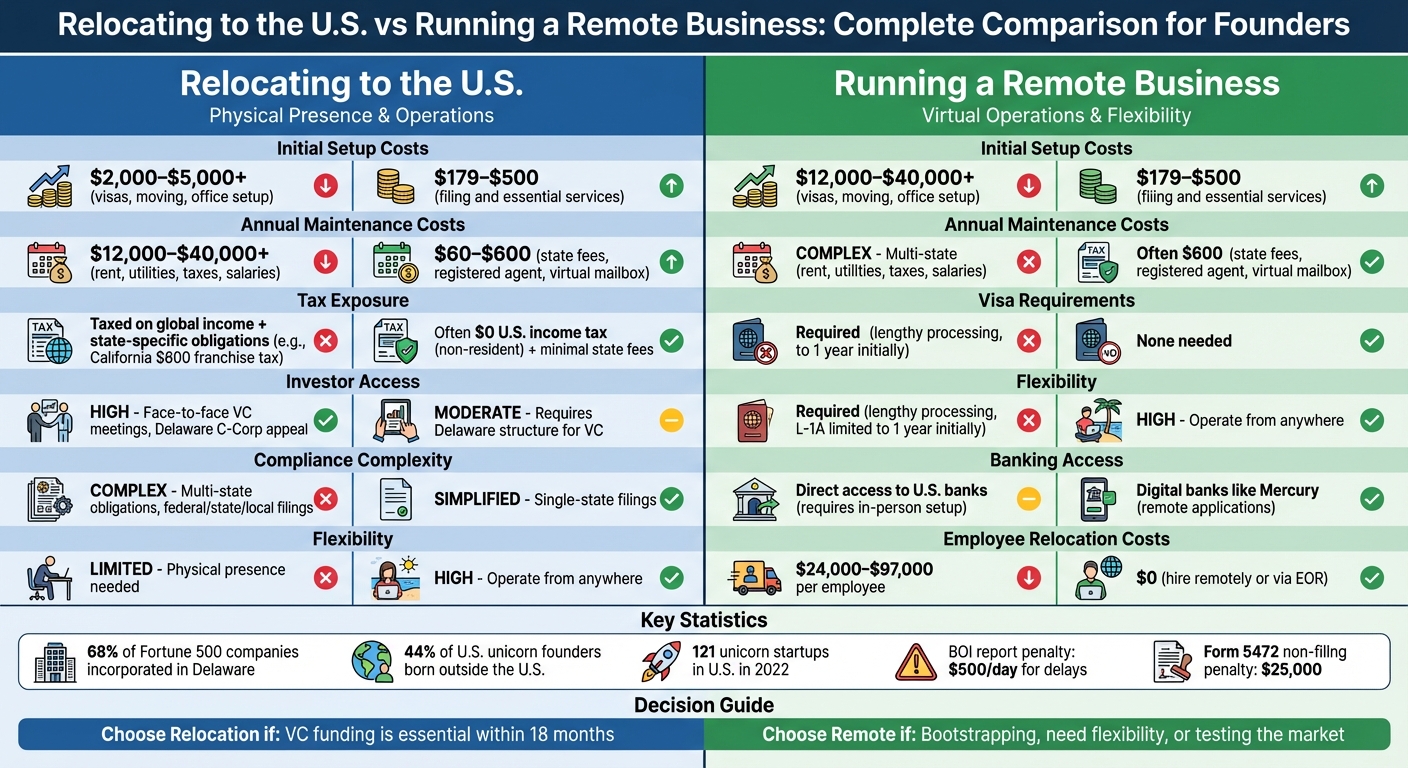
Relocating to U.S. vs Remote Business: Complete Cost and Feature Comparison
Relocating to the U.S.: Benefits and Drawbacks
Benefits of Relocating
Moving to the U.S. opens doors that remote management often can’t. One of the biggest perks is better access to venture capital. Investors in hubs like Silicon Valley and New York often prefer face-to-face interactions and are drawn to structures like Delaware C-Corporations. In fact, the U.S. was home to 121 unicorn startups (companies valued at over $1 billion) in 2022 alone.
Being physically present also means direct exposure to a massive consumer market of over 330 million people with significant purchasing power. For enterprise buyers, having a local presence is a big deal – it adds credibility through a U.S. legal identity and bank account.
Relocating also simplifies hiring U.S.-based talent. You can manage payroll and compliance directly, cutting out the need for third-party services. On top of that, being on-site makes networking and forming strategic partnerships much easier. Business hubs in the U.S. are rich with incubators, accelerators, and mentorship opportunities that can help fast-track growth.
While these benefits can make scaling smoother, they come with associated costs and challenges that need careful consideration.
Drawbacks of Relocating
Despite the advantages, moving to the U.S. comes with its own set of hurdles, starting with visa complexities. Owning a U.S. business doesn’t automatically grant residency or work rights. Visa processing can be lengthy, and options like the "new office" L-1A visa are initially limited to one year, contingent on a detailed business plan and a physical office lease.
Relocation also brings tax complications. Meeting the Substantial Presence Test makes you a resident alien, meaning you’re taxed on worldwide income. On top of that, some states, like California, impose minimum franchise taxes ($800 annually) even if your business isn’t turning a profit .
Living costs in major business hubs can be steep. Rent, healthcare, transportation, and daily expenses are significantly higher, and leasing office space only adds to the financial strain.
Compliance is another challenge. A physical presence means navigating federal, state, and even local tax filings. If you operate in multiple states, you might face additional registration and tax obligations. Missing crucial deadlines, like those for the Beneficial Ownership Information (BOI) report, could result in penalties of up to $500 per day.
Comparison Table: Relocation Benefits and Drawbacks
| Factor | Benefits | Drawbacks |
|---|---|---|
| Investor Access | In-person VC meetings and Delaware C-Corp appeal | Requires a physical presence and significant time investment |
| Banking | Direct access to U.S. banks and payment tools | Needs a U.S. address and often in-person account setup |
| Taxation | – | Worldwide income taxation and state-specific obligations |
| Visa Requirements | – | Lengthy processing times; must secure appropriate visa |
| Living Costs | Access to a thriving economic ecosystem | High daily living expenses and office space costs |
| Credibility | Builds trust with enterprise clients | Requires ongoing investment in local infrastructure |
| Compliance | Simplifies payroll and employment management | Complex tax filings; penalties for BOI delays can reach $500/day |
sbb-itb-ba0a4be
Running a Remote Business: Benefits and Drawbacks
Managing a business remotely comes with its own set of trade-offs, particularly when it comes to costs, compliance, and flexibility. Let’s break down what you can expect.
Benefits of Remote Operations
One of the biggest perks of running a business remotely is sidestepping the hassle of visas and relocation. You can manage your company from anywhere in the world while still tapping into the U.S. market. This includes access to payment processors like Stripe and PayPal, as well as USD banking services – all without the expense of physically moving to the U.S.
Remote operations also help you save on living and office expenses. For example, non-U.S. residents operating a disregarded entity may owe $0 in U.S. income tax, provided they don’t have a U.S. presence. However, you’ll still need to file Form 5472 to avoid penalties. The state you choose for incorporation matters too – Wyoming’s annual report fee is just $60, while New Mexico charges a one-time $50 filing fee with no annual report required. Compare that to California’s hefty $800 annual franchise tax, and the savings are clear.
"One key area of savings is the reduced need for physical office space. This frees up capital that can be reinvested into areas like technology and employee development, which ultimately drive growth."
– Jonathan Goldberg, CEO and founder of Kimberfire
Digital tools make compliance easier. Services offering low-cost LLC formation, virtual mailboxes, and registered agent support can help you meet U.S. requirements without ever setting foot in the country. Plus, having a U.S.-based entity adds a layer of credibility that’s often valued by international clients and enterprise customers.
That said, remote operations aren’t without their challenges, especially when it comes to banking, compliance, and maintaining privacy.
Drawbacks of Remote Operations
While the flexibility and cost savings are undeniable, running a remote business has its hurdles – particularly in banking and compliance. Traditional banks like Chase or Wells Fargo often require in-person visits and proof of U.S. residency to open an account. Many remote entrepreneurs turn to digital-first banks like Mercury or Relay, which cater to non-residents. However, these options may lack some of the services offered by traditional banks.
Address verification is another sticking point. Platforms like Amazon and Shopify now reject P.O. Boxes for Know Your Customer (KYC) checks. To meet these requirements, you’ll need a physical street address from a Commercial Mail Receiving Agency (CMRA), which functions as a virtual mailbox. These services can cost anywhere from $240 to $780 per year, depending on the plan.
Compliance deadlines also add pressure. For instance, under new regulations, all LLCs will need to file a Beneficial Ownership Information (BOI) report with FinCEN within 90 days of formation starting in 2026. On top of that, specialized accounting for filings like Form 5472 and Form 1120 can cost $500 to $800 annually.
"The penalty for not filing [Form 5472] is $25,000; the IRS doesn’t care if you didn’t know."
– Komolafe Philip, Founder
Privacy can be another concern. If you use your home address for LLC filings, it becomes part of the public record. The best virtual mailbox services can protect your privacy, but they add to your recurring costs. Plus, running a remote business often requires investing in various software tools like Zoom, Slack, and project management platforms, which can increase operational expenses – especially if you’re working across multiple jurisdictions.
Comparison Table: Remote Business Benefits and Drawbacks
| Factor | Benefits | Drawbacks |
|---|---|---|
| Setup Costs | Low initial costs; states like Wyoming and New Mexico offer minimal fees | Additional expenses for virtual mailbox services and registered agent fees |
| Taxation | Potential for $0 U.S. income tax for non-residents without a physical presence | Filing Form 5472 is mandatory, and non-compliance can lead to $25,000 penalties; accounting fees apply |
| Banking | Digital banks like Mercury make remote applications easy | Traditional banks often require in-person visits and proof of U.S. residency |
| Compliance | Digital tools simplify EIN filing and compliance tracking | BOI report required within 90 days; delays result in $500 daily fines |
| Location | Freedom to operate from anywhere in the world | Lack of physical presence may impact credibility in some industries |
| Privacy | Virtual mailbox services keep your home address private | Without a CMRA service, your home address becomes public |
| Operational Costs | Eliminates U.S. living and office expenses | Recurring costs for digital tools and software subscriptions |
Compliance Requirements: Relocation vs Remote
Navigating compliance requirements can be tricky, whether you’re relocating or running a remote business. Let’s break it down. All U.S.-based businesses, regardless of setup, need to meet certain federal standards. For instance, every LLC must get an Employer Identification Number (EIN) from the IRS. It’s free and necessary for banking and hiring. Additionally, starting in 2026, all businesses must file a Beneficial Ownership Information (BOI) report with FinCEN within 90 days of formation.
Common Compliance Requirements
At the core, both relocation and remote business setups share some basic steps. These include filing Articles of Organization with your chosen state, appointing a registered agent with a physical address in that state, and obtaining an EIN. If you’re a foreign-owned single-member LLC, there’s an additional annual requirement to file Form 5472 and a pro forma Form 1120, even if your business generates no income. Skipping this can result in a hefty $25,000 penalty.
Costs can add up quickly. For instance, professional BOI filing services typically run around $37, while annual registered agent fees range from $50 to $300. Missing the BOI filing deadline could cost you up to $500 per day in civil penalties.
While these steps are standard for all businesses, relocation introduces additional layers of complexity.
Differences in Compliance Processes
Relocation brings unique challenges once you’ve handled the basics. Moving to a new state creates a "nexus" – a tax connection that triggers further compliance requirements. For example, if you form an LLC in Wyoming but move to California, you’ll need to register as a Foreign LLC in California. This means you’ll pay both Wyoming’s $60 annual fee and California’s $800 minimum franchise tax. Additionally, you’ll need registered agents in both states and must file annual reports in each jurisdiction.
Skipping these steps can be costly. Connecticut, for instance, collected $1.3 million in penalties from businesses that failed to register as foreign LLCs. On the other hand, remote businesses that are truly location-independent avoid these double compliance headaches, keeping their registration confined to a single state.
"If you operate in California, you owe California’s $800 franchise tax regardless of where you formed. You’d pay both Wyoming fees AND California foreign LLC fees."
– Trevor Fenner, Founder, Ecommerce Paradise
For most businesses – about 90%, in fact – it makes sense to incorporate in their home state to avoid the added costs and deadlines of multi-state compliance. If you’re planning a permanent move, incorporating directly in your new state can save you from managing two sets of fees and deadlines.
Comparison Table: Compliance Requirements
| Requirement | Remote Business (Single State) | Relocated Business (Multi-State) |
|---|---|---|
| Formation Filing | One-time fee (e.g., $100 in Wyoming, $50 in New Mexico) | Formation fee plus foreign qualification fee |
| Annual Reports | Filed in one state only | Filed in both formation state and state of residence |
| Registered Agent | One agent required in formation state ($50–$300/year) | Two agents required – one in each state |
| Tax Obligations | Federal plus potentially $0 state tax (Wyoming, Nevada) | Federal plus state income/franchise taxes in residence state (e.g., $800 in California) |
| BOI Reporting | Required within 90 days of formation | Required within 90 days of formation |
| Address Type | Virtual Business Address (CMRA) recommended | Physical office or home address (becomes public record) |
Cost and Growth Potential Analysis
When comparing remote business operations to relocating to the U.S., the financial picture couldn’t be more different. Remote setups are budget-friendly and streamlined, while relocation demands a hefty upfront investment.
Initial Setup Costs
Starting a remote business is a relatively low-cost endeavor. State filing fees range from about $35 in Montana to around $300 in more expensive states. For example, in New Mexico, it’s about $50, Wyoming charges roughly $100, and Delaware falls between $90 and $110. Adding a registered agent service – typically $50 to $300 annually – keeps your first-year costs comfortably under $500.
Relocation, however, is a different story. Beyond state filing fees, you’re looking at $2,000 to $5,000 for visa applications, travel, and moving expenses. If you’re relocating an employee, costs can skyrocket to $24,000 for renters or even $97,000 for homeowners. This includes expenses like real estate commissions and temporary housing. Physical office space in cities like New York or San Francisco can add another $1,000 to $3,000 per month, plus furniture, utilities, and IT setup.
While initial costs are starkly different, the ongoing expenses also highlight the contrasting financial realities of these models.
Recurring Maintenance Costs
Annual costs for remote businesses are minimal. Some states, like New Mexico, don’t charge for annual reports, while others, like Wyoming and Florida, charge $60 and $138.75, respectively. A registered agent from BusinessAnywhere costs about $147 per year, and virtual mailbox services range from $240 to $780 annually.
Relocated businesses face steeper recurring costs. For instance, California mandates an annual franchise tax of $800, regardless of revenue. Delaware charges at least $300 in franchise taxes. On top of that, maintaining a physical office – including rent, utilities, insurance, and upkeep – can easily exceed $12,000 annually. The relocation process itself can consume 800 to 1,000 hours of employee time, often leading to revenue losses during the transition.
"Loss of revenue can be a very dramatic hit in the whole relocation process."
– Helen Dennis, President and Co-founder, 300 Decisions
But beyond the numbers, the long-term growth potential of each model plays a crucial role in the decision-making process.
Scalability and Growth Opportunities
Your growth strategy heavily influences which model makes the most sense. If venture capital funding is in your plans, relocating to establish a Delaware C-Corp is almost a requirement. With 68% of Fortune 500 companies incorporated in Delaware, venture capitalists often expect this structure. Relocation also opens doors to direct networking, easier U.S. talent acquisition, and stronger market credibility. Interestingly, about 44% of U.S. unicorn founders were born outside the U.S., underscoring the scaling benefits of relocation.
"If VC funding is part of your roadmap and even if it is 18 months away, you should structure as a Delaware C-Corp from day one."
– Antravia Advisory
On the other hand, remote businesses excel in efficiency and flexibility. They can leverage U.S. banking and payment systems without triggering personal tax residency issues. Strategic relocation to more affordable areas might cut operating costs by 20% to 30%, but remote setups achieve similar savings without geographical limitations. For founders not pursuing venture capital, remote management offers privacy advantages – especially in states like Wyoming and New Mexico, where member names remain confidential. Compliance is also simpler, avoiding the complexity of multi-state regulations. Plus, Employer of Record (EOR) services make location-independent hiring a breeze.
Comparison Table: Cost and Growth Metrics
| Metric | Remote Business | U.S. Relocation |
|---|---|---|
| Initial Setup | $179–$500 (filing and essential services) | $2,000–$5,000+ (visas, moving, office setup) |
| Annual Maintenance | $60–$600 (state fees, registered agent, virtual mailbox) | $12,000–$40,000+ (rent, utilities, taxes, salaries) |
| Employee Relocation | $0 (hire remotely or via EOR) | $24,000–$97,000 per employee |
| Tax Exposure | Nominal state fees (in tax-friendly states like WY, NM) | $800+ franchise tax (in states like CA or DE) |
| Investor Access | Moderate (may require Delaware structure for VC) | Maximum (enhanced networking and market credibility) |
| Scalability | High efficiency with access to a global talent pool | High growth potential with strong U.S. market presence |
Conclusion: Choosing the Right Path for Your Business
Deciding on the best approach for your business comes down to your funding strategy, budget, and operational priorities. If securing venture capital within the next 18 months is on your radar, investors will likely expect a Delaware C-Corp and a physical U.S. presence. On the other hand, if you’re bootstrapping, exploring the market, or need flexibility, forming a Wyoming or New Mexico LLC offers a cost-effective and low-risk way to get started.
It’s important to conduct a nexus audit to evaluate your tax obligations and also understand how your home country treats U.S. entities. Relying solely on U.S. tax advice without considering your local tax implications could lead to unexpected liabilities. Working with tax professionals familiar with both jurisdictions is key to avoiding surprises. Compliance aside, operational flexibility is another critical factor to weigh.
For businesses that need to move quickly, minimize expenses, and maintain location independence, remote operations are an excellent option. Services like BusinessAnywhere simplify the process of forming a U.S. entity by bundling essentials like registered agent services, virtual mailboxes, EIN applications, and compliance support. Starting at $0 plus state fees, their offerings include a free registered agent for the first year and ongoing low maintenance costs, making it easier to establish a credible U.S. presence without the hefty overhead of relocation.
Ultimately, the right choice depends on your goals and timeline. You can test the waters remotely by hiring U.S. talent through an Employer of Record. If your business gains traction, you can always transition to a physical presence later. Remote management provides a scalable solution without the complexities of visas or the added costs of relocating.
FAQs
Will relocating to the U.S. make me taxable on worldwide income?
Relocating to the U.S. doesn’t mean you’re immediately taxed on all your worldwide income. Your tax responsibilities depend on several factors, including your residency status, the type of income you earn, and any tax treaties between the U.S. and your home country. Typically, non-residents are only taxed on income earned from U.S. sources – unless they meet certain conditions that classify them as tax residents.
How can I avoid creating U.S. “nexus” while running my business remotely?
To steer clear of creating a U.S. nexus, it’s important to carefully manage your business activities and presence in certain states. Only register in states where your operations genuinely establish a nexus – this typically includes having employees, inventory, or property there. Consider adopting a remote work policy, keeping a close eye on state laws, and leveraging tools like registered agents or virtual mailboxes. These steps can help you stay compliant without inadvertently triggering tax obligations. Thoughtful planning plays a big role in reducing nexus-related risks.
What’s the simplest U.S. entity setup if I might raise VC later?
A Delaware C Corporation is often considered the go-to choice for founders looking to attract venture capital. Its appeal lies in its investor-friendly legal framework, tax benefits, and ability to support growth on a large scale.