


Burnout is real, and as a startup founder, your time is your most limited resource. Outsourcing tasks can save you time and money – up to 70% in costs – and help you focus on growing your business. But knowing when and how to start is key.
- When to outsource: Start when routine tasks are delaying growth or when your hourly worth exceeds the cost of hiring help.
- What to outsource first: Administrative work, customer support, digital marketing, and finance tasks are great starting points.
- Where to find freelancers: Platforms like Upwork (for long-term projects) and Fiverr (for quick tasks) offer affordable options.
- How to manage outsourcing: Use clear contracts, measurable goals, and free tools like Trello or Asana to track progress.
Outsourcing doesn’t mean losing control – it means freeing up your time for high-value activities. Let’s break down how to do it effectively.
When to Start Outsourcing Tasks
Outsourcing can be a game-changer when it comes to focusing on tasks that drive revenue. The trick is knowing when to start. Many founders wait until they’re overwhelmed, which often means lost time, money, and missed opportunities. Let’s break down how to identify bottlenecks, reclaim your time, and weigh the costs of outsourcing against hiring.
Spotting Workflow Bottlenecks
A bottleneck happens when important tasks keep getting delayed. If you’re missing deadlines, turning down new clients, or struggling with slower customer response times, you’ve likely hit a capacity limit.
Take the example of a Canadian software company in 2024. They faced delays caused by manual data verification, which slowed their entire operation. To fix this, they worked with 1840 & Company to hire a six-person remote team based in the Philippines. Within just 14 days, the team was onboarded, saving the company $232,000 annually while eliminating the bottleneck.
"Outsourcing is most powerful when it’s driven by purpose, not desperation." – 1840 & Company
If you’re unsure whether you’re facing a bottleneck, track your time for a week or two. Are you spending hours on tasks like bookkeeping or leaving customer inquiries unanswered? If so, it’s time to delegate.
Freeing Up Time for Core Business Activities
Here’s a simple test: calculate your hourly worth based on your target salary. Now compare that to the cost of a virtual assistant, which typically ranges from $15 to $25 per hour. If you’re spending your $100/hour time on $20/hour tasks like scheduling or data entry, you’re mismanaging your resources.
By handling low-value tasks yourself, you’re not just wasting time – you’re also missing out on opportunities to grow your business. And when key team members are tied up with routine work instead of focusing on high-impact projects, it’s like throwing money out the window.
"Letting go of the right responsibilities isn’t giving up control, it’s making space to double down on the work only you can do." – Entrepreneur
Comparing Costs: Outsourcing vs. Hiring
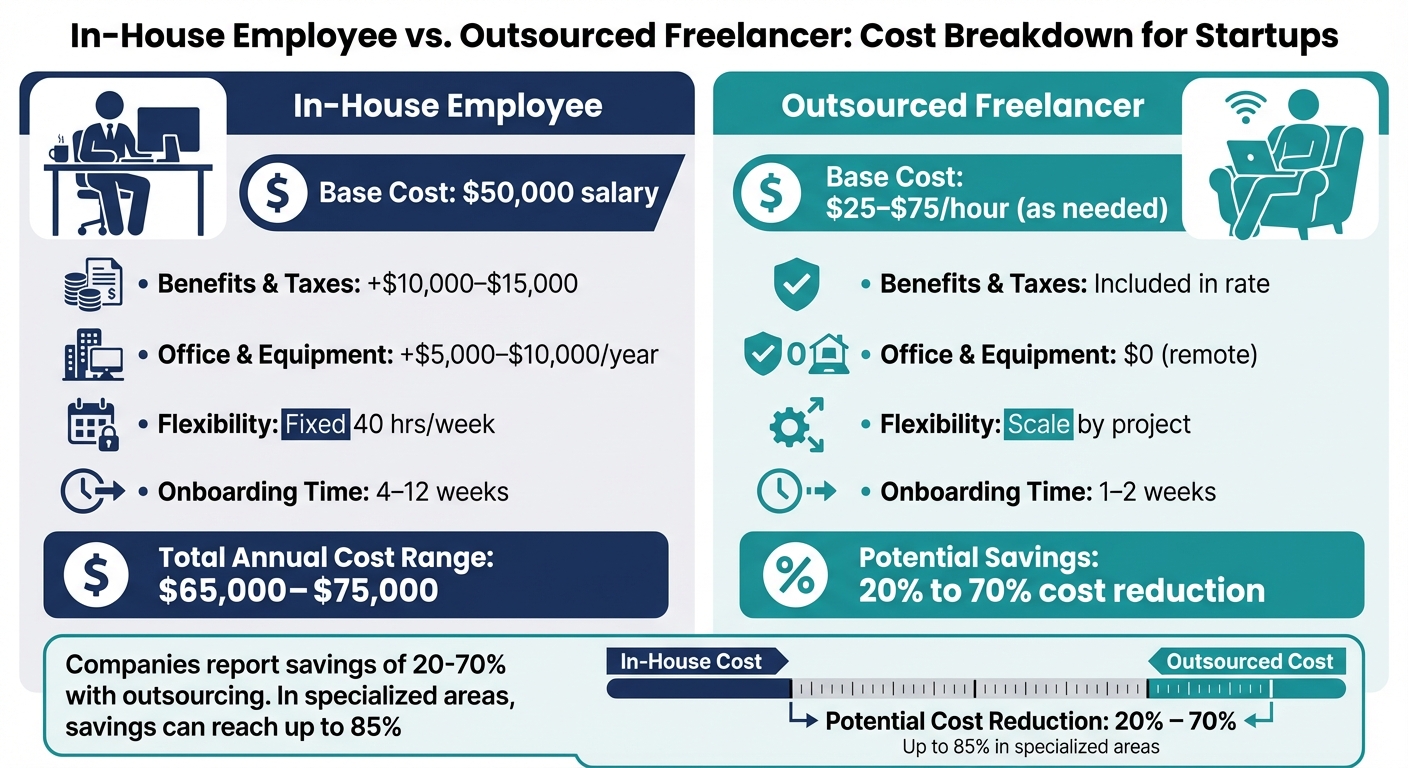
Once you see the time-saving potential of outsourcing, take a closer look at the financial side. A $50,000 salary might seem simple enough, but factor in benefits (an additional 20% to 30%), recruitment costs, training, office space, equipment, payroll taxes, and the time spent managing the employee. That $50,000 quickly balloons to $65,000–$75,000 – and it’s a fixed cost, whether you need full-time help or not.
Outsourcing offers a more flexible model. You pay for work delivered, not idle hours. For example, if you need 10 hours of graphic design one month and 30 the next, you can adjust without worrying about severance or awkward conversations. Companies report savings of 20% to 70% with outsourcing, and in certain specialized areas, savings can reach up to 85%. For accounting alone, outsourcing can cut labor costs by as much as 51%.
Here’s a side-by-side comparison:
| Cost Factor | In-House Employee | Outsourced Freelancer |
|---|---|---|
| Base Cost | $50,000 salary | $25–$75/hour (as needed) |
| Benefits & Taxes | +$10,000–$15,000 | Included in rate |
| Office & Equipment | +$5,000–$10,000/year | $0 (remote) |
| Flexibility | Fixed 40 hrs/week | Scale by project |
| Onboarding Time | 4–12 weeks | 1–2 weeks |
Start small by outsourcing non-core tasks – those that need to get done but don’t define your competitive edge. Areas like accounting, payroll, IT support, and customer service are excellent starting points. These roles require expertise but don’t directly differentiate your business from competitors.
Which Tasks to Outsource First
To make the most of your time and resources, start by outsourcing tasks that are time-consuming and don’t directly contribute to your business’s core strengths. A good way to identify these tasks is by auditing your weekly activities to pinpoint those that take up time but only produce 20% of your results. Delegating these low-return tasks allows you to focus on what truly matters – like closing deals, improving your product, or building strategic relationships – while ensuring daily operations run smoothly. This approach sets the stage for scaling efficiently.
Here are some task categories that are ideal for outsourcing:
| Task Category | Specific Tasks | Key Benefit |
|---|---|---|
| Administrative | Calendar management, travel booking, CRM updates, data entry | Saves ~16 hours/week for founders |
| Customer Support | Email/chat support, virtual receptionists, after-hours coverage | Enables 41% faster revenue growth |
| Digital Marketing | Social media, SEO, content creation, graphic design | Provides access to expertise without full-time costs |
| Finance | Bookkeeping, payroll, tax compliance | Cuts labor costs by up to 51% |
In fact, many small businesses report a 200–300% ROI on outsourcing, often gaining $2–$3 in value for every $1 spent. The key is to delegate tasks that offer immediate relief and don’t require constant oversight.
Administrative Tasks
Administrative work often eats up a significant chunk of time that could be better spent on strategic initiatives. Founders, on average, dedicate 16 hours per week to tasks like email management, scheduling, travel planning, and document organization. That’s two full workdays lost to routine chores.
Start with calendar and email management – these tasks are easy to evaluate because they provide immediate feedback. For example, you’ll quickly notice if meetings are being scheduled correctly or if important emails are being flagged. Once those are covered, you can expand to other tasks like travel booking, CRM updates, data entry, meeting briefs, and basic research.
"The most successful founders aren’t the ones doing everything; they’re the ones who know what to stop doing." – Coconut VA
Before outsourcing, create clear instructions or Standard Operating Procedures (SOPs). Tools like Loom can help you record step-by-step video guides, which minimize confusion and reduce the need for follow-ups.
Customer Support
Outsourcing customer support is a smart way to maintain strong customer relationships while freeing up your time to focus on growth. By delegating this function, you can ensure faster response times and extended coverage – without the expense of hiring full-time staff. Whether it’s handling email inquiries, live chat, or phone support, outsourcing ensures customers get timely assistance while you concentrate on big-picture goals.
Businesses that prioritize customer service often see 41% faster revenue growth compared to those that don’t. Outsourced teams can manage after-hours inquiries, shared inboxes, and FAQs, giving your customers quick answers without requiring you to be available 24/7.
Focus on outsourcing routine questions while keeping more complex issues in-house. This blended approach keeps you in control of critical interactions while reducing your daily workload.
Digital Marketing
Digital marketing is another area where outsourcing can make a big difference. It’s a field that demands specialized knowledge, from SEO and social media algorithms to content creation and paid ads. Most founders don’t have the time to master these skills, but outsourcing to agencies or freelancers provides access to professionals who can deliver high-quality campaigns without the cost of hiring a full-time team.
Tasks like social media scheduling, blog writing, email newsletters, SEO optimization, and graphic design are ideal for outsourcing. Instead of relying on one generalist, you can tap into a team of specialists – like designers, copywriters, and SEO experts – for a comparable or even lower cost.
The benefits are immediate. You’ll get polished, professional content without having to spend months learning the ropes of digital marketing. Plus, outsourcing turns fixed costs into flexible ones, allowing you to scale up during busy periods and cut back when things slow down. Platforms offering affordable freelancers can help you find the right people for these tasks.
Affordable Platforms for Finding Freelancers
Once you’ve decided which tasks to delegate, the next step is finding the right freelancers. If your startup is working with a tight budget, Upwork and Fiverr are two platforms worth considering. Each caters to different outsourcing needs.
Upwork is a bidding marketplace where you post a job, and freelancers submit tailored proposals. It’s great for both short-term tasks and ongoing, complex projects, like managing social media or building a website. The platform connects you with over 18 million freelancers from more than 180 countries, and on average, you can hire someone within three days. Upwork supports both hourly and fixed-price contracts, giving you flexibility based on your project’s scope.
Upwork: A Hub for Specialized Skills and Long-Term Projects
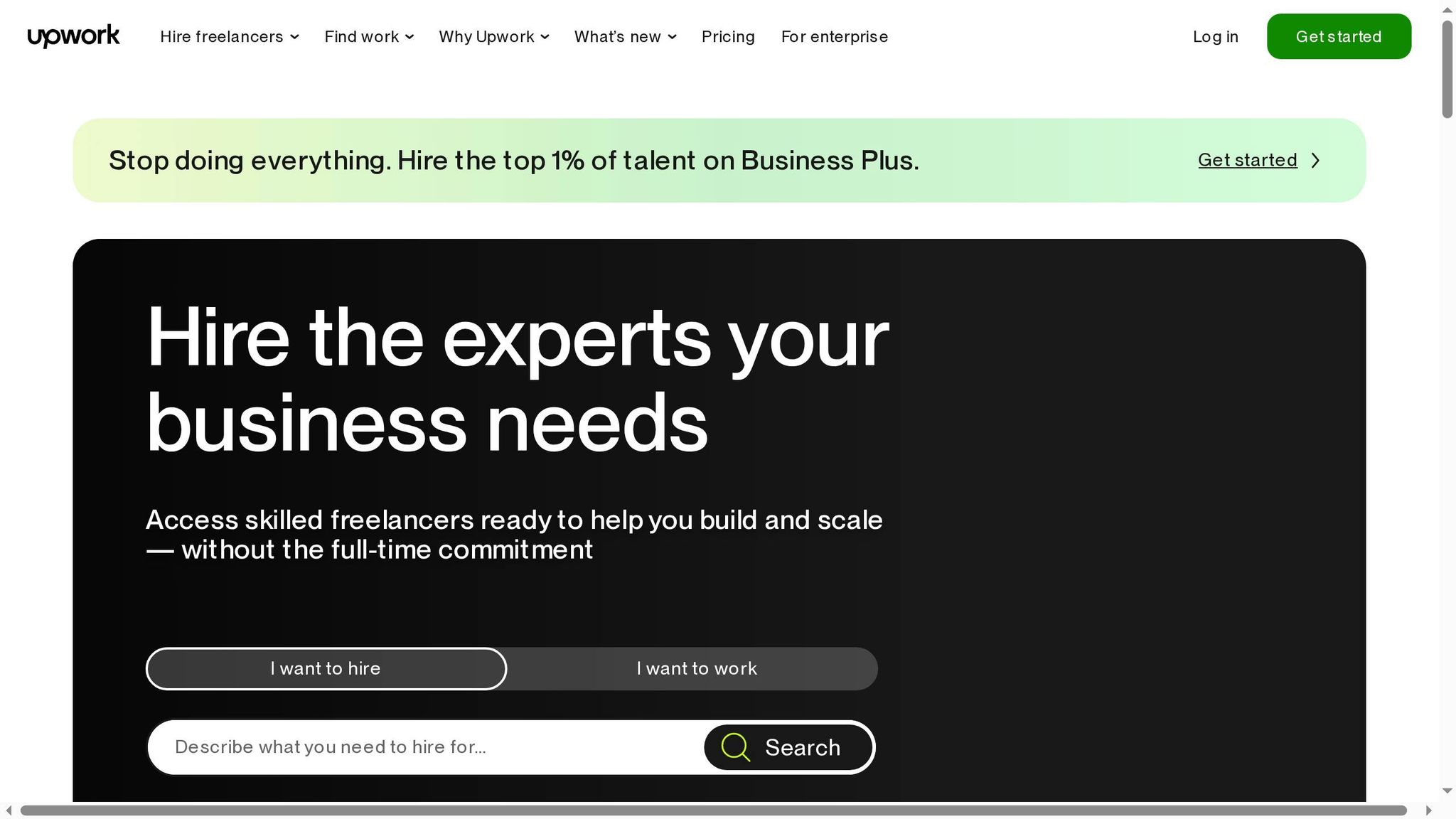
Upwork is ideal when you need expertise or ongoing collaboration. After posting a job, you’ll receive proposals from freelancers, including their rates, portfolios, and work histories. You can even interview candidates using Upwork’s built-in video tools. The platform covers over 10,000 skills across categories like admin support, customer service, digital marketing, web development, and content writing. Rates vary depending on the freelancer’s skill level and location. For example, virtual assistants typically charge $10–$20 per hour, while AI engineers might charge $35–$60 per hour.
| Skill Category | Role | Typical Hourly Rate |
|---|---|---|
| Administrative | Virtual Assistant | $10–$20/hr |
| Customer Support | Customer Service Rep | $10–$19/hr |
| Digital Marketing | SEO Expert / Social Media Manager | $15–$35/hr |
| Writing | Content Writer / Copywriter | $15–$45/hr |
| Development | Full Stack Developer | $16–$35/hr |
| Design | Graphic Designer | $15–$35/hr |
Upwork charges a one-time contract initiation fee, ranging from $0.99 to $14.99, when starting work with a new freelancer. Additionally, the platform charges a service fee of up to 10% on payments. U.S.-based clients using ACH transfers may qualify for lower fees, as low as 3%. To ensure both parties are protected, Upwork uses an escrow system that holds funds until the work is approved.
"Upwork isn’t just a hiring platform for us – it’s a strategic partner. It’s helped us fill every technical gap, accelerate our delivery from months to weeks, and even bring on leaders who’ve become foundational to our business." – David Wrench, Co-Founder and CEO, Datajoi
For startups, Upwork’s "Basic" plan is free to use – you only pay when you hire someone. If you’re in a rush to find talent, the "Business Plus" plan offers curated shortlists and additional features, though it comes with higher fees. For simpler tasks, Fiverr might be the better option.
Fiverr: Fast and Budget-Friendly for Defined Tasks
On the other hand, Fiverr shines when it comes to quick, straightforward tasks. Instead of posting a job and waiting for proposals, you browse through pre-set "Gigs" offered by freelancers (referred to as sellers). Each Gig includes a description, pricing, delivery time, and examples of past work. This setup is perfect for tasks like logo design, writing a blog post, or recording a voiceover.
Gigs start at just $5.00, making Fiverr an affordable choice for startups. The platform supports over 300 skills across 13 categories, including graphic design, video editing, voiceovers, and basic coding. Since sellers set their prices upfront, you’ll know exactly how much you’re spending before committing.
| Fee Type | Cost |
|---|---|
| Standard Service Fee | 5.5% of total order value |
| Small Order Surcharge | $3.50 (for orders under $100) |
| Fiverr Pro Advanced | $129/month (optional for enterprise tools) |
| Gig Price Range | Starts at $5.00 |
Fiverr charges a 5.5% service fee on every transaction, with an additional $3.50 fee for orders under $100. Like Upwork, Fiverr uses an escrow system to hold funds until the work is approved.
While Fiverr is perfect for well-defined tasks with clear deliverables – like "a 500-word blog post" or "a logo with three revisions" – it’s not the best option for ongoing projects or roles requiring regular communication. For those needs, Upwork’s flexibility might be a better fit. If you’re seeking vetted, high-quality talent, Fiverr also offers a "Fiverr Pro" tier featuring verified professionals with proven experience.
Both platforms offer practical options for outsourcing, allowing you to delegate tasks efficiently based on your specific needs and budget.
How to Outsource Tasks: Step-by-Step Guide
When you’re ready to scale your business without breaking the bank, outsourcing can be a game-changer. But to do it effectively, you need a structured approach. Here’s how to break it down: identify the right tasks, set clear goals, and build strong working relationships.
Identify Tasks and Set Clear Goals
Before hiring anyone, take a close look at what you need help with. Spend a week tracking your daily activities to pinpoint time-consuming tasks. Pay attention to the ones you keep avoiding or always leave undone – these are often the best candidates for outsourcing.
Separate your core tasks from those you can delegate. Core activities – like developing your product strategy, shaping your brand identity, or nurturing key client relationships – are crucial to your business and should stay in-house. On the other hand, non-core tasks such as bookkeeping, data entry, or managing social media can often be handed off to someone else. In fact, research shows that 60–70% of a typical business owner’s weekly workload can be effectively managed by a virtual assistant without compromising quality.
Once you’ve chosen tasks to outsource, take the time to document the process. Write clear instructions, outline quality standards, and provide examples of what you expect. For instance, if you’re outsourcing blog writing, include a style guide, target word count, and key SEO requirements. This level of detail sets your freelancer up for success.
Set measurable goals for every task. Instead of saying, "Improve our social media presence", be specific: "Post five times per week on Instagram and achieve an engagement rate of at least 2%." This clarity helps both you and your freelancer understand what success looks like.
Find and Evaluate Freelancers
Now that you know what you need, it’s time to find the right person for the job. Use trusted freelance platforms to connect with skilled professionals. Look at their portfolios, past work, and client reviews to get a sense of their abilities.
Pay attention to communication during your initial conversations. Quick, clear responses are often a good sign of a reliable freelancer. Also, seek out people who have worked with businesses like yours in terms of size or industry.
Ask practical, scenario-based questions to get a better sense of their problem-solving skills. For example, if you’re hiring a virtual assistant, you could ask, "How would you handle two overlapping appointments?" or "What would you do if a client request lacked key details?" Their answers can reveal how they think on their feet.
Before committing to a long-term arrangement, start with a short, paid trial. This allows you to test their communication, reliability, and the quality of their work.
"Outsourcing is a great way to ‘try before you buy.’ I’ve worked with a lot of freelancers who have become full-time employees, and their freelance work was an opportunity for both parties to see if they enjoyed working together."
– Ryan Johnson, Founder of Bread & Circuses.
Create Contracts and Performance Metrics
Once you’ve found the right freelancer, lock in the details with a written contract. Even for smaller projects, a contract ensures both parties are on the same page. Be sure to include the scope of work, specific deliverables, payment terms, deadlines, and revision policies.
Consider adding Service Level Agreements (SLAs) to define measurable quality standards. For example, if you’re outsourcing customer support, your SLA might state that all inquiries must be answered within two hours during business hours or that customer satisfaction scores must stay above 4.5 out of 5 stars.
From the start, establish Key Performance Indicators (KPIs) that align with your business goals. Whether you’re tracking social media engagement, follower growth, or administrative efficiency, clear KPIs help ensure accountability.
Finally, address data security and compliance in your contract. If the freelancer will be handling sensitive information, include protocols for protecting that data. Specify the tools they’ll use, how confidential information will be managed, and any relevant industry regulations, such as HIPAA for healthcare or GDPR for European customers. Regular check-ins can help you monitor progress and make adjustments as needed.
sbb-itb-ba0a4be
Managing Outsourced Workers on a Budget
Managing outsourced workers effectively is crucial for achieving growth while keeping costs under control. By combining clear communication, affordable tools, and performance tracking, you can ensure quality results without overspending.
Maintaining Clear Communication
Did you know that 56% of project failures happen due to poor communication? To avoid this, centralize all discussions on one platform, like Slack or Asana, instead of juggling emails, texts, and various apps. A single, consistent communication channel ensures everyone stays on the same page.
For freelancers working across time zones, asynchronous communication is key. Let them respond on their own schedule rather than expecting instant replies. This flexibility keeps things moving without creating unnecessary pressure. When explaining complex tasks, skip long emails – use screenshots or annotated videos instead. These visuals save time and reduce misunderstandings.
Set clear guidelines for communication frequency, preferred channels, and designated points of contact. For instance:
- Use Slack for quick questions.
- Reserve email for formal requests.
- Stick to your project management tool for task updates.
Poor knowledge sharing costs organizations an average of $2.1 million annually. To combat this, document communication protocols and update them every two weeks to reflect evolving processes.
Once communication is streamlined, affordable tools can help you manage projects even more efficiently.
Low-Cost Project Management Tools
You don’t need expensive software to track projects effectively. Many tools offer free plans that work perfectly for small teams and freelancers. Here are a few standout options:
- Trello: Great for visual workflows, with 10 boards per workspace and unlimited cards on its free plan.
- Asana: Offers unlimited projects and tasks for up to 10 users, along with a "My Tasks" view to help freelancers focus.
- ClickUp: Provides unlimited tasks and users, 100MB of storage, and 13 task views, including Gantt charts and mind maps.
- Wrike: Features spreadsheet-style tracking with unlimited projects and 200 active tasks for free.
"Asana makes everything shareable, which saves us time executing programs because it’s so much easier to replicate and learn from what others have done." – Simon Levinson, Global Digital Manufacturing Process Innovation Manager, Danone
Use these tools to centralize assignments. For example, add tasks directly into the platform, assign them to freelancers with clear deadlines, and request that completed work be attached to the task. This creates one reliable source for tracking progress in real time, eliminating the need for constant status updates. To stay on top of finances, set a regular invoicing schedule – such as bi-weekly or monthly – and maintain a budget tracker within your project management tool to compare planned spending with actual costs.
Tracking Results and Making Adjustments
Once communication and task management are running smoothly, shift your focus to results. This means monitoring outcomes rather than micromanaging hours. Start each project by defining clear success metrics that align with your goals. For example, if you’ve outsourced social media management, measure engagement rates, follower growth, and post frequency instead of tracking time spent online.
Schedule weekly, monthly, and quarterly reviews to assess progress. Compare the work delivered against your expectations and KPIs. If a freelancer consistently misses deadlines or delivers below-par results, don’t hesitate to make changes. As Ryan Johnson, Founder of Bread & Circuses, puts it:
"Don’t hire contractors or freelancers without continuously raising the bar. Often, companies will bring on freelancers and accept mediocre work because some effort is required to find replacements, but working with freelancers gives you the opportunity to continuously test new talent."
Incorporate feedback loops into your workflows. For example, request a draft before the final submission to catch issues early and avoid costly revisions. Also, document everything – processes, performance metrics, access credentials – so you can maintain continuity if you switch providers. Small businesses typically see a 200-300% ROI on outsourcing, gaining $2 to $3 in value for every dollar spent. But this return only happens when you actively monitor performance and adjust your approach based on real data.
Using BusinessAnywhere Services to Support Outsourcing
Scaling your business on a budget requires more than just delegating tasks – it means managing physical operations and staying on top of legal compliance. As your outsourced team grows, so does the complexity of handling these responsibilities. To stay efficient, you’ll need tools like a professional U.S. address for official correspondence, remote document management solutions, and compliance services to keep everything on track. Services like those offered by BusinessAnywhere can help you cut costs while staying organized.
Virtual Mailbox for Remote Document Management
When working with a remote team, dealing with physical mail can be a major bottleneck. While digital tasks are easily managed by virtual assistants, handling physical correspondence often requires someone local. Enter the virtual mailbox – a service that digitizes mail processing. With it, you can receive mail at a professional U.S. address, have it scanned, and access it online, all from one platform.
This kind of centralization saves time and effort. Instead of spending hours chasing down paperwork, you can manage everything in one place, freeing up valuable time.
The financial benefits are equally compelling. Physical office space typically runs $25 to $60 per square foot annually, and companies save an average of $11,000 per year for each half-time remote employee by cutting real estate and overhead costs. BusinessAnywhere offers a virtual mailbox service starting at just $20 per month. This includes unlimited scans and global forwarding from locations like Florida, Arizona, New Mexico, and Wyoming. With this setup, you can scale your team without signing a lease or expanding your physical footprint.
While virtual mailboxes streamline document management, compliance services ensure your business remains legally sound as you grow.
EIN and Compliance Services for Growing Businesses
Smooth operations are just one part of the equation – compliance is equally critical. Managing remote contractors comes with tax and labor law obligations, and ignoring these can lead to fines, legal trouble, or even the loss of vital business assets. Interestingly, 83% of businesses report better risk management after outsourcing functions like compliance.
One key step is obtaining an Employer Identification Number (EIN). This number allows you to legally hire contractors, open business bank accounts, and manage payroll taxes without navigating the process on your own. BusinessAnywhere simplifies this with their EIN application service, which costs $97 as a one-time fee and handles IRS filings for you, reducing the risk of costly errors. Mishandling financials can result in hefty penalties from the IRS.
In addition to the EIN, having clear, formal agreements is essential. Contracts that define intellectual property rights, confidentiality, and task expectations – such as a Statement of Work (SOW) – protect your business and ensure every change is documented and traceable. Outsourcing payroll and compliance tasks can also save businesses about 18% compared to managing them internally, a crucial advantage when 46% of startups fail due to running out of money.
Conclusion
Outsourcing at the right moment can free up resources, allowing you to focus on what truly drives growth and aligns with your strategic goals. It’s a way to make the most of your most precious asset: your time. If you notice patterns like missed deadlines, overwhelmed team members stuck in repetitive tasks, or growth outpacing your internal capacity, it might be time to consider outsourcing.
Start by delegating non-core tasks such as administrative duties, customer support, or digital marketing. Platforms like Upwork and Fiverr can connect you with affordable talent, but it’s wise to start with a pilot project before making any long-term commitments. Outsourcing doesn’t just offer flexibility – it can provide a strong return on investment, often bringing in $2 to $3 for every $1 spent. This cost-effectiveness can help you allocate resources to other tools and strategies that support remote operations.
A solid infrastructure is just as important as effective delegation. For example, BusinessAnywhere’s virtual mailbox service starts at $20 per month and digitizes your physical correspondence, removing the need for costly office space. Meanwhile, their EIN application service ($97 one-time) ensures compliance with IRS requirements, enabling you to work with contractors legally and efficiently. Combining smart task delegation with reliable compliance tools creates a foundation for sustainable growth.
"Outsourcing is not an admission that you cannot do something. It is a recognition that your time and attention are your most valuable resources." – Beancount.io
Regularly evaluate how your time and your team’s time are spent. Identify tasks that drain too many hours without adding much value, and delegate those. With projections showing that 90% of small businesses plan to outsource at least one function by 2026, the real question isn’t if you should outsource – it’s when and how to do it effectively.
FAQs
How do I know which tasks are safe to outsource without hurting quality?
To maintain quality while outsourcing, stick to tasks that are routine, clearly outlined, and don’t demand in-house expertise – think administrative duties or data entry. Avoid outsourcing anything closely linked to your core business operations or customer interactions. Begin with smaller, low-risk tasks to test the waters, keep a close eye on the outcomes, and scale up gradually. Make sure to thoroughly check the provider’s track record to confirm they can meet your quality expectations.
What should I include in an outsourcing contract to protect my startup?
To protect your startup when outsourcing, it’s essential to include intellectual property (IP) protection and confidentiality clauses in your contracts. These should clearly outline who owns the IP for the work produced, establish confidentiality obligations, and require non-disclosure agreements (NDAs). By doing this, you can ensure your startup retains control over its creations and that sensitive information stays secure. These steps are crucial for reducing risks like data breaches or IP theft while safeguarding your business interests.
How can I keep freelancers accountable without micromanaging them?
To ensure freelancers stay on track without hovering over their every move, start by setting clear instructions, expectations, and deliverables right from the beginning. This helps eliminate confusion and sets a solid foundation for the work.
Regular check-ins can also make a big difference. These aren’t about constant oversight but rather about touching base to discuss progress, address questions, and realign if needed. Assigning trial tasks early on is another smart way to gauge their skills and work ethic before committing to larger projects.
Finally, leverage tools designed for communication and progress tracking. Platforms like Trello, Asana, or Slack can help you monitor their work while giving them the freedom to manage their tasks responsibly. This balance ensures accountability without stifling their independence.