

When your business purchases equipment, you can save big on taxes using Section 179 and bonus depreciation. These IRS provisions let you deduct the cost of qualifying equipment in the year it’s put to use, instead of spreading it out over time. For 2026, the Section 179 limit is $2,560,000, with a phase-out starting at $4,090,000. Bonus depreciation, meanwhile, allows a full 100% deduction for qualifying assets and can even create a net operating loss. Use Section 179 first, then apply bonus depreciation for any remaining costs to maximize savings. Timing and accurate records are key to claiming these deductions.
Equipment and Assets That Qualify for Deductions
Expanding on the tools discussed earlier, knowing which assets qualify can help you plan for immediate tax benefits.
Common Qualifying Assets and Equipment
The IRS provides a broad list of business purchases that are eligible for deductions. This includes tangible personal property like machinery, manufacturing equipment, office furniture, printers, and business-grade electronics. Computers and related peripherals also qualify, as they are no longer considered "listed property."
Standard, off-the-shelf software is deductible as long as it’s available to the public and isn’t custom-made for your business. Vehicles with a gross vehicle weight rating (GVWR) of over 6,000 pounds – such as heavy SUVs, trucks, and vans – also qualify. For example, heavy SUVs placed in service in 2025 can be deducted up to a maximum of $31,300. Additionally, starting in 2025, energy-related assets like qualified facilities and energy storage technology will be classified as 5-year property for depreciation purposes.
However, it’s important to note that qualifying assets must be "new to you" – meaning they haven’t been previously used by your business or acquired from a related party. Land and items for personal use are not eligible for these deductions.
Next, it’s crucial to understand the business use requirements that determine eligibility for these tax benefits.
Business Use Requirements for Eligibility
To qualify, assets must be used more than 50% for business purposes during the first year they are placed in service. For example, if you use a laptop 80% for business and 20% for personal tasks, only 80% of its cost is deductible.
For certain types of listed property, like vehicles or cameras, the IRS requires detailed records, such as mileage logs and timestamps, to verify that at least 50% of their use is for business. If the business use of an asset later drops below 50%, the IRS may require you to repay part of the tax benefit through a process called deduction recapture.
Lastly, to claim the deduction, the equipment must be fully installed and operational – referred to as being “placed in service” – by December 31 of the tax year.
Section 179 Deduction Limits and Rules for 2026
Now that you know which assets qualify, let’s dive into the specific dollar limits and rules for the 2026 tax year.
2026 Maximum Deduction and Spending Cap
For 2026, businesses can deduct up to $2,560,000 for qualifying equipment purchases – a notable increase from the 2025 limit. However, the deduction begins to phase out dollar-for-dollar once total equipment spending exceeds $4,090,000. If your equipment purchases hit $6,650,000 or more, the Section 179 deduction is entirely phased out.
| Tax Year | Maximum Deduction | Phase-Out Threshold |
|---|---|---|
| 2026 | $2,560,000 | $4,090,000 |
| 2025 | $1,250,000 | $3,130,000 |
| 2024 | $1,220,000 | $3,050,000 |
For example, if your total equipment spending is $4,200,000, the deduction is reduced by $110,000, leaving you with a maximum deduction of $2,450,000.
Remember, equipment must be placed in service – fully installed and operational – by December 31, 2026. Simply purchasing the equipment isn’t enough; it needs to be ready for use to qualify.
Income Limits and Carryover Rules
In addition to spending caps, income limits also apply. Specifically, your Section 179 deduction cannot exceed your business’s total net taxable income. For instance, if your business has $150,000 in profit but you purchase $200,000 worth of equipment, you can only deduct up to $150,000 in 2026.
What happens to the unused $50,000? Don’t worry – you won’t lose it. The IRS allows you to carry forward any unused deduction to future tax years indefinitely. If your business income increases in later years, you can apply the unused portion then. This carryover rule is especially helpful for businesses expecting higher profits down the line.
To get the most out of your deduction, keep a close eye on your business income throughout the year. If you’re nearing the profit limit, consider timing your equipment purchases carefully or combining Section 179 with bonus depreciation. A bit of strategic planning can go a long way in maximizing your tax savings.
Bonus Depreciation Rules and Phase-Out Status for 2026
2026 Phase-Out Percentage and Timeline
Starting in 2026, bonus depreciation returns to 100% for qualifying assets placed into service, reversing the phase-out schedule initially set by the Tax Cuts and Jobs Act. Under the previous plan, the rate would have dropped to 20% by 2026, but this change restores the full deduction for eligible purchases.
Here’s a breakdown of how bonus depreciation rates have shifted over recent years:
| Tax Year | Bonus Depreciation Rate |
|---|---|
| 2022 | 100% |
| 2023 | 80% (Original Phasedown) |
| 2024 | 60% |
| 2025 (Before Jan 20) | 40% |
| 2025 (After Jan 19) | 100% |
| 2026 | 100% (Restored) |
Under these updated rules, businesses can deduct the full cost of qualifying equipment in the year it’s purchased. For example, if a company buys machinery worth $500,000 in 2026 and has already maximized Section 179, the entire amount may still be deducted through bonus depreciation.
To take advantage of this deduction, the equipment must be both acquired and operational by the end of the tax year. Importantly, both new and used property are eligible, as long as the equipment hasn’t been previously used by the same taxpayer. These updates highlight how bonus depreciation works alongside Section 179 to maximize creative tax deductions and benefits.
How Bonus Depreciation Differs from Section 179
The updated bonus depreciation rules make it easier to see how this deduction differs from Section 179 in practical use. One major distinction is that bonus depreciation has no spending cap or dollar limit, while Section 179 begins to phase out once total equipment purchases exceed a specific threshold. Additionally, bonus depreciation isn’t tied to taxable income – it can even create a net operating loss. In contrast, Section 179 deductions are limited to the amount of taxable income generated by the business.
Flexibility is another key difference. Section 179 allows businesses to pick and choose which assets to deduct and how much to apply to each. Bonus depreciation, on the other hand, is generally applied to all assets in a given property class unless you elect out. For this reason, many businesses use Section 179 first to target specific purchases and then apply bonus depreciation to the remaining balance.
It’s also important to note that not all states align with federal bonus depreciation rules. Some states require businesses to add back the federal deduction and instead apply standard depreciation for state tax purposes. To navigate these differences, consulting a tax advisor is highly recommended to ensure compliance with your state’s specific requirements.
sbb-itb-ba0a4be
How to Use Both Deductions Together for Maximum Savings
Choosing Between Section 179 and Bonus Depreciation
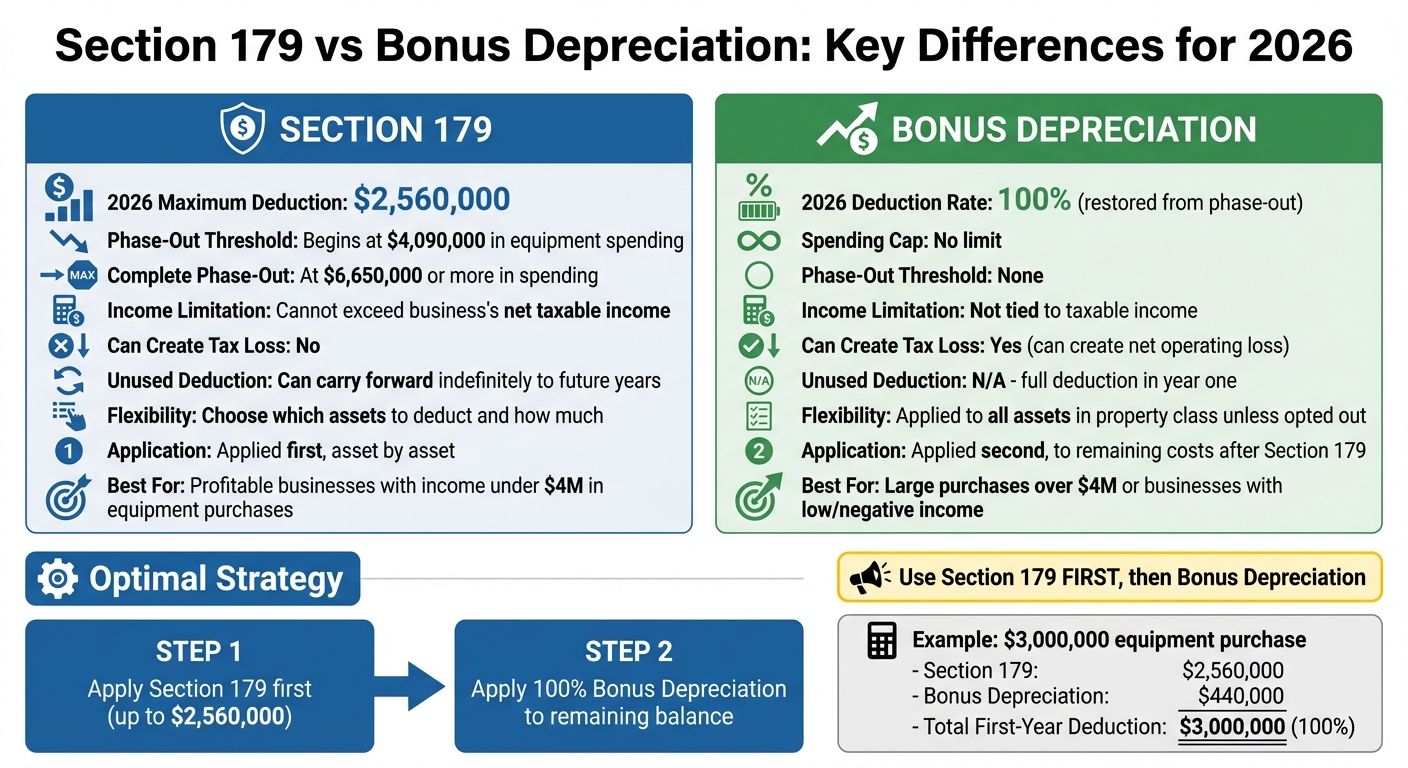
When it comes to tax savings, the smartest move is to apply Section 179 first, then use bonus depreciation for any remaining cost. This is not just a suggestion – it’s how the tax law is structured. Section 179 gives you more flexibility, letting you decide which assets to expense and how much to deduct. On the other hand, bonus depreciation applies to all assets in a specific property class unless you actively opt out.
Here’s a key difference: Section 179 can’t create a tax loss. That means it’s best used in years when your business is profitable, up to the $2,560,000 limit. If your income is low or negative, bonus depreciation becomes the better choice since it isn’t tied to taxable income.
Now, let’s talk about spending limits. If your equipment purchases exceed $4,090,000 and phase out entirely at $6,650,000, Section 179 won’t fully cover you. That’s when bonus depreciation steps in as your go-to option, since it doesn’t have a spending cap. Combining these two strategies ensures you’re making the most of your deductions, as the following example illustrates.
Example: Applying Both Deductions to One Purchase
Imagine a business buys $3,000,000 worth of manufacturing equipment in 2026. Here’s how the deductions could work:
- First, apply the $2,560,000 Section 179 deduction.
- Then, use 100% bonus depreciation on the remaining $440,000 for a full first-year write-off.
Now, let’s look at the numbers for a business in the 35% tax bracket. If it spends $2,750,000 on equipment, the first-year tax savings could total $962,500. That means the actual out-of-pocket cost drops from $2,750,000 to $1,787,500.
The bottom line? You don’t have to pick one deduction over the other. By combining them, you can maximize your first-year tax savings and keep more money in your business.
Tax Planning Tips for Small Businesses and Remote Entrepreneurs
Timing Equipment Purchases for Tax Benefits
When it comes to Section 179 and bonus depreciation, timing is everything. To qualify for deductions in the current tax year, any equipment you purchase must be placed in service by December 31. Waiting too long could push your deduction into the following year, so it’s critical to act early and ensure vendors guarantee delivery and installation by the year-end deadline.
If your taxable income is low this year, you can carry over any unused Section 179 deduction to a future year when your income is higher. Keep in mind, the deduction cannot exceed your net taxable income. Another option to consider is Section 179 Qualified Financing, which allows you to claim the full deduction upfront with minimal cash outlay. In many cases, the tax savings from this strategy can even cover your first year’s financing payments.
These timing strategies ensure you make the most of your available deductions while aligning with your business’s financial situation.
Working with a Tax Professional
Navigating the complexities of tax deductions can be tricky, which is why working with a tax professional is a smart move. They can help you interpret the fine print of Section 179 and bonus depreciation, ensuring your assets meet key requirements like the "more than 50% business use" rule and the "new to you" condition. This is especially critical for listed property such as laptops, cameras, and vehicles, which demand detailed record-keeping.
"By understanding precisely what qualifies for Section 179 – and how to document it properly – you can help your business maximize this valuable deduction and keep more cash on hand for growth."
– Section179.org
A tax expert can also guide you on the best way to combine Section 179 with bonus depreciation. For instance, they’ll help you apply Section 179 first and then use bonus depreciation for any remaining costs. They’ll also ensure your equipment is officially "placed in service" before year-end and assist with maintaining the detailed logs, invoices, and usage records required to substantiate your deduction in case of an IRS review.
How BusinessAnywhere Supports Tax Compliance

Tax compliance requires careful planning and organization, and that’s where BusinessAnywhere can make a difference. Their suite of services simplifies compliance and keeps you organized:
- The best registered agent service ensures you stay on top of state filing deadlines with timely alerts.
- Bookkeeping services help you maintain critical records like purchase invoices, installation dates, and usage logs – all in one place.
- The virtual mailbox provides a professional U.S. address with unlimited mail scanning, giving you remote access to vital tax documents.
With all your records accessible through a single online dashboard, you’ll have 24/7 access to the information your accountant needs to maximize deductions. This streamlined approach not only reduces stress during tax season but also helps you reinvest tax savings directly into growing your business.
Conclusion
Tax deductions like Section 179 and bonus depreciation can turn equipment purchases into immediate financial advantages for small business owners in 2026. Instead of spreading out depreciation over several years, these tools allow you to deduct the full cost of qualifying equipment upfront. This means more cash in hand and increased working capital to reinvest in your business.
Recent changes in legislation make bonus depreciation a permanent 100% deduction for property acquired after January 19, 2025, and increase the Section 179 limit to $2,500,000. To take full advantage of these benefits in 2026, ensure your equipment meets the eligibility criteria outlined earlier. Start planning your purchases now, keep accurate records of invoices and installation dates, and consult with a tax professional to make sure you’re maximizing every deduction available.
A smart approach is to use the Section 179 deduction first, up to its $2,500,000 limit, and then apply bonus depreciation to cover any remaining amount. This strategy allows for a complete first-year write-off, turning your equipment investments into immediate tax savings that can help fuel your business growth.
The time to act is now. With careful planning and proper documentation, you can minimize your tax burden in 2026 while acquiring the tools and equipment your business needs to thrive. By leveraging these deductions strategically, you’ll preserve cash flow and set the stage for future success.
FAQs
What types of equipment are eligible for Section 179 and bonus depreciation?
Equipment that qualifies for Section 179 and bonus depreciation covers a broad range of tangible assets used in business operations. This includes items like machinery, office furniture, computers, software, and specific vehicles (with restrictions based on weight and usage). To be eligible, the equipment must be used primarily for business purposes (over 50%), purchased or financed within the tax year, and placed into service during that same year.
Both new and used equipment can qualify if these conditions are met. Bonus depreciation, which allows for 100% immediate expensing after applying Section 179, is available for most eligible property. This includes vehicles with a gross vehicle weight rating (GVWR) exceeding 6,000 pounds. This provision enables businesses to deduct the full cost of assets, such as manufacturing equipment, commercial vehicles, and other essential tools, in the year they are put into use, offering a substantial opportunity to reduce taxable income.
What’s the difference between Section 179 and bonus depreciation?
Businesses looking to deduct the cost of equipment and other qualifying assets have two key options: Section 179 and bonus depreciation. While both serve a similar purpose, they operate in unique ways.
Bonus depreciation allows companies to deduct a significant portion – sometimes as much as 100% – of an asset’s cost in the year it’s placed into service. This deduction applies automatically, with no annual limits, making it a great choice for larger investments or high-cost assets.
Section 179, on the other hand, gives businesses the option to elect the deduction. It permits the full deduction of qualifying equipment costs, but only up to a set limit ($1,220,000 for 2025). However, if total spending surpasses a certain threshold, the deduction amount begins to phase out. This method provides more control and is particularly useful for smaller purchases or when businesses want to manage their deductions strategically.
In essence, bonus depreciation is straightforward and ideal for significant investments, while Section 179 offers more flexibility, especially for smaller-scale spending.
Can I claim both Section 179 and bonus depreciation in the same tax year?
Yes, it’s possible to take advantage of both Section 179 and bonus depreciation in the same tax year. These two tax incentives work independently, but when combined, they can help you maximize your deductions. Section 179 allows you to deduct all or part of the cost of qualifying equipment right away, while bonus depreciation lets you write off a percentage of the remaining cost. Using both together can lower your taxable income significantly, offering a strong advantage for your tax planning strategy.