

When deciding where to incorporate your business, the choice between your home country and a foreign jurisdiction can significantly impact taxes, legal compliance, and operational ease. Here’s the key takeaway: your incorporation location should align with your business goals, financial strategy, and operational needs.
Quick Overview:
- Incorporating at Home: Simpler compliance, easier banking, familiarity with laws, but potentially higher taxes and less global appeal.
- Incorporating Abroad: Tax advantages, global investor appeal, and remote management options, but higher costs and complex compliance.
Key factors to consider:
- Legal Requirements: Protect your business with the right structure (e.g., subsidiary, branch).
- Tax Planning: Look at corporate tax rates, double taxation treaties, and additional costs.
- Remote Management: Some jurisdictions, like Estonia, excel with digital tools, while others require in-person presence.
Quick Comparison:
| Factor | Home Incorporation | Abroad Incorporation |
|---|---|---|
| Tax Filing | Single jurisdiction | Multi-country filings |
| Costs | Standard local fees | Dual compliance possible |
| Banking Access | Easier | May need in-person setup |
| Global Appeal | Limited | Higher for investors |
Your choice depends on your business model, growth plans, and where you operate. Keep reading for a detailed breakdown of the pros, cons, and top jurisdictions.
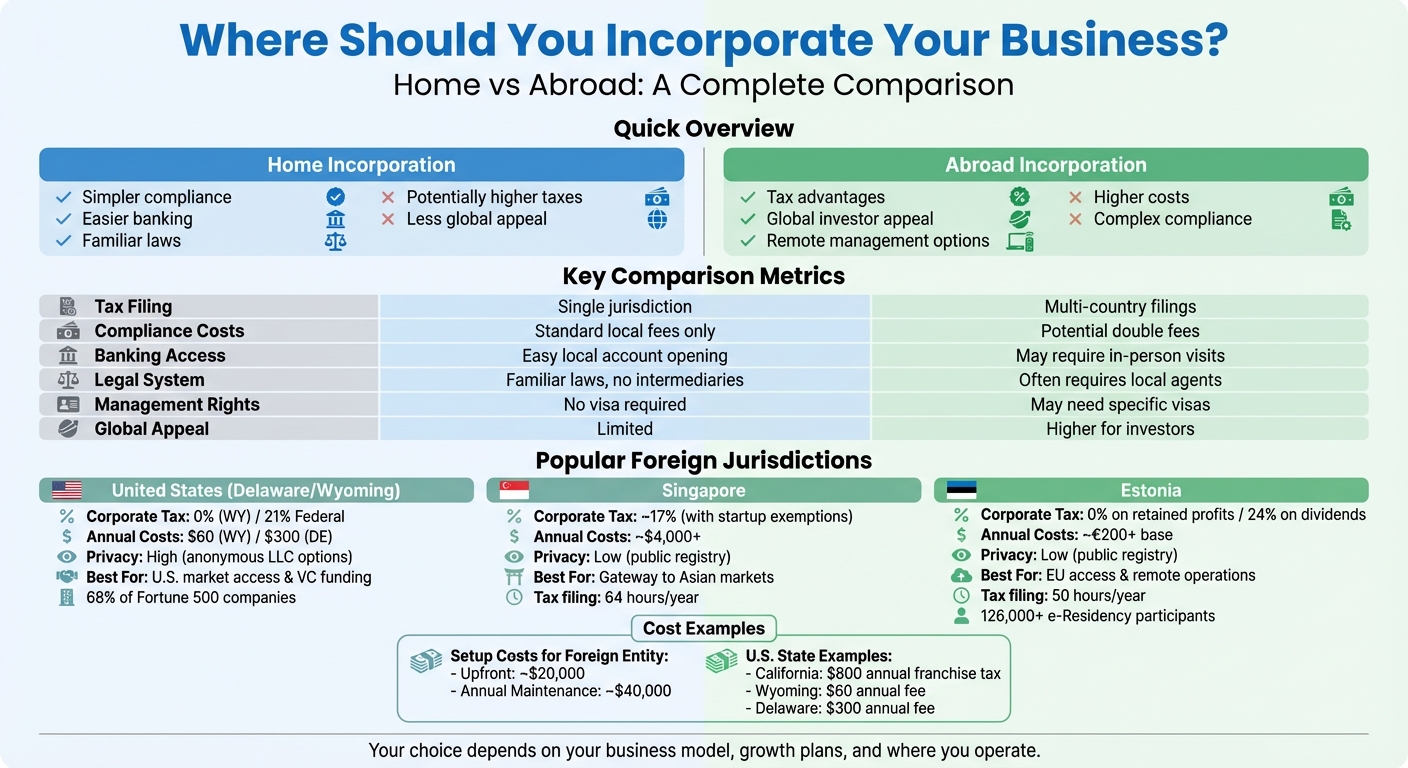
Home vs Abroad Business Incorporation Comparison: Costs, Taxes, and Requirements
What to Consider When Choosing Where to Incorporate
Deciding where to incorporate your business involves balancing legal requirements, tax policies, and operational needs with your specific business goals. Different jurisdictions offer unique advantages, but what works for a SaaS startup might not suit a small e-commerce venture.
Legal and Regulatory Requirements
Legal frameworks vary widely, and choosing the wrong structure could expose your business to unnecessary risks. You’ll need to decide between options like:
- Subsidiary: A separate legal entity that protects the parent company from liabilities.
- Branch: An extension of the parent company, which may subject all profits to local taxes.
- Representative Office: A non-transactional setup limited to activities like marketing.
The concept of nexus determines tax obligations based on your business presence, such as having employees, warehouses, or significant sales in a region. For example, incorporating in Delaware doesn’t exempt you from California’s $800 minimum franchise tax if you operate in San Francisco. Similarly, Permanent Establishment (PE) rules abroad may trigger tax liabilities if local authorities deem your operations profitable within their borders without proper registration.
"Incorporation is not just an administrative step – it’s a tax and compliance strategy." – Kevin Stickle and Jennae Thompson, CPAs, Larson Gross
Some jurisdictions also impose specific ownership or director requirements. For instance, Saudi Arabia mandates a percentage of local ownership in certain industries, while Singapore requires at least one resident director for all companies. In the U.S., new regulations like the Corporate Transparency Act require foreign-owned entities to file Beneficial Ownership Information (BOI), adding another compliance layer. On the other hand, states like Wyoming, Delaware, and Nevada offer strong asset protection laws, including "charging order" protections that shield business interests from personal creditors.
These legal factors directly influence tax planning, which is another critical area to evaluate.
Tax Implications and Financial Planning
Once you’ve defined your legal structure, tax considerations will help you refine your decision. While corporate tax rates are important, they only tell part of the story. For example:
- The U.S. federal corporate tax rate is 21%, but state taxes vary – Delaware charges 8.7% on in-state income, California imposes an $800 minimum franchise tax, and Wyoming has no corporate tax.
- Estonia stands out by taxing retained earnings at 0% and applying a 22% rate only when profits are distributed.
- Singapore offers a 17% flat rate, with a 75% exemption on the first 100,000 SGD for new startups.
Double Taxation Treaties (DTTs) play a key role when moving money across borders. Countries like the UK have 155 DTTs, while Estonia has 62. Without a treaty, dividends could face taxation both where the company is incorporated and in your country of residence. Additionally, Controlled Foreign Company (CFC) rules in many countries may tax undistributed foreign profits at the founder level, reducing the appeal of low-tax jurisdictions.
The Place of Effective Management (PoEM) rule is another factor. It determines tax residency based on where key business decisions are made, not just where the company is registered. For example, if you incorporate in Estonia but manage operations from Texas, you may still owe U.S. taxes. Establishing a foreign entity can cost around $20,000 upfront and $40,000 annually for maintenance, so any tax savings must outweigh these expenses.
With tax and legal frameworks in place, operational considerations become the final piece of the puzzle.
Operational Flexibility and Accessibility
Jurisdictions that embrace digital administration offer a significant edge. Estonia’s e-Residency program allows businesses to manage invoicing, banking, and reporting entirely online. In Hong Kong, you can receive a Certificate of Incorporation in just one hour, compared to the UK’s 24-hour processing time.
However, banking access often proves more challenging than incorporation itself. Many banks in Singapore, Hong Kong, and the UAE require in-person Know Your Customer (KYC) verification, complicating remote setups. Jurisdictions like Singapore and New Zealand, which require local directors, may also increase costs if you need to hire nominee directors. Delaware, chosen by over 68% of Fortune 500 companies, stands out for its Court of Chancery, which ensures predictable legal outcomes in business disputes.
Labor laws also influence operational ease. Some businesses incorporate in one jurisdiction for legal benefits while hiring in lower-cost regions like Eastern Europe or Asia. Remote-first companies are increasingly turning to fintech platforms like Wise, Payoneer, and Revolut to navigate traditional banking hurdles. Aligning your jurisdiction’s strengths with your business model ensures smoother operations and minimizes friction in day-to-day activities.
Incorporating at Home: Pros and Cons
When deciding where to incorporate, starting in your home country is often the most straightforward option. However, while it simplifies certain processes, it may not always align with your long-term business goals. Let’s break down the advantages and challenges of incorporating where you live.
Benefits of Incorporating at Home
One of the biggest perks of incorporating locally is avoiding dual compliance headaches. When your business is registered in the same country where you live and work, you only need to navigate one set of tax filings and regulations. For instance, take Sarah, a web designer who incorporated in Wyoming but lived in California. Despite Wyoming’s lower fees, she still had to pay California’s $800 minimum franchise tax due to nexus rules, effectively doubling her compliance costs.
"The wrong choice can cost you thousands annually in extra taxes and compliance fees." – Rick Mak, Global Business Strategist
Another advantage is easier banking access. As a local resident, you won’t face the in-person verification hurdles often required in foreign jurisdictions like Singapore or Hong Kong. Plus, you’re already familiar with the local language and legal systems, so there’s no need to hire expensive intermediaries to interpret documents or liaise with regulatory bodies. For U.S. citizens, incorporating at home also eliminates the need for work visas or residency permits to manage your business.
The cost structure is also more predictable. For example, while states like California charge $800 annually and New York can tax up to 10.9% of income, you’re only dealing with one jurisdiction’s fees. In contrast, incorporating abroad while maintaining a home presence can lead to overlapping costs – think annual fees, registered agent expenses in multiple states, and potentially double taxation.
These conveniences make home incorporation appealing, but there are some significant trade-offs to consider.
Challenges of Home Incorporation
The downside? Higher tax burdens in certain regions. For example, California’s 13.3% personal income tax and $800 franchise tax can take a big chunk out of your profits. Compare that to Estonia, where retained earnings are taxed at 0% – a stark difference. If you’re aiming to attract venture capital, you might also face pressure to reincorporate in Delaware. Over 68% of Fortune 500 companies are incorporated there due to its specialized Court of Chancery and consistent legal rulings.
Another drawback is that local incorporation might lack the global appeal of international business hubs. Investors often prefer jurisdictions like Delaware for their credibility and efficiency. Additionally, some regions have slower, more cumbersome registration processes. For example, Estonia’s e-Residency program or Hong Kong’s rapid one-hour incorporation highlight how streamlined international systems can be.
Even if you incorporate abroad, nexus rules can still tie you back to your home country for tax purposes. Tax authorities often determine liability based on where your business activities – like work, inventory, or employees – are physically located, not just where you’ve filed your paperwork. So, before deciding, it’s crucial to map out all locations where your business operates to understand your tax obligations fully.
Comparison Table: Home vs Abroad Incorporation
| Feature | Incorporating at Home | Incorporating Abroad |
|---|---|---|
| Tax Filing | Single jurisdiction; simplified reporting | Multi-state or multi-country filings needed |
| Compliance Costs | Standard local fees only | Potential double fees (home + abroad) |
| Banking Access | Easy local account opening | May require in-person visits or fintech solutions |
| Legal System | Familiar laws; no intermediaries needed | Often requires local agents or specialized counsel |
| Management Rights | No visa required to operate | May need specific visas for on-site management |
| Annual Fees (U.S. Examples) | CA: $800, NY: varies by income | WY: $60, DE: $300, FL: $138.75 |
Top Foreign Jurisdictions for Incorporation
For entrepreneurs looking beyond their home country to set up a business, specific jurisdictions offer tailored benefits depending on your goals. Three standout locations for global entrepreneurs are the United States, Singapore, and Estonia. Each provides distinct perks based on your business model, target audience, and expansion plans.
Incorporating in the United States
If you’re focusing on North American markets or aiming to attract venture capital, the U.S. is a prime choice. Delaware is especially popular, with over 68% of Fortune 500 companies incorporated there. Its specialized Court of Chancery ensures efficient and predictable rulings, which investors value. This legal framework is particularly appealing for startups seeking venture capital.
For solopreneurs or e-commerce sellers, Wyoming might be more appealing. The state offers "anonymous LLCs", where owner names are not listed in public records, and annual fees are as low as $60 compared to Delaware’s $300 franchise tax. Wyoming is also emerging as a hub for cryptocurrency businesses, thanks to its forward-thinking regulations set to take effect by 2025.
"Nevada is often called the ‘Fort Knox’ of US business privacy." – Esha Panda, doola
Foreign entrepreneurs should be aware of specific compliance requirements, such as filing Form 5472 for single-member LLCs to avoid penalties of $25,000. You’ll also need a registered agent and a virtual mailbox service to maintain compliance.
Next, let’s look at why Singapore is an excellent choice for accessing Asian markets.
Incorporating in Singapore
Singapore serves as a strategic entry point to Asian markets, offering a strong banking infrastructure and a transparent regulatory system. The corporate tax rate is around 17%, and startups enjoy generous tax exemptions and an extensive network of treaties to minimize double taxation.
However, Singapore mandates a local director and company secretary, which increases annual maintenance costs to $4,000 or more. Additionally, tax filing in Singapore requires about 64 hours per year, slightly more than Estonia’s 50 hours.
Now, let’s shift focus to Estonia, which takes a digital-first approach to incorporation.
Incorporating in Estonia
Estonia is often highlighted as the ideal choice for fully remote businesses. Its e-Residency program has drawn over 126,000 participants who have established more than 36,000 companies as of July 2025. This program allows you to manage an EU-based business entirely online.
Estonia’s tax system is particularly appealing for companies focused on growth. Retained and reinvested profits are taxed at 0%, with a 24% tax applied only when dividends are distributed (as of July 2025).
That said, banking can be a hurdle. Traditional banks often require physical verification, leading many to rely on fintech solutions. Another consideration is the "permanent establishment" risk. If you manage your Estonian company from a high-tax country, such as Germany, that country might claim tax rights based on where decisions are made.
The registration fee in Estonia is €265, with an optional e-Residency card costing €100–€150. Base annual costs start at €200, with monthly accounting fees ranging from €79 to €100. Tax filing in Estonia is the most time-efficient among the three jurisdictions, averaging just 50 hours annually.
Comparison Table: U.S. vs Singapore vs Estonia
| Factor | United States (Wyoming/Delaware) | Singapore | Estonia |
|---|---|---|---|
| Corporate Tax | 0% (Wyoming); 21% (Federal for C-Corps) | ~17% (with startup exemptions) | 0% on retained profits; 24% on dividends |
| Annual Costs | Wyoming: $60; Delaware: $300 | ~$4,000+ (local director/secretary) | ~€200+ base costs |
| Privacy | High (anonymous LLC options available) | Low (public director/shareholder info) | Low (public business registry) |
| Banking Access | Excellent (remote-friendly fintechs) | World-class (physical presence may be required) | Challenging (relies on fintech solutions) |
| Remote Management | High (requires a registered agent) | Limited (requires local director) | 100% digital (via e-Residency) |
| Registration Time | 1–2 days | 1–3 days | ~2 hours |
| Best For | U.S. market access & VC funding | Gateway to Asian markets | EU market access & location-independent operations |
sbb-itb-ba0a4be
Remote Tools and Compliance Strategies with BusinessAnywhere
Navigating complex cross-border regulations can be a headache, especially when managing a business remotely. Once you’ve picked the perfect place to incorporate, the real work begins – keeping your operations compliant and running smoothly. That’s where BusinessAnywhere steps in, offering a suite of tools tailored for global entrepreneurs who need to manage their businesses without being tied to a specific location. Their approach focuses on three main areas:
Simplifying Incorporation Tasks
BusinessAnywhere takes the hassle out of incorporation. They handle U.S. business registrations nationwide, covering popular states like Wyoming, Delaware, New Mexico, and Florida. Their $0 formation option means you only pay state fees, such as $102 for Wyoming, $110 for Delaware, or $50 for New Mexico. Plus, they include a free first year of registered agent service, saving you $147. For non-U.S. residents, they make the EIN application process straightforward with a flat fee of $97.
"I’ve used many LLC formation services before, but this one is the best I’ve ever used – super simple and fast!" – Verified User, BusinessAnywhere
Managing Compliance Remotely
Staying compliant while managing a business from abroad requires more than just filing a few forms. BusinessAnywhere helps with automated compliance tracking and reminders for annual report deadlines, so you can avoid penalties ranging from $25 to over $2,000. They also handle Beneficial Ownership Information Reporting (BOIR) filings for just $37, ensuring you meet federal transparency requirements.
For entrepreneurs looking for a comprehensive solution, the Digital Nomad Kit bundles essential services like LLC registration, EIN, registered agent, virtual mailbox, compliance tools, and banking setup support. The package costs about $3,070 for U.S. citizens (discounted from $4,668) and $3,200 for non-U.S. residents.
But compliance is just one piece of the puzzle. BusinessAnywhere also provides tools to streamline everyday operations.
Increasing Operational Flexibility
To help you manage your business remotely, BusinessAnywhere offers a virtual mailbox service. This gives you a real street address in states like Florida, Arizona, New Mexico, or Wyoming, with unlimited mail scanning and global forwarding. Plans start at just $20 per month for two recipients, letting you handle correspondence without revealing your personal address.
For legal documentation, their remote online notary services – priced at $37 per notarization – are accepted across all U.S. states. They also provide registered agent services, giving your business a legal address and ensuring compliance. Together, these tools make it possible to run a fully remote and compliant operation.
"Excellent service, quick turnaround, very professional – exactly what I needed as a nonUS resident." – Verified User, BusinessAnywhere
Conclusion: Matching Incorporation to Your Business Goals
Choosing where to incorporate is about more than just cutting costs – it’s about ensuring the jurisdiction aligns with your long-term goals and vision.
For instance, if securing venture capital is a priority, Delaware stands out. Its specialized Court of Chancery and well-established legal framework have made it the go-to for over 68% of Fortune 500 companies. On the other hand, digital nomads might find Estonia appealing, with its 0% tax on retained earnings and fully online company management. If your focus is on trading or international business, Singapore or the UAE offer strong banking networks and enhanced credibility.
It’s also crucial to consider where your business activities create tax obligations. For example, incorporating in Wyoming to save on fees won’t exempt you from paying taxes in California or New York if that’s where you live and operate. In such cases, you could end up paying fees in both jurisdictions. The key question isn’t just about finding the lowest tax rate – it’s about determining where your company can operate efficiently and grow sustainably.
Ultimately, pick a jurisdiction that simplifies operations and supports your long-term growth, rather than focusing solely on upfront savings.
FAQs
Will I still owe taxes at home if I incorporate abroad?
Yes, even if you set up a business overseas, you’ll still need to pay taxes on your worldwide income to your home country. That said, you might be eligible for certain exclusions, like the Foreign Earned Income Exclusion (FEIE), provided your tax home is in another country. To fully understand your responsibilities and possible advantages, it’s best to consult a tax professional.
How do I avoid triggering permanent establishment or tax residency?
To steer clear of triggering permanent establishment or unexpected tax residency, it’s crucial to carefully plan your business’s jurisdiction and activities. Here are some practical steps to consider:
- Select a jurisdiction with clear tax rules and favorable laws regarding taxable presence.
- Minimize physical and management presence in countries where you don’t want to establish tax residency.
- Make key decisions remotely to show that management and control occur outside the foreign jurisdiction.
For tailored guidance, consult local tax regulations or work with a legal expert to ensure your business complies with specific jurisdictional requirements.
What’s the real yearly cost to run a foreign company?
The annual expenses of operating a foreign company can vary significantly depending on the country and the type of business structure you choose. Key costs often include registration fees, compliance expenses, taxes, and operational costs such as employee wages and meeting legal obligations. These expenses can range anywhere from a few thousand dollars to tens of thousands per year, depending on the jurisdiction and the specific needs of the business.