


If you’re a foreign entrepreneur looking to start or grow your business in the U.S., understanding visa options is critical. The U.S. doesn’t offer a dedicated "startup visa", but there are four main visa types tailored for founders:
- E-2 Treaty Investor Visa: Requires citizenship from a treaty country and a significant investment (typically $100,000+). Offers indefinite renewals but no direct path to a green card.
- L-1A Intracompany Transferee Visa: Ideal for founders expanding a foreign business into the U.S. Provides a pathway to permanent residency through the EB-1C category.
- O-1A Extraordinary Ability Visa: Designed for founders with notable achievements in their field. No investment or nationality restrictions, but spousal work authorization is not included.
- H-1B Specialty Occupation Visa: Competitive, with an annual cap and new fees for consular processing. Dual intent allows green card applications, but compliance is complex for startups.
Each visa has unique requirements, benefits, and limitations. Your choice depends on factors like your nationality, funding, professional achievements, and long-term immigration goals.
Quick Comparison
| Visa Type | Key Requirement | Investment Needed | Green Card Path | Spouse Work Authorization | Duration & Renewal |
|---|---|---|---|---|---|
| E-2 | Treaty nationality & investment | $100,000+ | No | Yes (automatic) | 2–5 years, unlimited |
| L-1A | 1-year foreign employment | Operating capital | Yes (EB-1C) | Yes (with EAD) | Up to 7 years |
| O-1A | Extraordinary achievements | None | Indirect (EB-1A) | No | 3 years, unlimited 1-year |
| H-1B | Degree & specialty role | None | Yes | Limited | 3 years, up to 6 years |
The right visa can shape your business success in the U.S. Plan 6–12 months ahead to align your immigration strategy with your business goals, and ensure your U.S. entity is well-structured for compliance. Services like BusinessAnywhere can simplify business setup and compliance tasks.
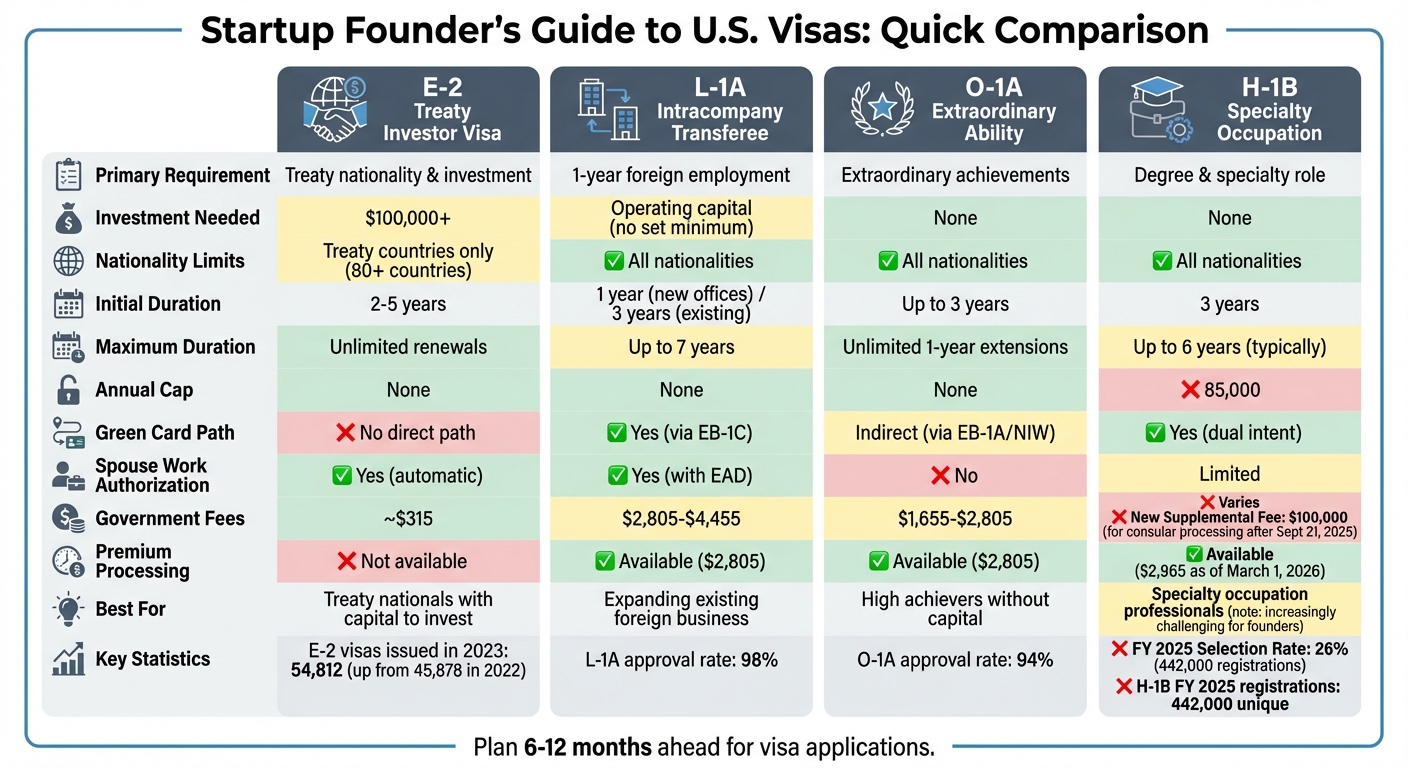
U.S. Startup Visa Comparison: E-2, L-1A, O-1A, and H-1B Requirements and Benefits
E-2 Treaty Investor Visa: Investing in Your U.S. Startup
Eligibility and Investment Requirements
The E-2 Treaty Investor visa is a go-to option for startup founders aiming to establish their businesses in the United States. To qualify, you must hold citizenship from one of the 80+ countries that have a treaty of commerce and navigation with the U.S.. If you’re from a country without a treaty – like India, China, or Brazil – you’d need to first obtain citizenship in a treaty country, such as Grenada or Turkey, to become eligible.
While there’s no set minimum investment amount, your investment needs to be substantial in comparison to the total costs of starting your business. Typical investments range from $100,000 to $200,000. For startups with lower setup costs, you may need to invest nearly the entire amount, while higher-cost businesses can justify a smaller percentage of the total costs.
It’s critical that your investment is fully committed to the business – money sitting idle in a bank account doesn’t count. You must either own at least 50% of the company or have operational control through a managerial role. Additionally, the business must be an active, legitimate commercial enterprise, not a passive investment.
"Funds merely sitting in a bank account are a common denial trigger… Funds placed in a correctly structured escrow account however can be considered ‘irrevocably invested’ and ‘at risk.’"
– Mark I. Davies, Esq., Chairman, Davies & Associates
To meet the non-marginality requirement, your business should generate enough income to support you and your family. A strong business plan that outlines hiring 2–3 U.S. employees within three to five years is a great way to demonstrate this. Once these conditions are met, the application process becomes relatively straightforward.
Application Process and Renewal Options
After meeting the eligibility and investment criteria, you can move on to the application process. Unlike some other visa types, the E-2 application skips the initial USCIS step and goes straight to consular processing, which typically takes 2 to 4 months. You can apply at a U.S. Embassy abroad or request a change of status if you’re already in the U.S.
Here’s what you’ll need to do:
- Set up your U.S. business entity (LLC or C-Corp).
- Obtain an EIN (Employer Identification Number).
- Open a U.S. bank account and commit funds to business expenses like equipment, inventory, or lease deposits under an E-2-compliant arrangement.
- Secure a signed commercial lease for a physical office (virtual offices are not accepted).
You’ll also need to prepare a detailed 5-year business plan, including market analysis, financial projections, and hiring plans. Complete forms DS-160 and DS-156E, and attend an in-person interview. Be ready to provide a clear paper trail showing the lawful source of your investment funds, such as bank statements, tax returns, or property sale records.
E-2 visas are issued in 2-year increments but can be renewed indefinitely as long as your business remains operational and compliant. Depending on your treaty country, the visa stamp may be valid for up to 5 years. In 2023, U.S. consulates issued 54,812 E-2 visas, a noticeable increase from 45,878 in 2022. This process not only secures your legal status but also sets the stage for growing your business in the U.S.
Benefits of the E-2 Visa
The E-2 visa offers several perks for startup founders and their families. It provides work authorization for your spouse and educational opportunities for your children, along with indefinite renewal options as long as your business stays active. Your spouse is automatically granted work authorization without needing a separate Employment Authorization Document, allowing them to work for any U.S. employer. Unmarried children under 21 can attend U.S. schools, though they are not allowed to work.
Another advantage is that you only need to show an intent to leave the U.S. when your E-2 status ends – there’s no requirement to maintain a permanent residence abroad. The costs are also relatively low, with a visa application fee of $315 and an additional $250 OBBA Integrity Fee.
"Having the E-2 Treaty Investor Visa is the next best thing to having a Green Card."
– Mark I. Davies, Esq., Chairman, Davies & Associates
However, keep in mind that if you apply for a change of status through USCIS while in the U.S., you won’t receive a visa stamp for international travel. If you travel abroad, you’ll need to visit a U.S. consulate to get a visa stamp before re-entering. For founders who need flexibility to travel, consular processing is often the better choice.
L-1A Visa: Expanding Your Foreign Business to the U.S.
Eligibility Criteria and Qualifying Relationships
The L-1A visa is an excellent option for startup founders looking to expand their foreign business into the U.S. To be eligible, you must have worked for your foreign company for at least one continuous year within the three years prior to entering the U.S. Your role abroad needs to have been either managerial or executive – meaning you were responsible for high-level decision-making with minimal oversight or oversaw professional employees while managing key business functions.
Additionally, your foreign company and U.S. startup must share a qualifying corporate relationship. This could include structures like a parent/subsidiary, branch/headquarters, or affiliates under common ownership. Both entities must be actively engaged in business operations, not just maintaining a passive presence like an empty office. Regardless of the corporate setup, your role in the U.S. must also be managerial or executive in nature.
"Executive capacity generally refers to the employee’s ability to make decisions of wide latitude without much oversight."
– USCIS
The L-1A visa offers a maximum stay of 7 years. Your spouse (on L-2 status) is automatically authorized to work for any U.S. employer, and your unmarried children under 21 can accompany you. Some immigration platforms report L-1A approval rates as high as 98%.
Once you meet the eligibility requirements, you can proceed with the application process, which differs depending on whether you are establishing a new U.S. office or transferring to an existing one.
Application Process for New and Existing Offices
The steps for applying vary based on whether you’re opening a new U.S. office or transferring to an already established location. If you’re setting up a new office, your initial approval is valid for just 1 year, compared to 3 years for transfers to established offices. This shorter period allows USCIS to assess whether your new office can genuinely support a managerial or executive role.
For new office petitions, you’ll need to submit evidence such as a signed lease or purchase agreement for office space. A detailed business plan is also required, outlining how the U.S. office will grow within 12 months, including hiring goals and financial projections. Additionally, you must provide documentation like bank statements or funding records to show that your business can sustain operations and pay your salary.
Here’s a breakdown of the core filing fees:
- Form I-129: $1,385
- Fraud prevention fee: $500
- ACWIA fee: $750 or $1,500, depending on company size
If you opt for premium processing, an extra $2,805 ensures a decision within 15 business days, while standard processing takes 2 to 4 months. Legal assistance typically costs between $8,000 and $10,000.
To extend your new office petition after the initial year, you’ll need to prove that your business is actively operating, has hired staff, and that your role remains managerial or executive rather than operational. USCIS pays close attention to whether your job description emphasizes strategic duties over routine tasks.
Once approved, the L-1A visa also opens the door to permanent residency.
Path to Permanent Residency
One of the standout benefits of the L-1A visa is its direct pathway to a green card through the EB-1C category, designed for multinational executives and managers. The EB-1C process skips the PERM labor certification, which can save significant time. Plus, the L-1A’s "dual intent" feature allows you to pursue permanent residency without affecting your nonimmigrant status.
To transition, you’ll need to file Form I-140 and then Form I-485. For holders of a new office L-1A, your U.S. business must have been operational for at least one year before sponsoring you for an EB-1C petition. The timeline for this process typically ranges from 6 months to 2 years, depending on factors like visa number availability and whether premium processing is used.
Here’s an overview of the green card application fees:
- I-140 filing fee: $700 to $715
- I-485 fee: $1,140 to $1,440
- Premium processing (optional): $2,805
When visa numbers are current, filing both forms simultaneously can speed things up. Throughout the process, it’s critical to maintain the corporate relationship between your U.S. and foreign entities and to provide strong documentation of your managerial or executive responsibilities at both companies.
O-1A Visa: For Founders with Extraordinary Abilities
The O-1A visa is tailored for startup founders who have demonstrated exceptional achievements in their field – essentially, those who have reached the pinnacle of their profession. Unlike the H-1B, the O-1A visa has no cap, lottery, or degree requirement. Instead, it places its emphasis entirely on documented accomplishments. This makes it an appealing option for founders with strong traction, significant funding, or notable recognition within their industry.
The visa allows an initial stay of up to three years, with unlimited one-year extensions as long as your work continues. For those in a hurry, premium processing ensures a decision within 15 business days for an additional fee of $2,965 (effective March 1, 2026). Standard processing, on the other hand, can take anywhere from 7.5 to 9 months.
"The O-1A visa was designed for individuals operating at the outer edges of achievement… for professionals whose work is not merely competent, but consequential."
– Swati Gohite Pawar, Content Writer, Ascend HSI
While self-petitioning isn’t an option, your U.S. company can petition on your behalf, provided an independent board verifies a genuine employer-employee relationship. Additionally, each petition requires a written advisory opinion from a peer group or labor organization in your field.
Meeting the Criteria for Extraordinary Ability
To qualify for the O-1A visa, you must either have won a major internationally recognized award (like a Nobel Prize) or meet at least three of eight specific evidentiary criteria. USCIS then evaluates your evidence holistically to determine if you truly stand out in your field.
Here’s how the eight criteria might apply to startup founders:
| Criterion | Examples for Founders |
|---|---|
| Awards/Prizes | Winning TechCrunch Disrupt, acceptance into Y Combinator or Techstars, Forbes 30 Under 30 recognition |
| Memberships | Inclusion in exclusive founder networks or invitation-only industry boards |
| Published Material | Features or interviews in outlets like TechCrunch, Forbes, or The Wall Street Journal |
| Judging | Reviewing pitch decks for accelerators, judging hackathons, or peer-reviewing industry journals |
| Original Contributions | Patents, proprietary technology, or launching a disruptive business model |
| Scholarly Articles | Writing technical white papers, industry books, or influential blog posts |
| Critical Role | Serving as CEO or CTO of a venture-backed startup or other high-profile organization |
| High Remuneration | Earning a salary, equity, or SAFE agreements placing you in the top 5–10% of your field |
If your startup has raised funding from well-known venture capital firms, this can often satisfy multiple criteria, such as demonstrating leadership, competitive achievement, and high remuneration through equity valuation. Be sure to include formal valuation documents or SAFE agreements when using equity as evidence.
When it comes to media coverage, USCIS is particular. The focus should be on your personal contributions, not just your company’s success. Sponsored press or purchased awards are typically dismissed. To strengthen your case, aim to gather 5 to 8 recommendation letters from recognized experts in your industry, with at least 2 or 3 coming from independent professionals who haven’t worked directly with you. Documentation packages can range from 500 to 700 pages, and specialized legal firms often report approval rates exceeding 99% when cases are well-prepared.
Benefits and Application Process
The O-1A visa offers several advantages compared to other visa categories. There’s no annual cap or lottery, and you can extend your status indefinitely in one-year increments. It’s also dual-intent-friendly, allowing you to pursue permanent residency (like the EB-1A category) while holding O-1A status.
To apply, your U.S. company (or an agent) must file Form I-129 along with supporting evidence. This includes an employment contract, a detailed itinerary of planned activities, and the required advisory opinion. Below is a breakdown of typical filing fees:
- Form I-129: $1,055 (or $530 for small employers with 25 or fewer employees)
- Asylum Program Fee: $600
- Premium Processing (Form I-907): $2,965 (effective March 1, 2026)
- DS-160 Visa Fee: $205 (for consular processing)
- Attorney Fees: Usually between $5,000 and $15,000
When building your case, focus on providing strong evidence for 3 to 5 criteria rather than weak or marginal proof across all eight. If technical metrics are part of your evidence, explain them clearly for USCIS officers.
"Quality outweighs quantity: strong evidence for three criteria is far more persuasive than weak or marginal evidence spread across several."
– Beyond Border
Lastly, if your employment is terminated for reasons other than voluntary resignation, your employer is legally required to cover the reasonable cost of transportation back to your last residence abroad.
H-1B Visa: Specialty Occupations for Startup Founders
The H-1B visa, widely used in the tech world, presents unique hurdles for startup founders. Unlike the O-1A or E-2 visas, the H-1B has an annual cap of 85,000 visas – 65,000 for general applicants and an additional 20,000 reserved for individuals with U.S. master’s degrees. For FY 2025, there were 442,000 unique registrations, resulting in an initial selection rate of just 26%.
In January 2025, a new policy allowed founders with over 50% ownership to self-petition through their own companies.
"The January 2025 H-1B Modernization Final Rule removed the employer-employee relationship language… creating unprecedented opportunities alongside new compliance challenges."
– Pegah Karimbakhsh Asli, Immigration Attorney, Alma
For FY 2027, the registration period runs from noon Eastern on March 4 to noon Eastern on March 19, 2026. A new wage-weighted lottery system, effective February 27, 2026, prioritizes higher-paid roles. Wage Level IV positions receive 4× the selection weight, Level III gets 3×, Level II earns 2×, and Level I (entry-level) has the lowest odds with 1× weight. For startups offering entry-level salaries, this change can significantly lower their chances in the lottery.
Eligibility and Cap Exemptions
To qualify as a founder, your role must meet the specialty occupation standard. This means the job must require highly specialized knowledge and a U.S. bachelor’s degree (or an equivalent foreign degree) in a directly related field. Founders need to prove that over half of their work time is spent on duties tied to this specialized knowledge, not general business tasks.
Using technical titles like "Founder & CTO" or "CEO & Chief Engineer" can help clarify your role. Additionally, having an independent board or advisory committee can strengthen the employer-employee relationship. These requirements make the H-1B process more challenging for startup founders compared to traditional applicants.
Your startup must meet several criteria, including being a U.S.-based entity with a Federal Employer Identification Number (FEIN), active bank accounts, and any necessary licenses. You must also receive the Department of Labor’s prevailing wage through standard W-2 payroll; equity, "sweat equity", or deferred compensation won’t meet the requirements. Founders must also demonstrate at least 12 months of salary funding, supported by bank statements or investor commitments.
Another key distinction is that initial H-1B approvals for founders with more than 50% ownership are limited to 18-month terms for the first two approvals, compared to the standard 36 months for other employees.
If you’re already in the U.S. on a different visa, like F-1 OPT or L-1, you can bypass the lottery by working for a cap-exempt employer (such as a university or nonprofit research organization) while filing a concurrent H-1B petition for your for-profit startup.
Challenges and Strategies for Founders
Founders face unique challenges, particularly with the lottery system. Startups, which made up 95% of H-1B employers filing ten or fewer petitions in FY 2025, are especially vulnerable to the lottery’s odds. The new wage-weighted system adds further difficulty for early-stage companies unable to offer higher salaries at Wage Levels III or IV.
If your budget allows, offering a salary at Level II or higher can improve your lottery chances. If you hold a U.S. master’s degree or higher, ensure you’re registered in the additional 20,000-visa pool for advanced degree holders.
Another challenge is the $100,000 supplemental fee introduced by a September 2025 Presidential Proclamation. This fee applies to petitions filed after September 21, 2025, through consular processing. Founders already in the U.S. can avoid this fee by filing for a "Change of Status" instead of "Consular Notification".
USCIS has also increased its site visit authority, including unannounced inspections at designated work sites. To stay compliant, maintain a physical office (not just a P.O. box) and keep necessary documentation readily available. Additionally, the Department of Labor’s 2025 "Project Firewall" initiative investigates potential program abuse, such as improper job arrangements or underpayment.
Here’s a breakdown of typical H-1B filing costs for startups with 25 or fewer employees:
| Fee Type | Amount |
|---|---|
| Registration Fee | $215 |
| Base Filing Fee (Form I-129) | $460 |
| Asylum Program Fee | $300 |
| ACWIA Training Fee | $750 |
| Fraud Prevention Fee | $500 |
| Premium Processing (Form I-907) | $2,965 (effective March 1, 2026) |
| Supplemental Fee (if applicable) | $100,000 |
For founders with strong technical skills but uncertain lottery odds, the H-1B visa remains an option. Those already in the U.S. or who qualify for cap-exempt concurrent employment may have an advantage. However, the process demands careful planning and strict adherence to compliance requirements compared to other visa types.
sbb-itb-ba0a4be
Comparing Visa Options for Startup Founders
This section provides a detailed comparison of the E-2, L-1A, O-1A, and H-1B visas to help startup founders make informed decisions. Selecting the right visa depends on factors like your nationality, the stage of your business, available capital, and long-term immigration goals. Each option serves a specific type of entrepreneur, and understanding the nuances can help you avoid costly mistakes.
The E-2 visa is tailored for nationals of treaty countries willing to invest a significant amount – typically $100,000 or more – in a U.S.-based business. While it offers unlimited renewals and automatic work authorization for spouses, it does not provide a direct route to permanent residency.
The L-1A visa is designed for founders expanding an existing foreign company into the U.S. To qualify, applicants must have worked for a related entity abroad for at least one year within the last three years. It provides a clear path to permanent residency through the EB-1C category and includes spousal work authorization.
The O-1A visa is an excellent choice for founders with exceptional abilities who want to avoid investment requirements. It has no nationality restrictions and allows indefinite extensions in one-year increments. However, it does not grant work authorization for spouses.
The H-1B visa targets professionals in specialty occupations and supports dual intent for green card applications. With an annual cap of 85,000 visas, it is competitive and limits spousal work authorization.
"Choosing the right business visa isn’t just about meeting requirements – it’s about aligning your immigration strategy with your business goals." – SaaS Legal Services
Comparison Table: E-2, L-1A, O-1A, and H-1B Visas
| Feature | E-2 Treaty Investor | L-1A Intracompany Transferee | O-1A Extraordinary Ability | H-1B Specialty Occupation |
|---|---|---|---|---|
| Primary Requirement | Treaty nationality & investment | 1-year foreign employment | Extraordinary achievement | Degree & specialty role |
| Investment Needed | Substantial (typically $100,000+) | Operating capital (no set minimum) | None | None |
| Nationality Limits | Treaty countries only | All nationalities | All nationalities | All nationalities |
| Initial Duration | 2–5 years | 1 year (for new offices) | Up to 3 years | 3 years |
| Maximum Duration | Unlimited renewals | Up to 7 years | Unlimited extensions | Up to 6 years (typically) |
| Annual Cap | None | None | None | 85,000 |
| Green Card Path | No direct path | Yes (via EB-1C) | Indirect (via EB-1A/NIW) | Yes (dual intent) |
| Spouse Work Authorization | Yes (automatic) | Yes (with EAD) | No | Limited |
| Government Fees | ~$315 | $2,805–$4,455 | $1,655–$2,805 | Varies |
| Premium Processing | Not available | Available ($2,805) | Available ($2,805) | Available ($2,805) |
This breakdown highlights the strengths of each visa for different founder scenarios. For instance, the O-1A visa is appealing for early-stage entrepreneurs with strong credentials but limited capital, as it bypasses the investment requirements of the E-2 visa. In contrast, the L-1A visa is ideal for scaling an international business and offers a smoother route to permanent residency. Meanwhile, treaty nationals with sufficient funds might find the E-2 visa advantageous for its relatively quick processing time of 2–4 months.
Practical Tips and Business Setup with BusinessAnywhere
Setting Up Your Business with BusinessAnywhere
If you’re navigating the U.S. immigration process as an entrepreneur, establishing a properly structured business is a key step. A U.S. entity isn’t just a formal requirement for many visa types – it also strengthens your application by demonstrating your commitment and compliance. Without this foundation, even a strong visa application could face setbacks.
BusinessAnywhere simplifies this process by offering $0 business registration (you only cover the state fees). Whether you’re choosing between an LLC or a C‑Corporation, you can get things up and running quickly. For founders pursuing O‑1A or H‑1B visas, your own entity can even act as the petitioning employer, as long as there’s a clear separation between ownership and employment decisions.
One essential step is obtaining an EIN (Employer Identification Number) – this confirms your business’s legitimacy. BusinessAnywhere provides an EIN service for $97, tailored for foreign founders who lack a Social Security Number. The process typically takes 4–10 business days.
They also offer additional services to make compliance easier:
- Registered agent service: The first year is free, and it’s $147 annually after that. This service provides a physical address to receive official government and USCIS correspondence.
- Virtual mailbox: Starting at $20/month, this gives you a U.S. business address for operations and mail scanning. (Keep in mind, L‑1 visas may require proof of a physical office space.)
Once your business is established, the focus shifts to maintaining compliance, which is essential for long-term success.
Staying Compliant for Long-Term Success
Keeping your business in good standing is critical – not just for growth, but also for maintaining your visa status.
"Forming a U.S. company is often simple; maintaining proper compliance is where most founders run into issues." – Mark I. Davies, Esq., Chairman, Davies & Associates
Visa renewals often depend on showing that your business is active and compliant. USCIS uses the Validation Instrument for Business Enterprises (VIBE) to verify this, and any discrepancies in your records can jeopardize your application. BusinessAnywhere offers compliance alerts to help you stay on top of state annual reports and tax deadlines, so you don’t risk losing your good standing.
Another important requirement is filing the Beneficial Ownership Information Report (BOIR). BusinessAnywhere provides this service for $37, ensuring you meet FinCEN‘s mandatory reporting rules for foreign-owned businesses. Missing filings or unclear ownership structures can lead to Requests for Evidence (RFEs) from USCIS. By addressing these requirements from the start, you can avoid common pitfalls and set your business up for smooth visa renewals and long-term growth.
Conclusion: Choosing the Right Visa for Your Startup
Selecting the right visa for your startup hinges on five critical factors: your nationality, funding availability, professional accomplishments, timeline, and long-term residency plans. For entrepreneurs from treaty countries with capital ready to invest, the E-2 visa offers a quick solution and was utilized by 54,364 founders in FY 2024. If your strength lies in professional achievements but you lack significant funding, the O-1A visa might be your best bet. With a 94% approval rate and no annual cap, it also allows for unlimited extensions. For founders expanding an existing foreign business into the U.S., the L-1A visa provides a straightforward path to permanent residency via the EB-1C category. These considerations can help you align your visa strategy with your business goals.
The H-1B visa, once a popular choice, has become less accessible for many early-stage founders due to the $100,000 fee for applicants outside the U.S., which takes effect on September 21, 2025. As a result, merit-based options like the O-1A and EB-2 NIW are gaining traction. Meanwhile, International Entrepreneur Parole (IER) is emerging as an alternative for VC-backed startups with at least $311,071 in qualified U.S. investment.
"The US is the best place in the Western world to build a tech business right now. To get an O-1, you need to show that you’re a high earner, you’ve made a meaningful contribution to your field." – Christopher Kong, Co-Founder & CEO of Corvera
Choosing the right visa is more than just an immigration decision – it’s a crucial step toward establishing sustainable growth in the U.S. market. To set yourself up for success, plan at least 6–12 months in advance. Use this time to gather key evidence, such as securing media coverage, joining a selective accelerator, or formalizing your company’s governance structure. Early preparation is key to structuring your U.S. entity effectively. This not only strengthens your visa application but also signals your commitment to building a robust business in the U.S. Services like BusinessAnywhere can simplify the process with $0 registration fees (state fees apply), EIN services for $97, and compliance alerts to help you maintain good standing for future visa renewals.
FAQs
Which visa is best for my startup stage?
The right visa for your startup journey depends on where you are in your business development, what you’ve accomplished, and your future plans.
- If you’re in the early stages and can demonstrate extraordinary achievements, the O-1A visa might be a great fit.
- Planning to make a substantial investment in a U.S.-based business? The E-2 visa could be your best bet.
- For those eyeing long-term residency, options like the EB-1A or EB-2 NIW may be worth exploring.
To make the right choice, it’s smart to consult with an immigration expert who can guide you based on your unique situation.
How can I prove my startup is real and not “marginal”?
To establish your startup as legitimate and not on the fringe, focus on showcasing its growth potential, ability to create jobs, and overall economic contribution. Start by presenting a comprehensive business plan that outlines your goals, strategies, and revenue streams. Include evidence of substantial investment, such as funding from reputable investors or venture capital, to reinforce your startup’s credibility.
Additionally, provide operational documentation – this could include signed contracts, revenue projections, or agreements with key partners. Highlight your active commercial activities to show that your business is already making an impact. Emphasize having a scalable business model and clear plans for expansion, as these elements demonstrate long-term viability and set your startup apart from smaller, less sustainable ventures.
Can my spouse work in the U.S. on my visa?
Yes, your spouse might be able to work in the U.S., but it largely depends on the type of visa you hold. For instance, spouses on an H-4 visa (dependent on an H-1B visa holder) must obtain an Employment Authorization Document (EAD) before they can legally work. On the other hand, certain visas, like the L-1, typically allow spouses to apply for work authorization more easily. Be sure to review the specific regulations tied to your visa type and stay updated on any recent policy changes.