

Startup visas are a great way for entrepreneurs to launch businesses in foreign countries while gaining residency benefits. These programs are designed to attract founders with innovative business ideas, offering perks like mentorship, funding access, and pathways to permanent residency. In 2026, there are 46 active programs across 39 countries, but some, like Canada’s Start-up Visa, are closing soon. Here’s a quick look at five prominent programs:
- Canada: Offers direct permanent residency but stopped accepting new applications after December 2025. Existing applicants must finalize by June 30, 2026.
- Netherlands: Focuses on innovation without requiring large investments. Provides mentorship through approved facilitators.
- France: The French Tech Visa offers a 4-year residence permit with no educational prerequisites for founders.
- Estonia: Known for its digital-first approach, the Startup Visa includes access to the EU market and 0% tax on reinvested profits.
- United Kingdom: The Innovator Founder Visa offers a 3-year residency pathway with no minimum investment requirement.
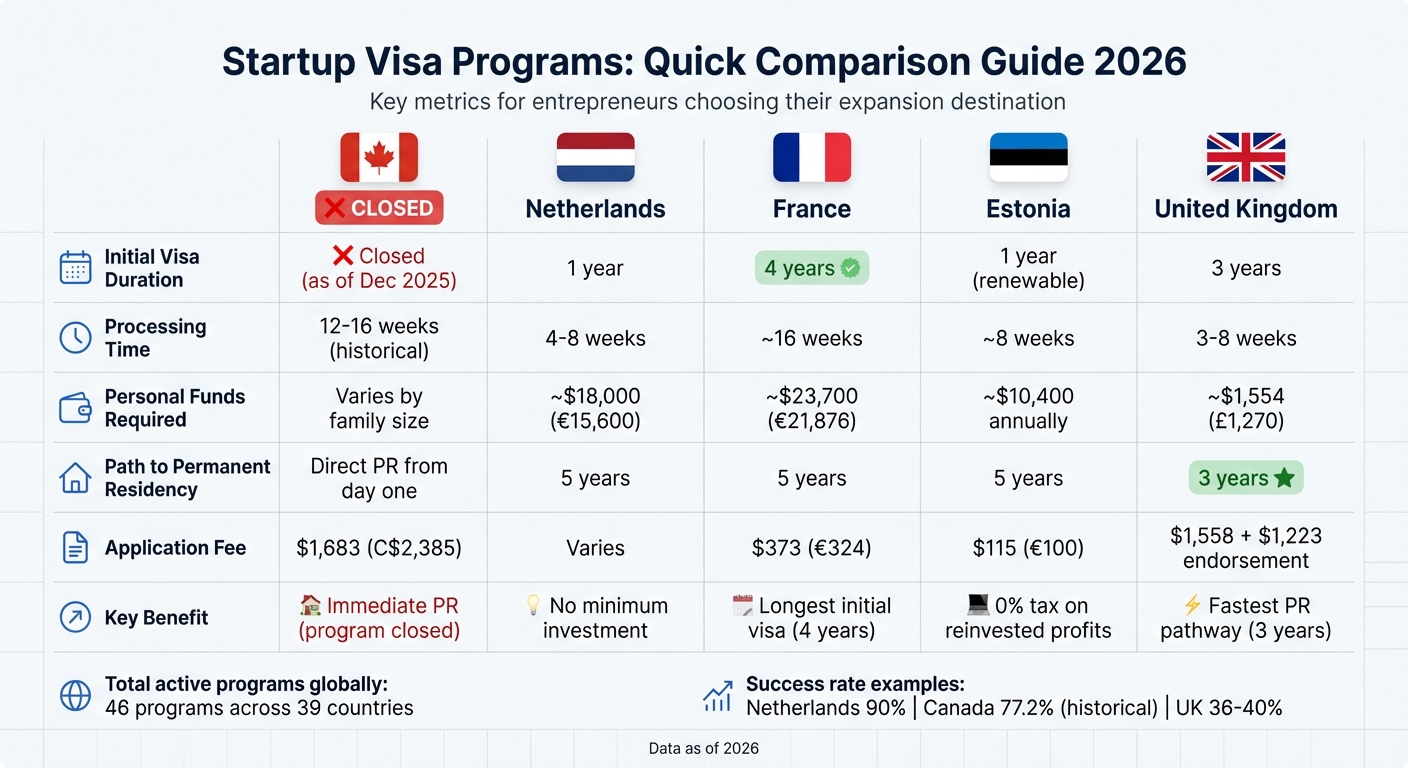
Each program has distinct requirements, fees, and benefits, so it’s crucial to align your choice with your business goals. Below is a quick comparison to help you decide.
Quick Comparison
| Country | Initial Visa Duration | Processing Time | Personal Funds Required | Path to Residency | Application Fee |
|---|---|---|---|---|---|
| Canada | Closed (as of 2025) | 12–16 weeks | Varies by family size | Direct PR from day one | $1,683 (C$2,385) |
| Netherlands | 1 year | 4–8 weeks | ~$18,000 (€15,600) | 5 years | Varies |
| France | 4 years | ~16 weeks | ~$23,700 (€21,876) | 5 years | $373 (€324) |
| Estonia | 1 year (renewable) | ~8 weeks | ~$10,400 annually | 5 years | $115 (€100) |
| United Kingdom | 3 years | 3–8 weeks | ~$1,554 (£1,270) | 3 years | $1,558 + $1,223 endorsement |
Each option caters to different business needs and timelines. Whether you’re targeting the EU market, seeking fast residency, or leveraging digital infrastructure, these programs offer unique opportunities for global expansion.
Startup Visa Programs Comparison: 5 Countries for Entrepreneurs 2026
1. Canada Startup Visa
Important update: Canada’s Start-Up Visa Program will stop accepting new commitment certificates after December 31, 2025. If you already have a valid 2025 commitment certificate, you must submit your permanent residency application by June 30, 2026. This deadline is non-negotiable – missing it means losing your eligibility. For entrepreneurs holding these certificates, this update is crucial.
Benefits Offered
The Canada Startup Visa grants permanent residency right away, skipping the need for a temporary work visa. This program allows you to live and work anywhere in Canada, not just where your business operates. Plus, your spouse can receive an open work permit, and your children are eligible for study permits.
Another key perk? The program connects you with mentorship opportunities through approved venture capital funds, angel investor groups, or business incubators. These organizations not only evaluate but also support your business idea. Unlike many other programs, there’s no personal net worth requirement – the focus is entirely on the strength and potential of your business idea.
Eligibility Requirements
To qualify, you’ll need a Letter of Support from one of these designated organizations:
- Venture capital fund: Requires a minimum $200,000 investment.
- Angel investor group: Requires a minimum $75,000 investment.
- Business incubator: No investment required, but you must be accepted into their program.
Each founder must hold at least 10% of the voting rights, and collectively, the founders and the designated organization must control more than 50% of the business. Language proficiency is also required – Canadian Language Benchmark (CLB) level 5 in English or French for speaking, reading, writing, and listening.
While the official settlement fund minimum is $15,263 CAD for a single person, experts suggest having closer to $200,000 to cover living expenses and business development. Once these requirements are met, you can proceed with the application process.
Application Process
You’ll apply through the Permanent Residence Portal under the "Start-Up Business Class" category. Here’s a breakdown of the costs:
- Processing fees: $2,385
- Biometrics: $85 per person (capped at $170 for families)
- Designated organization fees: Can range from $10,000 to $50,000 for their review and support.
Processing times average about 37 months, so patience is essential. While the 2023 success rate was 77.2%, competition has increased. Immigration targets have dropped significantly – from 5,000 spots in 2024 to just 1,000 by 2026.
Path to Permanent Residency
One standout feature of the Canada Startup Visa is that it grants immediate permanent residency upon approval – no conditional period required. This means you’ll have full PR status from day one, allowing you to apply for Canadian citizenship later, provided you meet the residency requirements. However, to maintain your status, you’ll need to actively manage your business from within Canada.
sbb-itb-ba0a4be
2. Netherlands Startup Visa
Benefits Offered
The Netherlands Startup Visa stands out because it doesn’t require a minimum investment. Instead, the focus is on how innovative and scalable your business idea is.
With this visa, you’ll collaborate with a government-recognized facilitator who will provide mentorship, networking opportunities, and guidance to navigate the Dutch business ecosystem. There are over 150 active facilitators to choose from, including well-known names like YES!Delft, Rockstart, and StartupAmsterdam. The approval rate for applications is high, hovering around 90%.
Another plus? The Netherlands has a highly English-proficient workforce, which makes doing business much easier. Entrepreneurs can also tap into tax benefits like the "starter’s deduction", worth $2,323 (€2,123), which can be claimed three times within the first five years. Additionally, the "30% ruling" tax benefit might apply, offering further financial advantages.
"The Dutch Startup Visa offers investors and entrepreneurs the chance to build and manage a business directly in the European market instead of committing EUR 500,000 or more to real estate or funds."
– Jean-François Harvey, Founder, Harvey Law Group
These benefits make the Netherlands an appealing option, but you’ll need to meet specific eligibility criteria to get started.
Eligibility Requirements
Your business idea must meet Dutch standards for innovation. This means your product or service should either be new to the Netherlands, use cutting-edge technology, or introduce a fresh way of working. You’ll also need a signed agreement with a government-approved facilitator who will review your business plan and provide ongoing support. Plus, you must show proof of $22,300 in maintenance funds for the first year (about $1,858 per month).
Budget for health insurance costs as well, which typically range from $131 to $170 (€120 to €155) per month. While there’s no Dutch language requirement for the initial visa, you’ll need to reach an A2 level of proficiency if you plan to stay long-term and apply for permanent residency after five years.
Application Process
Once you’ve ensured you meet all the requirements, here’s how to apply:
Start by preparing a detailed business plan and reaching out to potential facilitators at least three months before your intended application date. After securing an agreement with a facilitator, you’ll need to register your business with the Netherlands Chamber of Commerce (Kamer van Koophandel), open a Dutch bank account, and deposit your required maintenance funds.
Typically, your facilitator will submit your application electronically to the Immigration and Naturalisation Service (IND). Entrepreneurs from countries like the U.S., Canada, Japan, and South Korea can apply directly. Once your application is submitted, you’ll provide biometrics and then pick up your residence permit at an IND desk or Expat Center. Processing usually takes around 90 days.
Expect to pay a visa application fee of roughly $463 (€423). Facilitator fees range between $4,380 and $7,665, and if you choose to form a Dutch BV, you can do so with as little as $0.01 (€0.01) in share capital.
Path to Permanent Residency
To stay in the Netherlands long-term, you’ll need to transition from the startup visa to a "self-employed" residence permit within a year. This requires proving that your business is viable and showing signs of growth. After five years of continuous residence and passing a civic integration exam (which includes demonstrating A2-level Dutch language skills), you can apply for permanent residency.
In 2025, over 420 Startup Visas were issued, and Dutch tech investments reached about $4.6 billion (€4.2 billion). Amsterdam alone hosts more than 20 tech unicorns and over 4,500 active startups, giving you access to a thriving entrepreneurial community. With a GDP per capita of around $69,000 (€63,000), far above the EU average of $43,500 (€39,700), the Netherlands offers a market with strong purchasing power and ample opportunities for growth.
3. France French Tech Visa
Benefits Offered
France’s French Tech Visa offers a renewable four-year "Talent Passport", giving you long-term stability along with immediate work rights for your spouse and study permits for your children. Unlike many other business visas, this program has no educational prerequisites for founders – the focus is entirely on the innovative potential of your project.
The program connects you to a thriving ecosystem of over 29,000 startups, placing France at #12 in global rankings. Since its inception, it has supported over 1,200 companies in recruiting international talent. After five years of legal residence, you can apply for a 10-year resident card or even French citizenship. A French passport is highly valuable, currently ranking as the third most powerful worldwide.
"The simplicity, speed and clarity of administrative procedures for obtaining a residence permit are important criteria for applicants and for the international reputation of our country." – Welcome to France
These features make the French Tech Visa stand out with its straightforward and supportive application process.
Eligibility Requirements
France’s focus on innovation means your business project must meet specific standards. To qualify, you need to:
- Be a non-EU, EEA, or Swiss applicant.
- Have an innovative business project that’s recognized by a French public-sector body.
- Obtain certification from the Ministry of the Economy, which requires either selection by a partner incubator or accelerator, or support from two recognized French Tech ecosystem members.
The financial requirements are clear-cut: you’ll need to show $23,700 (€21,876.40) in annual resources, equivalent to France’s statutory minimum wage (SMIC) as of January 1, 2026. For a family of three, this amount increases to approximately $42,200 (€39,000). The program allows one to four founders per project.
Application Process
Start by securing an endorsement from a partner incubator or accelerator. Once you’ve got that, submit your innovation recognition request through the demarches-simplifiees.fr portal. After approval by DRIEETS IDF, the Ministry of the Economy will issue your acknowledgment letter.
With this letter, you can apply for your long-stay visa via the France-Visas website. Make sure to apply no earlier than three months before your planned arrival. Visa processing usually takes five to six months. Once in France, you’ll need to finalize your four-year residence permit at your local Prefecture.
Initial administrative costs come to $351 (€324), which includes $107 for the visa, $217 for the residence permit tax, and $27 for stamp duty. Renewals are slightly cheaper, costing $244 (€225). Be aware that fees are set to change on May 1, 2026, potentially ranging between $163 and $380 (€150 to €350).
Path to Permanent Residency
After five years of continuous legal residence, you can apply for a renewable 10-year resident card, setting the stage for full French citizenship. To ensure a smooth transition, start your renewal process at least three months before your current permit expires. While no French language certification is required for the initial visa, you’ll need to demonstrate language proficiency if you decide to pursue citizenship down the line.
4. Estonia Startup Visa
Benefits Offered
Estonia stands out for its cutting-edge digital infrastructure, making it an attractive hub for entrepreneurs. Through its e-Residency program, you can set up and manage your business entirely online, while gaining access to the EU Single Market. Plus, the program allows for free movement within the Schengen area – connecting you to a market of over 450 million potential customers.
One of Estonia’s standout features is its 0% corporate tax on reinvested profits, allowing startups to grow without immediate tax burdens. There’s also no minimum investment requirement, giving you the flexibility to begin with the capital that fits your needs. With over 1,500 startups thriving in Estonia, including global successes like Skype and Bolt, the country has a proven track record of fostering innovation.
"Estonia is truly a force-multiplier for any startup… it allows you to focus on your product, and business idea with its unique ‘Startup Visa & Digital Nomad’ concept." – Emre Tinaztepe, Founder & CEO, Binalyze
Eligibility Requirements
Estonia’s startup visa program focuses on ventures that are technology-driven, innovative, and scalable. Ideal candidates include businesses in areas like SaaS, fintech, artificial intelligence, and biotech. Traditional businesses, such as restaurants or retail stores, typically don’t meet the criteria. To qualify, you’ll need to present a Minimum Viable Product (MVP) or a working prototype that shows initial market traction – applications based solely on ideas are unlikely to succeed.
Financial stability is another key requirement. You must show proof of funds amounting to approximately $866 per month (around $10,392 annually) for a single founder. If you’re bringing a spouse, the financial requirement increases to about $18,700 annually. Additionally, you’ll need health insurance with a minimum coverage of $32,500. Approval of your application by the Startup Committee is the final step to meeting eligibility criteria.
Application Process
The process starts with submitting your business plan and CV to the Startup Committee via their online portal. Think of this step as pitching to an investor – your submission should include strong growth strategies and detailed financial projections. The Committee typically delivers a decision within 10 business days.
Once approved, you’ll receive a verification letter and a unique Startup Code. These are essential for applying for either a long-stay D-visa (valid for up to 12 months) or a Temporary Residence Permit (TRP), which can last between 1 and 5 years. The D-visa costs around $108, while the TRP fee ranges from $173 to $244. The entire process, from submission to final approval, usually takes about 60 days. After arriving in Estonia, you must register your local address and complete your company registration within 30 days – a task that takes less than three hours thanks to Estonia’s digital-first approach.
Path to Permanent Residency
Estonia provides a clear pathway to permanent residency. The Temporary Residence Permit initially grants 1 to 5 years of residency, which can be extended as your business grows. After five years of continuous legal residence, you can apply for permanent residency. Full citizenship is attainable after eight years, though it requires passing an Estonian language exam. Keep in mind, however, that Estonia does not allow dual citizenship, so you would need to renounce your original citizenship if you pursue this route.
5. United Kingdom Innovator Founder Visa
Benefits Offered
The UK’s Innovator Founder Visa has done away with the minimum investment requirement. Previously, applicants needed to put down £50,000 upfront. Now, you only need to show that you have adequate funds to carry out your business plan.
This visa is one of the quickest routes to permanent residency among global startup programs – just three years instead of the usual five. Like other programs covered here, it’s tailored to encourage entrepreneurial growth and international expansion. You can work for your own business and even take on secondary skilled employment (at RQF Level 3 or higher) outside your venture. Plus, it’s a great option for families: your partner and children can join you with full work and study rights.
"The Innovator Founder route is the UK’s clear pathway from a promising idea to establishing a UK company with a route to permanent residency." – Openvisa Blog
Since November 25, 2025, international students finishing their studies can switch to this visa from within the UK, allowing them to start self-employment while their application is being processed. This is a big advantage for graduates eager to dive into their entrepreneurial plans right away.
Eligibility Requirements
The UK uses a 70-point scoring system to assess applicants. To qualify, you’ll need an endorsement from one of four Home Office–approved bodies: Envestors Limited, UK Endorsing Services, Innovator International, or the Global Entrepreneurs Programme. These endorsers will check if your business meets three key criteria:
- Innovation: Your idea must be original and stand out in the market.
- Viability: Your business plan should be practical and achievable with the resources at hand.
- Scalability: There should be a clear plan for creating jobs and growing the business.
You’ll also need to prove your English proficiency at CEFR Level B2 and show that you’ve had $1,554 (£1,270) in personal funds for at least 28 consecutive days before applying. Endorsing bodies will want to see a detailed business plan that highlights how your product or service is genuinely new compared to existing options in the UK.
Application Process
Start by creating a solid business plan and submitting it to an approved endorsing body. You can expect to hear back in 4–8 weeks, and the endorsement fee is $1,223 (£1,000). Once you have your endorsement letter, you’ll have three months to apply for the visa on the GOV.UK website.
Visa application fees are $1,558 (£1,274) if you’re applying from outside the UK and $1,945 (£1,590) for in-country switches. On top of that, there’s an annual Immigration Health Surcharge of $1,266 (£1,035). Processing times typically take about 3 weeks for applications made outside the UK and up to 8 weeks for those submitted within the country.
Path to Permanent Residency
The visa is initially granted for three years and can be extended indefinitely. To apply for permanent residency (Indefinite Leave to Remain) after three years, your business must meet at least two out of seven specific milestones. These include:
- Creating 10 full-time jobs for settled workers.
- Generating $1.22 million (£1 million) in annual gross revenue.
- Achieving $611,500 (£500,000) in annual revenue, with at least $122,300 (£100,000) coming from overseas exports.
Additionally, you must not spend more than 180 days outside the UK in any 12-month period. The application fee for Indefinite Leave to Remain is $3,704 (£3,029) per person. Once you secure ILR, you can apply for British citizenship, which allows dual nationality. This streamlined process sets the UK apart from other global startup visa programs, as detailed in the next section.
Program Comparison
When choosing where to establish your startup, the fine details can make all the difference. Here’s a breakdown of five startup visa programs to help you weigh your options:
| Country | Initial Visa Duration | Processing Time | Personal Funds Required | Path to Permanent Residency | Application Fee |
|---|---|---|---|---|---|
| Canada | Closed as of Dec 2025 | 12–16 weeks (historical) | Varies by family size | Direct PR from day one | $1,683 (C$2,385) |
| Netherlands | 1 year | 4–8 weeks | $17,500–$18,000 (€15,224–€15,600) | 5 years | Varies by municipality |
| France | 4 years | ~16 weeks | Meets minimum requirement for living expenses | 5 years | $373 (€324) |
| Estonia | 1 year (renewable) | ~8 weeks | Meets minimum requirement for living expenses | 5 years | $115 (€100) |
| United Kingdom | 3 years | 3–8 weeks | Meets minimum requirement for living expenses | 3 years | $1,558 + $1,223 endorsement |
The United Kingdom stands out with its three-year pathway to permanent residency, though applicants must secure an endorsement, which has an approval rate of 36%–40%. Meanwhile, France offers the longest initial visa duration at four years, allowing entrepreneurs more time to focus on their business without frequent renewals.
In contrast, the Netherlands and Estonia both start with one-year visas. The Netherlands requires transitioning to a self-employed permit after the first year to stay eligible for permanent residency. Estonia’s visa, however, is renewable and can eventually lead to a five-year residence permit.
Canada’s now-closed Start-up Visa program was unique in granting permanent residency immediately upon approval. While the official processing time was listed as 12–16 weeks, the program faced issues with fraud and significant backlogs, with reported delays stretching up to 40 months. As OpenVisa explained: "Canada’s Start-up Visa program closed to new applications on December 19, 2025. The pilot program will end entirely in June 2026".
All programs require proof of sufficient personal funds to cover living expenses without relying on local employment. These requirements vary, from Estonia’s modest thresholds to the Netherlands’ more specific savings expectations. Ultimately, each program offers distinct benefits – from the UK’s fast-track settlement to France’s extended visa period – making it essential to align your choice with your business goals and timeline.
Up next, learn how U.S. business formation can work alongside these international opportunities.
Combining U.S. Business Formation with International Expansion
Keeping a U.S. business entity while pursuing an international startup visa is not only possible but also a smart move for global growth. Even though there isn’t a federal startup visa program in place, the United States remains the top choice worldwide for forming startup businesses. A U.S. entity opens doors to North American markets, boosts credibility with venture capitalists, and provides a strategic home base – even if you’re operating from abroad. This setup complements international startup visas by enhancing both credibility and market access.
Having a U.S. business structure comes with key advantages. It allows you to sign contracts within the U.S., open domestic bank accounts, and attract investors who often require a U.S.-based legal entity before committing funds. For U.S. citizens eyeing expansion into the Netherlands, the Dutch American Friendship Treaty (DAFT) offers an appealing option. With an investment requirement of just €4,500 (around $4,900), it’s a much lower barrier compared to the typical E-2 visa requirements. As OpenVisa puts it:
"The Netherlands DAFT (Dutch American Friendship Treaty) wins for Americans. And it’s not even close".
Modern online management tools make it easier to integrate your U.S. operations with global expansion. Platforms like Business Anywhere simplify remote management by offering services such as unlimited scanning, global mail forwarding through a virtual mailbox, registered agent services to ensure compliance, and a remote online notary for document authentication. Whether you’re launching in France with a four-year French Tech Visa or scaling up in Estonia using a renewable one-year permit, these tools let you manage your U.S. business from a single dashboard – eliminating the need for in-person paperwork.
Pairing a U.S. business with global startup visa strategies also supports a smoother transition to permanent residency. An established U.S. entity not only builds investor confidence but can also strengthen your case for permanent U.S. residency. For instance, the International Entrepreneur Rule rewards startups that secure at least $264,147 in funding from qualified U.S. investors. By maintaining both a U.S. presence and an international footprint, you set the stage for long-term flexibility – whether that means entering new markets, attracting global talent, or relocating your headquarters.
Conclusion
Startup visa programs unlock opportunities in global markets, offering tailored pathways for entrepreneurs. The United Kingdom’s Innovator Founder Visa stands out with its fast track to permanent residency in just 3 years, though it has a challenging endorsement approval rate of 36–40%. Meanwhile, the Netherlands leads with the shortest processing times – just 2 to 4 weeks – and offers U.S. citizens a low investment requirement of €4,500 (around $4,900) under the Dutch American Friendship Treaty. For those seeking long-term stability, France’s French Tech Visa grants a 4-year residence permit, while Estonia’s Startup Visa appeals to digital-first businesses and tech founders. Note, however, that Canada’s Start-up Visa is set to close on December 19, 2025.
Each program suits different entrepreneurial needs. For instance, founders in the pre-revenue stage might find the Netherlands or France more accessible due to lower financial barriers and available incubator support. High-growth tech companies with valuable intellectual property could benefit from the UK’s expedited settlement process. For U.S. citizens, the Netherlands DAFT is particularly appealing, with OpenVisa describing it as the best option, stating, "And it’s not even close".
Before applying, research each program’s current requirements and ensure you meet its endorsement or innovation criteria. Many successful applications rely on partnerships with local incubators or government-backed organizations. Be prepared to cover costs such as minimum investments, endorsement fees, healthcare surcharges, and personal funds – like the £1,270 required in the UK, which must be held for 28 days.
For entrepreneurs looking to expand internationally while maintaining a U.S. presence, pairing a U.S. business entity with an international startup visa can offer the best of both worlds. Tools like Business Anywhere simplify remote management with services such as a virtual mailbox, registered agent, and online notary. Whether you’re aiming to reach European Union customers through Estonia or seeking long-term residency in France, the right startup visa can help turn your global business goals into reality.
Choose a program that aligns with your business stage, target market, and citizenship, and take the first step toward international expansion.
FAQs
Which startup visa is best for my business stage?
The best visa for your startup largely depends on your business’s current stage and specific needs. If you’re an early-stage founder, the O-1A visa could be a great fit, especially if you have notable achievements in your field. Alternatively, entrepreneurs from treaty countries making substantial investments might look into the E-2 visa. For businesses planning to expand operations into the U.S., the L-1 visa is often the go-to option. Meanwhile, later-stage startups aiming to hire specialized talent may find the H-1B visa to be the most suitable choice.
Can my co-founders and family apply with me?
Yes, many startup visa programs let co-founders and family members apply with you. Co-founders are often included as part of the business team, while family members typically qualify as dependents or accompanying relatives, based on the immigration rules of the country in question.
What are the most common reasons startup visa applications get rejected?
When applying for a startup visa, rejections often occur for several reasons: not meeting the program’s eligibility criteria, submitting incomplete or incorrect paperwork, failing to provide adequate financial proof, or performing poorly during the interview. Other common issues include prior visa violations, unclear travel intentions, suspected plans to immigrate permanently, or submitting fake documents or misleading information.
To increase your chances of approval, ensure your application is thorough and accurate. Double-check that all documents meet the requirements, clearly outline your business plans, and provide strong evidence of your financial stability. Every detail matters when it comes to presenting a solid case.