

Looking to cut business costs? These five states offer the most tax-friendly environments in 2026:
- Wyoming: No corporate or individual income tax. Sales tax is low at 4%, and property tax is among the lowest in the U.S.
- South Dakota: No corporate or individual income tax. Sales tax reduced to 4.2%. Property tax ranks 8th nationally.
- Alaska: No individual income or state-level sales tax. However, corporate tax rates are higher at 9.4%.
- Florida: No individual income tax. Corporate tax is 5.5%, but sales tax ranges from 6% to 8%.
- Montana: No state sales tax. Corporate tax is 6.75%, and individual income tax is being reduced to 5.4% by 2027.
These states stand out for their low or nonexistent income taxes, competitive sales tax rates, and business-friendly policies. Choosing the right state for your business can significantly reduce costs and increase profitability.
1. Wyoming
Wyoming takes the top spot on the 2026 State Tax Competitiveness Index, thanks to its simple and business-friendly tax structure. The state does not impose a corporate income tax or an individual income tax. In fact, Wyoming is one of only two states, along with South Dakota, that avoids both of these taxes without substituting a gross receipts tax. This approach allows businesses to keep more of their earnings.
Corporate Income Tax Rates
Wyoming’s corporate income tax rate is a flat 0% [10, 11]. While corporate profits remain untaxed, the state does charge a very small capital stock tax based on net worth.
Individual Income Tax Rates
Wyoming also boasts a 0% individual income tax, which is especially beneficial for business owners of pass-through entities. Since their business income flows directly to their personal tax returns, they avoid state-level taxation altogether.
Sales Tax Rates
The statewide sales tax in Wyoming is 4.00%, but local governments can add up to 2%. This results in an average combined rate of 5.56%. However, the state’s broad sales tax base includes business inputs, which can lead to tax pyramiding and potentially higher production costs [10, 11].
Property Tax Burden
Wyoming’s effective property tax rate is 0.55%, and homeowners benefit from primary residence exemptions [10, 11]. Despite these measures, the state ranks 37th nationally for property taxes in the 2026 Index.
Wyoming’s low tax rates and straightforward policies create a welcoming environment for businesses and individuals alike.
2. South Dakota
South Dakota takes the #2 spot in the 2026 State Tax Competitiveness Index, thanks to its straightforward tax policies. With no corporate income, individual income, or gross receipts taxes, the state offers a business-friendly environment. Let’s dive into the details of what makes South Dakota such a tax haven.
Corporate Income Tax Rates
South Dakota boasts a 0% corporate income tax rate, earning it the top spot nationwide. Unlike some states, it avoids hidden charges that can lead to tax pyramiding, allowing businesses to retain more of their profits.
Individual Income Tax Rates
With a 0% individual income tax rate, South Dakota ranks #1 in the country. This is particularly advantageous for owners of pass-through entities like S-corporations or LLCs, as their business income flows directly to personal returns without any state-level tax. According to U.S. News & World Report, South Dakota leads the nation in offering a low tax burden.
Sales Tax Rates
On July 1, 2023, South Dakota reduced its state sales tax from 4.5% to 4.2%, aiming to stay competitive. However, its sales tax system is less favorable overall, ranking #31. This is because the tax applies broadly to business inputs, potentially leading to tax pyramiding. Local municipalities may also add their own charges, further impacting the overall rate.
Property Tax Burden
South Dakota’s property tax structure is another highlight for businesses. Ranked #8 for property taxes in the 2026 Index, the state exempts tangible personal property and business inventory from taxation. This is a big plus for industries like manufacturing and retail. While the state does rely on relatively high property taxes to fund local governments, the system remains business-friendly.
3. Alaska
Alaska ranks #4 in the 2026 State Tax Competitiveness Index, offering a tax environment that stands out in several ways. The state eliminates both individual income tax and state-level sales tax, creating opportunities for certain businesses. However, its corporate tax structure introduces some complexities that warrant a closer examination.
Corporate Income Tax Rates
Alaska’s corporate income tax rate is 9.4%, placing it at #35 nationally. The state’s tax system includes unique provisions, such as a 20% net CFC-tested income (NCTI) inclusion and a throwback rule that can tax out-of-state business activities. These elements add a layer of complexity, making it essential for C corporations to carefully evaluate potential tax exposure before setting up operations in the state.
Individual Income Tax Rates
Alaska takes the top spot (#1) for individual income tax, as it doesn’t impose one. This is especially advantageous for entrepreneurs operating pass-through entities like LLCs or S-corporations, where business income flows directly to personal tax returns. Without a state-level tax burden, residents and businesses alike benefit from a lighter overall tax load. Combined with the absence of a state sales tax, this creates a highly favorable environment for many.
Sales Tax Rates
While Alaska doesn’t have a state-level sales tax, earning it a #5 ranking in this category, local governments – such as cities and boroughs – can impose their own sales taxes. This means the total sales tax rate can vary depending on the region. To streamline compliance for remote sellers, local jurisdictions have adopted a uniform code with centralized administration.
Unemployment Insurance Tax
On the downside, Alaska ranks last (#50) for unemployment insurance tax competitiveness. This makes payroll costs higher for employers, which is a critical consideration for businesses planning to hire within the state. Factoring in these higher UI tax expenses is important when budgeting for operations in Alaska.
This mix of tax benefits and challenges places Alaska among the most distinctive low-tax states, offering advantages for some businesses while requiring careful planning for others.
4. Florida
Florida ranks #5 on the 2026 State Tax Competitiveness Index. With a 5.5% flat corporate income tax rate, the state offers a middle ground – higher than states with no corporate tax but still attractive compared to many others. Adding to its business-friendly approach, Florida provides a $50,000 exemption on corporate taxable income, which can be a significant relief for smaller businesses.
Corporate Income Tax Rates
The elimination of the commercial lease tax in October 2025 has further reduced financial pressure on businesses. Despite these advantages, Florida sits at #17 nationally for corporate tax competitiveness. For capital-heavy industries, the state offers 15% first-year expensing on machinery and equipment, which can influence short-term financial obligations. Beyond corporate taxes, Florida’s individual tax policies add to its overall appeal.
Individual Income Tax Rates
Florida stands out by not imposing an individual income tax, earning it the #1 spot in this category. This policy leads to considerable savings for pass-through entities and makes the state a magnet for skilled professionals. Business profits flow directly to personal returns without any state-level taxation, making it especially attractive for entrepreneurs and investors.
Sales Tax Rates
Florida applies a 6% base sales tax, but local jurisdictions can tack on discretionary surtaxes ranging from 0% to 2%. This results in a combined sales tax rate of 6% to 8%, depending on the location. Nationally, the state ranks #16 for sales tax competitiveness. Since rates can vary locally, it’s a good idea to double-check the current rates specific to your area.
Property Tax Burden and Unemployment Insurance Tax
Florida also stands out for its property and payroll tax policies. The state ranks #20 for property tax burden, with an effective rate of 0.74% on owner-occupied housing and a $25,000 de minimis exemption for tangible personal property. On the payroll side, Florida ranks #8 for unemployment insurance tax, which helps keep payroll costs manageable. Together, these factors solidify Florida’s reputation as one of the most tax-friendly states for businesses.
5. Montana
Montana holds the 6th spot on the 2026 State Tax Competitiveness Index, largely thanks to its lack of a statewide sales tax. Without this tax, businesses avoid the hassle of collecting and managing sales tax, which helps them keep prices lower for consumers. Montana is one of just five states in the U.S. that forgo this tax entirely.
Corporate Income Tax Rates
Montana imposes a flat corporate income tax rate of 6.75%. While this rate is higher than in states that don’t tax corporate income, it remains appealing when paired with Montana’s other tax advantages. The state ranks 24th in corporate tax competitiveness. For smaller corporations with annual gross sales under $100,000 and no real estate holdings, Montana offers an alternative gross sales tax of just 0.5%. This flexibility is particularly helpful for small businesses. Additionally, Montana’s graduated individual income tax system showcases its commitment to tax reform.
Individual Income Tax Rates
Montana uses a graduated system for individual income taxes, with rates ranging from 4.7% to 5.9%. In 2024, the top rate dropped to 5.9%, and further reductions are planned – 5.65% in 2026 and 5.4% in 2027. These changes highlight the state’s focus on reducing tax burdens. Montana has also simplified its tax structure, cutting down from seven brackets to just two, making compliance easier for sole proprietors and pass-through entities. Currently, the state ranks 12th in the nation for individual income tax competitiveness.
Property Tax Burden and Unemployment Insurance Tax
Montana employs a "split roll" property tax system, applying different formulas to various types of properties. While this system benefits owner-occupied homes with an effective property tax rate of 0.6%, it can result in higher taxes for commercial properties and rental units with four or more units, as these are classified as commercial. The state ranks 17th in property tax competitiveness. For unemployment insurance, Montana ranks 25th nationally and offers a de minimis exemption to help businesses reduce compliance costs.
sbb-itb-ba0a4be
Tax Rate Comparison Across All 5 States
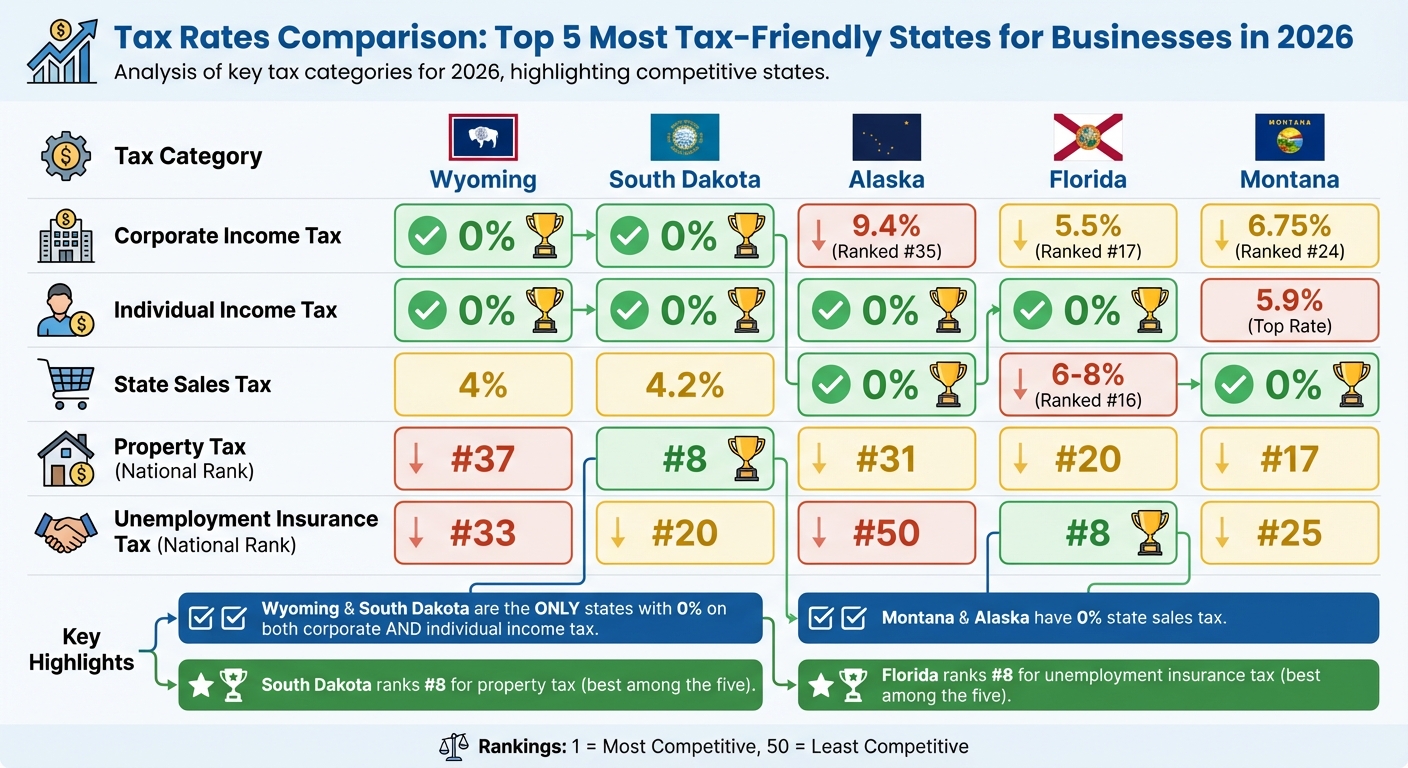
Tax Rates Comparison: Top 5 Most Tax-Friendly States for Businesses in 2026
When deciding where to establish your business, understanding the tax advantages each state offers is crucial. Here’s a breakdown to help you evaluate the options.
Wyoming and South Dakota stand out as the only two states in the U.S. that skip both corporate and individual income taxes while also avoiding a gross receipts tax. This makes them especially appealing for pass-through entities and sole proprietors. Alaska and Florida also do not impose individual income taxes, joining Wyoming and South Dakota at a 0% rate for that category. On the other hand, Montana has a top individual income tax rate of 5.9%.
Sales tax rates further set these states apart. Montana and Alaska shine with a 0% state-level sales tax. Wyoming follows closely with a competitive 4% sales tax, and South Dakota recently lowered its rate to 4.2%. Florida, however, ranks 16th nationally in sales tax competitiveness, which suggests a relatively higher burden in this category. The table below provides a detailed comparison of these rates.
| State | Corporate Income Tax | Individual Income Tax | Sales Tax (State) | Property Tax Rank | Unemployment Insurance Rank |
|---|---|---|---|---|---|
| Wyoming | 0% | 0% | 4% | #37 | #33 |
| South Dakota | 0% | 0% | 4.2% | #8 | #20 |
| Alaska | Ranked #35 | 0% | 0% | #31 | #50 |
| Florida | Ranked #17 | 0% | Ranked #16 | #20 | #8 |
| Montana | Ranked #24 | 5.9% (Top) | 0% | #17 | #25 |
Note: Rankings are based on competitiveness, with 1 being the best and 50 the least competitive.
South Dakota emerges as the leader in property tax efficiency, ranking 8th nationally, while Florida excels in unemployment insurance tax competitiveness, also ranking 8th. These distinctions could play a significant role in your decision, depending on your business’s priorities.
Benefits of Operating in a Low-Tax State
Running your business in a low-tax state can give you more working capital to grow and invest. Lower corporate taxes directly increase your net profit, freeing up funds to hire staff, upgrade your technology, or expand your operations. For instance, a corporate headquarters in Wyoming faces an effective tax rate of 6.9%, compared to 25.35% in New York – an enormous difference that impacts your bottom line.
If your business operates as a pass-through entity, like an LLC or S-corporation, the advantages can be even greater. States with no individual income tax allow entrepreneurs to keep more of their earnings. When individual income tax rates are at 0%, those savings add up quickly, providing more flexibility for reinvestment or personal financial goals.
Better cash flow is another key advantage. Immediate expensing provisions, for example, let you deduct the full cost of equipment purchases right away. This is especially helpful during growth phases when every dollar counts. Instead of spreading deductions over years, you can use those savings immediately to fuel your business’s growth. These benefits are even easier to access when paired with BusinessAnywhere’s streamlined business formation services.
"High corporate tax rates can lower net profit, making it more difficult to expand operations, invest in new technologies, or hire additional staff." – Stripe
States with lower or no sales tax also give businesses a pricing edge. For example, Montana and Alaska have a 0% state sales tax, letting businesses avoid the added costs that can drive customers away. This allows you to price your products more competitively and retain local customers without worrying about sales tax cutting into your profits.
BusinessAnywhere makes it simple to take full advantage of these tax benefits when forming your business.
How BusinessAnywhere Simplifies Business Formation in These States
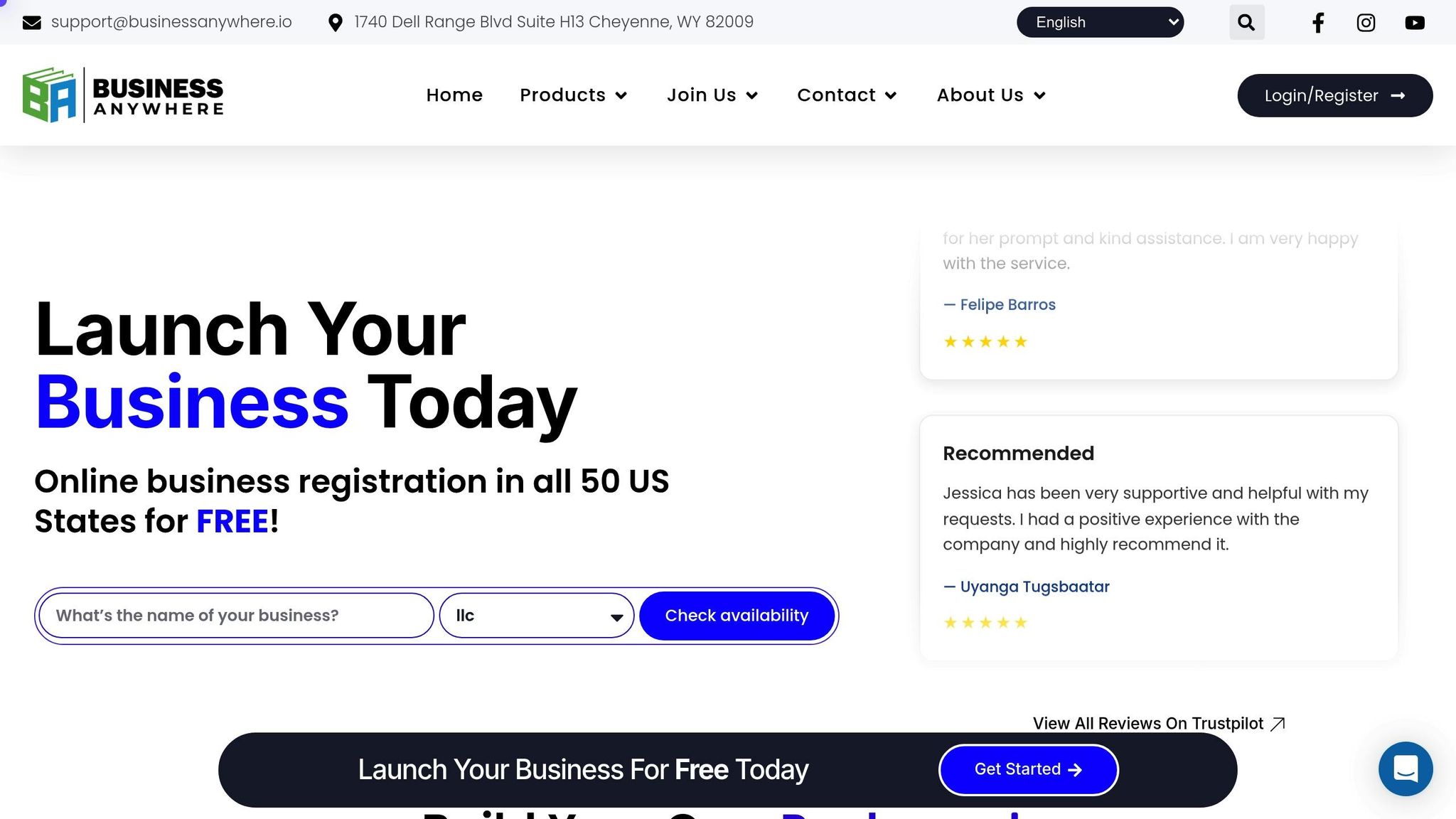
Taking advantage of tax-friendly states is easier than ever with BusinessAnywhere’s straightforward process. The platform handles registrations across Wyoming, South Dakota, Alaska, Florida, and Montana. Even better, there’s no service fee – you only cover the required state filing fees. For instance, Wyoming’s fee is about $100, while Florida’s is $125.
You can kickstart your online registration in less than five minutes. Once you begin, BusinessAnywhere files your Articles of Organization with the Secretary of State, completing the process in just 1–2 days. The service also includes a free registered agent for the first year (normally $147 annually), giving you a professional address to safeguard your privacy – especially useful in states like Wyoming.
After your business is formed, BusinessAnywhere offers additional services to keep things running smoothly. They’ll secure an EIN for a one-time fee of $97 and provide a virtual mailbox service starting at $20 per month. This includes unlimited mail scanning and global forwarding. They also handle ongoing compliance, such as annual report filings. For example, Wyoming’s annual report fee is $60, while Florida’s is $138.75.
"BusinessAnywhere has helped thousands of digital entrepreneurs navigate state selection and incorporation. Our expert team handles everything from formation to ongoing compliance, letting you focus on growing your business." – BusinessAnywhere
BusinessAnywhere also provides tools to help you make informed decisions about where to incorporate. Their resources include a Best State Incorporation Decision Tree and an LLC Formation Cost Calculator, designed to guide you based on your unique needs for privacy and nexus. For international entrepreneurs, the platform simplifies the process of setting up a U.S. business – no physical presence required.
Conclusion
Where you choose to base your business can have a big impact on your bottom line. States like Wyoming and South Dakota stand out with no corporate or individual income taxes. Alaska and Montana skip state sales tax altogether, while Florida offers no individual income tax and a moderate corporate tax rate of 5.5%. Florida also recently eliminated its commercial lease tax, adding to its appeal.
The benefits of operating in these states extend beyond tax savings. Lower tax burdens mean more capital to reinvest in your business – whether that’s developing new products, hiring top talent, or staying competitive in pricing. Plus, states with no or low individual income taxes can help attract skilled professionals by letting them take home more of their earnings.
When deciding where to establish your business, it’s essential to evaluate your specific needs. Think about your business structure, revenue streams, and operational goals. Don’t forget to account for factors like employee-related taxes, property taxes, and local sales tax rules, as these vary widely by state. The best choice will depend on your unique circumstances.
If you’re ready to take advantage of these tax-friendly states, BusinessAnywhere makes it simple and affordable to get started. They handle the process quickly, charging only state filing fees and even offering a free registered agent for the first year. Head over to BusinessAnywhere’s business registration page to start forming your business today.
FAQs
Which state is best for my LLC or S-corp?
South Dakota and Wyoming are popular choices for setting up LLCs or S-corps, largely due to their lack of corporate and individual income taxes. These tax advantages can significantly reduce the financial burden on businesses, making these states appealing to entrepreneurs looking to optimize their expenses.
Do local taxes still apply in no-tax states?
In states like Wyoming and South Dakota, which are known for not imposing state corporate or income taxes, local taxes generally don’t apply. That said, certain local jurisdictions within these states might still impose specific taxes or fees, so it’s worth checking the rules in particular areas.
Will forming in a low-tax state cut my taxes if I operate elsewhere?
Forming your business in a state with lower taxes might help reduce your overall tax liability. However, keep in mind that you may still owe taxes in the state where your business activities take place. The actual savings will depend on where your business operates and earns its income.