


- O-1 Visa: For individuals with extraordinary ability in fields like business or science. Requires proof of exceptional achievements. No investment needed. Temporary but renewable.
- E-2 Visa: For citizens of treaty countries who make a substantial business investment (typically $100,000+). Renewable but doesn’t lead directly to a green card.
- International Entrepreneur Parole (IER): For startup founders with significant U.S. investment ($311,071) or government grants ($124,429). Temporary, with a maximum stay of 5 years.
- EB-5 Visa: Investment-based green card. Requires $800,000 for businesses in designated areas or $1,050,000 elsewhere, plus the creation of 10 full-time jobs.
Each option has unique requirements, costs, and benefits. Your nationality, funding, and long-term goals will determine the best fit. Below, we’ll break down the details of each pathway to help you make an informed decision.
O-1 Visa: For Entrepreneurs with Extraordinary Ability
The O-1 visa is designed for individuals who demonstrate extraordinary ability in their field. Entrepreneurs typically apply under the O-1A classification, which covers areas such as science, education, business, and athletics. According to USCIS, extraordinary ability refers to "a level of expertise indicating that you are one of the small percentage who have arisen to the very top of the field". Meeting this standard requires clear evidence of exceptional achievement.
Take the example of Soundarya Balasubramani, a startup founder who successfully met these high standards. Soundarya, the founder of the educational venture Unshackled, secured an O-1A visa in September 2023, following a prior denial under the O-1B category. Her application included evidence across all eight O-1A criteria: authorship of two books (Admitted and Unshackled), a social media reach of 15 million people, receipt of an Emergent Ventures India grant, and proof that her Salesforce salary placed her in the top 10% for her role in San Francisco. Her petition was approved within three business days of submission.
Eligibility Requirements and How to Apply
To qualify for an O-1A visa, you must meet at least three of eight specific criteria. These include achievements such as receiving nationally or internationally recognized awards, membership in prestigious associations, having your work featured in major media, serving as a judge of others’ work in your field, making significant original contributions, holding a critical role in a distinguished organization, and earning a salary that is notably high compared to peers.
However, self-petitioning is not an option. Your startup can act as your petitioner by establishing a valid employer-employee relationship. To support your application, you’ll need to provide several key documents: a written advisory opinion from a peer group or expert in your field, a contract or summary of employment terms, and a detailed itinerary of your planned activities. Form I-129 must be filed at least 45 days before your intended start date but no more than one year in advance.
Before proceeding, it’s important to weigh the O-1 visa’s benefits and limitations to determine if it’s the right fit for your entrepreneurial goals.
Benefits and Drawbacks
The O-1 visa offers several notable advantages. It is initially granted for up to three years, with the possibility of unlimited one-year extensions. Unlike other visa categories, there is no annual cap on the number of O-1 visas issued. Additionally, you can pursue permanent residency without jeopardizing your O-1 status. Recent policy updates, effective January 8, 2025, have clarified eligibility for individuals in critical and emerging technology fields, making it easier for STEM founders to qualify.
However, the visa’s high standard can be a significant hurdle. Demonstrating sustained national or international recognition is often difficult for entrepreneurs early in their careers. To build your profile, consider using time on Optional Practical Training (if applicable) to publish articles, speak at industry events, or serve as a judge at pitch competitions. These activities can help strengthen your credentials.
It’s also worth noting that while your spouse and children can join you in the U.S. under O-3 dependent status, they are not allowed to work. However, they may enroll in full- or part-time studies.
sbb-itb-ba0a4be
E-2 Treaty Investor Visa: For Citizens of Treaty Countries
While the O-1 visa highlights personal achievements, the E-2 visa focuses on financial investment, making it a go-to option for citizens of treaty countries looking to establish a business in the U.S.
The E-2 visa is exclusively available to citizens of countries that have a treaty of commerce and navigation with the United States. This means eligibility hinges on your nationality, so it’s crucial to confirm your country’s treaty status before committing resources to this visa path.
Unlike the O-1 visa, which emphasizes individual accomplishments, the E-2 visa revolves around your financial commitment to a U.S. business. To qualify, you’ll need to make a “substantial” investment in an active, operating enterprise. It’s important to note that the E-2 visa doesn’t lead directly to a green card – it’s classified as a non-immigrant visa. However, it can be renewed indefinitely in two-year increments, provided your business continues to meet the necessary criteria. Additionally, spouses of E-2 visa holders are eligible for work authorization.
Eligibility and Investment Requirements
The first step is verifying that your nationality qualifies. You can check the U.S. Department of State’s Treaty Countries list to confirm whether your country has an E-2 treaty with the U.S.. If you obtained citizenship through a citizenship-by-investment program, you’ll need to prove you lived in that treaty country for at least three consecutive years before applying.
There’s no fixed minimum investment amount for the E-2 visa. Instead, the U.S. Citizenship and Immigration Services (USCIS) uses a proportionality test. According to USCIS, a “substantial” investment is one that is significant in relation to the total cost of purchasing or starting the business. In practice, successful applications often involve investments starting around $100,000, though some tech startups have been approved with investments as low as $65,000 or as high as $300,000.
The investment must be irrevocably committed – idle funds or speculative investments won’t qualify. You’ll need to document your financial commitment with evidence like canceled checks, wire transfers, and purchase orders.
Ownership is another key requirement. You must own at least 50% of the business or demonstrate operational control through a managerial role. Additionally, the business cannot be “marginal,” meaning it must generate more than just a minimal living for you and your family. For startups, you’ll have a five-year window to meet this requirement.
Advantages and Limitations of the E-2 Visa
The E-2 visa comes with several perks that appeal to entrepreneurs. You’ll receive an initial two-year stay, with no cap on the number of two-year extensions you can request. There’s also no annual limit on the number of E-2 visas issued, and your unmarried children under 21 can accompany you to the U.S.. Spouses can work in the U.S. without needing a separate application.
However, there are some drawbacks. The visa is only available to nationals of treaty countries, and you must maintain the intention to leave the U.S. when your visa status expires. Additionally, the E-2 visa doesn’t provide a direct route to permanent residency. If obtaining a green card is your goal, you’ll need to explore other immigration options.
| Feature | E-2 Treaty Investor Details |
|---|---|
| Eligibility | Nationals of treaty countries only |
| Investment Amount | No fixed minimum; must be “substantial” relative to business costs |
| Ownership Requirement | At least 50% ownership or operational control |
| Duration of Stay | Initial two years; renewable indefinitely in two-year increments |
| Path to Green Card | Not directly available; requires a separate process |
| Spousal Work Authorization | Automatically granted; no additional application required |
| Annual Cap | No numerical limit |
To improve your chances of approval, prepare a robust five-year business plan outlining how your venture will create jobs for U.S. workers and contribute to the economy. Consider using escrow accounts to safeguard your investment, ensuring funds are released only if your visa is approved. Finally, meticulously document your source of funds with evidence like wire transfers, property records, and tax returns – poor documentation is a common reason for E-2 visa denials.
International Entrepreneur Parole (IER): A Temporary Option for Startups
Building on the discussion of traditional visa options, the International Entrepreneur Parole (IER) program offers a temporary alternative for startup founders who don’t meet the criteria for standard visa categories. If your startup has secured funding from qualified U.S. investors or government grants, the IER program could be a viable option. Unlike a traditional visa, IER is a grant of parole, allowing up to 2.5 years of work authorization, with the possibility of extending for another 2.5 years, for a total of five years.
This program is tailored for founders who demonstrate strong business growth and job creation, rather than relying on personal achievements or treaty-based qualifications. Under IER, you’re authorized to work for your startup without needing a separate Employment Authorization Document (EAD). However, it’s important to note that IER doesn’t lead directly to permanent residency, and you generally can’t switch to another visa category while staying in the U.S.
Eligibility Requirements for IER
To qualify, you must own at least 10% of your startup at the time of application and play a key role in its operations. The business must also have been established in the U.S. within the five years leading up to your application.
The financial requirements are specific. Starting October 1, 2024, your startup must show one of the following:
- At least $311,071 in investments from qualified U.S. investors within the 18 months before applying.
- A minimum of $124,429 in federal, state, or local government grants or awards.
If your funding falls short of these thresholds, you can present other evidence – such as impressive user metrics, social impact, or past achievements – to prove your startup’s growth potential.
Qualified investors must meet strict criteria. They must be U.S. citizens, lawful permanent residents, or U.S.-based organizations majority-owned by them. Additionally, these investors need a history of investing at least $746,571 in startups over the past five years, with at least two of those investments resulting in companies that created five qualified jobs or generated $622,142 in revenue with 20% annual growth. Personal investments from you or close family members don’t count.
A maximum of three entrepreneurs per startup can be granted parole. For re-parole (extension), the ownership requirement drops to 5%, as long as you continue to play a central role. Your startup must also meet performance benchmarks, such as generating $622,142 in revenue with 20% annual growth or creating at least five qualified jobs.
Benefits and Drawbacks
The IER program offers some distinct advantages compared to traditional visa options. Your spouse and unmarried children under 21 can join you, and your spouse can apply for work authorization after being paroled into the U.S. Additionally, you’ll receive a multi-entry parole document, allowing you to travel internationally and return during your authorized period.
However, there are significant limitations. Parole doesn’t count as formal admission to the U.S., which means you generally can’t adjust your status to another visa category while in the country. If you’re already in the U.S. under a different status (like B-1 or F-1), you’ll need to leave and re-enter at a port of entry to activate your IER status. Lastly, because parole decisions are made on a case-by-case basis, there’s no option to appeal if your application is denied.
| Feature | Initial Parole | Re-Parole (Extension) |
|---|---|---|
| Ownership Requirement | At least 10% | At least 5% |
| Duration | Up to 2.5 years | Up to 2.5 additional years |
| Investment/Grant | $311,071 (investment) or $124,429 (grant) | Revenue of $622,142+ with 20% annual growth or creation of 5 qualified jobs |
| Job Creation | Demonstrated potential for growth | At least 5 qualified jobs |
| Revenue | Not required | $622,142+ with 20% annual growth |
To improve your chances of approval, ensure your investors meet the program’s qualifications and prepare detailed documentation of your role in the company. If you’re already in the U.S., plan for international travel to re-enter at a port of entry to finalize your parole status.
Next, we’ll dive into the EB-5 Immigrant Investor Visa, which offers a direct route to permanent residency.
EB-5 Immigrant Investor Visa: Path to Permanent Residency
The EB-5 visa stands out from temporary visa options by offering a direct route to a permanent green card for founders willing to make a substantial capital investment. To qualify, you need to invest in a new commercial enterprise. This can be any for-profit business established after November 29, 1990, or an older business that has been restructured or expanded by at least 40% in either net worth or workforce.
This visa comes with specific requirements regarding investment and job creation. Your investment must be "at risk", meaning you can’t have agreements guaranteeing repayment or fixed returns. Acceptable capital includes cash, equipment, inventory, or other tangible assets at fair market value. You’ll also need to prove that your funds were obtained legally and show active involvement in the business, whether through daily management or policy-making.
One key benefit of the EB-5 program is conditional permanent residency for two years. To transition to full permanent residency, you must file Form I-829 within 90 days before your two-year anniversary. This form demonstrates that you maintained your investment and met the job creation requirements. Once approved, the conditions are lifted, and you’ll hold a permanent green card.
Investment Amounts and Job Creation Rules
The required investment depends on your business’s location. As of March 15, 2022, the standard investment is $1,050,000 for businesses located anywhere in the U.S. If your business is in a Targeted Employment Area (TEA) – defined as a rural area or a high-unemployment zone – the minimum drops to $800,000. These thresholds are adjusted for inflation every five years, with the next update scheduled for January 1, 2027.
Meeting the job creation requirement involves creating at least 10 permanent full-time jobs for qualified U.S. workers. These positions must require at least 35 hours per week and be filled by U.S. citizens, lawful permanent residents, or other authorized immigrants. However, jobs held by you, your spouse, or your children do not count. Temporary, seasonal, or intermittent jobs can qualify only if they are expected to last at least two years.
If you’re not working through a Regional Center, all 10 jobs must be direct positions on your company’s payroll. You can meet the full-time requirement through job-sharing arrangements, where two or more employees split a single 35-hour-per-week position. For those taking over a "troubled business" – one that has existed for at least two years and lost 20% of its net worth – you can satisfy the requirement by maintaining current employee levels instead of creating new jobs.
Standard vs. Targeted Employment Area Investments
Choosing between a standard investment and a TEA investment involves weighing capital requirements against location constraints. A high-unemployment TEA must have an unemployment rate at least 150% above the national average, while a rural area TEA includes locations outside metropolitan statistical areas or towns with populations under 20,000.
The U.S. Citizenship and Immigration Services (USCIS) now directly designates TEAs for high-unemployment areas. Before committing $800,000 to a project, confirm that your chosen location meets current census tract criteria. Additionally, the EB-5 program reserves 20% of visas for rural area investments and 10% for high-unemployment areas, which can lead to faster processing for TEA projects.
| Feature | Standard Investment | Targeted Employment Area (TEA) |
|---|---|---|
| Minimum Amount | $1,050,000 | $800,000 |
| Location Requirement | Anywhere in the U.S. | Rural area or high-unemployment area (150% of national average) |
| Job Creation | 10 direct full-time jobs | 10 direct full-time jobs |
| Visa Set-Asides | Unreserved | 20% (Rural), 10% (High Unemployment) |
| Next Adjustment | January 1, 2027 (inflation-based) | January 1, 2027 (inflation-based) |
To successfully navigate the EB-5 process, document job creation thoroughly during the two-year conditional residency period. You’ll need to provide this evidence when filing Form I-829, following the initial Form I-526. This detailed overview highlights how the EB-5 visa can serve as a pathway for foreign entrepreneurs looking to establish themselves in the U.S. permanently.
How to Choose the Right Visa for Your Startup
Selecting the right visa for your startup involves weighing factors like your nationality, available funds, the stage of your business, and your long-term residency plans. Here’s a closer look at what you need to consider.
Start by evaluating your investment capacity. For instance, the E‑2 visa generally requires a significant investment, often around $100,000 or more. The International Entrepreneur Parole (IER) program, on the other hand, requires at least $311,071 in qualified funding from investors or $124,429 if you’re relying on government grants. Meanwhile, the EB‑5 program demands an investment between $800,000 and $1,050,000, depending on the location and type of investment.
The maturity of your business is another key factor. The IER is designed for startups established within the past five years, while the E‑2 and EB‑5 programs cater to more developed businesses.
Ownership and your role in the company also play a big part. For example, the IER requires you to hold at least 10% ownership initially (dropping to 5% for extensions) and maintain an active, central role in the business. The E‑2 visa typically requires you to own at least 50% of the business or have operational control. If you have a track record of extraordinary achievements – such as significant awards or notable media coverage – the O‑1 visa could be a better fit, though it requires sponsorship from a U.S. entity.
Your long-term goals matter, too. Temporary visas like the O‑1, E‑2, and IER do not provide a direct path to a green card. However, the EB‑5 program offers a direct route to permanent residency, making it ideal for those with sufficient capital who plan to settle in the U.S. permanently.
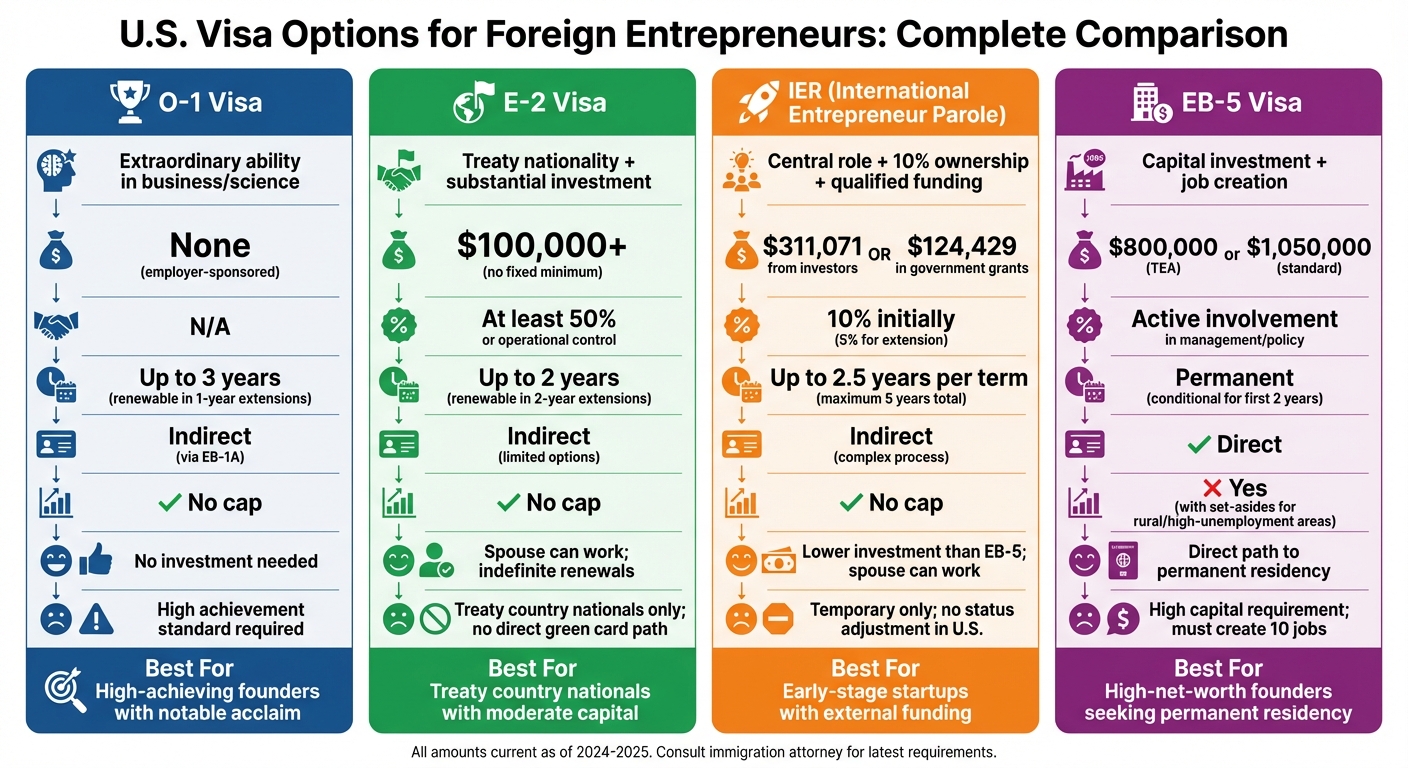
To help you compare your options, here’s a breakdown of key visa types:
Visa Comparison Table
| Visa Type | Primary Requirement | Investment Amount | Duration | Green Card Path | Best For |
|---|---|---|---|---|---|
| O‑1 | Extraordinary ability in business/science | None (employer-sponsored) | Up to 3 years (renewable in 1-year extensions) | Indirect (via EB‑1A) | High-achieving founders with notable acclaim |
| E‑2 | Treaty nationality plus substantial investment | Typically $100,000+ (no fixed minimum) | Up to 2 years (renewable in 2-year extensions) | Indirect (limited options) | Treaty country nationals with moderate capital |
| IER | Central, active role with at least 10% ownership plus qualified funding | $311,071 from investors or $124,429 in grants | Up to 2.5 years per term (maximum of 5 years total) | Indirect (complex process) | Early-stage startups with external funding |
| EB‑5 | Capital investment and job creation | $800,000 (TEA) or $1,050,000 (standard) | Permanent (conditional for the first 2 years) | Direct | High-net-worth founders seeking permanent residency |
Steps to Simplify the Application Process
To make your visa application smoother, consider these practical steps:
- Check your eligibility: If you’re exploring the E‑2 visa, confirm that your country is on the Department of State’s list of treaty nations.
- Keep financial records organized: For investment-based visas like the E‑2 and EB‑5, ensure you have clear documentation – such as bank statements, tax returns, or contracts – to prove your funds were obtained legally.
- Plan for biometrics: For IER applications, both you and your family will need to complete fingerprinting and photo submissions. Schedule these appointments early to avoid delays.
- Seek legal advice: Immigration laws can be complex, especially for visas like the O‑1 or EB‑2 NIW. Consulting an immigration attorney can help strengthen your application and avoid costly mistakes.
- Use temporary visas strategically: If you’re on an O‑1 or IER and aiming for permanent residency, you might start your EB‑1A or EB‑2 NIW application while maintaining your current visa. Keep in mind that IER parole isn’t considered an official admission, which can complicate green card adjustments without leaving the U.S.
Conclusion
Choosing the right visa is crucial for aligning with your business goals, available capital, and future plans. Whether you’re exploring temporary options like the O-1, E-2, or International Entrepreneur Parole (IER), or aiming for permanent residency through programs such as the EB-5 Immigrant Investor visa, each route caters to different needs and comes with specific requirements.
Temporary visas offer flexibility to launch and expand your business, with the possibility of transitioning to permanent residency options later, such as the EB-1A or EB-2 National Interest Waiver (NIW). Factors like your ownership percentage, the stage of your business, and whether you need immediate work authorization or long-term residency should guide your decision. Since entrepreneur visas are assessed individually, consulting an experienced immigration attorney is essential. They can help you navigate complex requirements, maintain detailed records of your investments and business operations, and avoid potential missteps that could lead to denial or removal. Careful planning and preparation are key to a strong application.
To move forward, confirm your eligibility by reviewing the specific requirements of each visa type. For example, check treaty status for E-2 visas, provide clear documentation of funding sources for investment-based visas, and ensure your business meets ownership criteria like the 10% stake for IER or 50% control for E-2 status. Proper preparation, combined with expert legal advice, can be the difference between a smooth process and costly setbacks.
Take the first step by evaluating which visa best suits your startup’s current stage and your personal qualifications. Then, work with an immigration attorney to build a strong application that positions your business for success in the U.S. market.
FAQs
What is the difference between the O-1 and E-2 visas for startup founders?
The O-1 visa and E-2 visa serve different purposes and cater to distinct types of startup founders, each with its own set of eligibility criteria and requirements.
The O-1 visa is tailored for individuals who demonstrate extraordinary ability or achievement in fields like science, business, or the arts. To qualify, applicants need to showcase national or international recognition, which could include awards, groundbreaking contributions, or other significant accomplishments in their industry. This visa works well for founders who are seen as trailblazers or thought leaders in their respective fields.
In contrast, the E-2 visa is specifically for entrepreneurs from treaty countries who make a substantial financial investment in a U.S.-based business. Eligibility is centered on the amount of the investment, the business’s potential for success, and the founder’s capability to oversee and grow the enterprise. Unlike the O-1, the E-2 focuses more on the economic impact and viability of the business rather than the founder’s personal accolades.
To put it simply, the O-1 visa is ideal for accomplished founders with a strong reputation in their industry, while the E-2 visa is better suited for entrepreneurs who are committing significant financial resources to building and managing a business in the U.S.
What are the benefits of the International Entrepreneur Parole program for startup founders?
The International Entrepreneur Parole program gives foreign entrepreneurs a chance to temporarily live and work in the U.S. while focusing on building and expanding their startups. This program is aimed at founders whose businesses contribute to the public good by driving innovation, creating jobs, or boosting the economy.
To be eligible, entrepreneurs must demonstrate that they play a central role in their startup and that the business has strong growth potential. This program is especially useful for early-stage startups that don’t yet meet the criteria for traditional visa options, offering a more flexible route to establish operations in the U.S. while considering longer-term immigration possibilities.
What are the investment requirements for obtaining a green card through the EB-5 visa program?
To secure a green card through the EB-5 visa program, you need to invest at least $800,000 in a Targeted Employment Area (TEA) project or $1,050,000 in a non-TEA project. This investment must come from a lawful source, be at risk, and result in the creation or retention of at least 10 full-time jobs for U.S. workers.
This program aims to drive economic development and job opportunities, making it an appealing choice for investors and entrepreneurs seeking to build a future in the United States.