
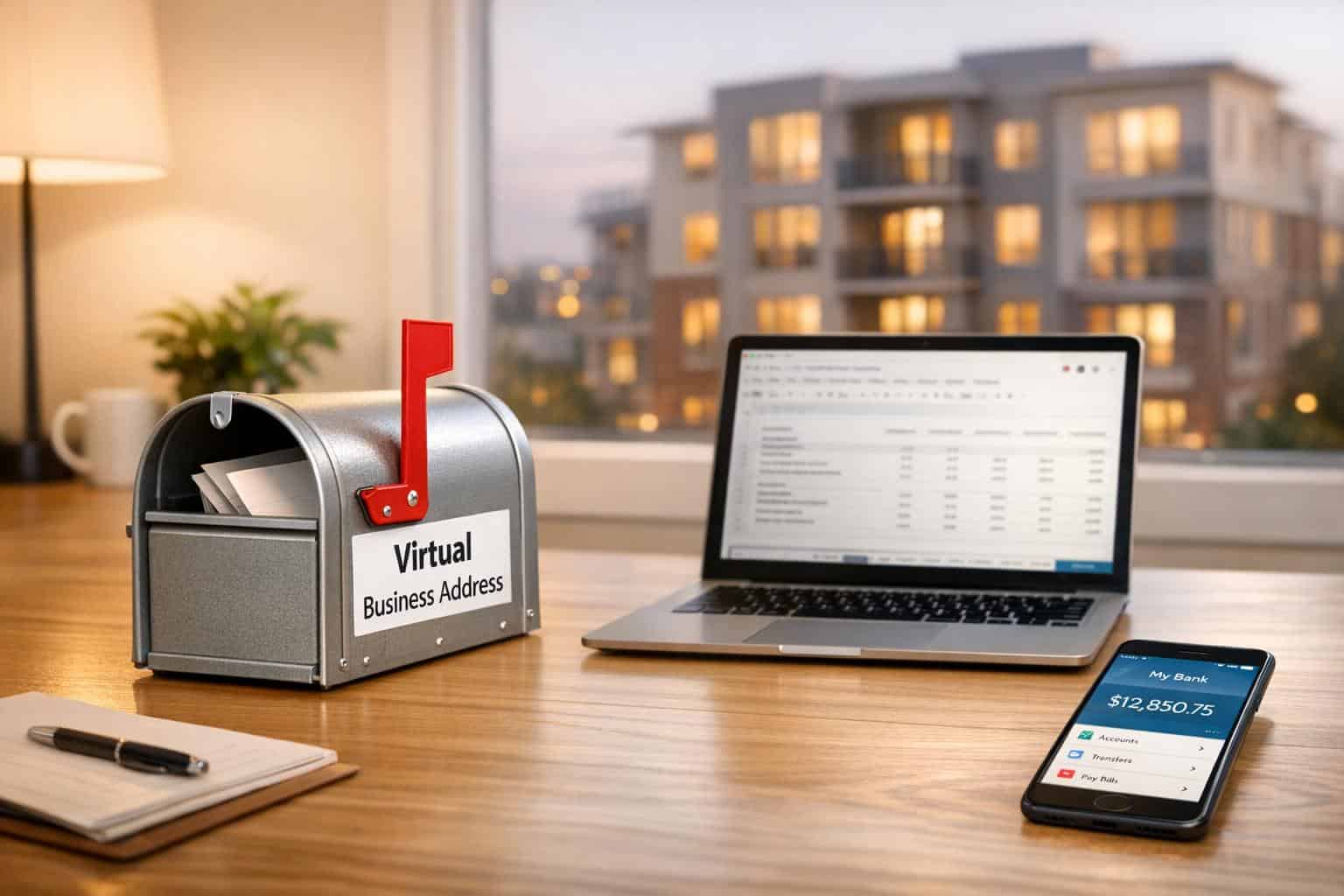
Using your home address for managing rental properties can expose your personal information, create privacy risks, and blur professional boundaries. A virtual mailbox offers a secure, professional alternative. It provides a real street address for business filings, tenant communication, and mail handling – keeping your home address private.
Here’s what you need to know:
- Privacy: Protects your home address from public records and tenant access.
- Professionalism: Offers a credible business address for leases and filings.
- Mail Management: Digitally scans and organizes mail, with options for forwarding or shredding.
- Cost: Plans typically range from $4.99 to $14.99/month, depending on features.
However, virtual mailboxes have limitations: they can’t replace a registered agent for legal documents or meet certain banking requirements. Combining a virtual mailbox with a registered agent service ensures compliance and full functionality. Always check state-specific rules and complete USPS Form 1583 to authorize mail handling.
The Problems with Using Your Home Address for Rental Properties
Public Records Expose Your Personal Address
Using your home address for rental properties can put both your privacy and professionalism at risk. When you register a rental property business with your state, your business address often becomes public information. This means your personal address could end up on Secretary of State websites for anyone to see.
Additionally, property deeds and legal filings, like those for evictions or small claims cases, can reveal your home address. This public exposure increases your vulnerability to identity theft – a problem that affects 7–10% of Americans. On top of that, residential mailboxes pose another risk. Check fraud, for example, has doubled between 2021 and 2023, and unsecured mailboxes make it easier for fraudsters to exploit your information. These issues not only threaten your personal security but also complicate your role as a landlord.
How Your Home Address Affects Tenant Relationships
Beyond the privacy concerns, using your home address can blur the boundaries between your personal and professional life. When tenants know your home address, they may feel entitled to show up unannounced, especially during disputes. This can disrupt your personal time and make it harder to maintain a professional relationship.
When your home serves as your business address, the clear separation between landlord and tenant often disappears. Tenants might start viewing you more as a neighbor than a professional, which can make enforcing lease terms or resolving conflicts much more challenging. This lack of boundaries can also take a toll on your work-life balance, as personal and business matters start to overlap.
There’s also the issue of mail handling. Sharing a mailbox with tenants could lead to accusations of mail tampering, which is a federal offense carrying hefty fines or even imprisonment. This adds another layer of legal risk to an already complicated situation.
Using a Virtual Mailbox as Your Business Address
What Virtual Mailboxes Offer Landlords
A virtual mailbox gives you a real street address where your mail is received, scanned, and made accessible online. Unlike a P.O. Box – which many states won’t accept for business registration – a virtual mailbox provides a legitimate physical address that can be used for lease agreements, business cards, and state filings.
For landlords, the mail scanning and forwarding features are especially practical. Rent checks can be processed and deposited directly into your bank account, eliminating the hassle of in-person bank visits. Plus, all incoming mail is converted into text-searchable PDFs, making it easy to find documents by searching keywords like "water bill" or "maintenance invoice."
Security is another key benefit. Your mail is handled at a professionally staffed facility, reducing the risk of theft compared to a residential mailbox. This is particularly important given that reports of check fraud nearly doubled between 2021 and 2023. On top of that, the service filters out junk mail, ensuring you only see important documents like legal notices, tenant communications, and property bills.
"I live out of state and use PostScan Mail as my single point of contact for all my tenant-related correspondence." – Louis M., Landlord
Home Address vs. Virtual Mailbox: A Direct Comparison
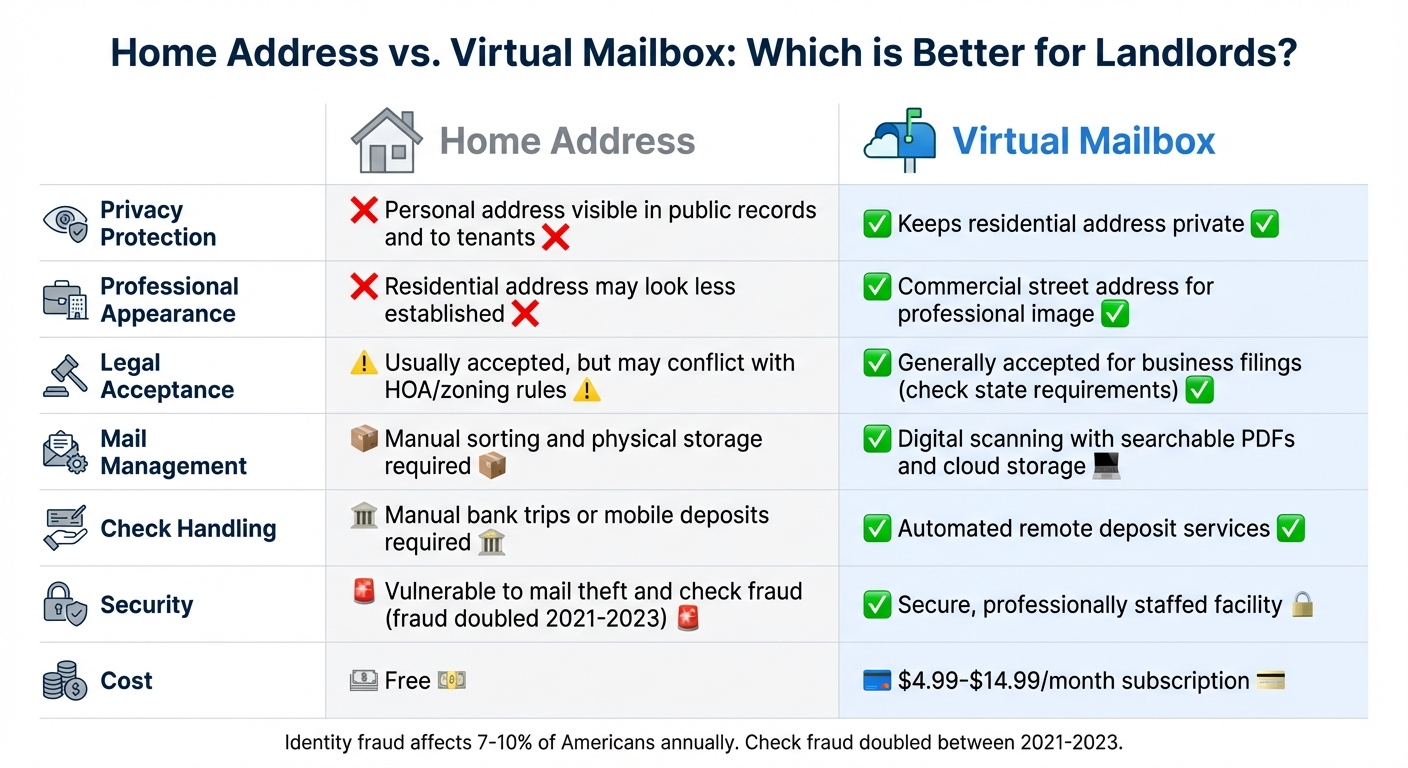
Here’s how using your home address stacks up against a virtual mailbox for landlords managing rental properties:
| Feature | Home Address | Virtual Mailbox |
|---|---|---|
| Privacy Protection | Your personal address appears in public records and is visible to tenants. | Keeps your residential address private. |
| Professional Appearance | A residential address may not look as established. | Provides a commercial street address for a more professional image. |
| Legal Acceptance | Usually accepted, but may conflict with HOA or zoning rules. | Generally accepted for business filings; check state requirements. |
| Mail Management | Requires manual sorting and physical storage. | Offers digital scanning with searchable PDFs and cloud storage. |
| Check Handling | Involves manual bank trips or mobile deposits. | Supports automated, remote deposit services. |
| Security | More vulnerable to mail theft and check fraud. | Managed in a secure, professionally staffed facility. |
While using your home address is free, a virtual mailbox comes with a monthly subscription. However, it offers greater privacy, convenience, and efficiency. Up next, explore Business Anywhere’s tailored plans for landlords seeking secure and professional mail handling.
Business Anywhere‘s Virtual Mailbox Plans for Landlords
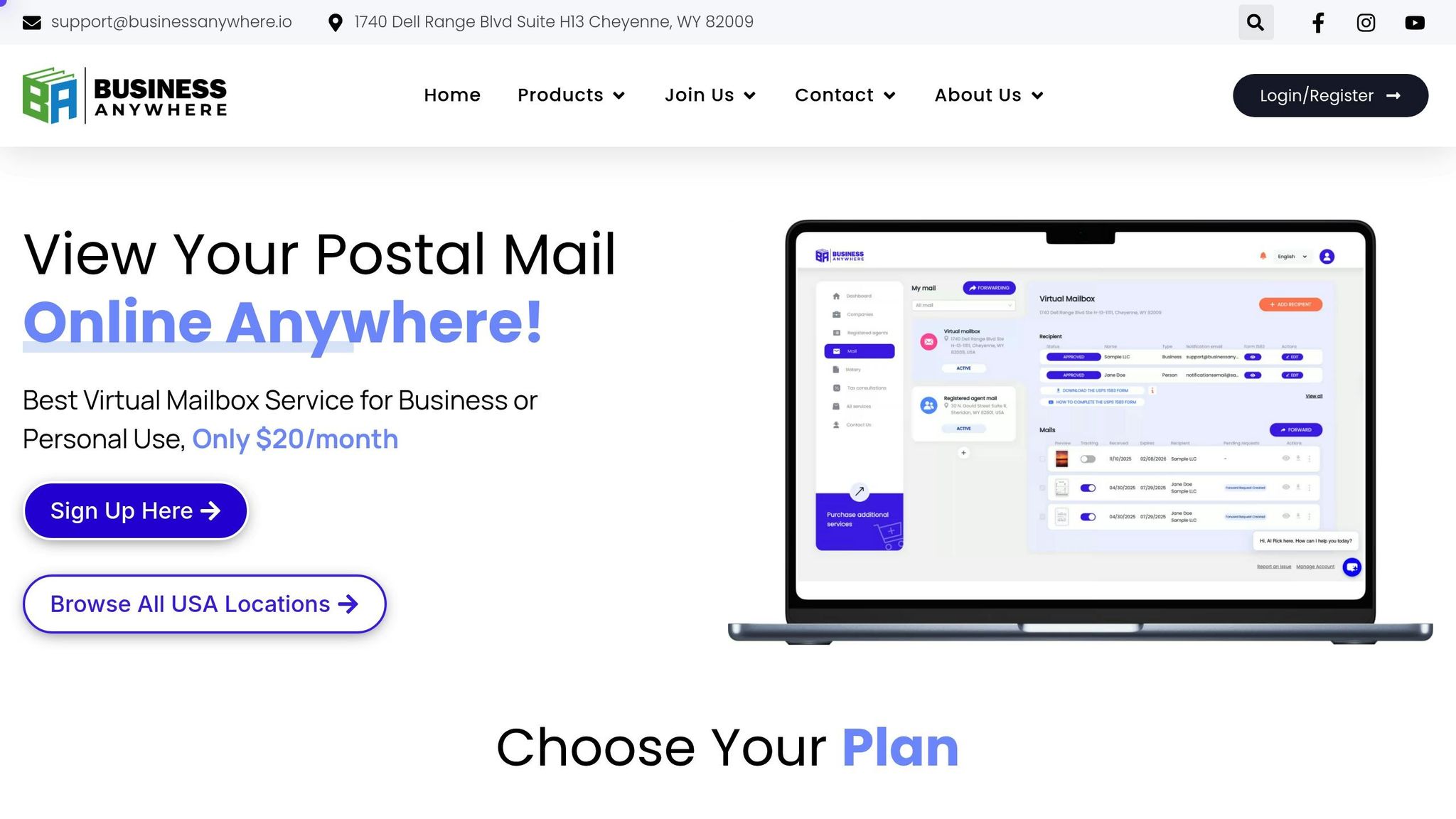
To cater to landlords, Business Anywhere provides virtual mailbox plans with features designed to streamline managing rental properties. These plans, billed annually, include unlimited mail scanning, which is invaluable for handling property documents, lease agreements, and rent checks.
- Basic Plan: $20 per month, supports 2 recipients.
- Premium Plan: $30 per month, accommodates 5 recipients.
- Advanced Plan: $65 per month, supports up to 20 recipients.
All plans include global mail forwarding, so if you’re traveling or living abroad, you can have physical documents sent anywhere in the world. The service offers addresses in Florida, Arizona, New Mexico, and Wyoming – states known for their business-friendly policies and privacy safeguards. Everything is managed through an online dashboard, where you can view, forward, or shred mail. For more details, visit Business Anywhere Virtual Mailbox.
Legal Requirements for Landlords Using Virtual Mailboxes
State Business Filing Rules for Virtual Mailboxes
Many states differentiate between a business mailing address and a registered office. While virtual mailboxes can often be used for general communication – like tenant notices or vendor payments – states typically require a registered agent to maintain a physical street address where legal documents can be served during business hours.
Some states, such as Delaware, Wyoming, and Florida, are more lenient and allow virtual addresses for business registration, as long as they are actual street addresses (not P.O. Boxes). However, Oregon explicitly prohibits using commercial mail receiving agencies or virtual offices as registered offices for LLCs.
"The registered office may not be a commercial mail receiving agency, a mail forwarding business or a virtual office." – Oregon Revised Statutes Section 63.111
California has specific disclosure laws for those using private mailbox services. Businesses must disclose their legal name and the physical street address where operations occur in all advertising and promotional materials. Failure to comply can result in penalties of up to six months in jail, a $2,500 fine, or both. However, landlords working from home may avoid this requirement if they file USPS Form 1583 and authorize the mail service to act as their agent for service of process.
To meet these requirements, many landlords opt to hire a commercial registered agent service, ensuring someone is available to accept legal documents in person. For more details, check out Business Anywhere’s Registered Agent Service.
Next, let’s look at the USPS regulations that complement these state rules.
USPS Form 1583 Requirements
Federal regulations also play a role in how virtual mailboxes operate. Before using a virtual mailbox, you must complete USPS Form 1583, which authorizes a Commercial Mail Receiving Agency (CMRA) to handle mail on your behalf. This form links a responsible party to the mailbox, helping to prevent fraud and ensuring USPS records are accurate.
To complete the form, you’ll need two forms of identification: one government-issued photo ID (like a driver’s license or passport) and a secondary ID showing your current residential address (such as a utility bill, lease, or voter registration card). Social Security cards, credit cards, and birth certificates are not accepted.
If your mailbox is for an LLC or corporation, select "Business/Organization Use" in Section 3 of the form, and provide your business name, address, and registration details. The form must be notarized, which can be done in person or remotely through a U.S.-commissioned notary service.
It’s important to note that while a virtual mailbox keeps your home address private from tenants or the public, the CMRA must retain your actual residential address. Additionally, USPS Form 1583 is specific to the provider you initially file with – if you switch mailbox services, you’ll need to complete a new form.
Using Virtual Mailboxes for IRS and FinCEN Documents
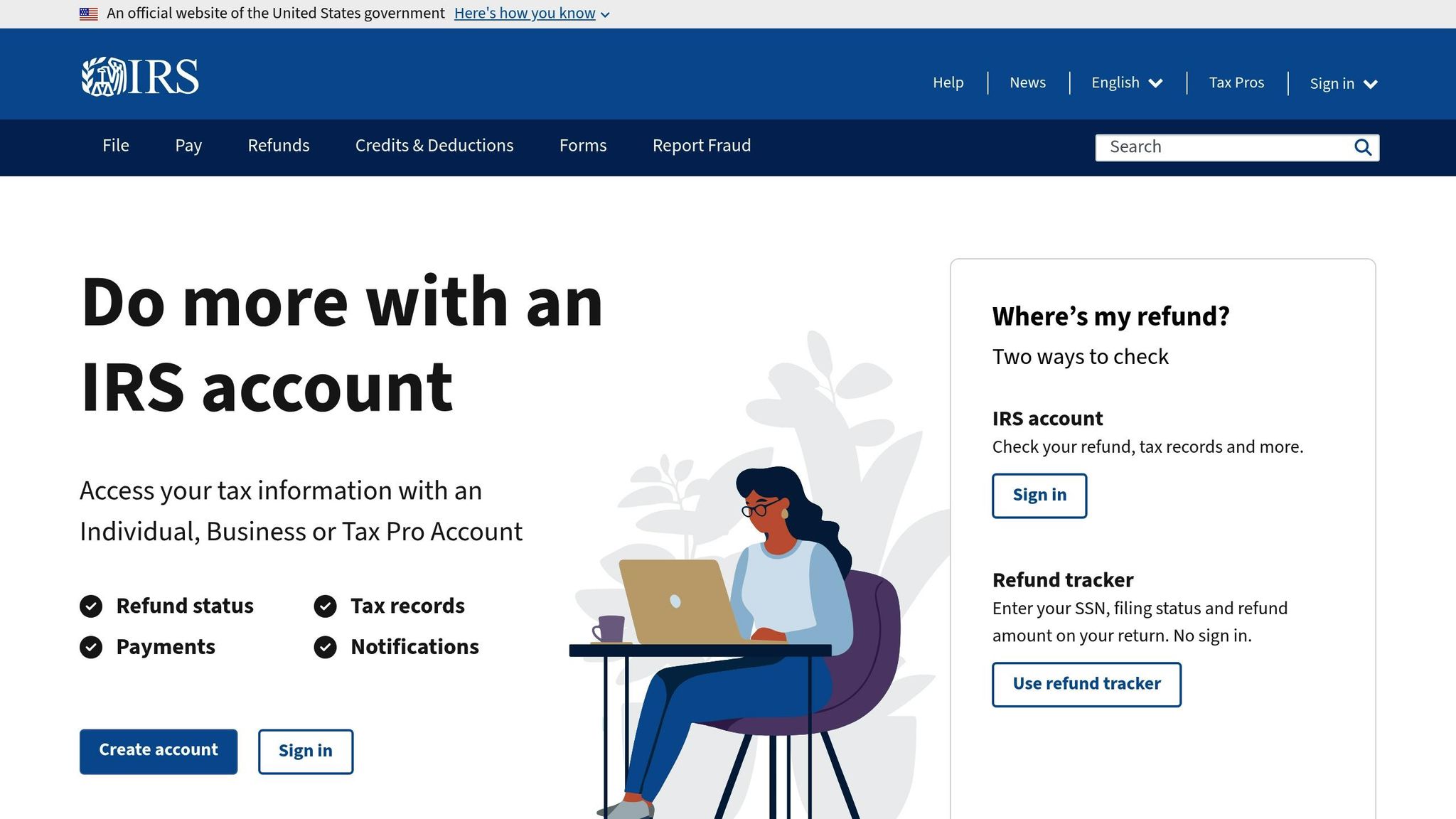
Federal agencies like the IRS and FinCEN also have specific guidelines for virtual addresses. The IRS allows virtual addresses for business-related filings, such as EIN applications (Form SS-4) and business tax returns, as long as the virtual address is a real street address registered as a CMRA. However, personal tax returns require your actual residential address.
"The IRS generally accepts virtual addresses for business purposes, such as business tax returns and correspondence. However, for personal tax returns, you must use the actual residential address where you live and receive mail." – LegalZoom
For FinCEN filings, such as Beneficial Ownership Information (BOI) reports, landlords can use virtual addresses if they qualify as verifiable physical locations. Business Anywhere offers BOI filing services for $37.
Banks, on the other hand, often require a physical street address due to Know Your Customer (KYC) and Anti-Money Laundering (AML) laws. Before choosing a virtual mailbox for banking, confirm whether your provider can supply supporting documents like a lease agreement or utility bill in your business name, as these are commonly required.
Here’s a quick summary of the key requirements:
| Requirement | IRS (Business) | FinCEN/Banks (KYC) | USPS (Mail Receipt) |
|---|---|---|---|
| Accepts P.O. Box? | No | No | N/A |
| Accepts CMRA? | Yes (for business) | Often no (physical required) | Yes (with Form 1583) |
| ID Verification? | Via EIN/SSN | Strict KYC/AML | 2 Forms of ID + Notary |
| Physical Address? | Required for EIN filings | Required for CIP | Required on Form 1583 |
sbb-itb-ba0a4be
Virtual Mailbox Limitations and How to Use Them Correctly
What Virtual Mailboxes Can and Cannot Replace
While virtual mailboxes are excellent for managing routine mail and protecting your privacy, they can’t fully replace a physical address in every situation. For instance, banks and payment processors often reject virtual mailbox addresses due to federal Know Your Customer (KYC) rules. These regulations require a verifiable physical U.S. address for tasks like opening a business bank account or setting up merchant processing for online rent payments. To meet these requirements, you’ll need a service that provides a physical address along with proper documentation.
Here are a few key scenarios where virtual mailboxes fall short:
- Google My Business listings: A physical location is required to list your business.
- Personal tax returns: The IRS mandates a real residential address.
- Proof of residence: Necessary for tasks like obtaining a driver’s license.
Combining Virtual Mailboxes with Registered Agent Services
While virtual mailboxes are great for handling everyday correspondence, they can’t fulfill all the roles of a physical address, especially when it comes to legal compliance. For instance, a virtual mailbox is perfect for managing rent checks, vendor invoices, and tenant notices, but it cannot replace a registered agent. A registered agent is essential for meeting state requirements by receiving legal documents in person.
Many landlords use a combination of both services. The virtual mailbox ensures privacy by keeping your home address off public documents, while the registered agent handles legal obligations. For example, Business Anywhere offers a Registered Agent Service for $147 annually, with the first year free if you register your business through them. This setup allows you to manage daily operations efficiently while staying compliant with legal requirements.
Practical Tips for Managing Rental Properties with a Virtual Mailbox
Using a virtual mailbox can simplify property management while keeping your personal information secure. Here’s how to make the most of it:
- Lease agreements and invoices: Use the virtual address on these documents to protect your home address.
- Marketing emails: To comply with the CAN-SPAM Act, include a valid physical mailing address in any emails sent to tenants or prospects.
- Rent collection: Look for a provider that offers automatic check deposit. This feature scans, endorses, and deposits rent checks directly into your bank account, eliminating the need for bank visits. It’s also a safer option, considering check fraud incidents nearly doubled from 2021 to 2023, with residential mailboxes being a common target.
Before registering your LLC, check your state’s filing rules. Some states won’t accept P.O. boxes or certain virtual addresses for business registration. Additionally, if you’re running your rental business from home, review local zoning laws and HOA regulations, as some areas prohibit operating a business from a residential address. Finally, consider integrating your virtual mailbox with accounting software like QuickBooks to keep your financial records organized.
Conclusion: Protecting Your Privacy as a Landlord
Main Points for Landlords to Remember
Using a virtual mailbox as your business address is a smart way for landlords to protect their privacy while maintaining a professional appearance. With identity fraud affecting 7% to 10% of the U.S. population annually, keeping your home address off public records is crucial. A virtual mailbox ensures your personal address stays private, shielding it from public records like Secretary of State websites, lease agreements, and marketing materials – a particularly valuable layer of protection during tenant disputes. On top of that, it offers practical tools to streamline your business operations.
While a virtual mailbox is excellent for managing correspondence and improving your professional image, it’s important to note its limitations. It cannot serve as a registered agent or independently fulfill banking requirements. For a more comprehensive solution, services like Business Anywhere combine virtual mailbox plans with registered agent services for $147 annually (free for the first year when you register your business).
Before signing up, make sure to check your state’s filing requirements and choose the best registered agent service and complete the notarized USPS Form 1583 to stay compliant. Also, ensure your provider is a USPS-authorized Commercial Mail Receiving Agency (CMRA). By pairing a virtual mailbox with registered agent services, you can effectively safeguard your privacy while projecting a polished and professional business image.
FAQs
Can I use a virtual mailbox as my legal business address in every state?
Not every state will allow you to use a virtual mailbox as your official business address. In many cases, states require a physical street address or a registered agent address, which a virtual mailbox usually doesn’t fulfill.
Make sure to review your state’s specific rules before deciding on a virtual mailbox. This is particularly crucial when dealing with legal documents or official communications to ensure you meet all legal and business requirements.
What privacy advantages does a virtual mailbox offer landlords?
A virtual mailbox offers landlords a practical way to keep their home address private. Instead of using their personal address, they get a separate, real street address for all rental-related communication. This means their personal details won’t appear on leases, payment notices, or legal documents, helping to safeguard both their privacy and safety.
Beyond privacy, virtual mailboxes come with secure systems for managing mail. Documents are scanned and stored on encrypted servers, and only authorized users can access them. This ensures that sensitive information, such as tenant applications or financial records, is handled with care and remains protected.
On top of that, digitizing and centralizing mail provides landlords with a clear, traceable record of mail activity. It helps them stay compliant with privacy regulations, reduces liability risks, and adds a layer of professionalism to their rental operations.
How can a virtual mailbox enhance professionalism for landlords managing rental properties?
A virtual mailbox provides landlords with a dedicated U.S. street address for receiving rent payments, legal notices, and other crucial documents. Unlike a personal home address or a P.O. Box, it presents a more professional and polished image, which can help build trust with tenants and business partners.
This service safeguards your privacy while giving your rental business a consistent, reliable address for official communications. It’s a simple way to keep your personal life separate from your business, all while projecting professionalism.