

Starting an LLC isn’t the same across the U.S. – some states make it far more expensive and complex than others. While the average LLC cost by state is average filing fee is $132, certain states pile on steep costs, annual taxes, and excessive paperwork. Here’s the bottom line:
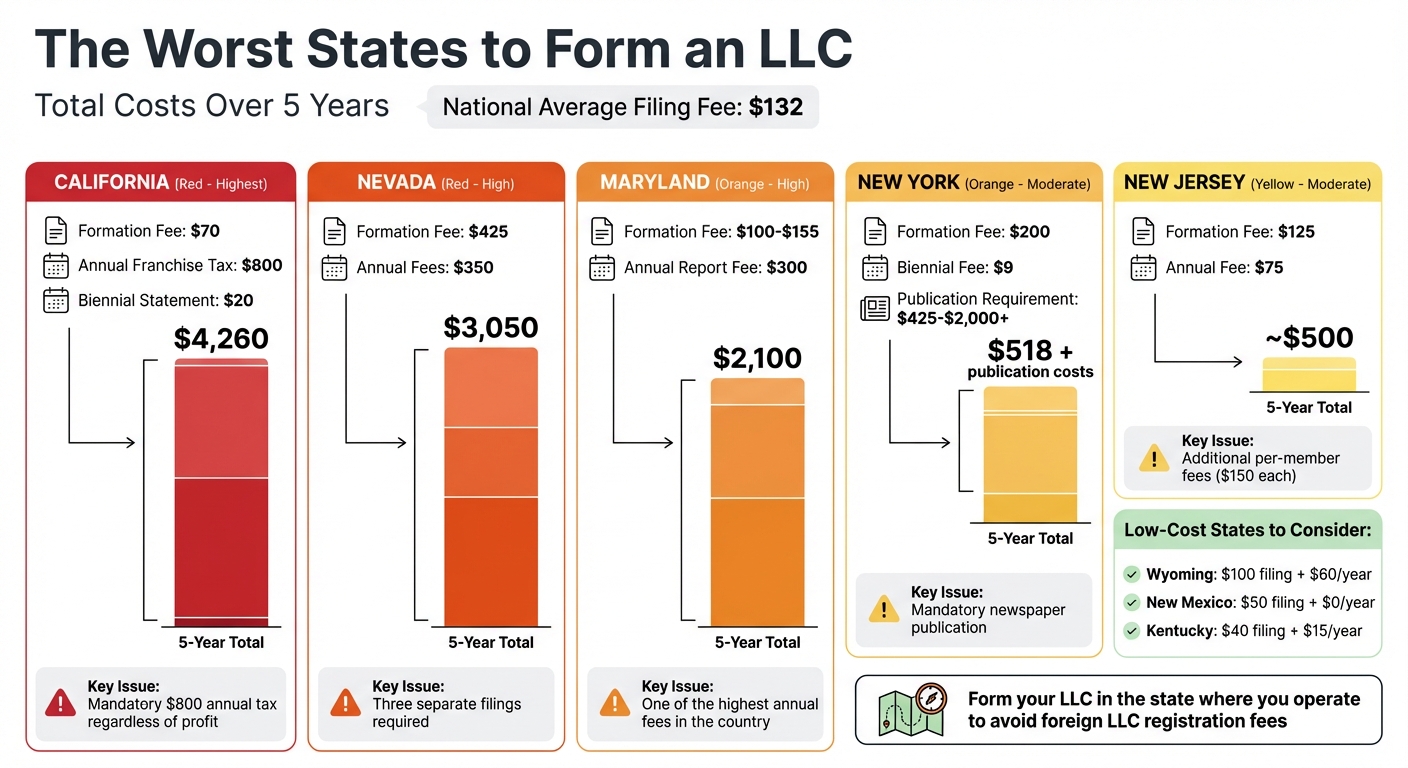
- California: Low $70 filing fee, but the $800 annual franchise tax makes it the most expensive over time ($4,260 in 5 years).
- New York: High publication costs ($425–$2,000+) and a $200 filing fee make it tough for small businesses.
- Nevada: A $425 setup fee and $350 annual costs lead to a significant long-term expense.
- New Jersey: Moderate $125 filing fee, but added taxes and member fees can add up.
- Maryland: $100–$155 to start, plus a $300 annual fee, one of the highest in the country.
Key takeaway: Form your LLC in the state where you operate to avoid extra fees for registering as a foreign LLC. States like Wyoming, New Mexico, and Kentucky offer lower costs and simpler rules. California, New York, Nevada, New Jersey, and Maryland are among the worst for LLC formation due to high fees and regulatory hurdles.
1. New York
New York is known for being one of the most expensive states to form an LLC, largely due to its mandatory publication requirement.
Formation Costs
To start a New York LLC, you’ll need to pay a $200 filing fee for the Articles of Organization – well above the national average of $132. But the real financial hurdle comes with the mandatory publication requirement. Only a handful of states, such as Arizona and Nebraska, have a similar rule, but New York’s costs are notably higher. Depending on the county, publication fees can range from $200–$300 in smaller areas to as much as $2,000 in New York City. Once the publication process is complete, you’ll also need to pay a $50 filing fee to submit the Certificate of Publication. If you fail to meet this requirement within 120 days, your LLC loses its authority to operate. Altogether, startup costs for a New York LLC can range from $450 to over $1,450, depending on where you’re publishing.
Annual Fees
After the initial setup, there are ongoing costs to keep your LLC active. Every two years, you’ll need to file a Biennial Statement for just $9. However, the state also requires an Annual Filing Fee (Form IT-204-LL), which is tied to your New York source gross income. For instance, LLCs making less than $100,000 pay $25, but those earning over $25 million could owe up to $4,500.
Regulatory Complexity
New York also has some unique regulatory requirements. For example, LLC members must create a written Operating Agreement within 90 days of filing. If you file the Articles of Organization online, approval is instantaneous, but mailing your application can take two to three weeks. These added steps and high costs make forming an LLC in New York particularly challenging.
sbb-itb-ba0a4be
2. California
California might seem appealing with its low upfront costs for forming an LLC, but the ongoing expenses quickly make it one of the priciest states to maintain a business. While the initial fees are relatively modest, the recurring obligations can add up fast.
Formation Costs
Starting an LLC in California begins with filing the Articles of Organization for just $70, which is significantly lower than the national average of $132. On top of that, you’ll need to submit a Statement of Information within 90 days of formation and then every two years after that, for a fee of $20. While these initial costs may sound manageable, missing the filing deadline results in a hefty $250 penalty.
Annual Fees
California imposes one of the steepest ongoing costs for LLCs in the country. Every LLC must pay an $800 Annual Franchise Tax, regardless of whether the business is active, profitable, or even generating revenue.
As Erik Pham, MSc Digital Leadership at BizReport, explains:
"Every LLC operating in California is required to pay the $800 Annual Franchise Tax to the California FTB. You’re required to pay this while your LLC exists, regardless of income or business activity".
If you form an LLC between October and December, you’ll be hit with two consecutive $800 payments, totaling $1,600 in a very short span. Beyond this fixed tax, additional fees are tied to your revenue, further increasing the financial burden.
Tax Burden
In addition to the $800 franchise tax, California levies an Estimated LLC Fee on businesses with gross receipts of $250,000 or more. This fee is income-based and starts at $900 for receipts between $250,000 and $499,999, climbing to $11,790 for businesses earning $5 million or more annually. Unlike most states, which tax only local revenue, California calculates this fee based on your global gross income. Failing to pay on time results in a 5% penalty and an additional monthly interest charge of 0.5%.
Regulatory Complexity
California also stands out for its strict regulatory requirements. Every LLC must have an operating agreement, a rule that many other states don’t enforce. Additionally, the Statement of Information must be filed within 90 days of forming the LLC, a deadline that often catches new business owners off guard, leading to immediate penalties.
If you want to operate under a name other than your LLC’s legal name, you’ll need to file a Fictitious Business Name (DBA) at the county level. This process includes publishing the name in a local newspaper for four consecutive weeks. These extra steps add to the administrative workload and potential costs for LLC owners in California.
3. Nevada
Nevada might seem like a business-friendly state, but its LLC requirements come with steep costs and extra steps that can catch new business owners off guard. Unlike most states that require just one filing to form an LLC, Nevada demands three separate filings, which significantly increases the complexity and upfront expenses [36,40]. This makes Nevada a prime example of how hidden fees can quickly add up.
Formation Costs
Setting up an LLC in Nevada comes with a hefty price tag of $425 in state fees – over three times the national average of $132 [36,18]. Here’s the breakdown:
- Articles of Organization: $75
- Initial List of Managers or Managing Members: $150
- State Business License: $200
As Matt Horwitz, Founder of LLC University, points out:
"In most states, you just have to file a single LLC formation document. However, in Nevada, you have to file an Articles of Organization as well as a State Business License and Initial List of Managers or Managing Members."
If you choose to file online, an extra 2.5% credit card processing fee bumps the total to about $436 [37,40]. And if you’re operating in cities like Las Vegas or Henderson, local business license fees can range from $25 to $700 annually [36,37]. These expenses make Nevada one of the costliest states for forming an LLC.
Annual Fees
The high costs don’t stop after formation. Every LLC in Nevada has to meet annual requirements and pay $350 to remain active:
- Annual List of Managers or Members: $150
- State Business License Renewal: $200
These fees are mandatory, whether your business is thriving or not. Missing the anniversary deadline for these filings results in a $100 late penalty, and prolonged delays can even lead to administrative dissolution [41,42].
Regulatory Complexity
Nevada’s multi-step filing process can be overwhelming for new business owners. The Initial List doubles as your first annual report and must be filed immediately after formation. Skipping any of the three required filings – Articles of Organization, State Business License, or Initial List – means your LLC won’t be officially formed [36,40].
Additionally, Nevada requires every LLC to have a Registered Agent with a physical address in the state. If you opt for a professional service, this adds another $100 to $300 per year to your costs [36,5].
4. New Jersey
New Jersey presents a range of challenges for LLC owners, particularly when it comes to costs and regulatory requirements. While the $125 formation fee is slightly below the national average of $132, the state’s additional fees, tax obligations, and strict regulations can quickly become overwhelming. Here’s a closer look at what makes forming and maintaining an LLC in New Jersey more demanding than in other states.
Formation Costs
Starting an LLC in New Jersey requires a $125 filing fee, obtaining an EIN from the IRS, and completing Form NJ-REG for state tax registration – even if you’re not hiring employees or collecting sales tax right away.
Standard processing takes 2–3 weeks, but if you’re in a hurry, expedited services are available for fees ranging from $25 to $1,000. Additionally, if you plan to operate under an alternate business name (DBA), you’ll need to add a DBA to your LLC for $50. If you skip this step and use the name anyway, you’ll face a $50 penalty for every year the name remains unregistered.
Annual Fees
New Jersey requires LLCs to pay a $75 annual report fee, which is due during the anniversary month of your LLC’s formation. Missing this deadline can lead to administrative dissolution, which removes your limited liability protection. As Matt Horwitz, Founder of LLC University, explains:
"The LLC annual fee is an ongoing fee paid to the state to keep your LLC in compliance and in good standing."
If your LLC has two or more members, you’ll also need to pay an additional $150 per member each year when filing the partnership tax return (Form NJ-1065). For instance, a three-member LLC would owe $450 in member fees on top of the $75 annual report fee, bringing the total yearly cost to $525 just to stay compliant.
Tax Burden
New Jersey enforces a minimum Corporation Business Tax, starting at $500 for businesses with gross receipts under $100,000. If your business earns $1,000,000 or more in gross receipts, the minimum tax jumps to $2,000 annually. These minimum taxes are considerably higher than in states that don’t impose such requirements, adding a significant financial burden.
Regulatory Complexity
New Jersey’s regulatory landscape adds another layer of difficulty for LLC owners. Unlike many states where tax registration and formation are separate processes, New Jersey mandates filing Form NJ-REG for state tax registration at the time of formation. Local licensing rules vary by municipality, further complicating compliance. Additionally, any amendments to your Certificate of Formation cost $100 – nearly as much as the original filing fee. These strict rules and ongoing administrative requirements make managing an LLC in New Jersey particularly challenging.
5. Maryland
Maryland presents some hurdles for LLC owners, thanks to its high annual fees and strict filing rules. While the initial setup cost is relatively low, the ongoing expenses and complex requirements can make operating in the state a pricey endeavor.
Formation Costs
Filing the Articles of Organization in Maryland starts at $100. However, if you file online, you’ll face an additional $50 expedited fee, bringing the total to $150. On top of that, Maryland tacks on a 3% technology fee for credit card and PayPal payments or a flat $3 fee for eCheck payments. Need same-day processing? That’ll cost you $325 for the "Rush" service. If you prefer to avoid extra fees, you can file by mail, but be prepared to wait 4–8 weeks for processing.
Annual Fees
Maryland’s ongoing costs are steep. The state charges a $300 annual report fee, one of the highest in the country. To put that in perspective, it’s six times higher than Virginia’s $50 fee and significantly more than Pennsylvania’s $7 fee. Over five years, LLC owners in Maryland could shell out around $1,500 just in annual fees.
Regulatory Complexity
Maryland’s regulations add another layer of difficulty for LLC owners. The state requires a combined filing for the Annual Report and Personal Property Tax Return, both due by April 15. Even if your LLC has no taxable property, you’re still on the hook for the full $300 fee.
Additionally, Maryland doesn’t allow for Professional Limited Liability Companies (PLLCs). This means professionals like doctors and lawyers must form either a standard LLC or a professional corporation. Retail businesses face another hurdle: securing a Trader’s License. Fees for this license range from $15 to $800, depending on the wholesale value of inventory – or up to $2,125 if you’re in Baltimore City.
Comparison: Costs and Requirements by State
When deciding where to form your LLC, it’s crucial to weigh both upfront costs and long-term expenses. Here’s a breakdown of formation fees, ongoing costs, and tax and annual report requirements across five states. The differences are eye-opening, especially when you consider the total costs over five years.
| State | Formation Fee | Annual/Biennial Fee | Major Tax/Fee Requirement | 5-Year Total Cost |
|---|---|---|---|---|
| California | $70 | $800 (Annual) + $20 (Biennial) | $800 minimum franchise tax; additional fees if revenue >$250K | $4,260 |
| Nevada | $425 | $350 (Annual) | No state income tax; high business license and annual list fees | $3,050 |
| New York | $200 | $9 (Biennial) + $50 publication fee | Newspaper publication requirement ($425–$2,000+) | $518 + publication costs |
| Maryland | $100–$155 | $300 (Annual) | $300 minimum Personal Property Return fee | $2,100 |
| New Jersey | $125 | $75 (Annual) | Pass-through taxation; standard annual reporting | ~$500 |
This table highlights how upfront savings in some states can be offset by long-term fees and taxes.
California leads in long-term expenses. While the formation fee is just $70, the $800 annual franchise tax quickly adds up, resulting in a five-year total of about $4,260. For LLCs earning over $250,000 annually, additional fees ranging from $900 to $11,790 apply, making California a costly choice.
Nevada comes in second-highest. The $425 formation fee and $350 annual renewals bring the five-year total to $3,050. Although there’s no state income tax, hefty administrative fees can offset any perceived tax advantages.
New York has a low $9 biennial fee, but its mandatory newspaper publication requirement can cost between $425 and $2,000, significantly increasing startup expenses.
Maryland and New Jersey fall into the mid-range. Maryland’s $300 annual fee results in a five-year total of around $2,100. New Jersey stands out as the most budget-friendly option here. With a $125 formation fee and $75 annual fee, the five-year cost is approximately $500 – lower than most other states.
For entrepreneurs, understanding these cumulative costs is vital. While some states may seem affordable initially, ongoing fees and regulatory requirements can quickly outweigh the savings.
Conclusion
Setting up an LLC in states like New York, California, Nevada, and Maryland can be expensive and complicated. For instance, California requires an $800 annual franchise tax, even if your business isn’t making a profit. New York adds the burden of pricey publication notices, Nevada has several hidden fees, and Maryland enforces a $300 minimum annual fee.
It’s usually best to form your LLC in the state where you operate. Doing so avoids the extra costs of registering as a foreign LLC in another state. If you’re looking to save money, consider states with lower fees and simpler rules. For example:
- Wyoming: $100 filing fee, $60 annual fee
- New Mexico: $50 filing fee, no annual fee
- Kentucky: $40 filing fee, $15 annual fee
As the cost comparison table highlights, even small differences in fees can add up over time. Take a five-year perspective, factoring in all annual reports, franchise taxes, and additional fees. For example, California’s total over five years could reach $4,260, while Missouri’s is only $175. Making an informed choice can help you save thousands and steer clear of unnecessary hurdles.
FAQs
Why is maintaining an LLC in California so expensive?
Maintaining an LLC in California comes with a hefty price tag, primarily due to the $800 annual franchise tax. This fee is mandatory, no matter how much income the business generates – or even if it doesn’t operate at all. Paid to the Franchise Tax Board, it stands out as one of the highest recurring costs for LLCs in the United States.
Beyond the franchise tax, there are additional costs to consider, like filing fees for necessary forms and expenses tied to staying compliant with state regulations. These financial demands make California a tough choice for entrepreneurs aiming to keep their operational costs low.
What challenges should I be aware of when forming an LLC in New York?
Starting an LLC in New York can be a bit more complicated than in many other states, mainly due to higher costs and strict regulations. While the initial filing fee for the Articles of Organization is $205, there’s an added burden: New York’s publication requirement. This rule mandates that you publish notices about your LLC formation in two newspapers and file a Certificate of Publication. The cost for this step can vary a lot depending on the county, with some areas being much pricier than others.
On top of that, LLCs in New York must appoint a registered agent and stay on top of ongoing compliance tasks, like annual filings. These extra steps can make the process both more expensive and more time-consuming compared to other states. If you’re planning to form an LLC in New York, it’s important to budget for these additional expenses and make sure all legal requirements are handled properly to avoid any penalties or delays.
How do Nevada’s LLC fees stack up against other states?
Nevada’s LLC fees are relatively moderate when stacked up against many other states. To get started, you’ll need to pay an initial filing fee for the Articles of Organization, along with mandatory fees for a business license and an initial list. Each year, you’ll also need to budget for renewing your business license and submitting an annual list.
By comparison, states like Massachusetts and Illinois often charge significantly higher initial fees – sometimes exceeding $200 – and may tack on extra expenses like franchise taxes or publication requirements. Nevada, with its lower ongoing costs, offers a more budget-friendly option for entrepreneurs seeking to establish an LLC.