


AI is transforming small businesses in 2026. From automating repetitive tasks to improving financial management and customer relationships, AI tools are saving time, cutting costs, and boosting efficiency. Here’s what you need to know:
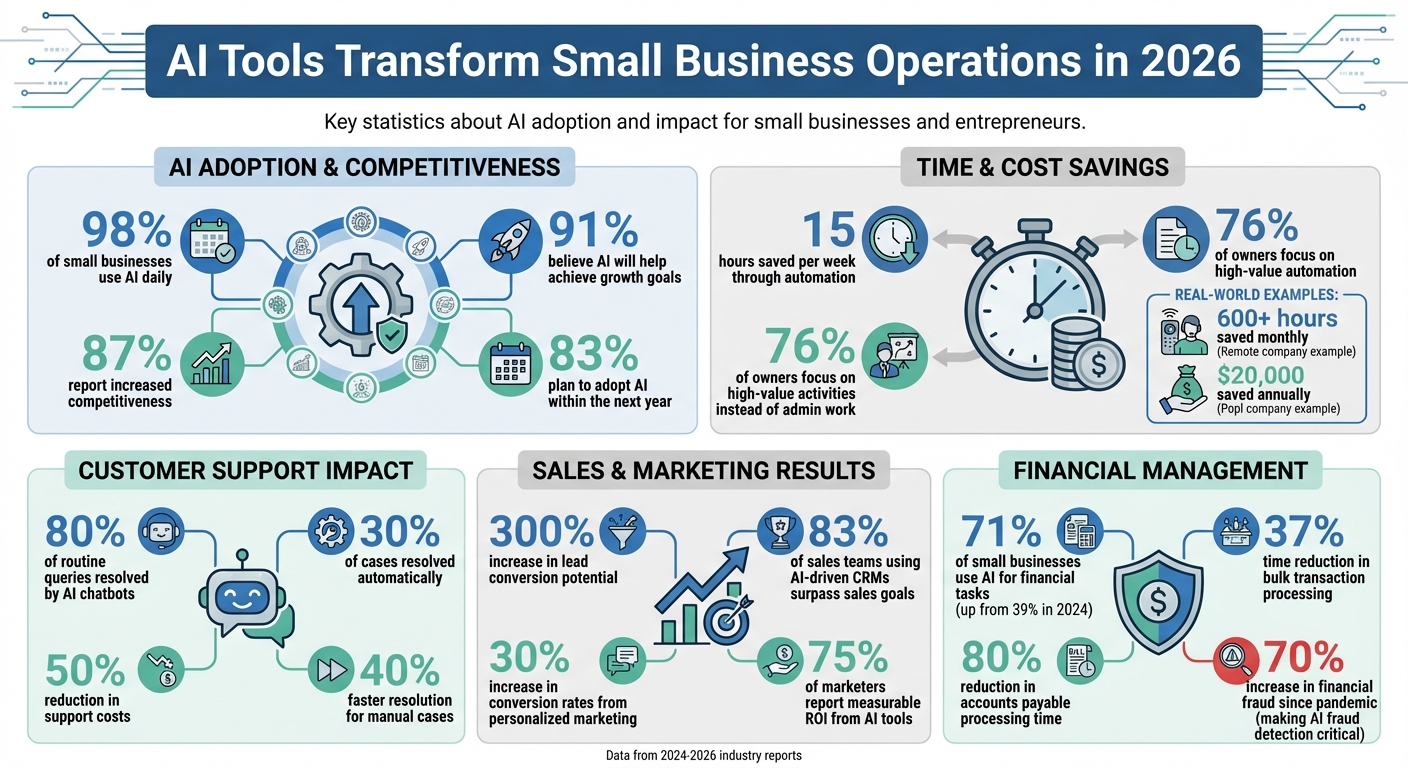
- 98% of small businesses use AI daily, and 87% report increased competitiveness.
- AI automation can save 15 hours per week on tasks like data entry, email management, and report generation.
- Tools like QuickBooks, Salesforce, and ChatGPT handle expense tracking, customer support, and content creation with ease.
- Predictive analytics helps forecast trends, manage inventory, and improve decision-making.
- AI-powered CRMs and chatbots enhance customer engagement, increasing lead conversions by 300% and cutting support costs by 50%.
To start, focus on automating one high-impact task – like invoicing or lead scoring – and track your results over 30 days. Pair AI tools with services like BusinessAnywhere for seamless business operations, especially for remote teams. AI isn’t replacing you – it’s helping you focus on growth.
AI Tools Impact on Small Business: Key Statistics and Time Savings
How AI Improves Workflow Automation and Productivity
For entrepreneurs, one of the standout benefits of AI is its ability to cut down the hours spent on repetitive tasks. Unlike traditional automation that relies on rigid "if this, then that" rules, AI workflows can interpret context and make decisions. For example, AI can analyze the sentiment of an email to determine whether it’s a potential sales lead or a customer support issue. This means AI doesn’t just automate tasks – it also streamlines decision-making.
On average, AI can save business owners up to 15 hours per week by taking over routine tasks like data entry, email responses, and report generation. In fact, 76% of small business owners report that AI allows them to focus on high-value activities like product development and strategic planning, instead of getting bogged down by administrative work. Let’s explore some key examples of how AI transforms repetitive tasks.
Automating Repetitive Tasks with AI
AI tools are particularly effective at handling the monotonous tasks that often eat up valuable time. For instance, ChatGPT (starting at $20/month) can create first drafts of content in minutes, significantly reducing the time spent on content creation. Cassie Clark, CMO of ThoughtTree, highlights this shift:
"Instead of spending several hours a week writing content briefs, I can quickly edit AI-generated content and move on to the next task."
Customer support is another area where AI delivers tangible results. In 2025, Norwegian telecom company VEV implemented Salesforce’s Agentforce 360 to automate support tickets. The system resolved 30% of cases automatically, while smarter routing sped up the resolution of manual cases by 40%. This allowed VEV to scale its customer service without adding extra staff.
The benefits don’t stop there. At Remote, a company with over 1,800 employees, the IT team used tools like Zapier and ChatGPT to handle 1,100 monthly support tickets. By automating 28% of the workload, they saved over 600 hours every month.
AI is also revolutionizing sales processes. For instance, Popl, a digital business card company, integrated OpenAI with Zapier to manage hundreds of daily lead submissions. The AI filtered spam, enriched leads with company data, and triaged inbound emails, ultimately saving the company $20,000 annually in manual labor costs.
Enhanced Time Management with AI
AI doesn’t just automate tasks – it helps you manage your time more effectively. Meeting assistants like Notta and Sembly AI (starting at $14–15/month) can record, transcribe, and summarize conversations, highlighting key action items and decisions. This eliminates the need to manually sift through meeting notes.
Project management platforms like ClickUp and Asana now incorporate AI to streamline workflows. ClickUp’s AI agents, for example, can automate task assignments and status updates. When a new client signs up, the system can automatically trigger onboarding tasks, ensuring projects stay on track even when you’re focused elsewhere.
Email management tools such as Google Gemini and Microsoft Copilot also simplify inbox management. These tools can summarize lengthy email threads, draft replies, and suggest the best times to send messages. For entrepreneurs juggling a flood of daily emails, this means less time spent in their inbox and more time dedicated to growing their business.
To get started, identify one or two high-impact tasks and test an AI tool for 30 days. Track the time saved and refine your approach before rolling it out to other areas of your business.
AI Tools for Financial Management
Handling finances can be a time-consuming task, but AI is changing the game. In fact, 71% of small businesses now rely on AI to automate financial tasks – up from 39% in 2024. This shift not only saves time but also improves accuracy and helps business owners make better decisions. While AI has already transformed areas like workflow and CRM, it’s also making waves in financial management by reducing administrative burdens and driving growth.
Today’s AI platforms can automatically categorize expenses, predict cash flow, and even detect fraud by analyzing historical data. With financial fraud against small businesses rising by 70% since the pandemic began, having AI monitor transactions in real time has become a crucial safeguard for protecting your bottom line.
AI-powered bookkeeping also speeds up month-end processes and minimizes errors. Let’s dive into two key areas where AI simplifies financial management: expense tracking and invoicing.
Expense Tracking and Budgeting
Gone are the days of manually sorting through piles of receipts. Tools like QuickBooks and Xero use AI to scan and categorize expenses automatically. These platforms leverage historical data to streamline receipt management, with plans starting at $20/month and often including introductory discounts.
- QuickBooks uses optical character recognition (OCR) to scan receipts, extract important details, and integrate them into your accounting system. You can simply snap a photo of a receipt, and the AI will log, categorize, and match it to your bank statement effortlessly.
- Xero takes it a step further with its conversational AI assistant, "Just Ask Xero" (JAX), which allows users to inquire about their finances in plain English.
AI doesn’t just track expenses – it also excels at predictive budgeting. By analyzing past revenue and spending trends, these tools can forecast cash flow and flag potential shortfalls before they become critical. This gives you the chance to adjust spending or secure additional funding proactively.
For example, in 2024, Repurpose, a company focused on plant-based materials, adopted BILL’s AI-powered accounts payable platform. According to Senior Controller Sarah Sanders, the AI’s ability to pre-fill invoice details significantly reduced manual data entry for their accounts payable manager. Automating accounts payable processes like this can cut processing time by up to 80%.
AI also keeps an eye on transaction patterns to detect anomalies, such as unusually large payments or duplicate invoices, helping to identify potential fraud early.
But AI’s capabilities don’t stop at expense tracking – it also simplifies invoicing and payment management.
Automated Invoicing and Payment Management
AI-powered invoicing tools in platforms like QuickBooks and Xero can generate invoices directly from emails, notes, or even photos, ensuring a steady cash flow without the need for manual input. This feature alone can save business owners hours each week.
Advanced AI features in QuickBooks allow for bulk transaction processing, cutting time spent on these tasks by 37%. The platform also automates recurring billing, ensuring that regular invoices go out on schedule without requiring manual oversight.
Payment reminders are another area where AI shines. Instead of manually chasing overdue payments, AI tools send personalized reminders at the perfect time based on customer behavior. Some platforms even analyze payment trends to recommend the most effective options for faster settlements.
Additional tools like Ramp (offering a free basic plan or $15/month per user for the Plus plan) and Docyt (starting at $299/month) enhance financial management further. Ramp’s AI, for instance, automatically matches transactions with bank statements, keeping your books updated without the need for manual reconciliation.
For business owners managing multiple clients and projects, these AI-driven features minimize payment delays and errors, ensuring more consistent cash flow. Plus, they free up time to focus on growing your business instead of getting bogged down in administrative tasks.
"AI is no longer a hypothetical – it’s an everyday tool that can help business owners save time and make smarter financial decisions." – CNBC Select
To get started, review your current financial processes and pinpoint time-consuming tasks like receipt sorting or manual data entry. Start small – automate one area, such as payment reminders or invoice matching, and test an AI tool for 30 days. Measure the time saved and improvements in accuracy before deciding to expand automation to other parts of your financial workflow.
Using AI to Improve Customer Relationship Management (CRM)
Managing customer relationships manually becomes overwhelming as businesses grow. Just like AI has transformed workflows and financial processes, it’s now reshaping CRM by leveraging real-time data and automation to fuel growth. AI-powered CRM systems analyze customer behavior, automate outreach to ensure no lead is missed, and transform your CRM into a predictive tool that forecasts buying patterns. In fact, 89% of business leaders now see AI strategies as a key factor when selecting a CRM, and 83% of sales teams using AI-driven CRMs report surpassing their sales goals.
AI tools can pinpoint which customers are most likely to make a purchase, identify unhappy clients before they churn, and automate personalized communication at scale. These platforms also enhance customer profiles in real time, allowing teams to focus on high-value leads instead of wasting time on manual data entry.
The numbers speak for themselves: AI-powered lead scoring and qualification can boost lead conversion potential by 300%, while AI-driven targeted advertising and personalized marketing can increase conversion rates by 30%. For entrepreneurs juggling multiple tasks, these tools act as a virtual sales coach, offering actionable suggestions – like sending a follow-up email or scheduling a call – to keep deals moving forward.
AI-Driven Lead Scoring and Analytics
AI takes the guesswork out of prioritizing leads by analyzing historical customer behavior. AI-driven lead scoring evaluates data such as email engagement, website activity, and purchase history to assign a score that reflects a prospect’s likelihood to convert. Platforms like HubSpot‘s Breeze and Salesforce’s Einstein AI use these scores to flag high-potential leads for immediate follow-up. For instance, if a prospect downloads multiple whitepapers and visits your pricing page twice in one week, the AI identifies them as a hot lead and prompts immediate action.
These platforms also incorporate sentiment analysis to monitor customer feedback in real time. This helps businesses spot dissatisfied clients early, giving teams a chance to address issues before customers decide to leave.
In 2025, ActiveCampaign tackled a 25% churn rate among users who lacked personalized onboarding. By implementing an AI-supported workflow, they automatically tagged new signups by language and enrolled them in relevant webinars. This resulted in a 440% increase in webinar attendance and a 15% drop in early churn.
Pricing for AI-driven CRM tools varies. HubSpot Smart CRM offers a free tier with basic features, while paid plans range from $15–$20/month per seat for Starter, $50/month for Professional, and $75/month for Enterprise. Salesforce starts at around $25 per user/month, and ActiveCampaign begins at $15/month for up to 1,000 contacts.
Building on these capabilities, AI-powered chatbots take customer engagement to the next level by delivering instant, tailored support.
AI Chatbots for Customer Support
While lead scoring helps refine customer targeting, AI chatbots enhance the CRM ecosystem by managing real-time customer queries. With customers expecting instant responses, small teams often struggle to provide 24/7 support. AI chatbots solve this problem by handling routine inquiries around the clock, freeing up human agents to focus on more complex issues. AI chatbots can resolve up to 80% of routine customer questions, potentially cutting support costs by 50%.
These chatbots do more than just answer FAQs – they integrate with your CRM to access purchase history, past interactions, and customer preferences, ensuring personalized support at any time. For example, if a customer asks about their order status, the chatbot can instantly retrieve tracking information from the CRM without requiring any manual input.
VEV, a small Norwegian telecommunications company, adopted Salesforce’s Agentforce 360 in 2025 to automate customer support processes. The result? 30% of support cases are now resolved automatically, while the remaining cases are handled 40% faster thanks to smarter routing that directs complex issues to the appropriate human agents.
The secret to effective support lies in starting with a "triage" approach. Use an AI agent to classify customer intent – deciding whether a query can be resolved with self-service or requires human assistance. 84% of service representatives say AI improves their ability to respond to tickets through automatic routing and prioritization, leading to quicker resolutions and happier customers.
"Human agents and AI will complement each other in a way that AI will cover some repetitive tasks and boost efficiency. It will support human agents with additional data, which will help them to focus on more complex issues." – Agata Rogińska, Support Team Leader, Text
To get started, identify your top 10 most common customer questions and automate responses for those first. Platforms like HubSpot and Salesforce offer chatbot builders that connect directly to your CRM, ensuring accurate and consistent replies. As chatbots handle routine inquiries, your team can focus on the high-value, relationship-building work that fosters long-term growth.
sbb-itb-ba0a4be
AI for Data Analytics and Decision-Making
AI is changing the game in data analytics, turning raw data into insights that drive smarter decisions. Instead of spending hours sifting through spreadsheets, businesses can now rely on machine learning to uncover patterns, correlations, and anomalies that traditional methods often miss. The results speak for themselves: 91% of small businesses believe AI tools will help them achieve their growth goals, and 75% of marketers report measurable ROI from using AI tools.
These tools analyze both structured and unstructured data – think customer purchase histories or social media activity, which make up 80–90% of enterprise data – and deliver real-time insights tailored to current market conditions.
AI-powered predictive analytics uses historical data to anticipate future outcomes, such as identifying which customers are likely to make a purchase or which products will see a spike in demand. Meanwhile, prescriptive analytics goes a step further, diagnosing root causes and suggesting actionable solutions. For instance, if sales in a particular region drop, the AI can pinpoint whether pricing, competition, or seasonal trends are at fault.
"AI business analytics can expose hidden patterns and correlations that traditional methods often overlook." – Domo
Self-service analytics makes these insights accessible to everyone, even those without a technical background, by enabling natural language queries. This reduces dependence on specialized data experts.
Real-Time Data Tracking and Visualization
Gone are the days of static monthly reports. With real-time dashboards, businesses can access live data streams that update continuously. Tools like Domo, Tableau, and Microsoft Power BI transform this data into interactive visualizations, helping entrepreneurs spot trends and anomalies as they happen. Instead of waiting until the end of the quarter to identify a problem, these dashboards allow you to monitor shifts in customer behavior, sales velocity, or website traffic in real time.
Key performance indicators (KPIs) such as conversion rates, average order value, and customer acquisition costs are tracked and highlighted. For example, if website traffic suddenly spikes but conversions drop, the dashboard will flag this inconsistency, prompting a closer look at potential issues like checkout errors or pricing changes.
Embedded analytics takes this a step further by integrating these visualizations directly into everyday tools like CRMs, project management platforms, or financial software. This seamless integration means you can access critical insights without toggling between multiple applications.
To make dashboards effective, visual hierarchy is key. Placing the most important KPIs at the top ensures they’re seen first, while detailed breakdowns follow below. Using neutral colors for background data and a single bright accent color for key metrics helps users focus on the most critical insights quickly.
With these tools, businesses can respond faster and plan smarter, thanks to AI-driven predictive analytics.
Predictive Analytics for Planning
Predictive analytics shifts planning from reactive to proactive. By analyzing historical and live data, AI tools forecast customer behavior, demand trends, and market shifts, allowing businesses to plan ahead. Companies like Blue Yonder specialize in demand forecasting, helping businesses optimize inventory and avoid costly stockouts or overstock situations.
Salesforce Einstein is another standout example, using predictive analytics to personalize customer interactions. For instance, if a customer typically reorders every 60 days, the system can flag this pattern and prompt your team to send a timely reminder or special offer, boosting customer loyalty.
Financial forecasting also benefits from AI. Tools like FP&A Genius analyze cash flow, expenditures, and budgets to generate detailed projections. Instead of building models manually, businesses can input current data and receive forecasts that account for seasonal trends and market conditions, leading to more precise budgeting and strategic decision-making.
Anomaly detection adds an extra layer of security. By monitoring data in real time, AI can flag irregularities that might indicate operational issues or emerging market trends. For example, Anadot specializes in identifying anomalies and alerting teams immediately when performance metrics deviate from expectations.
Looking ahead, 83% of small business owners plan to adopt AI within the next year, recognizing its ability to provide a competitive edge. Starting with specific use cases – like inventory management or customer churn prediction – and ensuring clean, well-structured data are critical for accurate, reliable insights.
Combining AI Tools with BusinessAnywhere for Remote Operations
Running a remote business often means juggling administrative tasks across different time zones. This is where BusinessAnywhere steps in, providing essential services like a registered agent, virtual mailbox, and compliance alerts. Meanwhile, AI tools take care of digital processing and automation, ensuring that everything operates smoothly. Together, they bridge the gap between the physical and digital aspects of running a business, especially when it comes to U.S. business formation and compliance, where accuracy in legal and financial processes is essential.
For instance, when legal documents or invoices are delivered to your BusinessAnywhere virtual mailbox, AI tools can immediately extract important details from scanned images. Tools like Google Gemini can pull key information from receipts and organize it into spreadsheets automatically. Similarly, AI workflow platforms such as Zapier can connect compliance alerts with project management tools, creating tasks with deadlines and assigning them to the right team members.
The impact of this integration is clear. In December 2025, Popl, a digital business card company, implemented over 100 AI workflows using Zapier and OpenAI. When leads submitted forms via HubSpot, the system automatically verified information in Google Sheets, sent Slack notifications, and routed leads to sales representatives based on their region. Combined with AI-powered email triaging, this setup saved the company $20,000 annually while efficiently processing hundreds of daily submissions.
AI Tools in U.S. Business Formation and Compliance
Setting up and maintaining a U.S. business involves a steady stream of paperwork, from formation documents to tax filings and legal notices. BusinessAnywhere handles the physical requirements, such as providing a professional U.S. address and registered agent services, while AI tools take over the tedious tasks of document processing and tracking deadlines.
For example, when you receive a legal notice through your registered agent service, AI-powered sentiment and intent analysis can prioritize urgent filings and summarize complex legal language. Instead of sifting through dense documents, AI tools highlight the key actions required, deadlines, and responsible parties. Software like QuickBooks Online (starting at $30/month) and Gusto (starting at $40/month plus $6 per user) can then automate tax calculations, bookkeeping, and payroll compliance, turning compliance alerts into completed tasks. For signing documents, platforms like DocuSign (starting at $10 per user/month) integrate seamlessly with your business formation paperwork to enable secure, remote e-signatures.
AI assistants can also help draft initial versions of business plans, operating agreements, or job postings, saving hours of work. ActiveCampaign demonstrated this in October 2025 when addressing a 25% churn rate among users lacking personalized onboarding. They implemented an AI-driven system that tagged users by language and automatically enrolled them in relevant webinars via Demio. This effort led to a 440% increase in webinar attendance and a 15% drop in early churn.
"AI workflow automation is basically automation with a brain." – Nicole Replogle, Staff Writer, Zapier
AI-powered receptionists, like the RingCentral AI Assistant (winner of Overall Best of Enterprise Connect 2024), add another layer of efficiency. These tools manage 24/7 inbound call routing and appointment scheduling, ensuring a professional front for your business without needing physical staff. This feature keeps U.S.-based businesses responsive across time zones – even when you’re offline. On average, RingCentral AI Assistant saves employees 9 hours per month by automating communication tasks.
Manual vs. AI-Enhanced Processes
The advantages of AI-enhanced processes become evident when comparing them to manual workflows. Here’s a quick look:
| Aspect | Manual Process | AI-Enhanced Process |
|---|---|---|
| Mail Management | Physically checking mail or reading scans manually | AI summarizes scans and extracts key dates and amounts |
| Compliance Tracking | Tracking deadlines manually via spreadsheets | AI automates filings and tax workflows triggered by alerts |
| Data Entry | Time-consuming and error-prone manual entry | AI extracts data from mailbox scans instantly |
| Document Drafting | Writing from scratch | AI generates drafts based on prompts and templates |
| Communication | Limited to human receptionists or rigid phone trees | 24/7 AI receptionists with conversational capabilities |
| Decision Making | Relies on manual data analysis | Real-time analytics and trend spotting with AI |
| Scalability | Requires hiring more staff to manage growth | AI workflows scale instantly without additional staff |
Start small by linking your virtual mailbox to financial software like QuickBooks for automatic expense tracking. Over time, expand your AI setup to cover more areas. It’s a good idea to review your AI tools every three months to spot overlapping features or tools with low returns. Keep in mind that while AI can handle repetitive tasks, human oversight remains crucial, especially for sensitive legal or financial matters. The goal isn’t to replace humans but to free them from routine work, allowing them to focus on growing the business.
Conclusion
AI tools have become a game-changer for entrepreneurs looking to stay ahead in competitive markets. Consider this: 98% of small businesses now rely on AI daily, 91% believe it will help them achieve growth goals, and automation alone can save up to 15 hours per week. On top of that, AI chatbots are managing 80% of routine customer queries while slashing support costs by half. With predictive analytics offering data-driven insights, the case for adopting AI is hard to ignore.
The best way to start? Focus on solving a single pain point – whether it’s automating invoicing, improving lead scoring, or enhancing customer support. As Andrew Ng, a renowned computer scientist, explains:
"AI systems are good at spotting patterns when given access to the right data".
By building on the productivity and efficiency gains that AI delivers, you can take things a step further by combining it with services designed to streamline your operations. Pairing AI tools with BusinessAnywhere’s offerings – like registered agent support, virtual mailboxes, and compliance tracking – creates a seamless system for managing both your digital and administrative needs. This integration helps centralize business formation, compliance, and everyday operations, making it easier to focus on scaling your business.
Take a closer look at your current software stack and find areas where AI can make a difference. Start small, and as you see results, expand your automation efforts. It’s worth noting that 76% of small business owners say AI enables them to focus on strategic, high-value tasks instead of routine busywork. AI isn’t about replacing human decision-making – it’s about freeing up your time to focus on what matters most.
FAQs
How can AI tools help entrepreneurs save time on repetitive tasks?
AI tools are a game-changer for entrepreneurs, streamlining time-consuming tasks like data entry, scheduling, and customer support. Imagine having software that organizes emails, updates records, or sets up appointments automatically – this means business owners can dedicate more energy to big-picture strategies instead of getting bogged down by routine work.
On top of that, AI-powered tools like chatbots offer 24/7 customer support, handling common inquiries without needing a person on the other end. By cutting down on manual work and reducing errors, these tools not only boost efficiency but also create more room for innovation, business growth, and building meaningful connections with customers.
How can AI improve financial management for small businesses?
AI has the potential to transform financial management for small businesses by taking over tedious tasks like bookkeeping, invoicing, and expense tracking. This automation not only frees up valuable time but also minimizes mistakes, giving business owners the chance to concentrate on growing their business and planning strategically.
On top of that, AI-powered tools can quickly process vast amounts of financial data, delivering real-time insights into cash flow, revenue, and expenses. These insights empower entrepreneurs to make quicker, well-informed decisions that strengthen their financial position. By reducing human errors and boosting precision, AI also ensures accurate financial reporting and compliance, providing a strong base for sustained success and stability.
How can AI-powered CRM systems improve customer engagement and boost lead conversion?
AI-powered CRM systems transform how businesses interact with customers by combining automation and detailed data analysis to create more personalized experiences and efficient workflows. These tools dig into customer behaviors and preferences, enabling businesses to deliver tailored communication and targeted marketing efforts that build stronger relationships and trust.
By analyzing engagement patterns, AI can identify high-potential leads, helping teams focus their follow-up efforts where it matters most, ultimately boosting conversion rates. Routine tasks like scheduling, data entry, and sending reminders are automated, freeing up sales and marketing teams to concentrate on bigger-picture strategies. Plus, with real-time insights and predictive analytics, businesses can anticipate customer needs, address potential concerns before they arise, and improve overall satisfaction. This blend of efficiency and personalization makes AI-powered CRMs a game-changer for entrepreneurs aiming to scale their businesses effectively.