


Incorporating in the U.S. offers foreign entrepreneurs access to a massive economy, trusted legal systems, and unmatched business infrastructure. Here’s a quick look at the top advantages:
- Access to the U.S. Market: Tap into a $26.7 trillion economy and over 330 million consumers.
- Investor and Client Trust: U.S. entities, especially Delaware C-Corps, are highly regarded by investors and clients worldwide.
- Legal Protections: Safeguard personal assets through limited liability while benefiting from clear corporate laws.
- Tax Opportunities: Optimize taxes with deductions, exemptions, and treaties, depending on your business structure.
- Banking and Payments: Seamlessly integrate with U.S. banking systems for faster transactions, funding access, and credibility.
Whether you’re looking to scale globally or attract investors, incorporating in the U.S. can position your business for success. The process of starting a U.S. business is straightforward, and the benefits are substantial.
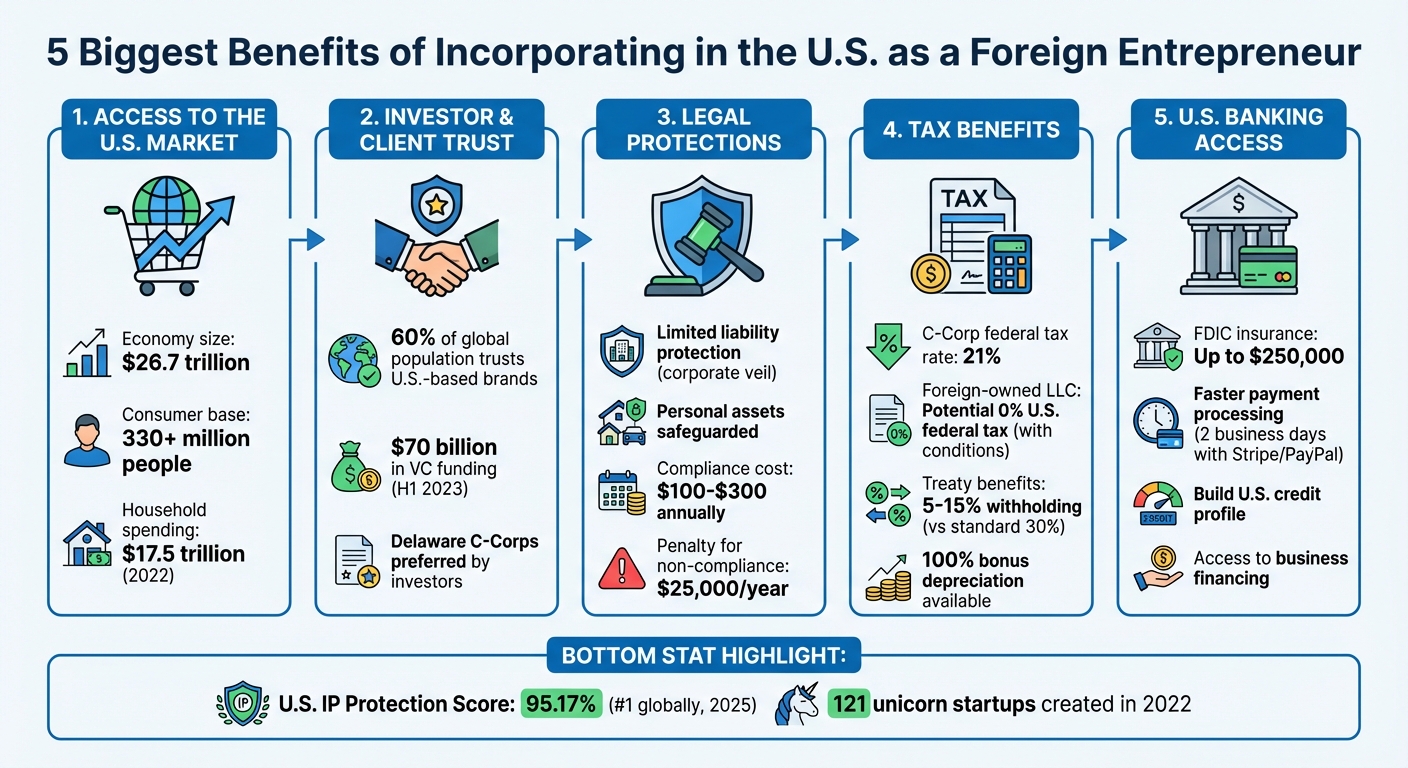
5 Key Benefits of U.S. Incorporation for Foreign Entrepreneurs
1. Access to the U.S. Market
Setting up a business in the U.S. opens the door to one of the largest and most dynamic markets in the world. With over 330 million consumers and household spending reaching approximately $17.5 trillion in 2022, the opportunities are immense. By starting a U.S. LLC to establish a local presence, foreign entrepreneurs shift from being external players to becoming an integral part of this thriving economy.
Trust plays a huge role in consumer behavior. U.S.-based companies enjoy greater credibility among American buyers, who value the legitimacy and legal safeguards that come with domestic businesses. This trust extends to business partnerships, as many major corporations and government agencies prefer working with domestic entities. Without incorporating in the U.S. as a non-citizen, many of these lucrative opportunities remain out of reach.
What makes the U.S. market even more appealing is its regional diversity. Each region has its own economic strengths – think of the West Coast’s dominance in tech and entertainment, the Northeast’s leadership in finance, and the South’s focus on manufacturing and energy. Entrepreneurs can test their products or services in specific regions before scaling nationwide, minimizing risk while gathering valuable insights.
Incorporating in the U.S. also provides access to advanced financial tools. Platforms like Stripe and PayPal offer quick payouts – sometimes within just two business days. These services often include additional benefits like working capital options through programs such as Stripe Capital, which are typically unavailable to foreign businesses.
Finally, a U.S. entity can act as a launchpad for global growth. For example, invoicing European clients from a U.S.-registered business is often met with less scrutiny compared to invoices from other jurisdictions. This credibility makes it easier to build trust with international partners and explore new markets more efficiently.
sbb-itb-ba0a4be
2. Increased Credibility with Investors and Clients
Incorporating in the U.S. connects your business to one of the most trusted global business systems. Here’s why that matters: 60% of the global population relies on U.S.-based brands, largely due to their strict adherence to standards and regulations. This reputation fosters trust, which translates into quicker deals, smoother negotiations, and easier access to capital. It’s a credibility boost that can open doors to opportunities with both investors and clients.
For venture capitalists and institutional investors, U.S. entities – especially Delaware C-Corporations – are the gold standard. Delaware’s Court of Chancery offers consistent and predictable legal resolutions for corporate disputes, making it particularly appealing to international investors. This legal stability played a key role in helping investors allocate approximately $70 billion in funding during the first half of 2023.
Operationally, U.S. incorporation offers additional perks. International banks and payment processors often view U.S. entities as lower-risk, thanks to the country’s robust federal and state oversight. This means fewer hurdles when opening accounts or processing transactions. Many founders choose to open a US business bank account remotely to simplify this process. Additionally, top startup accelerators like Y Combinator and Techstars frequently require international startups to convert into Delaware C-Corporations, aligning them with investor expectations.
Adopting U.S. GAAP (Generally Accepted Accounting Principles) further strengthens your position. It signals that your business is audit-ready and committed to growth, which can significantly streamline the due diligence process. This level of standardization can reduce negotiation time and may even be the deciding factor in securing funding or missing out on key opportunities.
3. Legal Protections and Limited Liability
Incorporating your business in the U.S. creates a legal divide – commonly known as the "corporate veil" – between you and your company. This separation ensures that your personal assets are shielded from business-related liabilities, a benefit provided by both LLCs and corporations.
"With the protection of the corporate veil, the assets of the corporation will be the only assets available to satisfy a claim." – Rich Evans, Attorney, DLA Piper
This legal safeguard is a cornerstone of business security.
That said, this protection doesn’t happen automatically. To maintain it, you’ll need to follow certain corporate formalities, such as keeping separate bank accounts, maintaining accurate records, and ensuring your personal and business finances don’t overlap. Foreign entrepreneurs also face specific requirements, like [filing IRS Form 5472](https://businessanywhere.io/how-to-file-irs-form-5472-without-an-accountant-as-a-non-us-resident/). Failure to comply can lead to penalties starting at $25,000 per year.
The type of business structure you select also plays a role in the level of protection. Corporations generally offer the most robust safeguards due to their structured framework of officers and directors. LLCs, on the other hand, deliver similar protections but with fewer formalities. It’s worth noting that S-Corporations are typically off-limits for foreign business owners, as they are restricted to U.S. citizens and residents.
To keep these legal protections intact, staying compliant is crucial. This involves filing annual reports, paying franchise taxes, and appointing a registered agent with a physical U.S. address to handle legal documents. These compliance measures usually cost between $100 and $300 annually. For added convenience, services like Business Anywhere provide free compliance reminders during the first year.
4. Tax Benefits and Planning Options
Navigating the U.S. tax system can unlock strategic opportunities for foreign entrepreneurs – if you choose the right business structure and understand how to take advantage of deductions and exemptions. Here’s a breakdown of how different business structures impact these benefits.
C-Corporations are taxed at a flat federal rate of 21%, but they come with the downside of double taxation on dividends. On the bright side, they offer access to substantial deductions, such as 100% of medical premiums, fringe benefits, and charitable contributions. Additionally, paying yourself a salary can reduce the corporation’s taxable income. If your home country has a tax treaty with the U.S., you might even lower the standard 30% withholding tax on dividends to as little as 5% or 15%.
On the other hand, LLCs provide a unique advantage. A foreign-owned single-member LLC with no physical presence in the U.S. and only foreign-sourced income could potentially face a 0% U.S. federal income tax liability. However, this benefit comes with strict compliance requirements. Even if no tax is owed, you must file Form 5472 and a pro forma Form 1120 annually to avoid a hefty $25,000 penalty.
"In many cases where there is no U.S. office, employees, or U.S.-source income, a foreign‑owned, single‑member LLC taxed as a disregarded entity may owe no U.S. federal income tax."
- InCorp Services
The state you choose to incorporate in can also influence your tax strategy. Delaware is popular for its lack of sales tax and flexible corporate laws, while states like Wyoming, Nevada, and South Dakota impose no state corporate income tax. Beyond selecting the right structure and location, there are additional tax incentives to consider. For example, you can claim R&D tax credits for innovation-related expenses and take advantage of 100% bonus depreciation on capital investments like machinery and computer equipment. For longer-term gains, Qualified Small Business Stock (QSBS) under Section 1202 allows for the exclusion of 100% of capital gains if the stock is held for at least five years.
5. Access to U.S. Banking and Payment Systems
Having a U.S. business bank account is much easier when you have a domestic entity and an EIN. These are essential credentials for accessing the American financial system. Traditional banks and fintech platforms like Mercury, Brex, Stripe, and PayPal often require these before they’ll even consider your application. Without a U.S. entity, gaining access to this financial infrastructure can be a real challenge.
A U.S. bank account offers practical advantages. You can handle transactions directly in U.S. dollars, avoiding the hassle and costs of currency conversion. Domestic payment processing is also faster than international alternatives, which can streamline your operations. On top of that, deposits are insured by the FDIC up to $250,000, giving you peace of mind about the safety of your funds.
"A U.S. LLC can significantly boost credibility with global clients, banks, payment processors, and enterprise partners, making it easier for non‑U.S. founders to win contracts, open accounts, and be taken seriously as a professional business."
- InCorp Services
Beyond convenience, having a U.S. bank account can enhance your business’s credibility with partners worldwide.
Another major benefit is the ability to build a U.S. banking history, which can open the door to business credit and financing opportunities. Your company can establish its own credit profile, separate from your personal finances. This can make it easier to qualify for larger loans, better interest rates, and improved vendor terms. Platforms like Stripe Capital also offer loans based on your business’s revenue and performance rather than relying on traditional credit scores. This financial foundation strengthens both the credibility and flexibility of your business.
To get started, apply for your EIN as a foreign entrepreneur as soon as your business is incorporated. It’s free when filed directly with the IRS. Additionally, use a professional registered agent and set up a U.S. business address to meet bank requirements. Many modern platforms now allow you to open accounts remotely, provided you have your formation documents and EIN. Be sure to keep personal and business funds separate – this not only preserves your limited liability protection but also ensures clear records for any potential bank audits.
Conclusion
Incorporating in the U.S. unlocks a wealth of opportunities for foreign entrepreneurs. With access to a $26.7 trillion market, enhanced credibility among investors and clients, strong legal protections for both personal assets and intellectual property, tax planning options, and seamless integration with U.S. banking systems, the benefits are undeniable. These advantages set the stage for international growth and success.
The numbers speak for themselves. The U.S. leads the world in intellectual property protection, earning the top spot in the 2025 International IP Index with a 95.17% score. It also attracts more than three times the venture capital investment of any other country. These factors give businesses a competitive edge, whether they’re securing contracts, raising funds, or scaling globally.
Getting started is simpler than you might think. Choose the right structure – an LLC for flexibility or a C-Corp to attract venture capital. Pick a state like Delaware or Wyoming for strategic benefits, obtain your EIN, and stay compliant to avoid penalties.
BusinessAnywhere makes the process hassle-free, handling everything from formation (starting at $0 plus state fees) to compliance, registered agent services, EIN applications, and even U.S. banking – all managed remotely through one easy-to-use dashboard. With clear pricing and expert support, you can establish your U.S. presence without unnecessary complications or expenses.
The U.S. market isn’t just massive – it’s built for entrepreneurs with global ambitions. With the same infrastructure that supported the creation of 121 unicorn startups in 2022, your business can thrive on a global scale. The real question isn’t if you should incorporate, but how soon you can get started.
FAQs
Should I choose a U.S. LLC or a Delaware C-Corp?
When deciding between a U.S. LLC and a Delaware C-Corp, it all comes down to your business’s goals and future plans. LLCs are known for their simplicity and flexibility, offering pass-through taxation, which can be a great fit for smaller businesses or operations that don’t require a complex structure. On the other hand, a Delaware C-Corp tends to be the go-to choice for startups aiming to attract investors or eventually go public. It’s recognized for its reputation, unlimited shareholder capacity, and a legal framework that’s particularly business-friendly. To make the best choice, it’s always wise to consult with professionals who can guide you based on your specific needs.
Do I need to live in the U.S. to incorporate there?
No, you don’t need to live in the U.S. to start a business there. Foreign entrepreneurs can set up a company remotely by following steps like choosing a state, registering the business, and securing an EIN (Employer Identification Number). However, keep in mind that forming a U.S. company doesn’t automatically provide residency or work authorization. If you plan to live or work in the U.S., you’ll need a specific visa, such as the E-2 or L-1, to handle those aspects.
What filings do foreign-owned U.S. companies need each year?
Foreign-owned companies operating in the U.S. are required to submit various annual documents to meet federal and state regulations. This includes IRS filings like Form 5472, which details transactions with foreign-related parties, and often a pro forma Form 1120, even if the company has no income to report. Additionally, businesses may need to handle state-specific requirements, such as annual reports or franchise taxes. It’s essential to maintain precise records for 5-7 years to stay compliant and avoid potential penalties.