

Investing in U.S. real estate as a foreign national requires careful planning to avoid legal and financial pitfalls. Setting up a U.S. LLC, obtaining an EIN, and opening a U.S. bank account are key steps to protect your assets, simplify taxes, and ensure compliance with federal laws. Here’s a quick overview:
- Form a U.S. LLC: Choose a state (like Wyoming or Delaware), file Articles of Organization, and designate a registered agent. This structure shields personal assets and makes estate transfers easier.
- Get an EIN: Apply for an Employer Identification Number through the IRS to identify your LLC for tax purposes. Non-residents can apply via fax or mail without a Social Security Number.
- Open a U.S. Bank Account: Use your LLC documents, EIN, and passport. Remote banking platforms like Mercury or Wise are options if traveling to the U.S. isn’t feasible.
These steps not only streamline property purchases but also help avoid hefty estate taxes and penalties. Compliance with IRS filings (like Form 5472) and FinCEN rules is crucial to stay on the right side of the law. Services like BusinessAnywhere can simplify the process, offering LLC setup, EIN applications, and compliance support.
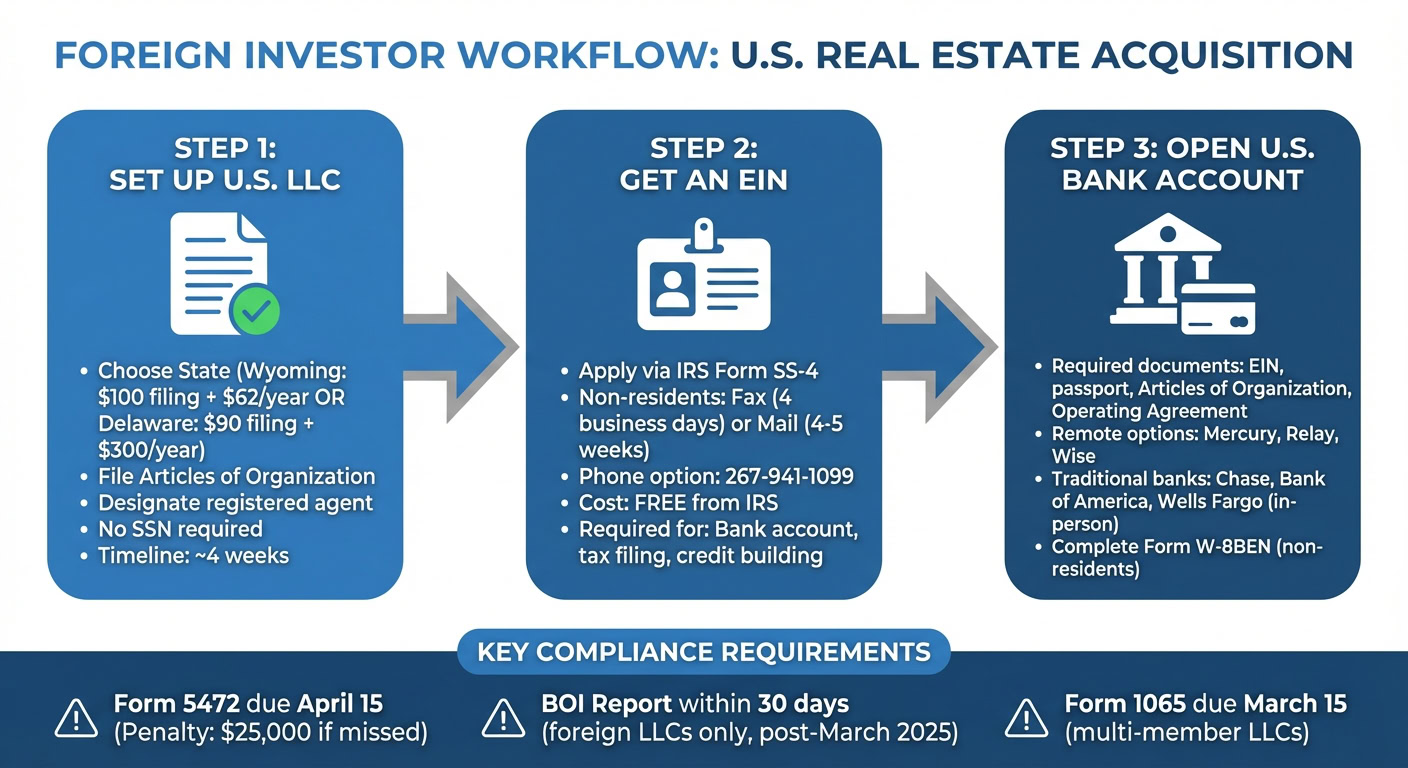
3-Step Process for Foreign Investors to Set Up U.S. LLC and Bank Account
Step 1: Setting Up Your U.S. LLC as a Foreign Investor
Selecting the Best State for Your LLC
As a foreign investor, you can form a U.S. LLC in any state, which gives you the flexibility to choose based on factors like tax advantages, privacy, and filing costs.
Wyoming and Delaware are often the go-to states for non-resident investors. Wyoming stands out with its low $100 filing fee and $62 annual renewal cost. It also offers strong privacy protections, allowing you to use a nominee owner to keep your name off public records. Delaware, on the other hand, charges $110 to file and has a $400 annual franchise tax. It boasts a specialized Court of Chancery, designed to handle business disputes efficiently, making it particularly appealing for those seeking a sophisticated legal framework.
"Wyoming is the most popular state for non-resident entrepreneurs who run online businesses, e-commerce businesses, or business owners who want an easy and simple way to form and manage their companies." – Doola
If your investment involves real estate in a specific state, it’s usually best to register your LLC there. For instance, if you’re buying property in Florida, forming the LLC in Florida can help you avoid foreign qualification fees and ensure compliance with local regulations. However, if you’re managing properties in multiple states or running an online business along with your real estate investments, Wyoming’s low fees and privacy features might make it the better option.
Required Documents for LLC Formation
The good news? You don’t need a U.S. Social Security Number, green card, or citizenship to form an LLC. Here’s what you’ll need:
- Articles of Organization: This essential document, filed with the Secretary of State, includes your LLC’s name, business address, registered agent details, and a brief description of your business purpose.
- A valid government-issued photo ID, usually your passport, and proof of your home country address (such as a utility bill or bank statement).
- A registered agent with a local address in the state where you’re forming your LLC. This agent will handle legal and tax documents on your behalf.
- A U.S. business address for correspondence, often fulfilled through virtual office or mail forwarding services.
- An Operating Agreement: While not always legally required, this internal document outlines ownership percentages, member roles, and profit-sharing arrangements. Banks often ask for it when you open a business account, and it reinforces your limited liability protection.
The entire LLC formation process typically takes about four weeks. Be sure to complete this step before applying for your EIN to avoid delays.
How BusinessAnywhere Simplifies LLC Formation
BusinessAnywhere makes setting up a U.S. LLC hassle-free for foreign investors. They offer $0 business registration – you only pay the state filing fees – and handle all the paperwork remotely. That means no need to travel to the U.S. or deal with complicated filing systems.
When you register through BusinessAnywhere, you’ll also get a free registered agent service for the first year (valued at $147). This service provides a legal U.S. address for receiving official documents and compliance reminders. After the first year, the service continues for $147 annually.
Their user-friendly dashboard lets you manage your LLC documents, track compliance deadlines, and add services like EIN applications, virtual mailboxes (starting at $20/month), and Beneficial Ownership Information Reporting. Everything is done digitally with clear, upfront pricing – no hidden fees.
Once your LLC is set up and running smoothly, you’ll be ready to move on to securing an EIN in Step 2.
Step 2: Getting an EIN for Your U.S. LLC
What an EIN Is and Why You Need One
An EIN, or Employer Identification Number, is a unique nine-digit number assigned by the IRS to identify your business. Think of it as a Social Security Number – but for your LLC. It’s also referred to as a Federal Employer Income Number (FEIN) or Federal Tax Identification Number (FTIN).
Why is an EIN so important? For starters, you can’t open a U.S. business bank account without one. It’s also necessary for filing annual tax returns (like Form 1120 or 1065) and managing payroll taxes if you hire U.S.-based employees. Beyond meeting legal requirements, having an EIN allows your LLC to build its own credit profile, separate from your personal credit. This independence can help your business secure loans and other financial resources.
"An EIN separates your LLC from your personal affairs, granting you liability protection. Look at it this way, when your LLC has its’ own identification number, an EIN, it’s seen as a separate entity." – Rick Mak, Global Entrepreneur and Business Strategist, BusinessAnywhere
How to Apply for an EIN as a Non-Resident
Once your LLC is established, obtaining an EIN is an essential next step. If you’re a non-resident alien without a U.S. Social Security Number (SSN), you won’t be able to use the IRS’s online application system. Instead, you’ll need to fill out Form SS-4 (Application for Employer Identification Number) and submit it via fax or mail.
Before you apply, make sure your LLC is officially formed. You’ll need to have its formation date and legal business name on hand. Additionally, you’ll need a physical U.S. address for your business (P.O. Boxes are not accepted) and details about the responsible party who oversees the LLC.
| Application Method | Availability for Non-Residents | Estimated Processing Time |
|---|---|---|
| Online | SSN or ITIN required | Immediate |
| Phone | Yes (267-941-1099, Mon-Fri 6 a.m.–11 p.m. EST) | Immediate (during call) |
| Fax | Yes | ~4 Business Days |
| Yes | 4–5 Weeks |
For non-residents, faxing Form SS-4 is typically the quickest route, with processing times of about four business days. Mailing your application, on the other hand, can take up to five weeks. Keep in mind that the IRS limits each responsible party to one EIN application per day.
The best part? The IRS doesn’t charge a fee for issuing an EIN. But if you’d rather avoid the paperwork and potential delays, BusinessAnywhere offers an EIN application service for $97. They’ll handle the entire process for you, ensuring accuracy and a quicker turnaround. You can add this service when setting up your LLC through their dashboard or at a later time.
With your EIN in hand, you’ll be ready to take the next step: opening your U.S. business bank account.
Step 3: Opening a U.S. Bank Account as a Foreign Investor
Once you’ve secured your EIN, the next step is setting up a bank account to manage your U.S. business finances effectively.
Documents Needed to Open a U.S. Bank Account
To open a U.S. business bank account, you’ll need specific documents to verify your business and identity. These include:
- Articles of Organization (or Certificate of Formation) to confirm your LLC’s existence.
- Your EIN confirmation letter from the IRS, either the CP 575 or 147C form.
For personal identification, a valid passport is essential. Some banks may also request a secondary ID, such as a driver’s license, national ID card, or U.S. visa. If you’re a non-resident without a Social Security Number, you’ll need to complete IRS Form W-8BEN, which certifies your non-U.S. taxpayer status.
Additionally, banks often require proof of address, such as a utility bill, lease agreement, or bank statement dated within the last 60 days. You’ll also need your LLC’s Operating Agreement, which outlines ownership and management details, and a physical U.S. business address – note that P.O. Boxes are not accepted, though some banks may allow virtual office addresses.
Once your documents are ready, you can consider remote banking options.
Remote Banking Options for Non-Residents
If traveling to the U.S. isn’t feasible, there are fintech platforms like Mercury, Relay, and Wise that allow non-residents to open accounts remotely. These platforms typically require just your EIN and passport to get started. They cater to international entrepreneurs and often have lower fees than traditional banks.
On the other hand, major banks like JPMorgan Chase, Bank of America, and Wells Fargo usually require you to visit a branch in person, which can be a hurdle if you’re overseas. However, some global institutions like HSBC offer remote options for existing clients, making them worth considering if you already bank with them internationally.
"A US bank account for foreign corporation isn’t as easy to open as it used to be. It can be a difficult, time-consuming process." – Melissa Simpson, Senior Sales Manager, UpCounsel
Before applying, ensure you have a U.S. phone number that supports SMS for two-factor authentication, as most banks require it. Services like BusinessAnywhere can help streamline the process, connecting you with banks that work with foreign investors and ensuring your documentation meets requirements. This can save time and reduce the chances of rejection.
Once your account is active, you’ll need to comply with standard KYC and AML regulations.
KYC and AML Compliance Requirements
U.S. banks are required to follow strict Know Your Customer (KYC) and Anti-Money Laundering (AML) laws. Under the Bank Secrecy Act, banks must monitor transactions of $3,000 or more (known as the "Travel Rule"), and they’re required to maintain these records for five years.
To meet these regulations, banks will verify your identity using official photo IDs and recent proof of address. You’ll also need to clearly explain how the account will be used – whether for receiving rental income from U.S. real estate or handling international transfers – to satisfy their risk assessments. If your LLC has 25% or more foreign ownership, you’ll need to disclose beneficial ownership details as part of federal compliance.
Staying compliant is a standard requirement for all foreign investors. Ensure your documents are up to date, as proof of address older than 60 days is usually rejected. If a bank asks for a personal tax ID and you don’t have a Social Security Number, you can apply for an Individual Taxpayer Identification Number (ITIN) using IRS Form W-7. Keep in mind, though, that processing an ITIN takes about seven weeks.
sbb-itb-ba0a4be
Compliance Requirements for Foreign-Owned LLCs
Once your LLC is up and running, staying on top of federal reporting obligations is essential to keep things legal and avoid hefty penalties.
After setting up your bank account, you’ll need to address specific reporting duties tied to foreign-owned LLCs. These requirements go beyond banking and involve filings with the IRS and FinCEN.
Filing Form 5472 for Foreign-Owned LLCs
If you’re a foreign investor with a single-member LLC, the IRS categorizes your entity as a "disregarded entity" for tax purposes. However, this doesn’t exempt you from reporting. You’re required to file Form 5472 along with a pro forma Form 1120 annually by April 15.
"Since 2017, all foreign-owned Single-Member LLCs that are Disregarded Entities are treated as Corporations for federal reporting requirements." – Matt Horwitz, Founder, LLC University
Form 5472 tracks transactions between your LLC and you, the foreign owner. This includes contributions, distributions, loans, and even fees paid for forming or dissolving the LLC. Missing this filing comes with severe consequences: a minimum $25,000 penalty. Fail to correct it within 90 days of an IRS notice, and you’ll face an additional $25,000 fine every 30 days.
For multi-member LLCs, the rules differ. These entities must file Form 1065 (Partnership Return) by March 15. Penalties for missing this deadline are $205 per month, multiplied by the number of partners.
To simplify the process, companies like BusinessAnywhere can manage Form 5472 filings for you, ensuring deadlines are met and penalties avoided. If you’re uncertain about whether your activities create a tax liability, filing a protective Form 1040-NR can help preserve your right to claim deductions in the future.
Next, let’s look at FinCEN’s updated rules for beneficial ownership disclosure.
Beneficial Ownership Information Reporting
Starting March 26, 2025, FinCEN revised its Beneficial Ownership Information (BOI) reporting rules. If your LLC was formed in the U.S., you’re now exempt from BOI reporting. However, if your LLC was formed under foreign laws and registered to do business in the U.S., you must file a BOI report within 30 days of registration.
This report requires detailed information about anyone owning 25% or more of the LLC or exercising "substantial control" over it. You’ll need to provide legal names, birth dates, addresses, and a valid ID like a passport. FinCEN estimates the cost of preparing and submitting this report at about $85 for simple entities, but BusinessAnywhere offers a BOI filing service for $37 to make compliance easier and more affordable.
"FinCEN published an interim final rule on March 26, 2025, that revised the definition of ‘reporting company’… to mean only those entities formed under the law of a foreign country that have registered to do business in any U.S. State or tribal jurisdiction." – FinCEN
If you need to update or correct any information, you have 30 days from when you become aware of the change to file an amended report.
S-Corp Tax Election for Your LLC
Comparing S Corp vs LLC tax benefits shows that electing S-Corporation status can help reduce self-employment taxes, but it’s only an option for U.S. citizens and resident aliens. Non-resident aliens are not eligible to be S-Corp shareholders. To qualify as a resident alien, you’d need to meet either the "green card test" or the "substantial presence test".
If you meet these criteria in the future – say, by obtaining a green card or spending enough time in the U.S. – you can file IRS Form 2553 to elect S-Corp status. BusinessAnywhere offers this service for $147. Until you’re eligible, your LLC will remain taxed as a disregarded entity (for single-member LLCs) or as a partnership (for multi-member LLCs).
| Requirement | Entity Type | Form(s) | Due Date |
|---|---|---|---|
| Reporting | Foreign-owned SMLLC | Form 5472 & Pro-forma 1120 | April 15 |
| Partnership Return | Multi-Member LLC | Form 1065, K-1, K-2, K-3 | March 15 |
| Beneficial Ownership | Foreign LLCs registered in U.S. | BOI Report (FinCEN) | Within 30 days of registration |
| Income Tax Return | Non-resident with ECI | Form 1040-NR | April 15 |
Conclusion
Forming a U.S. LLC, obtaining an EIN, and setting up a bank account are essential steps for foreign investors looking to purchase real estate in the United States. An LLC helps shield personal assets from business liabilities, the EIN serves as the required tax identification for compliance, and a dedicated business bank account makes it easier to manage property-related expenses and rental income.
Following these steps in the right order can save you from unnecessary delays and complications. Once your structure is ready, platforms like BusinessAnywhere can simplify the process even further. They assist with LLC formation in states that are investor-friendly, handle EIN applications for non-residents who can’t apply online, and provide the U.S. business address required for banking compliance. With added benefits like a year of free registered agent services and pricing starting at $0 plus state fees, you’ll have professional support every step of the way.
"Excellent service, quick turnaround, very professional – exactly what I needed as a non-US resident." – Rick Mak, Global Entrepreneur and Business Strategist, BusinessAnywhere
Staying compliant with requirements like Form 5472, BOI reporting, and state regulations is just as important as setting up your business. BusinessAnywhere offers compliance services, including BOI filing for $37 and Form 5472 management, to help you meet deadlines and avoid penalties. With these safeguards in place, you can focus on growing your U.S. real estate portfolio with confidence.
FAQs
What advantages does forming a U.S. LLC offer for foreign real estate investors?
Forming a U.S. LLC offers several advantages for foreign real estate investors. One of the most important benefits is the protection of personal assets. By limiting liability to the company’s assets, an LLC ensures that an investor’s global wealth is safeguarded from claims tied to the property.
From a tax perspective, LLCs are generally treated as pass-through entities for U.S. tax purposes. This setup can simplify tax reporting and, in some cases, help reduce overall tax obligations.
An LLC also makes it easier for investors to manage their financial operations. With an Employer Identification Number (EIN), they can open a U.S. business bank account, handle expenses, and access U.S. payment systems. It also opens the door to financing opportunities, such as applying for mortgages or loans, without needing a Social Security Number.
Another benefit is the flexibility and privacy that LLCs provide. They can be owned by individuals, trusts, or other entities, and in many states, ownership details remain private. This structure is particularly useful for long-term planning, like estate management or succession strategies, while ensuring compliance with U.S. laws.
How can a foreign investor get an EIN without a Social Security Number?
Foreign investors can get an Employer Identification Number (EIN) from the IRS even if they don’t have a Social Security Number (SSN). To do this, fill out Form SS-4 with the LLC’s information, leaving the SSN or ITIN section blank or marking it as "N/A." Once completed, you can send the form to the IRS by fax or mail, or you can call the IRS international number for guidance. After the IRS processes the form, they will issue the EIN.
This allows foreign investors to comply with U.S. tax and business regulations without requiring an SSN or ITIN.
What documents do I need to open a U.S. bank account as a foreign investor?
To open a U.S. business bank account as a foreign investor, you’ll need to present documentation that confirms your LLC’s legitimacy and your authority to act on its behalf. Here’s what banks typically require:
- Proof of LLC formation: This includes a certified copy of your Certificate of Formation (or Articles of Organization) and your LLC’s operating agreement, which outlines the roles of members or managers.
- Employer Identification Number (EIN): The IRS-issued EIN confirmation letter is a must for tax and banking purposes.
- U.S. address: You’ll need to provide proof of a valid U.S. address for the LLC, such as a utility bill, lease agreement, or virtual mailbox statement.
- Personal identification: A government-issued photo ID, like a passport, is required. Some banks may also ask for a secondary form of ID.
- Authorization letter: A resolution or letter granting you the authority to open and manage the account on behalf of the LLC.
By submitting these documents in an organized and complete manner, you can make the account-opening process much smoother, even if you’re a non-resident.