

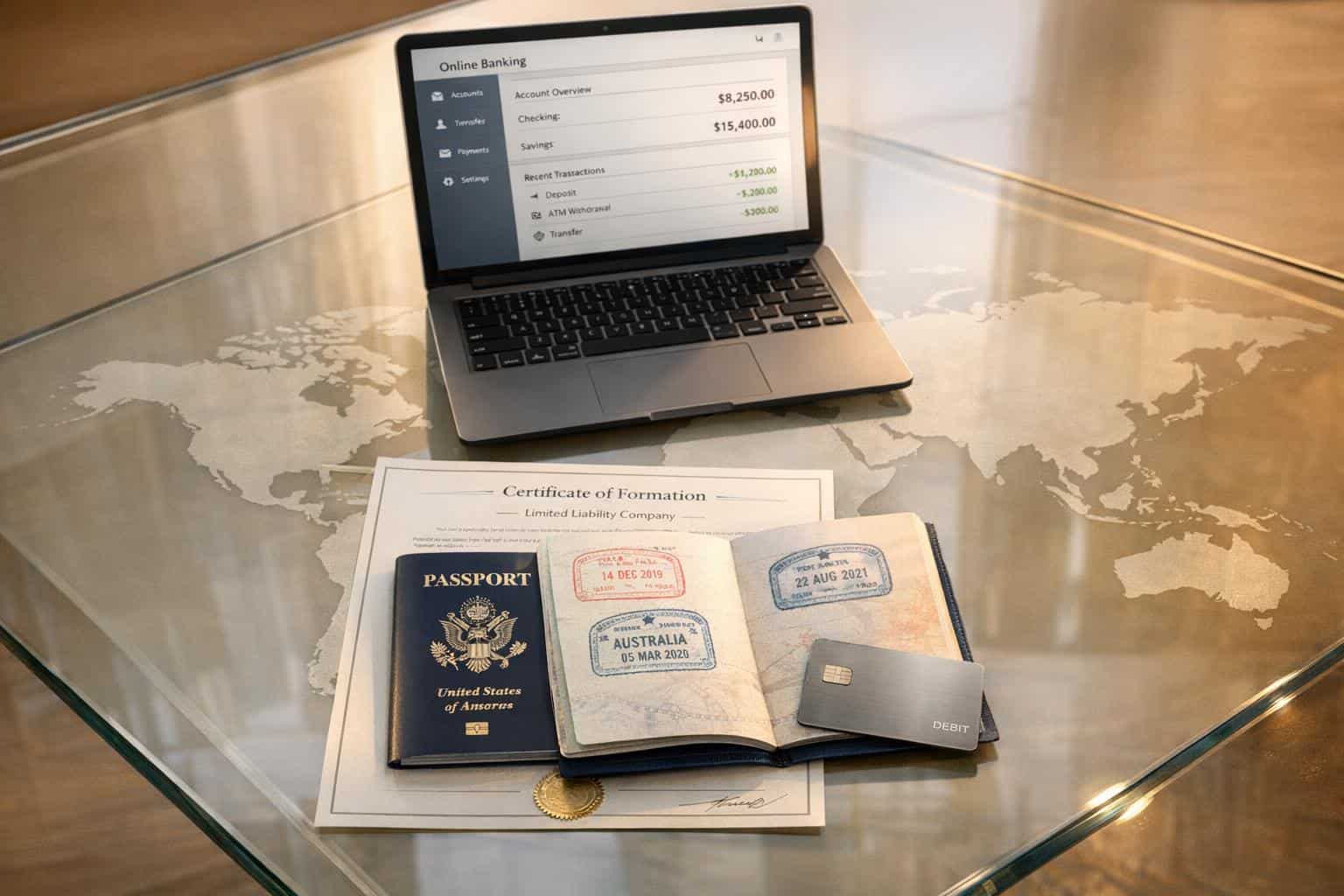
Running a business while traveling can be tricky, but setting up a U.S. business can simplify things. Here’s what you need to know:
- Incorporation: Forming a U.S. LLC is ideal for most digital nomads. Popular states include Wyoming (low fees), Delaware (great for startups), and New Mexico (lowest cost). Services like BusinessAnywhere can handle everything remotely.
- Banking: Opening a U.S. business bank account can be done online through platforms like Mercury or Wise Business. You’ll need an EIN, quality documents, and a U.S. address (virtual options work).
- Visas: Your U.S. business can support visa applications like the E-2 (for investors), L-1A (for expanding businesses), or O-1 (for extraordinary ability). Proper documentation is key.
These steps ensure smooth operations, access to global clients, and potential residency options – all without needing to visit the U.S.
How to Incorporate Your U.S. Business Remotely
Choosing the Right Legal Entity
Deciding on the right business structure is the first big step. For most digital nomads, an LLC (Limited Liability Company) is the go-to option. It offers protection for your personal assets, flexible tax options, and less paperwork compared to a corporation.
If you’re launching a tech startup and plan to raise venture capital, a C-Corporation might be a better choice. It’s worth noting that over 68% of Fortune 500 companies are incorporated in Delaware, thanks to its stable legal system and the specialized Court of Chancery. However, keep in mind that corporations face double taxation – profits are taxed at the corporate level and again when distributed as dividends. Plus, you’ll need to handle formalities like board meetings and record-keeping.
For licensed professionals – like doctors, lawyers, or architects – PLLCs (Professional LLCs) are available. But unless you’re in one of these fields, a standard LLC is usually the smarter choice.
Once you’ve decided on your entity type, you can move forward with forming your LLC remotely.
Step-by-Step U.S. LLC Formation Process
Start by choosing the state where you’ll form your LLC. Your choice affects costs and compliance requirements, so it’s worth doing some homework. Here’s a quick breakdown of popular states for LLC formation:
- Wyoming: A favorite among digital nomads. Wyoming created the LLC structure back in 1977 and offers low costs – just $102 to file and $60 annually to stay in good standing.
- Delaware: Filing here costs $110, with a $300 annual franchise tax. Delaware is ideal for businesses seeking investor funding due to its strong legal framework.
- New Mexico: The most affordable option with a $50 filing fee and no annual fees, though it lacks the reputation of Wyoming.
After picking a state, you’ll need to file your Articles of Organization with the Secretary of State. This document includes your business name, registered agent information, and management structure. Processing times vary but usually take 5–10 business days. Services like BusinessAnywhere can speed this up.
You’ll also need a registered agent – someone with a physical address in your chosen state to handle legal documents on your behalf. This is crucial for digital nomads who don’t have a fixed U.S. address. Registered agent services typically cost between $100 and $300 annually. BusinessAnywhere includes the first year for free when you register your business and charges $147 annually after that.
Don’t forget an Operating Agreement. While not always required, this document is essential for outlining ownership, profit-sharing, and management roles. It also helps solidify the separation between your personal and business assets [3, 4].
Required Compliance Filings: EIN, and S-Corp Election
To operate your LLC, you’ll need an Employer Identification Number (EIN). This 9-digit number is required for opening business bank accounts, hiring employees, and filing taxes. U.S. residents with a Social Security Number can apply online and receive it instantly. If you’re not a U.S. resident, you can call the IRS at +1-267-941-1099 for faster processing. BusinessAnywhere offers an EIN application service for $97, saving you from navigating IRS procedures.
If your business generates significant income, you might consider electing S-Corp status to reduce self-employment taxes. By filing IRS Form 2553, you can split your income between salary and distributions, potentially lowering the 15.3% self-employment tax on the distribution portion. Keep in mind, this option is generally limited to U.S. residents since non-resident aliens typically can’t be S-Corp shareholders. BusinessAnywhere offers Form 2553 filing services.
| State | Filing Fee | Annual Fee | Best For |
|---|---|---|---|
| Wyoming | $102 | $60 | Privacy and low cost |
| Delaware | $110 | $300 | VC-backed startups |
| New Mexico | $50 | $0 | Lowest total cost |
| Florida | $125 | $138.75 | E-commerce businesses [4, 7] |
Setting Up Virtual Banking and Business Infrastructure
How to Open U.S. Business Bank Accounts Remotely
Once your LLC is established and you have your EIN in hand, the next step is opening a U.S. business bank account. The challenge? Traditional banks often reject 95% of non-resident applications and require in-person visits. That’s why many digital nomads and remote entrepreneurs turn to fintech platforms like Mercury, Relay, and Wise Business. These platforms let you open accounts entirely online.
Here’s how they work: while not traditional banks, these platforms partner with FDIC-insured institutions like Thread Bank or Column N.A. to provide banking services. The process is streamlined – Mercury and Relay typically approve accounts within 48–72 hours, compared to the 4–8 weeks it can take with traditional banks. Plus, most of these platforms charge no monthly fees and offer free ACH transfers, which is perfect for remote business operations.
"The most frustrating part isn’t forming the company, it’s opening a US business bank account." – Vincenzo Villamena, CEO, Entity Inc.
To ensure your application goes smoothly, prepare high-quality (300 DPI) color PDFs of your passport, EIN letter, and Articles of Organization. Low-quality or cropped images can lead to rejection. You’ll also need a physical address. While your foreign home address (verified with a utility bill or bank statement) is usually acceptable, some platforms like Mercury have started rejecting Registered Agent addresses and PO boxes, now requiring a verifiable U.S. address.
Be specific when describing your business during the application. Avoid vague terms like "consulting", as these can raise red flags during risk screenings. For added security, consider opening accounts with more than one bank. This way, if one account is frozen unexpectedly, you’ll have a backup to avoid disruptions.
If you’re unsure about the process, services like BusinessAnywhere offer bank account opening assistance as part of their Digital Nomad Kit. Initial deposits can range from $30 to over $1,000, depending on the bank.
Once your bank account is set up, consider virtual services to manage your mail and legal correspondence.
Virtual Mailbox and Registered Agent Services
Every business needs a Registered Agent – a person or service with a physical address available during business hours to receive legal documents like subpoenas or lawsuits. BusinessAnywhere provides the first year of Registered Agent service for free when you register your LLC, with an annual renewal fee of $147.
A Virtual Mailbox, on the other hand, handles your daily business mail. Services like BusinessAnywhere’s Virtual Mailbox (starting at $20/month for up to two recipients) can scan your mail digitally and forward packages worldwide. These services are especially useful for entrepreneurs who are constantly on the move.
To avoid complications, use your virtual address consistently across all official forms, bank applications, and business documents. Keep in mind that some states, like California, may require a "real" physical address for certain registrations. In such cases, you can use your Registered Agent’s address for official records.
These tools are essential for managing your business remotely and staying organized.
Other Tools for Remote Business Operations
In addition to banking and mail services, several other digital tools can help streamline your remote business management:
- Virtual phone systems like Grasshopper: These provide a dedicated U.S. phone number, separate from your personal line, and support international call routing. This is especially handy for bank verification calls and client communication.
- Accounting tools like QuickBooks or Xero: These cloud-based platforms integrate with fintech banks, automatically categorizing transactions for bookkeeping and tax preparation.
- Payroll and contractor management: Platforms like Gusto and Rippling handle U.S. payroll and tax withholding, while services like Deel or Remote simplify hiring and paying international contractors.
- Remote notary services: BusinessAnywhere offers online notary services for $37 per document, accepted across all U.S. states and many international jurisdictions. This eliminates the hassle of finding a physical notary while traveling.
- Payment processing: Use Stripe to accept global credit card payments. You’ll need your EIN to set up an account.
- International transfers: Wise Business allows you to manage multiple currencies with local account details in over 40 currencies. Their transparent fees, starting at 0.41%, are a cost-effective alternative to traditional banks, which often charge hidden exchange rate markups of 3.5% or more.
Here’s a quick overview of essential tools:
| Tool Category | Recommended Providers | Key Function |
|---|---|---|
| Banking | Mercury, Relay, Wise Business | Remote account opening, USD transactions |
| Virtual Mail | BusinessAnywhere | Digital mail scanning and global forwarding |
| Phone | Grasshopper | Virtual U.S. number for bank verification |
| Accounting | QuickBooks, Xero | Automated bookkeeping and tax preparation |
| Payroll | Gusto, Rippling, Deel | U.S. and international employee management |
| Payments | Stripe | Credit card processing and global payments |
These tools form the backbone of a well-organized, fully remote business operation.
sbb-itb-ba0a4be
Visa Options for Digital Nomads with U.S. Businesses
Common Visa Options for Entrepreneurs
If you’re running a U.S. business and living the digital nomad lifestyle, several visa options can help you establish legal residency. Owning a U.S. business opens doors to visas tailored for entrepreneurs. One of the most sought-after is the E-2 Treaty Investor Visa, especially for citizens of treaty countries. In 2023 alone, U.S. consulates approved 54,812 E-2 visas. To qualify, you need to invest at least $100,000 in your business while maintaining at least 50% ownership or operational control. This visa is valid for two to five years and can be renewed indefinitely as long as your business remains active.
The L-1A Intracompany Transferee Visa is another option if you already own a business abroad and plan to expand into the U.S. To apply, you must demonstrate a qualifying relationship between your foreign and U.S. entities and work in a managerial or executive capacity. Initially, you’ll receive a one-year approval for a "new office", with the possibility of extensions up to a total of seven years.
For individuals with a proven track record of excellence, the O-1A Extraordinary Ability Visa is a strong choice. While no financial investment is required, you’ll need to provide substantial evidence of national or international recognition in fields like business, science, or education. Your U.S. business can sponsor your application, and the visa is valid for up to three years, with one-year renewals available.
If you’re a startup founder, the International Entrepreneur Parole (IER) might be the best fit. To qualify, you must own at least 10% of a U.S. company established within the past five years and secure a minimum of $311,071 in U.S. investments or $124,429 in government grants (as of October 1, 2024). This program allows you to stay in the U.S. for up to five years. For shorter stays, the B-1 Temporary Business Visitor Visa offers up to six months for activities like negotiating contracts or scouting office locations. However, you’re not allowed to actively run your business under this visa.
Once you’ve chosen the right visa, the next step is to showcase the legitimacy of your U.S. business to strengthen your application.
Using Your U.S. Business for Visa Applications
Your U.S. LLC or Corporation plays a crucial role in supporting most visa applications. Start by gathering your EIN assignment notice, which confirms your business’s official registration. For E-2 visa applications, additional documentation is required, including a detailed five-year business plan with financial projections, tax returns, bank statements, and proof of capital deployment. Funds must be actively used for business expenses like leases, equipment, or marketing – not just sitting idle in a bank account.
"A bona fide enterprise refers to a real, active, and operating commercial or entrepreneurial undertaking which produces services or goods for profit." – USCIS
Your business also needs to prove it’s more than "marginal." This means it should generate enough income to support more than just your basic living expenses and contribute economically within five years. To demonstrate this, keep detailed payroll records, quarterly wage reports, and business licenses as evidence of your company’s operations.
For an L-1A Visa, you’ll need to provide documentation showing the connection between your foreign and U.S. entities, as well as proof of a physical office in the U.S. If you’re pursuing an O-1 Visa, prepare to submit evidence of your professional achievements, such as letters from peers, media coverage, or other documentation highlighting your expertise.
Conclusion
Running a business as a digital nomad doesn’t have to be complicated. By focusing on three main pillars – incorporation (choosing the right state and business entity), banking (ensuring access to U.S. financial systems remotely), and visas (leveraging your business for residency options) – you can create a streamlined foundation that supports both your business goals and your location-independent lifestyle.
BusinessAnywhere takes the hassle out of this process with its Digital Nomad Kit, which bundles essential services like LLC formation, registered agent support, virtual mailbox, banking assistance, and compliance management – all in one platform. With setups completed in just 5–10 business days, it also helps reduce annual costs through optimized tax planning. Whether you’re a U.S. citizen navigating FATCA and FEIE requirements or a non-U.S. individual starting your first American business, the platform provides personalized consultations and strategy reports to tailor your structure to your needs.
"This kit isn’t a cost, it’s a shortcut to long-term freedom, privacy, and keeping more of what you earn." – BusinessAnywhere
Additional features include managing annual state filings (starting at $60 per year in Wyoming), biweekly webinars on regulatory updates, and a Digital Nomad Residency Guide to align your business with global mobility strategies. With these tools, you can focus on growing your business while traveling, knowing that compliance and operational tasks are handled by experts who understand the nomadic lifestyle.
The digital nomad economy continues to grow, and setting up a properly structured U.S. business can unlock opportunities like E-2 visas and international banking relationships. Establish your remote business today to take advantage of these benefits and secure the freedom to live and work on your terms. A well-structured U.S. business isn’t just a tool – it’s your gateway to a truly global lifestyle.
FAQs
Do I need to visit the U.S. to form an LLC and open a bank account?
No, you don’t have to travel to the U.S. to set up an LLC or open a bank account. Thanks to online services, you can handle both tasks remotely, making it easier for non-residents to start and manage their businesses from wherever they are.
What U.S. address should I use for my LLC and banking applications?
When setting up your LLC and banking accounts, it’s important to use a legitimate U.S. business address. Options like a virtual mailbox or a registered agent address are great choices, as long as they meet state requirements and are accepted by banks. This approach not only ensures legal verification but also helps protect your privacy.
How does a U.S. company help with E-2, L-1A, or O-1 visa eligibility?
Establishing a legitimate business presence in the U.S. can help a company support eligibility for visas such as the E-2, L-1A, and O-1.
- E-2 Visa: The business must not only exist but also be operational, with a substantial investment already made. This demonstrates the company’s commitment and viability.
- L-1A Visa: This requires a U.S. branch connected to a foreign company, facilitating the transfer of executives or managers.
- O-1 Visa: An active U.S. business can play a key role in highlighting professional achievements and recognition, strengthening the case for individuals with extraordinary abilities.
Each visa type has specific requirements, but having a functioning and credible U.S. business is a critical step.