

Managing international finances can be a hassle. High currency conversion fees, slow transfers, and complex compliance requirements often eat into profits and time. But modern fintech tools are changing the game. Here’s a quick rundown of five tools that can simplify cross-border financial operations:
- Wise Business: Offers local bank details, multi-currency accounts, and low conversion fees using the mid-market rate. Supports payments to 70+ countries with 95% arriving within 24 hours.
- Stripe Treasury: Allows businesses to manage funds in 135+ currencies, with fast transfers via local payment networks like ACH and SEPA.
- Plaid: Connects to 12,000+ financial institutions for real-time transaction syncing with accounting tools like QuickBooks and Xero.
- Brex: Simplifies global expense management with virtual cards, automated VAT tracking, and ERP integrations.
- BusinessAnywhere: Helps non-U.S. residents set up U.S. businesses, file for EINs, and stay compliant with legal requirements.
Each tool addresses specific pain points, from reducing foreign exchange costs to automating compliance and bookkeeping. Below is a quick comparison to help you decide which fits your needs best.
Quick Comparison
| Feature | Wise Business | Stripe Treasury | Plaid | Brex | BusinessAnywhere |
|---|---|---|---|---|---|
| Currencies Supported | 40+ | 135+ | N/A (data connectivity) | 100+ | N/A (legal setup) |
| International Payments | Yes (70+ countries) | Yes (local networks) | N/A | Yes (local billing) | N/A (banking setup) |
| Key Integrations | QuickBooks, Xero | Xero, QuickBooks | QuickBooks, Xero | ERP systems, Xero | Legal documents only |
| Compliance Features | FCA-regulated, FDIC-insured | KYC, AML tools | GDPR-compliant | VAT tracking, AI controls | EIN filing, state compliance |
These tools can save you time, money, and effort while managing global finances. The right choice depends on your specific needs, whether it’s multi-currency accounts, expense tracking, or legal compliance.
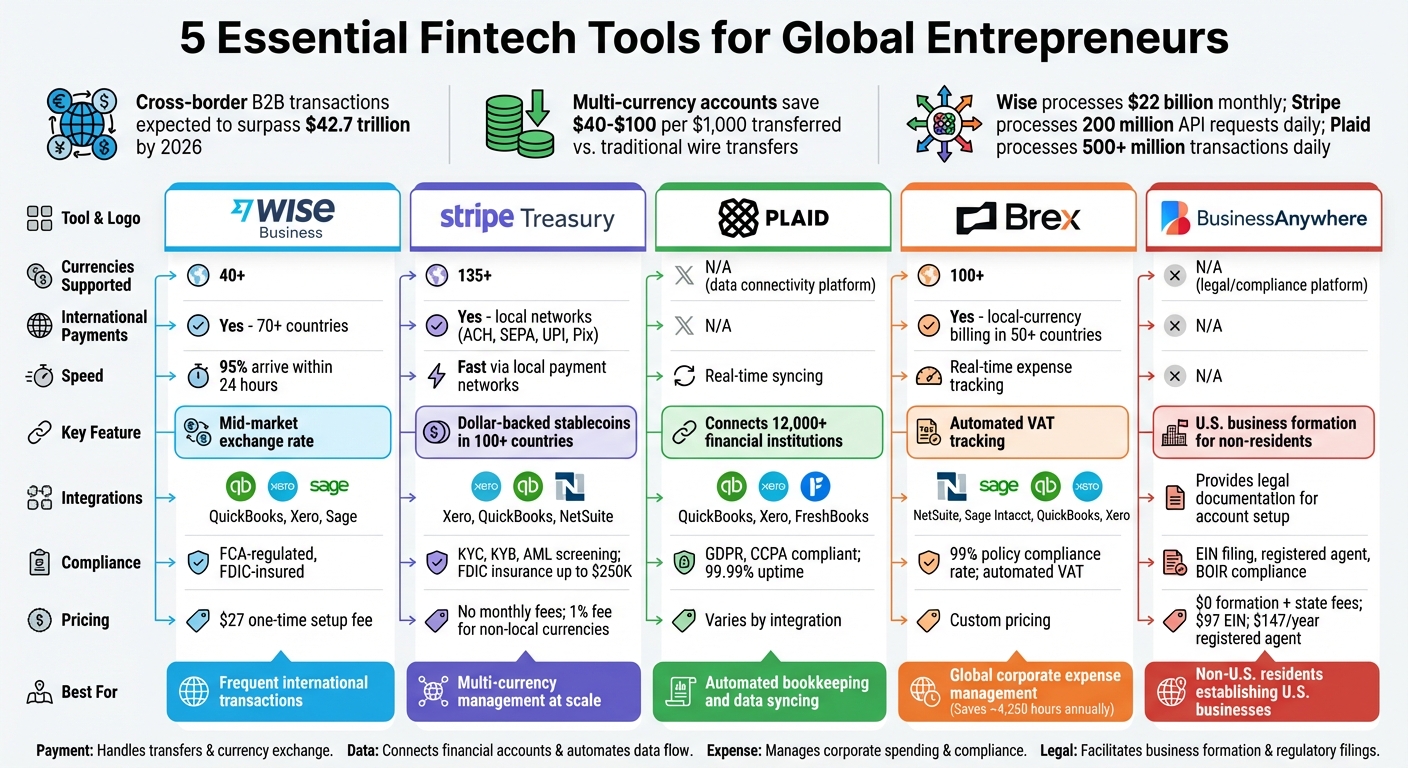
Comparison of 5 Essential Fintech Tools for Managing International Business Finances
1. Wise Business
Multi-currency support
Wise Business provides local bank details in 10+ major currencies – including US routing numbers, UK sort codes, and IBANs – without requiring a local address. This allows businesses to receive payments from clients in regions like the US, Europe, or Australia as if they were local, avoiding the steep conversion fees often charged by platforms like Amazon, Etsy, or Upwork.
With a single account, you can hold and manage balances in over 40 currencies. You have the flexibility to convert funds when exchange rates are favorable or hold them until later. Wise uses the mid-market exchange rate – the same rate you’d find on Google – with no hidden markups. Unlike traditional banks that typically add a 3–4% markup to the mid-market rate, Wise charges a straightforward fee starting at just 0.57%.
These features make managing multiple currencies and international transactions hassle-free.
International payment capabilities
When managing cash flow across time zones, speed is critical. Wise excels in this area, with 70% of payments arriving in 20 seconds and 95% delivered within 24 hours. The platform supports money transfers to over 70 countries and offers batch payments, enabling you to send funds to up to 1,000 recipients with a single click.
"Sending payments to all our clients used to take me close to a week, and with Wise’s batch payments feature, I can accomplish this in just a few minutes." – Chris Kennedy, Rident Royalties
Additionally, Wise provides physical and digital debit cards that work in 40+ currencies across 160+ countries, with no foreign transaction fees. These cards allow you to set spending limits and track expenses in real-time, simplifying the management of budgets for remote teams.
Integration with accounting or financial tools
Wise integrates seamlessly with popular accounting platforms like Xero, QuickBooks, and FreeAgent, categorizing multi-currency transactions automatically. For example, Xero syncs every 4 hours, while QuickBooks imports transaction data daily. This reduces the need for manual data entry and ensures accurate financial tracking.
Wise also connects with e-commerce platforms such as Stripe and Shopify, enabling you to manage global sales revenue from one central dashboard. These integrations make it easier to oversee your financial operations, no matter where your business operates.
Compliance and regulatory support
Wise prioritizes security and compliance. Regulated by the FCA and registered with FinCEN, the platform keeps client funds in separate accounts and performs over 7 million anti-fraud checks daily. Transactions are protected with 2-factor authentication and HTTPS encryption.
With over 700,000 businesses using Wise to move $22 billion monthly, it’s a trusted solution for secure and efficient global transactions.
2. Stripe Treasury
Stripe Treasury tackles global payment challenges by blending multi-currency functionality with quick, localized transfers.
Multi-currency support
With Stripe Treasury (now part of Stripe Financial Accounts), you can manage, hold, and spend funds in over 135 currencies from a single dashboard. It allows you to open local accounts in more than 100 countries, locking in mid-market exchange rates and instantly converting currencies. This feature helps shield your business from rate fluctuations.
Another standout feature is its support for dollar-backed stablecoins in over 100 countries. This lets you move money at blockchain speeds while maintaining the stability of traditional currencies – a great option for quick payments without the unpredictability of crypto markets. In the U.S., eligible accounts receive FDIC pass-through insurance up to $250,000 via partner banks like Fifth Third Bank.
Next, let’s see how Stripe Treasury streamlines international payments.
International payment capabilities
Stripe Treasury integrates directly with local payment networks like ACH, SEPA, UPI, and Pix, making international transfers faster and more affordable compared to traditional wire transfers. You can send payments to 50 countries using just an email address, simplifying the process of paying contractors and vendors overseas.
For example, in 2023, GitHub used Stripe’s infrastructure for its "GitHub Sponsors" program, onboarding developers in 34 countries. What used to be a manual, 9-step, week-long process was transformed into a localized 2-minute experience that supported multi-currency donations. Shopify also leveraged Stripe Treasury for "Shopify Balance", enabling merchants to access funds quickly and offering integrated financial tools directly within their platform.
Integration with accounting or financial tools
Stripe Treasury seamlessly connects with Xero and QuickBooks (via QuickBooks Sync by Acodei), automatically importing transactions to eliminate manual data entry and speed up financial reporting. This automation reduces the risk of errors, especially in multi-currency accounting.
The platform processes 200 million API requests daily with 99.999% uptime, ensuring reliable data flow into your accounting systems. For more advanced needs, Stripe can also integrate with ERP tools like NetSuite, supporting complex financial operations.
These integrations make managing finances smoother while setting the stage for its advanced fraud protection, discussed next.
Compliance and regulatory support
Stripe provides comprehensive compliance tools, including Know Your Customer (KYC), Know Your Business (KYB), and real-time Anti-Money Laundering (AML) screening. Its AI-driven fraud detection has significantly improved, catching card testing attacks at a rate of 97%, up from 59%. This ensures secure cross-border transactions.
"Stripe Financial Accounts gives us the flexibility to customise Shopify Balance specifically for our merchants. By building across Stripe’s payments and embedded finance infrastructure, we’ve been able to give Shopify merchants access to critical financial products that meet their needs." – Shopify
Stripe Financial Accounts come with no monthly fees or minimum balance requirements. However, a 1% fee applies for receiving payouts in non-local settlement currencies, with minimum fees like $2.50 USD or £2.00 GBP.
3. Plaid
Plaid takes the financial integrations offered by tools like Wise and Stripe Treasury a step further, providing real-time data connectivity that simplifies money management.
With connections to over 12,000 financial institutions, Plaid acts as a secure bridge between your bank accounts and business applications. This setup allows financial data to flow seamlessly, making it easier to manage international transactions and streamline operations.
Integration with Accounting or Financial Tools
Plaid automatically syncs bank transactions with popular tools like QuickBooks, Xero, and FreshBooks, saving businesses from the hassle of manual data entry. Every day, it processes and enriches over 500 million transactions, using AI to categorize them based on business needs. Whether it’s identifying revenue, payroll, or loan payments, Plaid’s system does the heavy lifting.
In May 2025, Plaid introduced "Transactions for Business", a specialized API now used by companies like Brex, Bluevine, and Wave. This API features 13 tailored categories designed to enable real-time expense tracking and automate bookkeeping for small businesses. For instance, Conrep, a PSA software provider, uses Plaid to automatically match bank payments to invoices across ACH, wire transfers, and PayPal, cutting down on manual bookkeeping tasks.
"We chose Plaid because we love the data quality and how much thought they put into elevating the user experience." – Mani Fazeli, Senior Vice President of Product
Plaid also provides live account balances and up to 24 months of transaction history for business accounts in North America and Europe. This real-time visibility helps businesses stay on top of cash flow, avoid overdrafts, and eliminate the need to log into multiple banking portals.
While its data integration capabilities are impressive, Plaid also prioritizes compliance and security.
Compliance and Regulatory Support
Plaid ensures 99.99% uptime and uses bank-grade encryption to meet strict GDPR and CCPA standards. With over 100 million users worldwide and support for 17 languages, Plaid offers a localized, compliant experience across various regions. Its Identity product further boosts security by verifying essential business information – like name, address, and email – during onboarding to meet KYC requirements. Additionally, in Europe, Plaid’s Auth product can retrieve IBAN and BIC details, simplifying direct debit and payout setups.
4. Brex
Brex simplifies corporate expense management for global teams, offering tools designed to handle cross-border operations with ease. Its ability to manage multi-currency transactions natively makes global spending far less complicated.
Multi-Currency Support
With Brex, you can issue both physical and virtual cards in over 60 countries while supporting local-currency billing in more than 50, including CAD, EUR, GBP, BRL, ILS, INR, and JPY. This means employees in cities like Tokyo, London, or São Paulo can make transactions in their local currencies without a hitch.
Brex also allows you to set spending limits in over 100 currencies. These limits remain fixed in the chosen local currency, providing consistent budgeting regardless of exchange rate fluctuations. For example, a €5,000 monthly limit for a Berlin office stays exactly that – €5,000 – no matter the currency shifts.
This multi-currency functionality seamlessly integrates with advanced accounting tools, making cross-border financial management even smoother.
Integration with Accounting and Financial Tools
Brex goes beyond currency management by offering powerful integrations that improve financial operations. It connects with thousands of ERP and accounting systems, including NetSuite, Sage Intacct, QuickBooks, and Xero. Through entity-level mapping, Brex automatically categorizes and exports transactions to each subsidiary’s local ledger, eliminating the need for tedious manual data entry.
By automating these processes, Brex helps companies save an average of 4,250 hours annually. Additionally, the platform syncs with over 35 HRIS systems such as Workday, Gusto, and Rippling, ensuring that spending limits and approval workflows are updated automatically when employees change roles or locations.
"Now, we’re able to manage all our global subsidiaries with every transaction auto-mapped to our ERP. Brex has been a game-changer for us." – Victor Mendoza, Controlling Analyst, Incode
Brex also takes care of compliance needs, automating VAT tracking for international transactions. It collects and exports tax information directly to your ERP. Using OCR technology, it matches receipts to expenses automatically, and its AI-powered controls deliver an average expense policy compliance rate of 99%.
sbb-itb-ba0a4be
5. BusinessAnywhere
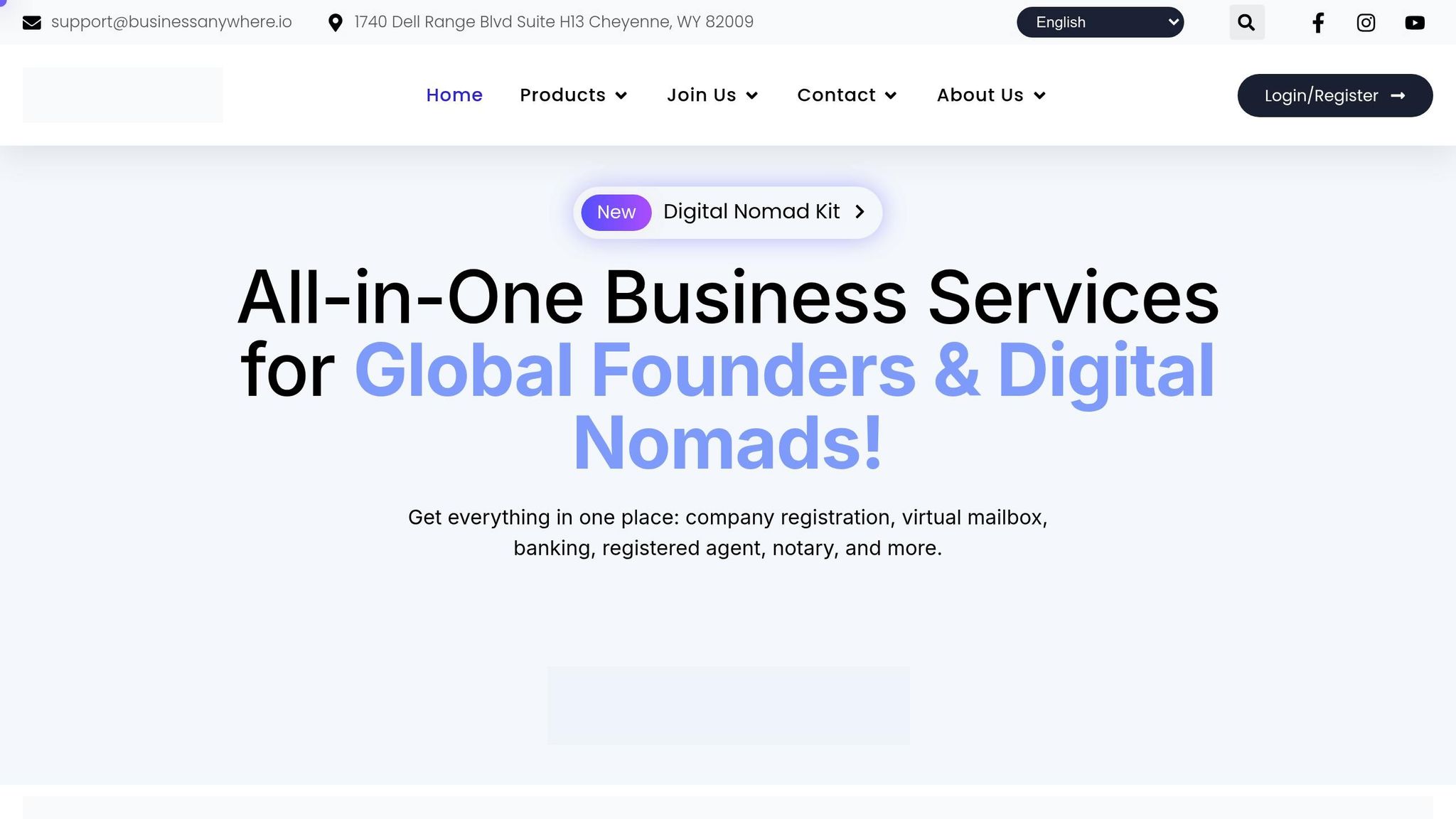
BusinessAnywhere specializes in helping non-U.S. residents establish and operate legitimate U.S. businesses by providing the legal and compliance framework needed to navigate the complexities of U.S. regulations.
Compliance and Regulatory Support
U.S. business regulations can feel overwhelming, especially for foreign entrepreneurs. BusinessAnywhere simplifies the process by handling key steps like filing the required documents – such as Articles of Organization for LLCs or Articles of Incorporation for corporations – with the Secretary of State. They also provide a virtual mailbox, complete with a legitimate U.S. address, which is essential for business registration, banking, and official correspondence.
For $97, BusinessAnywhere helps non-U.S. residents secure an Employer Identification Number (EIN) from the IRS. The EIN is a critical component for tax compliance, managing finances, and opening U.S. bank accounts.
Rick Mak, Global Entrepreneur and Business Strategist at BusinessAnywhere, highlights the feasibility of this process:
"US company formation for non-residents and non-citizens can be a little more difficult, but it’s certainly doable."
Beyond the initial setup, BusinessAnywhere offers ongoing support for legal compliance, covering areas like contract law, consumer protection, and data privacy. They also provide resources for those considering a more hands-on role in the U.S., including guidance on immigration compliance and visa options such as the E-2 Treaty Investor, L-1, and EB-5 visas. Additionally, their registered agent service ensures businesses remain in good standing with state requirements by handling legal notices. This service costs $147 annually after the first free year.
By addressing these legal and regulatory needs, BusinessAnywhere sets the stage for smooth financial operations.
Integration with Accounting and Financial Tools
Although BusinessAnywhere doesn’t directly integrate with accounting software, it provides the essential legal documentation – like operating agreements and corporate bylaws – that banks and financial institutions typically require for account setup and verification.
The platform also advises entrepreneurs to choose e-commerce platforms with localized financial features to streamline operations. With a solid legal foundation in place, integrating the necessary accounting and financial tools becomes much easier, supporting the growth of international business ventures.
Tool Comparison Table
For a quick look at features that simplify cross-border financial operations, check out the table below.
| Feature | Wise Business | Stripe Treasury | Plaid | Brex | BusinessAnywhere |
|---|---|---|---|---|---|
| Multi-Currency Support | 40+ currencies | 135+ currencies | N/A (data connectivity) | 100+ currencies | N/A (legal/compliance platform) |
| International Payments | Global payments using mid-market rates | Local payment networks (ACH, SEPA, UPI, Pix) | N/A | Local-currency billing in 50+ countries | N/A (supports banking setup prerequisites) |
| Key Integrations | QuickBooks, Xero, Sage | Xero, QuickBooks, NetSuite | QuickBooks, Xero, FreshBooks | NetSuite, Sage Intacct, QuickBooks, Xero | Essential legal documentation for account setup |
| Compliance Features | FDIC-insured partner banks; FCA regulated | KYC, KYB, AML screening; FDIC pass-through insurance | GDPR, CCPA compliant; bank-grade encryption | Automated VAT tracking; 99% policy compliance | U.S. business registration, EIN filing, registered agent, BOIR compliance |
| Pricing | $27 one-time setup fee; no monthly subscription | No monthly fees or minimum balance | Varies by integration | Custom pricing | $0 business formation + state fees; $97 EIN service; $147/year registered agent after first year |
Each tool stands out for its specific strengths, catering to varying business needs. Wise Business offers broad currency coverage and transparent, flat pricing, making it ideal for frequent international transactions. Stripe Treasury supports a wide range of currencies and integrates with localized payment systems like ACH and SEPA. Plaid specializes in connecting over 12,000 financial institutions, enabling smooth data transfers between banks and business apps. Brex is a go-to for managing corporate expenses across global teams, with features like automated VAT tracking and compliance monitoring.
BusinessAnywhere focuses on setting up a strong legal and compliance framework. It handles U.S. business registration, EIN filing, registered agent services, and BOIR compliance, ensuring businesses meet the requirements to open bank accounts and integrate with financial tools. This comparison highlights the importance of choosing tools that align with your business’s international finance goals.
Conclusion
Managing finances across borders doesn’t have to be overwhelming. The right fintech tools simplify international payments, currency conversions, and compliance hurdles that often complicate global operations. With cross-border B2B transactions expected to surpass $42.7 trillion by 2026, businesses that embrace modern financial platforms position themselves for long-term success.
No single tool can solve every challenge, but a well-rounded approach makes all the difference. Many successful global entrepreneurs rely on a mix of platforms to build a comprehensive financial system. For instance, you might use one service for handling multi-currency payments, another for tracking expenses, and a third for managing legal requirements. Multi-currency accounts alone can save between $40 and $100 on every $1,000 transferred, compared to traditional wire transfers.
The first step? Identify where you’re struggling. Whether it’s high foreign exchange markups, time-consuming bookkeeping, or delays in international payments, pinpointing these pain points helps you find the right tools to address them. These savings on FX costs highlight the competitive advantage fintech solutions can provide.
A strong financial strategy brings together the best features of each platform to create a seamless operation. The tools you choose today can lay the groundwork for future growth. Whether you’re paying freelancers around the world or managing revenue in multiple currencies, your platforms should integrate smoothly with your existing systems and scale as your business expands. Take the time to evaluate fees, currency options, and integration capabilities before making your decision.
FAQs
Which tool should I use first for overseas money management?
Start with Wise for managing your money across borders. It offers quick and secure international transfers, multi-currency accounts, and clear, upfront fees. This makes it an easy and reliable option for dealing with overseas finances.
How do I reduce FX fees on international payments?
To cut down on foreign exchange (FX) fees for international payments, look for platforms that offer transparent exchange rates and avoid hidden charges. Another smart option is using multi-currency accounts. These accounts let you hold and convert money at the mid-market rate, giving you the flexibility to time your conversions strategically. By steering clear of unnecessary markups and accessing competitive rates, these tools can significantly lower the costs of global transactions.
What do I need to stay compliant when operating globally?
To navigate global compliance, it’s crucial to stay informed about local rules regarding financial transactions, taxes, and currency exchange. Many fintech tools simplify this process by offering features such as local currency accounts, real-time foreign exchange tracking, and automated compliance systems.
Transparency is key – keep an eye on transaction limits and adhere to AML (Anti-Money Laundering) and KYC (Know Your Customer) regulations. Fintech platforms often come equipped with tools to streamline compliance processes and enhance data security, helping businesses meet legal requirements across multiple regions with less hassle.