

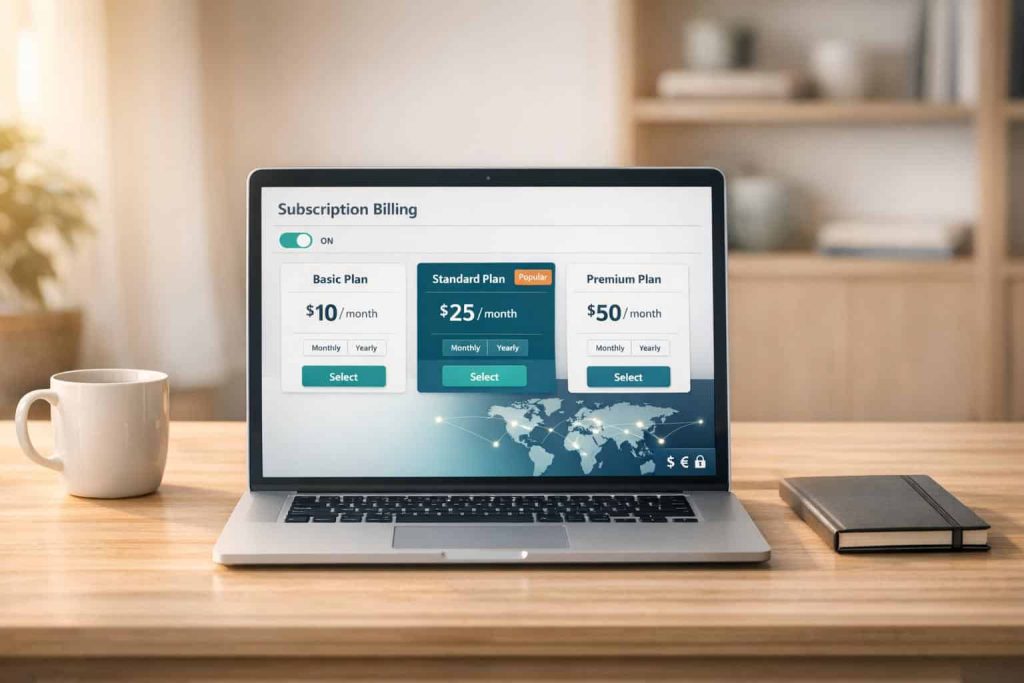
Subscription payment gateways automate recurring transactions, making them essential for remote businesses managing global customers. They securely handle payments, process multiple currencies, and support various payment methods like credit cards, digital wallets, and bank transfers. These systems reduce administrative work, improve customer retention with features like smart retries for failed payments, and ensure compliance with global regulations such as GDPR and PCI DSS standards.
Key Takeaways:
- Automates billing cycles (weekly, monthly, annually).
- Supports global payment methods (e.g., SEPA, Alipay, ACH).
- Handles currency conversion and displays local prices.
- Improves revenue recovery with tools like dunning management.
- Ensures security with PCI DSS compliance and fraud detection.
How Subscription Payment Gateways Work
The Recurring Payment Process
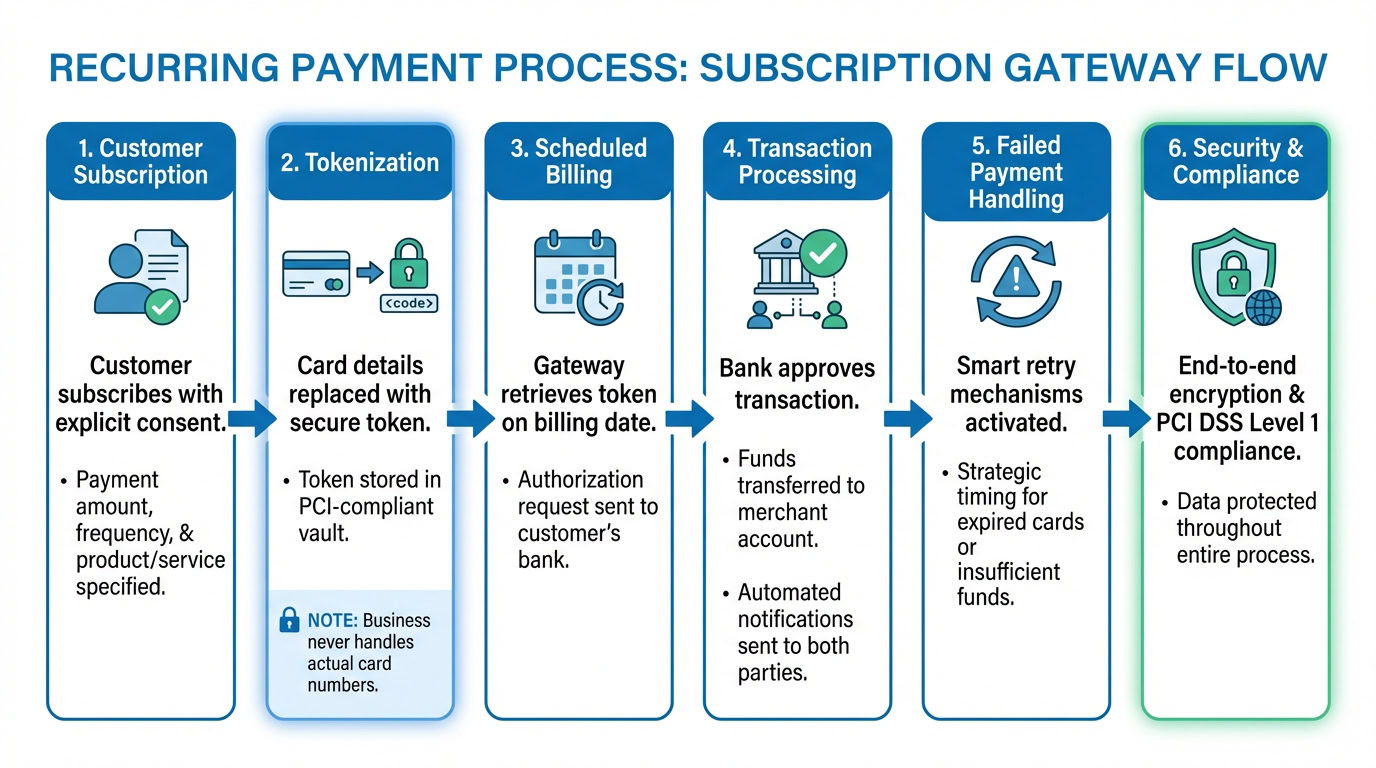
When a customer subscribes to a service with their explicit consent, the payment gateway securely handles the recurring payment details, including the amount, frequency, and the specific product or service. This thorough process minimizes risks like disputes or chargebacks.
Once the customer enters their credit card information, the gateway replaces sensitive card details with a token – a secure, encrypted placeholder. This token is stored in a PCI-compliant vault, ensuring your business never needs to handle or store actual card numbers, which significantly reduces security risks.
On the scheduled billing date, the gateway retrieves the token and sends an authorization request to the customer’s bank. If the bank approves the transaction, the funds are transferred to your merchant account, and both you and your customer receive automated notifications. In cases where the payment fails – due to issues like an expired card or insufficient funds – the gateway employs smart retry mechanisms. These retries are timed strategically to increase the likelihood of a successful transaction.
Throughout the entire process, advanced encryption protects sensitive data as it moves between the customer, your business, and financial institutions. Additionally, leading gateways meet PCI DSS Level 1 compliance standards, offering top-tier security while reducing the technical and legal responsibilities for your business.
Modern gateways don’t stop at recurring transactions – they also incorporate tools that simplify subscription management.
Core Features of Subscription Payment Gateways
Today’s payment gateways go beyond simple transaction processing. Many include automated billing features that handle everything from scheduling charges to generating invoices and sending digital receipts – all without requiring manual effort. If a payment fails, dunning management tools automatically send reminders and retry the transaction at optimized intervals, helping businesses recover revenue that might otherwise be lost. These tools have collectively recovered billions in missed payments.
Another valuable feature is account updater services, which automatically refresh expired or replaced card details. This ensures that subscriptions continue uninterrupted, reducing involuntary churn caused by outdated payment methods. Additionally, customer portals empower subscribers to manage their accounts independently. Through these portals, customers can update payment methods, review billing histories, and make changes to their subscription plans with ease.
For businesses that allow mid-cycle plan changes, advanced gateways use proration to calculate any partial charges or refunds instantly. For instance, if a customer upgrades from a $50 monthly plan to a $100 plan halfway through the billing cycle, the system adjusts the charges accordingly. Gateways also manage trial periods effectively, tracking subscription statuses like "trialing", "active", or "past due", and triggering the appropriate actions at each stage automatically.
These features not only make subscription management easier but also help businesses maintain long-term customer relationships while reducing payment-related challenges.
sbb-itb-ba0a4be
Choosing the Right Payment Methods for Remote Businesses
Payment Methods to Support
Credit and debit cards are a cornerstone of any payment strategy. They’re widely accepted and often the first choice for customers globally. But relying only on cards can limit your reach – around 13% of shoppers will abandon their carts if their preferred payment method isn’t available.
Digital wallets like Apple Pay, Google Pay, Alipay, and WeChat Pay are increasingly important. For example, in China, 54% of online transactions are made using digital wallets. They offer faster checkouts and enhanced security features like biometric verification, which are especially appealing to mobile shoppers in markets like the United States and the United Kingdom.
For B2B services and high-value transactions, bank-based methods are a must. Options like ACH transfers in the U.S. and SEPA Direct Debit in Europe come with lower processing fees, making them ideal for recurring payments or larger purchases. Bank redirects, such as iDEAL in the Netherlands and Bancontact in Belgium, are also popular in Europe. These methods allow customers to authorize payments directly through their online banking credentials, bypassing the need to share card details.
Buy Now, Pay Later (BNPL) services, including Klarna, Afterpay, and Affirm, can increase conversions for higher-priced items by spreading payments over installments. Additionally, real-time payment systems like UPI in India, PIX in Brazil, and FedNow in the U.S. enable instant and low-cost bank-to-bank transfers. In regions with large unbanked populations, cash-based vouchers like OXXO in Mexico and Boleto in Brazil provide a way for customers to pay for online purchases in cash at physical locations.
Offering a variety of payment methods is crucial, but remote businesses also need to navigate the complexities of multi-currency transactions.
Handling Multi-Currency Transactions
For subscription-based remote businesses, providing clear and transparent multi-currency support is key to building trust. Payment gateways that process over 135 currencies ensure customers see prices in their local currency while you receive payments in your base currency.
Transparency in currency conversion is critical. Customers want to know exactly what they’re paying without hidden fees or confusing exchange rates. Gateways with adaptive pricing automatically display prices in the customer’s local currency based on their location, reducing friction during checkout. Research shows that 87% of shoppers will abandon their purchase if the checkout process feels too complicated.
For subscription services, multi-currency support is even more vital. A customer in Germany, for instance, expects to see charges in euros on their bank statement – not unexpected amounts in U.S. dollars. Smart payment gateways handle these conversions seamlessly, ensuring you maintain consistent revenue in your base currency while avoiding customer confusion. This minimizes support inquiries and builds long-term trust with your audience.
Pricing Models and Costs for Subscription Payment Gateways
Common Pricing Structures
Understanding how subscription payment gateways charge is essential to gauge their value and impact on your bottom line.
Flat-rate pricing is the most straightforward option: you pay a fixed fee per transaction. Typically, this means 2.9% + $0.30 for every successful card charge. Its simplicity and absence of setup fees make it appealing to startups and small businesses looking for predictability.
Volume-based or tiered pricing scales costs based on your monthly processing volume. For example, you might pay $620/month for up to $100,000 in transactions, $1,500/month for up to $250,000, or $5,750/month for up to $1,000,000. This model lowers the per-transaction cost as your volume grows, potentially saving substantial amounts over time.
Pay-as-you-go models charge only a percentage of your billing volume, often around 0.7%, without recurring monthly fees. This is ideal for businesses with seasonal or unpredictable revenue since it eliminates fixed costs. For businesses handling B2B subscriptions or high-value transactions, ACH direct debit is a cost-effective alternative, charging 0.8% per transaction, capped at $5.00, compared to standard credit card fees.
Keep an eye out for additional charges like setup fees, monthly account maintenance, chargeback fees (typically $15–$50 per dispute), international card fees, and currency conversion costs, which usually add 1%–1.5%.
Evaluating Costs Against Features
Focusing solely on the cheapest option can backfire in the long run. For instance, a gateway with no setup fees but higher transaction costs might end up costing more as your sales grow. To get a clear picture, calculate your total cost, factoring in all possible fees, including chargebacks, refunds, and compliance costs.
Consider the extra value some gateways offer. Features like Smart Retries for failed payments and automated dunning management can recover revenue that would otherwise be lost to involuntary churn. For example, Stripe Billing tools helped businesses recover an average of 38% of failed payments in 2021 and reportedly enabled users to reclaim over $6.5 billion in revenue by 2024. These tools not only reduce churn but also cut down on administrative work, making them worth the investment.
For businesses handling multi-currency transactions, look into how the gateway manages currency conversion. Some offer adaptive pricing, which displays prices in the customer’s local currency. However, this often comes with a 1%–2% conversion fee. If you serve a global customer base, these fees can significantly impact your profit margins.
Your choice of pricing model should align with your business’s growth and operational needs. If you’re just starting out, a flat-rate model with no setup fees keeps things simple and manageable. As your transaction volume grows, switching to a tiered pricing structure or an API-hosted gateway can lower costs and improve profitability. For B2B subscriptions, prioritizing ACH transfers over credit cards can significantly reduce processing fees for high-value transactions.
Integration and Compatibility with Business Tools
APIs and Pre-Built Integrations
When it comes to automated subscription management, picking a payment gateway with strong integration options can make all the difference. Many subscription payment gateways offer API-hosted integrations and pre-built plugins for popular platforms like Shopify, WooCommerce, and Salesforce. APIs let you create a branded checkout experience directly on your website, while plugins simplify setup, requiring little to no technical expertise. To make things even easier, gateways often provide SDKs (Software Development Kits) for widely-used programming languages like Java, Python, and Ruby.
Another handy feature is webhooks, which send real-time updates for events like successful payments or subscription plan changes. These notifications can trigger automated actions in your CRM or email system. For instance, if a payment fails, your system can automatically send a dunning email – no manual action needed.
Some gateways also offer advanced tools, like Stripe Revenue Recognition for accrual accounting and Stripe Tax for simplifying sales tax compliance, helping to reduce manual errors and save time.
Checking Compatibility with Remote Business Operations
Beyond integration, it’s essential to ensure the gateway fits seamlessly into your broader business operations. Start by auditing your tech stack – this includes your accounting software, CRM, email marketing tools, and any custom apps. Use the gateway’s sandbox environment to test out the entire subscription lifecycle, from handling trial expirations to managing card declines.
Security is another key factor. Look for gateways that use client-side tokenization through hosted fields or elements. This approach keeps sensitive payment data off your servers, minimizing your PCI compliance burden. Additionally, confirm that the gateway supports multi-currency transactions and meets global security standards.
For remote businesses, seamless integration is key. For example, platforms like BusinessAnywhere offer a unified dashboard that ties everything together, boosting operational efficiency while maintaining security and scalability.
Security and Compliance Considerations
Fraud Prevention and Data Encryption
When managing recurring payments, security is non-negotiable. The risks are significant – 79% of organizations faced payment fraud attempts in 2024, and the average cost of a data breach reached $4.4 million. For remote businesses, selecting a payment gateway with strong security measures is essential.
One key step is ensuring PCI DSS Level 1 compliance, the highest certification standard for high-volume payment processors. Tokenization plays a critical role here, replacing sensitive card details with secure tokens for recurring transactions. Secure data transfers are guaranteed through SSL/TLS encryption.
Modern gateways also rely on real-time machine learning fraud detection to protect against threats. They analyze transaction patterns, IP addresses, geolocation, and customer behavior to identify risks. Take Stripe, for example – it processes over $1 trillion annually and uses its Radar AI system to detect and block suspicious activity. Additional tools like 3D Secure and multi-factor authentication (MFA) provide further layers of protection for high-risk transactions, reducing chargebacks while keeping the checkout process smooth for legitimate users.
These security measures not only protect your business but also align with the compliance needs of global operations.
Automated Compliance for Global Operations
For remote businesses, serving customers across multiple countries means navigating a maze of regulations. The right payment gateway simplifies this challenge by automating key compliance tasks. Many gateways now handle automated tax calculations, covering everything from EU VAT to U.S. state sales tax. This eliminates the need to manually track ever-changing tax laws.
Compliance with data regulations, such as GDPR, is also streamlined through tokenization and encryption. Many gateways operate under a shared responsibility model, where they manage up to 90% of security controls, leaving you to focus on your specific implementation and internal policies. The cost of non-compliance can be steep, making automated tools for tax and regulation management a smart investment.
With the introduction of PCI DSS v4.0 as the mandatory standard in March 2024, security requirements have become more stringent. Hosted gateways can ease this transition by handling the sensitive data environment on your behalf. This reduces the complexity of compliance, simplifying self-assessment questionnaires and minimizing technical demands. For remote businesses with limited technical resources, this approach allows you to maintain high security standards while concentrating on growing your operations.
Conclusion
Choosing the right subscription payment gateway isn’t just about processing payments – it’s a decision that can directly influence your business’s revenue and efficiency. A good gateway takes care of billing cycles automatically, works seamlessly with your CRM and accounting tools, and saves countless hours of manual work every week. For remote businesses, this kind of operational efficiency becomes even more critical when managing teams and customers across different time zones.
Here’s a fact worth noting: between 2012 and 2022, subscription-based businesses grew their revenue nearly five times faster than S&P 500 companies. On top of that, 70% of Americans now use multiple subscriptions. To tap into this growing market, businesses need payment systems that go beyond the basics. Features like reducing involuntary churn, supporting over 135 currencies, and offering localized payment methods are essential for breaking into international markets. These capabilities highlight how a well-designed payment system can drive global growth.
Your payment gateway also plays a big role in shaping the customer experience. Offering self-service options – like the ability to pause, upgrade, or modify plans – builds trust and flexibility. Interestingly, one-third of paused subscriptions are eventually reactivated. Combine these customer-friendly features with PCI Level 1 compliance and AI-powered fraud protection, and you’re not just handling transactions – you’re creating a solid foundation for growth.
Looking ahead, the digital payments market is expected to surpass $31 trillion by 2028. Investing in a strong payment infrastructure now can help remote businesses scale efficiently, cater to global customers, and lock in steady revenue streams. A well-chosen gateway doesn’t just simplify billing – it can turn your operations into a powerful competitive edge.
FAQs
How do subscription payment gateways help businesses retain customers?
Subscription payment gateways help businesses keep customers around by offering automated and hassle-free billing. With these systems, payments are processed on a regular schedule without the need for manual input, cutting down on missed payments and making life easier for customers. This kind of smooth process not only boosts convenience but also strengthens customer satisfaction and loyalty.
On top of that, these gateways prioritize secure transactions with features like encrypted card storage and fraud prevention tools. This ensures data safety and builds trust with users. Many gateways also offer flexible billing options, such as customizable plans and straightforward subscription management, so businesses can cater to what their customers need. By streamlining payments and improving the overall experience, subscription gateways are a crucial tool for fostering long-term customer relationships.
What security features do payment gateways use to protect sensitive data?
Payment gateways are designed with advanced security measures to protect sensitive information, like credit card details, throughout the transaction process. One of the core features is encryption, which secures payment data during both transmission and storage. This ensures that unauthorized access or data breaches are minimized.
To add another layer of protection, many gateways use fraud detection tools powered by machine learning. These tools monitor transactions in real time, flagging and blocking any suspicious activity. For businesses handling recurring payments, secure card vaults come into play. These vaults store customer payment details safely, further reducing the risk of exposure.
Another critical aspect is compliance with industry regulations like PCI DSS (Payment Card Industry Data Security Standard). By adhering to these stringent standards, payment gateways safeguard customer data and maintain trust, especially in the realm of online and remote transactions.
What’s the best way for remote businesses to manage multi-currency transactions?
Managing multi-currency transactions doesn’t have to be a headache for remote businesses. By leveraging global payment gateways that support various currencies, you can simplify the process. These platforms often handle currency conversions, compliance, and reconciliation automatically, taking much of the complexity out of cross-border payments.
For smoother operations, look for solutions that bring together multiple regional payment methods into one system. This not only improves the customer experience but also speeds up settlements and makes compliance across different regions more manageable. If you’re an entrepreneur or a digital nomad, tools like BusinessAnywhere can be a game-changer. They integrate financial management features tailored for multi-currency operations, ensuring your global transactions run seamlessly and efficiently.