

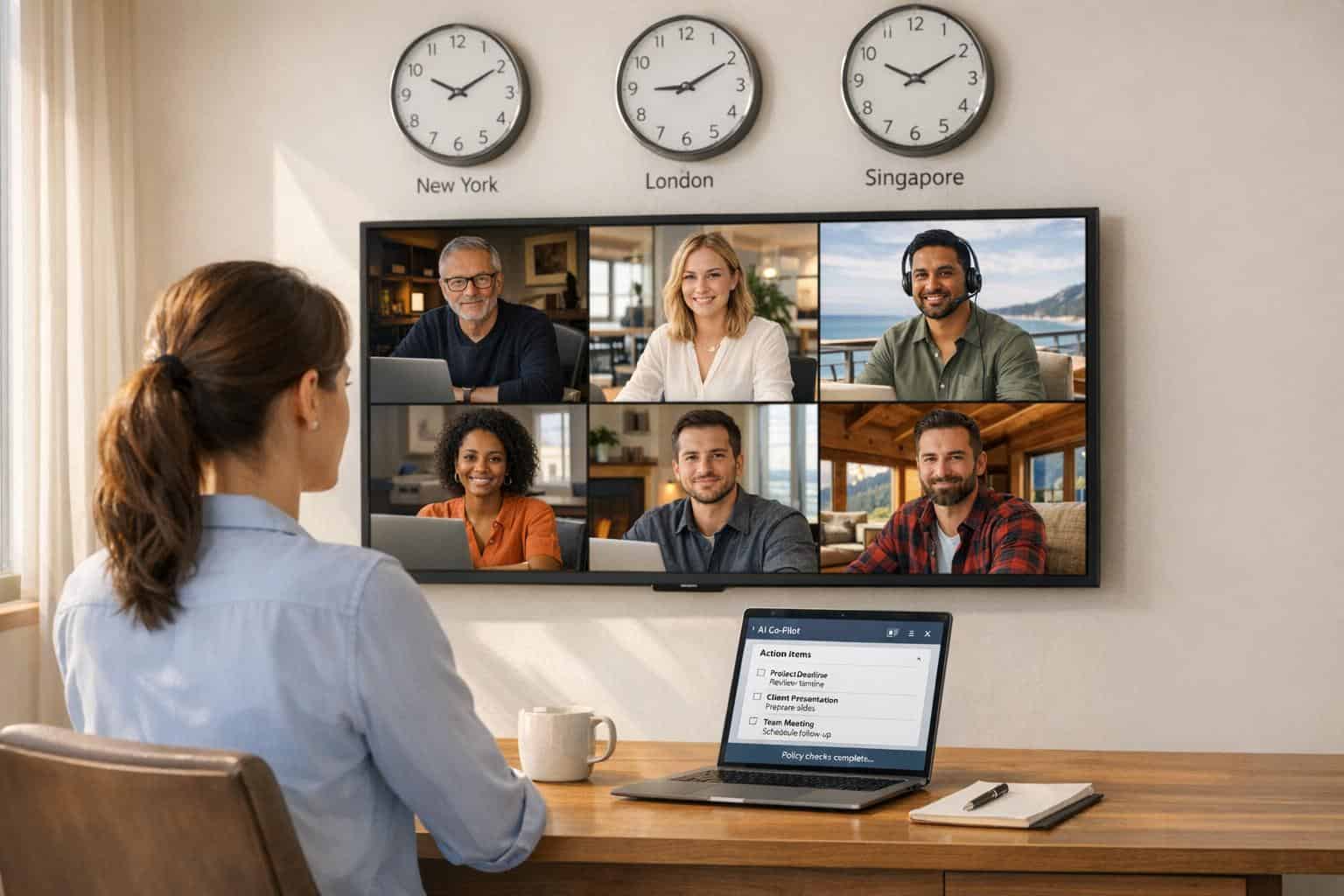
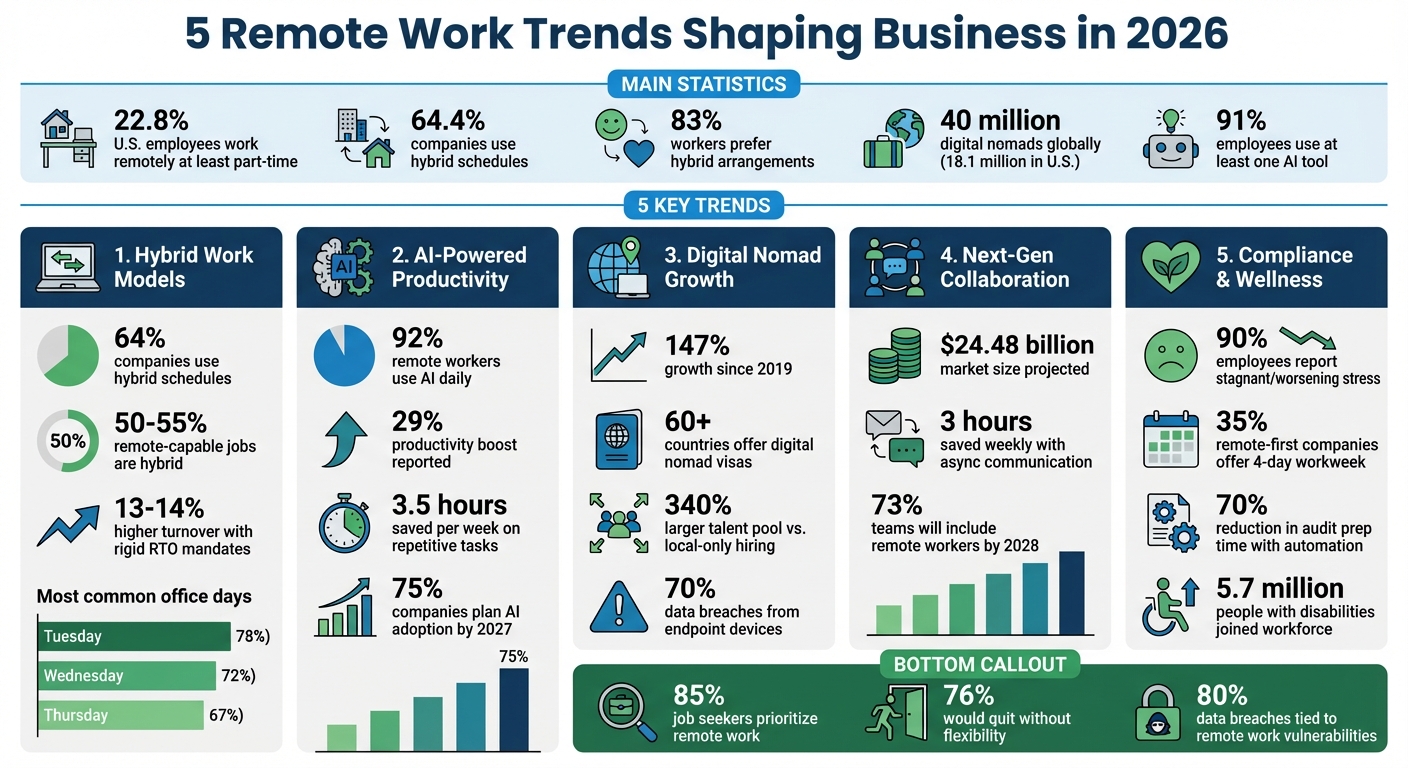
Remote work is no longer a temporary fix – it’s now a core part of how businesses operate. By 2026, 22.8% of U.S. employees work remotely at least part-time, with hybrid schedules leading the way. This shift has changed workplace dynamics, creating both opportunities and challenges for businesses. Here are the 5 key trends driving remote work today:
- Hybrid Work Models Dominate: Over 64% of companies now use hybrid schedules, with a focus on flexibility and outcome-based performance reviews.
- AI-Powered Productivity Tools: AI adoption has soared, with 91% of employees using it to save time and improve efficiency.
- Rise of Digital Nomads: Over 40 million people globally, including 18.1 million in the U.S., are working remotely while traveling, expanding the talent pool for businesses.
- Advanced Collaboration Platforms: Tools now prioritize asynchronous communication, AI integration, and even lightweight VR for global teamwork.
- Compliance and Wellness Programs: Automated compliance systems and wellness initiatives like mental health stipends address legal and employee satisfaction needs.
These trends highlight how businesses are using technology, flexibility, and global talent to stay competitive. But challenges like tax compliance, security risks, and employee burnout require careful planning. Companies that invest in the right tools and policies now will thrive in this new remote-first world.
Remote Work Statistics and Trends 2026: Key Data Points
1. Hybrid Work Models Become Standard
Hybrid work has become the go-to model for organizations. By 2026, it’s estimated that 64.4% of companies will rely on hybrid schedules, making it the leading structure for remote-capable roles. This shift aligns with employee preferences, as 83% of workers in these roles favor hybrid arrangements. Currently, hybrid positions make up around 50–55% of remote-capable jobs.
Impact on Workforce Management
The rise of hybrid work has reshaped how companies manage and evaluate performance. Instead of focusing on hours worked, only 12% of performance reviews now center on outcomes. This trend is expected to grow, with organizations increasingly prioritizing project milestones and customer satisfaction over traditional metrics. Fernanda Grace Lins from Global Workplace Solutions & Market Expansion at Croissant highlights the challenge:
"Hybrid work models don’t fail because people aren’t productive. More often it’s because companies impose outdated management practices on new work models."
Rigid return-to-office mandates are proving costly, with companies enforcing such policies seeing 13–14% higher turnover rates. In fact, 64% of remote workers say they’d quit if flexibility was taken away. Companies that opt to design rather than dictate office attendance – focusing on data-driven strategies – achieve better results. In-person time is increasingly reserved for activities like mentoring and strategic collaboration, which deliver higher value .
As hybrid work evolves, new technologies are stepping in to support these changes.
Adoption of Emerging Technologies
Technology has become a cornerstone of the hybrid work model. AI adoption among hybrid workers has reached 89%, with tools now streamlining tasks like transcription and scheduling. Asynchronous communication is gaining traction, with businesses relying on video messages and detailed documentation to accommodate deep work across different time zones.
Office spaces are also shifting in purpose. Instead of focusing on square footage, companies are using utilization data to redesign offices as hubs for collaboration rather than employee oversight.
These technological advancements are paving the way for actionable strategies that benefit entrepreneurs.
Practical Solutions for Entrepreneurs
Small businesses are finding creative ways to run a business remotely and thrive in the hybrid landscape. Many are turning to fractional roles – such as part-time executive assistants or marketing specialists – to balance scaling needs with cash flow. Additionally, over 35% of remote-first companies have adopted a 4-day workweek to reduce burnout and boost retention.
When crafting hybrid policies, involving employees in decisions can make a big difference. For instance, "anchor days" for in-person collaboration are increasingly popular. Flex Index data reveals that Tuesday (78%), Wednesday (72%), and Thursday (67%) are the most common office days, while Friday lags far behind at just 8%. Businesses can also use time-tracking tools to analyze work patterns, identifying which tasks are better suited for remote or in-person settings. This allows them to establish effective asynchronous rituals, like weekly planning, that work seamlessly across all locations.
sbb-itb-ba0a4be
2. AI-Powered Productivity Tools
With the rise of hybrid work and advanced technology, AI has become a key driver of productivity. It plays a crucial role in remote work environments. By 2026, an impressive 91% of employees are expected to report that their organizations utilize at least one AI tool. Meanwhile, 92% of remote workers already rely on AI daily for tasks like drafting emails, summarizing meetings, and managing schedules. Those using AI tools report a 29% productivity boost and save an average of 3.5 hours per week on repetitive tasks.
Impact on Workforce Management
AI is transforming how companies approach performance measurement, shifting the focus from hours worked to outcomes achieved. By automating tasks like scheduling across time zones, managing emails, and summarizing meetings, AI reduces administrative burdens. This allows managers and employees to concentrate on strategic, high-impact work. It also supports asynchronous workflows, enabling teams in different time zones to collaborate effectively without constant real-time meetings. Automated documentation and seamless handoffs ensure smooth operations.
"The future belongs to those who can balance technology with human-centric skills – using AI to handle administrative overhead while focusing human energy on creativity, connection, and strategic thinking."
Organizations that adopt ethical AI tools are seeing real benefits, including a 28% rise in voluntary knowledge sharing and a 31% drop in burnout symptoms. This shift is opening the door to advanced AI technologies that further optimize workflows.
Adoption of Emerging Technologies
Today’s platforms are integrating specialized AI agents, such as Business Co-Pilots for strategy and Personal Secretaries for scheduling. These tools are powered by advanced models like GPT-5.2, Claude Opus 4.5, and Gemini 3 Pro. Using the Model Context Protocol (MCP), these AI assistants seamlessly connect with tools like Gmail, Google Calendar, Notion, and Dropbox, creating a unified system.
Security remains a top priority, especially as over 80% of data breaches occur in remote or hybrid work settings. AI-driven Autonomous Endpoint Management (AEM) tools are stepping in to automate tasks like operating system updates and vulnerability fixes, resulting in a 52% drop in security incidents.
Beyond internal operations, AI is proving indispensable for virtual businesses.
Support for Virtual Business Formation
AI is removing traditional obstacles in areas like document creation and team management. For example, document generators can produce polished deliverables from simple prompts. AI-powered onboarding systems are reducing the time it takes to onboard new hires by 67% through adaptive learning and virtual buddy systems. Virtual businesses are also leveraging AI to manage fractional teams – part-time specialists who help maintain flexibility while keeping costs in check. With 75% of companies planning to adopt AI by 2027, early adopters are gaining a clear edge. In fact, companies that scale AI effectively are seeing three times higher shareholder returns compared to those that don’t.
Practical Solutions for Entrepreneurs
Entrepreneurs can take advantage of these advancements to streamline their business operations. Many AI platforms offer flexible pricing, with options ranging from free basic features to premium plans costing up to $200 per month. The key is to develop AI fluency – learning how to effectively work with specialized AI agents rather than just relying on basic tools.
To make the most of AI, focus on automating your biggest time sinks. For example, use AI Business Co-Pilots for tasks like financial modeling and market analysis. Automate document workflows to eliminate repetitive formatting tasks. At the same time, clearly define which tasks should remain human-led to avoid confusion and maintain team alignment.
3. Growth of the Digital Nomad Workforce
The digital nomad workforce has surged to over 40 million people globally by 2026, with 18.1 million based in the United States – a staggering 147% growth since 2019. Over 60 countries, including Portugal, Spain, Croatia, and Thailand, now offer digital nomad visas. This global shift gives businesses access to a talent pool that’s 340% larger than what local-only hiring offers. However, this also brings new challenges in managing and complying with workforce regulations, pushing companies to rethink their management strategies.
Impact on Workforce Management
Managing digital nomads requires a fresh approach. Instead of tracking employees’ online presence, businesses now focus on deliverables. Real-time meetings are being replaced with documented workflows, recorded updates, and written proposals that team members can access asynchronously. Many companies also rely on fractional roles – such as part-time executive assistants, marketing specialists, or financial leaders – to handle project needs across time zones without committing to full-time hires .
Support for Virtual Business Formation
For entrepreneurs creating virtual businesses, the rise of digital nomads brings both opportunities and hurdles. While the expanded talent pool is enticing, navigating compliance issues like cross-border taxes, labor laws, and contractor classifications can be tricky. Employer of Record (EOR) services are becoming critical tools, handling international payroll, local labor regulations, and tax compliance to minimize the risks of misclassification.
Another pressing issue is security. Around 70% of data breaches originate from endpoint devices. Adopting Zero Trust security models with multi-factor authentication helps safeguard sensitive data when employees access systems via public networks. Formalized BYOD (Bring Your Own Device) policies are also essential. These should include mandatory encryption and standardized software, as remote-work data breaches cost an average of $1.07 million more than those occurring in office environments .
Practical Solutions for Entrepreneurs
To fully leverage the digital nomad trend, entrepreneurs need targeted strategies. Begin by building a robust infrastructure for global operations. Tools like BusinessAnywhere cater specifically to digital nomads and remote businesses, offering U.S. business registration, virtual mailbox services, and compliance support. Their Digital Nomad Kit provides a one-stop solution, bundling LLC registration, EIN application, registered agent services, and banking setup assistance.
Shift to written documentation for critical decisions. This creates a searchable knowledge base that team members can access anytime, regardless of time zones. Use video messages for updates where tone and context matter, but rely on text for decisions that may need to be revisited.
When hiring, focus on portfolios and proven skills rather than traditional credentials. For instance, a developer’s GitHub contributions or a designer’s portfolio often reveal more about their capabilities than a degree.
Lastly, don’t overlook employee wellness. With 86% of fully remote workers reporting burnout, offering mental health stipends and virtual wellness programs can make a big difference. Encourage clear boundaries around response times and promote work-free zones in schedules, even for those working from the best digital nomad cities.
4. Next-Generation Collaboration Platforms
By 2026, collaboration tools will do much more than just host video calls or facilitate chatting. The global collaboration software market is projected to hit $24.48 billion, largely thanks to the integration of AI as a standard coworker. A striking 92% of remote workers already rely on AI daily for tasks like drafting emails, summarizing meetings, and managing schedules. These advancements are fundamentally reshaping how distributed teams work, moving away from constant real-time meetings to asynchronous communication that accommodates deep focus and global time zones.
Adoption of Emerging Technologies
One of the most significant changes is the adoption of async-first communication methods. These include video messages and detailed documentation, which allow teams to save up to 3 hours each week.
Virtual reality is also stepping into the workplace. Lightweight VR headsets from companies like Meta and Apple are now being used for daily standups and collaborative sessions, helping distributed teams feel more socially connected. On top of that, AI is optimizing meetings with features like automated transcription, facial recognition-powered name tags, and smart tools for assigning follow-up tasks – all aimed at reducing the friction of traditional meetings.
These advancements are also influencing how employee performance is managed.
Impact on Workforce Management
Modern collaboration platforms are shifting the focus of performance tracking. Instead of monitoring hours logged, managers are now prioritizing outcomes and the quality of work. This shift is happening even as 26% of workers report increased use of time-tracking software by employers in 2025. The best platforms steer clear of invasive practices like keystroke logging, opting instead for non-intrusive tools like productivity scoring and burnout detection to support employee well-being.
"Hybrid work has officially graduated from a temporary experiment to the way modern business gets done." – Matthew Saxon, Chief People Officer, Zoom
These platforms are also making it easier to hire part-time specialists.
Beyond improving workforce efficiency, they’re becoming essential for building virtual businesses.
Support for Virtual Business Formation
Next-generation platforms are providing the backbone for entrepreneurs creating virtual businesses. Features like integrated Employer of Record (EOR) services and global payroll systems simplify international hiring by automatically managing local labor laws, taxes, and data privacy requirements. This is especially important as 73% of teams are expected to include remote workers by 2028.
These platforms also document workflows and ensure smooth handoffs, creating searchable knowledge bases that new team members can access anytime, anywhere. For smaller teams, AI integration allows them to work as efficiently as larger organizations by automating repetitive tasks like data cleanup, email drafting, and schedule management.
Security remains a top priority. Modern platforms are adopting Zero Trust security principles and autonomous endpoint management to provide real-time insights into vulnerabilities and automate patching. This proactive approach helps prevent breaches rather than just detecting them.
Practical Solutions for Entrepreneurs
As virtual work environments continue to evolve, there are actionable steps to ensure smooth and secure operations. Start by auditing your current tools and training your team to fully utilize platform features. Shift to async-first communication by using recorded video updates and shared documentation instead of live meetings. Focus on deliverables and milestones to build trust and autonomy within your team. For global hiring, choose platforms with built-in compliance tools or partner with EOR services to handle cross-border regulations effortlessly.
For entrepreneurs running virtual businesses, platforms like BusinessAnywhere offer essential services alongside collaboration tools. They provide U.S. business registration, virtual mailboxes with unlimited scanning, and compliance support – all accessible through a single dashboard. The Digital Nomad Kit includes LLC registration, EIN application, registered agent services, and banking setup assistance, giving you everything you need to establish and grow your distributed team.
Lastly, prioritize robust security protocols for all remote team members. Require encrypted home networks, multi-factor authentication, and standardized software to minimize the heightened risk of data breaches in distributed setups.
5. Compliance Automation and Employee Wellness Programs
As remote work continues to reshape how businesses operate, companies are prioritizing automated compliance systems and employee wellness programs to ensure productivity and satisfaction. By 2026, compliance has become a key focus, especially with over 34 million Americans working remotely as of April 2025. Small businesses, in particular, must navigate a complex web of multi-state and international regulations. At the same time, stress remains a growing concern, with 90% of employees reporting stagnant or worsening stress levels. The answer lies in leveraging automation to manage legal challenges while reallocating resources to support employee well-being.
Adoption of Emerging Technologies
AI-powered compliance tools are revolutionizing how virtual businesses handle regulations. These platforms can automatically track employee locations and apply jurisdiction-specific rules for payroll, taxes, and leave . By integrating with cloud services, these tools also streamline audit processes, cutting preparation time by up to 70%.
New legislation is further driving the adoption of these technologies. For example, the Colorado AI Act, effective February 2026, mandates annual impact assessments and bias testing for companies using AI in hiring or performance evaluations. Violations can result in fines exceeding $500,000. Similarly, updates to digital I-9 and E-Verify systems now allow for automated recordkeeping and remote document verification, reducing manual errors and the risk of penalties.
Worker misclassification is another area where automation is making a difference. Misclassifying workers affects 10%-30% of employers and can lead to hefty back-pay and tax penalties. Automated systems help prevent these issues by using algorithms to assess classification risks.
These advancements not only simplify compliance but also free up resources for other priorities.
Impact on Workforce Management
Automating compliance tasks reduces risks and allows teams to focus on strategic goals instead of administrative burdens . This shift is especially important as 47% of workers identify a lack of flexibility as a dealbreaker when deciding to join or stay with a company.
While automation improves efficiency, wellness programs have shifted from optional perks to essential offerings. Therapy stipends, mental health days, and dedicated wellness budgets are now standard parts of remote-first employment packages. For instance, 35% of remote-first companies offer a 4-day workweek as a way to boost both productivity and wellness. Additionally, 37% of remote workers use time saved from commuting to focus on their mental health.
"Remote work is no longer an experiment. It is a core operating model. Companies that treat it as infrastructure, not a perk, will outperform in talent access, productivity, and resilience." – Aljon Tope
The benefits of remote work extend beyond convenience. For example, 5.7 million people with disabilities have joined the U.S. workforce, thanks to the accessibility provided by remote work arrangements.
These operational improvements also enhance the process of forming and managing virtual businesses.
Support for Virtual Business Formation
For entrepreneurs building virtual businesses, compliance automation is a game-changer. Platforms with Employer of Record (EOR) services manage multi-jurisdictional reporting and data localization laws, enabling businesses to operate globally without needing to establish local legal entities . This is particularly useful since even one remote employee can create a "tax nexus", triggering corporate income and sales tax obligations in a new state. Automation also helps with pay transparency by generating salary range disclosures for job postings and conducting internal pay equity analyses ahead of regulatory deadlines.
BusinessAnywhere is a platform that simplifies virtual business formation by combining compliance tools with essential services. For $37, it offers BOIR filing to meet FinCEN beneficial ownership requirements, along with registered agent services that provide compliance alerts and protect privacy. For digital nomads managing distributed teams, the Digital Nomad Kit includes LLC registration, EIN application, and ongoing compliance support – all accessible via a single dashboard.
Practical Solutions for Entrepreneurs
Instead of trying to automate every aspect of compliance, focus on one key regulation, like GDPR for EU customers or SOC 2 for enterprise clients. Use EOR services to hire in new states or countries without the complexity of setting up a local legal entity .
Automated leave tracking can help manage federal, state, and local requirements. For businesses using AI in hiring, adopting the NIST AI Risk Management Framework provides a solid defense against discrimination claims.
Real-time dashboards can help address compliance issues before they escalate into audit failures . Additionally, ensure HR and payroll systems are aligned before employees relocate to avoid tax nexus exposure and unregistered payroll liabilities.
| Compliance Area | 2026 Requirement | Automation Benefit |
|---|---|---|
| AI Governance | Mandatory bias audits (CO, IL, NYC) | Automated bias audits and selection tracking |
| Pay Transparency | Salary range disclosure in job ads | Real-time market data integration and range generation |
| Paid Leave | 15+ U.S. states with unique programs | Automated accrual tracking based on employee location |
| Worker Status | Stricter 1099 vs. W2 definitions | Algorithmic classification risk assessments |
| Wellness | Mental health support expectations | Automated stipend administration and wellness platforms |
How Businesses Can Apply These Trends
Businesses can use these trends to rethink their strategies and operations. The shift toward remote and hybrid work is clear in the numbers. At the start of 2023, on-site job postings peaked at 83%. However, as the year went on, these dipped to 66%, eventually stabilizing around 65% by Q4 2025. Hybrid roles held steady at 24%, while remote jobs peaked at 15% in Q4 2024 before settling at 11% by the end of 2025. As Stanford economist Nick Bloom aptly put it:
"the mix of remote vs office days remains ‘flat as a pancake’"
Different industries are adapting to these changes in unique ways. By Q4 2025, Marketing & Creative roles took the lead in offering flexible work options, with 44% of postings being flexible – split into 30% hybrid and 14% remote. Technology roles followed closely with 42% flexibility (29% hybrid and 13% remote). Finance & Accounting and Legal roles each offered around 39% flexibility, while Human Resources trailed at 31%. Experience level also matters: senior roles (requiring 5+ years of experience) offered 30% hybrid and 13% remote options, compared to entry-level roles, which offered just 18% hybrid and 9% remote. For small businesses, this opens the door to target mid-career professionals who value flexibility and are open to fractional or contract roles.
To make the most of these trends, businesses need the right tools and infrastructure. For example, BusinessAnywhere offers a virtual mailbox service starting at $20/month, giving companies a professional U.S. address with unlimited mail scanning and global forwarding. This ensures a centralized presence, even for teams spread across cities or countries. On the compliance side, the $37 BOIR filing service helps businesses meet FinCEN beneficial ownership requirements, while registered agent services provide privacy protection and compliance alerts. For digital nomads or businesses managing distributed teams, the Digital Nomad Kit is a one-stop solution that bundles LLC registration, EIN application, and ongoing compliance support into a single dashboard.
The benefits of adapting to these trends are evident: 76% of companies report improved employee retention when they offer remote work options. By investing in remote-friendly tools and building strong compliance systems, businesses can better attract and retain top talent, ensuring they remain competitive through 2026 and beyond. These steps align seamlessly with earlier efforts to refine remote and hybrid work strategies.
Conclusion
The five trends shaping remote work in 2026 – hybrid work models, AI-driven tools, the rise of digital nomads, advanced collaboration platforms, and compliance automation – are reshaping how businesses operate. These shifts enable companies to retain top talent and tap into global talent pools, meeting the growing demand for flexible work arrangements.
Ignoring these trends could lead to serious challenges. For instance, 85% of job seekers now prioritize remote work, and 76% of employees would consider quitting if flexibility isn’t offered. Beyond retaining talent, there are operational risks: over 80% of data breaches are tied to vulnerabilities in remote work setups. Without proper infrastructure, compliance measures, and security protocols, businesses risk legal issues and losing their competitive standing.
Virtual tools play a critical role in navigating this new landscape. BusinessAnywhere offers solutions tailored for distributed teams, such as a $20/month virtual mailbox that provides a professional U.S. address and a $37 BOIR filing service to ensure FinCEN compliance. Their Digital Nomad Kit simplifies LLC registration and ongoing compliance, removing barriers that often slow global teams.
Remote and hybrid work is no longer a passing trend – it’s the new normal. As Stanford economist Nick Bloom observed, "the mix of remote vs office days remains ‘flat as a pancake’". Companies succeeding in this environment are those investing in secure systems, formalizing flexible work policies, and building operational frameworks that function seamlessly across locations.
The future of work is already unfolding. The key question is: how quickly can your business adapt to these changes to stay ahead? Acting now ensures you’re not just keeping up but thriving in this evolving work environment.
FAQs
How do I pick the right hybrid schedule for my team?
To pick the best hybrid schedule, think about flexibility, employee needs, and your company’s objectives. Begin by understanding what your team requires – by 2026, most employees will prefer hybrid work setups. Instead of emphasizing fixed office locations, prioritize flexible hours to enhance both productivity and job satisfaction. Strike a balance between collaboration and focused work by coordinating in-office and remote days to match your goals. Regularly collect feedback and keep an eye on trends like asynchronous communication and AI advancements to fine-tune your strategy.
Which AI tasks should I automate first in a small business?
Automating repetitive tasks is a smart way for small businesses to save time and reduce expenses. Tasks like handling customer inquiries, managing invoices, generating reports, and entering data can be streamlined with automation tools. For example, AI chatbots can offer round-the-clock customer support, ensuring quick responses without the need for constant human involvement. Similarly, automating HR processes – such as recruitment and onboarding – can simplify workflows and free up valuable resources.
Focusing on these areas not only improves efficiency but also helps businesses remain competitive in the evolving, AI-focused, remote-friendly work environment of 2026.
How can I hire digital nomads without triggering tax or labor issues?
To bring digital nomads into your team without running into tax or labor complications, Employer of Record (EOR) services can be a smart solution. These providers take care of compliance, payroll, and tax responsibilities across different regions, ensuring your hiring aligns with local labor laws. Partnering with an EOR helps reduce legal risks and simplifies the process of managing a global workforce. Staying up-to-date on international regulations and collaborating with experts in this field can make cross-border hiring smoother and more efficient.