

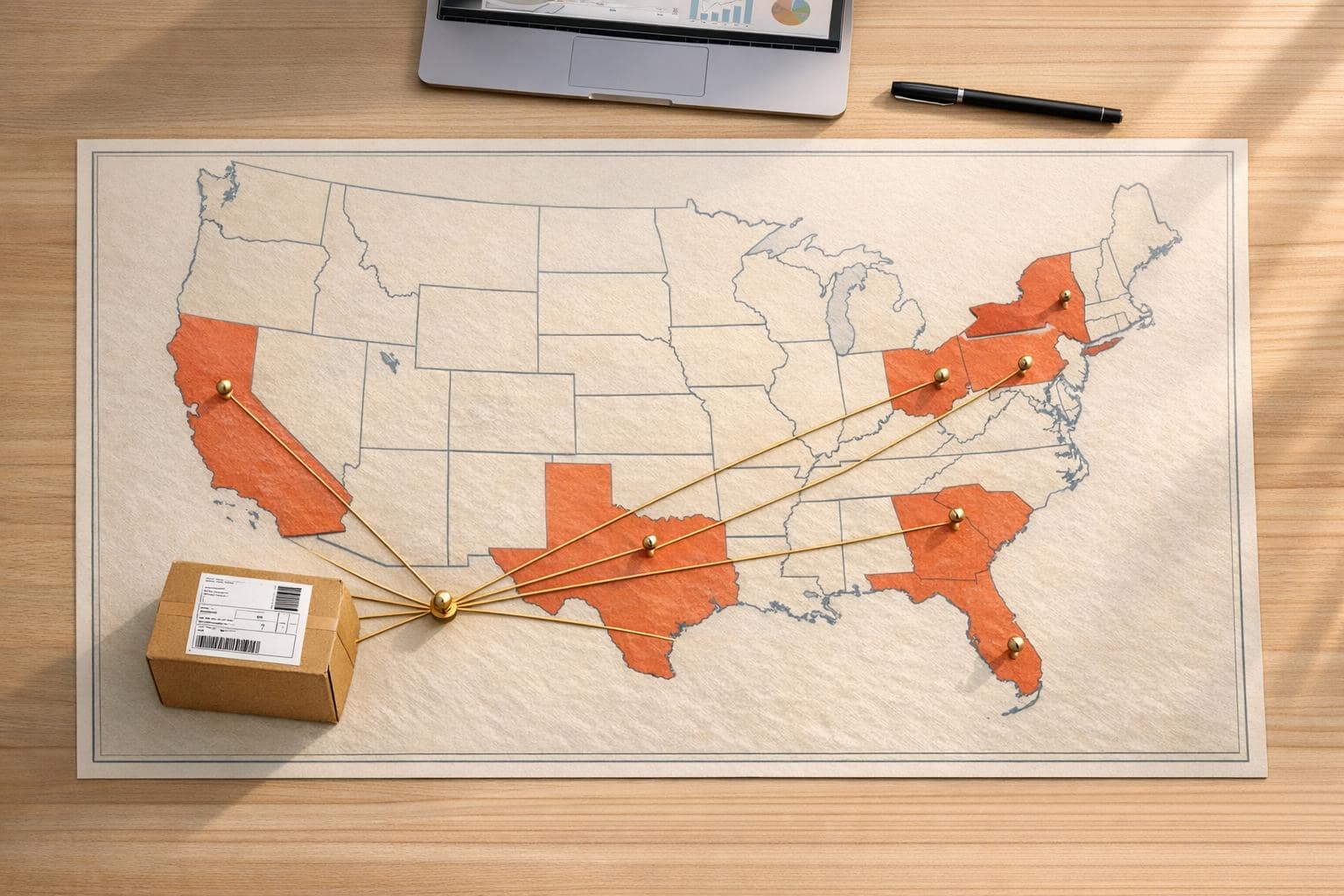
If you sell online, you might need to collect sales tax in states where your business has a "nexus." Nexus is the legal connection between your business and a state, which determines whether you must collect and remit sales tax there. This connection can be triggered by factors like physical presence (e.g., inventory in a warehouse), economic activity (e.g., sales thresholds), or affiliate relationships.
Here’s what you need to know:
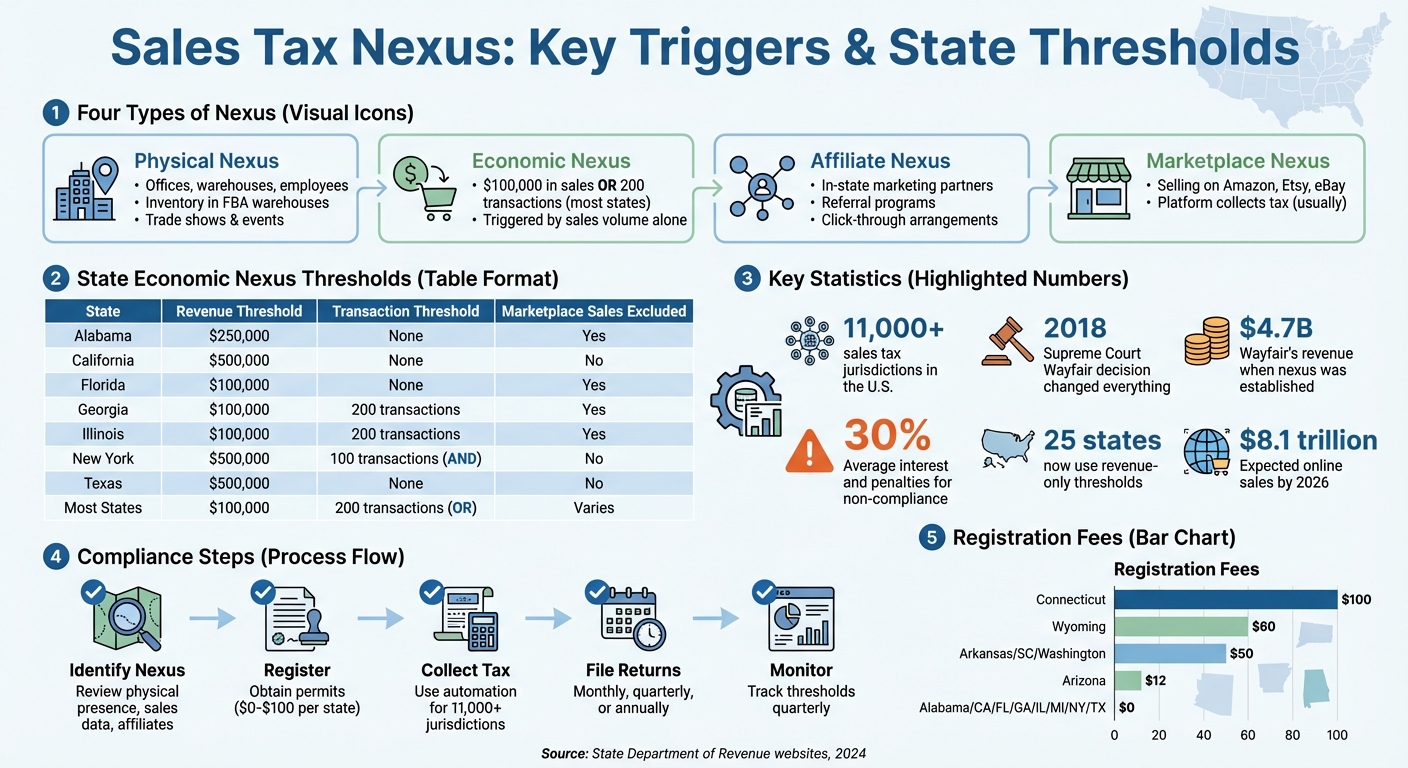
- Nexus Types: Physical (e.g., offices, employees), Economic (e.g., $100,000 in sales or 200 transactions in a state), Affiliate (e.g., referral programs), and Marketplace (e.g., selling on Amazon or Etsy).
- Key Ruling: The 2018 Supreme Court decision in South Dakota v. Wayfair, Inc. allows states to enforce economic nexus rules, even if you don’t have a physical presence.
- Risks of Non-Compliance: Not collecting sales tax can lead to penalties, interest, and personal liability for unpaid taxes.
- Steps to Stay Compliant: Identify where you have nexus, register for sales tax permits, track state-specific thresholds, and use software to calculate and remit taxes accurately.
With over 11,000 sales tax jurisdictions in the U.S., tracking obligations can be overwhelming. But understanding nexus rules and monitoring your sales activity can help you avoid costly mistakes and protect your business.
Sales Tax Nexus Triggers and State Thresholds for Online Businesses
What Sales Tax Nexus Means for Your Business
Sales tax nexus refers to the legal link between your business and a state, giving that state the authority to require you to collect and remit sales tax. Essentially, it ties your business to a state’s tax system. Once this connection is established, you’re responsible for tasks like registering for permits, calculating taxes, and filing returns.
The way nexus is triggered has shifted significantly over time. Today, it can be activated by factors like physical presence, sales thresholds, storing inventory, or affiliate relationships. Understanding these triggers is essential to avoid unexpected tax liabilities or legal troubles. This connection forms the basis for understanding the rules and responsibilities that come with it.
The Legal Foundation of Sales Tax Nexus
Sales tax nexus is rooted in two key constitutional principles: the Due Process Clause and the Commerce Clause. The Due Process Clause ensures there’s a minimum connection between a state and the taxpayer or transaction being taxed. The Commerce Clause, on the other hand, requires a "substantial nexus" and prevents states from placing undue burdens on interstate commerce.
Historically, the Commerce Clause limited state tax enforcement to businesses with a physical presence – like offices, warehouses, or employees – within state borders. This was reinforced by the 1992 Supreme Court ruling in Quill Corp. v. North Dakota, which cemented the physical presence requirement. However, this created a loophole for online sellers, exempting many from tax obligations and costing states significant revenue. Over time, this led to the expansion of nexus definitions to include economic and virtual connections.
The game changed on June 21, 2018, when the Supreme Court issued its decision in South Dakota v. Wayfair, Inc.. The court ruled that Wayfair, a company with over $4.7 billion in revenue, had established a "substantial nexus" in South Dakota through its virtual presence, even without any physical property or employees in the state. Justice Anthony Kennedy stated that the physical presence rule from Quill was "unsound and incorrect", arguing that it hindered states’ ability to thrive and created an uneven playing field for businesses.
This decision reshaped the landscape of online commerce. States began adopting economic nexus standards, which are triggered when businesses meet specific sales or transaction thresholds. Most states followed South Dakota’s model – typically $100,000 in annual sales or 200 separate transactions. Today, every state with a statewide sales tax has implemented economic nexus rules.
Why Understanding Nexus Protects Your Business
Knowing your nexus thresholds is critical for safeguarding your business. Overlooking these rules can lead to severe consequences, including personal liability for unpaid taxes, interest, penalties, and audits. States like Connecticut, Illinois, New York, and Pennsylvania are actively using data mining to track down out-of-state sellers who have triggered nexus but failed to register.
If you discover past tax liabilities, you might be able to mitigate them through a Voluntary Disclosure Agreement (VDA), which can reduce back taxes and waive penalties. Before you register for a sales tax permit, it’s crucial to identify when your nexus first began – whether it was triggered by storing inventory in an Amazon FBA warehouse or crossing a sales threshold.
Even if your business sells only tax-exempt products, some states still require registration and the filing of "zero" returns once nexus is established. As the Washington State Department of Revenue explains, "physical presence is a nexus standard that requires only more than the slightest presence". This means even minimal connections can create tax obligations, making it essential to stay informed and prepared. Understanding these rules now will set the stage for tackling compliance in the next sections.
sbb-itb-ba0a4be
What Triggers Sales Tax Nexus
Understanding what triggers sales tax nexus is crucial for online sellers aiming to stay compliant. Nexus can be established in several ways, and many sellers unintentionally create tax obligations in multiple states. These triggers generally fall into four categories: physical, economic, affiliate/click-through, and marketplace facilitator.
Physical Nexus: Location-Based Triggers
Physical nexus arises from having a tangible connection to a state. This could mean owning or leasing property, employing staff, or even engaging contractors in that state. Even remote employees can establish a nexus.
A common surprise for online sellers is how stored inventory can create nexus. For example, inventory stored in third-party fulfillment centers, like Amazon FBA warehouses, establishes a physical presence in those states.
Temporary activities – like attending trade shows or visiting clients – can also trigger nexus depending on state laws. To evaluate your physical nexus, track where your employees work, where your inventory is stored, and whether you regularly attend events in specific states. Reviewing inventory location reports can help confirm your physical presence.
But physical presence isn’t the only way to trigger nexus – your sales activity can also play a role.
Economic Nexus: Sales and Transaction Thresholds
Economic nexus is determined by your sales activity within a state, regardless of whether you have a physical presence. After the 2018 South Dakota v. Wayfair decision, states began enforcing economic nexus rules based on revenue or transaction thresholds.
While most states set their thresholds at $100,000 in sales or 200 transactions annually, there are exceptions. For example:
- California and Texas have higher thresholds at $500,000.
- New York requires both $500,000 in sales and 100 transactions.
- Alabama enforces a $250,000 threshold but doesn’t count transactions.
Some states are simplifying their rules. About 25 states now rely solely on revenue thresholds, removing the transaction count requirement. States like Indiana and South Dakota no longer consider transaction volume at all. However, these thresholds are calculated differently – some use the previous calendar year, while others use a rolling 12-month period. This makes it essential to regularly monitor your gross revenue and transaction counts.
| State | Economic Nexus Threshold | Transaction Threshold | Marketplace Sales Excluded |
|---|---|---|---|
| Alabama | $250,000 | None | Yes |
| California | $500,000 | None | No |
| Florida | $100,000 | None | Yes |
| Georgia | $100,000 | Or 200 Transactions | Yes |
| Illinois | $100,000 | Or 200 Transactions | Yes |
| New York | $500,000 | And 100 Transactions | No |
| Texas | $500,000 | None | No |
Beyond physical and economic factors, relationships formed through marketing can also create nexus.
Affiliate and Click-Through Nexus
Affiliate nexus occurs when your business has partnerships with in-state entities – like subsidiaries or representatives – that help you enter or maintain a market. These relationships can create tax obligations.
Click-through nexus, on the other hand, is triggered when you reward an in-state person or business for referring customers via website links. About 15 states have specific click-through nexus laws, and their thresholds are often lower than those for economic nexus. For instance:
- Georgia sets the threshold at $50,000 in referral sales over the previous 12 months.
- Idaho has a much lower threshold of $10,000.
"Click-through nexus laws establish a sales tax obligation for remote retailers that reward persons in the state for directly or indirectly referring potential purchasers through links on a website." – Gail Cole, Avalara
To determine if you’re affected, review your referral programs and track where your affiliates are located. Keep a close eye on sales generated through referral links, as these can also count toward your economic nexus thresholds.
Marketplace Facilitator Nexus
If you sell on platforms like Amazon, Etsy, or eBay, these marketplaces typically handle sales tax collection and remittance for you. Marketplace facilitator laws require these platforms to collect tax on behalf of sellers in most states, easing the compliance burden.
However, there are exceptions. Some states, like Connecticut, still require sellers to register and file returns even when the marketplace collects the tax. Additionally, if you make direct sales through your own website, you’re responsible for collecting and remitting tax on those transactions.
"The devil is in the details… inventory establishes physical nexus in many states, but some states may provide an exception for inventory stored in a facility owned and operated by a marketplace." – Gail Cole, Avalara
For sellers using platforms like Amazon FBA, inventory storage can create physical nexus in multiple states. It’s crucial to maintain separate records for marketplace sales and direct sales to fully understand your compliance obligations. Don’t assume the marketplace handles everything – tracking all nexus triggers is key to staying compliant across states.
How to Determine Where You Have Nexus
Once you’ve identified the triggers for sales tax nexus, it’s time to take a thorough look at your operations across the country. Many online sellers find they have nexus in more states than they initially thought – sometimes as many as five to ten or even more.
Start by gathering data from payroll systems, inventory reports, sales platforms, and affiliate networks. Record the exact date nexus began in each state, as this "nexus start date" is a common requirement on state sales tax registration forms. If you’ve had nexus for years without registering, you could face back taxes, interest, and penalties. This makes proper documentation absolutely essential.
Document Your Physical Presence
Create a detailed list of states where you have a physical presence. This includes any offices, inventory storage, or employees. Physical presence can also be established through warehouses, retail locations, or even computer servers. For remote workers, independent contractors, and salespeople, their home addresses determine nexus.
If you use third-party fulfillment, such as Amazon FBA, download the "Amazon Inventory Event Detail" report. This report shows when and where your inventory was first stored, giving you the nexus start date you need for registration.
| Physical Nexus Trigger | Documentation Method |
|---|---|
| Employees/Contractors | Use payroll records and home address registries |
| Inventory (3PL/FBA) | Pull inventory movement reports |
| Owned/Leased Property | Collect lease agreements and property tax records |
| Trade Shows/Events | Keep registration receipts and travel logs |
| Equipment/Servers | Review asset registers and service agreements |
Don’t forget temporary activities like trade shows, craft fairs, or client meetings. Even a single day at an event can establish nexus in some states. Start by documenting all aspects of your physical presence.
Calculate Your Sales by State
Economic nexus rules vary by state, and tracking your sales accurately is crucial. Some states calculate nexus based on the previous calendar year, others on the current year, and some use a rolling 12-month period. Export your sales data by "Ship To" state from your e-commerce platform, as states determine economic activity based on where customers receive goods, not their billing addresses.
Separate taxable sales from exempt sales (like wholesale transactions), as states have different rules about what counts toward thresholds. For example, California includes all sales, even nontaxable ones, in its $500,000 threshold, while Florida only counts taxable retail sales for its $100,000 threshold.
"What trips sellers up is that states calculate nexus differently… some states count gross sales, including exempt transactions, while others count only taxable sales." – Tom Hoopes, TaxCloud
If you sell through marketplaces like Amazon or Etsy, check whether platform sales count toward state thresholds. In states like Texas and California, marketplace sales are included, but in Florida and Alabama, they’re excluded if the marketplace facilitator is registered. Some states, such as Illinois, require quarterly reviews based on the prior 12 months. Set up a regular schedule to monitor your sales data.
Review Your Affiliate and Marketplace Connections
Document all partners, influencers, or referral agents who help drive sales, and identify their states of residence. If you’re paying in-state residents for referrals and those sales exceed state thresholds, you may have click-through nexus. For instance, Georgia sets the threshold at $50,000 in referral sales over 12 months, while Idaho’s is just $10,000.
For marketplace sellers, verify whether platforms like Amazon, Etsy, or eBay are collecting tax in states with marketplace facilitator laws. Check each platform’s tax settings to confirm. However, even when the marketplace collects tax, those sales might still count toward your economic nexus thresholds in certain states.
If you use Amazon FBA or other third-party logistics providers, review your fulfillment center reports to identify where inventory is stored. Physical nexus is created by inventory storage, even if sales volume is low. You might discover products stored in warehouses across multiple states, each requiring separate registration.
Build Your Nexus Map
Combine all your findings – physical, economic, and affiliate-related – into a single document or "nexus map." This map should list each state where you have obligations, the type of nexus (physical, economic, or both), and the date nexus began. Include the specific thresholds that triggered economic nexus and note whether marketplace sales are included in each state’s calculation.
Update this map quarterly, especially if you’re approaching thresholds in additional states. With over 12,000 sales and use tax jurisdictions in the U.S., staying organized is key to avoiding costly mistakes. If you discover long-term exposure, consider consulting a tax professional about Voluntary Disclosure Agreements (VDAs). These agreements can reduce the look-back period and waive certain penalties before you register.
Keep copies of all supporting documents – inventory reports, payroll records, lease agreements, and sales data exports. These not only help prove when nexus began but also protect you during audits. A well-maintained nexus map simplifies registration and strengthens your overall compliance strategy.
How to Register and Stay Compliant
Once you’ve determined where your business has a sales tax nexus, the next step is to register for the necessary permits and set up a reliable system for collecting, filing, and remitting taxes. Delaying or skipping registration can lead to back taxes, interest, and penalties – even for unintentional mistakes. With your nexus map ready, here’s a guide to help you handle registration and stay compliant.
Register for Sales Tax Permits
Before collecting sales tax, you must obtain valid permits in every state where you have a nexus. Collecting tax without a permit is not allowed. Head to the Department of Revenue website for each state (look for the ".gov" domain) to avoid unnecessary fees charged by third-party services.
Most states require key business details, including your Federal Employer Identification Number (EIN), primary business address, entity type (like LLC or Corporation), NAICS code (454110 for online stores), and the Social Security Numbers and contact information of the business owners. Be sure to include your nexus start date – the date your business first established a physical or economic presence in the state. For Amazon FBA sellers, this date can be found in your Amazon Inventory Event Detail report.
Registration fees differ by state. Some states – like Alabama, California, Florida, Georgia, Illinois, Michigan, New York, and Texas – don’t charge any fees. In contrast, Connecticut charges $100, Wyoming $60, and Arizona $12 per location. While some states offer instant online registration, mail-in applications can take two to four weeks to process.
If you operate in multiple states, the Streamlined Sales Tax (SST) program can simplify things. This program allows you to register in 24 participating states with a single form. Partnering with a Certified Service Provider (CSP) through the SST program can even make these registrations free.
Be cautious in Home Rule states – Alabama, Alaska, Arizona, Colorado, and Louisiana – where local cities manage their own sales taxes. These states may require additional local registrations. If you’ve had nexus in a state for a while but haven’t registered, consider a Voluntary Disclosure Agreement (VDA). VDAs can limit how far back states can look for unpaid taxes and may waive penalties.
| State | Registration Fee | Registration Portal |
|---|---|---|
| Connecticut | $100 | Department of Revenue Services |
| Wyoming | $60 | WY Department of Revenue |
| Arkansas, South Carolina, Washington | $50 | State Revenue Departments |
| Arizona | $12 per location | AZ Taxes |
| Alabama, California, Florida, Georgia, Illinois, Michigan, New York, Texas | $0 | State Revenue Portals |
Collect and Remit Sales Tax
Once you’ve secured your permits, the focus shifts to collecting and remitting sales tax properly. Charge the correct rate, collect it from buyers, and remit it to the appropriate state authorities on time. Most states use destination-based sourcing, which means you charge tax based on the buyer’s location. However, a few states use origin-based sourcing for in-state sales.
Sales tax rates often combine state, county, city, and special district rates. With over 11,000 tax jurisdictions across the U.S., rates can vary significantly – even within the same state. Automated tax software is a lifesaver here, as it calculates real-time rates based on the buyer’s full address.
For sales to resellers or nonprofits, make sure to collect valid exemption certificates. These documents justify not charging tax on certain transactions. Keep detailed records of all sales, including transaction counts, revenue per state, and whether the sales were taxable or exempt. Failing to collect sales tax when required means your business will have to cover the taxes yourself.
Each state assigns a filing frequency – monthly, quarterly, or annually – based on your estimated sales volume. Filing deadlines are usually on the 20th day of the month following the taxable period.
Meet Filing Deadlines and Keep Records
Missing a filing deadline can lead to penalties and interest charges. Use tools like calendar reminders or automation to stay on top of filing schedules. Tax software such as TaxJar, QuickBooks, and Avalara can calculate rates, track nexus exposure, and manage filings for you.
"Failing to keep pace can expose your business to significant penalties and audit risks." – Sarah Craig, TaxJar
Maintain accurate records comparing collected sales tax with what you owe. This can help you spot and fix calculation errors before an audit. Keep copies of exemption certificates, sales reports, and filed returns for at least three to seven years, depending on the state’s requirements.
If your sales are nearing economic nexus thresholds in new states, use a tracking tool or dashboard to get alerts when you cross $100,000 in revenue or 200 transactions. Regularly update your nexus map – quarterly is a good rule of thumb – to ensure you meet each state’s requirements. Staying proactive with monitoring and record-keeping can save your business from costly surprises and help you remain compliant.
Managing Sales Tax Across Multiple States
Keeping up with tax rules, rates, and deadlines in different states can feel overwhelming. Each state has its own tax system, complete with unique requirements. From varying nexus definitions to economic thresholds and filing schedules, the complexity is undeniable. Add to that the fact that there are over 11,000 tax jurisdictions in the U.S., and it becomes clear that staying compliant requires careful planning.
Navigate State-by-State Tax Differences
One key challenge is understanding how states handle taxes. Some use origin-based sourcing, while others rely on destination-based sourcing, which impacts tax rates and filing processes. For instance, California has a base state tax rate of 7.25%, but local district taxes can increase the total by as much as 2.5%. On the other hand, states like Alaska, Delaware, Montana, New Hampshire, and Oregon don’t impose statewide sales tax at all.
The complexity doesn’t stop there. Product taxability varies widely. For example, SaaS is taxable in Connecticut but not in California. Similarly, items like digital goods, clothing, and groceries are subject to different rules depending on the state. Some states are even simplifying their systems by removing transaction-count thresholds. South Dakota, for example, eliminated its 200-transaction requirement on July 1, 2023, with Indiana following suit. Staying on top of these differences is critical to avoiding penalties and unexpected liabilities.
Given the intricacies of state tax systems, automation can be a game-changer.
Automate Compliance with Software
When you’re managing taxes across multiple states, automation isn’t just helpful – it’s essential. Compliance software tracks your sales revenue and transaction counts, notifying you when you’re approaching a state’s threshold for tax registration. It also calculates tax rates in real-time for different jurisdictions, streamlines filing, and minimizes the risk of audits.
The best tools go beyond basic calculations. They manage product taxability rules, distinguish between taxable and exempt sales, and even handle registration forms automatically. By centralizing transaction data and automating filing and remittance, you can save time and avoid the headache of manually filing returns in dozens of states every month. Many platforms also include dashboards that highlight discrepancies between collected taxes and what’s owed, reducing the chance of triggering an audit. For context, more than 80% of startups using Stripe sell into 20 or more states and countries, making automation a no-brainer for scaling operations.
Consider Professional Compliance Services
If the complexity of multi-state compliance feels like too much to handle, professional services can step in to help. Outsourcing sales tax compliance is a smart option for businesses operating in numerous states or those dealing with past nexus exposure. For example, if you’ve been selling in a state without collecting tax, a Voluntary Disclosure Agreement (VDA) can help you address back taxes while potentially reducing penalties. These agreements, along with multi-year liability calculations, often require the expertise of a CPA or tax advisor.
Outsourcing doesn’t just improve accuracy – it also frees up time and resources so you can focus on growing your business.
"If you should have collected sales tax from your customers but failed to, you’ll have to pay past-due sales tax out of your own pocket with interest and penalties that average 30% of the amount of sales tax due." – Stripe
Conclusion
Take charge of your sales tax compliance with a few key steps. Start by determining where you have nexus – this could be through a physical presence, like storing inventory in warehouses, or by exceeding economic thresholds, such as $100,000 in sales. Once you identify your obligations, register for permits quickly. Waiting too long could result in back taxes, penalties, and interest charges of up to 30%.
Keeping detailed records and automating compliance can save you time and trouble. Make sure to maintain state-specific sales records and important documents like invoices and exemption certificates to prepare for audits. With over 12,000 sales tax jurisdictions in the U.S., manually tracking compliance is nearly impossible. Automation tools can simplify the process by monitoring thresholds, calculating rates at checkout, and managing filing deadlines – all without the hassle of spreadsheets.
If you’ve already triggered nexus but haven’t addressed it, act now. Some states, like Connecticut, Illinois, New York, and Pennsylvania, use data mining to track down non-compliant sellers. A Voluntary Disclosure Agreement might be a good option to resolve back taxes while potentially reducing penalties and limiting how far back the state can audit.
Don’t wait. With online sales expected to hit $8.1 trillion by 2026, tax authorities are paying closer attention to e-commerce businesses. Whether you use automated tools or seek expert guidance, addressing your sales tax responsibilities today can help you avoid expensive surprises down the road. Taking these steps now keeps your business compliant and protected in every state.
FAQs
How do I know the exact date my sales tax nexus started in a state?
To pinpoint the exact date your sales tax nexus started in a state, you need to identify the activity that triggered it. This could be something like storing inventory in the state or exceeding sales thresholds. Once you know the activity, figure out when it happened.
- For physical presence nexus, the start date is usually when you established that presence in the state.
- For economic nexus, it’s the date your sales crossed the state’s threshold. You can confirm this by reviewing your sales records or inventory logs.
Accurate records are key to determining this information.
Do marketplace sales (like Amazon or Etsy) count toward economic nexus thresholds?
When you sell through marketplaces like Amazon or Etsy, those sales often contribute to meeting economic nexus thresholds. Many states factor in marketplace sales when evaluating whether your sales volume or transaction count meets the criteria for establishing nexus. It’s crucial to check the specific laws in each state to understand how marketplace sales might affect your compliance obligations.
What should I do if I triggered nexus but didn’t collect sales tax?
If you’ve established nexus in a state but failed to collect sales tax, it’s crucial to act fast. Begin by registering with the state’s tax authorities so you can start collecting and remitting sales tax moving forward. Keep in mind, you might owe back taxes, along with penalties and interest for previous periods. To navigate this, consider consulting a tax professional or leveraging compliance software to determine what you owe and to handle the filings correctly. Taking swift action can help reduce penalties and get you back on track with compliance.