


Running a remote business means dealing with complex state tax rules. Since the 2018 Supreme Court decision in South Dakota v. Wayfair, Inc., states can require businesses to file taxes based on sales volume or transactions, even without physical presence. This concept, called economic nexus, applies to sales, income, and other state taxes.
Key points to know:
- Economic Nexus: Triggered by sales thresholds (e.g., $100,000 or 200 transactions in most states). Some states, like California, set higher thresholds ($500,000).
- Physical Nexus: Created by having employees, inventory, or property in a state, even remotely.
- Tax Types: Businesses face income taxes, sales/use taxes, and franchise or gross receipts taxes, varying by state.
- Compliance Risks: Non-compliance can result in audits, fines, back taxes, and interest.
- Tools and Strategies: Use digital tools for tracking thresholds, automating filings, and monitoring employee locations to ensure remote work tax nexus compliance.
Understanding these rules helps avoid penalties and keeps your business running smoothly.
Understanding Nexus: Economic and Physical Triggers
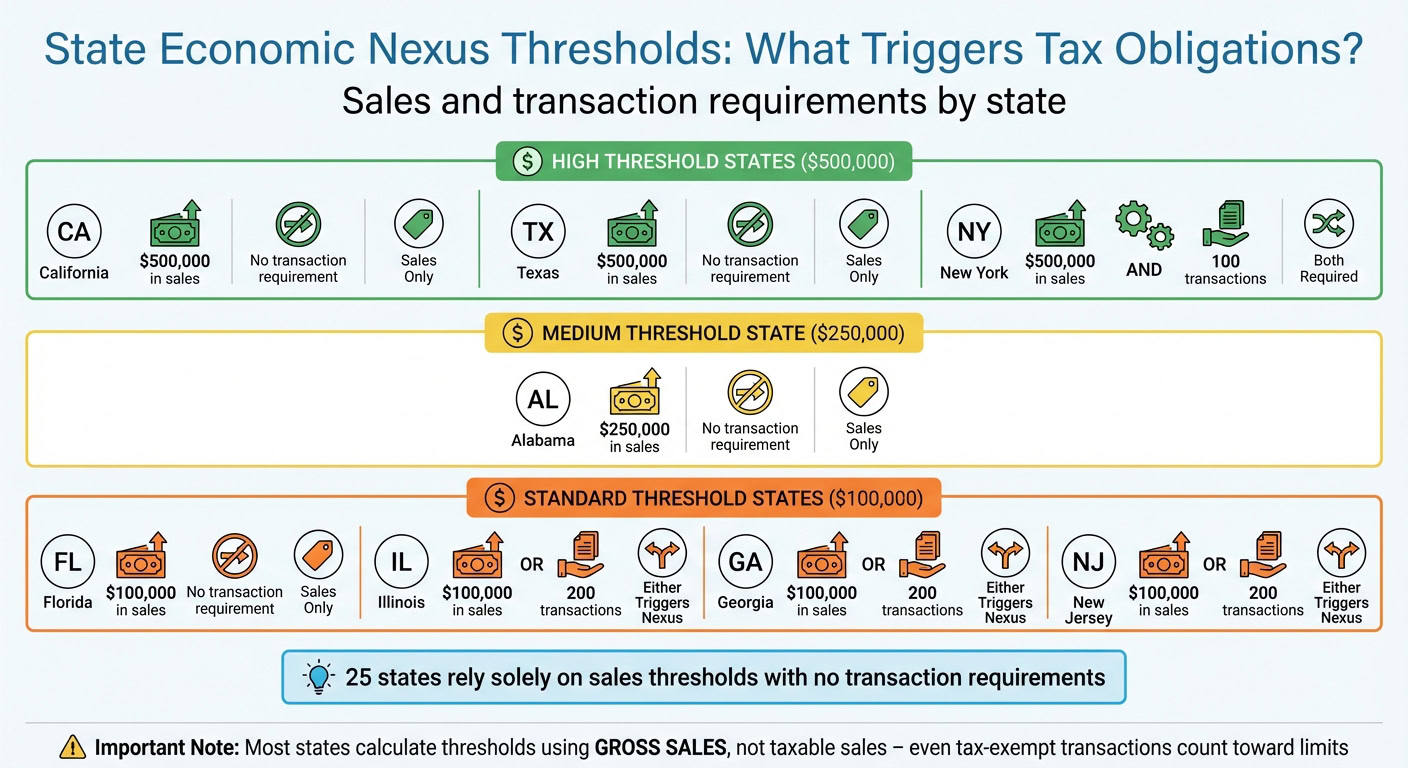
Knowing what triggers nexus is crucial for avoiding unexpected tax liabilities. Nexus can be divided into two main categories: economic nexus, which is tied to your financial activity within a state, and physical nexus, which depends on your physical presence in that state.
Economic Nexus Thresholds
Economic nexus occurs when a business meets specific sales or transaction thresholds in a state, regardless of whether it has a physical presence there. For example, many states, including Florida, Illinois, New Jersey, and Georgia, set their benchmark at $100,000 in sales or 200 transactions. Meanwhile, states like California and Texas have higher thresholds, requiring $500,000 in sales, and Alabama falls in the middle with a $250,000 sales threshold.
Threshold structures vary by state. Some states use an "OR" approach, meaning meeting either the sales or transaction limit establishes nexus. Others, like New York and Connecticut, require both criteria to be met. In New York, for instance, businesses must exceed $500,000 in sales and complete more than 100 transactions. Interestingly, 25 states rely solely on sales thresholds.
"Establishing economic nexus through transactions alone is quite burdensome as compliance costs associated with collection and remittance requirements could be greater than the business transacted." – Tax Foundation
Another critical factor is how states calculate these thresholds. Most use gross sales instead of taxable sales, meaning even tax-exempt transactions count toward the limit. For instance, in Arkansas, you could trigger nexus by making 200 transactions totaling just $1,000 – selling 200 items at $5 each would be enough.
| State | Sales Threshold | Transaction Threshold | Nexus Structure |
|---|---|---|---|
| California | $500,000 | None | Sales Only |
| Texas | $500,000 | None | Sales Only |
| New York | $500,000 | 100 | Sales AND Transactions |
| Florida | $100,000 | None | Sales Only |
| Illinois | $100,000 | 200 | Sales OR Transactions |
| Alabama | $250,000 | None | Sales Only |
Physical Nexus Considerations
Physical nexus is established when a business has a tangible presence in a state. This can include owning property, employing staff, or storing inventory. According to the Streamlined Sales Tax Governing Board:
"If you have a physical presence in a state, you are not a Remote Seller and are required to register in that state regardless of the amount of sales." – Streamlined Sales Tax Governing Board
Even a single remote employee working from home in another state can create a physical nexus, triggering obligations for income and payroll taxes. Similarly, using third-party fulfillment services like Amazon FBA to store inventory establishes nexus in every state where your goods are warehoused. Other potential triggers include leasing office space, company vehicles, attending trade shows, or engaging in "click-through" nexus, where in-state affiliates earn commissions for web referrals.
Multi-State Nexus Challenges
Operating in multiple states comes with its own set of challenges, as each state has its own thresholds, rules, and filing requirements. This patchwork of regulations can make compliance both costly and time-consuming, sometimes outweighing the profits from sales in a particular state. Remote employees scattered across states further complicate tracking physical presence and tax responsibilities.
Adding to the complexity, many states are narrowing the protections offered by Public Law 86-272, which historically exempted businesses that only solicited orders for tangible goods. Now, states are interpreting activities like gathering customer data through cookies or offering online chat support as creating taxable presence.
On the brighter side, some states have reciprocal agreements for payroll taxes. For instance, Arizona has agreements with California, Indiana, Oregon, and Virginia, allowing employees to request exemptions from withholding taxes in their work state. However, these agreements are limited, with only 16 states and the District of Columbia participating.
These challenges highlight the importance of staying vigilant with state tax nexus planning to avoid costly penalties. Up next, we’ll dive into the primary state tax types that remote businesses need to navigate.
sbb-itb-ba0a4be
Key State Tax Types for Remote Businesses
Remote businesses encounter three primary state taxes: income, sales/use, and franchise/gross receipts taxes. Each comes with its own set of rules, and understanding how they apply is crucial for compliance. Here’s a closer look at how these taxes affect remote operations.
State Income Taxes
State income taxes rely heavily on the concept of nexus, which can be established not only by physical presence but also through remote work arrangements. For corporations, even a single remote employee can create nexus. Pennsylvania’s Department of Revenue provides a clear example:
"A non-filing out-of-state corporation which has a Pennsylvania resident working at home has nexus based solely on the activities of that employee."
For instance, if a Delaware C-Corp employs a remote worker based in Pennsylvania, the company establishes nexus in Pennsylvania.
Additionally, eight states – Alabama, Connecticut, Delaware, Nebraska, New Jersey, New York, Oregon, and Pennsylvania – enforce "convenience of the employer" rules. These rules mean that nonresidents working remotely for in-state employers may still be taxed by the employer’s state, even if the employee never physically works there. For example, if a New York company hires a remote developer living in Florida, New York could tax the developer’s entire income unless the remote work arrangement is deemed a business necessity.
Beyond income taxes, remote sellers also need to navigate sales and use tax obligations.
Sales and Use Taxes
Remote sellers are required to collect sales tax once they surpass a state’s economic threshold, which typically falls between $100,000 and $500,000 in annual sales.
Marketplace facilitator laws simplify this process for businesses selling exclusively through platforms like Amazon or Etsy, as these platforms handle the collection and remittance of sales tax. However, if you sell directly through your own website and exceed the state’s threshold, you’ll need to register and handle tax collection yourself.
Use tax comes into play when your business purchases taxable items from out-of-state vendors without paying sales tax. For instance, if you buy digital products or "Remote Access Software" for business use in Washington, you owe use tax based on the purchase price. States are increasingly clarifying that digital goods, streamed media, and cloud-based software fall under sales and use tax requirements.
In addition to income and sales taxes, some states impose taxes based on gross revenue.
Franchise and Gross Receipts Taxes
Certain states tax businesses on gross revenue rather than net income. This means taxes are applied to total sales before expenses, which can be particularly challenging for businesses with tight profit margins.
For example:
- California requires every LLC and corporation doing business in the state to pay a $800 minimum franchise tax, even if the business doesn’t turn a profit.
- Texas imposes a franchise tax based on total revenue, with rates varying depending on the type of business.
- Washington levies a B&O (Business and Occupation) tax on total sales proceeds, including revenue from digital products and remote access software used in the state.
- Ohio and Delaware apply gross receipts taxes, which can result in the same revenue being taxed multiple times as it moves through the supply chain.
Here’s a quick comparison of notable state taxes:
| State | Tax Type | Key Feature |
|---|---|---|
| California | Franchise Tax | $800 minimum annual tax for LLCs and corporations |
| Washington | B&O Tax | Gross receipts tax on sales, including digital products |
| Texas | Franchise Tax | Based on total revenue, varies by business type |
| New Jersey | Corporate Income Tax | Highest corporate income tax rate in the U.S. |
Understanding these tax categories is essential for remote businesses to anticipate their obligations and avoid penalties. Up next, we’ll dive into strategies for managing compliance across multiple states.
Tax Compliance Strategies for Remote Businesses
Managing tax compliance for a remote business involves setting up systems that track obligations, maintain legal presence, and ensure deadlines are met. While tools and services like registered agents simplify the process, choosing a state with favorable tax policies can further reduce your compliance workload.
The Role of Registered Agents
If your business establishes a nexus in any state, you’re required to designate a registered agent – a person or service with a physical address authorized to receive legal documents, tax notices, and official correspondence on your behalf. This ensures your company has an official "place of business" in every state where it operates. Registered agents play a critical role in helping you avoid missed deadlines and maintain compliance with state authorities. They also add a layer of privacy by shielding your personal address from public records.
For U.S.-based businesses, BusinessAnywhere offers registered agent services for $147 annually, with the first year free when you register your business through them. This service covers all states where you need representation, sparing you the hassle of juggling multiple providers. Plus, their registered agent services integrate seamlessly with digital compliance tools, making it easier to stay on top of tax obligations.
Using Digital Tools for Compliance
Digital tools are essential for automating compliance tasks and reducing the risk of penalties. Tracking work locations, sales thresholds, and filing deadlines manually can be error-prone and time-consuming. These tools help monitor nexus thresholds, track employee locations, and calculate withholding requirements automatically.
Accurate location tracking is especially important. More than half of U.S. states require businesses to withhold taxes from the very first day a nonresident employee works in the state. For example, if an employee works remotely in another state, withholding obligations might kick in immediately. Keeping detailed records – such as daily work logs, travel receipts, and hotel stays – can provide the documentation you’ll need if you face an audit.
BusinessAnywhere’s platform simplifies compliance by consolidating everything into a single dashboard. Its virtual mailbox captures official correspondence, while registered agent services ensure you never miss critical notices. Automated alerts notify you of approaching deadlines, and the platform even supports tasks like EIN applications and S-Corp tax filings. This all-in-one approach can significantly lighten the administrative load for remote businesses.
Tax-Friendly States for Remote Entities
Some states are more appealing for remote businesses due to their lighter tax burdens. Wyoming, South Dakota, and Alaska are consistently ranked as top choices because they don’t impose corporate or individual income taxes. For businesses deciding where to incorporate, these states offer clear financial advantages.
Wyoming and Nevada are particularly attractive for businesses that don’t require a physical office. Both states have no corporate or personal income tax, offer strong privacy protections, and have straightforward compliance requirements. Delaware, while a favorite for corporations seeking venture capital, does impose an $800 minimum franchise tax.
Flexibility is another factor to consider. States like Indiana and Illinois have a "30-day safe harbor" rule, allowing employees to work remotely for up to 30 days without triggering tax filing or withholding obligations. On the other hand, states like New York and California may impose obligations after just one day of work or upon reaching minimal wage thresholds.
It’s also wise to avoid incorporating in or hiring from states with "convenience of the employer" rules – such as New York, New Jersey, Delaware, Nebraska, and Pennsylvania. These rules can tax remote workers even if they never set foot in the state, leading to potential double taxation. Michael Smith, Director of Tax at ADP, explains:
"The broader underlying goal for many updates pertaining to remote workers and tax compliance today is incentivizing organizations to embrace a more remote work environment while maintaining a focus on improved compliance".
Filing Requirements and Deadlines for Remote Businesses
Once you’ve established nexus and identified your tax obligations, the next step is navigating filing requirements and deadlines. Remote businesses often find themselves managing multiple state deadlines, each with its own specific rules. Missing a deadline can lead to penalties, interest charges, or even heightened scrutiny from state tax authorities.
Quarterly and Annual Tax Returns
Most remote businesses operate on a calendar year basis, though some may follow alternative fiscal years or short tax years if they were active for less than a full year. These businesses are typically subject to "pay-as-you-go" rules, requiring quarterly estimated tax payments if income isn’t adequately covered by withholding.
If your business employs remote workers across state lines, additional employment tax obligations come into play. These may include state-specific requirements for withholding taxes, unemployment insurance, and disability insurance, all of which follow varying schedules based on the state.
State registration deadlines also differ significantly. For instance:
- California: Registration is required as soon as you exceed a $500,000 threshold.
- New York: Businesses must register within 30 days of meeting nexus criteria.
- Texas: Registration is due by the first day of the fourth month after thresholds are met.
To simplify tracking these deadlines, many businesses rely on digital compliance tools. These platforms help ensure you’re meeting state-specific requirements without missing critical dates.
Combined Reporting States
Some states, like California, enforce combined reporting rules for businesses with income both within and outside the state. This requires filing a consolidated return that includes income from related entities, such as parent companies and subsidiaries. Income is then allocated based on where business activities occur. These rules aim to prevent companies from shifting income to states with lower or no taxes.
If your business has nexus in California and earns income from other states, you’ll need to use specific apportionment formulas to calculate the portion of income attributable to California. This process requires detailed records of sales, payroll, and property by state. To avoid errors, consider working with a tax professional or using an integrated compliance platform. Accurate filing is essential – not just for compliance but also for avoiding penalties that could disrupt your remote operations.
Meeting Deadlines and Avoiding Penalties
Automating deadline tracking can be a game-changer for remote businesses. Tools like BusinessAnywhere’s platform send automated compliance alerts to help you stay on top of filing deadlines. Their virtual mailbox feature also ensures you receive timely notifications about audits, penalties, or updates to filing requirements from state tax authorities.
In addition to automation, maintaining thorough documentation is critical. Keep records like daily work location logs, travel receipts, and employment agreements detailing remote work arrangements. These documents can be invaluable during an audit, especially if your employees work remotely in multiple states.
It’s also essential to update withholding promptly. If an employee moves or changes their primary work location, adjust their W-4 form and state withholding settings immediately to avoid underpayment penalties. If withholding falls short, you may need to make additional quarterly estimated tax payments to cover the gap. Addressing these changes early is far easier – and less costly – than dealing with penalties and interest later.
Conclusion: Managing State Tax Obligations for Remote Businesses
Keeping up with state tax obligations as a remote business demands constant attention. For businesses operating across multiple states, navigating compliance has become a regular challenge. Missing deadlines, misjudging nexus rules, or failing to track employees’ work locations can lead to hefty penalties and even audits.
To stay ahead of these risks, proactive monitoring and automation are critical. Tools that track economic nexus thresholds, log daily work locations for remote employees, and provide timely alerts for important deadlines can simplify the process. As discussed earlier, the complexities of nexus – whether tied to economic thresholds or physical presence – make automated compliance systems a valuable resource for managing the maze of income, sales, and franchise tax rules across jurisdictions.
Platforms like BusinessAnywhere offer solutions designed for these challenges. With features like automated state filing deadline alerts, a virtual mailbox service for receiving timely notifications from tax authorities, and registered agent services to maintain legal compliance while safeguarding privacy, these tools centralize and streamline your tax management efforts. They not only address current obligations but also prepare businesses for future regulatory shifts.
As remote work continues to expand, states will undoubtedly refine their tax policies to capture revenue from digital businesses. Katherine Loughead of the Tax Foundation highlights this ongoing complexity:
"The state nonresident income tax landscape will remain unnecessarily complex".
Instead of waiting for a simpler system that may never materialize, it’s wise to invest in tools and processes that make compliance manageable now. With systems in place for location tracking, automated calculations, and centralized compliance management, you can confidently handle state tax obligations while enjoying the flexibility that remote business offers.
FAQs
What’s the difference between economic nexus and physical nexus for remote businesses?
Economic nexus and physical nexus are two key ways states determine whether a business is required to collect and remit taxes.
Physical nexus comes into play when a business has a tangible presence in a state. This could mean having an office, a warehouse, inventory, or employees located there. If a business has any of these, it must register and pay state taxes, no matter how much – or how little – it sells.
Economic nexus, however, is determined purely by sales activity. Following the 2018 South Dakota v. Wayfair decision, many states implemented specific thresholds – often $100,000 in sales or 200 transactions. If a business surpasses these thresholds, it must collect taxes, even without any physical presence in the state.
For remote businesses, tax obligations can arise from either exceeding these sales thresholds (economic nexus) or having a physical presence (physical nexus). Knowing how these rules apply is crucial for staying compliant when operating across multiple states.
How can remote businesses manage state tax compliance effectively when operating across multiple states?
Managing state tax compliance for a remote business means keeping track of where your activities establish a tax nexus – a legal connection that triggers tax responsibilities in a specific state. For instance, you’ll need to monitor your sales and transactions to ensure they don’t go over state-specific thresholds, like $100,000 in sales or 200 transactions per year. If you exceed these limits, it’s time to register for a seller’s permit, start collecting the appropriate sales tax, and file the necessary returns.
Employee locations are another crucial factor. Even having remote staff in a state can create obligations for income and payroll taxes. To navigate this maze of regulations, tools like BusinessAnywhere can be a game-changer. They provide features to track tax nexus, manage registrations, and handle filings. Automating these tasks can help remote businesses stay compliant, avoid costly penalties, and concentrate on growing their operations.
What are the risks of not complying with state tax obligations for remote businesses?
Failing to meet state tax requirements can spell trouble for remote and digital businesses, both financially and legally. States might establish a nexus – a connection that obligates you to pay taxes – if you have employees or conduct business within their borders. This could mean filing income, sales, or other taxes, and in some cases, it might even lead to double taxation, where both your home state and the state where your remote operations take place demand taxes.
The risks of non-compliance are steep. You could face interest on unpaid taxes, penalties for late filings, and even audits that might reveal additional liabilities. Worse still, failing to remit sales taxes could result in criminal charges. These financial and legal headaches can eat into your profits, tarnish your reputation, and make it harder to grow your business.
How BusinessAnywhere can help: BusinessAnywhere takes the stress out of compliance by handling U.S. business registrations, conducting nexus analyses, managing tax filings, and providing ongoing support. With their help, your business can avoid costly penalties and stay on the right side of the law.