


The O-1 visa for startup founders is a U.S. visa designed for individuals with extraordinary ability in fields like business, science, or education. For entrepreneurs, it provides a path to manage and grow a U.S.-based startup without the restrictions of annual caps or lotteries. To qualify, you must meet at least three out of eight USCIS criteria, such as securing venture funding, receiving media recognition, or holding leadership roles. The visa is initially valid for up to three years and can be extended in one-year increments. It also allows a pathway to permanent residency through the EB-1A green card.
Key Points:
- Eligibility: Demonstrate extraordinary ability with documented achievements.
- Criteria Examples: Venture capital funding, Forbes 30 Under 30, patents, media features, or high compensation.
- Benefits: No annual cap, family inclusion (O-3 visas), and flexibility to manage a startup.
- Costs: Application fees range from $8,000 to over $10,000, including attorney fees and optional premium processing.
With careful preparation – such as securing strong recommendation letters, detailed evidence of achievements, and possibly working with an experienced attorney – you can build a strong case for approval. This visa is an excellent option for founders with a proven track record of impact in their field.
Meeting the ‘Extraordinary Ability’ Standard
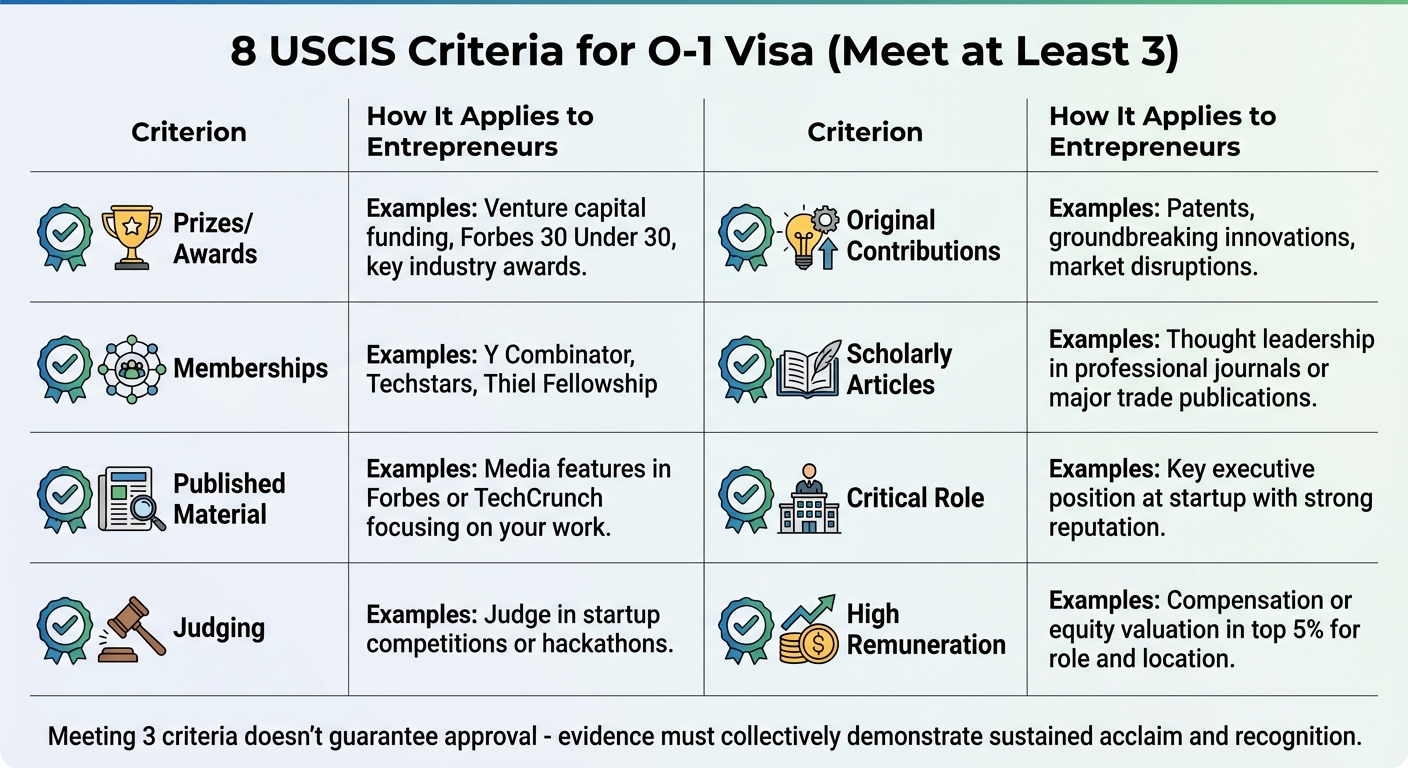
O-1 Visa USCIS 8 Criteria for Entrepreneurs: Requirements and Examples
What ‘Extraordinary Ability’ Means for Founders
The United States Citizenship and Immigration Services (USCIS) describes extraordinary ability as being among the small percentage of individuals who have reached the very top of their field. For business founders seeking an O-1A visa, this means proving national or international recognition through clear, documented achievements. This distinction is not just about being successful – it’s about being recognized as a leader and trailblazer in your industry.
"Extraordinary ability in the field of science, education, business or athletics means a level of expertise indicating that you are one of the small percentage who have arisen to the very top of the field." – USCIS
Your recognition must come from external sources, such as peers or industry leaders, rather than self-promotion or internal titles. USCIS evaluates whether your contributions are acknowledged and celebrated within the broader business community.
USCIS Evaluation Criteria
USCIS relies on a two-step evaluation process – known as the Kazarian Framework – to assess O-1 applications. First, they examine whether you meet at least three of eight specific criteria. Then, they conduct a "final merits determination" to decide if your evidence collectively shows you’re at the top of your field. Below is an overview of how these criteria apply to entrepreneurs.
| USCIS Criterion | How It Applies to Entrepreneurs |
|---|---|
| Prizes/Awards | Examples include venture capital funding, being named to Forbes 30 Under 30, or winning key industry awards. |
| Memberships | Admission to elite programs like Y Combinator, Techstars, or fellowships such as the Thiel Fellowship. |
| Published Material | Media features in outlets like Forbes or TechCrunch that focus specifically on your work. |
| Judging | Participation as a judge in startup competitions or hackathons. |
| Original Contributions | Evidence of patents, groundbreaking innovations, or market disruptions you’ve created. |
| Scholarly Articles | Thought leadership through articles in professional journals or major trade publications. |
| Critical Role | Holding a key executive position at a startup with a strong reputation. |
| High Remuneration | Compensation or equity valuation placing you in the top 5% for your role and location. |
It’s important to note that meeting three criteria doesn’t guarantee approval. USCIS explicitly states that "the fact that the petitioner has produced evidence satisfying at least three evidentiary criteria does not necessarily establish that the beneficiary is eligible for the O-1 classification". The evidence must collectively demonstrate a sustained level of acclaim and recognition.
Examples of Qualifying Achievements
To meet these criteria, your achievements must clearly reflect external recognition of your impact. For instance, under the awards criterion, securing venture capital funding, being named to Forbes 30 Under 30, or winning a competition like TechCrunch Disrupt would qualify.
For the published material criterion, media features in prominent outlets such as Forbes, TechCrunch, or Harvard Business Review would count, provided the coverage focuses on your personal contributions rather than your company’s product or funding announcements.
The critical role criterion requires demonstrating that your startup has a strong reputation. This could be backed by significant investor funding, contracts with high-profile clients, acceptance into prestigious accelerators, or government research grants. For high remuneration, founders who draw low salaries can use independent 409A valuations to show the monetary value of their equity. To qualify, your total compensation – including salary and equity – should rank in the top 5% for your role and city. These examples align with strategies that can strengthen your O-1 visa application.
Key Evidence Categories for Your O-1 Application
Crafting a compelling O-1 visa petition means showcasing your expertise and achievements across multiple areas. Instead of relying on a single accomplishment, successful applications combine business success, public recognition, and measurable contributions. Together, these elements create a well-rounded case that highlights your exceptional talent. Below, we break down key evidence categories that can help address misconceptions about O-1 visa eligibility.
Business Accomplishments and Funding Success
Securing venture capital funding is a strong indicator of your innovation and market potential. While VC funding alone doesn’t fulfill the "Awards" criterion, it can bolster the "Critical Role" and "Original Contributions" aspects of your application. Take the case of Awais, who received O-1 approval in just six days in October 2022. He documented his startup’s $98,000 seed funding through SAFE agreements and highlighted Wave’s $200 million Series A funding, emphasizing his role in creating fintech software for sub-Saharan Africa.
Acceptance into prestigious accelerators like Y Combinator, Techstars, or Berkeley SkyDeck also demonstrates industry recognition. Similarly, winning or being a finalist in prominent competitions – such as TechCrunch Disrupt, SXSW Pitch, or the MIT $100K Startup Competition – can directly satisfy the "Prizes and Awards" criterion.
"If the petitioner demonstrates that receipt of a high salary is not readily applicable to the beneficiary’s position as an entrepreneur, the petitioner might present evidence that the beneficiary’s highly valued equity holdings in the startup are of comparable significance to the high salary criterion." – USCIS Policy Manual
Using SAFE agreements to establish your company’s valuation provides objective proof, especially when equity-based compensation is part of your case. This approach can counter arguments that such compensation is speculative.
Media Coverage and Public Recognition
Media coverage is a powerful way to validate your achievements and reinforce your reputation as a leader in your field. Coverage in major outlets like Forbes, Bloomberg, TechCrunch, or Harvard Business Review offers solid evidence of national or international recognition. For smaller or niche publications, you’ll need to demonstrate their reach using tools that track monthly readers, visitor statistics, and audience engagement. A letter from the publication’s editor confirming editorial standards and readership demographics can further support your case.
"USCIS does not infer merit. Every claim must be explicitly proven, contextualized, and tied to a specific O-1 criterion." – Deel
Be sure to save URLs, screenshots, and traffic metrics to document your media impact. For non-English press, include certified translations along with audience analytics. Writing thought leadership articles for major publications can also qualify under the "Scholarly Articles" criterion, while being featured in significant press coverage meets the "Published Material About You" requirement.
Industry Influence and Innovation
Patents, trademarks, and proprietary innovations provide concrete evidence of your original contributions. This could include unique product designs, technological advancements, or business models that have driven change in your industry. For example, Leo Martinez, founder of Flow Logistics, strengthened his O-1 petition by publishing a white paper titled The Agile Warehouse in Global Supply Chain Review. He supported this with analytics showing high readership and a letter from the editor confirming the publication’s rigorous selection process.
Serving as a judge for high-profile events like TechCrunch Disrupt, SXSW Pitch, or accelerator pitch competitions is another way to demonstrate your expertise. Scorecards, review reports, or feedback emails can serve as objective proof of your role.
Measurable outcomes – whether through revenue growth, acquisitions, user adoption, or job creation – can further solidify your case. For instance, Awais showcased "high remuneration" by proving that his 2021 compensation at Wave ranked in the top 10th percentile for New York City engineers, according to data from the US Bureau of Labor Statistics. These documented achievements, combined with your innovations, highlight your leadership in the industry.
Common Misconceptions About O-1 Visa Eligibility
When it comes to the O-1 visa, eligibility is based on documented achievements, not financial milestones or years of experience. Unfortunately, some persistent myths discourage qualified entrepreneurs from applying. Let’s break down these misconceptions and clarify what really matters.
Do You Need Millions in Funding?
No, you don’t need millions in venture capital to qualify. While VC funding can enhance your application by showcasing your startup’s reputation, it’s not a requirement. Sophie Alcorn, Attorney and Founder of Alcorn Immigration Law, emphasizes:
"You absolutely can qualify for an O-1A while you’re bootstrapping, and VC funding is not required for the O-1A!"
USCIS reviews the overall evidence supporting your extraordinary ability. Bootstrapped founders often qualify by presenting alternative achievements like government grants, pitch competition wins, media coverage, or strong user traction. Even if your cash salary is modest, you can use valuations to show your total compensation ranks in the top 90th percentile.
Is Prior Founder Experience Required?
Another myth is that you need extensive experience as a founder. This is simply not true. First-time founders can qualify if they demonstrate exceptional accomplishments. USCIS doesn’t demand prior founder experience; instead, it looks at your professional achievements as a whole. As Beyond Border explains:
"Prior experience as a founder is not strictly required. Early-stage founders can qualify if they demonstrate exceptional traction, funding, recognition, or past achievements that reflect extraordinary ability"
What matters is evidence of extraordinary ability across various criteria, not how long you’ve held a CEO title.
Can Solo Entrepreneurs Apply?
Some believe solo founders are ineligible for the O-1 visa, but that’s another misconception. Solo entrepreneurs can absolutely qualify, often using a "U.S. Agent" sponsorship model. This approach allows you to work for your own startup without the need for a traditional employer-employee setup. USCIS evaluates solo founders based on their business impact, innovation, and achievements like patents, proprietary technology, accelerator participation, or media recognition. Team size doesn’t limit your eligibility – your results and extraordinary ability do.
sbb-itb-ba0a4be
How to Build a Strong Application
Once you’ve cleared up any misunderstandings about O‑1 eligibility, the next step is putting together a solid petition that proves your extraordinary ability. The key here is quality over quantity. A well-prepared application depends on thorough documentation, credible endorsements, and often, the guidance of a skilled immigration attorney to present your achievements in the best possible light. This approach helps establish your status as a standout talent in your field.
Required Documentation for Your Application
The process begins with filing Form I‑129 (current cost: $1,055 in 2026). Along with this, you’ll need a written advisory opinion from a peer group or industry expert, an employment contract (or a detailed summary of its terms), and a comprehensive itinerary of your business activities, including specific start and end dates.
To strengthen your petition, you’ll need to show that you meet at least three of the eight USCIS criteria. This can include evidence of funding, leadership roles, media coverage, or notable contributions. If you’re highlighting press coverage, tools like SimilarWeb can help validate the reach and impact of your media presence.
For those using a high salary as a criterion, include benchmarking data from trusted sources like the U.S. Bureau of Labor Statistics or Payscale to demonstrate that your compensation ranks among the top in your field and location. If you’re relying on judging experience, make sure to include detailed scorecards or selection reports to clearly show your influence.
Jemima Owen‑Jones from Deel points out:
"Most O-1 denials stem from weak evidence framing, not weak credentials."
To further reinforce your case, include strong, independent recommendation letters.
Getting Strong Recommendation Letters
Recommendation letters are a critical component of your application, providing the external validation USCIS requires. Aim to secure 5–7 letters from a mix of collaborators and independent experts. Letters from individuals outside your organization carry more weight, as they provide unbiased confirmation of your abilities.
Each letter should address specific O‑1A criteria and explain why your accomplishments matter to your entire field, not just your company. Choose recommenders who are respected in your industry, such as award recipients, journal editors, association leaders, or prominent venture capitalists. Provide them with your CV, a summary of your major achievements, and clear instructions on which USCIS criteria to emphasize.
Ask for these letters at least a month in advance to allow time for revisions. Ensure that they are printed on official letterhead and avoid generic, overused language that could weaken their impact.
Grace Remington, Esq. from Ashoori Law highlights:
"Letters from independent experts (outside your current employer/client base) typically carry more weight than exclusively internal references."
Working with Immigration Attorneys
To maximize your chances of success, consider hiring an experienced immigration attorney. While you can technically file an O‑1 petition on your own, a skilled attorney can make a big difference. They’ll assess your credentials, identify which USCIS criteria best fit your case, and help you organize a petition that aligns with USCIS standards for extraordinary ability.
Attorneys are also adept at translating complex technical achievements into language that USCIS can easily understand. When choosing a law firm, look for one with a strong track record in O‑1 cases. Make sure you’ll have direct access to the attorney handling your case, rather than being routed through paralegals for all communication.
Many attorneys offer flat-fee pricing, which often includes responses to Requests for Evidence (RFEs), helping you avoid surprise costs. Some specialized firms can even prepare an entire O‑1A petition within two to three weeks.
If USCIS issues an RFE, an experienced attorney can craft a detailed response to address any concerns. As BCA Law Firm explains:
"One of the most valuable services an attorney provides is crafting a clear legal argument for why your experience meets the O-1 standard."
USCIS’s standard processing time for O‑1 petitions is typically between 3.8 and 8 months. However, you can opt for premium processing for an additional $2,965, which guarantees a decision within 15 business days.
For founders managing compliance after approval, BusinessAnywhere offers services like registered agent support, virtual mailboxes, and ongoing compliance tools to help maintain your U.S. business operations while on O‑1 status.
Costs, Timelines, and Permanent Residency
Once you’ve crafted a strong O‑1 petition, it’s time to dive into the costs and timelines involved. The total expenses for an O‑1 visa application generally fall between $8,000 and over $10,000. These costs include USCIS fees, consulate or embassy fees, and legal services.
Financial and Time Commitments
USCIS filing fees start at $780, or $460 for small employers and nonprofits. Additionally, most petitions include a $600 Asylum Program Fee. For faster processing, premium service is available for $2,965, guaranteeing a decision within 15 business days. Legal fees vary significantly – some firms offer flat rates around $8,000, while others charge hourly. These fees usually cover petition preparation and any responses to USCIS requests.
Before filing, plan for 3 to 6 months to gather evidence, recommendation letters, and necessary documents. Once submitted, USCIS standard processing takes 7.5 to 9 months for about 80% of cases. If premium processing is used, a decision is issued within 15 business days.
Pathway to the EB-1A Green Card
Although the O‑1 visa is temporary, it’s dual-intent friendly, meaning you can pursue permanent residency without risking your current visa status. Many O‑1 visa holders transition to the EB‑1A green card, designed for individuals with extraordinary abilities. This category demands even stronger evidence than the O‑1. Unlike the O‑1 visa, which requires a U.S. employer or agent sponsor, the EB‑1A allows self-petitioning, and spouses are eligible for work authorization.
Most O‑1 holders transition to the EB‑1A after 2 to 3 years, giving them time to build a sustained record of accomplishments. Beyond Border explains:
"O-1 approval proves you meet the baseline for extraordinary ability. But EB-1A requires: stronger evidence for each criterion, national or international scope, sustained achievements over time, and demonstrable impact on your field or the U.S."
Filing for the EB‑1A green card (Form I‑140) costs $715, with an additional $1,440 for adjustment of status (Form I‑485) if you’re already in the U.S.. The entire green card process typically takes 7 to 16 months. After holding permanent residency for five years, you can apply for U.S. citizenship. Specialized immigration firms working with technologists report a 98% approval rate for both O‑1 and EB‑1A petitions.
Building a strong track record and staying compliant with regulations are key to long-term success.
Using BusinessAnywhere for Compliance and Support
Once your O‑1 visa is approved, keeping your U.S. business operations compliant becomes crucial. BusinessAnywhere provides essential services like registered agent support, virtual mailboxes with scanning and forwarding, and compliance alerts for important filings. For founders who establish a company during the O‑1 process, BusinessAnywhere’s dashboard simplifies document management, mail handling, and compliance tracking – all accessible 24/7.
Additionally, the platform offers online notary services for $37 per notarization, covering business and immigration-related documents.
Whether you’re just beginning your O‑1 journey or preparing for an EB‑1A transition, having reliable compliance tools allows you to focus on growing your business instead of juggling administrative tasks.
Conclusion: Key Takeaways for Entrepreneurs
The O‑1 visa provides a strong opportunity for founders to establish and expand their businesses in the U.S., bypassing many of the restrictions tied to traditional visa options. However, success hinges on presenting clear and convincing proof of your achievements. As Steve Maggi from Extraordinary Team puts it:
"Extraordinary isn’t a job title, it’s a pattern. Many applicants misunderstand ‘extraordinary ability’ as a label you claim. In reality, it’s a pattern USCIS must be convinced of."
To strengthen your case, focus on securing venture capital, gaining media recognition, and building key industry connections well in advance – ideally 6 to 12 months before filing. The evaluation process values depth over breadth, so providing strong evidence for three criteria is more effective than spreading thin proof across multiple categories.
The O‑1 visa also offers operational flexibility, particularly through the agent sponsorship model. This setup allows you to work for your own startup or shift between ventures as needed. With no annual cap and a reported 98% approval rate from specialized immigration platforms, the O‑1 visa can also act as a stepping stone to the EB‑1A green card. Once approved, platforms like BusinessAnywhere simplify compliance with services such as registered agent support, virtual mailboxes, and automated filing reminders. This lets you focus on scaling your business while minimizing administrative burdens, aligning perfectly with the operational flexibility the O‑1 visa offers.
FAQs
How do I pick the best 3 O-1 criteria for my founder profile?
When preparing your O-1 visa application, it’s important to focus on showcasing your exceptional ability and recognition in your field. Here are some key areas to emphasize:
- Awards and Accolades: Highlight any industry awards, media features, or other forms of recognition that demonstrate your expertise and accomplishments. These achievements serve as clear evidence of your standing in your profession.
- Leadership and Contributions: Provide examples of your leadership roles or unique contributions. This could include founding a company, spearheading notable projects, or holding patents that have made an impact in your industry.
- External Validation: Include instances where your expertise has been acknowledged by others. Examples might be serving as a judge in competitions, publishing articles or research, or being invited to speak at conferences.
Focus on showcasing consistent recognition and influence throughout your career. This not only strengthens your application but also underscores your lasting impact in your field.
Can I sponsor my own O-1 through my startup or a U.S. agent?
Yes, it’s possible to sponsor your O-1 visa through your startup or a U.S. agent. The key requirement for an O-1 visa is having a U.S. employer or agent file a petition on your behalf. If you’re an entrepreneur, you can use your own U.S.-based company as the petitioner. This allows startup founders with extraordinary abilities to essentially self-petition and manage their business in the U.S. by submitting Form I-129 to USCIS.
What evidence is most persuasive in the final merits review?
External validation is one of the strongest forms of evidence when evaluating an applicant’s recognition and impact within their field. This includes things like awards, media coverage, or notable contributions that have been acknowledged by respected industry peers or organizations. Achievements that are self-reported tend to carry less weight compared to endorsements or recognition from credible third-party sources.