

70% of startups pivot, and those that pivot once or twice grow 3.6x faster. But how do you know when to change course? If your revenue is stuck, customer complaints pile up, or market shifts leave you behind, it might be time to rethink your strategy.
Key indicators include:
- Stagnant or declining revenue despite marketing efforts.
- High churn rates or users ignoring your main features.
- External challenges, like new competitors or shifting regulations.
Successful pivots fall into three main types:
- Product Pivot: Focus on features users love (e.g., Instagram shifting to photo sharing).
- Customer Segment Pivot: Target a new audience (e.g., Slack moving from gamers to businesses).
- Channel Pivot: Change how you deliver (e.g., Netflix shifting from DVDs to streaming).
To pivot effectively:
- Analyze your business data to confirm the need for change.
- Test new directions with small experiments before committing.
- Execute carefully while staying compliant with regulations.
Use tools like Google Analytics and Lean Canvas to guide decisions, and keep stakeholders informed throughout the process. Pivoting isn’t failure – it’s how startups find better opportunities.
When to Pivot Your Startup
Deciding to pivot isn’t easy, but it’s essential to base this decision on clear data. The real challenge lies in identifying whether your startup is facing a temporary hurdle or if there’s a deeper issue that demands a shift in direction. Here are some signs that might indicate it’s time to rethink your strategy.
Flat or Declining Revenue
If your revenue has been stuck in neutral or declining for several months, even with ongoing marketing efforts, it could mean your product isn’t resonating with customers or that your market is smaller than you anticipated. Pay close attention to your unit economics. For instance, if your customer acquisition cost (CAC) is higher than your customer’s lifetime value (LTV) – like spending $500 to acquire a customer who only brings in $150 – there’s a deeper issue that marketing alone won’t fix. Customer feedback can also provide clues, especially if it consistently points to unmet needs.
Repeated Customer Complaints
A high churn rate is another red flag. For example, if 95% of users abandon your product within the first week, it’s a clear sign of poor product-market fit. This often means your product isn’t solving a big enough problem for your audience.
"The loudest warning sign is customer apathy. If users sign up but never return, or if they claim they love the product but refuse to pay for it, you lack product-market fit." – Zyner.io
Look closely at what your customers do, not just what they say. If 60% of active users are ignoring your core features and instead using a secondary tool for unrelated tasks, it’s a strong indication that your product’s focus needs to change.
Changes in Your Market or Competition
Sometimes, external factors can push you to pivot. For instance, if a tech giant like Apple or Google launches a built-in version of your product, or if new regulations disrupt your industry, sticking to your current plan might be riskier than changing course.
A real-world example? FORE Enterprise noticed that over 90% of its clients were asking for help with data pipelines, even though the company initially focused on predicting employee turnover. This shift in demand made it clear that the market was calling for something different.
That said, increased competition alone isn’t always a reason to pivot. However, if competitors consistently outperform you by serving a niche better or offering something you can’t match, it’s time to reevaluate. The goal is to respond strategically to market trends rather than reacting emotionally to a single competitor’s move. Interestingly, startups that pivot based on solid market insights are 36% more likely to succeed than those that ignore these signals.
Recognizing these warning signs is just the beginning. The next step is figuring out how to pivot in a way that positions your business for success.
sbb-itb-ba0a4be
Common Types of Pivots with Examples
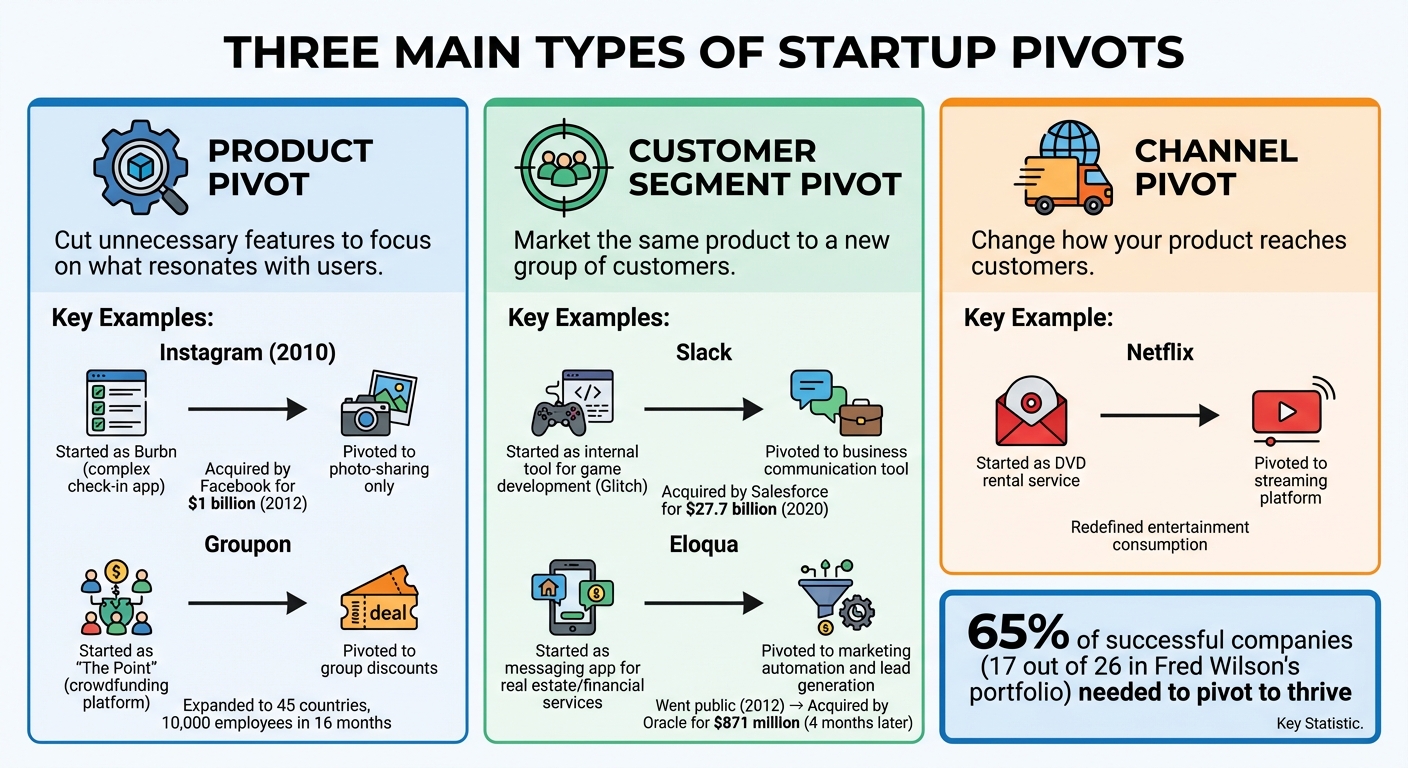
When it’s time to pivot, the next step is deciding which type of pivot aligns best with your market challenge. Knowing the main categories can help you adjust your startup to meet market demands. Here are three common types of pivots, paired with real-world examples to show how they work.
Product Pivot
A product pivot involves cutting out unnecessary features to focus on what’s actually resonating with users. Essentially, it’s about zeroing in on one standout function and building your business around it.
Consider Instagram. Back in 2010, founders Kevin Systrom and Mike Krieger launched Burbn, a check-in app with photo-sharing and point-earning features. The app’s complexity turned users off, but the photo-sharing and filter tools were a hit. Recognizing this, they stripped down the app to just photo-sharing, liking, and commenting. The result? Instagram took off, and Facebook purchased it for $1 billion in 2012.
Another example is Groupon, which began as "The Point", a crowdfunding platform for social causes. When the team noticed that group discounts – dubbed "Groupons" – were gaining the most traction, they pivoted to focus entirely on local deals. This shift led to rapid growth, expanding to 45 countries and hiring 10,000 employees in just 16 months.
Customer Segment Pivot
Sometimes the product is solid, but the audience isn’t the right fit. A customer segment pivot involves marketing the same product to a new group of customers.
Slack is a perfect example. Initially, Stewart Butterfield’s company, Tiny Speck, was working on a multiplayer game called Glitch. When the game failed to generate profits, the team realized their internal communication tool was far more valuable. They pivoted to market this tool to businesses instead of gamers. The move paid off – Salesforce acquired Slack in 2020 for $27.7 billion.
Similarly, Eloqua started as a messaging app for industries like real estate and financial services. Founder Mark Organ soon discovered these sectors didn’t need messaging tools as much as they needed help generating sales leads. By pivoting to focus on marketing automation and lead generation, Eloqua went public in 2012 and was acquired by Oracle for $871 million just four months later.
Channel Pivot
A channel pivot changes how your product reaches customers. This could mean transitioning from physical to digital distribution or adopting a new sales method.
Netflix provides a standout example. Originally a DVD rental service, Netflix shifted to streaming, completely redefining how people consumed entertainment.
These examples highlight an essential takeaway: around 65% of successful companies (17 out of 26 in venture capitalist Fred Wilson’s portfolio) needed to undergo some form of transformation to thrive. The challenge lies in identifying which pivot type best suits your situation – whether it’s refining your product, targeting a new audience, or rethinking your delivery method.
Grasping these pivot types is a crucial step toward crafting a winning pivot strategy.
How to Execute a Successful Pivot
Executing a pivot demands quick action, careful validation, and adherence to regulatory requirements. Here’s how to make the shift without losing momentum or running into compliance issues.
Confirm You Need to Pivot
Before making any major changes, ensure a pivot is truly necessary. Start by analyzing your revenue and growth trends. If your revenue is flat or declining despite solid marketing and execution, it could signal a deeper issue. High churn rates and difficulties in acquiring customers often point to a lack of product-market fit.
Take a close look at how users are interacting with your product. Are they ignoring your main offering but showing strong interest in a secondary feature? That’s exactly what happened with Close (formerly Elastic Sales) back in 2012. Founder Steli Efti noticed their internal CRM tool was getting far more traction than their "sales as a service" model. To test this, he ran both businesses side by side for a year. The CRM ultimately proved its value, leading to the company’s growth to over $30 million in annual recurring revenue (ARR), while the original service was phased out.
"The clearest signal it’s time to pivot? Customers want something you’re not offering."
– Entrepreneur
Another red flag is rising customer acquisition costs paired with lukewarm feedback. Enthusiastic feedback often indicates you’re solving a meaningful problem, while indifferent responses suggest otherwise. If your product isn’t sparking excitement, it may not be addressing a high-priority need.
Internally, gauge your team’s confidence. If doubts outweigh belief – what some call the "80/20 rule" – it’s time to consider a pivot. As Efti wisely notes, "No idea survives first contact with reality."
Once you’ve identified clear signs that a pivot is needed, focus on narrowing down the most promising new direction.
Evaluate Your Pivot Options
With confirmation that a pivot is necessary, the next step is deciding where to go. Revisit your core assumptions: who your customer is, what problem you’re solving, how you deliver value, and your monetization approach.
Develop a framework to classify these assumptions as "validated", "untested", or "failing." This helps pinpoint weak spots in your business model. For each potential pivot, consider three factors: how much effort it will take to test, the potential payoff, and the risks or opportunity costs if it doesn’t work out.
"The smartest pivots are evolutionary, not revolutionary. They take what you’re already good at and apply it in a more valuable, scalable, or sustainable direction."
– Entrepreneur
Identify "bright spots" in your business – features, customer segments, or services that outperform the core offering in engagement or feedback. The best pivots build on existing strengths. Steli Efti calls this keeping "one foot on the ground" – leveraging your expertise rather than making a blind leap. A great example is Adobe, which transitioned from traditional software licenses to a subscription model in 2013. By leaning on their existing products and customer relationships, they achieved record revenue.
Test Your New Direction
Once you’ve selected a viable pivot option, validate it through small-scale experiments. Think of this as a "learning sprint" with clear, short-term goals. Test just one or two variables at a time to avoid spreading your efforts too thin. Use lightweight tools like landing pages, prototypes, or stripped-down versions of your new offering to gauge interest before committing significant resources.
Start by testing with your existing customers. They already know your brand and can provide honest feedback on whether your new direction resonates. Set defined testing periods and track short-term results to allow for quick adjustments.
"A pivot isn’t failure. It’s a focused adjustment. It means changing one or more key assumptions about your customer, product, or market while still chasing the same overall vision."
– Valentina Espina, Customer Success Associate, Capwave
By focusing on just one or two elements at a time, you can isolate what works and avoid the chaos of overhauling everything at once.
Implement While Staying Compliant
After validating your pivot, execution is key – but compliance cannot be overlooked. Shifting to a new market or business model often introduces new regulatory challenges. Use a three-step approach: identify your obligations based on business activities, target markets, and applicable regulations.
Pay attention to three main compliance areas: regulatory requirements (licenses and authorizations), data protection (such as GDPR or U.S. privacy laws), and consumer protection (marketing and e-commerce rights). Keep in mind that these obligations apply specifically to your operating company, not just any holding structure you may have.
If your pivot involves handling sensitive data – like health records, biometrics, or criminal data – or processing large-scale information, you may need to appoint a Data Protection Officer (DPO). The stakes are high: GDPR violations can result in fines of up to €20 million or 4% of annual revenue. As of October 2023, there have been 1,853 GDPR fines, totaling over €4.4 billion.
BusinessAnywhere’s business registration and virtual mailbox services can support compliance during transitions. When pivoting into new states or restructuring your business, having a reliable registered agent and professional business address ensures you don’t miss critical notices or filing deadlines. This is especially important while you’re focused on testing and implementing your new strategy.
Finally, communicate transparently with all stakeholders – investors, employees, board members, customers, and partners. Proactive updates build trust and manage expectations. To avoid confusion, actively retire features or business models that no longer align with your new strategy.
Tools to Help You Pivot
Using the right tools can replace guesswork with clear, data-driven insights, ensuring any pivot you make is well-informed and strategic. These tools work hand-in-hand with the steps outlined earlier, helping you stay on track.
Market Analysis Tools
To start, platforms like Google Analytics can reveal how users interact with your product. By analyzing feature usage, engagement trends, and drop-off points, you can identify areas needing attention. Pair this with SurveyMonkey Market Research, which gives you access to over 335 million respondents across 130 countries. Their "Usage & Attitudes" surveys can provide a snapshot of consumer habits, while their Price Optimization tool (based on the Van Westendorp method) helps pinpoint the best price for your product.
For an AI-powered boost, try LeanPivot.ai (also called PivotBuddy). This tool organizes customer feedback and tracks your learning speed to guide pivot decisions. Another option is SWOTPal, which quickly generates SWOT and TOWS analyses to uncover market gaps, competitive risks, and partnership opportunities. Many of these tools offer free versions, with premium plans starting at roughly $30 per month.
Decision-Making Methods
Once you gather insights, use decision-making frameworks to evaluate your options. The Lean Canvas methodology, trusted by over 1 million entrepreneurs, simplifies mapping your business model on a single page. This helps you identify any weak assumptions. Tools like LEANSpark take it further by testing these assumptions for viability, feasibility, and timing.
Keep an eye on key metrics like engagement trends, churn rates, sales cycles, and runway constraints. Monitoring these in 8-week rolling windows can help differentiate between temporary setbacks and deeper strategic issues. For example, a monthly churn rate over 5% (or 46% annually) might signal a misalignment with the market. On the flip side, if more than 40% of users say they’d be very disappointed without your product, a major pivot may not be necessary.
Before committing to a pivot, consider this question: If we started today with what we know now, would we build the same product? If the answer is no, it’s time to evaluate a pivot based on future opportunities instead of past investments. Founders often struggle with the sunk cost fallacy, which can lead to hesitation. Bringing in an external advisor, whose sessions typically cost $200–$500, can provide an unbiased perspective and help avoid expensive mistakes.
BusinessAnywhere Services for Startups
During a pivot, reducing administrative distractions is just as important as making strategic moves. BusinessAnywhere offers services to keep operations running smoothly. Their virtual mailbox service provides a professional U.S. business address, starting at $20 per month for the Basic plan. This ensures consistency even if your physical location or business model changes. The service includes unlimited mail scanning, global forwarding, and 24/7 access to important documents.
Additionally, their registered agent service (free for the first year with business registration, then $147 annually) ensures you won’t miss critical legal, tax, or government notices. This is especially helpful if you’re expanding into new states or restructuring your company. Using a registered agent checklist can help you maintain compliance during these transitions. Both services are managed through a single dashboard, minimizing administrative tasks so you can focus on executing your pivot effectively.
Conclusion
Changing direction in your startup can be a calculated way to pursue better opportunities. The key is recognizing when it’s time to make that move. Signs like stagnant revenue despite solid execution, acquisition costs outpacing customer lifetime value, or users favoring features outside your main offering are clear indicators. As one Entrepreneur Contributor wisely put it, "The strongest founders don’t pivot because they failed – they pivot because they paid attention".
When it’s time to pivot, base your decisions on data. Analyzing your progress and learning from past experiments ensures you’re heading in the right direction. Before fully committing to a new path, test it with small-scale experiments – think landing pages, prototypes, or minimal viable products. Research highlights that startups making one or two pivots see user growth 3.6 times higher than those that never pivot or pivot too often. To stay on track, focus on altering just one or two key elements, like your target audience, pricing strategy, or distribution method. This measured approach ties back to the strategies discussed earlier for executing a successful pivot.
The tools mentioned in this guide, such as Google Analytics, SurveyMonkey, or BusinessAnywhere, can replace guesswork with actionable insights. Use them to track critical metrics like engagement, churn, and customer feedback. These insights help ensure your pivot aligns with both your growth goals and your startup’s core purpose. Stay focused, and always keep your mission front and center. Even as you shift, never lose sight of the core problem your solution is uniquely positioned to solve.
FAQs
How long should I wait before deciding to pivot?
When observing market trends, it’s important to wait for clear signals before acting. Look for patterns like prolonged stagnation, decreasing engagement, or noticeable shifts in market dynamics. These trends often take several months to reveal themselves. Use this period to study the data and analyze emerging patterns, ensuring your decisions are grounded in solid insights.
What metrics best confirm a real product-market fit problem?
Metrics that suggest a product might be struggling to find its place in the market include low customer engagement, poor adoption rates, and a lack of consistent traction. Additionally, feedback from the market indicating that customers aren’t seeing value in the product can highlight a problem. Keeping an eye on these indicators can help determine if a pivot is needed.
How can I test a pivot without burning my runway?
To evaluate a pivot without overextending your resources, start with small, controlled experiments or make minimum viable adjustments. These allow you to collect real-world data on customer behavior and feedback without significant investment. Keep an eye out for clear indicators, such as emerging trends or fluctuating user engagement, to guide your decision-making. This method ensures you can test your pivot effectively while maintaining your financial stability.