

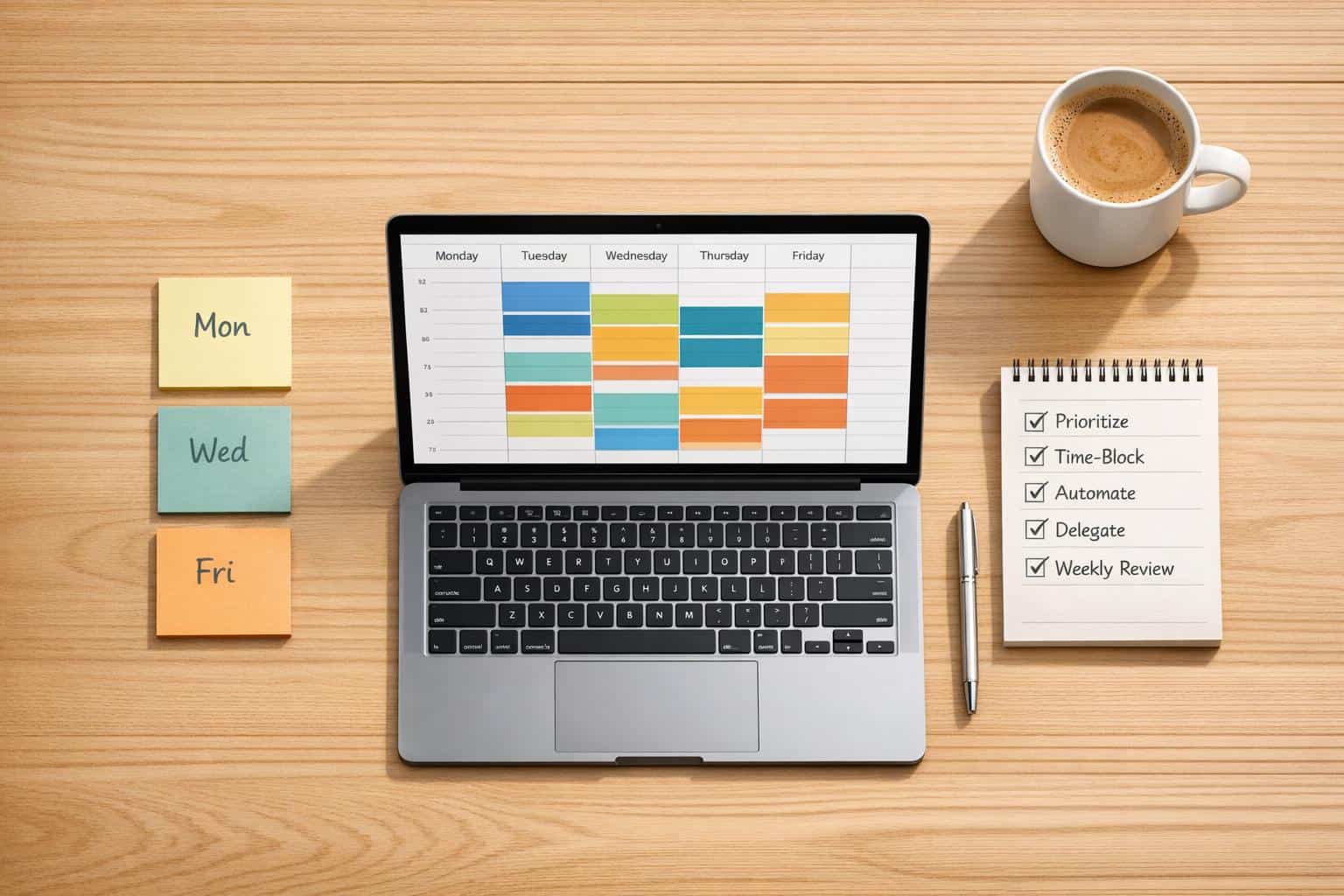
Entrepreneurs often face overwhelming workloads, but productivity isn’t about doing more – it’s about working smarter. This article breaks down 10 actionable strategies to help you save time, focus better, and reduce stress. Here’s what you’ll learn:
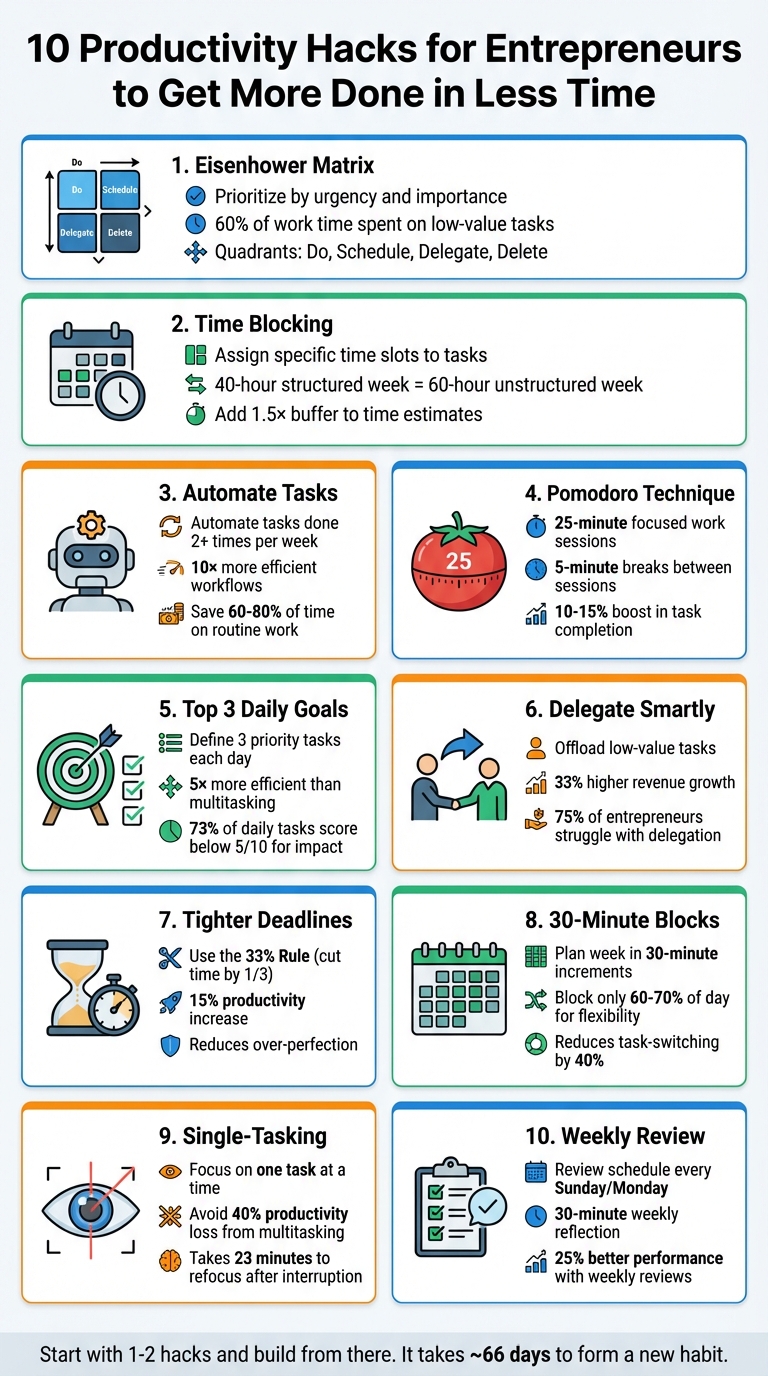
- Prioritize effectively: Use tools like the Eisenhower Matrix to focus on tasks that matter most.
- Time blocking: Schedule tasks in specific time slots to stay organized and avoid procrastination.
- Automate repetitive tasks: Leverage tools and AI to handle routine work, freeing up your energy for growth.
- Pomodoro Technique: Work in focused 25-minute intervals to minimize distractions.
- Set daily top 3 goals: Simplify your focus by tackling the most impactful tasks first.
- Delegate smartly: Hand off low-value tasks to your team to focus on high-impact work.
- Shorten deadlines: Avoid over-perfection and work efficiently by limiting task time.
- Weekly time review: Reflect and adjust your schedule to stay aligned with your goals.
- Focus on one task at a time: Avoid multitasking to improve quality and speed.
- Plan with 30-minute blocks: Structure your week for clarity and better time management.
These tips are designed to help you reclaim your time, sharpen your focus, and achieve meaningful results without burning out. Start with one or two strategies and refine them over time to fit your needs.
1. Use the Eisenhower Matrix to Prioritize Tasks
The Eisenhower Matrix is a simple yet effective way to prioritize tasks by sorting them into categories of urgency and importance. Urgent tasks need immediate action – like handling customer crises or meeting tight deadlines. On the other hand, important tasks contribute to long-term goals and strategic growth, even if they don’t demand attention right away.
"I have two kinds of problems, the urgent and the important. The urgent are not important, and the important are never urgent." – Dwight D. Eisenhower, 34th President of the United States
Here’s how the four quadrants of the matrix break down:
- Quadrant 1 (Do): Tasks that are both urgent and important. These might include critical deadlines, emergency customer issues, or last-minute sales opportunities.
- Quadrant 2 (Schedule): Tasks that are important but not urgent. Strategic planning, relationship building, and system improvements fall into this category.
- Quadrant 3 (Delegate): Tasks that are urgent but not important. Think routine emails, administrative tasks, or minor requests that someone else can handle.
- Quadrant 4 (Delete): Tasks that are neither urgent nor important, like excessive scrolling on social media or attending unnecessary meetings.
To make this process work, start your day with a "daily brain dump." Write down every task on your mind without overthinking. Then, use the 10-10-10 Rule: evaluate whether a task’s impact will last 10 minutes, 10 months, or 10 years. For added clarity, you can color-code tasks by quadrant to visualize priorities at a glance.
Why does this matter? Studies show that about 60% of work time is spent on "work about work" – things like status updates, follow-ups, and low-value tasks. By cutting out Quadrant 4 tasks and delegating Quadrant 3 items, you free up hours each week. Keep your list manageable by limiting each quadrant to 8–10 tasks. Then, protect your peak energy hours (usually between 9:00 AM and 11:00 AM) for Quadrant 2 work that supports long-term goals.
This method sets a strong foundation for time-blocking and delegation strategies that can further optimize your productivity.
2. Block Out Time for Specific Tasks
Time blocking transforms your to-do list into a structured schedule. Instead of simply jotting down tasks, you assign each one a specific time slot on your calendar. This shift from focusing on "what" to focusing on "when" changes everything. You’re no longer reacting to what feels urgent – you’re deliberately planning how your day will unfold.
Ever heard of Parkinson’s Law? It states that work will expand to fill the time available for its completion. So, if you block out 90 minutes for a task instead of leaving it open-ended, you’re more likely to finish it efficiently. In fact, a well-organized 40-hour workweek can achieve the same results as an unstructured 60-hour week.
Here’s how you can start: list all your tasks for the day and estimate how long each one will take. Most people underestimate time by about 50%, so add a 1.5× buffer to your estimates. For example, if you think a task will take 2 hours, schedule 3 hours. Plan to tackle your most challenging tasks during your peak energy hours – usually between 8:00 AM and 10:00 AM – and save less demanding tasks, like emails, for when your energy dips later in the day.
Grouping similar tasks together can also help you stay focused. Studies show that it takes an average of 23 minutes to fully regain focus after an interruption. Instead of checking emails sporadically, block two or three 30-minute slots for emails and calls. Use color-coded calendars to visually organize your day: red for deep work, blue for meetings, green for admin tasks, and yellow for breaks or personal time.
This method isn’t just about getting through the day – it’s about long-term productivity. Leaders like Jack Dorsey use "Day Theming", dedicating entire days to specific types of work, while Bill Gates takes it even further with "Think Weeks" reserved for strategic planning. To make this work for you, protect time not just for daily tasks, but also for big-picture thinking. Add 30–60-minute buffers between blocks to handle transitions or unexpected issues, and plan your schedule the night before to avoid wasting energy on morning decisions.
Time blocking isn’t just a productivity hack – it’s a way to take control of your time and make it work for you.
3. Automate Repetitive Business Tasks
If you find yourself doing the same task more than twice a week, it’s time to automate. Automation isn’t just about saving time – it’s about redirecting your focus to activities that drive growth. The difference in productivity between businesses that embrace automation and those that don’t is staggering, with automated workflows being up to 10 times more efficient.
Start by conducting an automation audit. Look for tasks that are repetitive, follow a clear process, and involve transferring data between systems. For example, think about copying leads from your website into your CRM or sending team notifications on Slack. A great case study here is MEWR Signal, an AI news agency. In March 2026, they implemented an automated system that processes 35 content sources, summarizes articles, and drafts newsletters – all in just 11 minutes a day. The cost? $20 per month, which replaced a $400 monthly human editor. This kind of audit helps you pinpoint where automation can have the biggest impact.
"If I have to do something more than once, I automate it." – Anna Burgess Yang, Freelance Content Marketer
Start small with zero-cost tools. Use email filters, scheduling links like Calendly (saving roughly 3 hours a week for entrepreneurs managing five or more calls), and document templates. Then, take it a step further by connecting your apps with no-code tools. For instance, set up a workflow where a submitted contact form automatically updates your CRM and triggers a welcome email. Finally, incorporate AI tools for tasks like drafting content or scoring leads – these can cut writing time by 60–80%.
4. Work in Focused 25-Minute Sessions
The Pomodoro Technique, created by Francesco Cirillo in the late 1980s, is a straightforward way to stay focused and productive. It divides your work into 25-minute intervals of concentrated effort, followed by five-minute breaks. After completing four of these cycles, you take a longer break of 15 to 30 minutes to recharge. This simple system has been shown to boost task completion rates by 10% to 15% in just one month and cut interruptions by half within six weeks.
By committing to just 25 minutes at a time, the technique makes even daunting projects more approachable. This structure helps overcome procrastination and the mental hurdles that come with tackling large tasks.
"Concentration and consciousness lead to speed, one Pomodoro at a time." – Francesco Cirillo, Creator of the Pomodoro Technique
To make the most of each 25-minute session, eliminate distractions. If a thought pops up – like remembering to email a client – jot it down on a list to handle later. Set your status on communication tools like Slack or Teams to "Do Not Disturb." Businesses that adopt focused work intervals often report a 20% to 30% improvement in project delivery times.
Take advantage of breaks to step away from your screen. Stretch, grab a drink, or move around – anything that helps reset your mind. Considering that knowledge workers already spend 57% of their time communicating rather than creating, these short breaks are essential for restoring energy and creativity. This focused approach not only boosts productivity but also lays the groundwork for optimizing your overall workflow.
5. Define Your Top 3 Daily Goals
After setting up effective time-blocking and focused work sessions, defining your top three goals for the day can help you channel your energy into what truly matters. Starting your day with clear priorities turns scattered effort into purposeful action, giving you a clear path to consistent progress.
Why focus on just three? Long to-do lists can feel overwhelming, leading to anxiety and mental fatigue. By narrowing your focus to three to five impactful tasks, you can avoid this mental drain. Research shows that setting detailed daily goals not only boosts motivation but also strengthens self-management skills. Plus, dedicating your attention to one high-impact task at a time can make you up to five times more efficient than juggling multiple tasks simultaneously.
"Without clear goals your work becomes reactive instead of proactive." – Nomad Excel
A helpful tip: define your top three goals the night before. This small habit eliminates decision fatigue in the morning, allowing you to dive straight into your most critical tasks. Use the SMART framework to make each goal Specific, Measurable, Achievable, Relevant, and Time-bound. For instance, instead of a vague goal like "work on marketing", try something specific like "draft three email sequences for the product launch by 11:00 a.m."
Plan to tackle your most important or challenging task during your peak energy hours, which for many people is early in the morning when willpower is at its strongest. This approach, often called "eating the frog", ensures you handle the most significant work before distractions creep in. It’s worth noting that 73% of daily tasks typically score below a 5/10 in terms of revenue impact. In other words, most tasks don’t significantly contribute to business growth. Your top three goals should align with the 20% of activities that drive 80% of your results.
6. Delegate Tasks to Your Team
Once you’ve streamlined your priorities, the next step is to tap into your team’s potential. You don’t have to do everything yourself. Delegation isn’t just about reducing your to-do list – it’s about creating space for you to focus on the decisions that drive growth. By handing off tasks, you can align your energy with high-value activities. Interestingly, while 75% of entrepreneurs find delegation challenging, those who master it often experience over 100% higher revenue growth.
Think of delegation as an extension of productivity tools like time blocking. It refines your workflow and amplifies your results. To start, categorize your tasks into three buckets:
- "Must be me": These are tasks like strategic planning, sales calls, or final approvals.
- "Could be me but doesn’t have to be": Tasks such as responding to emails, managing your calendar, or preparing bookkeeping documents.
- "Shouldn’t be me": Low-value activities like data entry, minor design edits, or routine admin work.
Begin by offloading the "Shouldn’t be me" tasks – these are the ones that pull you away from work that directly impacts revenue.
Here’s a quick way to assess delegation opportunities: calculate your hourly rate by dividing your annual income by your total work hours. If your time is worth $100 per hour, but you’re spending it on tasks that someone else could handle for $35 per hour, you’re essentially losing $65 for every hour spent on those activities. Research shows that CEOs who delegate effectively see 33% higher revenue growth than those who try to do it all themselves.
"Growth comes from delegation, not before it." – Entrepreneur
Start small – delegate 5 to 10 hours of work per week. To ensure quality, document your processes with clear Standard Operating Procedures (SOPs). When assigning tasks, be specific about the desired outcomes. For example, instead of saying, "Schedule meetings", provide detailed instructions like, "Set up sales meetings on Tuesdays and Thursdays, prioritize top-tier prospects, and include Zoom links." This level of clarity helps your team deliver exactly what you need.
sbb-itb-ba0a4be
7. Set Tighter Deadlines to Work Faster
Once you’ve nailed down delegation, it’s time to focus on what’s left on your plate. Here’s the thing: work tends to stretch to fit the time you give it. This idea, known as Parkinson’s Law, explains why a task that could take two hours somehow ends up consuming your entire afternoon. By setting shorter deadlines, you force yourself to zero in on what truly matters.
Tighter timeframes can actually boost productivity. A 2013 study found that teams who cut task time by 33% and held quick, daily 15-minute check-ins saw productivity jump by at least 15% – without sacrificing quality. Shorter deadlines encourage sharper focus and help curb the tendency to over-perfect.
"If you wait until the last minute, it only takes a minute to do." – Stock-Sanford
One way to apply this is by using the 33% Rule. Start by estimating how long a task should take, then schedule only about two-thirds of that time. For instance, if preparing a weekly report usually takes 90 minutes, give yourself just 60 minutes instead. This approach eliminates unnecessary padding that often leads to procrastination or endless fine-tuning.
To make deadlines stick, add some external accountability. While self-imposed deadlines can work, having someone else – like a colleague or mentor – set the deadline tends to deliver better results. For bigger projects, try breaking them into smaller chunks and assigning deadlines every 2–3 days. This keeps the momentum going and maintains a steady sense of urgency.
8. Schedule Your Week in 30-Minute Blocks
Once you’ve mastered shorter deadlines, breaking your week into 30-minute blocks can take your planning to the next level. This method transforms vague tasks into a clear, actionable schedule, helping you stay focused and intentional with your time.
Here’s something to think about: a well-structured, time-blocked 40-hour workweek can match the output of an unstructured 60+ hour week. These small blocks act as boundaries, keeping tasks from taking over your day. For instance, instead of letting emails eat up your entire morning, dedicate a specific 30-minute slot – like 11:00 AM – for them. This approach not only keeps your day on track but also sets the tone for a productive week.
Start with a Sunday Setup: Spend 60–90 minutes every Sunday planning your week. Write down everything you need to do and categorize tasks into "deep work" (like strategic planning or creative projects) and "shallow work" (like emails or admin tasks). Then, assign each task to a specific time based on your natural energy levels. For example, Jack Dorsey, former CEO of Twitter and Square, managed his dual roles by "day theming" – dedicating certain days to specific activities like management, product development, or marketing.
Here are a few tips to make this work:
- Block out only 60–70% of your day to leave room for flexibility.
- Group similar tasks together to minimize mental fatigue.
- Add a 30–60-minute buffer daily for unexpected issues or overruns.
Why does this matter? Studies show that jumping between tasks can reduce productivity by as much as 40%. By sticking to your blocks, you avoid the chaos of constant task-switching.
The real game-changer here is commitment. Unlike a simple to-do list, a time-blocked calendar feels like a promise. When your calendar says "Draft Q2 strategy" at 2:00 PM, it’s a clear signal to dive in and get it done. This structure helps eliminate procrastination and keeps you moving forward.
9. Focus on One Task at a Time
Despite what people often believe, your brain isn’t built to multitask. What feels like handling multiple tasks at once is actually rapid task-switching – your brain bouncing between activities. Each time it shifts, it has to "reload" the context of what you were doing, which eats up mental energy and slows you down. This phenomenon, known as the "cognitive switching penalty", can sap as much as 40% of your productivity. Add interruptions into the mix, and you could lose up to 40 minutes of focused work each time you’re pulled away.
This constant back-and-forth doesn’t just waste time – it can also lower the quality of your work.
"Every time you jump from a report to an email or chat message, you force your brain to reload the context. This drains mental energy, increases the risk of errors, and reduces the quality of your work." – Nextiva
Shifting to single-tasking can make a huge difference. When you focus on one task at a time, you avoid the inefficiencies of context-switching and can achieve a flow state where your best work happens. For instance, a report that might take 3 hours to complete while multitasking could be done in just 1.5 hours – and with better results – when you give it your undivided attention.
To make single-tasking work for you, start by silencing all notifications on your devices during focused work periods. Techniques like the Pomodoro Technique can help you stay engaged while avoiding burnout. Another tip? Batch similar tasks together – like checking emails only at specific times of the day. By safeguarding your attention, you’ll not only save time but also produce higher-quality work compared to juggling multiple tasks at once.
10. Review Your Schedule Weekly
Even the best productivity systems can lose their edge over time. Meetings sneak into your calendar, urgent tasks dominate, and suddenly you’re stuck reacting instead of proactively steering your goals. A weekly schedule review helps you regain control by identifying patterns, closing loops, and ensuring your time is spent on what truly matters.
There’s a psychological reason this works. The Zeigarnik Effect makes your brain obsess over incomplete tasks, sapping your energy and increasing stress. By reviewing your schedule and planning for unfinished tasks, you ease this mental strain. Studies show that employees who reflect on their goals weekly perform 25% better than those who review less often. High achievers who stick to weekly reviews also report feeling 40% more in control of their time.
Set aside just 30 minutes every Sunday or Monday for this review. Start by reflecting on the past week: What did you accomplish? What fell through the cracks? How did you spend your time? Look for imbalances – are you focusing too much on client work while ignoring marketing? Is reactive work eating into time meant for strategic projects?
"The most valuable habit I’ve acquired is using pain to trigger quality reflections. If you can acquire this habit, it will have an enormous impact on your effectiveness." – Ray Dalio, founder of Bridgewater Associates
Use these insights to plan your week. Time-block your top three priorities in 30-minute chunks and leave 20% of your schedule open as a buffer. If the same problems keep cropping up in three consecutive reviews, it might be time for structural changes – like implementing a "no-meeting" day. This simple weekly habit gives you 52 chances a year to reset, and research shows people are 47% more likely to chase ambitious goals at the start of a new week than mid-week.
Conclusion
After diving into these ten productivity strategies, one thing becomes clear: effective time management is about creating systems that consistently work, not trying to cram more tasks into your day. True productivity is about working smarter and aligning your efforts with meaningful outcomes – not just staying busy. The tips outlined here, from the Eisenhower Matrix to weekly schedule reviews, offer a practical framework to help you focus on what matters most.
Start small by implementing one or two hacks that address your biggest challenges. For example, if your schedule feels overwhelming, try time blocking. If repetitive tasks are eating away at your day, explore automation tools. Focus on mastering these changes before moving on to others. Remember, research suggests it takes around 66 days to develop a new habit, so give yourself the time to adapt and refine your approach.
Not every strategy will work for every situation. Administrative tasks may require a different approach than creative work. The key is to test, evaluate, and adjust based on what aligns with your specific needs. Use weekly reviews to spot patterns and identify areas where tweaks are necessary.
"Real productivity isn’t about doing more – it’s about honing your attention by working smarter, not harder." – Chris Reaburn, Chief of Strategic Execution at Nextiva
These strategies are designed to help entrepreneurs take back control of their time, sharpen their focus, and achieve meaningful growth. By committing to just one of these hacks today, you’re setting the stage for smarter, more impactful work moving forward.
FAQs
Which 1–2 productivity hacks should I start with first?
- Outline your daily objectives: Begin each day by identifying the key tasks you need to accomplish. This helps you zero in on what truly matters and steer clear of spending time on things that don’t align with your priorities.
- Schedule dedicated time for deep work: Block out specific periods in your day to focus solely on high-priority tasks. This approach minimizes distractions and prevents the urge to multitask, allowing you to work with greater clarity and efficiency.
By incorporating these two habits, you’ll be setting yourself up with a clear roadmap and the focus needed to tackle your day effectively.
How do I time-block when my day is full of interruptions?
To make time-blocking work when interruptions are common, try scheduling specific blocks for focused work while also leaving buffer periods for unexpected tasks. By grouping similar tasks into designated time slots, you can minimize distractions and maintain productivity. This method helps you stay on top of your schedule and ensures that key tasks are completed, even on hectic days.
What business tasks should be automated first?
The most effective tasks to automate first are those that consume a lot of time and involve repetitive work. Think about areas like content creation, customer onboarding, and data-intensive processes such as market research. Automation tools can take care of things like generating captions, analyzing customer reviews, and simplifying workflows. This allows you to shift your attention to more strategic growth opportunities.