


Delegation is not just about offloading tasks – it’s the secret to scaling your business and avoiding burnout. Founders often spend over 60 hours a week working, with a significant portion wasted on low-value, repetitive tasks. The solution? Focus on what truly drives growth and pass the rest to your team or external support.
Here’s how to start:
- Identify tasks to delegate: Use the "Three R’s" (Repeatable, Reactive, Low-leverage) and the 80/20 rule to pinpoint time-draining activities.
- Delegate effectively: Match tasks to team strengths or outsource when necessary. Use tools like SOPs and project management platforms for clarity.
- Overcome challenges: Build trust, avoid micromanaging, and handle mistakes constructively.
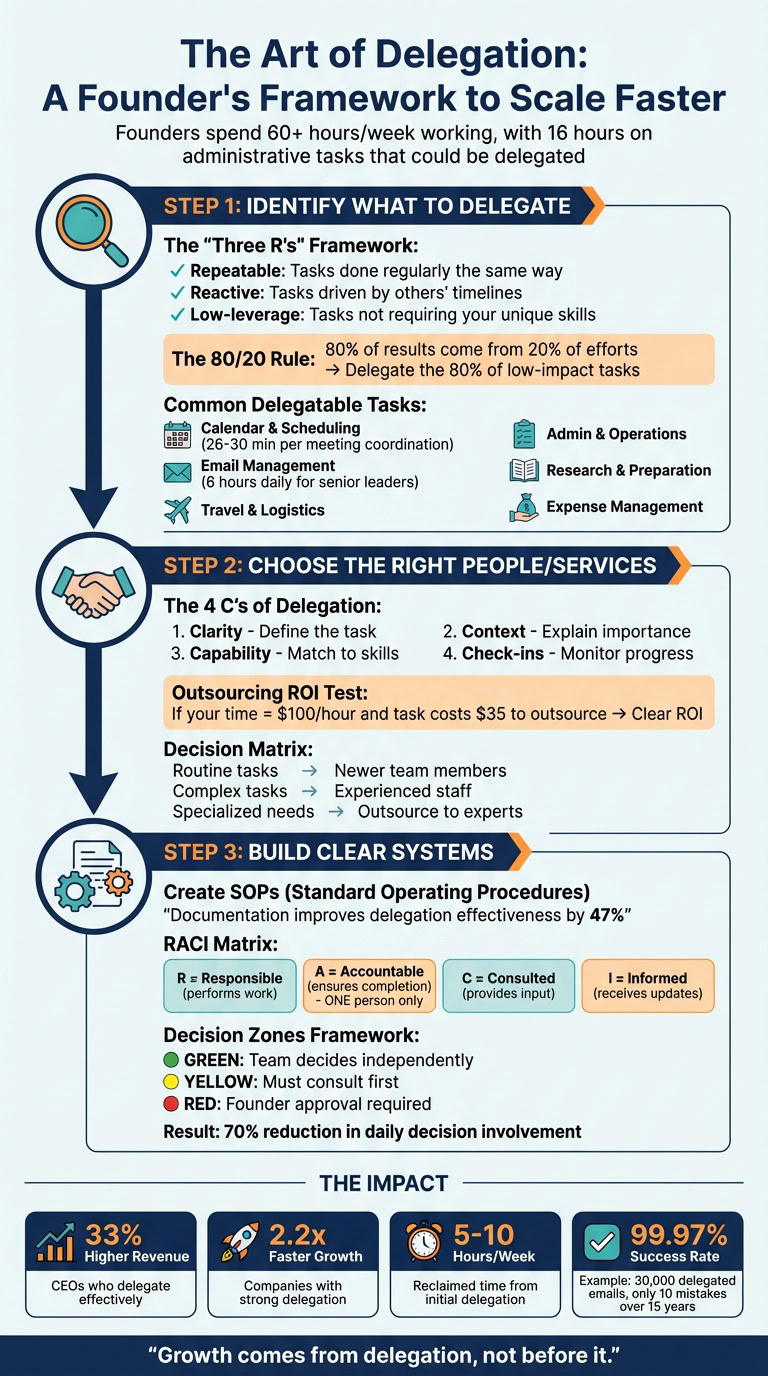
How to Identify Which Tasks to Delegate
Founders often feel overwhelmed but struggle to separate essential tasks from routine ones. The real challenge of delegation isn’t finding help – it’s figuring out what to pass on.
Separate High-Value Tasks from Routine Work
To focus on strategy, you need to distinguish between responsibilities that require your expertise and those that don’t. A practical way to identify tasks to delegate is by applying the "Three R’s":
- Repeatable: Tasks done regularly in the same way.
- Reactive: Tasks driven by others’ timelines, like responding to requests.
- Low-leverage: Tasks that don’t rely on your unique skills or relationships.
If a task can be broken down into a simple checklist, it’s routine work. In contrast, high-value tasks demand judgment and situational awareness. As a founder, your focus should remain on the high-value items, leaving the routine ones for delegation.
Another helpful tool is the "Ankle Biter" Test: identify small, recurring tasks that disrupt your focus. Even a quick five-minute task can be a distraction. Before delegating, consider whether it can be eliminated or automated instead.
"Never automate something that can be eliminated, and never delegate something that can be automated or streamlined. Otherwise, you waste someone else’s time instead of your own."
– Tim Ferriss
Apply the 80/20 Rule to Decide What to Delegate
The Pareto Principle (the 80/20 rule) suggests that 80% of your results stem from just 20% of your efforts. This means much of what clogs your schedule may not significantly impact your goals. Your task is to identify the "vital few" activities that drive growth and delegate the rest.
Start with a time audit: track your activities for a week to see where your time goes. You might uncover that hours are lost coordinating meetings – which can take 26 to 30 minutes per meeting due to scheduling back-and-forths – or managing emails, an area where senior leaders often spend six hours daily.
By identifying the 20% of tasks that yield the majority of your results, you’ll see which remaining tasks can be handed off. Delegation allows you to reclaim time for the work that matters most.
"When you get ruthless about prioritizing, you stop confusing movement with impact."
– Aloysius Carl, Future By Design Advisory
Once you’ve pinpointed low-impact tasks, delegate them as soon as possible.
Common Tasks You Can Delegate Right Now
If you’re currently spending around 16 hours a week on administrative tasks, here are some areas to consider delegating:
- Calendar and Scheduling: Coordinating appointments, resolving conflicts, and time-blocking for focused work.
- Email and Communication: Managing inboxes, drafting standard replies, and tracking follow-ups.
- Travel and Logistics: Researching travel options, creating itineraries, and handling rebookings.
Other delegatable areas include:
- Admin and Operations: Updating CRM systems, sending invoices, filing documents, and tracking signatures.
- Research and Preparation: Comparing vendors, summarizing competitor insights, preparing meeting briefs, and gathering client background information.
- Expense Management: Organizing receipts, preparing expense reports, and reconciling statements.
For example, Sam Corcos, CEO of Levels, delegated 400 tasks per month in February 2022 to a team of 12 outsourced executive assistants. These tasks ranged from updating Goodreads lists to drafting investor updates. Similarly, co-founder Josh delegated creating summary slides for team meetings, reducing the time required from two hours to just 15 minutes by reviewing an assistant’s work.
When delegating, aim to hand off entire workflows rather than isolated tasks. Documenting processes as Standard Operating Procedures (SOPs) – like a full travel planning guide – enables consistency and scalability as your business grows.
sbb-itb-ba0a4be
How to Choose the Right People or Services for Delegation
Once you’ve figured out what tasks to delegate, the next big step is deciding who or what service should take them on. Picking the right person or service can significantly boost your productivity and efficiency.
Match Tasks to Your Team’s Skills
Delegation works best when you know your team’s strengths and interests. A helpful framework is the "4 C’s of Delegation": Clarity (define the task), Context (explain its importance), Capability (align with the person’s skills), and Check-ins (monitor progress regularly).
When assigning tasks, consider both what your team members are already good at and what they’d like to learn. One-on-one conversations are a great way to uncover their growth goals. People who are eager to learn often perform exceptionally well when given the chance.
Also, think about the nature of the task. Is it a straightforward, step-by-step process? Or does it require strategic thinking? Routine tasks are well-suited for newer team members, while more complex, judgment-heavy work should go to those with a proven track record.
"Delegation is a leadership skill you can develop over time."
– Julia Martins, Asana
If a task doesn’t align with your team’s core strengths, outsourcing might be the better option.
When Outsourcing Makes More Sense Than Hiring
Not every task needs a full-time employee. Outsourcing is ideal for specialized skills, part-time needs, or when you want to avoid the costs of hiring, such as payroll taxes and benefits. A good rule of thumb is the hourly rate test: if your time is worth $100 an hour and a task costs $35 to outsource, the return on investment is clear. Start small – delegate just a few hours of work each week to test reliability before fully integrating an outsourced service into your workflow.
Managed services come with the benefit of handling hiring, training, and quality control for you. On the other hand, working with freelancers means you’ll need to manage these aspects yourself. For instance, BusinessAnywhere offers a virtual mailbox service that takes care of mail scanning, storage, and forwarding globally – completely removing the need to hire someone for mail management. Their registered agent service ensures compliance across multiple states without requiring in-house staff to track deadlines.
Choosing between generalist and specialist support is another key decision. Generalist virtual assistants can handle a wide range of tasks, like managing emails or scheduling, while specialists bring targeted expertise in areas like SEO, bookkeeping, or CRM setup. The task’s complexity should guide your choice.
Use Project Management Tools to Track Delegated Work
Once you’ve assigned tasks, keeping track of progress is critical – and digital tools make this a breeze. Transparency ensures accountability. Platforms like Trello, Asana, ClickUp, and Monday let you create shared task boards where everyone can follow assignments from start to finish. Each task should include a clear goal, quality expectations, and a deadline. Defining what "done" means upfront reduces misunderstandings.
For tasks that require detailed instructions or feedback, tools like Loom let you record quick video walkthroughs. Slack is great for short, daily updates, while project management tools are better for tracking longer-term projects.
If you’re using tools like BusinessAnywhere’s virtual mailbox or cloud phone system, these can integrate seamlessly into your workflow. For example, you can delegate mail management to a team member who can review scanned documents and flag anything needing your input.
To avoid micromanaging, set up regular status updates. This keeps you informed while giving your team the autonomy to work independently.
Build Clear Systems for Smooth Delegation
To make delegation work seamlessly, you need clear systems that ensure tasks are consistently executed. Without structure, delegation can quickly turn into chaos. When tasks come back to you because instructions were unclear, or team members make unexpected decisions, the issue usually lies in the lack of documented processes – not the people. Standard Operating Procedures (SOPs) bring order and clarity to your workflows, ensuring your methods aren’t just stored in your head but are accessible to everyone.
Think of documentation as a safety net for your team. With clear systems in place, even newer team members can deliver consistent results. Research shows that documenting elements like success criteria, decision boundaries, and available resources improves delegation effectiveness by 47% compared to informal handoffs.
Create Standard Operating Procedures (SOPs)
SOPs are the backbone of consistent task execution. They ensure work is done the same way every time, no matter who’s handling it. But for SOPs to work, they need to be practical. Each one should clearly define what “done” looks like, using success metrics, decision criteria, and examples of high-quality outcomes.
"SOPs don’t create bureaucracy; they create clarity that unlocks autonomy."
– Kamyar Shah, Fractional COO
Start by documenting recurring tasks like client onboarding, invoice processing, or responding to common customer inquiries. A solid SOP should include:
- Step-by-step instructions
- Required tools
- Quality standards
- Contingency plans for when things go wrong
Store these in a searchable knowledge base or wiki so your team can find answers without disrupting your day with Slack messages.
For greater efficiency, delegate entire workflows supported by complete SOPs instead of piecemeal tasks. This approach minimizes “reverse delegation,” where tasks bounce back to you due to unclear guidance.
Use RACI Matrices to Define Roles
Once your processes are documented, defining roles through a RACI matrix enhances accountability. RACI stands for:
- Responsible: The person performing the work.
- Accountable: The one ensuring the task is completed correctly.
- Consulted: Those whose input is needed.
- Informed: Those who need updates.
The golden rule? Assign only ONE Accountable person per task. When accountability is shared, it often leads to confusion and inaction. This clear structure eliminates the “everyone and no one owns it” problem that can stall progress.
| RACI Role | Definition | Key Rule |
|---|---|---|
| Responsible | The person who performs the work | Can be multiple people |
| Accountable | Ensures the task is completed correctly | Exactly one person per outcome |
| Consulted | Provides input before decisions/actions | Involved before a decision/action |
| Informed | Receives updates after decisions/actions | Notified after a decision/action |
To create a RACI matrix, list tasks on one side and assign roles to team members. Review it as a group to identify gaps (tasks without a “Responsible”), overlaps (multiple “Accountable” roles), or overloaded team members. Poor communication puts nearly 50% of project spending at risk, but a well-constructed RACI matrix can reduce confusion early on.
Document Your Processes for Future Growth
Documenting processes isn’t just about solving today’s problems – it’s about preparing for tomorrow. A strong foundation of documentation helps businesses scale efficiently. Companies with leaders who delegate effectively grow 2.2x faster than those that don’t. By documenting now, you avoid the headache of rebuilding systems when your team expands from 20 to 50 employees.
One useful tool is the "decision zones" framework, which defines authority levels:
- Green: Team can decide independently.
- Yellow: Team must check with others first.
- Red: Founder input is required.
For example, Tara Reed, CEO of Apps Without Code, implemented this framework in May 2025. Within weeks, her involvement in daily decisions dropped by 70%.
Every delegated task should include a "Minimum Viable Brief" that outlines:
- Desired outcome
- Context
- Constraints
- Decision rights
- Milestones
- Resources
- Escalation paths
This level of detail prevents misunderstandings and empowers your team to act with confidence. Founders of small and mid-size businesses spend an average of 16 hours per week on administrative tasks that could be delegated. Proper documentation ensures those tasks stay delegated.
How to Overcome Common Delegation Problems
Delegation can be tricky, even with clear systems in place. Psychological barriers often get in the way: only 30% of managers feel confident delegating, and just one in three are seen as effective at it. This gap between intention and execution can lead to hidden productivity costs. Founders often find themselves redoing tasks or "babysitting" staff instead of focusing on growth. Yet, CEOs who delegate effectively see 33% higher revenue growth compared to those who don’t.
Most issues with delegation fall into three main categories: struggling to let go of control, micromanaging, or panicking when mistakes happen. Below are practical strategies to address these common challenges.
Learn to Trust Your Team and Release Control
Trust is one of the biggest hurdles to effective delegation. Here’s the key: trust your systems, not just your people. With well-documented SOPs, templates, and checklists, you’re not relying on intuition – you’re leaning on a proven process.
Start with the "Sandwich" Method to ease into delegation. Begin by modeling the task yourself ("I Do"), then work through it together ("We Do"), and finally transition full ownership to your team ("You Do"). This step-by-step approach builds confidence on both sides without overwhelming anyone.
Another helpful tool is the "Ladder of Delegation", which matches autonomy levels to a team member’s readiness. At the start, they may follow strict instructions. As they gain experience, they can move to researching options, making recommendations, and eventually handling decisions independently. This method avoids the all-or-nothing mindset that can make delegation feel risky.
Encourage your team to bring solutions, not just problems. Instead of asking, "What should I do?", they should propose a plan: "I recommend X because of Y; do you approve?" This approach, known as "Yes-able Questions," accelerates decision-making and strengthens their problem-solving skills.
Lastly, define decision zones for your team: Green (decide independently), Yellow (consult others), and Red (requires your input). This framework reduces how often they need to involve you in day-to-day decisions.
Once trust is established, the next challenge is finding the right balance between oversight and autonomy.
Balance Oversight Without Micromanaging
Micromanagement often stems from focusing too much on task details instead of overall outcomes. Your role is to set clear expectations for success and then let your team decide how to achieve those results.
You can stay informed without being overbearing by using shared dashboards in project management tools or having staff BCC you on key emails. This keeps you updated without disrupting their workflow. Establish a predictable feedback schedule – such as a kickoff meeting, a midpoint check, and a final review – to maintain accountability without constant check-ins.
Give your team autonomy within boundaries. For example, set a 10-hour limit on research tasks or a $500 budget for solving specific problems. These guidelines provide structure while allowing room for independent action.
Differentiate between "Type 1" decisions (irreversible, high-stakes) and "Type 2" decisions (reversible, low-risk). Delegate Type 2 decisions fully while keeping closer oversight on Type 1. This ensures you stay involved where it matters most without becoming a bottleneck for everyday tasks.
Here’s a powerful example: one entrepreneur gave an assistant full access to six email accounts. Over 15 years, the assistant handled more than 30,000 responses, making only 10 serious mistakes – a 99.97% success rate. This shows that trusting your team with real responsibility can pay off.
Even with balanced oversight, mistakes will happen. How you handle them can make or break your delegation process.
Handle Mistakes and Improve Your Delegation Process
When mistakes occur, resist the urge to reclaim the task. Taking back control – known as reverse delegation – undermines trust and halts learning. Instead, figure out whether the issue stems from a personal skill gap or an unclear process. If it’s the latter, update the SOP to fix the problem rather than assigning blame.
"Delegation without follow-up is abdication." – Entrepreneur
Offer constructive feedback and let the team member correct the mistake. Keep in mind that 41% of workers’ daily time is spent on tasks that don’t add value, often because they’re waiting for approvals or redoing work due to unclear expectations.
Normalize mistakes by conducting quick After-Action Reviews (AARs). Discuss what went well, what didn’t, and how to improve next time. Document these lessons in your SOPs to avoid repeating errors. Treat setbacks as opportunities for growth.
As Shopify CEO Tobi Lütke wisely said:
"If you’re still the best person to answer support tickets at 50 employees, something’s wrong."
Delegation isn’t about achieving perfection – it’s about making progress. By trusting your systems, balancing oversight with autonomy, and learning from mistakes, you can build a team that operates effectively, freeing you to focus on strategic growth.
Conclusion
Delegation is the key to building a business that grows beyond your personal capacity. As highlighted earlier, founders who delegate effectively see a 33% boost in revenue and are 2.9 times more likely to achieve a successful exit.
Even small, consistent steps can unlock valuable time for strategic leadership. Start by offloading 5–10 hours per week of routine tasks like managing your inbox, scheduling, or tracking expenses. As you delegate, document your processes, clearly define what "done" looks like, and gradually increase your team’s independence. Take inspiration from Ritz-Carlton: they empower employees with a $2,000 discretionary budget to resolve customer issues instantly – no approvals needed. That level of trust creates a scalable foundation.
"Growth comes from delegation, not before it." – Entrepreneur
One ultimate test of your delegation system? Take a two-week vacation without checking in. If your business thrives without you, it’s a sign that your delegation strategy is working.
Your ability to focus on the bigger picture is what drives your company forward. Shifting your energy from micromanaging to empowering your team can accelerate growth. Don’t let yourself become the bottleneck – build systems that let your team thrive.
FAQs
What should I delegate first if I only have 1–2 hours to start?
If you’ve got 1–2 hours to start delegating, zero in on the tasks that eat up the most time but are straightforward to pass along. Start with repetitive administrative work – things like managing your calendar, filtering emails, or conducting basic research. Pinpoint your biggest time-wasters, pick five tasks from a single category, write down clear instructions for each, and assign them to a virtual assistant or team member. This simple approach can help you reclaim your time quickly and effectively.
How do I delegate without losing control or quality?
To delegate well while keeping things on track, it’s all about finding the right mix of trust and oversight. Begin by assigning tasks to team members who have the skills to handle them. Make your goals clear from the start and encourage open communication. Start small – hand over simpler tasks initially to build trust and observe how things progress. Give thorough instructions to ensure the work aligns with what you have in mind, and schedule regular check-ins. This way, you stay in the loop without hovering, maintaining quality while giving your team the confidence to succeed.
How do I know if I should outsource a task or hire for it?
Deciding between outsourcing and hiring comes down to the nature of the task. If the work is non-core, repetitive, or requires specialized expertise that you don’t need all the time – like logistics or customer support – outsourcing can save both time and resources. On the other hand, tasks that are strategic, long-term, or demand close collaboration and control are better suited for in-house hiring. Consider the task’s complexity, how often it’s needed, and its importance to your core operations to make the best choice for scaling efficiently.