

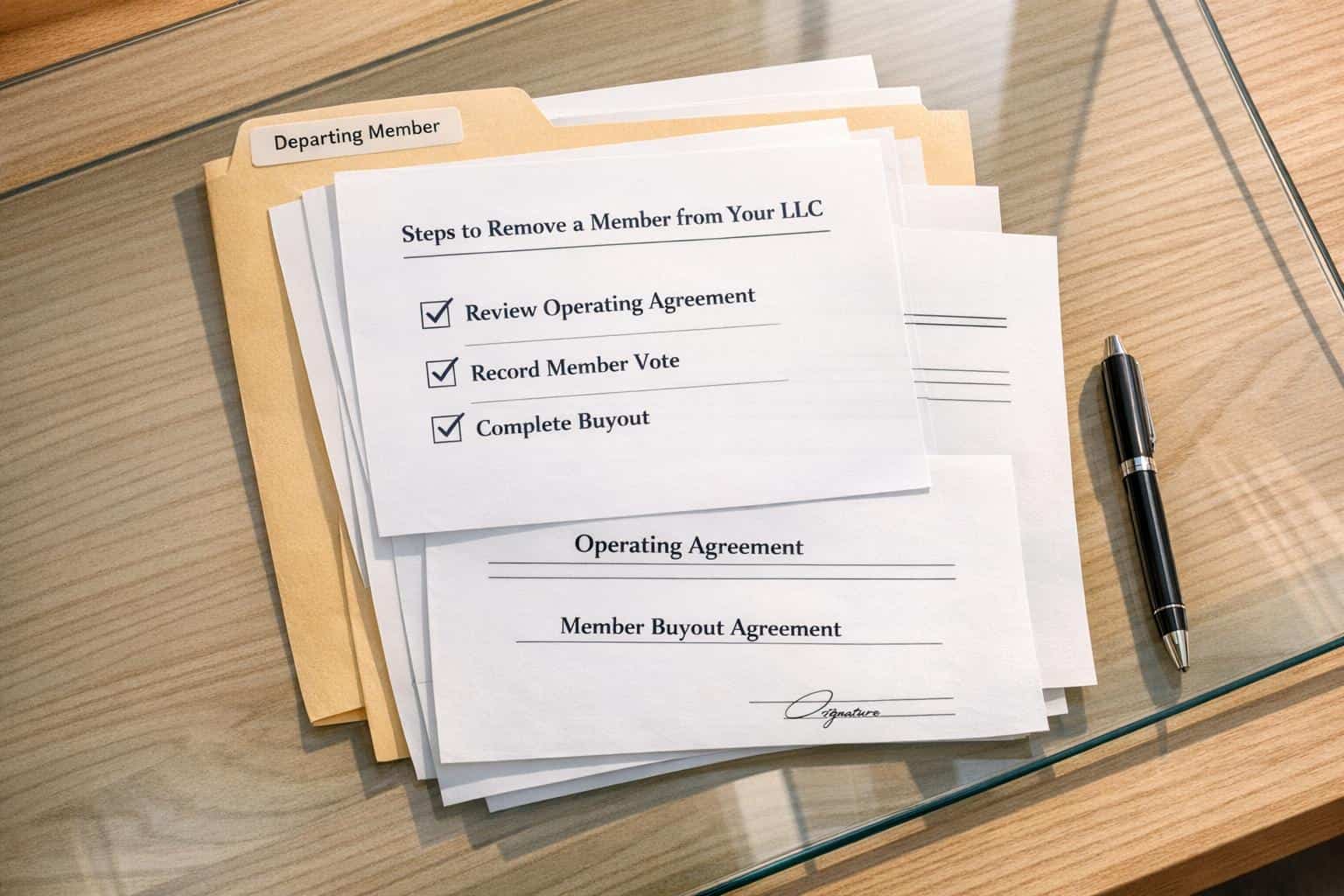
Removing a member from your LLC can be complex, but following the right steps ensures a smooth and legal process. Here’s a quick breakdown:
- Check Your Operating Agreement: This document often outlines the removal process, including voting requirements, notice periods, and buyout terms.
- Understand State Laws: If your agreement doesn’t cover removal, state laws will apply. Some states require court involvement for member removal.
- Determine Voluntary vs. Involuntary Removal: Voluntary departures are simpler, while involuntary ones require documentation and adherence to stricter rules.
- Document Everything: Keep records of votes, resolutions, and agreements to avoid disputes.
- Handle Financials: Use valuation methods like fair market value or book value to determine the departing member’s stake and negotiate payment terms.
- File Amendments: Update your LLC’s public records with the state and notify the IRS if necessary.
- Notify Stakeholders: Inform banks, creditors, and other parties to ensure proper transitions.
Skipping any of these steps can lead to legal or financial issues. Always consult your operating agreement and consider seeking legal advice for complex cases.
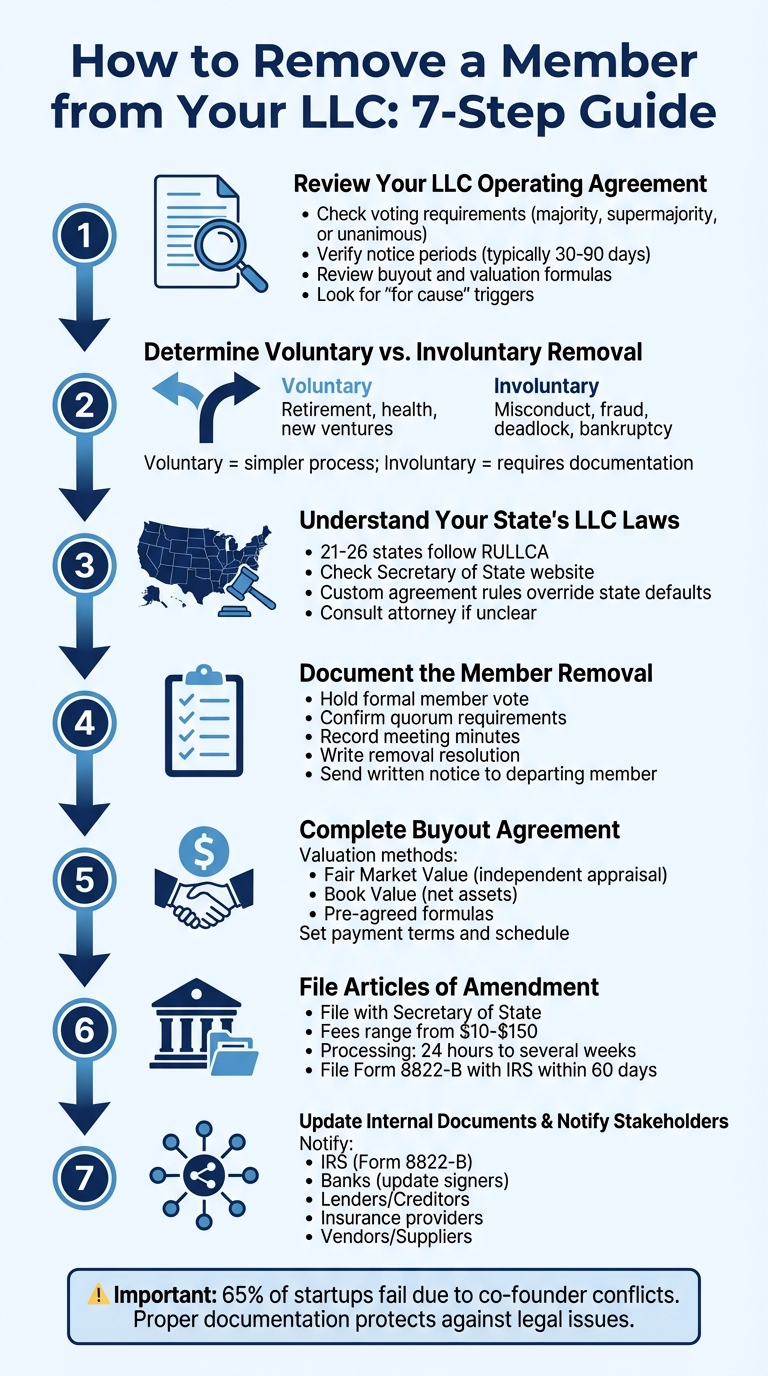
Step 1: Review Your LLC Operating Agreement
Your operating agreement is the cornerstone of your LLC’s internal operations. Before taking any action, it’s crucial to review this document carefully. State laws often defer to the rules outlined in your operating agreement, making it your go-to guide for handling member removal. Following these steps will help shield the remaining members from personal liability or claims of wrongful removal.
Find the Key Provisions
Start by locating the specific provisions in your operating agreement that deal with removal. These provisions typically cover:
- Voting Requirements: These outline the level of agreement needed to remove a member. It could require a simple majority, a supermajority (like two-thirds), or even unanimous consent from the remaining members.
- Notice Periods: Many agreements specify a required notice period, often ranging from 30 to 90 days, before a member can be removed or withdraw.
- Buyout and Valuation Formulas: These determine the value of the departing member’s interest. Common methods include:
- Fair Market Value, assessed by an independent appraisal.
- Book Value, based on the LLC’s net assets.
- Pre-agreed formulas, such as a multiple of revenue or earnings.
- Right of First Refusal (ROFR): This provision ensures the departing member must first offer their ownership interest to existing members before selling to an outsider.
For involuntary removals, check if the agreement includes "for cause" triggers. These might include breaches of fiduciary duty, illegal activities, fraud, bankruptcy, or failure to meet financial contributions. Some agreements also require mediation or arbitration before legal action can be taken.
These provisions lay the groundwork for managing either voluntary or involuntary member removal, setting the stage for the next steps based on the situation.
What to Do If Your Operating Agreement Doesn’t Address Removal
If your operating agreement doesn’t address member removal, the process becomes trickier. Without clear guidance, you’ll need to rely on state laws, which can complicate matters. Many states impose restrictions on removal when the agreement is silent.
In these cases, your options may include:
- Negotiating a Voluntary Buyout: Offer to purchase the member’s interest directly.
- Judicial Dissolution: If negotiations fail and an impasse occurs, you may need to petition the court to dissolve the LLC, effectively ending the business.
Legal action should always be a last resort. Over 20 states follow the Revised Uniform Limited Liability Company Act, which allows judicial expulsion only if the member’s actions make it "not reasonably practicable" to continue the business. Since removal rules vary widely by state, consulting a business attorney familiar with your state’s laws is essential before proceeding.
Step 2: Determine If the Removal Is Voluntary or Involuntary
Understanding whether a member’s departure is voluntary or involuntary is key to navigating the removal process effectively. This distinction influences the legal steps, required documentation, and potential challenges involved.
A voluntary resignation happens when a member decides to leave by choice – perhaps for reasons like retirement, health concerns, or pursuing other ventures. On the other hand, involuntary removal occurs when the LLC or its members initiate the process, often due to misconduct or failure to meet obligations. Voluntary exits are typically straightforward, requiring minimal documentation. In contrast, involuntary removals demand formal votes, clear documentation of cause, and carry higher litigation risks if mishandled.
Voluntary Member Removal
When a member voluntarily decides to leave, the process usually starts with a written notice of resignation submitted to the LLC and its members. The operating agreement should outline the required notice period – commonly 30 to 60 days – and the steps for valuing and buying out the member’s ownership interest.
A formal withdrawal agreement is essential. This document should include key details like the effective date of withdrawal, the compensation amount, the payment schedule, and a release of liability. Such agreements protect everyone involved. However, if the operating agreement prohibits withdrawal or sets a fixed term for the LLC, the resignation could be considered "wrongful", potentially making the departing member liable for damages.
It’s important to note that leaving the LLC doesn’t automatically release the member from personal guarantees on loans or debts. These obligations should be addressed explicitly in the withdrawal agreement to avoid future disputes.
Involuntary Member Removal
Involuntary removal is a more complex process with stricter requirements. Common reasons for this include theft, fraud, failure to meet capital contributions, criminal behavior, or creating a deadlock that hinders the business.
The operating agreement’s expulsion clause is your roadmap here. It should detail voting requirements, notice periods, and other procedures. Proper documentation of the member’s misconduct is crucial to defend against claims of wrongful expulsion. Avoid unilateral actions like changing locks or withholding distributions without legal authority, as these can lead to court battles.
In many states, a removed member immediately loses management and voting rights but may still receive profits until their ownership interest is bought out. This financial obligation often requires negotiation or legal intervention. If the operating agreement doesn’t address involuntary removal, you might need to petition the court for judicial dissociation or, in extreme cases, dissolution of the LLC.
| Feature | Voluntary Resignation | Involuntary Removal |
|---|---|---|
| Initiator | Departing member | Remaining members or LLC |
| Primary Document | Written notice of withdrawal | Removal resolution or court order |
| Common Reasons | Retirement, health, new ventures | Misconduct, fraud, deadlock, bankruptcy |
| Legal Threshold | Often permitted (may be "wrongful") | Requires documented cause or agreement provisions |
| Typical Outcome | Negotiated buyout or transfer of interest | Loss of rights; potential litigation |
Step 3: Understand Your State’s LLC Laws
The rules for removing an LLC member depend on state law, and each state has its own set of regulations. These laws are especially critical when your operating agreement doesn’t outline how to handle such situations. Around 21 to 26 states, along with the District of Columbia, follow the Revised Uniform Limited Liability Company Act (RULLCA).
Under RULLCA, unless your operating agreement specifies otherwise, removing a member typically requires filing a court petition for judicial dissociation. Courts use the "not reasonably practicable" standard to decide if continuing the business with the member in question is feasible.
For states not governed by RULLCA, the rules can vary significantly. For instance, Florida’s LLC laws are broad and often default to court involvement if your governing documents don’t address member removal. In Washington, the LLC Act doesn’t grant members the right to dissociate another member unless there’s a written operating agreement. As Fennemore Editor of Fennemore Law explains:
If your LLC doesn’t have an operating agreement with terms providing for removal of a member, you are out of luck–there is no right under the LLC Act to dissociate a member at the choice of the other members.
How to Research Your State’s Requirements
To get started, head to the Secretary of State’s website for the state where your LLC is registered. Most states provide a business division with searchable databases of LLC laws and filing requirements. Look up your state’s LLC Act (e.g., Washington’s RCW Chapter 25.15 or Florida’s Chapter 605) using terms like "dissociation", "expulsion", "withdrawal", or "judicial dissolution."
Pay close attention to language such as "unless otherwise provided in the operating agreement." This indicates where your custom agreement can override state laws. If the statutes seem unclear or your case is complicated, it’s wise to consult a business attorney familiar with your state’s LLC regulations to avoid costly missteps.
Once you’ve identified your state’s rules, compare them to your operating agreement to plan your next steps.
Default Rules vs. Custom Rules
After reviewing your state’s laws, match them against your operating agreement. Your operating agreement usually takes precedence over state statutes when it comes to internal governance. For example, if your agreement allows removal by a majority vote, this provision will generally override a state rule requiring court involvement.
However, if your agreement doesn’t address certain issues, state default rules will automatically apply. For instance, if your operating agreement doesn’t specify what happens to a removed member’s financial interest, state law determines whether that member retains distribution rights or must sell their stake. In New York, courts may order a mandatory sale of the dissociated member’s economic interest, while other states might allow the member to keep receiving distributions.
| Feature | Custom Operating Agreement Rules | State Default Rules (RULLCA) |
|---|---|---|
| Primary Authority | Overrides state law in most governance areas | Applies when the agreement is silent |
| Removal Method | May allow removal by majority or unanimous vote | Often requires judicial dissociation |
| Grounds for Removal | Can be "at-will" or defined by members | Limited to "for cause" (e.g., misconduct) |
| Economic Interest | Can outline buyout terms or formulas | May allow ongoing distribution rights |
A well-drafted operating agreement gives you more control and flexibility than relying on state default rules. Aligning your internal documents with your state’s requirements can help ensure a smoother and more predictable removal process.
Step 4: Document the Member Removal
Once you’ve reviewed state laws and your operating agreement, the next step is to create a clear and thorough paper trail. Proper documentation not only protects your LLC from potential legal challenges but also ensures the removal process is transparent and compliant with legal requirements. Without this step, the departing member might contest the decision or claim they still hold authority within the company.
Hold a Member Vote
To officially remove a member, start by conducting a formal vote among the remaining members. Notify all members in writing about the meeting, including details like the date, time, and purpose. Your operating agreement likely specifies how far in advance this notice must be sent and the acceptable delivery methods.
At the meeting, confirm that you have a quorum as defined in your operating agreement. Once this is established, proceed with the vote. The voting threshold will also be outlined in your agreement – it may require a simple majority (over 50%), a supermajority (like two-thirds or 75%), or even unanimous consent. Double-check these requirements to ensure the vote is valid.
After the vote, document the results in the meeting minutes. These minutes should include details like who attended, how each member voted, and the final outcome. Keep this record with your other official company documents.
Once the vote is recorded, the next step is to formalize the decision with a removal resolution.
Write a Removal Resolution
A removal resolution serves as the formal record of the decision. This document should outline the specific reasons for the member’s removal, such as a breach of fiduciary duty or voluntary withdrawal, and reference the relevant sections of your operating agreement or state law that allow for the action. If the removal is involuntary, include supporting evidence of misconduct to reduce the risk of a wrongful dissociation claim.
The resolution should also specify the effective date when the member’s authority and interest in the LLC will end. Additionally, it should address how their economic interest in the company will be handled. Be sure to secure signatures from the required majority of members who participated in the vote.
Once the resolution is signed, draft a written notice of removal and send it to the departing member. This notice should clearly state the grounds for removal and the effective date. Update the membership ledger to reflect the change in ownership and ensure the former member no longer has any management authority.
As Jane Haskins, Esq. emphasizes:
Be sure to document your actions with resolutions, letters of resignation, valuations, or other appropriate documents and retain them in your company records.
sbb-itb-ba0a4be
Step 5: Complete a Buyout Agreement (If Required)
After handling the necessary documentation and ensuring compliance with state laws, it’s time to tackle the financial side of things with a buyout agreement. This step involves determining the fair market value of the departing member’s stake and agreeing on payment terms to avoid future disputes.
Calculate Fair Market Value
First, check your operating agreement. It might already outline a valuation method or formula. For instance, in March 2025, a tech startup avoided legal disputes by using a pre-agreed formula to value a 40% ownership stake. The formula, based on three times the company’s average net income over the previous two years, streamlined the process.
If no valuation method is specified, you’ll need to calculate the company’s total value and multiply it by the departing member’s ownership percentage. Several methods can help determine this value:
- Income Method: This approach uses the company’s average monthly income from the last 24 to 36 months, adds cash reserves, subtracts debts, and applies an industry-specific multiplier.
- Asset-Based Approach: Here, you subtract total liabilities from the sum of tangible assets (like real estate, inventory, and cash) and intangible assets (such as brand names, patents, and intellectual property).
- Discounted Cash Flow (DCF): If the company has reliable financial forecasts, DCF calculates the present value of projected future cash flows.
Valuation adjustments may also be necessary. For example, minority interest discounts (10% to 30%) account for the lack of influence in major business decisions, while marketability discounts (5% to 20%) reflect the difficulty of selling a private ownership stake.
To ensure the valuation is defensible, consider hiring an independent appraiser. Once the valuation is clear, move on to structuring payment terms.
Negotiate Payment Terms
With the buyout amount established, the next step is to decide on payment terms. If cash flow is tight, installment payments might be a practical solution. For instance, a 24-month payment plan can help maintain the company’s financial stability.
When setting up installments, make sure to define the payment frequency (monthly, quarterly, or annually), interest rates, and penalties for late payments. It’s also essential to address whether the departing member will be released from personal guarantees tied to business loans or leases.
The final purchase agreement should be a legally binding document that includes key details like the agreed price, payment schedule, and any additional provisions, such as non-compete or confidentiality clauses. Once all parties sign, keep the agreement with your official company records for future reference.
Step 6: File Articles of Amendment with Your State
Once the buyout process is complete, the next step is to file Articles of Amendment with your state’s Secretary of State. This ensures that the state’s public records accurately reflect the updated ownership structure of your LLC. While your operating agreement remains an internal document, filing these amendments is a public declaration of the changes.
Prepare the Filing Documents
To complete the amendment form, you’ll need the following information:
- The legal name of your LLC
- The state-assigned file or charter number
- The original formation date of your LLC
Most states require you to specify which article is being amended and include the updated text. Be sure to provide the name of the departing member and the effective date of their dissociation. In some cases, you may also need to submit an updated list of the remaining members, including their ownership percentages or management roles. If the departing member was the LLC’s registered agent, you’ll need to include the name and address of the new registered agent in the filing.
To avoid errors, verify your LLC’s file number online before submitting the paperwork. The amendment must be signed by an authorized member, in compliance with state law and your operating agreement.
Additionally, if the departing member was listed as the Responsible Party with the IRS, you’ll need to notify the IRS by filing Form 8822-B within 60 days.
This documentation sets the stage for the next step: complying with your state’s specific filing requirements.
State-Specific Filing Procedures
Filing fees for Articles of Amendment vary by state, typically ranging from $10 to $150. For example, Florida charges $25 for Articles of Amendment or $50 if you’re updating member information through an Amended Annual Report.
Processing times also depend on the state and filing method. Some states, like Nevada and Kentucky, offer immediate or 24-hour processing for online filings. Others, such as Texas and New York, may take several weeks if you submit by mail. In Florida, paper filings are mandatory, and standard processing takes about 3–4 weeks.
If you need the amendment to take effect on a specific date, check if your state allows a delayed effective date – this is often permitted up to 90 days in the future. Be aware that some states, like Arizona, Nebraska, and New York, require LLCs to publish a notice of certain amendments in local newspapers and file an affidavit of publication with the state.
If your LLC is foreign qualified (registered to operate in multiple states), you’ll generally need to file the amendment in your home state first, then update your registration in every other state where your LLC is active. States like Florida, Illinois, and Texas also require updated membership lists to maintain foreign LLC qualification.
Final Steps After Filing
Once your amendment is filed, provide a copy of the stamped amendment to your LLC’s bank. This ensures the removed member no longer has access to company accounts and allows you to update authorized signers. Keep a copy of the amendment with your official company records for future reference.
After the state processes the amendment, immediately update your bank records and notify any relevant stakeholders, such as vendors or partners, to finalize the transition. Maintaining updated internal records ensures a smooth shift in ownership and management.
Step 7: Update Internal Documents and Notify Stakeholders
After filing your amendment, it’s time to ensure all internal and external records are up to date. Keeping everything current helps maintain smooth operations and prevents potential legal complications down the road.
Update the Operating Agreement and Ownership Records
Revise your operating agreement to reflect the updated ownership structure. This includes changes to ownership percentages, voting rights, and profit-sharing arrangements for the remaining members. Make sure your membership ledger and cap table are updated to document the departing member’s removal and the redistribution of their ownership interest. If your LLC uses membership certificates, cancel the certificate of the departing member and issue new ones to reflect the revised stakes.
"Accurate records protect the business from legal issues." – NCH
Additionally, have the departing member sign a withdrawal or separation agreement to confirm they’ve relinquished all ownership and management rights.
Once your internal documents are updated, focus on notifying external parties to ensure your business continues running smoothly.
Notify External Parties
It’s important to inform external stakeholders of the membership change. Here are some key parties to notify and actions to take:
| Party to Notify | Action Required | Why It’s Important |
|---|---|---|
| IRS | File Form 8822-B within 60 days | Updates the "Responsible Party" for your EIN |
| Banks | Update signature cards and authorized signers | Prevents former members from accessing company funds |
| Lenders/Creditors | Send formal notification to address personal guarantees | Clarifies liability for existing business debts |
| Insurance Providers | Amend policies to reflect the new ownership structure | Ensures coverage remains valid under the new structure |
| Vendors/Suppliers | Send formal written notice | Maintains business continuity and trust |
If your LLC operates in multiple states under foreign qualification, you’ll need to update membership records in those states (e.g., Florida, Illinois, Texas) to ensure your business remains compliant. Failing to do so could result in losing your right to operate in those states.
Additionally, revoke the departing member’s digital access by updating passwords, canceling subscriptions, and removing them from any online platforms. This step is crucial for safeguarding sensitive business information and financial systems.
If the departing member served as your LLC’s registered agent, appoint a new one immediately and file the change with your state. Skipping this step could lead to missed legal notices or compliance deadlines, which might result in penalties or even administrative dissolution. Services like BusinessAnywhere offer registered agent solutions for $147 per year to help you stay on top of state correspondence.
Finally, if your LLC transitions to a single-member structure, file IRS Form 8832 to update your tax classification accordingly.
Conclusion
Sticking to your LLC’s operating guidelines and state-specific requirements is essential, especially when it comes to removing a member. This process demands careful attention to legal procedures and thorough documentation.
It’s worth noting that approximately 65% of startups fail due to co-founder conflicts. Mishandling a member’s removal can lead to serious consequences like lawsuits, judicial dissolution, or other legal troubles. By following the protocols laid out in your LLC’s operating agreement and adhering to state laws, you can protect the remaining members from personal liability and avoid claims of wrongful removal.
"Consulting with legal professionals is advisable to ensure compliance with applicable laws and proper execution of the member removal process."
– Dr. Gabriel O’Neill, Esq.
This highlights the importance of seeking professional advice during such a critical process.
Keep detailed records of every step, including notices, meeting minutes, voting outcomes, and buyout agreements. A complete paper trail significantly reduces the risk of future disputes. Avoid taking matters into your own hands with actions like changing locks or withholding payments without legal authority – these can backfire.
If you’re dealing with a complex situation, such as an involuntary removal or unclear operating agreements, it’s wise to consult a business attorney. Services like BusinessAnywhere can also help. For $147 per year, they offer LLC compliance support and registered agent services, ensuring your records stay up to date and in line with state requirements. Following these steps will help your LLC navigate transitions smoothly and legally.
FAQs
Can I remove an LLC member without their consent?
Generally, removing an LLC member without their consent is not allowed unless it’s explicitly permitted by your operating agreement or state laws. Most operating agreements include a process for removing a member, which often involves a vote by the other members. If the operating agreement doesn’t address this issue, state laws usually require either the member’s consent or compliance with specific legal procedures. To proceed, carefully review your LLC’s operating agreement and the relevant state laws to understand the correct steps.
What if my operating agreement doesn’t explain member removal?
If your operating agreement doesn’t outline how to remove a member, start by reviewing your LLC’s Articles of Organization and applicable state laws for guidance. In most cases, state rules require the consent of other members for such actions. Be sure to document everything with a formal resolution, and update the operating agreement if necessary to reflect the changes. To ensure everything is handled correctly and complies with legal requirements, consider consulting an attorney or closely following state-specific LLC regulations.
How is a departing member’s buyout amount calculated?
When an LLC member leaves, their buyout amount is typically calculated based on valuation methods detailed in the LLC’s buyout provisions. These methods often include book value, fair market value, or liquidation value, which are usually determined through an independent appraisal. To avoid confusion, the buyout agreement should clearly outline the chosen valuation method and payment terms. Payments might be structured as a lump sum or spread out in installments, ensuring the process remains straightforward and equitable for all parties involved.