

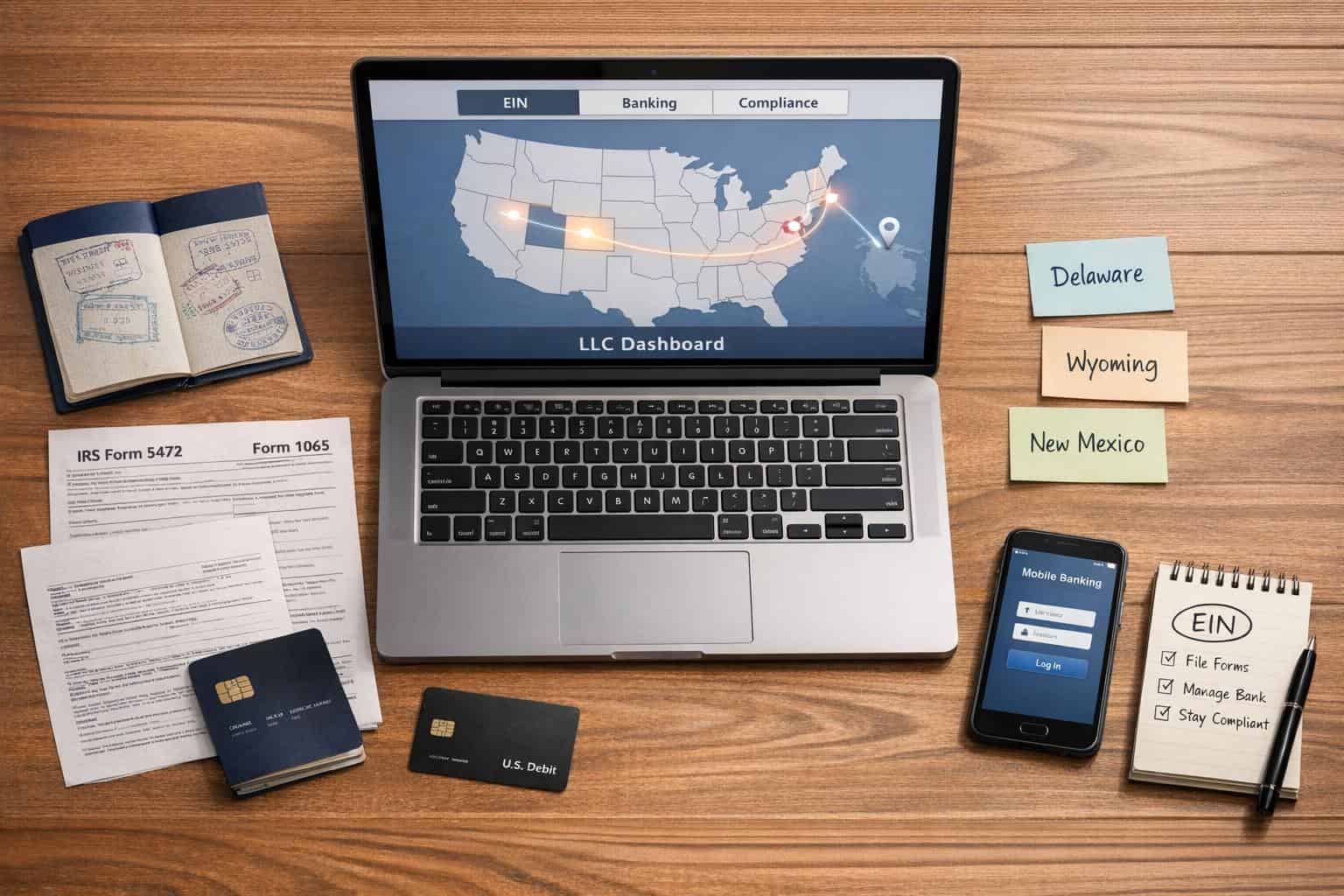
You can own and manage a U.S. LLC without being a U.S. resident or citizen. This guide explains how to set up and run your LLC remotely, covering state choices, tax requirements, and tools for smooth operations. Key points:
- No citizenship needed: Non-residents can own 100% of a U.S. LLC.
- State selection matters: Wyoming ($60 annual fee) and New Mexico ($0 annual fee) are cost-effective. Delaware ($300 tax) suits startups seeking investors. Avoid costly states like California ($800 minimum tax).
- Tax compliance is critical: File IRS forms like Form 5472 (single-member LLCs) or Form 1065 (multi-member LLCs) to avoid penalties starting at $25,000.
- Banking remotely: Use fintech platforms like Mercury or Wise for U.S. business accounts without in-person visits.
- Stay compliant: Use a registered agent for legal notices and a virtual mailbox for daily correspondence.
Managing a U.S. LLC from abroad is entirely possible with the right setup and tools. Read on for practical steps and solutions.
How to Set Up Your U.S. LLC as a Non-Resident
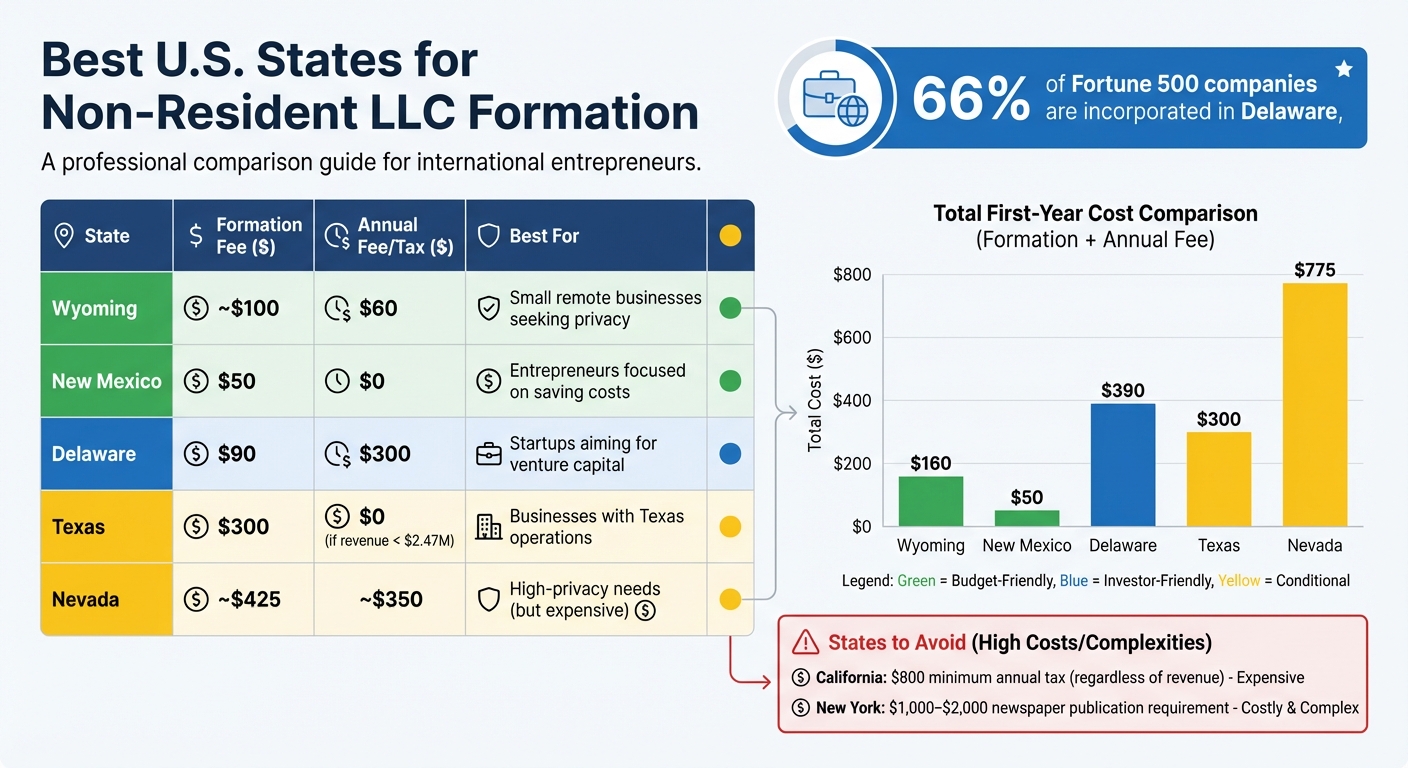
Best U.S. States for Non-Resident LLC Formation: Cost Comparison
Setting up a U.S. LLC as a non-resident can be done entirely online in four main steps: choosing a state, appointing a registered agent, getting an EIN, and creating an operating agreement. Let’s break these steps down to make the process as smooth as possible.
Selecting the Best State for Your LLC
The state you choose can impact costs, privacy, and compliance requirements. If your business operates in a specific U.S. state, register there to avoid extra fees for foreign qualification. For businesses without a physical U.S. presence, Wyoming and New Mexico are excellent options.
Wyoming is a favorite for non-residents due to its low $60 annual fee and strong privacy protections. It keeps LLC members’ names off public records. New Mexico is even more cost-effective, with no annual report fees, making it ideal for budget-conscious owners. Delaware is another popular choice, especially for startups seeking venture capital. Over 66% of Fortune 500 companies are incorporated there thanks to its specialized Court of Chancery. However, Delaware’s $300 annual tax may not be worth it for smaller, remote businesses.
"Wyoming generally offers better value for non-resident LLCs due to no state income tax, lower annual fees… and stronger privacy protections."
- Rick Mak, Author
Avoid states like California and New York unless absolutely necessary. California imposes a hefty $800 minimum tax annually, regardless of revenue. New York requires costly newspaper publications for LLC formation, which can run between $1,000 and $2,000.
| State | Formation Fee | Annual Fee/Tax | Best For |
|---|---|---|---|
| Wyoming | ~$100 | $60 | Small remote businesses seeking privacy |
| New Mexico | $50 | $0 | Entrepreneurs focused on saving costs |
| Delaware | $90 | $300 | Startups aiming for venture capital |
| Texas | $300 | $0 (if revenue < $2.47M) | Businesses with Texas operations |
| Nevada | ~$425 | ~$350 | High-privacy needs (but expensive) |
Once you’ve picked your state, the next step is appointing a registered agent.
Hiring a Registered Agent
Every U.S. LLC must have a registered agent – a person or service with a physical address in the state of formation who handles legal and official correspondence. If you’re a non-resident, hiring a professional agent is essential since a U.S. address is required.
Registered agent services typically cost $50 to $300 per year. Some LLC formation platforms, like BusinessAnywhere, include the first year of registered agent service for free, with an annual renewal fee of $147. This ensures you never miss critical deadlines or legal notices.
Getting an EIN Without a Social Security Number
An Employer Identification Number (EIN) is essential for opening a U.S. business bank account, filing taxes, and hiring employees. The good news? You don’t need a Social Security Number (SSN) or Individual Taxpayer Identification Number (ITIN) to get one.
To apply, complete IRS Form SS-4 and submit it via fax (this is faster than mailing it). On Line 7b, enter "Foreign" or "N/A". The IRS issues EINs for free, but international applications can take 2 to 4 weeks to process.
"You don’t need a SSN or US address to obtain an EIN."
- Vincenzo Villamena, CPA, CEO at Entity Inc.
Before applying, make sure your LLC is officially registered, and have its name and formation date ready. You can also authorize a third party, like a CPA or formation service, to handle the EIN application for you. For instance, BusinessAnywhere offers an EIN service for $97, taking care of the entire process on your behalf.
Creating an Operating Agreement
An operating agreement is a critical document that outlines how your LLC will function. It details ownership percentages, member responsibilities, profit-sharing rules, and procedures for adding or removing members. While most states don’t require this document, it’s vital for maintaining your limited liability protection and avoiding disputes.
Without an operating agreement, courts could "pierce the corporate veil", holding you personally liable for business debts. This document is especially important for opening bank accounts or applying for business credit.
Your operating agreement should cover key aspects like voting rights, capital contributions, allocation of profits and losses, procedures for a member’s exit, and dissolution processes. Keep this document in your business records – it’s not filed with the state but is essential for your LLC’s credibility and legal protection.
sbb-itb-ba0a4be
Tax Requirements for Foreign-Owned U.S. LLCs
Staying on top of tax compliance is essential to avoid hefty penalties. The IRS has specific filing requirements, even for businesses with no income. Missing these deadlines can lead to severe financial consequences. Here’s a breakdown of the key forms and deadlines you need to know.
Federal Tax Forms and Filing Deadlines
Your LLC’s tax obligations depend on its structure.
Single-member LLCs, considered "disregarded entities" by the IRS, must file Form 5472 along with a pro forma Form 1120 by April 15. This is used to report transactions between the LLC and its foreign owner. Even the initial registration fees you paid count as a reportable capital contribution. Missing or inaccurately filing this form can result in a $25,000 penalty per form, with an additional $25,000 for every 30 days after a 90-day notice from the IRS.
"Failure to comply can result in significant penalties – starting at $25,000 per form!"
- Serkan Haslak, Founder, Nonresident Tax
Multi-member LLCs, treated as partnerships, must file Form 1065 (U.S. Return of Partnership Income) by March 15. Additionally, they must issue a Schedule K-1 to each member. If you need more time, you can request a six-month extension using Form 7004.
If your LLC generates Effectively Connected Income (ECI), you’ll also need to file Form 1040-NR (for individuals) or Form 1120-F (for foreign corporations). Generally, an LLC is considered engaged in a U.S. trade or business if it has a physical office, U.S.-based employees, or agents authorized to finalize contracts.
Here’s a quick overview of the key forms:
| Form Number | Who Files | Filing Deadline | Purpose |
|---|---|---|---|
| Form 5472 + 1120 | Single-member foreign-owned LLCs | April 15 | Report transactions with foreign owner |
| Form 1065 | Multi-member LLCs | March 15 | Partnership income return |
| Form 1040-NR | Foreign individuals with ECI | April 15 | Nonresident income tax return |
| Form 114 (FBAR) | LLCs with foreign accounts over $10,000 | April 15 (auto-extension to Oct 15) | Report foreign bank accounts |
In addition to the IRS requirements, some filings are mandated under FinCEN regulations.
State-Level Tax Obligations
State tax requirements are independent of federal obligations and can apply even if your LLC has no federal income tax liability. Common state-level requirements include annual fees, franchise taxes, and income taxes.
Here’s a snapshot of state-specific obligations:
- Delaware: Charges a flat $300 annual franchise tax, due June 1 each year.
- California: Requires a minimum $800 annual franchise tax.
- Wyoming: Imposes an annual report fee based on asset value, which is typically low.
Federal tax treaties don’t always shield you from state taxes. For example, states like California, New Jersey, and Pennsylvania may tax income that’s exempt under federal treaties. Plus, after the South Dakota v. Wayfair decision, states can enforce sales tax on remote sellers who meet certain revenue or transaction thresholds, even without a physical presence.
"Many foreign LLC owners believe that ‘disregarded for tax purposes’ means they have no filing requirements. This is incorrect."
- SDO CPA
Even if your LLC is disregarded for federal tax purposes, you still need to file annual reports and pay franchise taxes in the state where your LLC is registered. Failing to meet these obligations can jeopardize your LLC’s good standing. Additionally, tracking your sales by state is crucial to comply with economic nexus laws for sales tax collection.
Tools and Methods for Managing Your LLC Remotely
Running a U.S. LLC from overseas means relying heavily on digital tools and strategies. These resources are crucial for non-resident owners to handle legal and operational tasks without needing to be physically present in the U.S.
Opening a U.S. Business Bank Account from Abroad
Traditional U.S. banks typically require in-person visits and often decline applications from non-residents. In fact, these banks reject over 95% of non-resident applications. Digital-first fintech platforms have stepped in as a practical alternative, offering easier access for international business owners.
Platforms like Mercury and Relay are popular choices for U.S. business banking. They don’t require a Social Security Number (SSN) and usually process applications within 48–72 hours. Mercury boasts a 78% approval rate for non-resident LLC owners, while Wise Business offers multi-currency accounts with an even higher approval rate of around 92%.
To meet the requirements for these platforms, you’ll need key documents such as:
- Your EIN confirmation
- Articles of Organization
- A valid passport
- A compliant U.S. business address (a virtual mailbox works)
Make sure your Operating Agreement includes valid signatures – electronic options like DocuSign are acceptable. Missing or incomplete signatures are a common reason for application rejections.
Once your bank account is set up, the next step is securing a dependable U.S. mailing address.
Using a Virtual Mailbox Service
A virtual mailbox provides you with the required U.S. address while keeping your personal address private. Unlike registered agents, who primarily handle legal documents, virtual mailbox services accept all types of mail, including packages from carriers like FedEx and UPS. They also offer real-time notifications and high-quality PDF scans, which you can access through their mobile apps.
To use a virtual mailbox legally, you’ll need to complete USPS Form 1583. This form authorizes the mailbox service to receive your mail and must be notarized. Thankfully, this can be done online through a notary service for about $25–$50, and the process takes around 15 minutes.
Some popular virtual mailbox providers include:
- Anytime Mailbox and iPostal1: Starting at $9.99 per month
- Earth Class Mail: Starting at $39 per month, with premium features like QuickBooks integration
- BusinessAnywhere: Plans from $20 per month, offering unlimited scanning, storage, and global forwarding
Ensure your chosen service provides a suite or unit number, as platforms like Amazon Seller Central and payment processors like Stripe often require this.
Software for Compliance Tracking and Team Communication
Staying compliant and maintaining smooth team communication are critical for running your LLC remotely. Missing compliance deadlines can result in hefty fines, such as the $25,000 minimum penalty for late IRS Form 5472 filings.
A registered agent service is essential for managing legal notices and reminders for state filings. These services often digitize documents and send them to you promptly. Reliable options include:
- Northwest Registered Agent: Typically costs between $125 and $300 per year
- BusinessAnywhere: Offers registered agent services for $147 per year after a free first year
For accounting and document management, choose platforms that integrate seamlessly with your bank account. For example:
- Earth Class Mail works with QuickBooks and Xero, syncing scanned invoices and receipts
- Wise Business integrates with accounting software to manage multi-currency expenses
If you’re managing a remote team, look for banking platforms that allow multiple users. Relay, for instance, lets you add team members, issue separate debit cards, and set spending limits – all without additional fees. Mercury offers similar features, making it easier to handle team expenses efficiently.
Common Problems Non-Resident LLC Owners Face
Managing a U.S. LLC from abroad can be tricky, even with modern tools that simplify remote work. Non-resident LLC owners often encounter unique challenges, especially when it comes to handling physical mail and staying compliant with regulations across multiple states.
Receiving and Managing Physical Mail
One of the biggest hurdles for non-resident LLC owners is dealing with physical mail. U.S. banks, payment processors like Stripe and PayPal, and platforms such as Amazon typically won’t accept P.O. Boxes for KYC (Know Your Customer) compliance purposes. Instead, they require a legitimate U.S. street address with a suite number to open accounts and maintain credibility.
A virtual mailbox is a practical solution. It provides a real street address where mail is received, scanned, and uploaded for online access. These services generally cost between $15 and $50 per month. Keep in mind that using a virtual mailbox may involve completing USPS Form 1583, so check the requirements beforehand.
"Using your home address in Spain, Mexico, Colombia, or Argentina results in bank rejections, compromised privacy, and diminished credibility." – GlobalLLCGuide Team
It’s wise to separate your registered agent service from your virtual mailbox. Also, don’t forget to file IRS Form 8822-B to officially update your LLC’s mailing address.
But mail isn’t the only challenge – multi-state compliance can be just as demanding.
Staying Compliant Across Multiple States
Operating in multiple states comes with its own set of compliance headaches. If your business activities – like hiring employees, maintaining an office, or storing inventory – extend beyond your formation state, you’ll need to register as a "foreign entity" in those additional states. This means you’ll face compliance requirements and fees in both your home state and any additional states where you operate.
Missing federal or state deadlines can lead to steep penalties. For a breakdown of these penalties, see the earlier tax section.
To stay on top of state-specific requirements, a reliable registered agent service can be a lifesaver. For instance, BusinessAnywhere offers a registered agent service for $147 annually after a free first year. Such services can handle legal notices, digitize documents, and send reminders about compliance deadlines. It’s also helpful to create a compliance calendar to track deadlines for annual reports and franchise taxes. For example, Wyoming charges a $60 annual fee, Delaware requires $300, and California imposes a minimum franchise tax of $800 – even if your LLC has no income.
Lastly, consulting a CPA with expertise in cross-border taxation is invaluable. They can guide you through U.S. tax treaties and Effectively Connected Income rules, helping you file correctly and avoid costly errors.
Conclusion
Operating a U.S. LLC from abroad is not only legal but also a common practice among digital nomads and international entrepreneurs. Even if your business generates no income, you’re still required to file federal tax reports, maintain a registered agent, handle physical mail, and comply with state deadlines.
The financial penalties for non-compliance can be steep. For example, failing to file Form 5472 comes with a minimum penalty of $25,000, while late filings for multi-member LLCs can result in fees of $210 per member per month.
To simplify operations, non-residents can benefit from choosing the right state for their LLC. States like Wyoming, with its low $60 annual fee, or Delaware, known for its strong reputation with investors, are popular options. Additionally, leveraging services like remote banking and virtual mailbox services can help streamline day-to-day management. It’s also wise to use separate services for your registered agent and regular correspondence to ensure you don’t miss critical legal notices.
Platforms like BusinessAnywhere make the process easier by bundling essential services. They offer U.S. business formation, registered agent support (free for the first year, then $147 annually), virtual mailbox solutions, and compliance tracking – all in one package. This all-in-one approach eliminates the need to juggle multiple vendors, saving time and reducing stress.
FAQs
Do I owe U.S. taxes if my LLC has no income?
If your LLC doesn’t generate any income, you generally won’t owe U.S. taxes. That said, you might still need to handle specific filing or compliance tasks depending on your circumstances. Staying on top of these requirements is crucial to avoid any penalties.
Will my LLC be taxed in my home country too?
Yes, your LLC might also face taxes in your home country, depending on local tax regulations and where the income originates. Income sourced in the U.S. is subject to taxation in the U.S. and must be reported to the IRS, even if you don’t owe U.S. taxes. It’s always a good idea to consult a tax professional to clarify your specific responsibilities.
When do I need to register in other U.S. states?
If your LLC operates in states other than where it was initially formed, you’ll need to register it in those states. This is known as "foreign qualification." It’s usually necessary if your business has a physical location, employees, or substantial economic operations in another state.
Keep in mind, the requirements and fees differ by state, so it’s essential to check the specific rules for each location. Skipping this step can lead to fines or legal complications, so take the time to evaluate your business activities and ensure you’re meeting all state regulations.