


Series LLCs allow businesses to operate multiple independent divisions under one LLC, offering liability protection for each. Originally introduced in Delaware in 1996, they are now available in several states, each with unique rules. Key highlights:
- States Allowing Formation: Delaware, Texas, Illinois, Utah, and Florida (starting July 1, 2026).
- States Recognizing Foreign Series LLCs: California and Georgia, among others.
- Liability Protection: Each series is shielded from the liabilities of others, but strict recordkeeping is essential.
- Tax Treatment: Each series is treated as a separate entity for federal taxes, though state rules vary.
This structure is popular for managing real estate properties and multiple business ventures due to its ability to isolate risks and streamline operations. However, compliance with state-specific rules and maintaining separation between series is crucial to preserving liability protection.
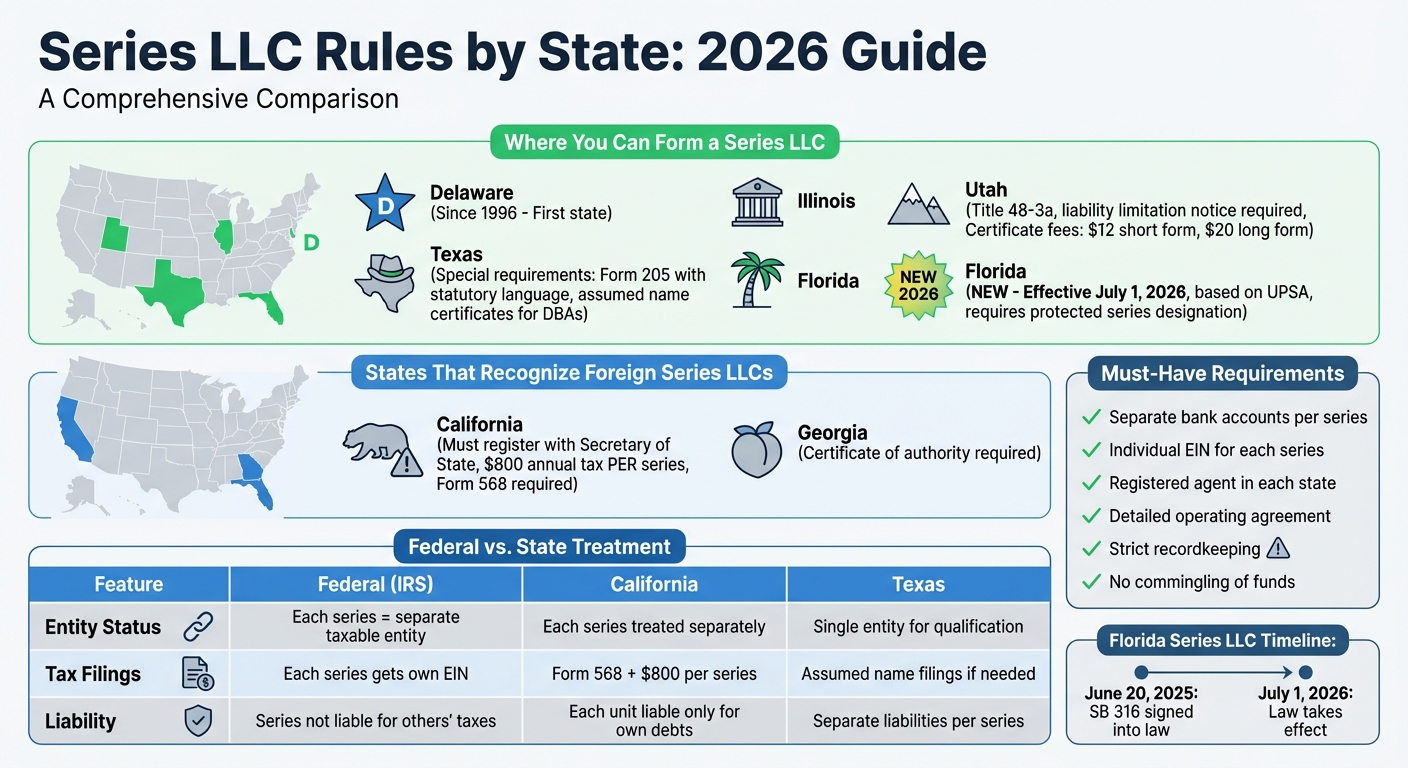
Which States Allow Series LLCs in 2026
The rules around Series LLCs differ from state to state. Some states allow you to form a Series LLC domestically, others recognize Series LLCs formed in different states, and many don’t acknowledge them at all. Knowing these differences is key before deciding where to set up your Series LLC.
States Where You Can Form a Series LLC
As of 2026, you can form a domestic Series LLC in Delaware, Texas, Illinois, and Utah, with Florida joining the list on July 1, 2026.
Texas has specific requirements for setting up a Series LLC. The Certificate of Formation (Form 205) must include statutory language about series creation in its Supplemental Text section. Additionally, each series must maintain its own asset records. If a series operates under a different name, you’ll need to file an assumed name certificate (DBA).
Utah operates under Title 48-3a and requires a liability limitation notice in the Certificate of Organization. For documentation, the state charges $12.00 for a Short Form Certificate of Existence and $20.00 for a Long Form.
States That Recognize Foreign Series LLCs
Some states don’t allow Series LLCs to be formed domestically but will recognize those created elsewhere. California is a prime example. It requires foreign Series LLCs to register with the Secretary of State before conducting any business in California.
“A SLLC formed in another state must register with the California Secretary of State (SOS) before they start doing business in California.” – California Franchise Tax Board
California treats each series as a separate tax entity, meaning every series owes an $800 annual tax. Payment vouchers and tax returns must include “Series LLC #” and the series number written in red ink at the top. The first series uses the Secretary of State (SOS) number, while additional series are assigned unique identification numbers by the Franchise Tax Board after the initial payment.
Georgia also recognizes foreign Series LLCs. While it doesn’t allow domestic formation, foreign Series LLCs must obtain a certificate of authority to conduct business in the state.
Florida’s Series LLC Law (Effective July 1, 2026)
Governor Ron DeSantis signed Senate Bill 316 (SB 316) into law on June 20, 2025, making Florida the latest state to permit Series LLC formation. The law officially takes effect on July 1, 2026, allowing time for the Florida Department of State to update its filing systems and procedures.
Florida’s new law is based on the Uniform Protected Series Act (UPSA), which provides a clear regulatory framework. To create a “protected series”, the parent LLC must file a protected series designation with the Department of State. This action requires unanimous member approval unless otherwise specified in the operating agreement.
Florida has strict naming rules: each series name must start with the parent LLC’s name and end with “protected series”, “P.S.”, or “PS.” The parent LLC must also include the names of all protected series in its annual state report.
“The law takes effect July 1, 2026, to give the Florida Department of State time to input new forms and filing procedures into its software.” – Louis T. M. Conti, Corporate Attorney, Holland & Knight
Florida’s law introduces two layers of liability protection: horizontal shields, which protect each series from the liabilities of other series, and vertical shields, which protect members from personal liability. However, these protections rely on strict recordkeeping to clearly assign assets and liabilities to the appropriate series.
Foreign Series LLCs can also operate in Florida, but they must register with the Department of State and specify which series will conduct business in the state.
These rules provide a foundation for understanding the next steps in filing processes and staying compliant with state requirements.
How to Form and Maintain a Series LLC by State
Filing Process and Naming Rules
To set up a Series LLC, you’ll need to start by filing the Articles of Organization or Certificate of Formation with the state. Make sure the document explicitly includes language that allows for the creation of series entities within the LLC.
When it comes to naming, each state has its own requirements. Generally, the parent LLC’s name must include terms like “Limited Liability Company”, “LLC”, or “L.L.C.” Interestingly, most states don’t require the word “Series” to appear in the name. A common practice is to use a hierarchical naming system, such as “Main Street Properties LLC – Series A”, to clearly indicate the connection between the parent LLC and its series.
Some states have additional naming and filing rules. For instance, in Texas, if a series operates under a name different from the parent LLC, you’ll need to file an assumed name certificate (also known as a DBA). Meanwhile, Utah requires the Certificate of Organization to include a specific notice outlining the liability protections for individual series. After filing, maintaining accurate records is critical to preserving the liability shield for each series.
Recordkeeping and Separating Assets
Keeping separate and organized records for each series is a must to ensure liability protection. This includes opening distinct bank accounts for the parent LLC and each series. Commingling funds between series or with the parent LLC can jeopardize the liability shield.
Each series also needs its own Employer Identification Number (EIN), as the IRS views each series as a separate taxable entity. To avoid confusion and potential legal issues, your operating agreement should outline the rules for forming or dissolving series and detail how profits and losses are shared. Beyond financial recordkeeping, staying compliant involves meeting registered agent requirements and paying any applicable filing fees.
Registered Agent Requirements and Filing Fees
Every Series LLC must have a registered agent in each state where it operates. A single registered agent can handle this role for both the parent LLC and its series, ensuring legal documents and official notices are received without issue.
Filing fees for Series LLCs vary widely by state. For example:
- California charges an $800 annual fee per series for foreign Series LLCs.
- Utah’s Certificate of Existence costs $12.00 for a short form and $20.00 for a long form.
- South Dakota requires a $15 fee for paper annual reports.
Many states also mandate annual or biennial reports to keep the Series LLC in compliance. Depending on the state, these reports may need to be filed for the parent LLC alone or for each individual series.
To simplify compliance across multiple states, services like BusinessAnywhere offer registered agent solutions for $147 annually. Plus, they provide the first year free when you register your business, streamlining the process with a single dashboard.
Liability Protection and Tax Rules
How Liability Protection Works
One of the key benefits of a Series LLC is its built-in liability shield. When properly managed, any debts or legal claims against one series won’t impact the assets of the parent LLC or other series within the structure. Essentially, each series functions as its own entity, operating independently.
Each series has the authority to act like a standalone entity – it can sue or be sued, enter into contracts, hold assets, and even grant liens or security interests under its own name. For example, if Series A faces a lawsuit over a tenant dispute, the assets of Series B remain untouched. However, this protection doesn’t happen by default. To establish it, you must include specific language in your Certificate of Formation and Operating Agreement that authorizes the creation of individual series.
To preserve liability protection, it’s crucial to maintain separate records and bank accounts for each series. Mixing funds between series is a quick way to lose that protection, as courts may “pierce the veil” and treat the entire structure as a single LLC. Some states, like Utah, also require a notice in the Certificate of Organization that outlines the liability protections for each series.
Keep in mind, though, that Series LLCs are still relatively new – Delaware introduced them in 1996. Because of this, courts in states without specific Series LLC statutes might not honor the liability separation between series, potentially leaving all assets vulnerable to a single claim.
Next, let’s explore how Series LLCs are treated when it comes to taxes.
How Series LLCs Are Taxed
Under proposed IRS regulations, each series within a Series LLC is treated as a separate taxable entity. This means that each series must obtain its own EIN, file its own tax returns, and can even make independent tax elections. For instance, one series might choose to be taxed as a partnership, while another opts for S-corporation status. Importantly, one series isn’t responsible for the federal income tax obligations of another series or the parent LLC.
State tax rules, however, are a different story and can vary widely. Take California, for example. Even though the state doesn’t allow the formation of domestic Series LLCs, it still requires each series within a foreign Series LLC to file Form 568 and pay an $800 annual tax. The first series uses the Secretary of State number, while additional series receive unique identification numbers from the Franchise Tax Board after their first payment.
Texas takes another approach. The state treats a Series LLC as a single legal entity for qualification purposes, but each series can have its own rights, obligations, and business activities. If a series operates under a name different from the parent LLC, you’ll need to file an assumed name certificate for that series.
Here’s a quick comparison of how Series LLCs are handled:
| Feature | Federal Treatment (IRS) | California | Texas |
|---|---|---|---|
| Entity Status | Each series is a separate taxable entity | Each series treated separately for tax/fees | Single entity for qualification |
| Tax Filings | Each series obtains its own EIN | Each series files Form 568 and pays $800 | Assumed name filings required as applicable |
| Liability | Series not liable for others’ taxes | Each unit liable only for its own debts | Separate liabilities per series |
To ensure you maintain proper tax treatment and liability protection, it’s essential to keep detailed records that clearly show each series operates independently. This level of documentation is especially important during audits or legal disputes, where the separation between series might come under scrutiny.
sbb-itb-ba0a4be
Common Uses for Series LLCs
These examples show how the unique structure of Series LLCs can provide practical benefits across different industries and scenarios.
Managing Multiple Real Estate Properties
Real estate investors often turn to Series LLCs to manage multiple properties under one master LLC. Each property is placed into its own series, creating a barrier that protects the assets of one property from the liabilities of another. For instance, if a tenant sues over a slip-and-fall incident at one rental property, or if a loan on an office building goes into default, creditors are typically limited to pursuing the assets of that specific series. The other properties remain shielded from the claim.
This structure also simplifies operations. Instead of filing separate paperwork for every new property, you can manage all properties under a single master LLC. Each series can even have its own members and managers, so you could partner with one group for a residential property and a different group for a commercial building.
That said, it’s crucial to confirm that the state where the property is located recognizes the Series LLC structure. Some states, like New York, don’t recognize the separate liability of individual series. In such cases, courts might treat the entire Series LLC as one entity, potentially exposing all properties to a single claim. Additionally, when signing contracts or loan documents, always use the name of the specific series – not just the master LLC – to maintain liability protection.
This same approach to asset segregation can be highly effective for entrepreneurs managing diverse business ventures.
Running Multiple Business Lines
For entrepreneurs juggling several business ventures, a Series LLC offers both asset protection and streamlined management. Instead of forming separate LLCs for each business, you can operate distinct ventures under one umbrella.
Take, for example, an entrepreneur who owns a restaurant, a catering service, and a food truck. By assigning each venture to its own series, the assets of the restaurant are protected if the food truck is involved in an accident or racks up debt.
The cost savings are another big advantage. Establishing a Series LLC usually requires just one initial filing with the state, compared to separate filings and fees for multiple LLCs. Plus, you avoid the hassle of managing multiple registered agents, annual reports, and compliance requirements.
Each series can also make its own tax elections, giving you the flexibility to tailor tax strategies for different business lines. To fully benefit from this structure, treat each series as its own entity. This means securing individual EINs for each series and drafting detailed operating agreements that outline management roles and profit-sharing for each venture. This approach reinforces the financial and legal separation between business lines, making it easier to protect assets and manage risks effectively.
Conclusion
Series LLCs offer a streamlined way to manage multiple ventures while keeping liability protection distinct for each. This setup can save money and simplify administration compared to creating separate LLCs for each business. However, these advantages hinge on meeting state-specific requirements.
Here’s a quick recap of the key points: State laws play a major role in how Series LLCs operate, particularly when it comes to liability and compliance. States like Delaware, Texas, Illinois, and Florida (starting July 1, 2026) have laws that support this structure. On the other hand, states such as New York, Pennsylvania, and Colorado may not fully recognize the liability protections for individual series. As Louis T. M. Conti, Chair of The Florida Bar Drafting Committee, puts it:
“The principal use for any series LLC is the ability to form one legal entity that may then create one or more separate series… with separate insulation from liability for the debts and obligations of the LLC”.
It’s important to note that operating in states that don’t recognize Series LLCs – or failing to maintain clear separation between series – can undermine the liability protections.
Additionally, state-specific compliance and tax regulations can impact the benefits of using a Series LLC. To make the most of this structure, you need to understand the rules in your state and ensure that each series remains properly separated to safeguard your assets.
FAQs
How do Series LLC regulations differ across states?
Series LLC regulations can vary widely depending on the state you’re dealing with. For instance, in Texas, you can create a Series LLC by including specific wording in the certificate of formation and keeping separate records for each series. Interestingly, there’s no extra filing fee for each series, but the operating agreement must outline the rights and responsibilities of each series clearly.
In Wyoming, the process is a bit different. Each new series must be reported to the Secretary of State within 30 days, with an additional $10 filing fee for each series on top of the $100 base fee. Wyoming also enforces stricter naming rules, requiring descriptive names like “LLC Series 1” or a hyphenated format for public records.
Meanwhile, California doesn’t permit the formation of Series LLCs within the state. However, if you’ve formed a Series LLC in another state, you can register it as a foreign LLC in California. Be prepared to pay the state’s $800 annual franchise tax and meet other filing requirements.
These differences highlight the importance of knowing the specific rules in your state of choice, from formation language to fees and reporting obligations. Services like BusinessAnywhere can make this easier by providing customized formation documents, compliance tracking, and tools for managing Series LLCs across different states.
How does liability protection work within a Series LLC?
In a Series LLC, each series functions independently, with its assets and liabilities kept separate from those of other series and the parent LLC. Here’s what that means: if Series A is sued, only the assets of Series A are at risk. The assets of Series B, Series C, and the parent LLC stay protected – provided the separation between them is properly maintained.
To ensure this protection holds up, each series generally needs its own name, bank account, and financial records. Adhering to state-specific regulations and keeping thorough documentation is absolutely essential. When managed properly, a Series LLC combines the efficiency of a single filing with strong liability protection for each individual series. Tools like those offered by BusinessAnywhere can help you stay organized and compliant every step of the way.
What are the tax rules for Series LLCs in different states?
Tax regulations for Series LLCs can be a maze, with each state setting its own rules for income, franchise taxes, and filing requirements. To make matters more complicated, the IRS has yet to clarify how Series LLCs are treated for federal taxation.
Take California, for instance. Series LLCs doing business there must pay an $800 annual franchise tax and file forms for the parent entity, even though each series functions independently. Meanwhile, Texas remains ambiguous, leaving Series LLC owners uncertain whether each series is taxed separately or if the entire structure is treated as a single LLC. States like Delaware, Nevada, and Wyoming often allow a single state income tax return for the parent entity but might tack on extra fees or demand specific registrations for various taxes.
This patchwork of rules can be overwhelming, which is why many Series LLC owners turn to tools for streamlining compliance. Platforms like BusinessAnywhere offer solutions to manage state-specific tax filings, automate franchise tax payments, and keep the records necessary to maintain liability protections while staying on top of multi-state obligations.