


When managing remote employees across state lines, businesses face a maze of legal obligations. Here’s what you need to know:
- Laws Depend on Location: Employment laws are based on where the employee works, not where the company is headquartered.
- Key Differences by State:
- California: Requires daily overtime pay, expense reimbursements (internet, phone), and strict worker classification rules.
- New York: Higher minimum wages, jury duty pay, and mandatory remote work policies.
- Texas: Follows federal standards, with no state-specific mandates for reimbursements or paid leave.
- Massachusetts: Offers extensive family leave benefits and mandatory jury duty pay.
- Tax Nexus Risks: A single remote worker in a state can trigger tax obligations like payroll withholding and corporate income tax.
- Policy Updates Are Essential: Regularly review and adjust remote work policies to comply with varying state laws.
Bottom Line: Employers must tailor remote work policies to state-specific requirements to avoid fines, wage claims, and tax liabilities. This is especially complex when operating in multiple states. Tracking employee locations and understanding local laws is critical for compliance.
Federal vs. State Employment Laws
Federal Employment Law Basics
Federal employment laws set a nationwide baseline for workplace rules, applying to businesses across the United States. At the heart of these laws is the Fair Labor Standards Act (FLSA), which establishes a federal minimum wage of $7.25 per hour and requires overtime pay at 1.5 times the regular rate for hours worked beyond 40 in a week. Anti-discrimination protections are also mandated under federal laws like Title VII of the Civil Rights Act, the Americans with Disabilities Act (ADA), and the Age Discrimination in Employment Act (ADEA).
Another key federal regulation, the Family and Medical Leave Act (FMLA), provides eligible employees at companies with 50 or more workers up to 12 weeks of unpaid leave for specific family or medical reasons. However, federal laws leave gaps in areas such as paid sick leave, jury duty pay, and expense reimbursement, as there are no federal requirements addressing these issues. Workplace safety is governed by OSHA, while employee benefits are regulated under ERISA.
How State Laws Differ
While federal laws provide a starting point, state laws often go further, introducing additional requirements that can be more favorable to employees. These state-specific rules take precedence when they offer greater protections, creating a complex regulatory landscape for employers, especially when doing business in multiple states with remote teams. For instance, while the federal minimum wage remains $7.25, states like California and New York have set much higher rates.
State laws also extend to other areas. In Connecticut, employees are entitled to 16 weeks of family leave within a 24-month period – four weeks more than the federal FMLA standard. Jury duty pay is another example of state-specific rules: while federal law requires no payment, New York mandates $40 for the first three days, and Massachusetts requires employers to pay regular wages for the first three days of jury duty. Additionally, California’s Labor Code 2802 obligates employers to reimburse remote workers for necessary expenses like internet and phone bills.
Overtime rules also vary widely. Federal law requires overtime pay after 40 hours in a week at 1.5 times the regular rate, but California goes further, requiring 1.5 times pay after eight hours in a single day and double pay after 12 hours in a day. State wage and hour laws take effect immediately when an employee starts working in that state, meaning employers must comply with the state’s rules from the very first day of employment.
sbb-itb-ba0a4be
How State Laws Affect Remote Work Policies
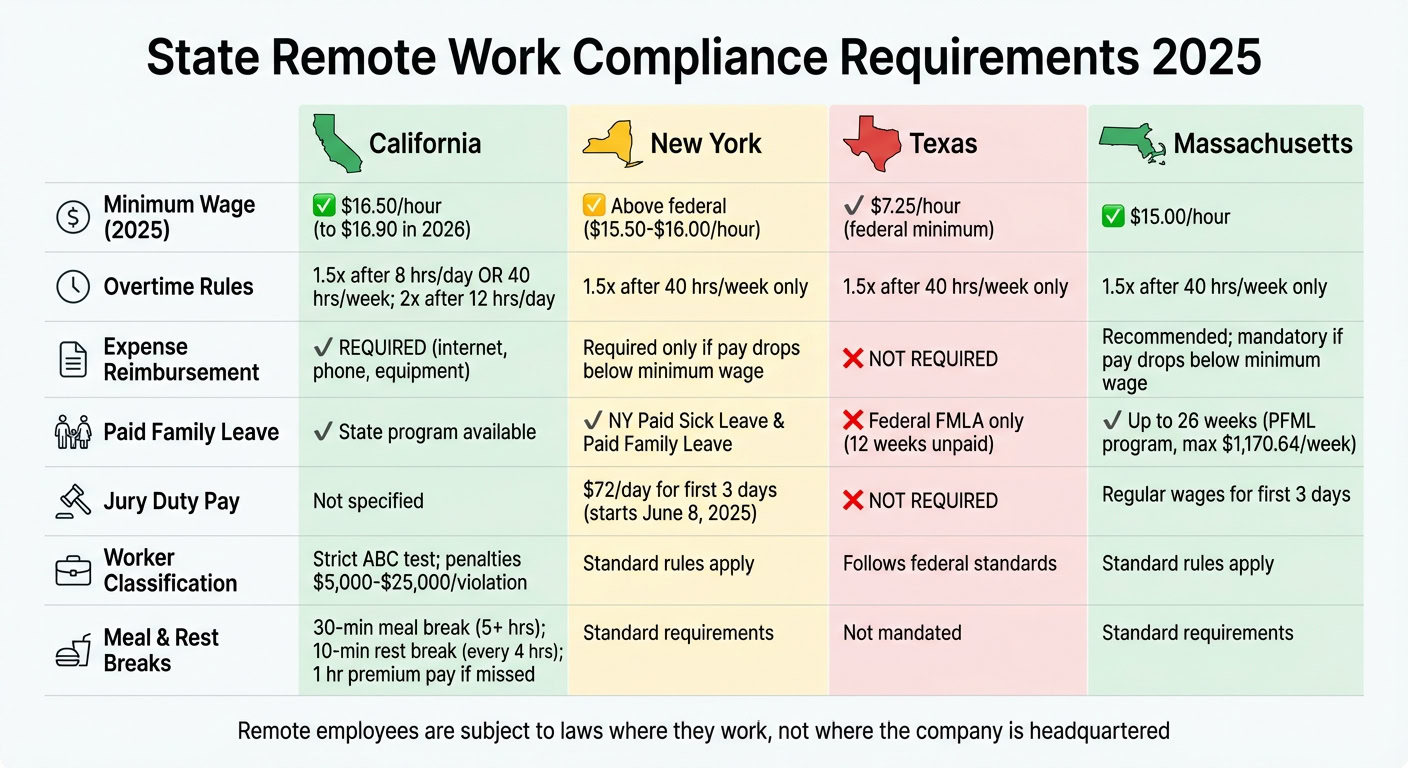
Remote work policies need to align with the laws of the state where an employee works. For instance, a remote worker in California operates under a completely different set of legal protections compared to someone in Texas, and employers must adapt to these differences. Managing teams spread across multiple states adds complexity. A Texas-based company employing remote workers in California and Massachusetts, for example, must navigate three distinct sets of regulations. California’s minimum wage will reach $16.50 per hour on January 1, 2025, and increase to $16.90 per hour on January 1, 2026. Meanwhile, Texas sticks to the federal minimum wage of $7.25 per hour, creating significant payroll differences depending on where employees are located.
Beyond wages, states differ in their rules on reimbursements and worker classifications. For example, California requires employers to reimburse remote workers for a fair portion of internet and phone expenses, even if the worker incurs no extra cost due to unlimited plans. This policy stems from the 2014 Cochran v. Schwan’s Home Service, Inc. case and was reaffirmed in 2023 by Thai v. International Business Machines Corporation (IBM), which also requires reimbursement for necessary home office expenses. Worker classification laws also vary, with California’s strict "ABC test" presuming workers are employees unless proven otherwise. Misclassifying workers in California can result in penalties ranging from $5,000 to $25,000 per violation. These differences highlight the importance of understanding state-specific rules.
Here’s a closer look at how some states handle remote work regulations.
California: Strict Worker Protections
California is known for its robust worker protections, which apply fully to remote workers. Overtime rules require 1.5 times the regular pay rate after 8 hours in a day (or 40 hours in a week) and double pay after 12 hours in a day.
"For purposes of the state’s wage and hour laws, the home office is generally treated the same as the regular office." – Shannon Bettis Nakabayashi, Attorney, Jackson Lewis
California also mandates meal and rest breaks: a 30-minute uninterrupted meal break for shifts over 5 hours and a 10-minute paid rest break for every 4 hours worked. Missing these breaks means one hour of premium pay at the regular rate. Employers must also cover all necessary business expenses under Labor Code Section 2802, including internet, phone, and ergonomic equipment, whether the employee chose remote work or not. Additionally, exempt software employees must earn at least $56.97 per hour starting January 1, 2025. Privacy laws add another layer, as nearly 96% of California companies monitor remote employees. Employers must notify and obtain consent before implementing monitoring systems.
New York: Wage and Hour Requirements
New York maintains a minimum wage above the federal level and will see further increases in 2026. Employers with 11 or more employees are required to pay $72 per day for the first three days of jury duty starting June 8, 2025, up from $40. The state has also introduced a law requiring employers to create a written remote work policy that clarifies work hours and communication expectations. This helps avoid disputes over availability and overtime while adding administrative responsibilities. Additionally, New York mandates short-term disability benefits for remote workers based in the state, regardless of the employer’s location.
Texas: Employer-Friendly Rules
Unlike California and New York, Texas follows a more relaxed approach, adhering primarily to federal standards. The state enforces the federal minimum wage of $7.25 per hour and does not require state-level increases.
"Remote employees are subject to the labor laws of the state in which they physically perform their work, not the state where the company is incorporated." – Philip Ruffini, Author
Texas does not mandate expense reimbursements, paid sick leave, or specific remote work policies. Employers have the flexibility to design internal guidelines that suit their operations, though clear policies are still recommended to avoid disputes. For leave, Texas relies solely on the federal Family and Medical Leave Act (FMLA), which offers 12 weeks of unpaid leave for eligible employees.
Massachusetts: Employee-Focused Requirements
Massachusetts offers extensive protections for remote workers, including up to 26 weeks of combined leave under the Paid Family and Medical Leave (PFML) program. This covers a wide range of family and health-related situations, with the maximum weekly benefit rising to $1,170.64 as of January 1, 2025.
"Massachusetts’ Paid Family and Medical Leave (PFML) offers up to 26 weeks of combined family and medical leave, covering a wide range of family relationships and health conditions." – Cymone Carlson, SHRM-SCP
The state has also expanded sick leave to include events like pregnancy loss and failed adoptions, effective November 21, 2024. Employers must pay regular wages for the first three days of jury duty if the employee worked in the three months prior to the leave. Additionally, employees have the right to access and obtain copies of their personnel records.
| Feature | California | New York | Texas | Massachusetts |
|---|---|---|---|---|
| Minimum Wage (2025) | $16.50/hour | Above federal | $7.25/hour | Above federal |
| Daily Overtime | 1.5x after 8 hours, 2x after 12 hours | Not mandated | Not mandated | Not mandated |
| Expense Reimbursement | Required | Not mandated | Not mandated | Generally required |
| Paid Family Leave | State program | State program | Federal FMLA only | Up to 26 weeks (PFML) |
| Jury Duty Pay | Not specified | $72/day (first 3 days) | Not mandated | Regular wages (first 3 days) |
| Personnel Record Access | Yes | Not mandated | Not mandated | Yes |
Tax and Nexus Rules for Multi-State Teams
When you hire remote employees across state lines, you’re stepping into a world of tax complexity. Even a single remote worker can establish what’s known as a "tax nexus", which can trigger obligations for corporate income tax, franchise tax, and even sales tax collection in that state. Courts have consistently ruled that having an employee working from a home office qualifies as "doing business" in that state, which adds another layer of compliance challenges for companies managing multi-state teams.
Take the case of Telebright Corp. v. Director, New Jersey Division of Taxation (2012), where a Maryland-based company was found liable for New Jersey taxes solely because one remote employee worked from home in New Jersey. Similarly, in Standard Pressed Steel Co. v. Washington Department of Revenue, the U.S. Supreme Court ruled that just one employee working from a home office was enough to establish a tax nexus.
While Public Law 86-272 offers some protection from state income tax, it’s limited to businesses whose only activity in a state is soliciting sales of tangible personal property. If remote employees perform tasks like software development or administrative work, this protection no longer applies.
Adding to the complexity, some states use the "convenience of the employer" rule. Under this rule, income is sourced to the employer’s location if the remote work is for the employee’s convenience rather than the employer’s necessity. As of January 2025, eight states – Alabama, Connecticut, Delaware, Nebraska, New Jersey, New York, Oregon, and Pennsylvania – apply this rule. For example, a New York-based company might owe New York taxes on wages paid to a remote employee, even if that employee never physically works in New York.
Tax nexus isn’t the only challenge. States have varying rules for withholding and registration, which can make compliance a real headache. Over 20 states require immediate withholding as soon as nonresident employees start working. Others offer short grace periods, such as Arizona (60 days), Connecticut (15 days), Illinois (30 days), and New York (14 days). California has stricter rules, requiring withholding after just one day if wages exceed $1,500, while Oklahoma sets the bar at $300 per quarter. Additionally, businesses must register for state unemployment insurance (SUI) in every state where employees are located.
For companies juggling these multi-state obligations, tools like BusinessAnywhere can streamline compliance. These platforms provide registered agent services and centralized dashboards to help businesses navigate state-specific requirements with ease.
How to Update Remote Work Policies for Compliance
Keeping remote work policies up to date is a continuous task, especially when it comes to tracking where employees are located. Employment laws are determined by the state where the employee works, not the company’s headquarters. For instance, if a California-based company has a remote worker in Texas, that employee is governed by Texas labor laws.
Instead of creating one massive handbook, consider a federal base policy with state-specific addendums. Emily Frederick, SHRM-CP and Senior HR Consultant at MyHRConcierge, explains:
"If you’ve got a separate state addendum for an employee that’s in California, all they have to see is your base employee handbook and the California addendum. And now, they’re at just 65 pages instead of 300".
To manage relocations, require employees to get written approval before starting remote work in a new location. This allows HR to review local labor laws, register for state taxes (using an ITIN or EIN), and adjust payroll systems. With nearly 27% of U.S. employees working remotely full-time or in hybrid setups, tracking these moves is more important than ever.
When reviewing policies, focus on areas like minimum wage rates, overtime rules, expense reimbursements, and paid leave requirements. Schedule updates at least twice a year to stay on top of evolving state regulations. Frederick also advises against packing handbooks with overly detailed procedures:
"Handbooks should not include detailed procedures, step-by-step instructions… instead, anything seen as a temporary policy should be sent out as a memo".
This strategy keeps your core policies consistent while allowing flexibility for short-term adjustments. Below, we’ll explore key compliance differences across states, tips for training HR teams, and tools to simplify the process.
State-by-State Compliance Comparison
Understanding how state laws differ is critical for remote work policies. Here’s a snapshot of key regulations in common remote work states as of 2025:
| Feature | California | New York | Texas | Massachusetts |
|---|---|---|---|---|
| 2025 Min Wage | $16.50/hr | $15.50–$16.00/hr | $7.25/hr (Federal) | $15.00/hr |
| Overtime | Daily (>8 hrs) + Weekly (>40 hrs) | Weekly (>40 hrs) | Weekly (>40 hrs) | Weekly (>40 hrs) |
| Reimbursement | Mandatory (Internet, phone, equipment) | Required if pay drops below minimum wage | Not required | Recommended; mandatory if pay drops below minimum wage |
| Paid Leave | Paid Sick Leave & Paid Family Leave | NY Paid Sick Leave & Paid Family Leave | No state mandate (FMLA applies) | Paid Family and Medical Leave (PFML) |
California, for example, has stricter rules, including daily overtime pay for hours worked beyond eight in a single day. A worker in California logging ten hours on a Monday earns overtime for the extra two hours, even if their weekly total doesn’t exceed 40. Additionally, the 2023 Thai v. International Business Machines Corporation (IBM) case reaffirmed that employers must reimburse remote work expenses deemed necessary, regardless of whether remote work was voluntary or mandatory.
By contrast, Texas follows federal minimums and has no state-specific mandates for reimbursements or paid leave. However, other states, like Florida, are making changes – its minimum wage increased from $13.00 to $14.00 per hour in September 2025. These shifts highlight how quickly laws can change and why regular policy reviews are essential.
Training HR Teams and Managers
Once your policies are updated, it’s crucial to train HR and management teams to ensure they’re applied consistently. Start by assigning compliance leads – managers equipped to handle remote work requests properly. Michael J. Nader, Shareholder at Ogletree Deakins, emphasizes the importance of this:
"The company may want to ensure that these gatekeepers are well trained to avoid miscommunications and inconsistencies, ensure that unauthorized company employees do not make decisions about remote work purportedly on behalf of the company, and ensure that company decisions in response to remote work requests are documented".
Managers should also be aware of time zone differences, which can impact compliance with break and overtime rules.
HR teams need to understand distinctions between "necessary" and "reasonable" expenses. Mike Letizia, President and CEO of Letizia HR Solutions Inc., notes:
"It’s so important for HR practitioners in California to understand that both the labor code and case law interpretations of statutes greatly influence our abilities to create and maintain compliant employment policies and practices".
For example, California’s definition of "hours worked" includes any time employees are under the employer’s control. Additionally, remote employees must have access to the same state and local labor law posters as their in-office counterparts.
Using Compliance Tools for Remote Businesses
Managing compliance across multiple states can be overwhelming, but tools designed for remote work can simplify the process. Platforms like BusinessAnywhere offer registered agent services in every state where your company operates, along with compliance alerts for upcoming deadlines and regulatory updates.
With features like a virtual mailbox and centralized dashboard, these platforms ensure you stay on top of state correspondence and compliance needs.
For payroll, HRIS platforms can automate tax withholdings and benefits contributions across different jurisdictions. Alternatively, Professional Employer Organizations (PEOs) can handle HR and payroll tasks entirely, freeing up internal resources.
Conclusion
Managing remote teams spread across state lines requires diligent tracking of employee locations. As Peter Siegel, Attorney at Greenspoon Marder, cautions:
"Such a laissez-faire attitude has caused many employers to run afoul of state tax and related laws".
With approximately 27% of U.S. employees now working remotely – whether full-time or in a hybrid capacity – the pressure to stay compliant has never been greater. This is especially critical as state regulations continue to evolve, creating new challenges for businesses.
Remote work policies should be treated as dynamic documents, regularly updated through audits and automated systems to address shifting liabilities. Many pandemic-era tax waivers have expired, leaving businesses unprepared for the unexpected liabilities that can arise. As highlighted earlier, staying proactive with policy updates can help avoid common compliance mistakes.
Beyond avoiding penalties, compliance safeguards your business from serious financial risks. For example, in California, willful misclassification of employees can lead to civil penalties ranging from $5,000 to $25,000 per violation. Add to that the potential for class-action lawsuits, back-tax obligations (with interest), and back wage payments, and the financial consequences of non-compliance can quickly escalate.
To help manage these complexities, BusinessAnywhere simplifies compliance with tools like registered agent services, automated compliance alerts, a virtual mailbox, and a centralized dashboard to keep you on top of regulatory updates.
FAQs
How do state laws affect reimbursement for remote work expenses?
State laws often demand that employers cover necessary expenses employees incur while working remotely. While federal law doesn’t impose this requirement, states like California, Illinois, and New York have specific rules that obligate businesses to reimburse costs such as internet, utilities, home office equipment, and even cell phone usage – provided these expenses are essential for completing job tasks.
Take California, for instance. Employers are required to reimburse employees for all work-related expenses, including a fair portion of home utility costs. Additionally, payments must be made within 30 days of the employee submitting the claim. To stay on the right side of the law, businesses should familiarize themselves with the specific regulations in states where their employees are located. Establishing clear policies for tracking and reimbursing expenses is crucial. Tools like BusinessAnywhere can simplify this process by automating workflows and ensuring compliance across different states.
What tax challenges do businesses face when employees work remotely from different states?
When employees work remotely in states different from where their employer is based, businesses face a maze of tax regulations. Typically, companies must withhold state income tax based on the state where the employee physically works, not the state where the business operates. This can sometimes result in double taxation if an employee resides in one state but works in another – unless the states involved have a reciprocity agreement in place.
Remote workforces across multiple states can also trigger nexus, meaning businesses may need to register, file taxes, and handle employer-related taxes in those states. This might include payroll taxes, unemployment taxes, and even corporate taxes. To remain compliant, employers must carefully monitor where employees live and work, understand the applicable state-specific tax laws, and ensure proper registration with relevant tax authorities.
Tools like BusinessAnywhere simplify this process by assisting businesses with multi-state registrations, payroll tax compliance, and ongoing reporting. These platforms help companies navigate the tax landscape efficiently, avoiding expensive compliance missteps while supporting their remote teams.
How can businesses comply with different state labor laws for remote employees?
To navigate the complexities of state labor laws, businesses need to start by pinpointing where their remote employees are based and researching the specific legal requirements of each state. Important factors to address include minimum wage standards, overtime regulations, paid leave policies, new-hire reporting obligations, and anti-discrimination laws. Developing a comprehensive guide tailored to each state can help ensure that company policies align with legal requirements.
A smart approach to compliance is to standardize core policies while adding state-specific adjustments as laws evolve. Leveraging tools like automated payroll systems and compliance platforms can minimize manual work and improve accuracy. Additionally, conducting regular audits, maintaining thorough documentation of employee classifications, and updating policies promptly – whether due to employee relocations or legal changes – are critical steps to avoid penalties and keep operations compliant.