


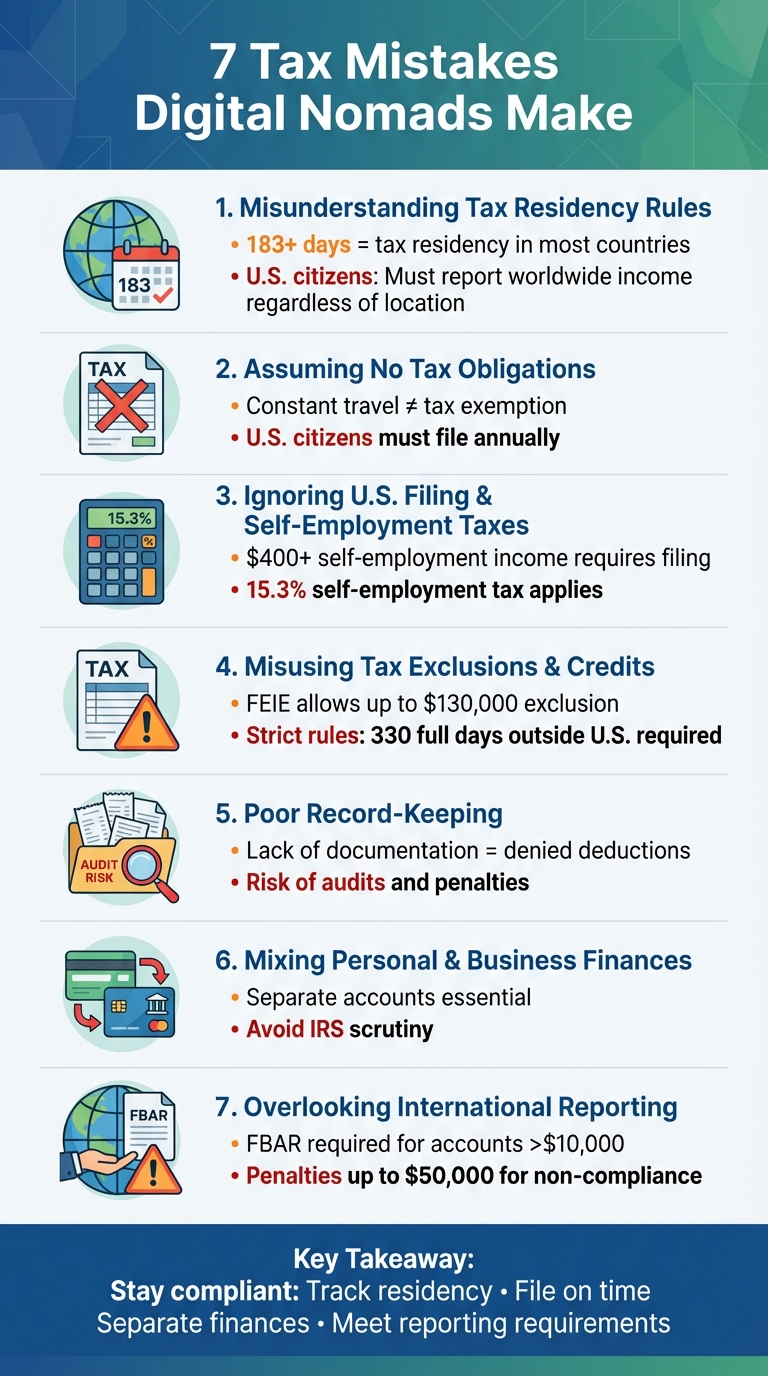
Digital nomads often face complex tax challenges, and common mistakes can lead to hefty penalties or even passport revocation. Here’s what you need to know to avoid trouble:
- Misunderstanding tax residency rules: Spending 183+ days in one country may trigger tax residency. U.S. citizens must report worldwide income regardless of residency.
- Assuming no tax obligations: Constant travel doesn’t exempt you from taxes. U.S. citizens must file annually and may owe self-employment taxes.
- Ignoring U.S. filing and self-employment taxes: Even low-income earners with $400+ in self-employment income must file and pay 15.3% in taxes.
- Misusing tax exclusions and credits: The Foreign Earned Income Exclusion (FEIE) and Foreign Tax Credit (FTC) have strict rules. Missteps can disqualify you.
- Poor record-keeping: Lack of documentation for income, expenses, or travel can lead to denied deductions or audits.
- Mixing personal and business finances: Separate accounts are essential to avoid IRS scrutiny and maintain clean records.
- Overlooking international reporting: Failing to file FBAR or FATCA forms for foreign accounts can result in penalties up to $50,000.
Key Takeaway: Stay compliant by tracking your residency, filing taxes on time, separating finances, and meeting international reporting requirements. Mistakes can cost thousands, but proper planning and tools can keep you on track.
1. Misunderstanding Tax Residency Rules
Understanding tax residency rules is crucial for avoiding unnecessary penalties or even double taxation. Many digital nomads mistakenly believe that their constant travel frees them from tax obligations. However, the reality is far more complex.
Most countries use the 183-day rule to determine tax residency. If you spend more than 183 days in a calendar year within a single country, you’re likely considered a tax resident there. Other nations may evaluate factors like where your family lives, where your business operates, or where your primary home is located to establish tax residency. This becomes even more important for U.S. citizens and green card holders.
For U.S. citizens, taxes are based on citizenship, not residency. This means that no matter where you live, you’re required to file and report your worldwide income. As H&R Block explains:
"The U.S. taxes Americans based on citizenship, not place of residence. That means it doesn’t matter where you currently live – if you’re legally considered a U.S. citizen… you have a tax obligation".
State-level tax residency adds another layer of complexity. Some states, like California, New York, and South Carolina, are known for their stringent rules. Even if you’ve moved abroad, these states may still consider you a resident for tax purposes. Katelynn Minott, CPA and CEO of Bright!Tax, highlights this challenge:
"States like California, New York, and South Carolina are notoriously ‘sticky,’ meaning they may still consider you a resident for tax purposes even after you’ve moved overseas".
Simple things like maintaining a driver’s license, voter registration, or a mailing address in one of these states could trigger state tax obligations.
To navigate these challenges, it’s essential to keep a detailed record of your time spent in each country. For U.S. citizens looking to claim the Foreign Earned Income Exclusion, you’ll need to prove that you spent at least 330 full days outside the U.S. within a 12-month period. As Mike Wallace from Greenback Expat Tax Services notes:
"A ‘full day’ means the entire 24-hour period outside the U.S.".
2. Assuming You Don’t Owe Taxes Anywhere
Let’s address a common misunderstanding among nomads: the idea of becoming a "fiscal nomad" and avoiding taxes entirely. Many believe that by constantly moving and never staying in one country long enough to establish residency, they can sidestep tax obligations. Unfortunately, this belief is far from accurate.
In most cases, nomads remain tax residents of their home country unless they’ve officially cut ties. For U.S. citizens and green card holders, the rules are even stricter: the U.S. taxes its citizens on their worldwide income, no matter where they live or work. Mike Wallace, CEO of Greenback Expat Tax Services, puts it plainly:
"The U.S. taxes based on the passport you hold. So even if you’re working from a laptop in Portugal for a German company while your business is registered in Estonia, Uncle Sam still expects to hear from you each year."
Even if you qualify for exclusions that reduce your federal tax liability to $0, filing a return is still mandatory. For self-employed nomads, the rules are even more specific: if your net earnings hit $400 or more, you’re required to file and typically pay a 15.3% self-employment tax for Social Security and Medicare. Interestingly, about two-thirds of American expats owe $0 in federal income tax after applying exclusions and credits, but they’re still required to file.
Overlooking these filing and tax obligations can lead to fines and legal trouble, so staying informed and compliant is crucial.
3. Ignoring U.S. Filing Requirements and Self-Employment Taxes
Many digital nomads forget that U.S. tax rules still apply, no matter where they live. The IRS makes it clear:
"If you are a U.S. citizen or resident alien, the rules for filing income, estate, and gift tax returns and paying estimated tax are generally the same whether you are in the United States or abroad."
For the 2025 tax year, you’re required to file a tax return if your gross income exceeds the filing threshold. Even if your income is relatively low, earning more than $400 in net self-employment income means you’ll need to file and pay a 15.3% self-employment tax. This includes 12.4% for Social Security (on income up to $176,100) and 2.9% for Medicare, which applies to all income .
While the Foreign Earned Income Exclusion can shield up to $130,000 of foreign-earned income from federal income tax, it doesn’t reduce your self-employment tax. This is a common misconception that catches many digital nomads off guard.
Living abroad does come with a small perk: you automatically get a two-month filing extension, giving you until June 15 (for calendar year filers) to submit your return. However, any taxes owed are still due by April 15 to avoid interest charges. If you’re paying into a foreign country’s social security system and that country has a totalization agreement with the U.S., you might be exempt from U.S. self-employment tax.
Missing tax deadlines can lead to serious consequences. Penalties for failing to file can exceed $10,000, and in extreme cases, tax delinquency could result in losing your passport. If you’ve fallen behind, the IRS provides a lifeline through its "Streamlined Foreign Offshore Procedures", allowing you to catch up without penalties – so long as your failure to file wasn’t intentional.
4. Misusing the Foreign Earned Income Exclusion and Tax Credits
The Foreign Earned Income Exclusion (FEIE) can be a game-changer for saving on taxes – allowing you to exclude up to $130,000 of foreign-earned income from federal taxes in 2025. But here’s the catch: it’s not automatic, and qualifying requires careful attention to the rules.
To use the FEIE, you need to meet one of two tests. The Physical Presence Test requires you to be outside the U.S. for 330 full 24-hour days within any 12-month period. Alternatively, the Bona Fide Residence Test applies if you live as a resident in a single foreign country for an entire calendar year. Many digital nomads mistakenly assume brief stays abroad will qualify, but even small missteps, like returning to the U.S. too often, can disqualify you. Filing on time is also critical – submit Form 2555 by the deadline, or risk losing tens of thousands of dollars in potential tax savings.
Another common mistake involves mixing the FEIE with the Foreign Tax Credit (FTC). You can’t claim both on the same income – doing so results in double-counting and could lead to issues with the IRS. The FTC, which provides a dollar-for-dollar credit for taxes paid to a foreign government, often applies to a broader range of income, such as dividends or rental income. In high-tax countries like Germany or France, the FTC might even save you more money than the FEIE. Plus, unused FTC credits can be carried forward for up to 10 years, offering long-term benefits.
One important limitation of the FEIE is that it only reduces regular income tax – it doesn’t touch the 15.3% self-employment tax. For digital nomads, this can result in a hefty tax bill, even with the FEIE in place. However, if you work in a country with a U.S. totalization agreement, you may be able to reduce or eliminate self-employment taxes. Using the right tax strategies and tools can help you avoid these pitfalls and maximize your savings.
5. Failing to Keep Proper Records and Track Expenses
Neglecting to maintain detailed records can lead to denied deductions and even IRS penalties. The responsibility to prove your claims rests entirely on you, and without thorough documentation, your business expenses could be rejected during an audit.
Start by carefully documenting all income sources. Save forms like 1099-NEC from clients, 1099-K from payment processors such as PayPal or Venmo (required if your payments exceed $20,000 and involve over 200 transactions), W-2s from remote employers, and any records of foreign-sourced income. For business expenses – whether it’s for travel, meals, equipment, or communication services – retain receipts and invoices as proof.
If you’re aiming to qualify for the Foreign Earned Income Exclusion, keeping a detailed daily location log is crucial. To meet the requirements, you must spend at least 330 full 24-hour days outside the U.S. within any 12-month period. Backup evidence like boarding passes, passport stamps, accommodation receipts, and dated photos can strengthen your case. As CPA Jose A. Cruz points out:
"A major mistake is failing to track which states or countries they spend time in. This can unintentionally create tax residency in multiple jurisdictions".
Another key step is separating your business and personal finances. Use dedicated bank accounts and credit cards exclusively for business transactions. This practice not only simplifies your tax filing but also ensures a clean audit trail. Mixing personal and business finances can make it harder to substantiate deductions and may lead to losing valid expense claims. For digital nomads running U.S.-based businesses remotely, tools like BusinessAnywhere can streamline bookkeeping and help keep financial records organized, no matter where you are.
Lastly, digitize everything. Scan and store receipts in well-organized folders categorized by tax year or jurisdiction. Convert all foreign income and expenses into U.S. dollars using the IRS’s official exchange rates at the time of each transaction. Keeping your records neat and accessible not only makes tax filing smoother but also reduces the chances of penalties or missed deductions.
sbb-itb-ba0a4be
6. Mixing Personal and Business Finances
Combining personal and business expenses can cause a mess in your financial records, making tax filing a nightmare and increasing the chances of raising red flags with the IRS. When business transactions are buried in your personal bank statements, you risk losing out on legitimate deductions for things like coworking fees, software subscriptions, or equipment purchases. On top of that, poor record-keeping can lead to misreporting income, which only adds to the complexity of your tax situation.
The IRS has strict rules when it comes to deductions, requiring you to prove that each expense is directly tied to your business. As Buzko Krasnov puts it:
"The governing principle is that expenses must be related to your business for you to deduct them".
Without separate accounts, it becomes almost impossible to distinguish between, say, a laptop you bought for personal use and one purchased for your business. This confusion can lead to denied deductions or even penalties if the IRS challenges your claims, potentially costing you thousands of dollars.
For digital nomads, the stakes are even higher. If you’re trying to establish residency in a tax-friendly state like Florida or Texas, financial ties to high-tax states like California or New York could pull you back into their tax systems. Keeping personal and business finances separate is crucial to proving you’ve made a clean break, which can protect your deductions and simplify your tax obligations – whether you’re running a sole proprietorship or an S Corporation.
The solution? Open a dedicated business bank account and use a separate credit card for all professional expenses. This simple step creates a clear audit trail and makes it much easier to calculate your net business income come tax time. For U.S.-based digital nomads running their businesses remotely, platforms like BusinessAnywhere can help with bookkeeping services, ensuring your financial records stay organized and compliant no matter where you’re working.
CPA Vincenzo Villamena underscores the importance of getting this right:
"Mistakes in this area are expensive to fix later".
7. Ignoring International Reporting and Compliance Requirements
Once you’ve nailed down accurate record keeping and expense tracking, the next big challenge is international reporting. A common misconception among digital nomads is that living abroad exempts them from reporting foreign financial accounts. That’s not the case. U.S. citizens are required to file specific international reports, and skipping these obligations can result in hefty penalties.
Two key forms come into play here: FBAR (FinCEN Form 114) and FATCA (Form 8938). If the total value of all your foreign financial accounts exceeds $10,000 at any point during the year, you’re required to file an FBAR. This doesn’t just apply to traditional bank accounts – it also includes digital wallets and payment platforms like Wise, Revolut, and PayPal if held abroad. FATCA, on the other hand, kicks in at higher thresholds: $200,000 at year-end or $300,000 at any time during the year for single expats. These requirements aren’t just bureaucratic red tape – they come with serious consequences if ignored.
Here’s a breakdown of what’s required, the thresholds, and the potential penalties:
| Requirement | Form | Threshold | Penalty |
|---|---|---|---|
| FBAR | FinCEN Form 114 | > $10,000 aggregate at any time | Up to $10,000 per account, per year |
| FATCA | Form 8938 | > $200,000 at year-end or > $300,000 at any time | $10,000 initial; up to $50,000 |
Failure to comply can result in steep fines. For example, not filing Form 8938 starts with a $10,000 penalty, which can climb to $50,000. Similarly, FBAR violations can cost up to $10,000 per account, per year. And the consequences don’t stop at fines. As Katelynn Minott, CPA and CEO of Bright!Tax, points out:
"Failing to file an FBAR or Form 8938 can lead to steep penalties – even for accidental noncompliance".
In extreme cases, noncompliance could even lead to passport revocation, which could abruptly end your digital nomad lifestyle.
If you’re behind on reporting, there’s still hope. The IRS offers streamlined foreign offshore procedures to help you catch up without penalties. This program allows you to file the last three years of tax returns and six years of FBARs, provided your failure to report was non-willful.
For digital nomads running U.S.-based businesses remotely, services like BusinessAnywhere can assist with bookkeeping and accounting, helping you stay on top of compliance requirements.
How the Right Tools Can Help Digital Nomads Avoid Tax Mistakes
Having the right systems in place can make a world of difference when it comes to avoiding tax missteps. Running a U.S.-based business requires more than just good intentions – it demands a strong legal foundation, accurate financial tracking, and reliable compliance tools. Here’s a closer look at how the right resources can help tackle these challenges.
Setting up a proper U.S. business structure, like an LLC or S Corp, is a critical first step. Not only does it give your business legitimacy, but it can also help reduce your tax liability. For instance, with an S Corp, you can divide your income between a "reasonable salary" and distributions, which may lower your self-employment tax burden. As Vincenzo Villamena, CPA and CEO of Online Taxman, explains:
"Choosing the right structure early on can save thousands in taxes and headaches. Mistakes in this area are expensive to fix later."
But forming the entity is just the beginning. Maintaining a U.S. presence is equally important. A virtual mailbox in a state with no income tax – like Florida, Texas, or Wyoming – can serve as your registered address for IRS notices. This not only keeps you organized but also helps you sever ties with high-tax states. Without a reliable U.S. address, you risk missing critical tax correspondence or unintentionally remaining liable for state taxes you thought you had avoided.
Automating bookkeeping and expense tracking is another game-changer. Tools that separate business and personal finances while keeping tabs on deductible expenses – like coworking memberships, equipment, or software subscriptions – can streamline tax preparation. By letting automation handle the details, you’re less likely to make errors that could lead to rejected deductions.
Finally, robust compliance tools are essential for meeting international reporting requirements, such as FBAR and FATCA, which come with steep penalties if ignored. Platforms like BusinessAnywhere offer an all-in-one solution, covering U.S. business registration, virtual mailboxes, bookkeeping, and compliance. These tools help you stay on top of deadlines, so you can focus on growing your business without the constant worry of tax-related issues.
Conclusion
For digital nomads, staying on top of tax compliance isn’t optional – it’s essential. Navigating the maze of international tax systems can be tricky, but understanding the rules and staying organized can save you from expensive mistakes.
To avoid potential pitfalls, take proactive steps. Track your daily location to ensure you meet the Foreign Earned Income Exclusion (FEIE) requirements. Consider updating your driver’s license and voter registration to a state with tax advantages. Keep your personal and business finances completely separate, and make sure to set aside funds for quarterly estimated tax payments. Falling short on these payments could result in a 20% penalty for underpayment.
A solid business structure, accurate bookkeeping, and reliable compliance tools – like those available through BusinessAnywhere – can help you avoid missteps. Putting the right systems in place now not only prevents costly errors but also allows you to focus on growing your business with peace of mind.
FAQs
What happens if a digital nomad spends more than 183 days in one country?
If you spend more than 183 days in one country, you might be classified as a tax resident there. This could mean having to file and pay income taxes in that country. But, as a U.S. citizen, you’re still required to file a federal tax return on your worldwide income, no matter where you reside.
To prevent being taxed twice on the same income, tools like the Foreign Tax Credit and the Foreign Earned Income Exclusion (FEIE) can come in handy. These options can help reduce or offset taxes paid overseas. It’s crucial to familiarize yourself with the tax regulations of the country you’re living in and seek advice from a tax professional to stay compliant with both local and U.S. tax laws.
What’s the best way for digital nomads to keep personal and business finances separate and avoid IRS issues?
To steer clear of IRS scrutiny, digital nomads need to keep their personal and business finances strictly separate. A good starting point is setting up a U.S. business entity, like an LLC or S-Corp. This allows you to get an EIN (Employer Identification Number) and open a dedicated business bank account and credit card. Keeping all business income and expenses in one place helps maintain clear records and avoids mixing personal transactions with business finances.
Leverage digital tools like bookkeeping software or accounting services (such as those from BusinessAnywhere) to categorize transactions and create a clear audit trail. Make sure to keep original receipts or digital copies for deductible expenses, such as travel, home office costs, and internet, and include notes on the business purpose of each expense. Using a virtual mailbox can also make managing receipts easier while you’re traveling.
To further separate finances, pay yourself a salary or take an owner’s draw from the business account instead of using personal funds directly. This not only strengthens your business’s credibility with the IRS but also makes tax filing more straightforward, leaving you with more time to enjoy your nomadic lifestyle.
What are the consequences of not reporting foreign financial accounts under FBAR and FATCA?
Failing to report foreign financial accounts can result in hefty penalties. Under FBAR regulations, if the violation is deemed non-willful, you could face civil penalties of up to $10,000 per year. However, for willful violations, the fines can climb to 50% of the account balance or $100,000, whichever is greater. In more severe cases, criminal penalties may also be enforced.
FATCA non-compliance carries its own set of consequences. These include a 40% withholding tax on certain U.S. source payments and civil fines starting at $10,000 per violation. Repeated violations can lead to even higher penalties. Adhering to these reporting requirements is essential to avoid both financial setbacks and potential legal trouble.