


- Estonia: Known for its fully digital e-Residency program, Estonia allows you to set up a business online in just hours. With no tax on reinvested profits and a thriving venture capital ecosystem, it’s a top choice for remote businesses and tech startups.
- Singapore: Ranked first globally for ease of doing business, Singapore offers a flat 17% corporate tax rate with exemptions for new businesses. Its strategic location and robust funding ecosystem make it ideal for scaling in Asia.
- United Arab Emirates (UAE): The UAE offers 100% foreign ownership in Free Zones, no personal income tax, and a 0% tax on profits up to $102,000. Its quick business setup process and Golden Visas attract global entrepreneurs.
- Ireland: With a 12.5% corporate tax rate and seamless access to the EU market, Ireland is perfect for tech startups. Programs like the Startup Entrepreneur Programme (STEP) and R&D tax credits add to its appeal.
- Netherlands: A logistics hub with strong global connectivity, the Netherlands simplifies business registration and supports innovation with tax incentives like the R&D credit and Innovation Box.
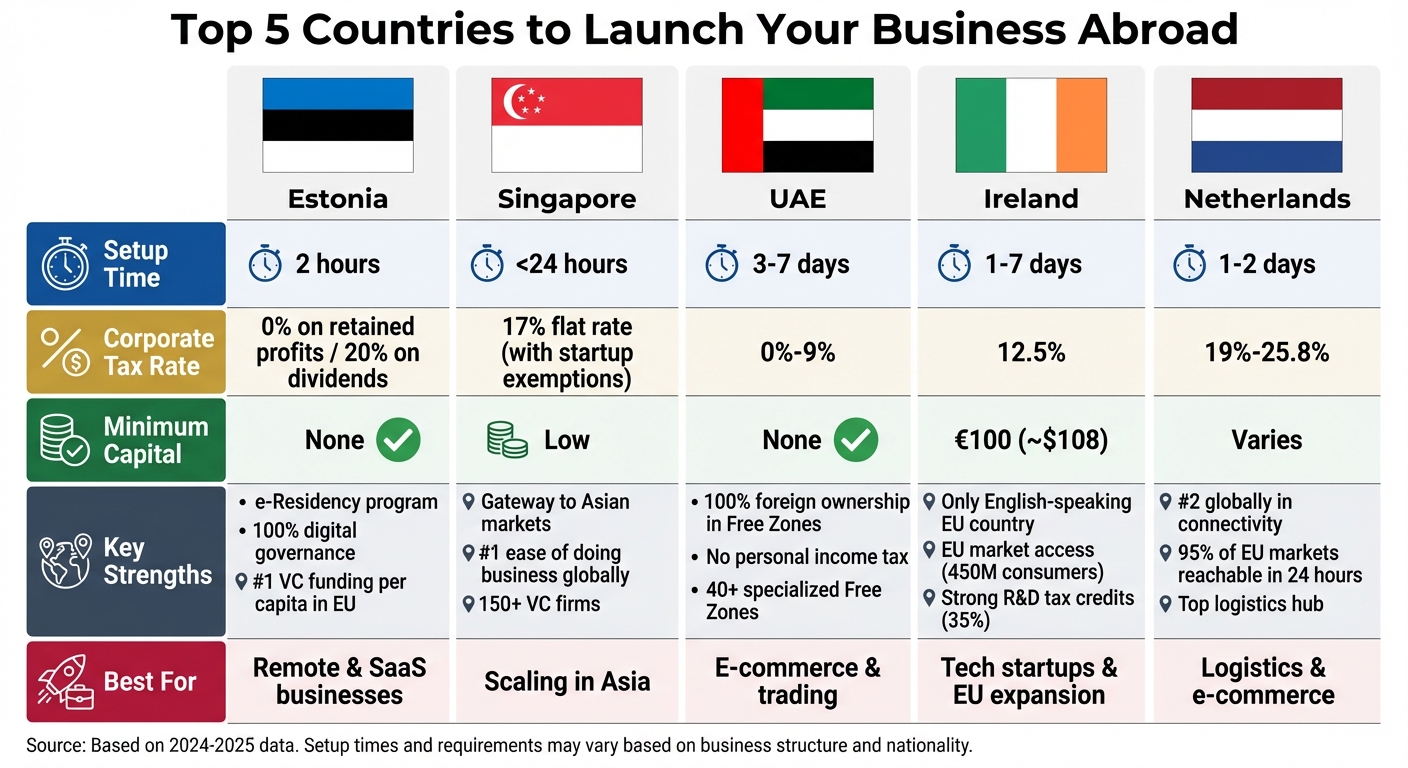
Quick Comparison
| Country | Setup Time | Corporate Tax | Key Perks |
|---|---|---|---|
| Estonia | 2 hours | 0% on retained profits; 20% on dividends | Fully digital governance; top VC funding per capita |
| Singapore | <24 hours | 17% flat rate | Gateway to Asian markets; tax exemptions for startups |
| UAE | 3–7 days | 0%–9% | Free Zones with 100% foreign ownership; no personal income tax |
| Ireland | 1–7 days | 12.5% | EU market access; strong R&D and startup tax relief |
| Netherlands | 1–2 days | 19%–25.8% | Excellent logistics; innovation-focused tax benefits |
Each country offers distinct benefits tailored to different business goals, from Estonia’s digital-first approach to Singapore’s strategic location. Choose the one that aligns with your needs, and take the next step toward global growth.
1. Estonia
Ease of Business Formation
Estonia makes starting a business incredibly straightforward, thanks to its e-Residency program. You can register an EU company in as little as 15 minutes to 3 hours, entirely online. In fact, 98% of all companies in Estonia are established digitally. The program provides a government-issued digital ID, which acts as your signature for contracts, tax filings, and even banking. It’s the first program of its kind to offer digital access to non-residents.
The cost? State registration is €265 (around $290), with an additional €200–€400 annually for a legal address and contact person. There’s no requirement for a local director, and you can defer the share capital payment during registration.
"E-Residency is the best option to set up a company for multiple founders without bureaucracy: our business was up and running cheaply within days". – Georg Klausner, Mansiontech OÜ
This streamlined process lays the groundwork for Estonia’s attractive tax and funding opportunities.
Tax Benefits for Startups
Once your business is set up, Estonia offers a tax system that’s incredibly appealing to startups. Profits that are reinvested are taxed at 0%, and you only pay a 20% tax on dividends. This system has earned Estonia the top spot in the International Tax Competitiveness Index for 12 years running. Additionally, there’s no tax on share transfers, placing Estonia in the same league as Delaware.
Estonia’s digital tax system is another major advantage. Entrepreneurs spend just 5 hours annually on tax compliance, a stark contrast to the 40+ hours required in many other countries.
"I can get my tax done in minutes. I just control it with my single ID card". – Vicky Brock, Vistalworks
Access to Funding
Estonia punches well above its weight when it comes to funding. It ranks first in Europe for venture capital funding per capita and has produced 10 tech unicorns, including Skype, Wise, Bolt, and Pipedrive. The country’s venture capital ecosystem manages €3.08 billion in funding, and Estonia boasts about six times more startups per capita than the European average.
For non-EU founders, the Startup Visa program simplifies relocating your team and tapping into Estonia’s funding ecosystem. To further ease the process, the country offers model legal documents to reduce early-stage legal expenses.
Startup-Friendly Ecosystem
Estonia’s startup ecosystem is thriving, with more than 1,500 active startups, 38% of which are driven by e-residents. The country’s government services are entirely digital, covering everything from company registration to tax declarations, eliminating the need for physical paperwork. Banking is equally advanced, with 99% of transactions conducted online.
"Estonia is able to offer this seamlessly, so I can log in and do my things anywhere in the world". – Frank Sondors, Salesforge
The government is also looking to the future. Its "Eesti.ai" initiative, launched in 2026, aims to double national productivity by 2035 through AI integration, showing a clear commitment to advancing its tech infrastructure.
sbb-itb-ba0a4be
2. Singapore
Ease of Business Formation
Singapore makes starting a business straightforward with its digital-first approach. The entire registration process happens online through the Accounting and Corporate Regulatory Authority (ACRA). You can set up your company in just 1.5 days, avoiding the usual paperwork delays.
Ranked 1st globally for ease of doing business, Singapore also offers the EntrePass, a visa tailored for foreign entrepreneurs launching tech-based or venture-funded startups. Its location serves as a strategic gateway to Southeast Asia and the Asia-Pacific region, making it an excellent choice for companies aiming for regional growth. This seamless setup also comes with appealing tax policies.
Tax Benefits for Startups
Singapore keeps corporate taxes simple with a flat 17% rate, eliminating the need to navigate complex tax brackets. For new businesses, the first S$200,000 of income (about $148,000) is exempt from taxes, providing essential breathing room for reinvestment during the early stages.
The country also skips taxing capital gains and doesn’t impose withholding taxes on dividend payments. Startups focused on research and development can benefit from a 250% tax deduction on qualifying R&D expenses conducted locally. With tax treaties spanning over 90 countries, businesses operating internationally can avoid double taxation.
Access to Funding
Singapore’s robust funding ecosystem gives startups a strong foundation to grow. With over 4,500 tech startups and more than 150 venture capital firms, incubators, and accelerators, the country is a hub for entrepreneurial activity. The government has committed S$25 billion (approximately $18.5 billion) under the Research, Innovation and Enterprise (RIE) 2025 Plan, along with an additional S$4 billion to support business expansion and workforce development.
For startups less than five years old, the government absorbs up to 70% of bank loan risks, making it easier to secure financing. The Economic Development Board‘s Connections Concierge links businesses with private sector partners for recruitment, funding, and property needs. Fintech startups can also benefit from the Monetary Authority of Singapore‘s Regulatory Sandbox, which allows them to test new products with relaxed regulations. These initiatives support companies from their inception to scaling up.
Startup-Friendly Ecosystem
Singapore fosters innovation with a business environment designed for success. It ranks 1st in Asia and 2nd globally for intellectual property rights protection, and AI patents can be approved in as little as six months. To further support innovation, the government has invested S$200 million (around $148 million) to enhance businesses’ digital capabilities and an additional S$2 billion (approximately $1.48 billion) into AI, sensors, and data science projects.
Everything from company registration to tax filings is handled digitally via platforms like Corppass. The country also hosts R&D labs for global giants like Dell and Salesforce, creating opportunities for startups to collaborate with established tech leaders.
3. United Arab Emirates (UAE)
The UAE stands out as a forward-thinking destination for startups, offering streamlined processes and a supportive environment for business growth. Its approach reflects how diverse regions are reshaping the startup landscape.
Ease of Business Formation
Starting a business in the UAE is incredibly efficient, thanks to platforms like Basher, which enable company formation in just 15 minutes. Alternatively, the Department of Economic Development (DED) offers a slightly longer process of 4 days, still much faster than the 10-day average in other high-income countries. The entire process operates through a unified digital system that integrates local and federal agencies.
Since June 2021, the UAE has removed the need for a local sponsor, allowing foreign entrepreneurs to own 100% of their onshore businesses in most industries. This change has made the UAE even more attractive to international investors, reflected in its ranking of 16th out of 190 countries in the 2019 Ease of Doing Business index.
"Effective June 1, 2021, the UAE removed the requirement for companies to have a local sponsor, allowing foreign investors and entrepreneurs to establish and fully own onshore companies in most sectors." – UAE Embassy in Washington, DC
The UAE also offers over 40 specialized Free Zones, which simplify procedures and allow 100% foreign ownership. All documentation is provided in English, and Free Zone authorities assist with recruitment and housing to reduce startup challenges. However, industries like healthcare or legal services may require additional government approvals.
This efficient setup is complemented by attractive tax policies that support entrepreneurs.
Tax Benefits for Startups
The UAE’s tax policies are designed with startups in mind. There’s no personal income tax, allowing entrepreneurs to reinvest their entire earnings into their businesses. Additionally, taxable income up to AED 375,000 (around $102,000) is taxed at 0%, with profits above this threshold subject to a modest 9% federal corporate tax introduced in 2023.
Free Trade Zones provide even more advantages, including 100% import and export tax exemptions and 15-year corporate tax holidays, which can be extended for another 15 years. Businesses also benefit from unrestricted capital and profit repatriation. The UAE Dirham’s peg to the US Dollar ensures currency stability, aiding financial planning. In 2021, Abu Dhabi slashed startup fees by 94%, and Dubai International Financial Center offers startup licenses starting at just $1,500 per year.
Beyond tax incentives, the UAE provides robust funding opportunities to fuel business growth.
Access to Funding
The UAE offers a rich funding ecosystem that includes venture capital, debt financing, and government support. Companies like Careem have secured $771.7 million in funding, while Masdar in renewable energy attracted $3.3 billion. Real estate developer Arada raised $1.4 billion in debt financing. Startups can tap into capital through venture capital firms like STV and BECO Capital or major banks such as Mashreq Bank and Dubai Islamic Bank.
Flexible immigration policies also play a role in attracting talent. Golden Visas offer 10-year residencies to investors and skilled professionals, making it easier to recruit top talent. By 2025, the UAE is expected to welcome 9,800 new high-net-worth individuals, bringing an estimated $63 billion in investable wealth. Free Zone authorities further assist with recruitment and housing, reducing initial hurdles for startups.
Startup-Friendly Ecosystem
The UAE’s modern infrastructure and strategic location make it an ideal hub for startups. It leads the Middle East and North Africa region as the most competitive economy, with over 20,000 companies operating in its Free Zones. The Dubai Financial Market offers a platform for IPOs, helping businesses scale faster.
Dual-licensing options in Abu Dhabi and Dubai allow Free Zone companies to operate onshore without needing a local partner. The ecosystem supports emerging trends like super-apps (e.g., Careem’s blend of transportation, food delivery, and financial services), PropTech innovations in fractional property investment, and significant investments in renewable energy.
"The UAE has engineered one of the world’s rarest combinations: economic openness, political stability, and cultural tolerance. For UHNW investors, that is more valuable than a low tax rate alone." – Prof. Dr. Amarendra Bhushan Dhiraj, Executive Chair, CEOWORLD Magazine
4. Ireland
Ireland stands out as one of the easiest places in Europe to launch a startup.
Ease of Business Formation
Starting a company in Ireland is straightforward. Through the CORE portal, you can register a new business in just 2–4 days using e-signatures and online filing. Ireland allows 100% foreign ownership and doesn’t require a minimum share capital for Private Limited Companies – you can begin with as little as €100 (about $108). However, to skip a €25,000 bond requirement, at least one company director must reside in the European Economic Area (EEA). Non-EEA entrepreneurs can access the Startup Entrepreneur Programme (STEP) by securing €50,000 in funding.
"Ireland’s business friendly environment positions it as one of Europe’s most accessible locations for establishing and registering a business." – Dublin.ie
Tax Benefits for Startups
Ireland’s low 12.5% corporate tax rate, combined with startup tax relief programs, makes it an attractive choice. This rate, which applies to trading income, is among the lowest in the EU. Under Section 486C, eligible startups can enjoy full or partial corporation tax relief during their first five years, with claims of up to €40,000 annually.
For companies involved in research, the R&D tax credit (set to rise to 35% in 2026) allows businesses to recover about $35 for every $100 spent on qualifying activities. Additionally, the Knowledge Development Box offers a reduced 10% tax rate on income from qualifying intellectual property. Investors can also benefit through the Employment Investment Incentive (EII) scheme, which provides income tax relief on investments up to €500,000 (around $540,000) for a seven-year period.
These tax incentives are further bolstered by strong funding opportunities.
Access to Funding
Ireland provides a wide range of funding options for startups. Agencies like Enterprise Ireland and Local Enterprise Offices offer capital, mentorship, and access to international networks. The national "New Frontiers" program also provides significant support. Venture capital is readily available through Allied Irish Banks (AIB) Equity, which specializes in early-stage investments, growth funding, and bridge loans.
Sector-specific accelerators, such as the Pearse Lyons Accelerator, Hatch Blue, and Accelerate Green, along with innovation hubs like Dogpatch Labs, NovaUCD, and the Guinness Enterprise Centre, further enrich the startup landscape.
Startup-Friendly Ecosystem
Ireland offers more than just tax breaks and funding. As the only English-speaking EU country post-Brexit, it provides seamless access to the European Single Market, which serves around 450 million consumers. Dublin was ranked first among "Small European Regions of the Future" in 2025 for its business-friendly environment and economic potential. The city’s "Silicon Docks", along with tech hubs in Cork and Galway, are home to major global tech firms and an expanding fintech sector.
Ireland also boasts a highly skilled workforce, with 53% of 30- to 34-year-olds holding university degrees – well above the EU average of 40%. Technology contributes over 13% to the country’s GDP, and in 2024 alone, the Dublin Region attracted 94 foreign direct investment projects from 91 companies.
"Dublin placed first among Small European Regions of the Future, leading in overall performance, economic potential, and business friendliness." – fDi Intelligence
5. Netherlands
The Netherlands stands out among European startup hubs for its streamlined business setup process and strong infrastructure, making it an appealing destination for entrepreneurs.
Ease of Business Formation
Starting a business in the Netherlands is straightforward. Entrepreneurs register their companies with the Netherlands Chamber of Commerce (KVK), which also notifies the Tax Administration automatically. You can choose from various legal structures, such as sole proprietorships (eenmanszaak), general partnerships (VOF), or private limited companies (BV).
For non-EU founders, the Startup Visa Scheme offers a one-year residence permit to launch innovative businesses. To qualify, founders must collaborate with a certified business mentor, referred to as a "facilitator". Additionally, the Netherlands has a special residence arrangement for hiring international talent, allowing startups to bring in highly skilled professionals without navigating all the usual sponsorship requirements.
This streamlined process is complemented by enticing tax benefits.
Tax Benefits for Startups
The Netherlands employs a two-tier corporate tax system: 19% on the first €200,000 (around $216,000) of taxable profit and 25.8% on amounts above that. This setup provides a financial cushion for startups in their early stages.
Several programs further support innovation. The WBSO scheme (R&D tax credit) helps reduce payroll taxes and social security contributions for businesses involved in research and development. The Innovation Box allows companies to pay a lower effective tax rate on profits tied to qualifying innovative activities and intellectual property. Entrepreneurs can also access the "Startup Box" tool, which identifies subsidies and funding options tailored to their business needs.
"The Dutch tax system offers tax incentives that promote innovation and growth." – PwC
These tax benefits, combined with other resources, create a fertile ground for startups.
Access to Funding
In addition to tax incentives, organizations like TechLeap.nl and the Netherlands Point of Entry provide guidance, mentoring, and tools to help startups navigate the local tech ecosystem.
Startup-Friendly Ecosystem
The Netherlands is exceptionally well-connected, ranking 2nd globally in the DHL Global Connectedness Index 2024. From Amsterdam or Rotterdam, 95% of Europe’s major consumer markets are reachable within 24 hours. The country also ranks 5th in the Global Talent Competitiveness Index 2023, with 83% of its population possessing basic digital skills and 54% excelling beyond that.
"The Netherlands is one of the most open economies in the world and among the best countries in terms of technology and innovation." – PwC
For international teams, the Netherlands offers another advantage: it tops the EF English Proficiency Index for non-native English speakers, ensuring smooth communication for global founders.
Country Comparison Table
Here’s a quick look at how different countries stack up when it comes to starting a business:
| Country | Business Setup Time | Corporate Tax Rate | Minimum Capital Requirements | Key Strengths |
|---|---|---|---|---|
| Estonia | 2 hours | 0% on retained profits; 20% on distributed dividends | No minimum capital | e-Residency program; 100% digital governance |
| Singapore | Less than 24 hours | 17% flat rate (with startup tax exemptions) | Low startup costs | Gateway to Asian markets; world-class financial system |
| UAE | 3 to 7 days | 0% to 9% | No minimum capital | 100% foreign ownership in Free Zones; strategic location |
| Ireland | 1 to 7 business days | 12.5% | Approx. $162 registration fee | English-speaking EU hub; thriving tech ecosystem |
| Netherlands | 1 to 2 days | 19% to 25.8% | Varies by structure | Top logistics hub; exceptional global connectivity |
Each country brings something distinct to the table:
- Estonia is a standout with its zero-tax policy on retained profits and a fully digitalized, lightning-fast registration process.
- Singapore combines speed with a flat tax rate and startup-friendly exemptions, making it a gateway to Asia.
- UAE offers unmatched benefits like 100% foreign ownership in Free Zones and no minimum capital requirements.
- Ireland provides seamless EU market access as the only English-speaking hub in the bloc, with low registration fees around $162 (€150).
- Netherlands excels in logistics and connectivity, although tax rates and capital requirements vary depending on the business structure.
Estonia and the UAE stand out for eliminating minimum capital requirements, which is a big plus for entrepreneurs starting on a tight budget. Meanwhile, registration fees remain affordable, with Estonia’s fee at approximately $287 (€265).
Conclusion
When choosing the best country for your startup, focus on which aligns most effectively with your business goals. Estonia’s digital-first approach and 0% tax on retained profits make it ideal for SaaS founders and remote teams. Singapore, with its thriving startup ecosystem and a projected 44.9% growth rate by 2025, solidifies its role as a gateway to Asian markets. The UAE provides tax-free zones tailored to e-commerce and trading businesses, while Ireland offers an English-speaking base in the EU with a competitive 12.5% corporate tax rate. For logistics and e-commerce, the Netherlands shines as a European hub. These factors all emphasize the importance of minimizing operational barriers to successful expansion.
"The ‘best’ country is the one that removes friction rather than adds it." – Jaime Watkins, Playroll
Next, consider whether your business model demands a physical presence or can remain entirely remote. For remote operations, Estonia and the UAE stand out by allowing 100% foreign ownership without requiring a local director. If a physical presence is necessary, explore startup visa programs like Singapore’s EntrePass or Ireland’s STEP, which align well with the benefits highlighted in the country reviews. Additionally, match your industry with the right environment – Fintech thrives in Singapore and Ireland, while the Netherlands excels in e-commerce and retail.
After selecting the right location, strengthen your global strategy by incorporating U.S. compliance tools. Combining international formation with U.S.-based solutions, such as BusinessAnywhere’s virtual mailbox and registered agent services, boosts credibility with American investors and opens doors to significant capital markets. BusinessAnywhere simplifies managing both your international entity and U.S. presence entirely online through one platform.
Lastly, review residency requirements and evaluate the tax implications in each country to ensure an efficient global operation.
FAQs
What should I consider when choosing a country to start my business abroad?
When deciding where to launch your business, it’s crucial to weigh the factors that align with your vision and provide an environment that supports growth. Start with the ease of doing business – how quickly and efficiently you can register your company and comply with local regulations. Countries that offer streamlined processes, especially those with digital tools, can help you save both time and money.
Next, examine the tax environment. Favorable corporate tax rates or startup-focused incentives can have a big impact on your bottom line. Don’t forget to explore funding opportunities and the availability of skilled talent. A robust startup ecosystem, complete with innovation hubs, venture capital networks, and government programs, can also give your business a strong foundation.
Lastly, consider long-term stability and infrastructure. This includes factors like political and economic conditions, quality of life, and access to reliable digital and physical infrastructure. By carefully evaluating these elements, you can pinpoint the ideal location to set your business up for success.
What are the benefits of Estonia’s e-Residency program for digital entrepreneurs?
Estonia’s e-Residency program provides digital entrepreneurs with a secure digital identity, allowing them to set up and manage an EU-based business entirely online. With this program, you can handle essential tasks like signing documents digitally, managing administrative duties, and accessing various e-services – all from anywhere in the world.
Beyond the practical tools, the program connects you to a global network of entrepreneurs who share similar goals. It also offers a simple way to tap into the European market, making it an appealing choice for remote business owners looking for flexibility and international opportunities.
What tax benefits does the UAE offer for startups?
The UAE offers enticing tax advantages for startups, making it a hotspot for entrepreneurs. One standout benefit is the 0% corporate tax rate for businesses earning under $820,000 (around AED 3 million) annually. This relief is part of the Small Business Relief program, which runs through the end of 2026.
On top of that, the UAE boasts a clear and business-friendly regulatory framework, aimed at encouraging growth and innovation. These measures allow startups to cut expenses and channel their resources into scaling their businesses efficiently.